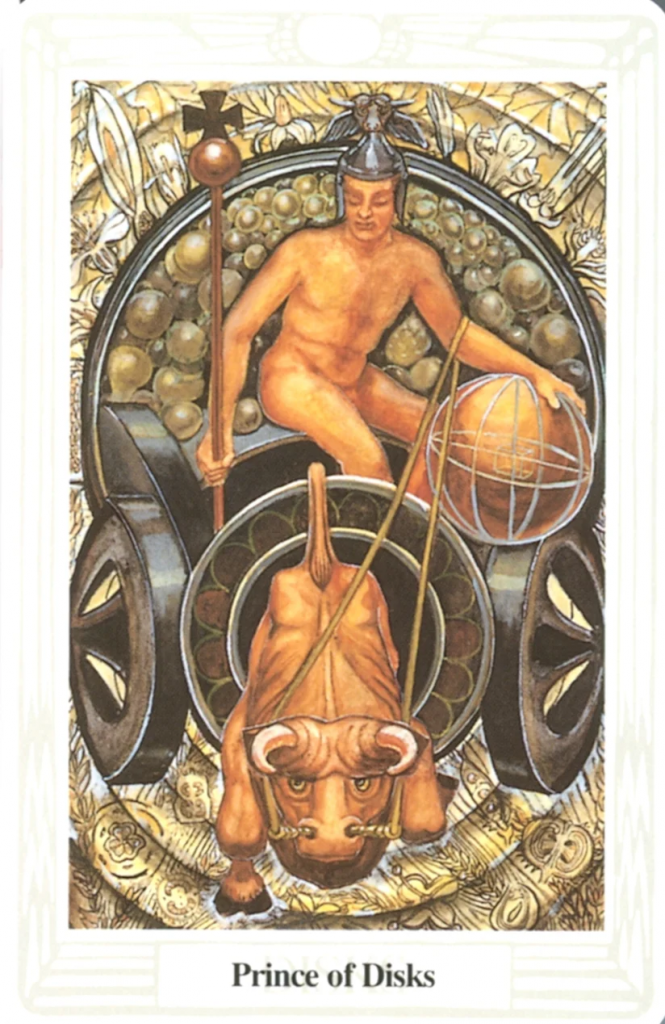
The man represented by the Prince of Disks is a quiet and meditative man, who works with unfailing determination towards the goals he sets himself. He is reliable and resourceful, unswerving and creative in his dedication.He is more imaginative than the Knight of Disks, though he has the same quiet strength and gentleness. His quality of contemplation often yields fruit in surprising ways, generating a deep and broad-sweeping understanding about the inner workings of life.If he is ill-dignified, the Prince of Disks can become stubborn and short-sighted – even bloody-minded in his attitudes. Faithful and loyal himself, he will not tolerate faithlessness in others. Neither will he accept lack of integrity, nor dishonesty.He is hard-working, trustworthy and inventive, often producing unusual yet practical solutions which resolve otherwise intractable problems. As a friend he is non-judgemental and supportive, though capable of shedding new perspectives on situations. He’s generally a good listener, though he has little patience with histrionics and manipulation.His approach to life overall is one of industrious practicality. He believes that all things yield to a determined will and well-directed activity.Though emotionally he at first gives the impression that he is solid and perhaps even a little unimaginative, when his feelings are roused, he can be deeply passionate and sensual.He rarely comes up to indicate a change of mood in a person, though sometimes he will appear to indicate some-one learning to take responsibility in everyday life.
“In the beginning was the Word, and the Word was with God, and the Word was God” – John 1.1
On May 25th, 2024, Jupiter, the planet of wisdom, enters Gemini, the sign of knowledge.
John’s gospel equates ‘word’, with ‘God’ – or awareness. Indeed, we became sentient beings when we gained awareness through the ‘word’ of knowledge.
It is believed that the Age Of Gemini began when Adam and Eve ate from the Tree of Knowledge (Gemini). Eating from the Tree of Knowledge means they developed awareness – hence realizing they are naked.
Eating from the Tree of Knowledge and developing awareness signifies the beginning of the sapient human, capable of thinking, reflecting, and understanding (Gemini).
Before the Age Of Gemini, human consciousness was tribal, not individualistic. It was during the Age Of Gemini that humans began to perceive reality through the separation of subject and object (witnessing). This Gemini mental process marked the birth of individual human consciousness.
In our 3D world where resources and tangible matters dominate our concerns, we tend to underestimate the importance of knowledge.
Jupiter in Gemini will change that.
In the next 12 months (May 2024-May 2025), it will become obvious to all of us that knowledge shapes our lives in ways much more profound than money or resources, for example. Knowledge is power indeed.
Jupiter In Gemini 2024-2025 – A Once Every 12-Year Transit
Jupiter’s ingress into Gemini is one of the most important transits of the year.
Jupiter spends approx. 1 year in each sign. In the last 12 months, Jupiter was in Taurus. Jupiter’s ingress into Gemini will be quite a noticeable shift! Gemini is VERY different from Taurus, so Jupiter in Gemini will bring a very different energy compared to Jupiter in Taurus.
Taurus is all about stability and preserving the status quo. Gemini is all about movement and change.
When Jupiter enters Gemini, our focus and priorities will dramatically change. There will be less concern with resources and safety, and more focus on connecting, learning, and moving forward.
Gemini is an outgoing, communicative sign. Jupiter thrives in social environments and values networking and exchanging ideas. With Jupiter in Gemini, expect a boom in information, communication, networking, mobility, and social activities.
Immediately after moving into Gemini, Jupiter forms an auspicious trine with Pluto in Aquarius, bringing the best out of the two energies. With Jupiter trine Pluto, the spreading of information can no longer be stopped.
Jupiter and Pluto give us the confidence to expose the truth and speak openly about what matters.
Jupiter And Gemini Archetypes
Jupiter and Gemini are very different energies, almost polar opposites. Jupiter is a consensus-seeking energy, while Gemini focuses on exploring what’s unique and different, by paying attention to details.
Gemini takes a linear approach, delving into data, facts, and technical knowledge. Gemini thrives on the specifics and intricacies.
Jupiter‘s energy, on the other hand, is holistic, big-picture, and focused on intuition.
If Jupiter is the forest, Gemini is the tree. Too much Gemini, and we can’t see the forest for the trees, missing the broader perspective. Too much Jupiter, and we overlook the tree in front of our eyes, getting lost in abstract concepts and missing the tangible aspects of reality.
The approaches of Jupiter and Gemini may seem incompatible at first; however, this polarity will eventually create a fertile ground for innovative connections and opportunities. We need complementary energies; we need to shake things up a bit to stimulate growth.
Jupiter is the largest planet in our solar system. Jupiter rules over 2 important things 1) our beliefs – how we make sense of the world, and 2) the ‘world’ itself i.e. our social circles, our communities, those groups of people that shape our sense of belonging.
Jupiter is how we fit – or we don’t – in the world.
With Jupiter in the human sign of Gemini, questions around belonging, social fit, or finding our tribe of like-minded people will be more important than ever.
Jupiter has an expansive influence. Just like a magnifying glass, Jupiter magnifies and enlarges everything it touches.
Jupiter in Gemini will bring us A LOT (Jupiter) of Gemini energy. Jupiter in Gemini is like Gemini on steroids. Think of an archetypal Gemini friend. Now imagine your Gemini friend multiplied by 1000, or 10000 – imagine a full stadium of Geminis. That’s Jupiter in Gemini.
Jupiter In Gemini – General Influences
Soon after Jupiter enters Gemini, it trines Pluto, now at 1° Aquarius. This is a positive influence that will boost innovation and forward-thinking initiatives in the realms of data, information and knowledge.
In the 2nd half of the year, Jupiter will square Saturn. Some of the initiatives implemented at the beginning of the transit might hit a brick wall (Saturn); their feasibility might come into question.
Some overlooked elements may need to be readdressed, restructured, and adjusted to create something that actually works and it’s fit for purpose.
Jupiter trines Pluto in Aquarius immediately after ingressing in Gemini; this is quite striking and I’d say, a pretty good omen.
When Jupiter entered Taurus last year, it immediately squared Pluto, bringing about a resource (Taurus) crisis.
A trine is a totally different story. There’s no more obstacles, just a smooth and harmonious flow. Things come together naturally, and effortlessly.
As many of us expect (and it’s pretty obvious when you read the news), this Air (Gemini-Aquarius) trine will most likely bring developments in the realm of data, information (Gemini), networks, and innovation (Aquarius).
Artificial Intelligence (AI) is on everyone’s radar, but there are many other ways in which the innovation-driven nature of this aspect can manifest in our everyday lives.
Remarkable Tablet
For example, before writing this article I saw an ad for the Remarkable tablet which I found to be very archetypally relevant not only for Jupiter in Gemini, but also for the Jupiter-Pluto in Aquarius trine.
The Remarkable tablet is a digital note-taking tool. It feels like journaling/handwriting (capturing the Gemini, tactile, on-the-go, energy) but it’s actually a framework (Jupiter) for organizing large amounts of data.
Remarkable is a great example of the Gemini (taking notes, writing down) and Jupiter (organizing) worlds coming together.
Google’s Gemini AI
Let’s take another Jupiter in Gemini example. As you may have heard by now, Google’s AI model is called …Gemini. Gemini AI is focused on massive (Jupiter) data (Gemini) processing. Quite literal for Jupiter in Gemini!
On May 14th, 2024 Google released the latest version of Gemini AI, stating that the company was now “pushing the boundaries” (how Jupiter!) of how much personal or business information it was able to pass on to Gemini AI for every query.
Gemini AI is designed to ‘remember’ (Gemini) everything you ever show or tell it and use that information to become like an AI that’s been custom-trained on the user’s personal data.
For example, Gemini AI can watch live videos from a user’s phone and offer detailed explanations of what’s in the video, tell the user where it last saw their glasses, or offer other personalized, contextual insights.
If Google’s Gemini AI is not a direct archetypal expression of Jupiter in Gemini, I don’t know what it is!
Translation And Natural Language Processing
Another interesting Jupiter in Gemini development is the advancement in natural language processing.
AI makes it now possible to communicate across different languages through software that offers real-time, two-way translation, mimicking one-on-one conversation.
Language barriers disappear as a result. People who didn’t travel before because they worried they didn’t speak the language can now feel empowered to explore a whole new world of opportunities.
Innovative Commuting
Gemini is the most mutable of the mutable signs. Gemini energy is always on the go – no wonder Gemini is associated with cars and transportation in general.
With Jupiter in Gemini, new types of innovation-driven commuting like electric bikes, electric scooters, high speed trains, drones and other cutting-edge technologies have the potential to transform (Pluto in Aquarius) the way people move around.
With Jupiter in Gemini, mobility will increase in general; we can expect investments in mobility solutions to address traffic congestion and other urbanization challenges, or to connect suburbs or remote locations to city centers for example.
Skill-Based Education
Both Jupiter and Gemini are archetypally connected with learning, knowledge and education. Jupiter in Gemini can bring us innovative (trine Pluto in Aquarius), skill-based education.
Traditional Jupiter institutions (universities) primarily produce thinkers and bureaucrats. And while we do need abstract thinkers, too much focus on higher education can lead to a shortage of skilled professionals or experts. J
Jupiter in Gemini will likely correct that, encouraging a shift towards more skill-based education that aligns with society’s current needs.
Neighbors First
With Jupiter in Gemini, social dynamics might change. Alliances formed on the basis of geographical proximity – rather than economic interests – may become more prominent.
Being neighbors becomes more important than culture, religion or traditional business ties.
Groups can have a dual agenda (Gemini); group members may be more willing to voice diverse opinions, even if this initially disrupts the status quo.
However, through open, transparent communication, they can find new ways to move forward.
Jupiter In Gemini In Your Natal Chart
How will Jupiter in Gemini influence you?
The Jupiter in Gemini ingress on May 25th will be quite noticeable. What used to be top of mind when Jupiter was in Taurus will no longer take center stage as attention shifts to the Gemini sector of our chart.
Jupiter will bring to your awareness and magnify the themes connected to the house (or houses) that it transits.
The Gemini house in your chart will reveal more about the area of life that will be under Jupiter’s influence.
And of course, there’s the generic Jupiter in Gemini influence that will impact everyone, regardless of your Gemini house.
In the next 12 months, you – just like everyone else – will become more interested in Jupiter in Gemini themes like learning and communication.
Here are some Jupiter in Gemini trends that could influence you at a personal level:
Your Friends And Social Groups
With Jupiter in Gemini, you can become more ‘experimental’ with your groups, networks, and social connections.
We learn the most in groups of people of diverse backgrounds. The reason minorities can sometimes have a hard time is that… they are in the minority. 99%, 90% or even 51% always drives the consensus, that’s just how the world works.
When we want things to change, we create an equal playing field to ‘break’ the consensus-generating quality of Jupiter. With Jupiter in Gemini, we want to be in a room with 12 people of all zodiac signs, instead of a room full of Leos or Libras.
With Jupiter in Gemini, it’s time to get out of the house, attend networking events, and meet new people.
If your groups or social connections feel boring, spice them up, find new friends, try something different. If you only make friends online, go offline. If you only meet people in grocery stores, try libraries.
Communication Skills
Jupiter in Gemini is the perfect time to improve your communication skills by joining a local Toastmasters or a creative writing club, for example.
Out of all zodiac signs, Gemini NEEDS to communicate, Gemini needs to be able to articulate itself, and learning to do that effectively is now more important than ever.
In fact, this transit is a great time to go back to school and improve your skills in general. Jupiter in Gemini is not the Capricorn “I have to get that diploma” type of transit. With Jupiter in Gemini, you learn for the sheer curiosity of it; if something draws you in, go and study it. What sparks your curiosity?
Learning And Education
Education is an undervalued investment – of course, except for long-term, formal education like university studies. People have become accustomed to spending significant amounts on university studies because everyone else is doing it (that’s the dogmatic aspect of Jupiter).
With Jupiter in Gemini, you’re encouraged to focus on shorter, more affordable studies that can help you in a very specific area, eventually leading to a much better return on investment.
With Jupiter in Gemini, the focus on education is no longer driven by getting a diploma or receiving social recognition; it’s about learning specific skills, learning quickly, and learning by applying the material.
Gemini learns by doing. It doesn’t read encyclopedias or boring, abstract books. It learns from practical examples in the real world.
Mindfulness And Meditation
Jupiter in Gemini is also a good transit to practice mindfulness and meditation. Gemini energy is all about the mind. When we meditate, we observe our thoughts from an outside, witness-like perspective.
This process allows us to distinguish between who we are as individuals (Self/Sun) and our mind and thoughts (Mercury). We are not our mind, indeed!
Meditation is very much a Gemini practice (you’d be surprised how many Gemini-energy people practice meditation, anecdotally, more than Pisces or Sagittarius, for example). And Jupiter brings structure to this process and gives us the needed meaning and direction.
Past Jupiter In Gemini Transits
If you want to know more specifically what to expect, reflect on what was going on in your life last time Jupiter was in Gemini, e.g., from June 2012 to June 2013 or from July 2000 to July 2001.
If you have planets or angles in Gemini (or in any Fire or Air sign) the transit of Jupiter in Gemini is good news – Jupiter will bring a boost of energy, optimism, and opportunities for growth and expansion.
Regardless of whether you have Gemini placements or not – Jupiter’s ingress into Gemini will likely bring positive developments, thanks to the friendly trine to Pluto which is in effect for the whole month of May and the first half of June.
Pay attention to any opportunities, changes of focus, or new ideas that come your way. You want to consciously tap into Jupiter in Gemini’s energy to make the best of this transit.
| Professor of Astrobiology, Psychology and Anesthesiology, and Director of the Center for Consciousness Studies at The University of Arizona, Tucson, Arizona.
| Regents Professor of Planetary Science and Cosmochemistry, and Director of the Arizona Astrobiology Center, The University of Arizona, Tucson, Arizona. He led NASA’s OSIRIS REx mission to Asteroid Bennu
Most scientists believe that consciousness came after life, as a product of evolution. But observations of extraterrestrial organic material, along with Roger Penrose and Stuart Hameroff’s quantum theory of consciousness, provide reason to believe that consciousness came before life. In fact, argue Hameroff and his collaborators, consciousness may have been what made evolution and life possible in the first place.
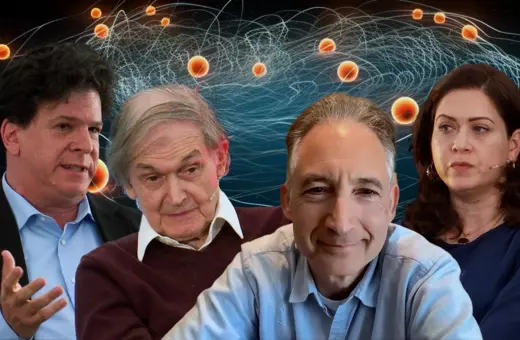
You can see Stuart Hameroff live, debating in ‘Darwin vs Consciousness’ alongside biologist Denis Noble and philosopher Antonella Tramacere at the upcoming HowTheLightGetsIn Festival on May 24th-27th in Hay-on-Wye.
Most scientists and philosophers believe that life came before consciousness. Life appeared on Earth about 3.8 billion years ago; consciousness and feelings, it’s said, evolved later due to complex biological information processing, perhaps only recently in brains with language and tool-making abilities. In fact, though, there’s good reason to think that consciousness preceded life, and was central to making life and evolution possible.
What is life? It is often described as its functions: metabolism, adaptation, reproduction, etc. But non-biological systems can have similar functions, for example, oceanic hydrothermal vents can metabolize, transform energy and synthesize chemicals, weather and climate systems adapt to changes in solar radiation, volcanic activity, and other natural factors, and a seed crystal in a solution can lead to the formation of more crystals with the same lattice structure, essentially reproducing itself. In the 19th century “vitalists” proposed life was a living field, force, or élan vital, but vitalism was eclipsed by molecular biology and genetics.
Erwin Schrödinger suggested that a form of “quantum vitalism” accounted for life’s unitary oneness, and Herbert Fröhlich later proposed that quantum coherent vibrational modes, similar to those in a laser, could play a central role in various biological processes (“Fröhlich coherence”). The idea is that in a crystal-like structure, laser-like coherent vibrations could be driven by small random changes in temperature or energy.
___
Penrose argues that consciousness is made of collapses of quantum superpositions into definite states
___
This was proven by Anirban Bandyopadhyay’s group for biological microtubules – self-assembling cylindrical lattice polymers of the protein tubulin. Microtubules dynamically organize the interiors of all animal and plant cells, as part of the cell’s structural cytoskeleton, and appear also to serve as its nervous system and memory bank.
Anirban’s team sent low-power electromagnetic signals of varying frequency into microtubules and measured their conductance. They found distinctive self-similar resonance conductance patterns where each conductance response is grouped into sets of three, and then these groups are themselves grouped into larger sets of three. These “triplets-of-triplets” repeat in microtubules every three orders of magnitude, in kilohertz, megahertz, gigahertz and terahertz.
The “triplets-of-triplets” are phase shifted to make a unique structure called a “time crystal” (first described for biology by Arthur Winfree in the 1960s). In ordinary crystals, like salt or quartz, atoms are arranged in a repeating spatial pattern. But in a time crystal patterns also repeat in time, in a regular, repeating cycle returning to the same positions over and over. This movement happens without using energy – it’s a stable, perpetual motion at the atomic level.
Microtubules are biologic time crystals that enable living systems to operate coherently over many orders of spatiotemporal scale. Microtubule vibrations emanate within each tubulin from aromatic organic molecules (rings that are made up of carbon atoms arranged in a closed loop with clouds of delocalized ‘pi resonance’ electrons). Simpler versions of these coherent oscillations, their resonance across frequencies, and time crystal behavior in early molecular systems may be considered putative “signs of life.”
What is consciousness? Many scientists view it as an emergent property of complex biological computation among simple brain neurons. But if so, how do we account for eons of purposeful behavior by earlier, simpler creatures, long before brains or genes? Animal behavior is driven by “reward,” which is made up of pleasurable feelings. Could feelings have been motivation for life right from its start?
We don’t yet know what consciousness is, nor what role it plays in the universe, so the possibility that conscious feelings existed before life cannot be excluded. Of course, we cannot test for signs of consciousness, which is private and unobservable. But anesthesia is selective, blocking consciousness while affecting very little else. We can therefore test molecular systems for what goes away under anesthesia. Furthermore, we have a plausible scientific story about what consciousness might be, which implies that conscious feelings did exist before life. Let’s look at that story now.
Penrose’s quantum consciousness
According to the physicist and Nobel laureate Sir Roger Penrose, quantum mechanics contains the key to consciousness. Quantum particles can exist in multiple wave-like possibilities simultaneously (“quantum superposition”), described by a wavefunction. In a nutshell, Penrose argues that consciousness is made of collapses of quantum superpositions into definite states.
Imagine a spinning coin that can land either heads or tails. In the quantum world it could land and exist simultaneously as both heads and tails in two locations, when no one was looking. However, when a conscious human observes the superposition, the coin is seen to have landed on either heads or tails in one position – the wavefunction has collapsed into one of the two possibilities.
For Penrose, such collapses, or “quantum state reductions,” occur spontaneously and ubiquitously in the random microenvironment due to an objective threshold, (objective reduction, OR). Moreover, OR events in the random microenvironment are predicted to be, or cause, “proto-conscious” moments, available to then be orchestrated and optimized in biological systems.
Penrose’s proposal is a novel answer to the “Measurement Problem” – the problem of explaining why we can never measure quantum superpositions because the very act of doing so seems to collapse them into definite states. The quantum pioneers John von Neumann and Eugene Wigner earlier suggested that the act of conscious observation causes quantum collapse, so that “consciousness collapses the wavefunction.” But although this interpretation still has some supporters (including Henry Stapp and David Chalmers), it cannot explain consciousness itself, and nor can it explain how quantum superposition is possible.
Penrose reverses von Neumann and Wigner’s interpretation. For Penrose, it’s not that consciousness causes the collapse of the wavefunction, but that the collapse of the wavefunction causes (or, perhaps, is) consciousness. This suggests the beginnings of an explanation of consciousness, but it raises the question: what collapses the wavefunction, if not consciousness?
To answer this question, Penrose first tries to explain the nature of superposition. How can a single particle exist in multiple states simultaneously? Here Penrose applies Einstein’s theory of general relativity (in which matter and gravity are equivalent to curvature in spacetime geometry) to tiny quantum particles with tiny spacetime curvatures. Superposition of a single particle in two locations could then be seen as two opposing curvatures in spacetime – a blister or separation in the fabric of reality at the most fundamental Planck scale, 10-33 cm.
___
He supports his claim that consciousness is caused by or made up of waveform collapses by appealing to Gödel’s Incompleteness Theorem
___
Now Penrose can explain what collapses the wavefunction. He suggests that spacetime separations are unstable and undergo spontaneous objective reduction (OR) dueto a threshold related to fundamental spacetime geometry at times t= ħ/EG. This is a form of the uncertainty principle, where ħ is the Planck-Dirac constant and EG represents the gravitational self-energy of spacetime separation. This is the energy required to separate an object (or its equivalent spacetime curvature) from itself. When the threshold is reached, separation/superposition terminate, and an OR event occurs which selects a single local reality, collapsing the short-lived beginnings of multiple, separated universes into one.
This alone is significant, but Penrose goes further, reaching for an explanation of consciousness. He supports his claim that consciousness is caused by or made up of waveform collapses by appealing to Gödel’s Incompleteness Theorem. This states that within a sufficiently complex formal system, there are always true statements that cannot be proven within that system – they are “non-computable.” We call these statements the Gödel sentences of the system; an “external determinant,” or a more powerful system, is required to prove a system’s Gödel sentences.
Penrose argues that conscious minds are not like these complex formal systems, since they don’t have any Gödel sentences. Put differently, consciousness involves a non-computable process – a process which cannot be classically computed. In contrast, familiar, classical reality is algorithmic and “computable.” Penrose therefore concludes that the non-computable process and its attendant conscious “feelings” or “qualia” must come from outside classical physics, namely from quantum physics with its own set of laws.
Although the quantum processes are non-computable and non-algorithmic, their selections are not random, according to Penrose. Rather, they are influenced by “Platonic values” intrinsic to spacetime geometry. Penrose proposed that each OR event marked a moment of phenomenal awareness – a fundamental unit of conscious experience. His picture thus provides the beginnings of explanations of quantum superposition, wavefunction collapse, and consciousness itself.
___
Occam’s razor would surely favor one grand solution to three great mysteries. Why couldn’t Penrose OR be the solution to the quantum measurement problem, consciousness, and the “spark of life”?
___
Penrose’s OR events would have been happening at the level of spacetime geometry in the microenvironment since the early universe – long before life arose. The qualia would presumably be random, disconnected, and lacking context. Penrose thus calls them “proto-conscious.” However, occasionally proto-conscious OR events would be pleasurable, and occur in molecules which could stabilize, resonate, desire and rearrange for more pleasure, prompting the origin and evolution of life.
Life and proto-consciousness in the primordial soup
How might proto-conscious OR events give rise to life? Life on earth is envisioned to have begun in a “primordial soup” – an oily froth of liquid and nutrients with occasional energy inputs. Simulations of this primordial soup in the 1950s found “amphipathic” molecules, which have sweet-smelling, oil-like (“aromatic”) rings on one end, and water-soluble structures on the other.
The aromatic rings are the basis for organic chemistry – the chemistry of life – due largely to clouds of delocalized “pi resonance” electrons, which envelop hydrocarbon rings and have quantum interactions with neighboring rings in quantum-friendly regions where photons can be absorbed, re-emitted (fluorescence), couple to mechanical vibrations (optical phonons), electricity (excitons), and enhanced light emission (super-radiance). Regions of aromatic rings inside certain brain proteins, friendly to quantum effects, are where anesthetics act to selectively block consciousness. Aromatic rings are also central to many psychoactive compounds including dopamine, serotonin, LSD and DMT .
___
The origin of life may have been prompted and driven by conscious feelings right from the start
___
In the ancient primordial soup, amphipathic molecules are thought to have formed soap molecule-like “micelles,” which envelope the insoluble, oil-like aromatic rings. These micelles were theorized by Alexander Oparin to have become biological “proto-cells,” developed behaviors for survival, and then become cells and organisms. But why would this have happened, long before genes and brains? What would motivate simple creatures’ purposeful behavior to survive?
Consider the following scenario, which contains a possible answer. In the primordial soup, quantum-coupled, entangled aromatic rings in superposition within micelles could have reached threshold for Penrose OR at times t=ħ/EG, resulting in sequences of random, disconnected proto-conscious moments. Some of these would exhibit positive reinforcement, a primitive form of pleasure. Thus, this mechanism could have served as a feedback fitness function for aromatic rings on amphipathic molecules to arrange within micelles for OR events which increase pleasure and avoid displeasure. Thus, the origin of life may have been prompted and driven by conscious feelings right from the start. Evolution may have worked to optimize, organize, and prioritize more advanced conscious experience involving memory, belief, forecasting, intention and iteration, driven by primitive, and then more advanced forms of pleasure-seeking. Life became the vehicle for consciousness.
How could we possibly find out whether something like this story is correct? The key might lie in the asteroids, ancient relics from the very dawn of the solar system.
Searching for extraterrestrial “signs of life” and “roots of consciousness”
The first section of this article suggested that we might consider collective coherent oscillations and other features as putative “signs of life.” Recent Japanese and US missions to near-Earth asteroids Ryugu and Bennu have returned with organic-rich materials, including some spherical structures reminiscent of micelles, called organic nanoglobules. These come in various forms, some of which involve aromatic molecules arranged in complex patterns with a range of textures and compositions.
We are studying the samples from the recent NASA mission to near-Earth asteroid Bennu led by Dante Lauretta and intend to study PAHs and especially nanoglobules for putative “signs of life.” These would be in the form of:
1) coherent oscillations among aromatic rings
2) cross-frequency phase coupling and resonance, like music
3) quantum optical fluorescence with phonon vibrations
4) time crystal behavior, e.g. repeating “triplets-of-triplets” at different scales
5) entanglement between separated aromatic rings
6) psychopharmacological effects of extraterrestrial poly-aromatic hydrocarbons, e.g. in cerebral organoids
7) self-replication and/or self-assembly
8) interaction with genetic material (RNA).
We will pay special attention to nanoglobules with complex patterns of aromatic materials, which could conceivably be akin to the micelles that Oparin thought were the starting point for life. Initially at least we will study intact nanoglobules “noninvasively” with quantum tunnelling and cloaking.
In preparation to analyze samples from Bennu we have revisited a well-studied polyaromatic molecule retrieved from the Murchison meteorite which fell in Australia in 1969. It is known as “Murchison Insoluble Organic Material Molecule” (M-IOM-M) and has numerous clusters of polyaromatic rings in a branching network, usually shown in two dimensions. Meteorite samples carry possible earthly contaminants, but this type of molecule has not been seen on earth, and similar molecules are apparent in the Bennu samples.
In three-dimensional energy minimization simulation, M-IOM-M folds into a two-nanometer, cigar-shaped dimer. Simulation of numerous such dimers showed they self-assemble into linear filaments, and numerous filaments align in parallel in a slight offset lattice, which curves into a cylinder, resembling a microtubule. Molecular dynamics simulation of M-IOM-M show time crystal behavior, with “triplets of triplets” petahertz oscillations, and binding to RNA. Thus four putative signs of life (numbers 1, 4, 7 and 8 above) were observed in simulation of M-IOM-M.These analyses will be carried out with actual experiments on PAHs and nanoglobules from Bennu. If the simulation results are confirmed, standard evolution “life-came-first” theories will be challenged.
What about consciousness? Penrose OR is the most specific scientific proposal for consciousness but is difficult to detect. However, some “signs of life” are pre-conditions for OR and could be detected, e.g. coherent oscillations, quantum optical superposition effects and triplets-of-triplets. If we find such signs of life in a sample, we will expose them to anesthetic gas to see if they are inhibited proportional to anesthetic potency in blocking consciousness in animals and humans. If so, these processes may be considered putative “roots of consciousness.”
In this way, we hope to dig deeper into the role and place of both life and consciousness in the universe. Our strategy depends on the idea of Penrose OR. This is controversial, both as a solution to the quantum measurement problem and as the source of consciousness. But Penrose OR is testable, profound, more sensible than alternatives, and comes from one of the truly great minds of these past two centuries. Occam’s razor would surely favor one grand solution to three great mysteries. Why couldn’t Penrose OR be the solution to the quantum measurement problem, consciousness, and the “spark of life”? If it is, then consciousness has to be seen as fundamental – not a consequence of evolution, but a prerequisite for it.
Acknowledgements: We thank Sir Roger Penrose and Eugene Jhong
You can see Stuart Hameroff live, debating in ‘Darwin vs Consciousness’ alongside biologist Denis Noble and philosopher Antonella Tramacere at the upcoming HowTheLightGetsIn Festival on May 24th-27th.
This article is presented in partnership with Closer To Truth, an esteemed partner for the 2024 HowTheLightGetsIn Hay Festival. Dive deeper into the profound questions of the universe with thousands of video interviews, essays, and full episodes of the long-running TV show at their website: www.closertotruth.com.
Fröhlich H (1970) Long range coherence and the actions of enzymes. Nature 228:1093. doi: 10.1038/2281093a0
Hameroff S (2017) The quantum origin of life: how the brain evolved to feel good, in On Human Nature eds M Tibayrenc and FJ Ayala (Elsevier 333–353).
Hameroff S, Penrose R (1996a) Orchestrated reduction of quantum coherence in brain microtubules. Math. Comput. Simul. 40, 453–480. doi: 10.1016/0378-4754(96)80476-9
Hameroff S, Penrose, R. (1996b). Conscious events as orchestrated space–time selections. J. Conscious. Stud. 3, 36–53.
Hameroff S, Penrose R (2014) Consciousness in the universe: a review of the ‘Orch OR’ theory. Phys. Life Rev. 11, 39–78.
Hameroff S, Watt RC (1982) Information processing in microtubules. J. Theor. Biol. 98, 549–561. doi: 10.1016/0022-5193(82)90137-0
Lauretta D et al (2017) OSIRIS-REx: sample return from asteroid (101955) Bennu. Space Science Reviews 212 (2017): 925-984.
Lazcano Antonio (2016) Alexandr I. Oparin and the origin of life: a historical reassessment of the heterotrophic theory. Journal of Molecular Evolution 83: 214-222.
Lauretta D (2024) The Asteroid Hunter, Grand Central Publications
Pathak AK, Hameroff S, Ghosh S, Lauretta D, Bandyopadhyay A (2024) “Signs of Life in Murchison IOM Molecule (M-IOM-M): “Triplets of Triplets” Poster Presentation at Arizona Astrobiology Center Poster Forum, May 3, 2024 https://static.uahirise.org/aabc/pathak-hameroff-may-24.pdf
Penrose R (1989) The Emperor’s New Mind, Oxford: Oxford Univ. Press.
Penrose, R. (2022) New physics for the Orch OR consciousness proposal, in Consciousness and Quantum Mechanics, ed. S. Gao (Oxford: Oxford Press).
Sahu et al ,(2013a) Atomic water channel controlling remarkable properties of a single brain microtubule: correlating single protein to its supramolecular assembly. Biosens. Bioelectron. 47, 141–148. doi: 10.1016/j.bios.2013.02.050
Saxena K et al (2020) Fractal, scale free electromagnetic resonance of a single brain extracted microtubule, a single tubulin protein and a single neuron. Fractal Fractional 4:12. doi: 10.3390/fractalfract4020011
Schrödinger, E. (1944). What is Life? Cambridge, MA: Cambridge University Press.
Singh P et al (2021) Electrophysiology using coaxial atom probe array: live imaging reveals hidden circuits of a hippocampal neural network. J. Neurophysiol. 125, 2107–2116. doi: 10.1152/jn.00478.2020
von Neumann, J (1955) Mathematical foundations of quantum mechanics.” (1955).
Wigner EP (1961) Remarks on the mind–body question. In (IJ Good, ed.) The Scientist Speculates.
Winfree AT (2010) The Geometry of Biological Time, Springer
“This particular crime has been uncovered, Pop. But a worse crime seems to me to be the spreading of the thought that leads to this type of thing. It has happened in mass proportions here in Germany, but who knows how far the ideas have spread or where else it may break out? I tell you, Pop, even more important than the punishment of the criminals here is the stamping out of their philosophy. As I wrote you once before, this is not a war between nations. but humanity’s struggle for the right to exist.”
–G.I. Joseph A. Wyant in a letter to his father quoted in Episode 3 of The U.S. and the Holocaust by Ken Burns
Mr. Edsall contributes a weekly column from Washington, D.C., on politics, demographics and inequality.
[Sign up for the Trump on Trial newsletter. The latest news and analysis on the trials of Donald Trump in New York, Florida, Georgia and Washington, D.C. Get it sent to your inbox.]
Over the past 30 years, authoritarianism has moved from the periphery to the center, even the core, of global politics, shaping not only the divide between left and right in the United States but also the conflict between the American-led alliance of democratic nations and the loose coalition of autocratic states including Russia, China, Iran and North Korea.
Marc Hetherington, a political scientist at the University of North Carolina, Chapel Hill, and a co-author of “Authoritarianism and Polarization in American Politics,” has tracked the partisanship of white voters in this country who are in the top 15 percent on measures of support for dictatorial rule.
Replying by email to my inquiry, Hetherington wrote:
In 1992, those whites scoring at the top of the authoritarianism scale split their two-party vote almost evenly between Bush and Clinton (51 to 49). In 2000 and 2004, the difference becomes statistically significant but still pretty small.
By 2012, those high-authoritarianism white voters went 68 to 32 for Romney over Obama. In both Trump elections it was 80 to 20 among those voters.
So from 50 Republican-50 Democrat to 80 Republican-20 Democrat in the space of 24 years.
The parallel pattern of conflicting values and priorities that has emerged between nations is the focus of a paper published last month, “Worldwide Divergence of Values” by Joshua Conrad Jackson and Dan Medvedev, both at the University of Chicago’s Booth School of Business. The two authors analyzed data from seven studies conducted by the World Values Survey in 76 countries between 1981 and 2022.
Jackson and Medvedev found that over those years, “Values emphasizing tolerance and self-expression have diverged most sharply, especially between high-income Western countries and the rest of the world” and characterized this split as a clash between “emancipatory” values and values of “obedience.”
I asked Medvedev whether authoritarianism represents the antithesis of a regime based on emancipatory principles, and he wrote back, “It certainly does seem that authoritarian regimes tend to reject values that we categorize as emancipative.”
He said he would prefer to use the word “traditional” but “that’s just my preference — I don’t think it’s incorrect to use ‘authoritarian.’”
Jackson and Medvedev found that “the rate of value divergence” could be determined using seven questions producing “the highest divergence scores.” Those were:
(1) justifiability of homosexuality, (2) justifiability of euthanasia, (3) importance of obedience of children, (4) justifiability of divorce, (5) justifiability of prostitution, (6) justifiability of suicide and (7) justifiability of abortion.
I wrote Jackson and Medvedev, asking about this divergence:
There has been a lot of speculation lately about new global divide pitting democracies led by the United States against a coalition including China, Russia, Iran and North Korea. Does this divide show up in your data on values differences between countries? Are there values differences between democratic countries and autocratic countries?
“The short answer is yes,” Jackson and Medvedev wrote back and provided a detailed analysis in support of their reply.
Sign up for the Opinion Today newsletter Get expert analysis of the news and a guide to the big ideas shaping the world every weekday morning. Get it sent to your inbox.
Their data shows that the citizens in authoritarian countries tend to “believe that homosexuality and divorce are not justifiable” while those living in the United States, Japan, Germany and Canada “tend to believe that homosexuality and divorce are justifiable and disagree that obedience is an important value to teach their children.”
More important, Jackson and Medvedev found that over those years, Russia, China and Iran have moved in an increasingly authoritarian direction while the democratic countries have moved in an emancipatory direction.
“These cultural differences were not always so stark; they have emerged over time,” Jackson and Medvedev wrote. “These two groups of countries are sorting in their emancipative values over time. For example, Russia and the United States used to be quite similar in their values, but now the United States is closer to Germany in its values, and Russia is closer to Iran.”
There is a debate among scholars of politics over the level of centrality that authoritarianism warrants and the forces that have elevated its salience, especially in American politics, where high levels of authoritarianism are increasingly linked to allegiance to the Republican Party.
What is clear is that authoritarianism has become an entrenched factor in partisan divisions, in global conflicts between nations and in the politics of diversity and race.
Rachel Kleinfeld, a senior fellow at the Carnegie Endowment, wrote that the embedded character of authoritarianism in America “is like a barnacle attached to our affective polarization, a side effect of a political realignment being run through the uniquely polarizing effects of our first-past-the-post, winner-take-all system and primary structure.”
In an email, Kleinfeld argued that the Great Recession played a pivotal role in stressing the importance of authoritarianism in American politics:
In 2008, the financial crisis created a great deal of anger and a desire for more government intervention. At the same time, an identity revolution was taking place in which group identity gained increased salience, especially in America.
Together these movements opened space for a political realignment: a long-dissatisfied group of voters who were pro-economic redistribution, but only to their “deserving” group, found political voice. These “more for me, less for thee” voters who hold left-wing redistributive economic ideas and socially conservative views formed Trump’s primary base in 2016, and moved firmly into the Republican camp in 2020.
The two-party system in the United States, Kleinfeld contended, strengthens authoritarianism by failing to provide a vehicle specifically dedicated to the agenda of the disgruntled electorate. As a result, these voters turned en masse in 2016 to an autocratic leader, Donald Trump, who, in his own words, became their “retribution.”
This newly mobilized, angry electorate, Kleinfeld continued, is “not choosing the antidemocratic behavior — they are choosing their tribe, and the behavior comes with it. Authoritarian behavior is happening in America, not in Europe, because of our political structures.”
In support of her argument, Kleinfeld cited a January report issued by the Democracy Fund, “Democracy Hypocrisy: Examining America’s Fragile Democratic Convictions,” that shows how Americans can endorse democratic principles and simultaneously support autocratic behavior by fellow partisans.
Among the report’s conclusions:
While a vast majority of Americans claimed to support democracy (more than 80 percent said democracy is a fairly or very good political system in surveys from 2017 to 2022), fewer than half consistently and uniformly supported democratic norms across multiple surveys.
Support for democratic norms softened considerably when they conflicted with partisanship. For example, a solid majority of Trump and Biden supporters who rejected the idea of a “strong leader who doesn’t have to bother with Congress and elections” nonetheless said their preferred U.S. president would be justified in taking unilateral action without explicit constitutional authority under several different scenarios.
About 27 percent of Americans consistently and uniformly supported democratic norms in a battery of questions across multiple survey waves, including 45 percent of Democrats, 13 percent of Republicans and 18 percent of independents.
In contrast to an overwhelming and consistent rejection of political violence across four survey waves, the violent events of Jan. 6, 2021, were viewed favorably by many Republicans. Almost half of Republicans (46 percent) described these events as acts of patriotism, and 72 percent disapproved of the House select committee that was formed to investigate them.
While much of the focus on authoritarianism in the United States has been on Republican voters, it is also a powerful force in the Democratic electorate.
In their 2018 paper “A Tale of Two Democrats: How Authoritarianism Divides the Democratic Party,” five political scientists — Julie Wronski, Alexa Bankert, Karyn Amira, April A. Johnson and Lindsey C. Levitan — found that in 2016 “authoritarianism consistently predicts differences in primary voting among Democrats, particularly support for Hillary Clinton over Bernie Sanders.” More specifically, “as a Democrat in the Cooperative Election Study survey sample moves from the minimum value on the authoritarianism scale to the maximum value, the probability of voting for Clinton increases from 0.33 to 0.76.”
Wronski and her colleagues determined that “Republicans are significantly more authoritarian than Democrats” but “the variation in authoritarianism is significantly higher among Democrats than Republicans.” Put another way: The level of authoritarianism among the top half of Democrats is almost the same as it is among Republicans; the bottom half of Democrats demonstrates lower levels of authoritarianism than all Republicans.
One of the more intriguing discoveries is that growing racial diversity activates authoritarianism.
“In white areas with minimal diversity, authoritarianism had no impact on racial prejudice, political intolerance and attitudes toward immigration,” they wrote. “As diversity rises, however, authoritarianism plays an increasingly dominant role in political judgment. In diverse environments, authoritarians become more racially, ethnically and politically intolerant and nonauthoritarians less so.”
Velez and Lavine defined authoritarianism as
a stable propensity concerned with minimizing difference and maximizing the “oneness and sameness” of people, ideas and behaviors or, more simply, as a preference for social conformity over individual autonomy. The worldview of authoritarians stresses conformity and obedience, as well as the belief that too much individual autonomy — and diversity in general — will result in social rebellion and instability of the status quo.
Authoritarians, Velez and Lavine wrote, “find diversity threatening, and they react to it with increasing racial resentment, anti-immigration beliefs and political intolerance. By contrast, nonauthoritarians react to diversity by becoming more politically tolerant and by embracing African Americans and immigrants.”
As issues “related to race and ethnicity, crime, law and order, religion and gender” have gained centrality, according to Velez and Lavine, “two fundamental changes have occurred in the nature of partisanship.”
The first is the creation of “an alignment between political identity and authoritarianism, such that high authoritarians have moved into the Republican Party and low authoritarians have moved into the Democratic Party.”
The second is that “the notion of partisan identities as social identities — defining what Democrats and Republicans are stereotypically like as people — has intensified, leading the two partisan groups to hold increasingly negative feelings about each other.”
As a result, the authors argued:
given that authoritarianism is (a) strongly linked to partisanship and (b) activated by ethnoracial diversity, it is likely that some of the “affective polarization” in contemporary American politics can be traced to authoritarianism. That is, perceptions of “us” and “them” have been magnified by the increasing alignment between party identification and authoritarianism.
Ariel Malka, a political scientist at Yeshiva University, contended in an email that there are further complications. “Public attitudes in Western democracies,” Malka wrote, “vary on a sociocultural dimension, encompassing matters like traditional versus progressive views on sexual morality, gender, immigration, cultural diversity and so on.”
Recently, however, Malka continued:
someevidence has emerged that the anti-immigrant and nativist parts of this attitude package are becoming somewhat detached from the parts having to do with gender and sexuality, especially among younger citizens. Indeed, there is a meaningful contingent of far-right voters who combine liberal attitudes on gender and sexuality with nativist and anti-immigrant stances.
What do these trends suggest politically? According to Malka:
As for how this relates to democratic preferences, citizens who hold traditional cultural stances on a range of matters tend, on average, to be more open toauthoritariangovernance and to violations of democratic norms. So there is some basis for concern that antidemocratic appeals will meet a relatively receptive audience on the right at a time of inflamed sociocultural divisions.
I asked Pippa Norris, a political scientist at Harvard, about the rising salience of authoritarianism, and she provided a summary of her forthcoming book, “The Cultural Roots of Democratic Backsliding.” In a description of the book on her website, Norris wrote:
Historical and journalistic accounts often blame the actions of specific strongman leaders and their enablers for democratic backsliding — Trump for the Jan. 6 insurrection in America, Modi for the erosion of minority rights in India, Netanyahu for weakening the powers of the Supreme Court in Israel and so on. But contingent narratives remain unsatisfactory to explain a general phenomenon, they fail to explain why ordinary citizens in longstanding democracies voted these leaders into power in the first place, and the direction of causality in this relationship remains unresolved.
Her answer, in two steps.
First:
Deep-rooted and profound cultural changes have provoked a backlash among traditional social conservatives in the electorate. A wide range of conventional moral values and beliefs, once hegemonic, are under threat today in many modern societies. Value shifts are exemplified by secularization eroding the importance of religious practices and teachings, declining respect for the institutions of marriage and the family and more fluid rather than fixed notions of social identities based on gender, sexuality, race, ethnicity, community ties and national citizenship. An extensive literature has demonstrated that the “silent revolution” of the 1960s and 1970s has gradually led to growing social liberalism, recognizing the principles of diversity, inclusion and equality, including support for issues such as equality for women and men in the home and work force, recognition of L.G.B.T.Q. rights and the importance of strengthening minority rights.
These trends, in turn, have “gradually undermined the majority status of traditional social conservatives in society and threatened conventional moral beliefs.”
Second:
Authoritarian populist forces further stoke fears and exploit grievances among social conservatives. If these political parties manage to gain elected office through becoming the largest party in government or if their leaders win the presidency, they gain the capacity to dismantle constitutional checks and balances, like rule of law, through processes of piecemeal or wholesale executive aggrandizement.
For a detailed examination of the rise of authoritarianism, I return to Hetherington, the political scientist I cited at the start of this column. In his email, Hetherington wrote:
The tilt toward the Republicans among more authoritarian voters began in the early 2000s because the issue agenda began to change. Keep in mind, so-called authoritarians aren’t people who are thirsting to do away with democratic norms. Rather they view the world as full of dangers. Order and strength are what, in their view, provide an antidote to those dangers. Order comes in the form of old traditions and conventions as well. When they find a party or a candidate who provides it, they support it. When a party or candidate wants to break from those traditions and conventions, they’ll oppose them.
Until the 2000s, the main line of debate had to do with how big government ought to be. Maintaining order and tradition isn’t very strongly related to how big people think the government ought to be. The dividing line in party conflict started to evolve late in the 20th century. Cultural and moral issues took center stage. As that happened, authoritarian-minded voters, looking for order, security and tradition, moved to the Republicans in droves. When people talk about the Republicans attracting working-class whites, these are the specific working-class whites that the G.O.P.’s agenda attracted.
As such, the movement of these voters to the G.O.P. long predated Trump. His rhetoric has made this line of conflict between the parties even sharper than before. So that percentage of high-scoring authoritarian voters for Trump is higher than it was for Bush, McCain and Romney. But that group was moving that way long before 2016. The seeds had been planted. Trump didn’t do it himself.
The Times is committed to publishing a diversity of letters to the editor. We’d like to hear what you think about this or any of our articles. Here are some tips. And here’s our email: letters@nytimes.com.
Thomas B. Edsall has been a contributor to the Times Opinion section since 2011. His column on strategic and demographic trends in American politics appears every Wednesday. He previously covered politics for The Washington Post. @edsall
Lust (or Strength, Fortitude, Lust for Life) is numbered eleven and is a card of spontaneity and enthusiasm. This is the card which gives us the strength and nourishment we need to get through.We usually see a young innocent girl opening the jaws of a lion and peering in. She must be reasonably certain she can cope with the results of her actions! There is no sense of competition between the two. Here we see the literal meaning of the card – walking straight into the jaws of danger and relying upon our own experiences and quick-wittedness to see us through.Lust tells us to joyously accept life – to trust ourselves to make the right choices and to be able to deal with whatever happens. With trust and self-belief we can grow and work towards happiness and fulfilment.
Miller Center • Jun 25, 2020 In one of the most celebrated non-fiction works of the year, Nell Irvin Painter asks and answers the question, “Who’s white?” Defining “whiteness” has proved challenging, if not elusive, but the consequences of being classified as “white” or not have been consequential. Painter is an historian who recently retired from the Princeton University faculty. The New York Times Book Review said that her book “has much to teach everyone, including whiteness experts.”
A mind-expanding and myth-destroying exploration of “whiteness”—an illuminating work on the history of race and power.
Eminent historian Nell Irvin Painter tells perhaps the most important forgotten story in American history. Beginning at the roots of Western civilization, she traces the invention of the idea of a white race—often for economic, scientific, and political ends. She shows how the origins of American identity in the eighteenth century were intrinsically tied to the elevation of white skin into the embodiment of beauty, power, and intelligence; how the great American intellectuals— including Ralph Waldo Emerson—insisted that only Anglo Saxons were truly American; and how the definitions of who is “white” and who is “American” have evolved over time.
A story filled with towering historical figures, The History of White People closes an enormous gap in a literature that has long focused on the nonwhite, and it forcefully reminds us that the concept of “race” is an all-too-human invention whose meaning, importance, and reality have changed according to a long and rich history. 70 illustrations.
Nell Irvin Painter is an American historian notable for her works on southern history of the nineteenth century. She is retired from Princeton University, and served as president of the Organization of American Historians. She also served as president of the Southern Historical Association.
She was born Nell Irvin to Dona and Frank E. Irvin, Sr. She had an older brother Frank who died young. Her family moved from Houston, Texas, to Oakland, California when she was ten weeks old. This was part of the second wave of the Great Migration of millions of African Americans from the Deep South to urban centers. Some of their relatives had been in California since the 1920s. The Irvins went to California in the 1940s with the pull of increasing jobs in the defense industry. Nell attended the Oakland Public Schools.
Her mother Dona Irvin held a degree from Houston College for Negroes (1937), and later taught in the public schools of Oakland. Her father had to drop out of college in 1937 during the Great Depression; he eventually trained for work as a laboratory technician. He worked for years at the University of California at Berkeley, where he trained many students in lab techniques.
Painter earned her B.A. – Anthropology at the University of California at Berkeley in 1964. During her undergraduate years, she studied French medieval history at the University of Bordeaux, France, 1962–63. She also studied abroad at the Institute of African Studies at the University of Ghana, 1965–66. In 1967, she completed an M.A. at the University of California at Los Angeles. In 1974, she earned an M.A. and Ph.D. at Harvard University. She returned to study and earned a B.F.A. at Rutgers University in 2009. Painter has received honorary degrees from Dartmouth College, Wesleyan University, and Yale University, among other institutions.
In 1989, Painter married the mathematician Glenn Shafer, co-creator of the Dempster–Shafer theory.
(from Wikipedia)
Consciousness, spirituality, biography, sexuality, androgyny, futurism, space, the arts, science, astrology, democracy, humor, books, movies and more