IN MIDNIGHT INTERVIEW, DRACULA SEES BRIGHT FUTURE FOR DEMOCRACY

‘Democracy and Vampires Have a Lot in Common,’ Says 600-Year-Old Romanian Count  

What does the world’s most famous vampire think about the future of democracy? Columnist Joe Mathews finds out in an exclusive interview with Dracula. Photo from the film Dracula (1931). Courtesy of Universal Studios via Wikimedia Commons. Public domain.

by JOE MATHEWS | MAY 14, 2024 (ZocaloPublicSquare.org)

I emailed Dracula’s people because I was heading to Romania, for a global democracy forum that I help lead.

While I’m in Bucharest, I asked, could I take the train up to Transylvania and spend a day chopping it up with the Count? After all, he’s been around for 600 years and has seen many, many dark times for governance and democracy.

In reply, I got a cryptic text telling me to arrive by midnight at an address in Beachwood Canyon, high in the Hollywood Hills above L.A. The place was invisible from the street, and so dark I had to turn on my iPhone flashlight to find the door.

But then, at my knock, the world’s most famous vampire opened the door. He ushered me to a chair in a room lit only by fireplace.

Dracula: Welcome to my castle in the air. Now, can my servant Renfield get you something to drink? Want to join me for a pint of O-negative?

Me: Thanks, but I’m fine, Count.

Dracula: Please, call me Vlad. And suit yourself (pouring blood into a glass). I need a drink from a stiff before discussing democracy these days.

Me: I hoped we’d be meeting in Eastern Europe and talking about June’s European elections and rising authoritarianism there. What are you doing in L.A.?

Dracula: Romania will always be home, but many decades ago, I realized that Hollywood would never stop calling. I used to stay with my friend Bela Lugosi, right down the street, but he got tired of the LAPD knocking on the door asking for me every time some teenage girl got a hickey. So, I had this place built. It’s small for a castle, but I never went and had a family like Gomez Addams.

It’s more than paid for itself. To date, more than 80 films have been made about me. Yes, those Netflix execs—who suck more blood in a half-hour pitch meeting than I have in my whole existence—don’t pay well. But it’s amazing how much work my fellow vampires at CAA can get me for uncredited script doctoring and story consulting.

I advised the cast during the New Orleans shoot of Renfield, a 2023 comedy with Nicholas Cage playing me. Nick and I hit it off. I’m not saying he’s a vampire—I respect his privacy—but I will say he didn’t have to do much to get into character.

Me: Do you see the story of Dracula having an impact on how the world runs?

D: Sometimes I worry I have too much impact. Porphyria—which they call the vampire disease, because you have trouble with sunlight and sometimes must retreat into darkness—used to be considered rare. Now, with everyone up half the night on their screens, people are becoming more like me.

Despair has its own calms, I suppose. And I enjoy a long night. But the fact that we’re so atomized makes democracy and self-government quite difficult.

AI means that humans can stay alive digitally long after our human bodies are dust. We are all vampires now. Which means that humans need to take a much longer view and build more flexible institutions.

Me: Vlad, you’ve been around longer than anyone living. In human form, you lived as the ruthless ruler of Wallachia in the 1400s, famous for your cruelty toward your enemies. Then, vampires became an obsession in the 1700s, and you emerged publicly in Bram Stoker’s 1897 novel, Dracula, and have been famous ever since. In all that time, what has changed the most in how humans govern themselves?

D: What’s changing the most is the very nature of what it means to be human. And that’s changed self-government and everything else.

We not only live longer, but we never go away. I died in 1476, yet I’m still around, sort of human. AI means that humans can stay alive digitally long after our human bodies are dust. We are all vampires now.

Which means that humans need to take a much longer view and build more flexible institutions. Because humans and vampires alike are changing so fast. Look at me. I started as this figure of fear—of violence, of disease. I was the bad, undead guy. But now in popular culture, I’m the cool Gothic mainstay, an outsider. Just look at how I’m portrayed by younger, better-looking actors.

The secret of my success is flexibility: I don’t fit into categories or labels. I’m good and I’m bad, real and unreal, dead and alive. And this makes me emblematic of what the British literary historian Nick Groom, in The Vampire: A New History, calls our “vampirocene era… in which the human race has the transformed the world, but in doing so has also lost its primacy.”

Me: Vampirocene? So, you’re saying the world is getting better?

D: It’s definitely more open, inclusive and democratic. I know that sounds strange—Dracula, optimist. But that’s only because so many people are still thinking too short-term.

GET MORE ZÓCALO

Ideas journalism with a head and heart.

You may opt out or contact us anytime.

Look at Romania. Just two generations ago, we were ruled by a far crueler villain than I ever was, Nicolae Ceaușescu, a communist dictator who built a society nearly as totalitarian as North Korea. But we learn from failure, not from success. Now Romania is in the European Union and the eurozone, and we have a real democracy, despite the pressures coming from that other Vlad, who impaled far more people than I ever did, running Russia.

Me: Aren’t you worried about potential right-wing gains in June’s European elections?

D: Sure. The world seems full of good men—but there are monsters in it.

There are always people trying to scapegoat democracy for our problems. There are always tyrants trying to kill off democracy.

Just like there are always people who hate vampires. Some hate us so much that, like that Buffy chick, they seek to slay us.

But no matter how hard they try to kill us, we vampires keep coming back, because people want us. Take Interview with the Vampire—it was a book, then a movie, and now it’s a TV show, all huge hits!  The same thing is true of democracy. Look at Turkey—its national government goes theocratic and authoritarian, and yet its cities respond by becoming more democratic.

Democracy and vampires have a lot in common.

Me: Do you really think that vampires can inspire a more democratic world?

D:  If an undead guy with a story as ugly and bloody as mine can still bring magic into the universe, then I’m quite sure that the living can collectively recognize that knowledge is stronger than memory, and conquer Earth’s scariest problems together.

JOE MATHEWSis columnist for Zocalo Public Square, founder-publisher of Democracy Local, and a leader of the 2024 Global Forum on Modern Direct Democracy, in Bucharest, Romania.

Matthieu Ricard on mindfulness

“In the freshness of the present moment, past is gone, future is not yet born and, if one remains in pure mindfulness and freedom, disturbing thoughts arise and go without leaving a trace.”

Matthieu Ricard (b.1946)
French Buddhist Monk
AN OPPORTUNITY FOR DAILY REFLECTION BROUGHT TO YOU BY THE SCHOOL OF PRACTICAL PHILOSOPHY

Weekly Invitational Translation

Translation is a 5-step process of “straight thinking in the abstract” comparing and contrasting what you think is the truth with what you can syllogistically and axiomatically prove is the truth.

The claims in a Translation may seem outrageous, but they are always (or should always be) based on self-evident syllogistic reasoning. Here is one Translation from this week. 

1)    Truth is that which is so.  That which is not truth is not so.  Therefore Truth is all that is.  Truth being all is therefore total, therefore whole, therefore complete, therefore full.  I think therefore I am.  Since I am and since Truth is all that is, therefore I, being, am Truth.  Since I, being, am Truth, therefore I have all the attributes of Truth.  Therefore I, being, am total, whole, complete, full.  Since I, being, am Truth and since I am mind/consciousness, therefore Truth is Mind/Consciousness.

2)    Experience is the best teacher.

Word-tracking:
experience:  peril, to test, try out, something that happens
happen:  to take place, to occur, to exist, to be
best:  comparison of good, better than all the others.
teach:  to show, to guide, to show through experience, to make visible.  

3)    Truth being Mind/Consciousness is therefore knowing, understanding, knowledge, things made visible.  Truth being all, therefore Truth is all-knowing, all-understanding, all-knowledge, all-things made visible, all-seeing.  Truth being one, cannot be better than all the others ’cause there are no others, therefore Truth is the only good.  Truth being all that is is therefore all that occurs, all that happens, all that is experienced.  Therefore Truth is the only experience.  

4)    Truth is all-knowing, all-understanding, all-knowledge, all-things made visible, all-seeing.  
        Truth is the only good.
        Truth is the only experience.  

5)    I, being, know that Truth is the only good, the only experience.

For information about Translation or other Prosperos classes go to: https://www.theprosperos.org/teaching

Word-Built World: alastor

Illustration: Anu Garg + AI

A.Word.A.Daywith Anu Garg

alastor

PRONUNCIATION:

(uh-LAS-tuhr) 

MEANING:

noun: An avenger.

ETYMOLOGY:

After Alastor, a deity or spirit of vengeance in Greek mythology. The name is apparently from Greek a- (not) + lathein (to forget), alluding to this deity’s role in ensuring that the members of a family remember acts of vengeance and commit fresh crimes, thus perpetuating the cycle of bloodshed (think Romeo & Juliet’s families). Earliest documented use: 1603.

Elon Musk’s Neighbors Fed Up With Eyesore Yard Covered In Broken-Down Cybertrucks

Published Yesterday (TheOnion.com)

Image for article titled Elon Musk’s Neighbors Fed Up With Eyesore Yard Covered In Broken-Down Cybertrucks

BOCA CHICA, TX—Accusing the billionaire tech mogul of dragging down property values, neighbors of Elon Musk told reporters Thursday they were fed up with his eyesore yard covered in broken-down Cybertrucks. “I don’t know if the guy who lives there is sick or has fallen on hard times or what, but I’m sorry—that yard looks like absolute shit,” said Alaina Barett, who was one of several neighbors who had called 311 in response to the mess strewn over Musk’s front lawn, complaining that the ramshackle Tesla trucks were a public health hazard due to the multiple families of rats, opossums, and hornets that had taken up residence inside the vehicles. “You can tell those things haven’t run in a very, very, very long time. Occasionally you’ll see him out in the yard trying to work on one, but most of the time it just starts sparking. I don’t understand why he doesn’t just haul all that junk away. They’ve got to be worth at least something at the scrapyard.” At press time, Musk had been fined $250 by his neighborhood’s HOA.

Vatican reveals new rules for the supernatural

Mark Lowen – BBC Rome Correspondent

Fri, 17 May 2024 (au.news.yahoo.com)

A statue of the Virgin Mary
Claims of religious phenomena are said to have soared in recent years in an era of social media [Getty Images]

When are reports of a weeping statue fake news? How credible is the claim that a holy relic led to a miraculous healing? And how should a divine apparition be confirmed?

These are the themes being addressed in the Vatican’s new guidelines on supernatural phenomena, which are being presented at a media briefing.

The document, compiled by the Vatican’s Dicastery for the Doctrine of the Faith, lays out rules to assess the truthfulness of such claims.

Reports of such phenomena are said to have soared in recent years in an era of social media – sometimes spread through disinformation and rumour.

The guidelines are likely to tighten criteria for the screening, analysis, and possible rejection of cases. The Vatican last issued rulings on the phenomena in 1978.

Apparitions have been reported across the centuries. Those recognised by the Church have prompted pilgrims, and popes, to visit spots where they are said to have taken place.

Millions flock to Lourdes in France, for example, or Fatima in Portugal, where the Virgin Mary is alleged to have appeared to children, promising a miracle – after which crowds are said to have witnessed the sun zig-zagging through the sky.

The visitation was officially recognised by the Church in 1930.

But other reports are found by church officials to be baloney. In 2016, an Italian woman began claiming regular apparitions of Jesus and Mary in a small town north of Rome after she brought back a statue from Medjugorje in Bosnia, where the Virgin Mary is also said to have appeared.

Crowds prayed before the statue and received messages including warnings against same-sex marriage and abortion. It took eight years for the local bishop to debunk the story.

And so the Vatican, an institution peppered with mysticism, and which still communicates via smoke signals, will be hoping its new rules can regulate claims of the supernatural.

(Courtesy of Janet Cornwell, H.W., m.)

Free Will Astrology: Week of May 16, 2024

BY ROB BREZSNY | MAY 14, 2024 (NewCity.com)

Photo: Guang Yang

ARIES (March 21-April 19): Polish-born author Joseph Conrad (1857–1924) didn’t begin to speak English until he was twenty-one years old. At twenty-five, his writing in that language was still stiff and stilted. Yet during the next forty-plus years, he employed his adopted tongue to write nineteen novels, numerous short stories and several other books. Today he is regarded as one of the greatest writers in the English language. You may not embark on an equally spectacular growth period in the coming months, Aries. But you do have extra power to begin mastering a skill or subject that could ultimately be crucial to your life story. Be inspired by Conrad’s magnificent accomplishments.

TAURUS (April 20-May 20): Hypothetically, you could learn to give a stirring rendering of Beethoven’s Symphony No. 5 on a slide whistle. Or you could perform the “To be or not to be” soliloquy from Shakespeare’s “Hamlet” for an audience of pigeons that aren’t even paying attention. Theoretically, you could pour out your adoration to an unattainable celebrity or give a big tip to a waiter who provided mediocre service or do your finest singing at a karaoke bar with two people in the audience. But I hope you will offer your skills and gifts with more discernment and panache, Taurus—especially these days. Don’t offer yourself carelessly. Give your blessings only to people who deeply appreciate them.

GEMINI (May 21-June 20): When I lived in San Francisco in 1995, thieves stole my Chevy Malibu. It was during the celebratory mayhem that swept the city following the local football team’s Super Bowl victory. Cops miraculously recovered my car, but it had been irrevocably damaged in one specific way: It could no longer drive in reverse. Since I couldn’t afford a new vehicle, I kept it for the next two years, carefully avoiding situations when I would need to go backward. It was a perfect metaphor for my life in those days. Now I’m suggesting you consider adopting it for yours. From what I can discern, there will be no turning around anytime soon. Don’t look back. Onward to the future!

CANCER (June 21-July 22): Cancerian basketball coach Tara VanDerveer is in the Women’s Basketball Hall of Fame. She won more games than anyone else in the sport. Here’s one aspect of her approach to coaching. She says that the greatest players “have a screw loose”—and she regards that as a very good thing. I take her to mean that the superstars are eccentric, zealous, unruly and daring. They don’t conform to normal theories about how to succeed. They have a wild originality and fanatical drive for excellence. If you might ever be interested in exploring the possible advantages of having a screw loose for the sake of your ambitions, the coming months will be one of the best times ever.

LEO (July 23-Aug. 22): Am I one of your father figures, uncle figures or brother figures? I hope so! I have worked hard to purge the toxic aspects of masculinity that I inherited from my culture. And I have diligently and gleefully cultivated the most beautiful aspects of masculinity. Plus, my feminist principles have been ripening and growing stronger for many years. With that as our background, I encourage you to spend the coming weeks upgrading your own relationship to the masculine archetype, no matter which of the seventy-seven genders you might be. I see this as an excellent time for you to take practical measures to get the very best male influences in your life.

VIRGO (Aug. 23-Sept. 22): Now that your mind, your heart and your world have opened wider than you imagined possible, try to anticipate how they might close down if you’re not always as bold and brave as you have been in recent months. Then sign a contract with yourself, promising that you will not permit your mind, your heart and your world to shrink or narrow. If you proactively heal your fears before they break out, maybe they won’t break out. (PS: I will acknowledge that there may eventually be a bit of contraction you should allow to fully integrate the changes—but only a bit.)

LIBRA (Sept. 23-Oct. 22): I would love you to cultivate connections with characters who can give you shimmery secrets and scintillating stories you need to hear. In my astrological opinion, you are in a phase when you require more fascination, amazement and intrigue than usual. If love and sex are included in the exchange, so much the better—but they are not mandatory elements in your assignment. The main thing is this: For the sake of your mental, physical and spiritual health, you must get your limitations dissolved, your understanding of reality enriched, and your vision of the future expanded.

SCORPIO (Oct. 23-Nov. 21): Scorpio writer Andrew Solomon made a very Scorpionic comment when he wrote, “We all have our darkness, and the trick is making something exalted of it.” Of all the signs of the zodiac, you have the greatest potential to accomplish this heroic transmutation—and to do it with panache, artistry, and even tenderness. I trust you are ready for another few rounds of your mysterious specialty. The people in your life would benefit from it almost as much as you.

SAGITTARIUS (Nov. 22-Dec. 21): Have you been nursing the hope that someday you will retrain your loved ones? That you will change them in ways that make them act more sensibly? That you will convince them to shed qualities you don’t like and keep just the good parts? If so, the coming weeks will be an excellent time to drop this fantasy. In its place, I advise you to go through whatever mental gymnastics are necessary as you come to accept and love them exactly as they are. If you can manage that, there will be a bonus development: You will be more inclined to accept and love yourself exactly as you are.

CAPRICORN (Dec. 22-Jan. 19): I brazenly predict that in the next eleven months, you will get closer than ever before to doing your dream job. Because of your clear intentions, your diligent pragmatism, and the Fates’ grace, life will present you with good opportunities to earn money by doing what you love and providing an excellent service to your fellow creatures. But I’m not necessarily saying everything will unfold with perfection. And I am a bit afraid that you will fail to capitalize on your chances by being too insistent on perfection. Please assuage my doubts, Capricorn! Welcome imperfect but interesting progress.

AQUARIUS (Jan. 20-Feb. 18): In his book “Ambivalent Zen,” Lawrence Shainberg mourns that even while meditating, his mind is always fleeing from the present moment—forever “lurching towards the future or clinging to the past.” I don’t agree that this is a terrible thing. In fact, it’s a consummately human characteristic. Why demonize and deride it? But I can also see the value of spending quality time in the here and now—enjoying each new unpredictable moment without compulsively referencing it to other times and places. I bring this up, Aquarius, because I believe that in the coming weeks, you can enjoy far more free time in the rich and resonant present than is normally possible for you. Make “BE HERE NOW” your gentle, relaxing battle cry.

PISCES (Feb. 19-March 20): Two-thirds of us claim to have had a paranormal encounter. One-fourth say they can telepathically sense other people’s emotions. One-fifth have had conversations with the spirits of the dead. As you might guess, the percentage of Pisceans in each category is higher than all the rest of the zodiac signs. And I suspect that number will be even more elevated than usual in the coming weeks. I hope you love spooky fun and uncanny mysteries and semi-miraculous epiphanies! Here they come.

Homework: I dare you to utterly renounce and dispose of a resentment you’ve held onto for a while. Newsletter.FreeWillAstrology.com

Wizard Reprimanded For Watching Porn On His Work Orb

Published Tuesday (TheOnion.com)

Image for article titled Wizard Reprimanded For Watching Porn On His Work Orb

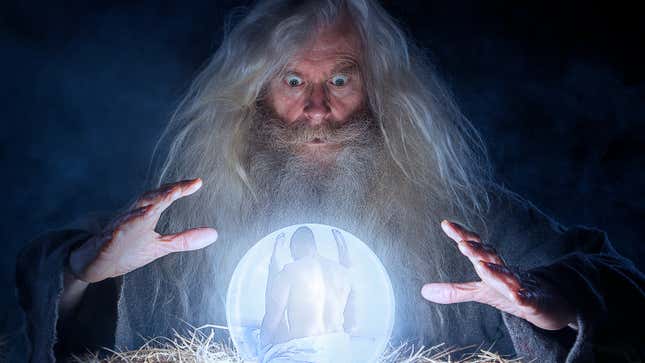
THE CASTLE OF ISIDORE—Scolding the associate magister for his inappropriate use of guild resources, the High Council at Calazar Keep reportedly reprimanded wizard Ashkahol the Geomancer for watching porn on his work orb Tuesday. “We’ve told Ashkahol repeatedly that we’re trying to maintain a professional sorcery environment here, and then I look over and he’s using his Divining Orb to gaze upon a threesome between three barely legal succubi,” said Archsage Maladrel, who emphasized that he did not care what the 374-year-old conjurer did with his personal orb, but that looking up AmateurBrujas.xxx on his work orb could risk infecting all of Calazar Keep’s enchanted devices with a foul and malignant hex. “It’s also projecting at full blast, which is deeply disrespectful. He really can’t even put a muting bind on his orb when that stuff is playing? And don’t think it isn’t obvious when I see him skulking off to an empty dungeon cell with that orb under his arm. By Creseis above, does he not understand we’re trying to bend the forces of God and Man using the seven divine elements here?” Maladrel added that per dress code, Ashkahol also needed to be wearing the company-issued big blue moon hat.

The Healing Power of Gardens: Oliver Sacks on the Psychological and Physiological Consolations of Nature

By Maria Popova (themarginalian.org)

“I work like a gardener,” the great painter Joan Miró wrote in his meditation on the proper pace for creative work. It is hardly a coincidence that Virginia Woolf had her electrifying epiphany about what it means to be an artist while walking amid the flower beds in the garden at St. Ives. Indeed, to garden — even merely to be in a garden — is nothing less than a triumph of resistance against the merciless race of modern life, so compulsively focused on productivity at the cost of creativity, of lucidity, of sanity; a reminder that we are creatures enmeshed with the great web of being, in which, as the great naturalist John Muir observed long ago, “when we try to pick out anything by itself, we find it hitched to everything else in the universe”; a return to what is noblest, which means most natural, in us. There is something deeply humanizing in listening to the rustle of a newly leaved tree, in watching a bumblebee romance a blossom, in kneeling onto the carpet of soil to make a hole for a sapling, gently moving a startled earthworm or two out of the way. Walt Whitman knew this when he weighed what makes life worth living as he convalesced from a paralytic stroke: “After you have exhausted what there is in business, politics, conviviality, love, and so on — have found that none of these finally satisfy, or permanently wear — what remains? Nature remains; to bring out from their torpid recesses, the affinities of a man or woman with the open air, the trees, fields, the changes of seasons — the sun by day and the stars of heaven by night.”

Illustration by Emily Hughes from Little Gardener.

Those unmatched rewards, both psychological and physiological, are what beloved neurologist and author Oliver Sacks (July 9, 1933–August 30, 2015) explores in a lovely short essay titled “Why We Need Gardens,” found in Everything in Its Place: First Loves and Last Tales (public library) — the wondrous posthumous collection that gave us Sacks on the life-altering power of libraries. He writes:

As a writer, I find gardens essential to the creative process; as a physician, I take my patients to gardens whenever possible. All of us have had the experience of wandering through a lush garden or a timeless desert, walking by a river or an ocean, or climbing a mountain and finding ourselves simultaneously calmed and reinvigorated, engaged in mind, refreshed in body and spirit. The importance of these physiological states on individual and community health is fundamental and wide-ranging. In forty years of medical practice, I have found only two types of non-pharmaceutical “therapy” to be vitally important for patients with chronic neurological diseases: music and gardens.

Oliver Sacks at the New York Botanical Garden. (Photograph by Bill Hayes from How New York Breaks Your Heart.)

Having lived and worked in New York City for half a century — a city “sometimes made bearable… only by its gardens” — Sacks recounts witnessing nature’s tonic effects on his neurologically impaired patients: A man with Tourette’s syndrome, afflicted by severe verbal and gestural tics in the urban environment, grows completely symptom-free while hiking in the desert; an elderly woman with Parkinson’s disease, who often finds herself frozen elsewhere, can not only easily initiate movement in the garden but takes to climbing up and down the rocks unaided; several people with advanced dementia and Alzheimer’s disease, who can’t recall how to perform basic operations of civilization like tying their shoes, suddenly know exactly what to do when handed seedlings and placed before a flower bed. Sacks reflects:

I cannot say exactly how nature exerts its calming and organizing effects on our brains, but I have seen in my patients the restorative and healing powers of nature and gardens, even for those who are deeply disabled neurologically. In many cases, gardens and nature are more powerful than any medication.

Art by Violeta Lopíz and Valerio Vidali from The Forest by Riccardo Bozzi

More than half a century after the great marine biologist and environmental pioneer Rachel Carson asserted that “there is in us a deeply seated response to the natural universe, which is part of our humanity,” Sacks adds:

Clearly, nature calls to something very deep in us. Biophilia, the love of nature and living things, is an essential part of the human condition. Hortophilia, the desire to interact with, manage, and tend nature, is also deeply instilled in us. The role that nature plays in health and healing becomes even more critical for people working long days in windowless offices, for those living in city neighborhoods without access to green spaces, for children in city schools, or for those in institutional settings such as nursing homes. The effects of nature’s qualities on health are not only spiritual and emotional but physical and neurological. I have no doubt that they reflect deep changes in the brain’s physiology, and perhaps even its structure.

Illustration by Ashleigh Corrin from Layla’s Happiness by Mariahadessa Ekere Tallie.

Complement this particular fragment of the altogether delicious Everything in Its Place with naturalist Michael McCarthy on nature and joy, pioneering conservationist and Wilderness Act co-composer Mardy Murie on nature and human nature, and bryologist and Native American storyteller Robin Wall Kimmerer on gardening and the secret of happiness, then revisit Oliver Sacks on nature and the interconnectedness of the universethe building blocks of identitythe three essential elements of creativity, and his stunning memoir of a life fully lived.