I am thrilled to present the Fourth in the Salon series for 2024.
William Shakespeare
M a c b e t h
William Shakespeare’ s – Macbeth** is the tragedy of the damaging physical and psychological effects ofunchecked political ambition on those who seek power. The story is of a once upright and brave Scottish general named Macbeth who receives a prophecy from a trio of witches that one day he will become King of Scotland. He thus becomes consumed byambition and spurred to action by his wife, Macbeth murders King Duncan and takes the Scottish throne for himself. And in all such tales comes the reckoning.
The play Macbeth will be the subject of the evening, Enlightening viewpoints will be shared by the Actors and directors from some of the productions of the plays & movies, to give us insights as to the culture, the characters, and even the playwright of the play. Followed by the best part of the evening, our conversation on the film.
An interesting side note about the play, Some people believe the play Macbeth is “cursed,” and that has created a theatrical tradition: any mention of the play’s name, or quoting the play in a theater requires the offender to leave the room (or building), turn around three times, spit, curse, quote Hamlet (“Angels and Ministers of grace defend us!”), knock, and humbly ask to be let back in. which then will remove the curse.
This salon offers one, an opportunity to see the importance of checks and balances within our own or any situation that status and power are offered.
Mark the Date on your Calendar, more information to come.
See you there!
Calvin
*Salon
A salon is a gathering of people with the aim “either to please or to educate”. Calvin’s Salons are in the tradition of the French literary and philosophical movements of the 17th and 18th centuries. An intimate gathering of diverse people hosted by a salonnière who moderates conversation in the pursuit of cognitive growth and artistic experience. Salon Calvin’s Updated method involves videos, movies, and books as cultural entertainment and insightful commentary and analysis for Salon participants to discuss, exchange ideas, and enjoy.
**Side note for Prosperos Students, know that this material being discussed is on the list of recommended Books from Thane’s High Watch Reading List.
It is said that before entering the sea a river trembles with fear. She looks back at the path she has traveled, from the peaks of the mountains, the long winding road crossing forests and villages. And in front of her,she sees an ocean so vast, that to enterthere seems nothing more than to disappear forever. But there is no other way. The river can not go back. Nobody can go back. To go back is impossible in existence. The river needs to take the risk of entering the ocean because only then will fear disappear, because that’s where the river will know it’s not about disappearing into the ocean, but of becoming the ocean.
Khalil Gibran (1883-1931) Lebanese Poet
AN OPPORTUNITY FOR DAILY REFLECTION BROUGHT TO YOU BY THE SCHOOL OF PRACTICAL PHILOSOPHY
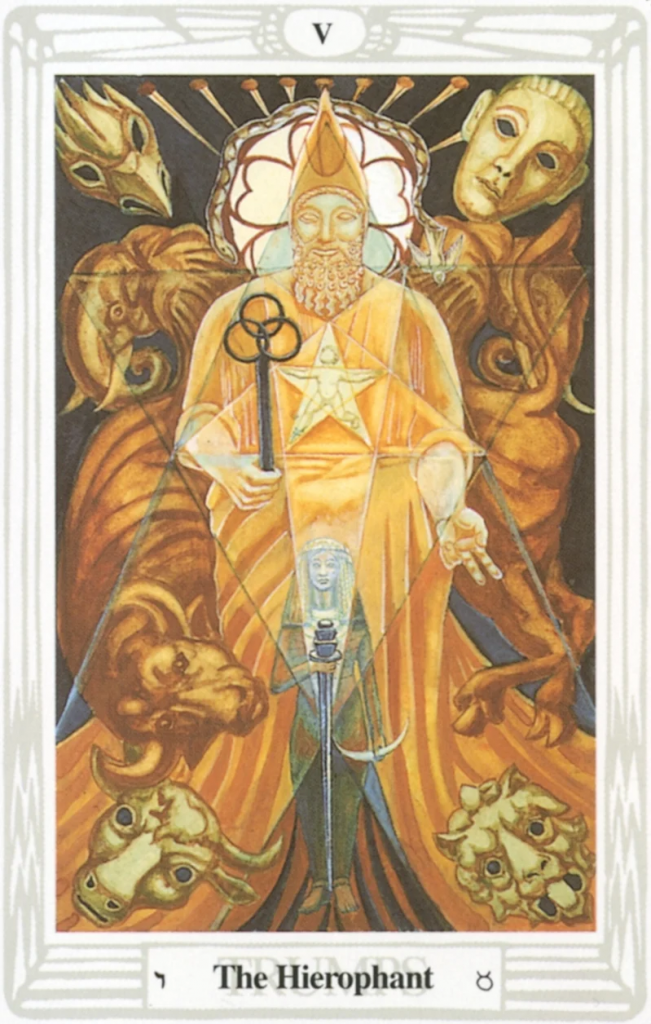
The Hierophant (or Pope, High Priest) is numbered five and is concerned with matters of faith, religion, belief and morality. This is the wise teacher, full of esoteric and occult knowledge. He can help us to understand the mysteries around and within us.The Hierophant is a holy man, but is in essence both male and female. He has a healthy connection with life and living – someone who has experienced life in full and now has the experience and wisdom needed in order to teach others.He is usually seen holding his index and middle finger extended, as though pointing at something. This symbolism is important, because the human Will is considered to be directed by these two fingers. The Hierophant is an archetype which represents the culmination of human development.His abilities reside like seeds within every one of us. We all have the ability to travel where he has already explored. He holds the keys to transformation.
A handful of times a lifetime, if you are lucky, an experience opens a trapdoor in your psyche with its almost unbearable beauty and strangeness, its discomposing unlikeness to anything you have known before. Down, down you go into the depths of the unconscious, dark and fertile with the terror and longing that make for suffering, the surrender that makes for the end of suffering, not in resignation but in faith. It is then that the still, small voice of the soul begins to sing; it is then that the trapdoor becomes a portal into a life larger, truer, and more possible — a kind of rebirth.
Nobel laureate Louise Glück (April 22, 1943–October 13, 2023) captures the essence of such experiences, the way they sober us to being mortal and to being alive, with an image of piercing originality in the title poem of her 1992 collection The Wild Iris (public library).
THE WILD IRIS by Louise Glück
At the end of my suffering there was a door.
Hear me out: that which you call death I remember.
Overhead, noises, branches of the pine shifting. Then nothing. The weak sun flickered over the dry surface.
It is terrible to survive as consciousness buried in the dark earth.
Then it was over: that which you fear, being a soul and unable to speak, ending abruptly, the stiff earth bending a little. And what I took to be birds darting in low shrubs.
You who do not remember passage from the other world I tell you I could speak again: whatever returns from oblivion returns to find a voice:
from the center of my life came a great fountain, deep blue shadows on azure sea water.
One of the hardest realizations in life, and one of the most liberating, is that our mothers are neither saints nor saviors — they are just people who, however messy or painful our childhood may have been, and however complicated the adult relationship, have loved us the best way they knew how, with the cards they were dealt and the tools they had.
It is a whole life’s work to accept this elemental fact, and a life’s triumph to accept it not with bitterness but with love.
How to make that liberating shift of perspective is what the playwright, suffragist, and psychologist Florida Scott-Maxwell (September 14, 1883–March 6, 1979) considers in a passage from her 1968 autobiography The Measure of My Days (public library).
A mother’s love for her children, even her inability to let them be, is because she is under a painful law that the life that passed through her must be brought to fruition. Even when she swallows it whole she is only acting like any frightened mother cat eating its young to keep it safe.
With a wary eye to the brunt of parental expectation under which all children live, well into adulthood, she writes:
No matter how old a mother is she watches her middle-aged children for signs of improvement. It could not be otherwise for she is impelled to know that the seeds of value sown in her have been winnowed. She never outgrows the burden of love, and to the end she carries the weight of hope for those she bore. Oddly, very oddly, she is forever surprised and even faintly wronged that her sons and daughters are just people, for many mothers hope and half expect that their newborn child will make the world better, will somehow be a redeemer. Perhaps they are right, and they can believe that the rare quality they glimpsed in the child is active in the burdened adult.
All four of these Mistakes are grounded in our culture, our way of thinking, our way of seeing the world, the stories we tell ourselves about who we are and why we’re here.
Until he extends his circle of compassion to all living things, man will not himself find peace. —Albert Schweitzer
In March of 1978 I met a man who for the next thirty years became a major force and role model in my life (I wrote a book about him titled The Prophet’s Way). Gottfried Mueller was, at the time, in his sixties and ran an internationally known famine relief and social work organization headquartered out of Germany. But his personal obsession was the near future, which he saw coming at us like an oncoming train.
We sat in Stadtsteinach, Germany, in the guest house of his organization Salem, and over a glass of organic red wine he put a paper between us on the table and with a pen drew a quick L – a vertical and horizontal line that was each a few inches long.
“Consider human population,” he said, starting to draw from the beginning point. “For a hundred thousand years we were pretty steady.” The line moved a few inches forward, left to right. “Then we started to grow. In 1800 we hit a billion. In 1930 two billion.” The line was starting to curve up. “Three billion in 1960. Four billion in 1974. And they say it’ll be five billion by 1987!” The line curved sharply up toward the top of the page.
“Now,” he said, drawing another L, look at everything else. “Poverty.” An upward line. “Diseases.” Another line shooting up. “Death of the forests and most things living in them.” Another line. “Pollution.” Another upward arc.
He continued through a dozen or so of the ills of humankind, from violence to crime to our consumption of food and water.
“When you see this curve,” he said, “you are in trouble. Each of these must hit a threshold. After the top of that threshold, there is either transformation or disaster, most often disaster. If you and I and others don’t do something about this, we are in trouble. The world is in trouble.”
He was right, and looking back on that March day in the rolling hills of the northern Bavarian Frankenwald forest I realize that, if anything, he was an optimist. He thought it may be a generation, maybe even two, before the crises would be so great that we’d be facing disasters of biblical proportions.
Yet in 2008 over 30 countries had food riots, and in the years since then famine has stalked the globe; today over 18 million people in Sudan are on the edge of starvation, not to mention the crisis in Gaza.
We’re seeing global warming break out of its former boundaries, threatening a planetwide cataclysm if we don’t get our fossil fuel use under control in the next decade.
The world is right now tottering atop three major thresholds: an environment that is so afire it may no longer be able to support human life across much of the planet; an economic “free market” system that is almost entirely owned, run, and milked by a tiny fraction of one percent of us; and an explosion of human flesh on the planet that has turned our species into a global Petri dish just waiting for another infective agent to run amok.
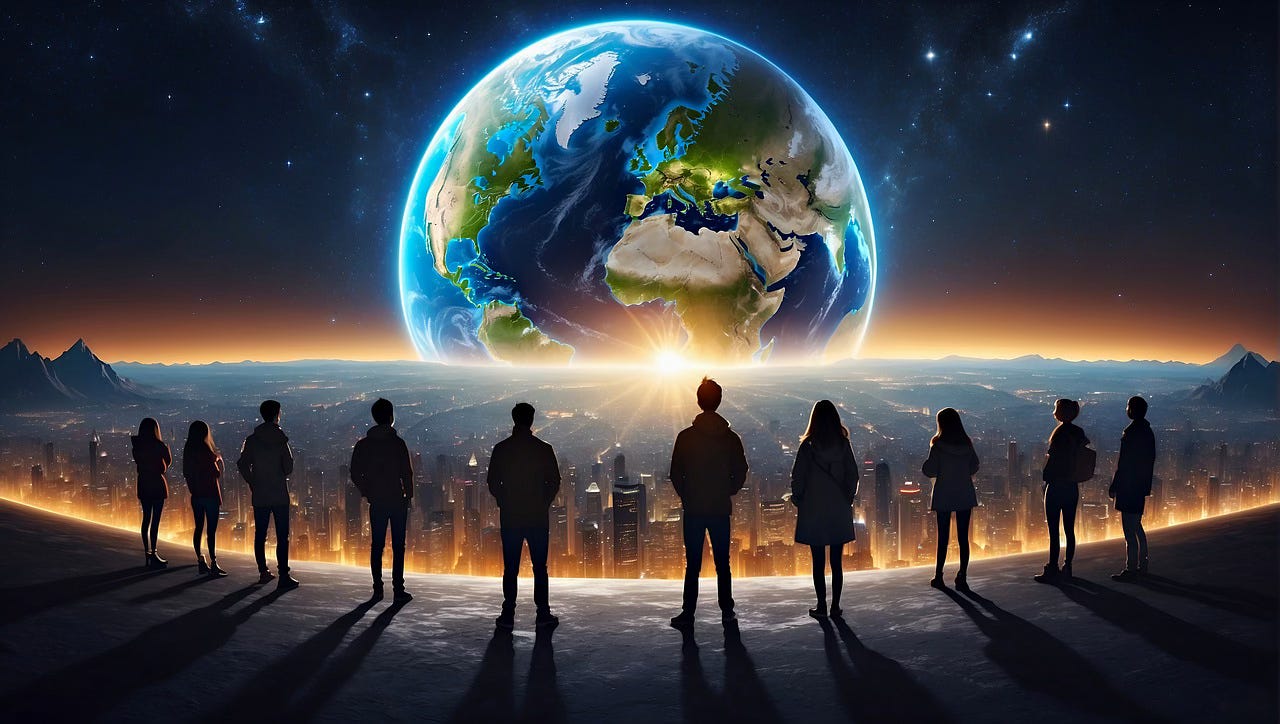
Four mistakes have brought us to this point, and the failure to recognize them at their deepest level, will only push us faster toward total tipping points where we are thrown into disaster. All four of these Mistakes are grounded in our culture, our way of thinking, our way of seeing the world, the stories we tell ourselves about who we are and why we’re here.
The first Mistake is a belief that we’re separate from nature. Our religions tell us we were created by a supernatural being who is not part of this Earth, not from this planet. He set us apart from all other life, and many among us — perhaps even the majority of the six billion of us — don’t even believe that we are animals, but instead think we’re a totally unique life form.
The second Mistake is a belief that an abstraction — an economic system — is divine and separated from us. This mythical so-called “free market,” so we believe, operates under its own divine rules and is entirely and eternally self-regulating. It is always right. The fact that it’s more than 95 percent owned and run by fewer than .0001 percent of us is, by this belief, “just the way things are, always were, and must be.” We are here to serve the economy, this ideology goes; it’s not here to serve us.
The third Mistake is a belief that men should run the world, and that women are their property. While it may seem that women’s rights are well advanced and society is nearly egalitarian in the First World, the US, Western Europe, and Australia combined are only about a quarter of the population of the world. In India it’s still a common rural practice for men to burn their wives to death simply because it’s more convenient than divorce. In many Arab countries and across much of Africa and South America it’s not uncommon for women to be murdered by their families if they “dishonor” the family by not going along with an arranged marriage or not being a virgin. Even in the First World, women are still routinely excluded from positions of power in the world’s largest institutions (like the Catholic Church), and most recently the Supreme Court and every Red state in America have gutted women’s right to control their own bodies.
This is one of our biggest Mistakes, not just because it’s morally deficient or because it can be biologically challenged, but because its primary result is an explosion in population.
The fourth Mistake is a belief that the best way to influence people is through fear rather than through the power of love, compassion, and support. We stand baffled when Palestinians in Gaza vote for a political party that has a long history of terrorist activity, somehow completely overlooking the fact that that same group has been feeding people, building hospitals and schools, and providing old age and widower pensions to people in need. We think we can threaten and bomb people into liking us and behaving in ways that are consistent with our best interests while ignoring theirs. We have come to believe that we are not our brother’s keeper, that we are separate from all other humanity on the planet.
The big questions and the big picture
Civilizations have come and gone, and those long gone mostly vanished because they despoiled their commons, allowed small elites to control their economies and governments, and lived in ways that were unsustainable. Those that survived for centuries or millennia are the ones that learned how to protect their commons, engaged in non-toxic commerce and governance, and organized their culture and lifestyles in ways that could continue in the same place and same way down through the ages.
If we don’t learn the lessons of the latter, we face the fate of the former…
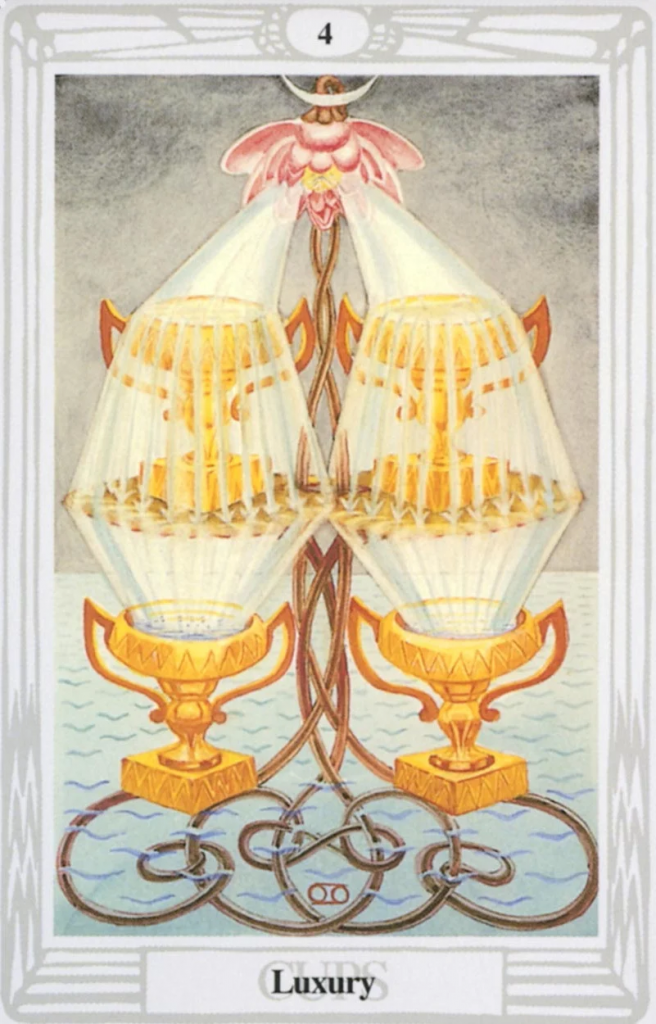
The Lord of Luxury is a card with a hidden sting in its tail. On the surface it indicates a wealth of loving affection, showing a person who is lucky enough to receive a great deal of devotion and tenderness.At first look, you would think we would be all too pleased with this situation wouldn’t you? However, the sting is this – sometimes, when we are loved deeply and for a long period of time, we are foolish enough to forget what it feels like when we are lonely and unloved. And as soon as we make that mistake, we start to undervalue the tenderness and emotional investment that others are making in us.We begin to get careless about the ways in which we treat those people who love us. We may hanker after love from some-one outside our circle, instead of valuing those people closer to hand who love us from the bottom of their hearts.In other words, we can begin to take love for granted. And there are three things in this world we are all silly to take for granted – love, good health and tranquillity. Every one of them slips away silently if we stop paying it due attention.So, when the Lord of Luxury appears, whilst you will know that there is a great deal of love in the air, there’s also a warning which must be taken on board – count your blessings, reciprocate, and don’t get your priorities in a mess. That way you’ll carry on being loved for a very long time.
Episode 1 | 2h 8m 43s | Video has closed captioning. | Ken Burns
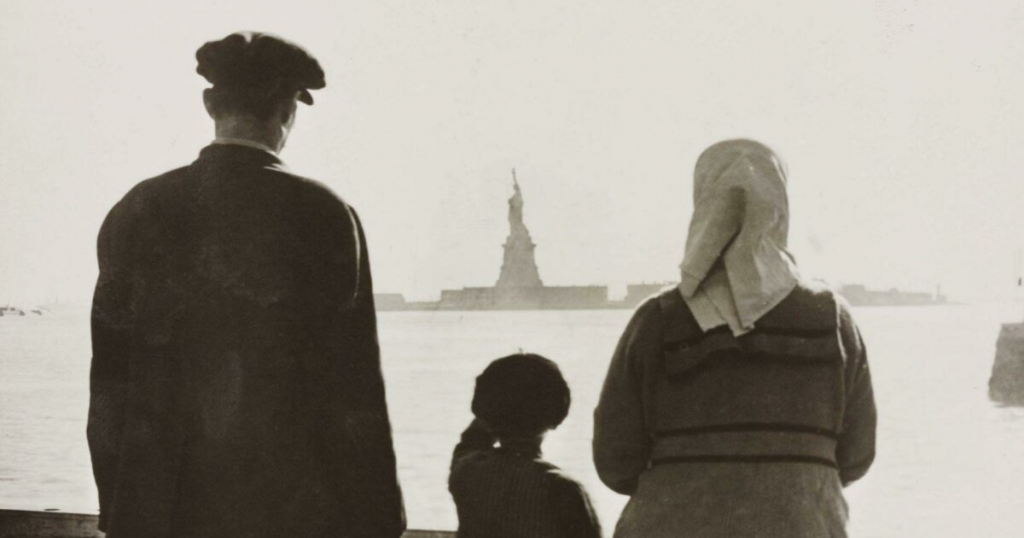
After decades of maintaining open borders, a xenophobic backlash prompts Congress to pass its first laws restricting immigration. Meanwhile, in Germany, Hitler and the Nazis begin their persecution of Jewish people, causing many to try to flee to neighboring countries or America. Franklin Roosevelt and other world leaders are concerned by the growing refugee crisis but fail to coordinate a response.
Aydelotte Foundation • May 10, 2024 • SWARTHMORE COLLEGE This talk was delivered on April 18, 2024 at Swarthmore College. Naomi Klein is an award-winning journalist and New York Times bestselling author. She is a columnist with The Guardian. In 2018 she was named the inaugural Gloria Steinem Endowed Chair at Rutgers University and is now Honorary Professor of Media and Climate at Rutgers. In September 2021 she joined the University of British Columbia as UBC Professor of Climate Justice (tenured) and co-director of the Centre for Climate Justice. This event is part of the South Africa to Gaza: World History and the Politics of Accountability series.The series draws its title and framing from the ICJ hearings on the Convention to Prevent and Punish the Crime of Genocide as it relates to Gaza. It is intended to create space for the sorts of thoughtful, informed dialogue on pressing contemporary issues that higher education aspires to produce by bringing internationally-renowned academics, journalists, artists, and legal experts to campus. The series is sponsored by the Aydelotte Foundation, the President‘s Fund for Racial Justice, Swarthmore College Libraries, Arabic, Art History, Black Studies, Educational Studies, English Literature, French & Francophone Studies, History, the Intercultural Center, Islamic Studies, Modern Languages & Literatures, Peace & Conflict Studies, Religion, and Sociology & Anthropology.
Consciousness, spirituality, biography, sexuality, androgyny, futurism, space, the arts, science, astrology, democracy, humor, books, movies and more


 It is said that before entering the sea


 THE WILD IRIS