Morning Meditation

Rob Huber.

I give my life to God to guide today

Today I will not burden myself by thinking I need to run the universe. I needn’t control anyone or anything. I need only to show up fully with my heart, committed to my excellence. I surrender everything to God, Who lives within me. Every burden and decision I place in His hands. I know that as I do so I will be led to divine right thought and action. The universe will arrange itself on my behalf.

How wonderful it is to relax at last and fall back into the arms of God. It is not a stiff neck but a soft heart that will guide my course of action. I will not forget to trust in God today.

I give my life to God to guide today

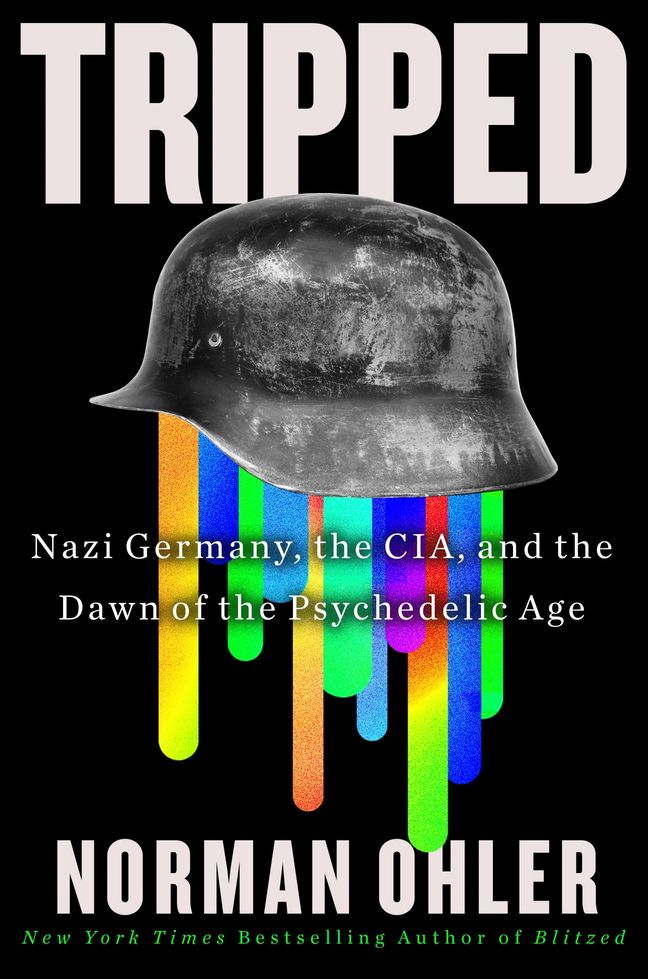
Book: “Tripped: Nazi Germany, the CIA, and the Dawn of the Psychedelic Age”

Tripped: Nazi Germany, the CIA, and the Dawn of the Psychedelic Age

Norman OhlerMarshall Yarbrough (Translator)

The author of the New York Times bestseller Blitzed returns with a provocative new history of drugs and postwar America, examining the untold story of how Nazi experiments into psychedelics covertly influenced CIA research and secretly shaped the War on Drugs.

Berlin 1945. Following the fall of the Third Reich, drug use—long kept under control by the Nazis’ strict anti-drug laws—is rampant throughout the city. Split into four sectors, Berlin’s drug policies are being enforced under the individual jurisdictions of each allied power—the Soviet Union, Britain, France, and the US. In the American zone, Arthur J. Giuliani of the nascent Federal Bureau of Narcotics is tasked with learning about the Nazis’ anti-drug laws and bringing home anything that might prove “useful” to the United States.

Five years later, Harvard professor Dr. Henry Beecher began work with the US government to uncover the research behind the Nazis psychedelics program. Begun as an attempt to find a “truth serum” and experiment with mind control, the Nazi study initially involved mescaline, but quickly expanded to include LSD. Originally created for medical purposes by Swiss pharmaceutical Sandoz, the Nazis coopted the drug for their mind control military research—research that, following the war, the US was desperate to acquire. This research birthed MKUltra, the CIA’s notorious brainwashing and psychological torture program during the 1950s and 1960s, and ultimately shaped US drug policy regarding psychedelics for over half a century.

Based on extensive archival research on both sides of the Atlantic, Tripped is a wild, unconventional postwar history, a spiritual sequel to Norman Ohler’s New York Times bestseller Blitzed. Revealing the close relationship and hidden connections between the Nazis and the early days of drugs in America, Ohler shares how this secret history held back therapeutic research of psychedelic drugs for decades and eventually became part of the foundation of America’s War on Drugs.

(Goodreads.com)

Thomas Aquinas: 3 Things Are Necessary to Save Yourself

A framework for a good life

Thomas Oppong

Thomas Oppong

Published in Personal Growth

Dec 14, 2023 (Medium.com)

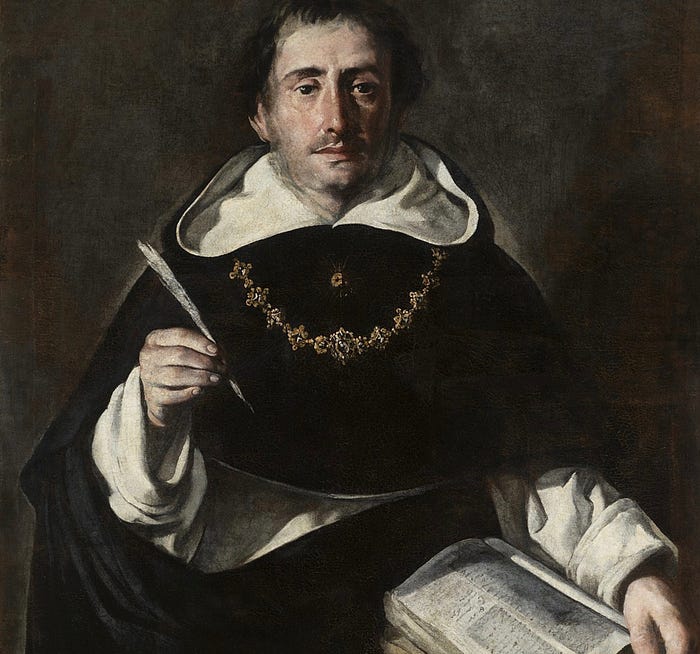
Photo: Santo Tomás de Aquino/Antonio del Castillo y Saavedra/Public

Values, principles, and priorities are three of the essential things for a good life. They give us a sense of direction. When we know what is important to us, we are more likely to be intentional about our choices.

We align our actions with our long-term goals. And, of course, it improves our chances of finding life satisfaction.

The renowned Italian theologian and philosopher Thomas Aquinas was born into a noble family in Roccasecca, Italy. He had a lot to say about mastering the human condition.

His early life was immersed in faith, as he was raised in a Benedictine monastery. At fifteen, he entered the Dominican Order, a decision that defied his family’s wishes.

Despite their opposition, Aquinas embraced the Dominican life without hesitation. He dedicated his life to studying theology and philosophy.

His intellectual journey took him to the University of Naples, where he was exposed to the works of Aristotle, a pivotal figure in his intellectual development.

Aquinas recognised the compatibility of Aristotelian philosophy with Christian theology. He believed both could provide insights into the nature of reality and the human condition.

His ability to bridge the gap between philosophy and theology caught the attention of the Dominican Order. He was sent to Paris in 1252 to study under Albert the Great, a renowned theologian and scholar.

Under Albert’s guidance, Aquinas’ intellectual life was further strengthened. His synthesis of faith and reason became more refined.

Aquinas observed, “Three things are necessary for the salvation of man: to know what he ought to believe; to know what he ought to desire; and to know what he ought to do.”

He recognised that the pursuit of salvation, the ultimate goal of human existence, requires a harmonious balance of knowledge, desire, and action.

Belief

Beliefs and convictions determine your perceptions and realities in life. We act based on what we believe to be true. As subjective as it may be. It’s even more life-changing in the context of religious or spiritual beliefs.

Beliefs evolve, though.

We can’t have full knowledge all at once. We must start by believing; then afterwards we may be led on to master the evidence for ourselves,” says Aquinas.

But what you believe to be the only truth for a good life (principles, doctrines, or assumptions) determines your worldview.

Knowledge, For Aquinas, may mean understanding God’s nature, the principles of morality, and the purpose of human existence. This knowledge provides a foundation for discerning right from wrong and making wise decisions.

Your fundamental truths about existence, morality, and the nature of reality are either helping you build your version of a great life or hindering your self “becoming.”

Philosopher Friedrich Nietzsche thought, ‘There are no facts, only interpretations.’ Be mindful of what you believe to be the “only way to live.” Your entire life depends on it.

Desire

Desire, Aquinas asserted, is the driving force behind human action. It is the longing for what we believe is good and fulfilling. A virtuous desire directs our actions towards what is truly good.

In a religious context, it involves desiring spiritual growth, righteousness, and a closer relationship with the divine. For philosophers, it could mean aspiring to ideals such as justice, compassion, and wisdom.

How do we apply desire in life? By setting meaningful and ethical goals. That means aspiring to personal excellence.

Desire can be channeled into personal growth, career development, and relationships. You can seek fulfilment in ways that go beyond immediate gratification.

Aquinas believed human desires are inherently good, as they reflect our innate inclination towards what is beneficial and fulfilling.

However, these desires can be misguided. Our desires can lead us towards fleeting pleasures or self-centred pursuits. A path that hinders spiritual development.

Conduct

Action, the final component, is the manifestation of our beliefs and desires. It is through our actions that we live out our values.

Aquinas emphasised the importance of good actions, guided by our knowledge and desires, as the path to achieving salvation.

Virtuous actions, guided by knowledge and good desires, are the bedrock of a fulfilling and spiritually enriching life.

Aquinas thought saving yourself is not just about beliefs and desires but also about what you do. In a religious context, it often aligns with the concept that faith without works is dead.

Or the need for believers to manifest their faith through charitable acts, kindness, and adherence to moral principles. Ethical actions lead to personal integrity and the greater good of society.

In practice, it means treating others with respect. “Always treat people as ends in themselves, never as means to an end,” Philosopher Immanuel Kant said.

Aquinas’ teachings on desire and action emphasise the transformative power of aligning our beliefs with what we ought to desire and do.

Cultivate desires rooted in knowledge and translate them into meaningful actions. It’s a path of personal and spiritual growth.

His statement suggests a holistic approach to life that integrates belief, desire, and action. It implies a good life is not a passive state but an active and transformative process.

It also involves the entirety of your being — mind, heart, and behaviour. Aquinas encourages us to align our beliefs with virtuous values, desires with virtue, and actions with moral principles.

While the original context may have been more closely tied to religious or philosophical teachings, these concepts can also be relevant for a good life.

Aquinas’s quote is a framework for leading a purposeful and meaningful life. Be intentional in your beliefs, desires, and actions. Be willing to adjust your beliefs in the face of new evidence or perspectives.

Be open to changing your perception of life when you come across better knowledge. “The greatest discovery of my generation is that human beings can alter their lives by altering their attitudes of mind,” says philosopher and psychologist William James.

Finally, remember what political ethicist Mahatma Gandhi said, “Your beliefs become your thoughts, your thoughts become your words, your words become your actions, your actions become your habits, your habits become your values, your values become your destiny.”

For more content like this, join over 70K curious subscribers who receive my best essays and free curated tools for smarter living. Join us and get a free ebook (A collection of essays on life, meaning and getting things done).

Thomas Oppong

Written by Thomas Oppong

·Writer for Personal Growth

Making the wisdom of great thinkers instantly accessible. As seen on Forbes, Inc. and Business Insider. For my popular essays, go here: https://thomasoppong.com

Seeking Happiness

Seeking Happiness 


There were 200 people attending a seminar on mental health. At one point, the speaker told the group they were going to do an activity. He gave each attendee one balloon and told them to write their name on it. Then, the balloons were collected and moved into a very small room.

The participants were then asked to go into the other room and were given two minutes to find their balloon. 

It was chaos. People were searching frantically for their balloon, pushing each other and running into one another while they grabbed a balloon, looked at it, and inevitably tossed it to the side. 

At the end of the two minutes, no one had found the balloon that had their name on it. 

Then, the speaker asked the participants to go back in the room and pick up one balloon at random, look at the name, and return it to its owner. Within minutes, everyone had been reunited with their original balloon. 

“This is what it’s like when people are frantically searching for their own happiness in life. People push others aside to get the things that they want that they believe will bring them happiness.”

“Our happiness actually lies in helping other people and working together as a community”. 

Author Unknown   

 AN OPPORTUNITY FOR DAILY REFLECTION BROUGHT TO YOU BY THE SCHOOL OF PRACTICAL PHILOSOPHY

Morning Meditation

Daniela Simona Temneanu

Today I bear witness to the agony of the world, praying to be used as a healing force

Let me not forget today the needless suffering of so many. I do not dwell on the suffering, but I bear witness with a compassionate heart.

May I not be tempted today to attend to my own pain while minimizing the suffering of others. May I not be swayed today by the insidiousness of selfish thought. Placing myself in service to the healing of the world, I gain greater perspective and a more powerful consciousness.

Dear God,

Today I remember those whom the world has forgotten:
Those who are tortured,
Those who are oppressed,
Those who are hopeless and feel no love around them.
May the love I send to them
Help work miracles in their lives.
Amen.

Today I bear witness to the agony of the world, praying to be used as a healing force

The Government Isn’t Ready for the Violence Trump Might Unleash

Juliette Kayyem/The Atlantic

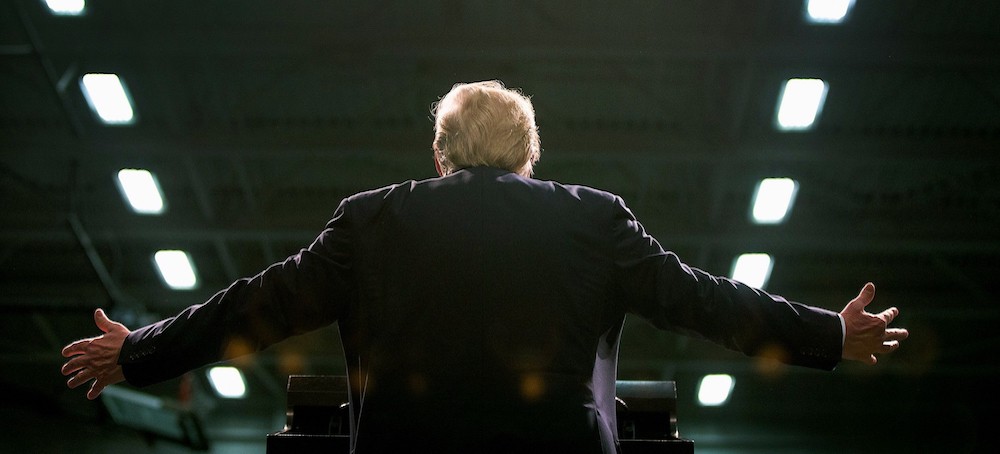
The Government Isn’t Ready for the Violence Trump Might UnleashDonald Trump. (photo: Intercept)

08 april 24 (RSN.org)

The Biden administration should be preparing for the worst.

No one in law enforcement should be caught off guard if trouble breaks out before, during, or after the November presidential election, because Donald Trump keeps talking as if addressing differences through violence is a normal part of the American political process. The presumptive Republican nominee recently promised forgiveness for the January 6 insurrectionists, posted a video involving a fake image of President Joe Biden hog-tied in the back of a truck, and riled up his supporters by claiming that “if we don’t win this election, I don’t think you’re going to have another election in this country.”

Trump could well prevail, polls suggest, but the former president is already making plans to undermine the result should he lose. In 2021, his refusal to admit defeat led to a bloody riot at the Capitol. As a candidate for reelection, Biden has every reason to warn voters about his Republican opponent’s dangerous assault on democratic norms. But as the president of the United States, Biden should also be pushing executive-branch agencies to protect the casting and counting of votes against violent interference and to ward off attempts to interfere with the certification of November’s outcome. He is obliged, in other words, to make sure that, regardless of whether he or Trump wins, the victor will be able to take office peacefully.

The January 6th Committee is best remembered for its damning account of what happened that day, and of the forces that led up to those events. But the committee’s report points to some of the preparations that urgently need to be made. The panel highlighted gaps among federal agencies in their protocols for sharing intelligence about extremism and other domestic threats to our democracy. The report recommended prioritizing election-related intelligence-sharing efforts so that public-safety officials are ready. It also recommended paying greater attention to getting the District of Columbia ready for the certification of electoral votes, and urged the president to designate the joint session of Congress during which the election will be certified as a “National Special Security Event.” This designation, which is also applied to the inauguration and the State of the Union address, requires elaborate planning and expanded security measures to protect an event of national significance. Biden should take the committee’s advice.

The executive branch alone can’t enact every proposal recommended by the January 6 committee. The panel called for enhanced penalties in criminal statutes prohibiting threats to election workers and attempts to overthrow elections. This would require congressional approval, which the Department of Justice can still seek.

At least until the next inauguration, the federal apparatus will be governed by Biden. It needs to be unified and focused on a singular threat to a peaceful election and transition to a new presidential term: The FBI is responsible for sharing intelligence with state and local authorities; the U.S. Marshals Service, part of the Department of Justice, protects judges; the Department of Homeland Security secures federal buildings and supports local and state public-safety agencies. In the report’s extensive appendixes, the January 6 Committee described how confusion resulting from D.C.’s unique political status hampered deployment of the National Guard on the day of the riot; the report also chronicled disarray among federal agencies about which one would lead the response to any turmoil. Those issues need to be addressed now.

Earlier this year, as the third anniversary of the Capitol riot approached, Biden described January 6 as “the day we almost lost America.” Biden should take his own rhetoric seriously by establishing task forces to get the government ready for what lies ahead. Little has been disclosed about how the White House is preparing. Perhaps he could draw upon the expertise of Trump-administration officials such as former White House Chief of Staff and Secretary of Homeland Security John Kelly, who has been vocal about Trump’s threat to democracy. Beyond implementing the committee’s recommendations, identifying and preparing for threats to vote-counting in swing states should be of particular focus. A show of readiness can also deter people who might have learned the wrong lesson from the Capitol riot: that just a bit more violence might have changed the outcome of the 2020 election.

Any attempts to shore up the nation’s defenses against political violence might be misinterpreted—or intentionally misconstrued—by some of Trump’s supporters as an attempt by a Democratic administration to use federal power to interfere in the 2024 election. But the fact that everything Biden does at this stage will be seen through a politicized lens shouldn’t scare him into inaction.

If Trump and his supporters want to quibble with plans to protect election officials from external pressure during vote counts in Georgia and Wisconsin, or to protect members of Congress from rioters during the certification process, then they should do so out loud, before the election. But preparing for election turmoil shouldn’t be a partisan issue. The right keeps warning us of the potential for left-wing antifa violence; surely conservatives would want the executive branch to prevent it from affecting the vote certification if Trump wins. The best course is to lay out transparent plans to safeguard the electoral process no matter who is ultimately sworn in.

What Orwell Really Feared

Stephen Metcalf/The Atlantic
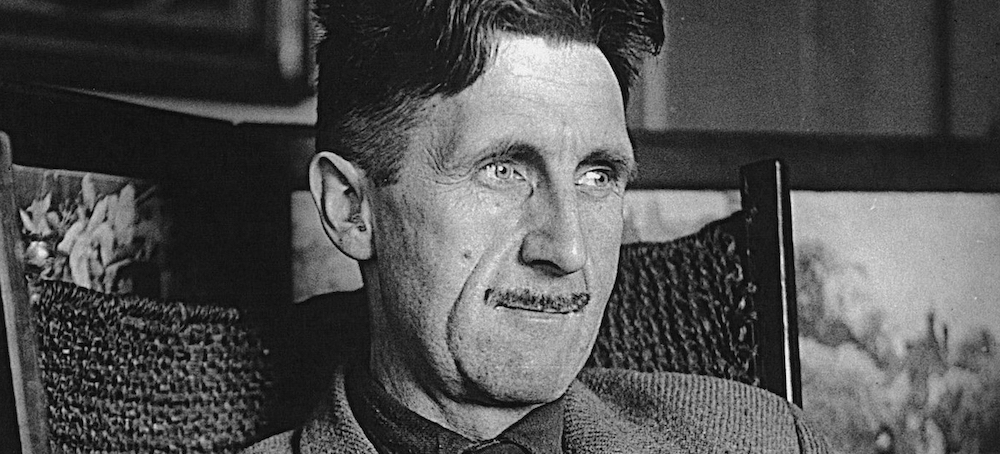
What Orwell Really FearedGeorge Orwell. (photo: Estate of Vernon Richards)

08 april 24 (RSN.org)

In 1946, the author repaired to the remote Isle of Jura and wrote his masterpiece, 1984. What was he looking for?

The Isle of Jura is a patchwork of bogs and moorland laid across a quartzite slab in Scotland’s Inner Hebrides. Nearly 400 miles from London, rain-lashed, more deer than people: All the reasons not to move there were the reasons George Orwell moved there. Directions to houseguests ran several paragraphs and could include a plane, trains, taxis, a ferry, another ferry, then miles and miles on foot down a decrepit, often impassable rural lane. It’s safe to say the man wanted to get away. From what?

Orwell himself could be sentimental about his longing to escape (“Thinking always of my island in the Hebrides,” he’d once written in his wartime diary) or wonderfully blunt. In the aftermath of Hiroshima, he wrote to a friend:

This stupid war is coming off in abt 10–20 years, & this country will be blown off the map whatever else happens. The only hope is to have a home with a few animals in some place not worth a bomb.

It helps also to remember Orwell’s immediate state of mind when he finally fully moved to Jura, in May 1946. Four months before Hiroshima, his wife, Eileen, had died; shortly after the atomic bomb was dropped, Animal Farm was published.

Almost at once, in other words, Orwell became a widower, terrified by the coming postwar reality, and famous—the latter a condition he seems to have regarded as nothing but a bother. His newfound sense of dread was only adding to one he’d felt since 1943, when news of the Tehran Conference broke. The meeting had been ominous to Orwell: It placed in his head the idea of Roosevelt, Churchill, and Stalin divvying up the postwar world, leading to a global triopoly of super-states. The man can be forgiven for pouring every ounce of his grief, self-pity, paranoia (literary lore had it that he thought Stalin might have an ice pick with his name on it), and embittered egoism into the predicament of his latest protagonist, Winston Smith.

Unsurprisingly, given that it culminated in both his masterpiece and his death, Orwell’s time on the island has been picked over by biographers, but Orwell’s Island: George, Jura and 1984, by Les Wilson, treats it as a subject worthy of stand-alone attention. The book is at odds with our sense of Orwell as an intrepid journalist. It is a portrait of a man jealously guarding his sense of himself as a creature elementally apart, even as he depicts the horrors of a world in which the human capacity for apartness is being hunted down and destroyed.

Wilson is a former political journalist, not a critic, who lives on neighboring Islay, famous for its whiskeys. He is at pains to show how Orwell, on Jura, overcame one of his laziest prejudices: The author went from taking every opportunity to laugh at the Scots for their “burns, braes, kilts, sporrans, claymores, bagpipes” (who is better at the derisive list than Orwell?) to complaining about the relative lack of Gaelic-language radio programming.

Scottish had come to mean something more to him than kailyard kitsch. These were a people holding out against a fully amalgamated identity, beginning with the Kingdom of Great Britain and extending to modernity itself. On Jura at least, crofters and fishermen still lived at a village scale. As to whether Jura represented, as has been suggested, suicide by other means—Orwell was chronically ill, and Barnhill, his cottage, was 25 miles from the island’s one doctor—Wilson brushes this aside. In fact, he argues that Jura was “kinder to Orwell’s ravaged lungs than smog-smothered London,” where inhabitants were burning scavenged wood to stay warm.

At Barnhill, Orwell set up almost a society in miniature, devoting his 16-acre homestead to his ideal of self-sufficiency. Soon after moving there, he was joined by his sister, his 2-year-old adopted son, and a nanny. Amid the general, often biting, austerity of postwar Europe, they enjoyed a private cornucopia, subsisting on, as Wilson says, a diet of “fish, lobster, rabbit, venison and fresh milk and eggs,” and were often warmed by peat that Orwell himself had cut. He intended to live there for the rest of his life, raising his son and relishing an existence as a non-cog in a noncapitalist machine.

He lived without electricity or phone; shot rabbits “for the pot,” as Wilson says; raised geese to be slaughtered and plucked; and fished the surrounding waters in a dinghy. He fashioned a tobacco pouch from animal skin and a mustard spoon out of deer bone, and served his aghast guests a seaweed blancmange. Over time, absconding to Jura and writing 1984 became aspects of a single premonition: a coming world of perpetual engulfment by the forces of bigness. As Orwell’s latest biographer, D. J. Taylor, has pointed out in Orwell: The New Life, Orwell’s novels before Animal Farm followed a common template of a sensitive young person going up against a heartless society, destined to lose. Eileen is the one who helped him—either by suggesting that Animal Farm be told as a fable or by lightening his touch, depending on whom you talk to—find a newly engaging, even playful (in its way), register.

The loss of Eileen and return of the self-pitying Orwell alter ego are certainly linked. And indeed, in 1984 he produces his most Orwellian novel, in both senses—only now both protagonist and situation are presented in the absolute extreme : The young man is the bearer (if we believe his tormentor, O’Brien) of the last shred of human autonomy, in a society both totally corrupt and laying total claim to his being.

What this absolutism produced, of course, was not another fusty neo-Edwardian novel à la Orwell’s earlier Keep the Aspidistra Flying, but a wild, aggrieved tour de force of dystopian erotica. Odd though it may sound, given the novel’s unremitting torments, 1984 quickly became a best seller, in no small part because its first readers, especially in America, found it comforting—a source of the release you might feel, in a darkened theater, when you remember that you yourself are not being chased by a man with a chain saw. The reader could glance up, notice no limitless police powers or kangaroo inquisitions, and say: We are not them.

Such complacency is hard to come by in 2024. Thinking of Orwell, famous though he is for his windowpane prose and the prescience of his essays, as the ultimate sane human being is not so easy either. Rereading 1984 in light of the Jura episode suggests that Orwell was an altogether weirder person, and his last novel an altogether weirder book, than we’ve appreciated.

Conventionally speaking, 1984 is not a good novel; it couldn’t be. Novels are about the conflict between an individual’s inner-generated aims and a prevailing social reality that denies or thwarts them. 1984 is the depiction of the collapse of this paradigm—the collapse of inner and outer in all possible iterations. Of course its protagonist is thinly drawn: Winston’s self lacks a social landscape to give it dimensionality.

In place of anything like a novel proper, we get a would-be bildungsroman breaking through to the surface in disparate fragments. These scraps are Winston’s yearnings, memories, sensual instincts, which have, as yet, somehow gone unmurdered by the regime. The entire state-sponsored enterprise of Pavlovian sadism in Oceania is devoted to snuffing out this remnant interiority.

The facsimile of a life that Winston does enact comes courtesy of a series of private spaces—a derelict church, a clearing in the woods, a room above a junk shop—the last of which is revealed to have been a regime-staged contrivance. The inexorable momentum of the novel is toward the final such private space, Winston’s last line of defense, and the last line of defense in any totalitarian society: the hidden compartment of his mind.

When all else fails, there is the inaccessibility of human mentality to others, a black box in every respect. Uncoincidentally, Winston’s final defense—hiding out in his head—had been Orwell’s first. While he struggled on Jura to finish 1984, Orwell apparently returned to “Such, Such Were the Joys,” his long and excoriating essay about his miserable years at St. Cyprian’s boarding school. He’d been sent there at the age of 8, one of the shabby-genteel boys with brains in what was otherwise a class snob’s paradise. He was a bed wetter to boot, for which, Orwell writes, he was brutally punished. No wonder he found dignity in apartness. Taylor’s biography is brilliant about the connection between Orwell’s childhood reminiscence and 1984.

In the essay, Orwell portrays his alma mater as an environment that invaded every cranny of its pupils’ lives. Against this, he formed his sense of bearing “at the middle of one’s heart,” as he writes, “an incorruptible inner self” holding out against an autocratic headmistress. As a cop in Burma, a scullion in Paris, an amateur ethnographer in northern England, he was a man who kept his own company, even when in company, and whom others, as a consequence, found by and large inscrutable.

What was this man’s genius, if not taking the petty anxieties of Eric Blair, his given name, and converting them into the moral clarity of George Orwell? Fearful that his own cherished apartness was being co-opted into nonexistence, he projected his fear for himself onto something he called the “autonomous individual,” who, as he said in his 1940 essay “Inside the Whale,” “is going to be stamped out of existence.” To this he added:

The literature of liberalism is coming to an end and the literature of totalitarianism has not yet appeared and is barely imaginable. As for the writer, he is sitting on a melting iceberg; he is merely an anachronism, a hangover from the bourgeois age, as surely doomed as the hippopotamus.

The fate of the autonomous individual, “the writer,” the literature of liberalism—he carried all of it to Jura, where he dumped it onto the head of poor Winston Smith.

Orwell typed for hours upstairs, sitting on his iron bedstead in a tatty dressing gown, chain-smoking shag tobacco. In May 1947, he felt he had a third of a draft, and in November, a completed one. In December, he was in a hospital outside Glasgow, diagnosed with “chronic” tuberculosis—not a death sentence, maybe, but his landlord on Jura suspected that Orwell now knew he was dying.

The following July, after grueling treatments and a stint in a sanatorium, he returned to Jura fitter but by no means cured, and under strict orders to take it easy. His rough draft, however, was a riot of scrawled-over pages. To produce a clean manuscript for the publisher, he would need to hire and closely supervise a typist, but no candidate was willing to trek to Jura, and Orwell was unwilling to leave it. He typed 1984 on his own, having all but spent himself writing it.

“He should have been in bed,” Wilson says, and instead sat “propped up on a sofa” banging out 5,000 words a day. Among all of its gruesome set pieces, culminating in Room 101 in the Ministry of Love, the novel’s most decisive act of torment is a simple glance in the mirror. Winston is sure—it is one of his last consolations, before breaking completely—that some inherent principle exists in the universe to prevent a system based on nothing but cruelty and self-perpetuation from triumphing forever. O’Brien calmly assures Winston that he’s wrong, that he is “the last man,” and to prove it, and the obvious nonexistence of “the human spirit,” he forces Winston to look at himself:

A bowed, greycoloured, skeleton-like thing was coming towards him. Its actual appearance was frightening, and not merely the fact that he knew it to be himself. He moved closer to the glass. The creature’s face seemed to be protruded, because of its bent carriage. A forlorn, jailbird’s face with a nobby forehead running back into a bald scalp, a crooked nose, and battered-looking cheekbones above which his eyes were fierce and watchful. The cheeks were seamed, the mouth had a drawn-in look. Certainly it was his own face, but it seemed to him that it had changed more than he had changed inside. The emotions it registered would be different from the ones he felt.

The final membrane between inner and outer is dissolving. 1984 can read like Orwell’s reverse autobiography, in which, rather than a life being built up, it gets disassembled down to its foundational unit. The body is now wasting; the voice is losing expressive competence. Worse, the face will soon enough have nothing left to express, as the last of his adaptive neurocircuitry becomes property of Oceania.

1984 is Orwell saying goodbye to himself, and an improbably convincing portrait of the erasure of the autonomous individual. He finished typing the novel by early December 1948. His final diary entry on Jura—dated that Christmas Eve—gave the weight of the Christmas goose “before drawing & plucking,” then concluded: “Snowdrops up all over the place. A few tulips showing. Some wall-flowers still trying to flower.” The next month, he was back in a sanatorium; the next year, he was dead. He was 46 years old.

1984 was published 75 years ago. Surprisingly, it immediately surpassed Animal Farm as a critical and commercial success. One by one, Orwell’s contemporaries—V. S. Pritchett, Rebecca West, Bertrand Russell—acknowledged its triumph. A rare dissenter was Evelyn Waugh, who wrote to Orwell to say that he’d found the book morally inert. “You deny the soul’s existence (at least Winston does) and can only contrast matter with reason & will.” The trials of its protagonist consequently failed to make Waugh’s “flesh creep.” What, he implied, was at stake here?

Talk about missing the point. Nowhere in Orwell’s work can one find evidence of anything essential, much less eternal, that makes us human. That’s why Winston, our meager proxy, is available for a thoroughgoing reboot. As the book implies, we’re creatures of contingency all the way down. Even a memory of a memory of freedom, autonomy, self-making, consciousness, and agency—in a word, of ourselves—can disappear, until no loss is felt whatsoever. Hence the terror of being “the last man”: You’re the living terminus, the lone bearer of what will be, soon enough, a dead language.

A precious language, indicating a way of being in the world worth keeping—if you’re George Orwell. From the evidence of Jura and 1984, persisting as his own catawampus self—askew to the world—was a habit he needed to prove he couldn’t possibly kick. He could be the far-off yet rooted man who loved being a father; performing what he deemed “sane” tasks, such as building a henhouse; indulging his grim compulsions (smoking tobacco and writing books). The soul, eternal fabric of God, had no place in that equation.

Waugh wasn’t the only muddled reader of the book. In the aftermath of the Berlin blockade and the creation of NATO, followed by the Soviets’ detonation of their first atomic weapon, readers—Americans, especially—might have been eager for an anti-Stalinist bedtime story. But Orwell had already written an anti-Stalinist bedtime story. If his time on Jura tells us anything, it’s that in 1984, he was exhorting us to beware of concentrated power and pay attention to public language, yes, but above all, guard your solitude against interlopers, Stalinist or otherwise.

In addition to the book’s top-down anxieties about the coming managerial overclass, a bottom-up anxiety about how fragile solitude is—irreducible to an abstract right or a material good—permeates 1984. Paradoxically, Winston’s efforts to hold fast to the bliss of separateness are what give the book its unexpected turns of beauty and humanity. (“The sweet summer air played against his cheek. From somewhere far away there floated the faint shouts of children: in the room itself there was no sound except the insect voice of the clock.”) For all of Orwell’s intrepidness, his physical courage, his clarity of expression, his most resolutely anti-fascist instinct lay here: in his terror at the thought of never being alone.


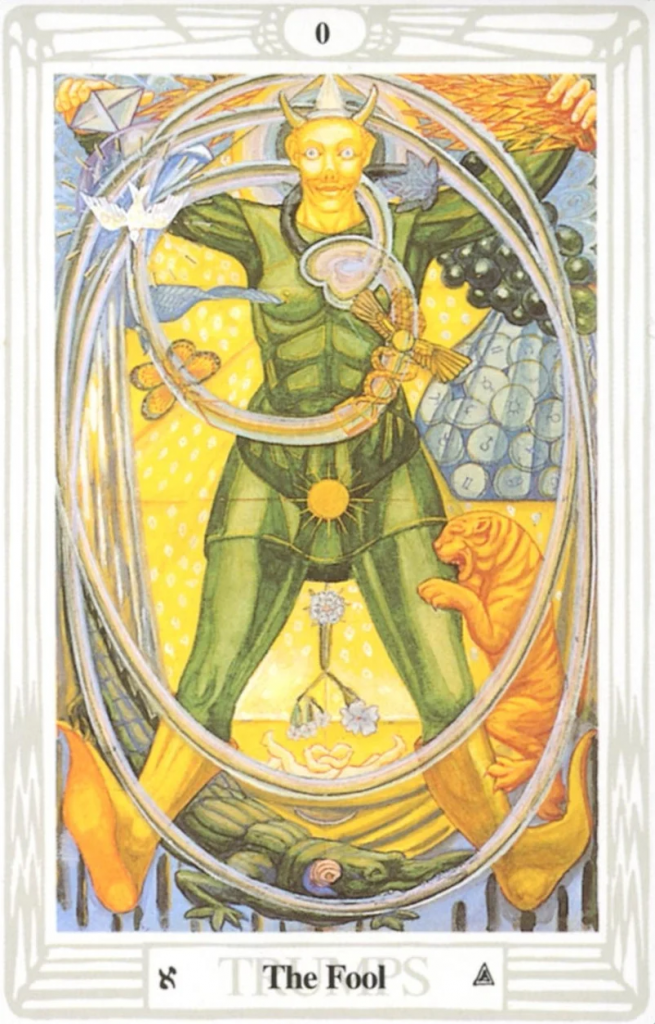
Tarot Card for April 9: The Fool

The Fool

The Fool is the first card of the Tarot and is generally unnumbered, or numbered zero. The Fool is at the start of our journey and is the initiator. Seen by many as the innocent, he has an eagerness and freshness about him. He is young and carefree, entering the World without preconceptions.The Fool trusts in life and expects his path to be a happy and rewarding one. There is faith in the gods to see him through and a complete absence of fear.Sometimes the Fool is seen as too carefree – certainly a good dose of other people’s more negative reality could damage him. However, for as long as the Fool has faith in his own purity and innocence, others will not be able to take advantage.This is the child within. This is how we were before the many experiences of life forced us to build up so many walls. The Fool does not shade himself from the light – here we are born and from here we walk the path. It’s time to jump off the cliff…