The origins of American football’s popularity go back to the turn of the 20th century, when the elite of an expansionist USA searched for a sport that would instill rugged manliness in their sons.
BY DAVE ZIRIN OCTOBER 5, 2023 (therealnews.com)

Theodore Roosevelt (1858 – 1919), twenty-sixth president of the United States of America. Photo by Stock Montage/Stock Montage/Getty Images
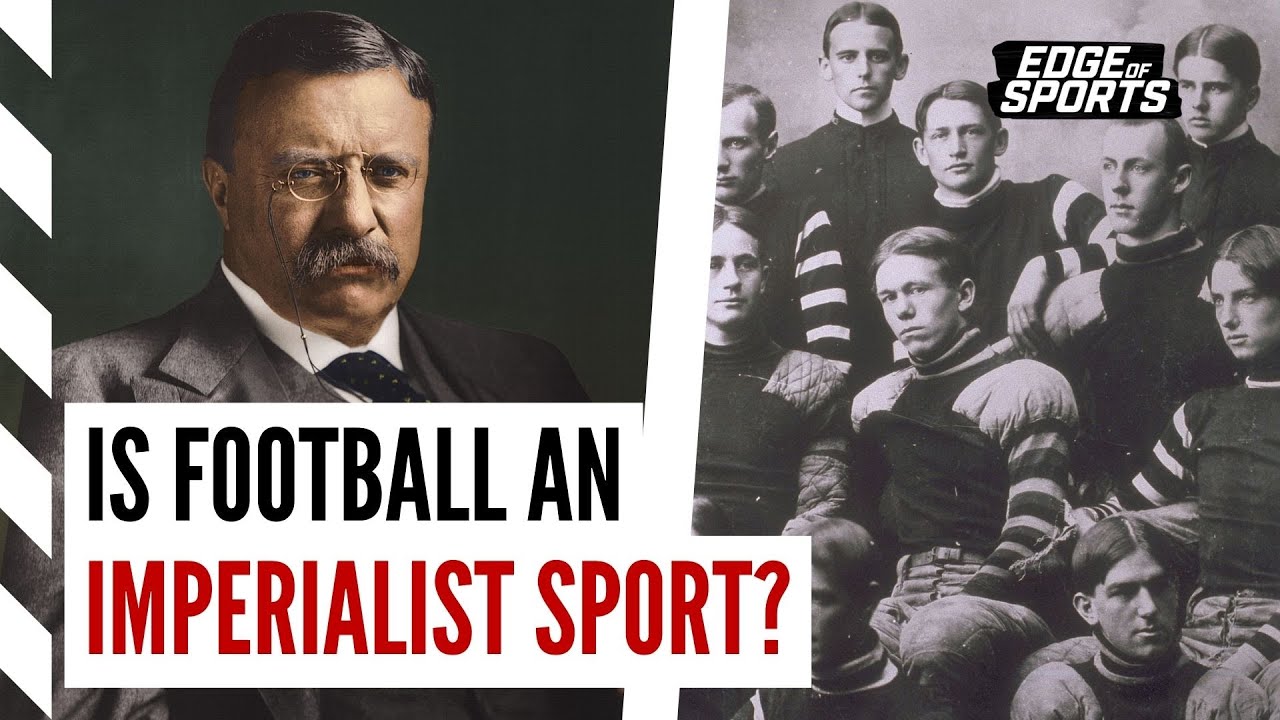
The US is the only country on earth where the word “football” refers to a different sport from the rest of the world. Where did American football come from, and why is it that the sport is virtually only played in the US? To answer that, Dave Zirin takes us on a brief journey through history to the turn of the 20th century, when imperialists like President Theodore Roosevelt took up the cause of promoting football as a way to cultivate a “masterful nation.”
Studio Production: David Hebden, Cameron Granadino
Post-Production: Taylor Hebden
Audio Post-Production: David Hebden
Opening Sequence: Cameron Granadino
Music by: Eze Jackson & Carlos Guillen
Join thousands of others who rely on our journalism to navigate complex issues, uncover hidden truths, and challenge the status quo with our free newsletter, delivered straight to your inbox twice a week:
TRANSCRIPT
Now some choice words. Okay. Look, the NFL season is underway and a big question always haunts me on Sunday afternoon when I sprint like Usain Bolt to my favorite part of my couch: Why is football only really popular in the United States? In the rest of the world, football is, of course, soccer, and our football is, at most, an afterthought – And please, don’t argue with me by bringing up NFL games in London. I am convinced those stands are packed with study abroad students on their way to Amsterdam.
So why is this the case? Why do other countries reject our football as a point of pride, especially when our other cultural products like music and movies or other sports like basketball tend to spread around the globe like wildfire? Now, I’ve heard some explain this by saying, well, the USA is a violent country, so people love a violent game, and that’s true. But while that sounds smart, as Jules Winfield said in Pulp Fiction, “That shit ain’t the truth.” There’s violence across the world and yet that doesn’t make people football fans. So what is it about this country that makes football our addiction of choice? Why are TV ratings, even in our fractured culture, always on the rise when it comes to football?
To understand why, you have to look at everyone’s favorite subject in high school: history. So let’s take a trip in the wayback machine and explain how football got baked into the cake of this country’s psyche.
Football began to flourish here at the turn of the 20th century, not as a fun diversion for kids, but to aid a US foreign policy obsessed with dreams of a global empire. Those dreams existed side-by-side with the fear that the children of the wealthy, the ones supposed to lead this conquest, were too soft, too weak, too “unmanly” for the task of running the world.
Now, this is hard for us to envision today because football draws most of its players from poor and working-class backgrounds, and the majority of NFL players are Black. But football started as a sport for privileged white elites on Ivy League campuses as a way to toughen up this new generation to lead what was called the American Century. That’s why this new game of football was embraced, not only as a sport, but as a training ground for war openly.
EDGE OF SPORTS WITH DAVE ZIRIN

MICHAEL RAY RICHARDSON OPENS UP ON HOW THE DRUG WAR KILLED HIS NBA CAREER

DESANTIS IS USING SPORTS SCHOLARSHIPS TO ‘PURGE’ A FLORIDA COLLEGE
More stories from the intersection of sports and politics…
Not surprisingly, the ultimate imperial war hawk, President Theodore Roosevelt, was one of the earliest and most prominent promoters of the sport. In an 1893 piece called “The Value of Athletic Training,” Roosevelt defended football, writing, “All of the masterful nations in history encouraged rugged sports.” He believed that athletic training in football could build a new Anglo-Saxon super-race ready to stand to stride the world. So football was born intertwined alongside ideas about white nationalism and imperial expansion.
These early games were so violent that dozens of young men died on the field of play. When newspapers started to report the shocking number of casualties and the grim reality that football had essentially become a death harvest, many prominent thinkers called for its elimination and even its abolition. The NCAA was actually formed initially to find a way to lower the body counts in the face of a torrent of criticism. In other words, my little rant here is not just hindsight, but people back then recoiled not just from the violence, but the ethos of the sport as well.
Charles Eliot, the president of Harvard, pushed for an abolition of football altogether, writing in 1915 that it was “A fight whose strategy and ethics are those of war where the weaker man is considered the legitimate prey of the stronger, all of which sets up the wrong kind of hero.”
But Teddy Roosevelt and other defenders of the sport were not having any of this Ivy League, powderpuff moralism. The one-time rough rider blasted Eliot and Harvard for wanting to “emasculate football.” Roosevelt’s belief that football was a necessary antidote to male effeminacy was so intense that he once wrote that he would disinherit his own sons if they didn’t play, and would “rather see one of them die than have them grow up as weaklings.”
So why is football so baked into the cake of the United States? Here’s the answer: its imperial ambitions and a ruling class fear of losing a masculine edge in a society where rich kids tend to grow up as soft as a duck feather pillow.
Now, fast-forward to 2023, and it’s amazing how little has changed. The GOP in particular has become the party of white male panic. Their platform is fear-based, fear of decline-ism, fear of the other, and fear that we won’t be able to keep what has already been conquered. This is not to say that only right-wingers are football fans; far from it. But only in a country such as this one, only in the United States of anxiety, do people clutch this sport so firmly. And maybe we clutch it because we feel it all just slipping away.
Dave Zirin is the sports editor of the Nation Magazine. He is the author of 11 books on the politics of sports, including most recently, The Kaepernick Effect Taking A Knee, Saving the World. He’s appeared on ESPN, NBC News, CNN, Democracy Now, and numerous other outlets. Follow him at @EdgeofSports.