What’s that smell? UCSF captures first glance at human scent detection

swiss cheese
UCSF scientists isolated the human protein that detects propionate, the molecule that gives Swiss cheese its rich, pungent scent and taste, then watched it closely to see the magic.Smabs Sputzer/Wikimedia Commons

Molecular biologists at UCSF have made a breakthrough in understanding the human sense of smell — a notoriously ephemeral process that has evaded precise description until now.

This month, for the first time, researchers were able to capture how a human odor receptor detects a scent molecule. Click here to view the interactive 3D model.
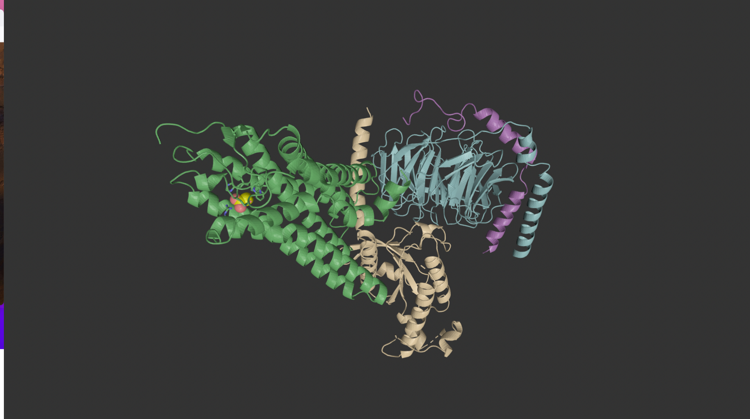
A 3D model depicts a scent molecule (yellow and red) interacting with an olfactory receptor (green, beige, cyan and violet).Courtesy UCSF

Aashish Manglik, an associate professor of pharmaceutical chemistry, explained that this is just the first piece of a very large map. The human sense of smell is the least understood of the physical senses and one of the most complex.

“This has been a huge goal in the field for some time,” he said. “But we haven’t been able to make this map because, without a picture, we don’t know how odor molecules react with their corresponding odor receptors.”

The team started out with a distinct, instantly recognizable scent — Swiss cheese — but eventually, as the scent map grows, a chemist could design a molecule and predict what it would smell like, said Manglik.

Scents, like flavors, are usually a harmony of molecules. Humans can detect hundreds of thousands of scents, and we use over 400 unique olfactory receptors to pick apart a smell when we detect one. The information we pick up from a scent can indicate whether or not something is edible or dangerous.

Propionate — the molecule that gives Swiss cheese its rich, pungent scent and taste — is very harsh by itself. First, Manglik’s team had to isolate the human protein that detects it — a nigh impossible task — then watch it closely to see the magic.

They found that the odor detectors only interacted with the propionate molecules in a very specific way — like a white blood cell catching germs.

“This receptor is laser-focused on trying to sense propionate and may have evolved to help detect when food has gone bad,” said Manglik. Detector proteins for pleasing smells like menthol or caraway might interact more loosely with the odors, he speculated, because they indicate medicinal or edible uses.

The effects of smells are not just knee-jerk “don’t eat that” repulsions or a pleasant reaction. The human microbiome is becoming more relevant in modern medicine, and the way smell interacts with it could mean big strides.

A positive association with a smell can be linked to serotonin release in the gut, for example. A negative smell may kick-start a form of prostate cancer.

With a comprehensive scent map, Manglik envisions new avenues in medicine, pharmaceuticals, cosmetics and food.

“We’ve dreamed of tackling this problem for years,” he said. “We now have our first toehold, the first glimpse of how the molecules of smell bind to our odorant receptors. For us, this is just the beginning.”

mhetherwick@sfexaminer.com

Molly Hetherwick

Molly Hetherwick

Margaret is a general assignment reporter for The Examiner and a graduate of UC Santa Cruz.
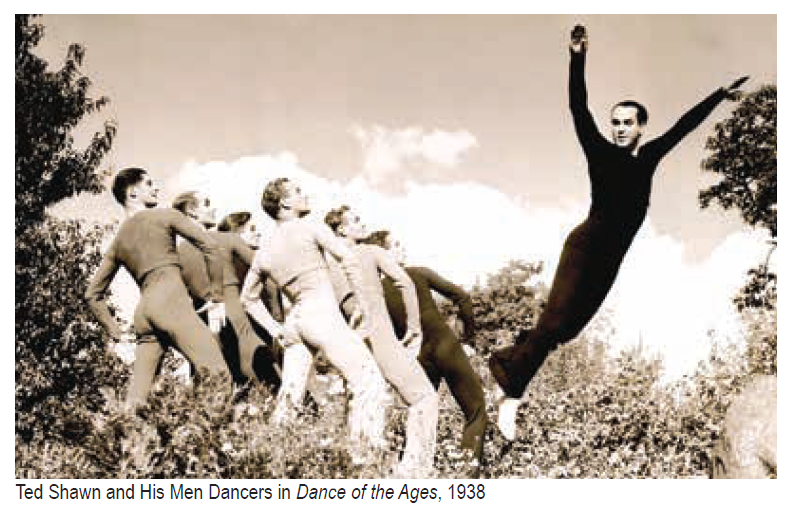
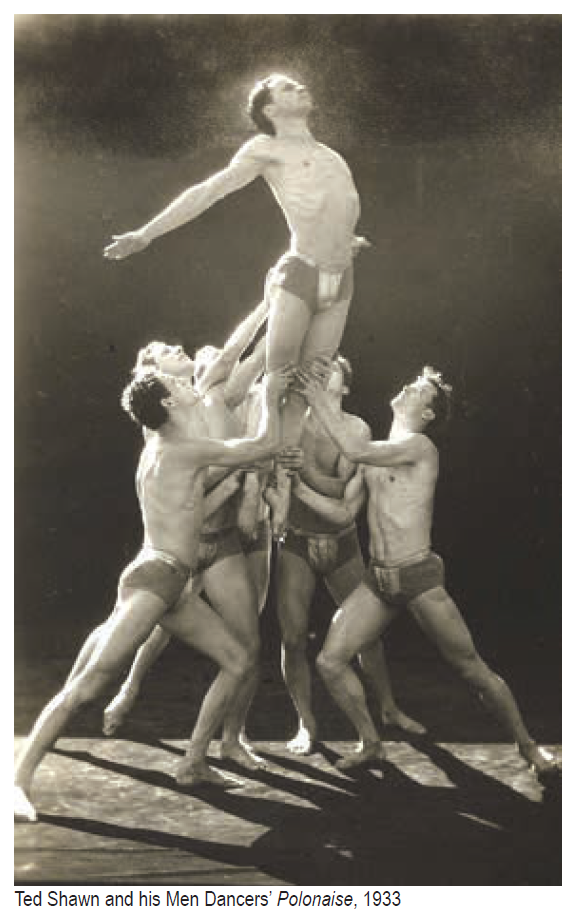
Ted Shawn and His Men Dancers

By Dr. Bill Lipsky–

Across his long and influential career, Ted Shawn (1891–1972) made many remarkable contributions to American dance, but his lifelong mission remained always to show that dancing was “a respectable profession for men” and “a legitimate medium for the creative male artist.” When he began his professional career in 1912, in the North Atlantic community of nations, the art had the reputation of being an especially feminine field, but Shawn was convinced he could change that.

In those far away times, America’s parents simply did not encourage their sons to consider a career in dance. Women who danced were lauded and adored, but the public saw male dancers as not only being light on their feet, but “light in the loafers.” Shawn himself originally planned to enter the ministry, until an illness he suffered when he was 19 caused him to become temporarily paralyzed from the waist down. Dancing became part of his physical therapy program.

After making a full recovery from his illness, Shawn became a professional dancer. In 1914 he met Ruth St. Denis, one of the pioneers of American dance performance. The next year, now married, they founded Denishawn, soon known as the “cradle of American modern dance,” and created a company, the Denishawn Dancers, to bring their work to the public. Their professional relationship ended in 1931, although they never divorced and remained close until St. Denis died in 1968.

Shawn became determined to challenge what he described as the “false idea … that dancing is an effeminate expression for men.” Not only was it a respectable career, he argued, but an art that could be enjoyed for its own sake. Creating“the first company in modern times composed entirely of men dancers,” he presented “a program of dances essentially masculine in principle and performance” to “glorify men as men in all their physical beauty and graceful movement.”

Shawn chose the men for his first dance troupe more for their masculinity, athletic ability, and stamina than for their experience as performers, which was nil for most of them. One had lettered in football, baseball, basketball, and track during high school only a few years earlier. Another was a record-setting pole vaulter. A third was a champion swimmer. Some had taken dance classes, but only Barton Mumaw, who became his lover, had more than a minimum of dance training.

Ted Shawn and His Men Dancerspremiered its “great panoply of masculinity” in Boston on March 21, 1933, the first all-male dance concert in the United States. Critics were impressed. Lucien Price, editor of The Boston Globe and eventually a strong supporter of Shawn’s work, wrote, “The dancing of the young men was boldly original … . In your company for the first time, it seemed to me, I saw young Americans dancing as Americans and dancing in an art form.”

The program that first night included Cutting the Sugar Cane, which combined many of the elements Shawn stressed in his work: heroic themes, male bonding, athleticism, exotic settings, and minimal costumes. He had been inspired by the workers he saw on a visit to Cuba, where they “cut the tall stalks with gleaming machetes, moving with a design and rhythm accompanied by chants or shouts that together created a natural dance design.” The dancers wore “only of red neckerchiefs and full, white cotton Cuban work pants tied with a red belt.”

As Mumaw described the production, “Four workers are portrayed under the unrelenting heat of an equatorial sun while they slash, carry, and stack the sugar cane. When the overseer’s back is turned, they interrupt this work … to compete in executing different patterns of village dance steps. Then the overseer bursts upon this moment of levity to whip the men back to work … . But the leader exits with a final, cavorting leap of defiance that seems to cry, ‘Curses to you! Our spirits are high!’”

Although stereotypes and cultural appropriations abound that are no longer acceptable, Shaw believed he was sharing a masculine work of social consciousness. At the time, his presentation, Mumaw later wrote, “was considered by American audiences and press alike as authentic and erotic.” Other groups, including the Hampton Institute Creative Dance Group, founded in 1934 by Charles Williams and one of the first African American touring companies in America to perform in New York, also presented it, with Shaw’s support.

Seven years after its first public concert in Boston, the company appeared there for the last time on May 7, 1940, having appeared before more than a million people in 750 cities in North America and Europe. By then, Shawn had established Jacob’s Pillow in Becket, Massachusetts, as a center for teaching and presenting dance. It struggled at first, but endured. In 2003, the federal government declared it a National Historic Landmark District, “an exceptional cultural venue that holds value for all Americans.”

Shawn continued to be a role model and spokesman for the masculinity of dancers, but he was never able to reveal one important truth about himself: that he was in all ways a lover of men. During an era when homosexuality was illegal in every American state and territory, he knew very well that public knowledge of his sexuality would not only end his career, but also his crusade “to restore dancing for men to its rightful standing.” 

Across his 50 years as a dancer and choreographer, Shaw brought almost every archetype—some would say stereotype—of maleness before the public. Was he successful in reshaping American views toward male dancers? Mumaw thought so, writing that Shawn “was able to change the attitude of an entire country toward men in dance.” Whether he did or not, Shawn made an enduring contribution to modern culture through his belief in “the art of dance” and its power “to lead humanity into continually higher and greater dimensions of existence.”Bill Lipsky, Ph.D., author of “Gay and Lesbian San Francisco” (2006), is a member of the Rainbow Honor Walk board of directors.

Faces from Our LGBT Past
Published on March 23, 2023 (SFBayTimes.com)

Free Will Astrology: Week of April 6, 2023

APRIL 4, 2023 AT 7:00 AM BY ROB BREZSNY

Photo: Yousef Espanioly

ARIES (March 21-April 19): Aries-born René Descartes (1596–1650) was instrumental in developing modern science and philosophy. His famous motto, “I think, therefore I am” is an assertion that the analytical component of intelligence is primary and foremost. And yet, few history books mention the supernatural intervention that was pivotal in his evolution as a supreme rationalist. On the night of November 10, 1619, he had three mystical dreams that changed his life, revealing the contours of the quest to discern the “miraculous science” that would occupy him for the next thirty years. I suspect you are in store for a comparable experience or two, Aries. Brilliant ideas and marvelous solutions to your dilemmas will visit you as you bask in unusual and magical states of awareness.

TAURUS (April 20-May 20): The dirty work is becoming milder and easier. It’s still a bit dirty, but is growing progressively less grungy and more rewarding. The command to “adjust, adjust, and adjust some more, you beast of burden” is giving way to “refine, refine, and refine some more, you beautiful animal.” At this pivotal moment, it’s crucial to remain consummately conscientious. If you stay in close touch with your shadowy side, it will never commandeer more than ten percent of your total personality. In other words, a bit of healthy distrust for your own motives will keep you trustworthy. (PS: Groaning and grousing, if done in righteous and constructive causes, will continue to be good therapy for now.)

GEMINI (May 21-June 20): “‘Tis the good reader that makes the good book,” wrote Gemini philosopher Ralph Waldo Emerson. “In every book, he finds passages which seem confidences or asides hidden from all else and unmistakably meant for his ear.” In the coming weeks, a similar principle will apply to everything you encounter, Gemini—not just books. You will find rich meaning and entertainment wherever you go. From seemingly ordinary experiences, you’ll notice and pluck clues that will be wildly useful for you personally.  For inspiration, read this quote from author Sam Keen: “Enter each day with the expectation that the happenings of the day may contain a clandestine message addressed to you personally. Expect omens, epiphanies, casual blessings, and teachers who unknowingly speak to your condition.”

CANCER (June 21-July 22): Traditional astrologers don’t regard the planet Mars as being a natural ally of you Crabs. But I suspect you will enjoy an invigorating relationship with the red planet during the next six weeks. For best results, tap into its rigorous vigor in the following ways: 1. Gather new wisdom about how to fight tenderly and fiercely for what’s yours. 2. Refine and energize your ambitions so they become more ingenious and beautiful. 3. Find out more about how to provide your physical body with exactly what it needs to be strong and lively on an ongoing basis. 4. Mediate on how to activate a boost in your willpower.

LEO (July 23-Aug. 22): I won’t ask you to start heading back toward your comfort zone yet, Leo. I’d love to see you keep wandering out in the frontiers for a while longer. It’s healthy and wise to be extra fanciful, improvisatory and imaginative. The more rigorous and daring your experiments, the better. Possible bonus: If you are willing to question at least some of your fixed opinions and dogmatic beliefs, you could very well outgrow the part of the Old You that has finished its mission.

VIRGO (Aug. 23-Sept. 22): The Supreme Deity with the most power may not be Jehovah or Allah or Brahman or Jesus’ Dad. There’s a good chance it’s actually Mammon, the God of Money. The devoted worship that humans offer to Mammon far surpasses the loyalty offered to all the other gods combined. His values and commandments rule civilization. I bring this to your attention, Virgo, because now is an excellent time for you to deliver extra intense prayers to Mammon. From what I can determine, this formidable Lord of Lords is far more likely to favor you than usual. (PS: I’m only half-kidding. I really do believe your financial luck will be a peak in the coming weeks.)

LIBRA (Sept. 23-Oct. 22): It’s an excellent time to give up depleted, used-up obsessions so you have plenty of room and energy to embrace fresh, succulent passions. I hope you will take advantage of the cosmic help that’s available as you try this fun experiment. You will get in touch with previously untapped resources as you wind down your attachments to old pleasures that have dissipated. You will activate dormant reserves of energy as you phase out connections that take more than they give.

SCORPIO (Oct. 23-Nov. 21): “The best revenge is not to be like your enemy,” said ancient Roman philosopher Marcus Aurelius. I’m tempted to advise every Scorpio to get a tattoo of that motto. That way, you will forever keep in mind this excellent advice; As fun as it may initially feel to retaliate against those who have crossed you, it rarely generates redemptive grace or glorious rebirth, which are key Scorpio birthrights. I believe these thoughts should be prime meditations for you in the coming weeks.

SAGITTARIUS (Nov. 22-Dec. 21): Sometimes love can be boring. We may become overly accustomed to feeling affection and tenderness for a special person or animal. What blazed like a fiery fountain in the early stages of our attraction might have subsided into a routine sensation of mild fondness. But here’s the good news, Sagittarius: Even if you have been ensconced in bland sweetness, I suspect you will soon transition into a phase of enhanced zeal. Are you ready to be immersed in a luscious lusty bloom of heartful yearning and adventure?

CAPRICORN (Dec. 22-Jan. 19): What shall we call this latest chapter of your life story? How about “Stealthy Triumph over Lonely Fear” or maybe “Creating Rapport with the Holy Darkness.” Other choices might be “As Far Down into the Wild Rich Depths That I Dare to Go” or “My Roots Are Stronger and Deeper Than I Ever Imagined.” Congratulations on this quiet but amazing work you’ve been attending to. Some other possible descriptors: “I Didn’t Have to Slay the Dragon Because I Figured Out How to Harness It” or “The Unexpected Wealth I Discovered Amidst the Confusing Chaos.”

AQUARIUS (Jan. 20-Feb. 18): It’s sway-swirl-swivel time for you, Aquarius—a phase when you will be wise to gyrate and rollick and zigzag. This is a bouncy, shimmering interlude that will hopefully clean and clear your mind as it provides you with an abundance of reasons to utter “whee!” and “yahoo!” and “hooray!” My advice: Don’t expect the straight-and-narrow version of anything. Be sure you get more than minimal doses of twirling and swooping and cavorting. Your brain needs to be teased and tickled, and your heart requires regular encounters with improvised fun.

PISCES (Feb. 19-March 20): When I was growing up in suburban America, way back in the twentieth century, many adults told me that I was wrong and bad to grow my hair really long. Really! It’s hard to believe now, but I endured ongoing assaults of criticism, ridicule, and threats because of how I shaped my physical appearance. Teachers, relatives, baseball coaches, neighbors, strangers in the grocery store—literally hundreds of people—warned me that sporting a big head of hair would cause the whole world to be prejudiced against me and sabotage my success. Decades later, I can safely say that all those critics were resoundingly wrong. My hair is still long, has always been so, and my ability to live the life I love has not been obstructed by it in the least. Telling you this story is my way of encouraging you to keep being who you really are, even in the face of people telling you that’s not who you really are. The astrological omens say it’s time for you to take a stand.

Homework: What do you love most about yourself? Newsletter.FreeWillAstrology.com

What Love Really Means: Iris Murdoch on Unselfing, the Symmetry Between Art and Morality, and How We Unblind Ourselves to Each Other’s Realities

By Maria Popova (themarginalian.org)

Decades into his long life, the poet Robert Graves defined love as “a recognition of another person’s integrity and truth in a way that… makes both of you light up when you recognize the quality in the other.” A generation later, the poetic playwright Tom Stoppard defined it as “knowledge of each other… knowledge of self, the real him, the real her, in extremis, the mask slipped from the face.” This unmasked fact is the antidote to the most dangerous fiction the Romantics bequeathed us — their model of love as union between lover and beloved, a kind of fusion of selves, with its connotation of mutual completion rather than mutual recognition of and rejoicing in two parallel completenesses.

Such gladsome recognition of the other’s otherness is the foundation of love and the foundation of morality — both requiring not a bridging of selves but an unselfing, both vulnerable to same fundamental misconception that fissures the very foundation upon which they rest. Almost every religious, spiritual, and contemplative tradition in the history of our species, when stripped of its mystical and counterscientific aspects, holds at its center an ethic of love. But also central to almost every tradition, especially of the West, is a dangerous warping of love in the hands of the self.

Most commonly known as the Golden Rule, it mistakes the reality of the self for the only reality, taking one’s own wishes, desires, and longings as universal and presuming that the other shares those precisely — negating the sovereign reality of the other, negating the possibility that a very different person might want something very different done unto them.

The remedy for this malady of selfing is to remember that there are infinitely many kinds of beautiful lives, each with its singular longings for and visions of beauty, goodness, and gladness. Nothing reminds us of this more readily than art, with its invitation to step into the intimate realities of other lives — the word “empathy,” after all, originated in the imaginative act of projecting oneself into a work of art — and no one has irradiated that reminder more luminously than the uncommon philosopher-novelist Iris Murdoch (July 15, 1919–February 8, 1999).

Dame Iris Murdoch by Ida Kar (National Portrait Gallery)

Long before her 1970 classic The Sovereignty of the Good, with its lovely conception of art as “an occasion for unselfing,” Murdoch began developing these ideas in an essay titled “The Sublime and the Good,” originally published in the Chicago Review in 1959 and later included in the altogether superb posthumous collection Existentialists and Mystics: Writings on Philosophy and Literature (public library).

She writes:

Art and morals are… one. Their essence is the same. The essence of both of them is love. Love is the perception of individuals. Love is the extremely difficult realisation that something other than oneself is real. Love, and so art and morals, is the discovery of reality.
In the same era when, across the Atlantic, Alan Watts was cautioning that “Life and Reality are not things you can have for yourself unless you accord them to all others” as he was introducing Eastern teachings in the West, Murdoch builds on the parallels between art and morality through the multiple dimensions of love — the personal and the political, the individual and the communal:

The enemies of art and of morals, the enemies that is of love, are the same: social convention and neurosis. One may fail to see the individual… because we are ourselves sunk in a social whole which we allow uncritically to determine our reactions, or because we see each other exclusively as so determined. Or we may fail to see the individual because we are completely enclosed in a fantasy world of our own into which we try to draw things from outside, not grasping their reality and independence, making them into dream objects of our own. Fantasy, the enemy of art, is the enemy of true imagination: Love, an exercise of the imagination… The exercise of overcoming one’s self, of the expulsion of fantasy and convention… is indeed exhilarating. It is also, if we perform it properly which we hardly ever do, painful.

“Real isn’t how you are made… It’s a thing that happens to you.” Maurice Sendak’s little-known 1960 illustrations for The Velveteen Rabbit.

In a sentiment that calls to mind James Baldwin’s reflection on love and his haunting observation that “nothing is more unbearable, once one has it, than freedom,” Murdoch adds:

The tragic freedom implied by love is this: that we all have an indefinitely extended capacity to imagine the being of others. Tragic, because there is no prefabricated harmony, and others are, to an extent we never cease discovering, different from ourselves… Freedom is exercised in the confrontation by each other, in the context of an infinitely extensible work of imaginative understanding, of two irreducibly dissimilar individuals. Love is the imaginative recognition of, that is respect for, this otherness.

Complement this fragment of Existentialists and Mystics — which also gave us Murdoch on art as a force of resistance and the key to great storytelling — with her almost unbearably beautiful love letters, then revisit Tolstoy on love and morality.

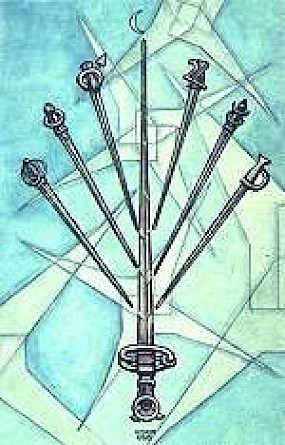
Tarot Card for April 6: The Seven of Swords

The Seven of Swords

The Lord of Futility represents the times in life where we feel too overwhelmed and doubtful to act decisively toward our problems. It will usually appear when there are difficult decisions to be made, or when situations arise that require we take action. Because we are weary, feeling over-stressed and helpless, we do nothing. As a result, of course, things inevitably get worse.

Sometimes the card will come up because we have such a poor view of ourselves. We start to believe that nothing we do could possibly make a difference to the unhappy circumstances we find ourselves in. If not challenged, this attitude will lead us into being poor-little-me’s, when we adopt a victim mentality, and secretly expect everybody else to sort things out for us.

When feeling the effects of the Lord of Futility, we are often ready to make unsuitable compromises in order to try to ease the pressure we experience. We can be more easily impressed by other people’s opinions, seeking to please them – often at our own expense. We vacillate, unable to stick to any decision we make. And all of this does nothing much more than increase our problems.

Neither of these options is viable, if we are to live a happy love-filled life, is it? So when this card appears in a reading for ourselves, we need to be prepared to commit ourselves to a course of action and then follow through. Even if it transpires that the choice we make could have been bettered, any choice is better than no choice at all, when the alternative is total inertia.

Often fear will be a big issue – fear of doing something wrong, fear of taking responsibility, fear of being even more hurt and feeling worse than we already do. In the end, we simply have to take our courage in both hands and, like The Fool, take that leap forward. The fact that we have acted will help us to break from of the Lord of Futility and to move on.

The Seven of Swords

(via angelpaths.com and Alan Blackman)

Dark Forces and the Nature of Evil with Tom Lombardo

New Thinking Allowed with Jeffrey Mishlove • Apr 4, 2023 Thomas Lombardo, PhD, is director of the Center for Future Consciousness in Glendale, Arizona. He is author of Future Consciousness: The Path To Purposeful Evolution; The Evolution of Future Consciousness; Wisdom, Consciousness, and the Future; and Mind Flight: A Journey Into The Future. He is also writing a four volume series, titled Science Fiction: The Evolutionary Mythology of the Future. The first volume was published in 2018. In this 2018 interview, he discusses many of the great villains of science fiction literature: Darth Vader and the evil emperor, The Mule, Alien, and the many reptilian and insectoid creatures. He notes that in almost every case, there is some ambiguity about who is really evil. The discussion turns to historical situations of evil: slavery and the civil war, Nazi Germany and the holocaust. The paradox is that, although sometimes evil must be totally destroyed, in so doing one takes on the qualities of evil oneself. Edited subtitles for this video are available in Russian, Portuguese, Italian, German, French, and Spanish. New Thinking Allowed host, Jeffrey Mishlove, PhD, is author of The Roots of Consciousness, Psi Development Systems, and The PK Man. Between 1986 and 2002 he hosted and co-produced the original Thinking Allowed public television series. He is the recipient of the only doctoral diploma in “parapsychology” ever awarded by an accredited university (University of California, Berkeley, 1980). He is also the Grand Prize winner of the 2021 Bigelow Institute essay competition regarding the best evidence for survival of human consciousness after permanent bodily death. (Recorded on November 2, 2017)

Book: “The Diaries of Adam and Eve”

The Diaries of Adam and Eve

Mark TwainJohn Updike (Foreword)Valda Raud (translator)

“Good deal of fog this morning. I do not go out in the fog myself,” notes Adam in his diary, adding, “The new creature does. It goes out in all weathers. And talks. It used to be so pleasant and quiet here.”
Adam has a lot to learn about Eve, and even more from her, as she names the animals, discovers fire, and introduces all manner of innovations to their garden home. Mark Twain’s “translation” of the diaries of the first man and woman offers a humorous “he said/she said” narrative of biblical events. The great American storyteller found comfort and inspiration in the company of women, and his irreverent look at conventional religion is also a thoughtful — and humorous — argument for gender equality.

(Goodreads.com)

The Astrology Of April 2023 – Solar Eclipse At 29° Aries

Astro Butterfly Apr 5, 2023

Compared to March, April 2023 is a breath of fresh air… at least until April 20th, when we have a very powerful Solar Eclipse at 29° Aries square Pluto!

April is a mix of highs and lows. Sun is conjunct Chiron early in the month, stirring the same wounds last month’s Jupiter-Chiron conjunction has made us painfully aware of. Just a few days later, we have an empowering Sun-Jupiter conjunction. Having embraced our wound, we are now ready to shine in our true essence.

Later in April we have a Total (Annular) Solar Eclipse in Aries. The eclipse is the 2nd lunation in Aries. In March we had a New Moon at 0° Aries, at the beginning of the sign; this New Moon is at 29°, at the very end of the sign. We are coming full circle. We are now ready to live our life on our own terms.

But let’s take a look at the most important transits of the month:

April 5th, 2023 – Sun Conjunct Chiron

On April 5th, 2023 Sun is conjunct Chiron at 15° Aries.

The Sun is our identity, and Chiron is a metaphor for the wholeness we find when we heal our identity wound. When Sun is conjunct Chiron, pay attention to what triggers you. To what makes you feel awkward. To what makes you feel you’re not enough.

Don’t brush it off. If there is something that is bothering you, it is bothering you for a reason. Your wound points to a potential that is yet to be fulfilled. What makes you uncomfortable is the KEY to something much greater. What is your higher self trying to tell you?

April 6th, 2023 – Full Moon In Libra

On April 6th, 2023 we have a Full Moon at 16° Libra. The themes of the Sun-Chiron conjunction will be activated by the Full Moon in Libra.

The Moon will oppose Sun, Chiron and Jupiter in Aries. Sometimes we get so absorbed with our wounds, our goals, our journey, that we forget to include the “other” in the equation. The Moon in Libra will remind us about striking a balance.

The Full Moon ruler, Venus, makes a beautiful sextile to Neptune in Pisces. Whenever in doubt, compassion is the answer.

April 11th, 2023 – Venus Enters Gemini

On April 11th, 2023, Venus enters Gemini.

Venus is what we value. In Taurus, Venus valued stability and comfort; in Gemini, Venus values curiosity and intellectual pursuits.

Gemini is a Mercury sign, so communication (Mercury) in relationships (Venus) is a central theme of this transit. When Venus is in Gemini, we find it easier to articulate our feelings.

Of course, feelings are there to be felt, but knowing how to label and put them into words can help us understand ourselves and others from a more objective lens. In this way, we can rewire outdated relating patterns, diffuse resentment, and find a new sense of intimacy.

April 11th, 2023 – Sun Conjunct Jupiter

On April 11th, 2023, Sun is conjunct Jupiter at 21° Aries. This is your opportunity to gain awareness of something very important about yourself, and about why you are here. Sun conjunct Jupiter will help you build a radiant sense of confidence and healthy self-esteem.

This is not a time to be shy or play small. Let your light shine.

Marianne Williamson said it best: “We ask ourselves, who am I to be brilliant, gorgeous, talented, fabulous? Actually, who are you not to be? You are a child of God. Your playing small doesn’t serve the world.”

April 20th, 2023 – New Moon Eclipse In Aries

On April 20th, 2023 we have a New Moon and Total (Annular) Solar Eclipse at 29° Aries. Occurring at a final, anaretic degree, the eclipse makes a strong statement. If the previous New Moon awakened us to the possibilities of living our life on our own terms, the Eclipse is a strong push forward. “Now I understand”. “I got this”.

This is a dynamite Eclipse exactly square Pluto at 0° Aquarius that will shake us to the core of our being. No more half-truths, no more living half lives. The North Node Solar Eclipse in the last degree of Aries square Pluto is a call for total authenticity.

April 20th, 2023 – Sun Enters Taurus

On April 20th, 2023 the Sun enters Taurus. Happy birthday to all Taurus out there!

If in the Aries season we felt inspired and came up with many ideas, now is the time to make things happen. Taurus will give us the practical intelligence and stamina we need to make our ideas a reality.

April 21st, 2023 – Mercury Goes Retrograde

On April 21st, 2023 Mercury goes retrograde at 15° Taurus.

Mercury is almost conjunct Uranus at 16° Taurus. We’re ready, not quite ready for a breakthrough. We can see it coming. We can see the spark of light being lit just ahead of us.

But there are still things to be figured out. Mercury will embark on a 3-week journey to the underworld, to tie some loose ends. By the time Mercury finally conjuncts Uranus (early June) we WILL be ready.