Tag Archives: UCSF

Newly approved pancreatic cancer drug has research ties with UCSF

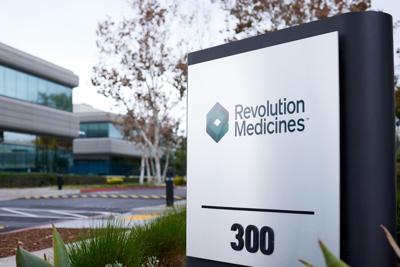
Revolution Medicines campus
Redwood City-based Revolution Medicines — the developer of the newly approved cancer medication Rasonque — lists UCSF professor Kevan Shokat among its co-founders.Courtesy Revolution Medicines

UCSF researchers are celebrating the approval by the U.S. Food and Drug Administration of a groundbreaking new drug — the research roots of which can be traced back to the university — to treat pancreatic cancer.

Daraxonrasib — also known by the brand name Rasonque — is a pill-based drug treatment for metastatic pancreatic cancer that presents a new option for patients with advanced forms of the disease. It targets a protein called RAS, which is found in 90% of patients with pancreatic cancer and drives tumor growth.

The drug is in some ways a “RAS inhibitor,” said Dr. Andrew Ko, a specialist in digestive cancers who has long been researching the protein and ran the clinical trial in partnership with Revolution Medicines, which developed the drug.

Kevan Shokat, one of the co-founders of the Redwood City-based biotech company, is a professor of cellular and molecular pharmacology at UCSF.

Last week’s approval is a milestone years in the making.

“The biology — in terms of this RAS molecule, understanding how it functions, understanding the different aspects of its structure — has been ongoing for the past 10 to 20 years,” Ko said. “This has long been called the holy grail in terms of trying to develop drugs that target this mutation because it’s so common, because it’s what drives the pancreatic cancer to grow and survive.”

Pancreatic cancer is one of the most lethal cancers, with a five-year survival rate of 13%, according to the American Cancer Society. About 67,000 new cases are diagnosed every year, and it’s often detected late, according to the FDA’s announcement last week.

The clinical trial for Rasonque, which involved 500 adults, took place at multiple clinics, including UCSF. It found that the drug improved patients’ median overall survival time to 13.2 months, compared with 6.7 months for standard chemotherapy.

The typical treatment up until this point has been traditional chemotherapy, which uses strong, intense drugs that can have serious side effects, including fatigue, hair loss, nausea, numbness and tingling, and suppression of the immune system, while only providing “moderate efficacy,” Ko said.

“This is a completely different drug,” he said of Rasonque. “This drug compared to traditional chemotherapy really significantly improved survival for patients … this will be huge for our patient population.”

To qualify for the new drug, patients must have already tried chemotherapy or not be eligible for combined chemotherapies — but the FDA’s language on those restrictions is “liberal,” Ko said.

“You may see the drug even being used as a frontline treatment for patients with a new diagnosis of metastatic pancreatic cancer,” he said.

The drug could also potentially be applied to other types of cancers that also have the RAS protein mutation, although to lower degrees than pancreatic cancer, such as lung cancer, colon cancer, and bile-duct cancer. Those types of applications are being studied at UCSF and elsewhere, Ko said.

The typical treatment for pancreatic cancer has been traditional chemotherapy, which uses strong, intense drugs that can have serious side effects.Gerry Broome/Associated Press file

Ko said it’s a little premature to say that this drug treatment should become the “gold standard,” Ko said, but it opens up possibilities to shift cancer patients away from the harsher intravenous drugs used for chemotherapy.

“That would be a wholesale shift if that happens,” he said.

Patients could have more agency by taking the pill at home, instead of having to go into a facility to receive chemotherapy, Ko said.

“I don’t want to imply it’s totally benign,” he said of the drug — which does have side effects that include nausea and edema — but it still could “hearken a wholesale transformation in how we treat patients.”

The drug might have other possibilities as well, including use at earlier stages in patients who have operable cancers, and to prevent recurrence of the cancer in patients who have undergone surgery.

The drug does have a hefty price tag, as reported Monday by The New York Times — about $480,000 a year, or $663 per dose, which Ko said has become common with molecularly targeted therapies in recent years.

“It’s a bigger issue in terms of our health system and how these drugs are priced,” he said. “You absolutely can make an argument that it’s super expensive and that contributes to why our health-care costs are what they are.”

But he said that even with the high cost, it’s likely to be covered by Medicare, and he said he anticipates that other insurers will follow suit.

Because chemotherapy also includes the cost of intravenous time and other factors, comparing the two would be “apples and oranges,” Ko said.

UCSF study finds childhood trauma has lasting effects into old age

UCSF Mission Bay (copy)
A UCSF study released Wednesday has discoverd links between adverse childhood experiences and other health complications persisting into old age.Examiner FILE

A new UCSF study shows how childhood trauma can impact people later in life — but the data also creates a roadmap for how to care for victims as they get older.

The study, published Wednesday in the Journal of General Internal Medicine, looked at how “adverse childhood experiences” — such as physical violence or abuse, severe illness, family financial stress, or being separated from parents — affected children.

Those who experienced these events — particularly violence — were more likely to have both physical and cognitive issues in life, persisting even until old age, the study showed.

For example, people who dealt with violence at a young age were 40% more likely to have some sort of mobility impairment, such as trouble walking; 80% were more likely to have difficulty with daily activities later in life; and those who came from unhappy families were 40% more likely to have at last mild cognitive impairment.

While there is interest in how someone’s childhood can influence health later on in life, there is still more that could be done, said Dr. Alison Huang, one of the lead authors of the study. Huang is a UCSF professor of medicine and director of research in general internal medicine at UCSF Health.

The study’s authors said they hope the information they gleaned from study participants will improve geriatric care as more and more of the U.S. population gets older.

“Thinking about it, not only on the individual level of what we can do in our clinical care, but also on a broader societal level of how we can intervene on these upstream determinants of health,” said Dr. Anita Hargrave, one of the study’s authors and an assistant professor of medicine at UCSF.

Challenging policymakers and the larger community to acknowledge this part of people’s health will be an important step in addressing some of the societal structures that cause these types of traumas, Hargrave said.

“People who identify with having historically marginalized identities, racial and ethnic identities, particularly African American and Latinx folks, have a higher burden of ACEs,” she said, referring to “adverse childhood experiences.”

“Studies have shown that they experience four or more ACEs more frequently than people who identify with other racial and ethnic identities,” she said. “So thinking about how these societal structures, discrimination, racism, structural violence, all influence not only the experience of adverse childhood events or trauma, but also how it can be perpetuated over time.”

For the study, more than 3,300 Americans between ages 50 and 97 underwent physical performance testing that evaluated their balance and walking ability, along with their cognitive and memory functions.

Nationally, the Centers for Disease Control and Prevention says 60% of adults have experienced childhood trauma, which can lead to physical issues like cardiovascular disease and diabetes to mental health problems, like depression.

“This research is just another way of looking at how early childhood experiences can impact not only the expression of genes and your mental health, but also potentially the way that you think, the way that you walk, the different ways that you can have a quality of life throughout your lifetime,” Hargrave said.

“I think most clinicians caring for older adults are just focusing on what’s happening to them now in older age, and not thinking about how what’s happening with older age could potentially have had its origin when patients were really young,” Huang said.

The findings also indicate the importance of these events to the patients themselves.

“We’re seeing in this study is that people really remember these experiences that happened to them over 50 years ago,” said Hargrave. “And that is really something that they hold in their memory and may impact their health currently.”

Huang, Hargrave and the study’s other authors hope to continue building off its results. Huang said it could even lead to changes in healthcare.

“It’s certainly something that I would like to continue to explore,” said Huang. “I think that an exciting part of this field is, is the next step, which is what do we do about this information?”

While the study was just released recently, Huang said she is already considering the possibilities.

“We can identify best practices in taking care of people who have experienced trauma,” she said. “And that’s where the field really is growing now, and that’s what makes it such an exciting time to be doing violence prevention and addressing violence, through understanding its mechanisms to impact health.”

What’s that smell? UCSF captures first glance at human scent detection

swiss cheese
UCSF scientists isolated the human protein that detects propionate, the molecule that gives Swiss cheese its rich, pungent scent and taste, then watched it closely to see the magic.Smabs Sputzer/Wikimedia Commons

Molecular biologists at UCSF have made a breakthrough in understanding the human sense of smell — a notoriously ephemeral process that has evaded precise description until now.

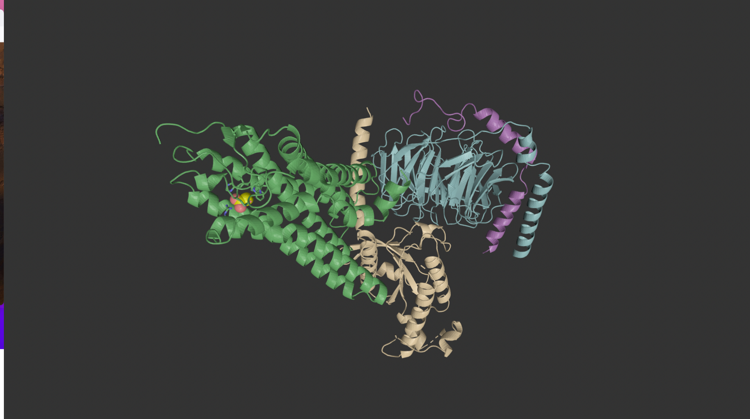
This month, for the first time, researchers were able to capture how a human odor receptor detects a scent molecule. Click here to view the interactive 3D model.

A 3D model depicts a scent molecule (yellow and red) interacting with an olfactory receptor (green, beige, cyan and violet).Courtesy UCSF

Aashish Manglik, an associate professor of pharmaceutical chemistry, explained that this is just the first piece of a very large map. The human sense of smell is the least understood of the physical senses and one of the most complex.

“This has been a huge goal in the field for some time,” he said. “But we haven’t been able to make this map because, without a picture, we don’t know how odor molecules react with their corresponding odor receptors.”

The team started out with a distinct, instantly recognizable scent — Swiss cheese — but eventually, as the scent map grows, a chemist could design a molecule and predict what it would smell like, said Manglik.

Scents, like flavors, are usually a harmony of molecules. Humans can detect hundreds of thousands of scents, and we use over 400 unique olfactory receptors to pick apart a smell when we detect one. The information we pick up from a scent can indicate whether or not something is edible or dangerous.

Propionate — the molecule that gives Swiss cheese its rich, pungent scent and taste — is very harsh by itself. First, Manglik’s team had to isolate the human protein that detects it — a nigh impossible task — then watch it closely to see the magic.

They found that the odor detectors only interacted with the propionate molecules in a very specific way — like a white blood cell catching germs.

“This receptor is laser-focused on trying to sense propionate and may have evolved to help detect when food has gone bad,” said Manglik. Detector proteins for pleasing smells like menthol or caraway might interact more loosely with the odors, he speculated, because they indicate medicinal or edible uses.

The effects of smells are not just knee-jerk “don’t eat that” repulsions or a pleasant reaction. The human microbiome is becoming more relevant in modern medicine, and the way smell interacts with it could mean big strides.

A positive association with a smell can be linked to serotonin release in the gut, for example. A negative smell may kick-start a form of prostate cancer.

With a comprehensive scent map, Manglik envisions new avenues in medicine, pharmaceuticals, cosmetics and food.

“We’ve dreamed of tackling this problem for years,” he said. “We now have our first toehold, the first glimpse of how the molecules of smell bind to our odorant receptors. For us, this is just the beginning.”

mhetherwick@sfexaminer.com

Molly Hetherwick

Molly Hetherwick

Margaret is a general assignment reporter for The Examiner and a graduate of UC Santa Cruz.