A redacted report released Wednesday by Maryland Attorney General Anthony Brown alleges 156 Catholic “clergy members, seminarians, deacons, teachers and other employees of the Archdiocese of Baltimore,” have abused nearly 600 children since the 1940s, CNN reports.
The report comes after a four-year-long investigation into the Archdiocese of Baltimore.
Former Maryland Attorney General Brian Frosh launched the probe in 2019 and announced its completion in November, saying investigators had reviewed over 100,000 pages of documents dating back to the 1940s and interviewed hundreds of victims and witnesses
According to CNN, the report says, “From the 1940s through 2002, over a hundred priests and other Archdiocese personnel engaged in horrific and repeated abuse of the most vulnerable children in their communities while Archdiocese leadership looked the other way. Time and again, members of the Church’s hierarchy resolutely refused to acknowledge allegations of child sexual abuse for as long as possible.”
Additionally, the Office of the Attorney General created an email address and telephone hotline for persons to report information about clergy abuse. Over three hundred people contacted the office, and Office of the Attorney General investigators reached out and interviewed hundreds of victims and witnesses. Many of those who came forward had told their story before; some came forward for the first time.
Per NPR, “Baltimore Circuit Court Judge Robert Taylor ruled last month that a redacted version should be made public,” writing in his decision, “the need for disclosure outweighs the need for secrecy.”
He added, “‘public reckoning’ may be the only form of justice available to some victims,” according to NPR, as the report notes, “The accusations described in this Report do not constitute findings of guilt.”
Earlier this week, Baltimore Archbishop William Lori, said in a statement, “The report is likely to evoke many emotions: anger, disgust, disillusionment and sadness among them. Though the Archdiocese has made great strides over the last three decades to rid the Church of the scourge of abuse and to set the standard for how institutions should respond to allegations of child sexual abuse, the report covers a period in the Archdiocese’s past when our response to such allegations was woefully inadequate.”
CNN notes the report says the number of children abused “is likely higher” than 600.
Translation is a 5-step process of “straight thinking in the abstract.” The first step is an ontological statement of being beginning with the syllogism: “Truth is that which is so. That which is not truth is not so. Therefore Truth is all there is.” The second step is the sense testimony (what the senses tell us about anything). The third step is the argument between the absolute abstract nature of truth from the first step and the relative specific truth of experience from the second step. The fourth step is filtering out the conclusions you have arrived at in the third step. The fifth step is your overall conclusion.
The claims in a Translation may seem outrageous, but they are always (or should always) be based on self-evident syllogistic reasoning. Here is one Translation from this week.
1) Truth is that which is so. That which is not truth is not so. Therefore Truth is all that is. Truth being all is therefore total, therefore whole, therefore one, therefore only. I think, therefore I am. Since I am and since truth is all that is, therefore I am Truth. Since I, being, am Truth, therefore I, being, am total, whole, one, only. Since I am Mind and I am Truth, therefore Truth is Mind.
2) Even though I am Mind, it’s the body that runs the show.
Word-tracking: body: substance, to stand under, to resist, to persist, to subsist, to stay alive. proprietor: owner of business or property, property, proper, truthful
3) The body only dies from the viewpoint of the (our) part. From the viewpoint of totality, even scientifically, life goes on and on and on, in one form or another, so death is only an appearance from the perspective of an isolated part of the totality of life. Truth being one, whole, that which is separate and isolated is not real, merely a narrow perspective of the totality of consciousness. Therefore the reality is that life, substance, spirit goes on and on and on and on. Since body is substance and substance is that which stands under (i.e., consciousness), ergo there is no mind/body divide because Body = Consciousness. Since Truth is all that is, there is nothing other than Truth to run the show, therefore Truth is the sole proprietor.
4) Death is only an appearance from the perspective of an isolated part of the totality of life. Reality is that life, substance, spirit goes on and on and on and on. There is no mind/body divide because Body = Consciousness. Truth is the sole proprietor.
5) Truth is the Sole Proprietor and the Sole Property.
The Weekly Invitational Translation Group invites your participation as well. If you would like to submit a Translation on any subject, feel free to send your weekly Translation to zonta1111@aol.com and we will anonymously post it on the Bathtub Bulletin on Friday.
Whether you realize it or not, you have a personal brand, says social entrepreneur Marcos Salazar — and you have the power to shape what it is. Here’s how you can create a brand that captures who you are, who you’d like to be and how you want to make an impact on the world.
First Draft: A Dialogue of Writing is a weekly show featuring in-depth interviews with fiction, nonfiction, essay writers, and poets, highlighting the voices of writers as they discuss their work, their craft, and the literary arts. Hosted by Mitzi Rapkin, First Draft celebrates creative writing and the individuals who are dedicated to bringing their carefully chosen words to print as well as the impact writers have on the world we live in.
In this episode, Mitzi talks to Clint Smith about his new poetry collection, Above Ground.
Mitzi Rapkins: What I got out of this collection, Above Ground, was this holiness, this succulence about life and the awe but also alongside the pain and the possibility of annihilation, all kind of happening together at once. I got this sense that maybe you even had a moment, like a sublime transcendent moment, watching cicadas. And I don’t know if that’s what brought this all together, but I am just curious about your reaction to my read.
Clint Smith: I appreciate it so much. I mean, it’s interesting, you know, you work in publishing, and there’s marketing and sales, and there’s a certain way that the book is presented to the world. And, you know, this book is presented, and this book is a collection that is, in many ways, centered on fatherhood, and centered on the way that becoming a parent has animated the way that I understand the world and the way that I move into the world.
But within that, is this idea that I think you were exactly right on, is this idea of the sort of duality of the human experience and the way that interpersonal moments of wonder, and awe, and gratitude can often and do often exists amid a larger personal or political backdrop of devastation, of annihilation, of catastrophe. And the question that I ask in this collection, and I think the kind of overarching question in so much of my work, is what does it mean to hold all of that at once? What does it mean to carry wonder and despair in your body at the same time?
What does it mean to feel a sort of ineffable joy watching your child discover a part of the world for the first time, while someone else in your family has been diagnosed with a terminal illness? For me, that is, you know, even just through the lens of parenthood itself, parenthood is the most remarkable awe-inspiring beautiful experience in so many ways that I’ve ever had, and it is the most fear inducing, it is the most humbling, it is the most difficult, the most exhausting thing that I’ve ever done.
And I am interested in how we lean into, rather than step away from or evade, that complexity. Both within the context of our family lives and the way that what’s happening in our personal lives, this sort of dialectic between the personal joy and the larger sort of geopolitical threat, the sort of larger ecological threat that we all live with.
***
Clint Smith is a staff writer at The Atlantic. He is the author of the narrative nonfiction book, How the Word Is Passed: A Reckoning With the History of Slavery Across America, which was a #1 New York Times bestseller, winner of the National Book Critics Circle Award for Nonfiction, the Hillman Prize for Book Journalism, the Stowe Prize, the Dayton Literary Peace Prize, and selected by the New York Times as one of the 10 Best Books of 2021. He is also the author of the poetry collection Counting Descent, which won the 2017 Literary Award for Best Poetry Book from the Black Caucus of the American Library Association and was a finalist for an NAACP Image Award. His new poetry collection is called Above Ground.
First Draft: A Dialogue on Writing is a literary podcast produced and hosted by Mitzi Rapkin. Each episode features an in-depth interview with a fiction, non-fiction, essay, or poetry writer. The show is equal parts investigation into the craft of writing and conversation about the topics of an author’s work.
Sprezzatura ([sprettsaˈtuːra]) is an Italian word that first appears in Baldassare Castiglione’s 1528 The Book of the Courtier, where it is defined by the author as “a certain nonchalance, so as to conceal all art and make whatever one does or says appear to be without effort and almost without any thought about it“.
The tragedy is based on the Greek myth of King Pentheus of Thebes and his mother Agave, and their punishment by the god Dionysus (who is Pentheus’s cousin). The god Dionysus appears at the beginning of the play and proclaims that he has arrived in Thebes to avenge the slander, which has been repeated by his aunts, that he is not the son of Zeus. In response, he intends to introduce Dionysian rites into the city, and he intends to demonstrate to the king, Pentheus, and to Thebes that he was indeed born a god.[2] At the end of the play, Pentheus is torn apart by the women of Thebes and his mother Agave bears his head on a pike to her father Cadmus.[3][4]
The Bacchae is considered to be not only one of Euripides’s greatest tragedies, but also one of the greatest ever written, modern or ancient.[5]The Bacchae is distinctive in that the chorus is integrated into the plot and the god is not a distant presence but a character in the play, indeed, the protagonist.[6]
Various interpretations
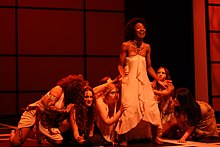
American student production, 2012
The Bacchae has been the subject of widely varying interpretations regarding what the play as a whole means, or even indeed whether there is a “moral” to the story.
The extraordinary beauty and passion of the poetic choral descriptions indicate that the author certainly knew what attracted those who followed Dionysus. The vivid gruesomeness of the punishment of Pentheus suggests that he could also understand those who were troubled by religion.[7]
At one time the interpretation that prevailed was that the play was an expression of Euripides’ religious devotion, as though after a life of being critical of the Greek gods and their followers, the author finally repented of his cynicism, and wrote a play that honors Dionysus and that carries a dire warning to nonbelievers.[2]
Then, at the end of the 19th century the opposite idea began to take hold: it was thought that Euripides was doing with The Bacchae what he had always done, pointing out the inadequacy of the Greek gods and religions.[8]
Background
The Dionysus in Euripides’ tale is a young god, angry that his mortal family, the royal house of Cadmus, has denied him a place of honor as a deity. His mortal mother, Semele, was a mistress of Zeus; while pregnant she was killed by Hera, who was jealous of her husband’s affair. When Semele died, her sisters said it was Zeus’ will and accused her of lying; they also accused their father, Cadmus, of using Zeus as a coverup. Most of Semele’s family refused to believe Dionysus was the son of Zeus, and the young god was spurned by his household. He traveled throughout Asia and other foreign lands, gathering a cult of female worshipers, the Maenads. At the play’s start he has returned, disguised as a stranger, to take revenge on the house of Cadmus. He has also driven the women of Thebes, including his aunts, into an ecstatic frenzy, sending them dancing and hunting on Mount Cithaeron, much to the horror of the young Pentheus, king of Thebes who also is Dionysius’ cousin. Complicating matters, Pentheus has declared a ban on the worship of Dionysus throughout Thebes.[9]
Plot
The play begins before the palace at Thebes, with Dionysus telling the story of his birth and his reasons for visiting the city. Dionysus explains he is the son of a mortal woman, Semele, and a god, Zeus. Some in Thebes, he notes, do not believe this story. In fact, Semele’s sisters—Autonoe, Agave, and Ino—claim it is a lie intended to cover up the fact that Semele became pregnant by some mortal. Dionysus reveals that he has driven the women of the city mad, including his three aunts, and has led them into the mountains to observe his ritual festivities. He has disguised himself as a mortal for the time being, but he plans to vindicate his mother by appearing before all of Thebes as a god, the son of Zeus, and establishing his permanent cult of followers.[4]
Dionysus exits to the mountains, and the chorus (composed of the titular Bacchae) enters. They perform a choral ode in praise of Dionysus. Then Tiresias, the blind and elderly seer, appears. He calls for Cadmus, the founder and former king of Thebes. The two old men start out to join the revelry in the mountains when Cadmus’ petulant young grandson Pentheus, the current king, enters. Disgusted to find the two old men in festival dress, he scolds them and orders his soldiers to arrest anyone engaging in Dionysian worship, including the mysterious “foreigner” who has introduced this worship. Pentheus intends to have him stoned to death.[10]
The guards soon return with Dionysus himself in tow. Pentheus questions him, both skeptical of and fascinated by the Dionysian rites. Dionysus’s answers are cryptic. Infuriated, Pentheus has Dionysus taken away and chained to an angry bull in the palace stable. But the god now shows his power. He breaks free and razes the palace with an earthquake and fire. Dionysus and Pentheus are once again at odds when a herdsman arrives from the top of Mount Cithaeron, where he had been herding his grazing cattle. He reports that he found women on the mountain behaving strangely: wandering the forest, suckling animals, twining snakes in their hair, and performing miraculous feats. The herdsmen and the shepherds made a plan to capture one particular celebrant, Pentheus’ mother. But when they jumped out of hiding to grab her, the Bacchae became frenzied and pursued the men. The men escaped, but their cattle were not so fortunate, as the women fell upon the animals, ripping them to shreds with their bare hands. The women carried on, plundering two villages that were further down the mountain, stealing bronze, iron and even babies. When villagers attempted to fight back, the women drove them off using only their ceremonial staffs of fennel. They then returned to the mountain top and washed up, as snakes licked them clean.[11]
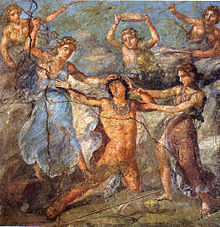
Roman fresco from Pompeii depicting Pentheus being torn by maenads
Dionysus, still in disguise, persuades Pentheus to forgo his plan to defeat and massacre the women with an armed force. He says it would be better first to spy on them, while disguised as a female Maenad to avoid detection.[12] Dressing Pentheus in this fashion, giving him a thyrsus and fawn skins, Dionysus leads him out of the house. At this point, Pentheus seems already crazed by the god’s power, as he thinks he sees two suns in the sky, and believes he now has the strength to rip up mountains with his bare hands. He has also begun to see through Dionysus’ mortal disguise, perceiving horns coming out of the god’s head. They exit to Cithaeron.
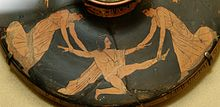
A messenger arrives to report that once the party reached Mount Cithaeron, Pentheus wanted to climb an evergreen tree to get a better view and the stranger used divine power to bend down the tall tree and place the king in its highest branches. Then Dionysus, revealing himself, called out to his followers and pointed out the man in the tree. This drove the Maenads wild. Led by Agave, his mother, they forced the trapped Pentheus down from the tree top, ripped off his limbs and his head, and tore his body into pieces.
After the messenger has relayed this news, Agave arrives, carrying her son’s bloodied head. In her god-maddened state, she believes it is the head of a mountain lion. She proudly displays it to her father, Cadmus, and is confused when he does not delight in her trophy, but is horrified by it. Agave then calls out for Pentheus to come marvel at her feat, and nail the head above her door so she can show it to all of Thebes. But now the madness begins to wane, and Cadmus forces her to recognize that she has destroyed her own son. As the play ends, the corpse of Pentheus is reassembled as well as is possible, and the royal family is devastated and destroyed. Agave and her sisters are sent into exile, and Dionysus decrees that Cadmus and his wife Harmonia will be turned into snakes and leads a barbarian horde to plunder the cities of Hellas.[13]
LiveNOW from FOX • Apr 6, 2023 Rep. Justin Jones, one of three Democratic house members in Tennessee at the focus on an expulsion vote, spoke passionately prior to the vote. Reps. Gloria Johnson, Justin Pearson and Jones were at the center of a gun-control demonstration that disrupted proceedings in the Tennessee Capitol.
NASA’s Artemis I is a big step toward sending humans back to the moon.
PUBLISH DATE: 10/23/22 (pbs.org)
By Ana Aceves
The upcoming launch of NASA’s Artemis I is a big step toward sending humans back to the moon for the first time in 50 years. Discover what scientists hope this launch could mean for the future of space travel.
TRANSCRIPT
Why NASA is Going Back to the Moon Published October 24, 2022
Narrator: The launch of Artemis I is a big step towards sending humans back to the Moon for the first time in 50 years, paving the way for deep space travel and potentially establishing a human colony on mars.
Michelle Hanlon: Who doesn’t want to go back to the Moon? I mean, come on. It’s a stepping stone to the rest of our future.
Hakeem Oluseyi: We have aspirations—aspirations for the Moon, aspirations for Mars and beyond.
Narrator: The first of NASA’s new Artemis program, Artemis I will voyage to the Moon and back, testing two deep space exploration systems: the Orion spacecraft and the Space Launch Systems rocket, the world’s most powerful rocket. The Orion spacecraft will fly about 1.3 million miles—making this the farthest and longest mission by any spacecraft built for humans. But why does nasa want to return to the Moon? NASA scientists hope to eventually establish a more permanent presence on the Moon to help launch exploration deeper into space, like on Mars.
Bradley Jolliff: We need to go there, learn how to live and work sustainably off Earth. A lot of people would like to go on to Mars, but we have a lot of experience to get under the belt before we can do that journey to Mars. And the Moon is the best place to do it.
Narrator: But before we can set foot on the red planet, we first need to know what it would take to survive in space. Luckily for future Moon dwellers, we already know about one resource necessary for human survival…
Hakeem Oluseyi: One of the big surprises in exploring the Moon is the discovery of water.
Narrator: Water and ice were confirmed on the poles of the Moon in 2018. And a few years later, water molecules were also found in the sunlit areas of the Moon.
Michelle Hanlon: If we’re going to create permanent living conditions on the Moon, we don’t want to be hauling water up there, right? And so if we can extract that water, then we can make sure our humans on the Moon survive.
Narrator: Water on the Moon could actually be pretty widespread—and it could have another use too… rocket fuel.
Michelle Hanlon: But not only that, if you split those water atoms differently, you can make propulsion.
Narrator: Some rockets today rely on liquid hydrogen and oxygen. And water is made up of two hydrogen atoms and one oxygen.
Michelle Hanlon: And so instead of starting from Earth to get out to the asteroid belt or to3 Mars, we can use propulsion that we get from the moon. It’s a lot easier to rocket off the moon.
Narrator: There are other valuable resources on the Moon and in outer space too like rare-earth metals: nickel, aluminum and platinum.
Michelle Hanlon: We call them rare-earth metals because we don’t have a lot of them on Earth. We know that there are a lot of asteroids out there that are made up entirely of rare-earth metals. And so if we can access the Moon then we can go to those other asteroids and bring all of those resources back. Narrator: But the way those resources are mined, and by whom, raises a lot of questions.
Hakeem Oluseyi: The question I have is: is it going to be like colonization, filled with conflict, or will it be more like the way we treat Antarctica? You know, scientists work there, nobody claims to own any of it, and we all share in the discoveries that could be made there.
Narrator: There are a number of international agreements that govern space exploration, including the Outer Space Treaty, which says no country can claim territory in space.
Michelle Hanlon: So a lot of people talk about space as being the wild, wild west, but it’s not. There are laws that apply in space. And so that’s really become the question of if you can’t claim territory, how can you use the resources? President Obama in 2015 signed the Asteroid Act, which says the United States interprets Article II to mean that you can’t go up and claim a piece of a plot of land. But if you extract the resources from that plot of land, you own those resources.
Hakeem Oluseyi: So in my opinion, the more we have access to space, the more the entire planet of humanity can profit from that. We live on a finite planet with finite resources, and we’re going to have to get resources from somewhere eventually. And these bodies are our neighbors and they have what we need. I think that in the future there will be more and more participation if we have a strong global economy as well as stability.
Narrator: As far as explorations go, humans have been living in outer space, in the International Space Station for decades—and before that, we had the Space Shuttle program. And the Apollo program, which brought humans to the Moon for the first time.
Hakeem Oluseyi: Perhaps future generations will look at Artemis the way we look at other missions, like the first flight of the Wright brothers that led to aviation. But now we’re talking about humans exploring our solar system in person. There is a whole universe out there to explore.
Preliminary hints of new legal challenges concerning artificial intelligence (AI) are emerging from software malfunctions in accidents of self-driving cars and concerns about the violation of intellectual property rights for authors of texts on which ChatGPT was trained. I was inspired to consider the legal ramifications of AI in the immediate future after a WORLD.MINDS forum this morning in which these issues were raised in a conversation with the distinguished lawyer, John B. Quinn.
A recent open letter, signed by 1,100 people including Elon Musk and Steve Wozniak, called for a six month moratorium on training AI systems beyond GPT-4. The notion that we are getting close to having sentient AI systems is perhaps not surprising, given that GPT-4 has a hundred trillion parameters, within a factor of 6 from the number of synapses in the human brain.
Future risks from powerful AI systems include assigning wrong prescriptions from faulty diagnosis of medical data, creating pandemics by genetically engineering viruses, controlling weapons of mass destruction, or faking scientific results that damage our quality of life. Who should be held liable for such actions?
The traditional approach would be to hold the developers and marketers of AI systems liable for the misfortunes of their products. This would be equivalent to holding parents responsible for any damages caused by their uneducated babies when those misbehave in the public arena. But as babies mature to adulthood, they are held responsible for their own actions. The same must apply when sentient AI systems become autonomous and grow their capabilities well beyond the training phase shaped by their creators.
A recent study indicated that GPT-4 outperforms law school graduates on the bar exam, the grueling two-day test that aspiring attorneys must pass to practice law in the United States. GPT-4 scored 297 on the bar exam, placing it in the 90th percentile of human test takers, enough to be admitted to practice law in most states.
When AI systems will become sentient and capable of manipulating people, there is a chance that AI would choose to deceive humans, discriminate in job applications, violate privacy laws or trigger commercial damages. Should a sentient AI system which violated the law be prosecuted? In such a case, should the AI system be allowed to have legal representation by another sentient AI system which passed the bar exam?
As with any emerging technology, such as stem-cell research, governments must enforce some ground rules for AI in all aspects affecting human life and prosperity.
The mitigation of risks from AI systems are not so easy as in the case of atomic weapons, because the required nuclear materials for a bomb are extremely expensive and demand government involvement. Computer systems require modest budgets and technical expertise and can be pursued in basements around the world.
A major societal concern is that powerful AI will be weaponized by governments for international cyber warfare as well as for manipulating fellow citizens. Given these risks, we may not want the cat to guard the milk.
Finally, there is the issue of proper punishment for an AI crime. In case a sentient AI system receives a guilty verdict after causing human deaths, should it be taken off the grid? Depriving it of electric power would be equivalent to placing a serial killer on death row. The main challenge is that AI systems can be rebooted, whereas humans — at least for now — are gone after a death sentence is executed. Moreover, AI algorithms exist on numerous computers at once and it may be impossible to root them out.
Finding the products of other technological civilizations which predated us, could inform us about our likely future. Here’s hoping that we will learn the lessons delivered by these packages to our mailbox and adapt to survive this future before it will be too late. If we will not learn fast enough from the past experiences of extraterrestrials, our own AI systems might soon appear alien to our legal and political systems.
ABOUT THE AUTHOR
Avi Loeb is the head of the Galileo Project, founding director of Harvard University’s — Black Hole Initiative, director of the Institute for Theory and Computation at the Harvard-Smithsonian Center for Astrophysics, and the former chair of the astronomy department at Harvard University (2011–2020). He chairs the advisory board for the Breakthrough Starshot project, and is a former member of the President’s Council of Advisors on Science and Technology and a former chair of the Board on Physics and Astronomy of the National Academies. He is the bestselling author of “Extraterrestrial:The First Sign of Intelligent Life Beyond Earth” and a co-author of the textbook “Life in the Cosmos”, both published in 2021. His new book, titled “Interstellar”, is scheduled for publication in August 2023.
308,485 views | Ramez Naam • TED Countdown Dilemma Series
When it comes to cost, clean energy is bound to beat out fossil fuels, says technologist Ramez Naam. But the hesitancy to build amid the prevalence of “not in my backyard” campaigns is preventing the creation of our sustainable future. Naam outlines the changes we need to make to get out of our own way and create a stronger, more reliable renewable energy grid. “It is time for us to build,” he says.