MARCH 7, 2023 AT 7:00 AM BY ROB BREZSNY (newcity.com)
Photo: Edward Howell
ARIES (March 21-April 19): Repressed feelings and dormant passions are rising to the surface. I bet they will soon be rattling your brain and illuminating your heart, unleashing a soothing turbulence of uncanny glee. Will you get crazy and wise enough to coax the Great Mystery into blessing you with an inspirational revelation or two? I believe you will. I hope you will! The more skillful you are at generating rowdy breakthroughs, the less likely you are to experience a breakdown. Be as unruly as you need to be to liberate the very best healings.
TAURUS (April 20-May 20): You finally have all you need to finish an incomplete mission or resolve a mess of unsettled karma. The courage and determination you couldn’t quite summon before are now fully available as you invoke a climax that will prepare the way for your awe-inspiring rebirth. Gaze into the future, dear Taurus, and scan for radiant beacons that will be your guides in the coming months. You have more help than you know, and now is the time to identify it and move toward it.
GEMINI (May 21-June 20): Our sun is an average star in a galaxy of one hundred billion stars. In comparison to some of its flamboyant compatriots, it’s mediocre. Over 860 light years away is a blue-white supergiant star called Rigel, which is twice as hot as our sun and 40,000 times brighter. The red supergiant Antares, over 600 light years away, has twelve times more mass. Yet if those two show-offs had human attitudes, they might be jealous of our star, which is the source of energy for a planet teeming with 8.7 million forms of life. I propose we make the sun your role model for now, Gemini. It’s an excellent time to glory in your unique strengths and to exuberantly avoid comparing yourself to anyone else.
CANCER (June 21-July 22): The philosophical principle known as Occam’s razor asserts that when trying to understand a problem or enigma, we should favor the simplest explanation with the fewest assumptions. While that’s often a useful approach, I don’t recommend it in the coming weeks. For you, nuances and subtleties will abound in every situation. Mere simplicity is unlikely to lead to a valid understanding. You will be wise to relish the complications and thrive on the paradoxes. Try to see at least three sides of every story. Further tips: 1. Mysteries may be truer than mere facts. 2. If you’re willing to honor your confusion, the full, rich story will eventually emerge.
LEO (July 23-Aug. 22): “There are no unsacred places,” wrote Leo poet Wendell Berry. “There are only sacred places and desecrated places.” Poet Allen Ginsberg agreed. “Holy! Holy! Holy! Holy! Holy!” he wrote. “Holy the solitudes of skyscrapers and pavements! Holy the cafeteria! Holy the mysterious rivers of tears under the streets! Holy the sea, holy the desert, holy the railroad.” With Berry’s and Ginsberg’s prompts as your inspiration, and in accordance with current astrological imperatives, I invite you to invigorate your relationship with sacredness. If nothing is sacred for you, do what it takes to find and commune with sacred things, places, animals, humans and phenomena. If you are already a lover of sacred wonders, give them extra love and care. To expand your thinking and tenderize your mood, give your adoration to these related themes: consecration, sublimity, veneration, devotion, reverence, awe and splendor.
VIRGO (Aug. 23-Sept. 22): My favorite Buddhist monk, Thich Nhat Hanh, wrote the following: “In us, there is a river of feelings, in which every drop of water is a different feeling, and each feeling relies on all the others for its existence. To observe it, we just sit on the bank of the river and identify each feeling as it surfaces, flows by, and disappears.” I bring this meditation to your attention, Virgo, because I hope you will do it daily during the next two weeks. Now is an excellent time to cultivate an intense awareness of your feelings—to exult in their rich meanings, to value their spiritual power, to feel gratitude for educating and entertaining you.
LIBRA (Sept. 23-Oct. 22): How might your life come into clearer focus when you uncover secrets that inspire your initiative and ingenuity? What happens when resources that had been inaccessible become available for your enjoyment and use? How will you respond if neglected truths spring into view and point the way toward improvements in your job situation? I suspect you will soon be able to tell me stories about all this good stuff. PS: Don’t waste time feeling doubtful about whether the magic is real. Just welcome it and make it work for you!
SCORPIO (Oct. 23-Nov. 21): It’s not the best time to tattoo a lover’s likeness on your abdomen. Maybe in May, but not now. On the other hand, the coming weeks will be an excellent time to see if your paramour might be willing to tattoo your name on their thigh. Similarly, this is a favorable period to investigate which of your allies would wake up at 5am to drive you to the airport, and which of your acquaintances and friends would stop others from spreading malicious gossip about you, and which authorities would reward you if you spoke up with constructive critiques.
SAGITTARIUS (Nov. 22-Dec. 21): Redwoods are the tallest trees in the world. They may grow as high as 350 feet. Their roots are shallow, though, reaching down just six to twelve feet before spreading out sixty to one hundred feet horizontally. And yet the trees are sturdy, rarely susceptible to being toppled by high winds and floods. What’s their secret? Their root systems are interwoven with those of other nearby redwoods. Together, they form networks of allies, supporting each other and literally sharing nutrients. I endorse this model for you to emulate in your efforts to create additional stability and security in your life, Sagittarius.
CAPRICORN (Dec. 22-Jan. 19): What’s the best way to be fulfilled? Hard work and discipline? Are we most likely to flourish if we indulge only moderately in life’s sweet pleasures and mostly focus on the difficult tasks that build our skills and clout? Or is it more accurate to say that ninety percent of success is just showing up: being patient and persistent as we carry out the small day-to-day sacrifices and devotions that incrementally make us indispensable? Mythologist Joseph Campbell described a third variation: to “follow our bliss.” We find out what activities give us the greatest joy and install those activities at the center of our lives. As a Capricorn, you are naturally skilled at the first two approaches. In the coming months, I encourage you to increase your proficiency at the third.
AQUARIUS (Jan. 20-Feb. 18): Mackerels are unusual fish in that they must keep swimming nonstop. If they don’t, they die. Do they ever sleep? Scientists haven’t found any evidence that they do. I bring them up now because many of you Aquarians have resemblances to mackerels—and I think it’s especially crucial that you not act like them in the coming weeks. I promise you that nothing bad will happen if you slow way down and indulge in prolonged periods of relaxing stillness. Just the opposite in fact: Your mental and physical health will thrive as you give your internal batteries time and space to recharge.
PISCES (Feb. 19-March 20): A financial advisor once told me I could adopt one of three approaches to running my business: 1. Ignore change; 2. always struggle with change, half-immobilized by mixed feelings about whether to change or stay pat; 3. learn to love and thrive on change. The advisor said that if I chose either of the first two options, I would always be forced to change by circumstances beyond my control. The third approach is ultimately the only one that works. Now is an excellent time for you Pisceans to commit yourself fully to number three—for both your business and your life.
How can a person be human and a deity at the same time?
Some claim Jesus never claimed to be God, but it’s pretty clear in the Bible.
There are a lot of controversial questions about Christianity, but there is only one that ultimately matters. Was Jesus God in the flesh?
The Gospel of John was written to show how Jesus was God in the Flesh. He starts with Jesus being with God and being God when the world was created.
Near the end of the book, John says:
John 20:31 But these are written that you may believe that Jesus is the Messiah, the Son of God and that by believing you may have life in his name.
Jesus was God in the Flesh, fully God and fully man at the same time. This is not controversial in Christian circles. This is the essential doctrine.
Without it, there is no Christianity. The rest is commentary.
Even so, there are detractors who try to shed doubt upon the claim. There could be a lot of reasons, but it was controversial at the time the claims were made too. The claim of being God in the flesh is what got Jesus killed.
Why it is an issue
In Biblical times, the Apostle Paul called the message of Christ “foolishness to the Greeks and a stumbling block to the Jews.” Those were the two main groups of the culture at the time — the “conservative” religious people and the Greeks, who were the “liberal” scholars of the day.
In contemporary Greek culture, spirit was spirit, and flesh was flesh, and the two could not possibly mix or even hardly exist together. God was in heaven, and man was on earth. God was good, and man was not. As a result, claiming anyone was God in the Flesh was ludicrous, or as Paul said foolishness. It flew in the face of popular philosophy and knowledge.
On the other side were the Jews or the religious world. They had worshipped Yahweh since the time of Abraham, well before Moses. They had also gotten in trouble for idol worship and wanted to avoid that again at all costs.
Because of that, anything that even hinted at anything other than Jehovah God as being the only true God was considered heresy. That was why it was a stumbling block.
Son of Man or the Son of God.
The three synoptic gospels emphasize his humanity, while John focuses more on the spiritual aspects.
When Jesus refers to himself as the Son of Man, he refers to his human self. We will see how John refers to himself as God in the flesh.
In biblical times being the son of someone was a claim to be equal. If you claimed to be the son of God, you were claiming equality with god — or claiming to be God.
There were several attempts among Greek scholars to explain this away because it was foolishness to them.
Some said he only appeared to be human or was less than God in some way. And in more modern times, some claim Jesus never made the claim, but he did.
Jesus may not have used those exact words to refer to himself, but he certainly claimed to be equal to God and from God in a way that no one else was. He also referred to HIS father and said he was busy doing his father’s work. All of the New Testament writers refer to Jesus as God.
The Bible is extremely clear in its claim that Jesus was divine in nature AND human in nature.
Here I want to outline the Biblical case for the divinity of Christ as recorded in the Gospel of John. The Gospel of John focuses on fewer stories, does not go into chronological detail, and is more concerned about presenting the supernatural, or divine Christ, than the other gospels are.
The Gospel of John.
The gospel of John ends his book by telling us the purpose of the writing itself.
But these are written that you may believe that Jesus is the Christ, the Son of God and that by believing, you may have life in his name. John 20:31
John wants us to believe Jesus is the Son of God. That is the purpose of his writing. The entire book of John is dedicated to this principle, laying out the stories that show Jesus to indeed be the Son of God.
John starts his gospel with these words:
“In the beginning was the Word, and the Word was with God, and the Word was God. He was with God in the beginning. Through him all things were made; without him, nothing was made that has been made.” (John 1:1–3, NIV)
“The word”, of course, refers to Jesus, who was with God, Was God, and was with God in the beginning. There never was a time that Jesus did not exist. We don’t really understand eternal and can’t really define it, but it means forever. Without a beginning or end. The “Word” is a translation of the Greek word LOGOS, from which we get our word Logo. It means the exact image, but more than that; it means the essence of the thing or the reality of the thing represented.
Verse two says he was God. Jehovah’s witnesses wrongly translate this as “A” God. It is true the Greek “can” be translated that way, but it is not translated that way in the rest of the passage, or anywhere else in the New Testament, so there is no reason to think it should be here.
John clearly states that Jesus was God at the beginning with God and that there was nothing created that was not created when Jesus was with God.
From there, he tells stories to illustrate the point several times.
The point of no return
In John Chapter 8, there is a fairly lengthy debate between the religious establishment and Jesus. They are trying to trap him in his words, to find something to use against him.
The great I AM
“You are not yet fifty years old,” the Jews said to him, “and you have seen Abraham!” “I tell you the truth,” Jesus answered, “before Abraham was born, I am!” At this, they picked up stones to stone him, but Jesus hid, slipping away from the temple grounds.” (John 8:58–59, NIV84)
Jesus says before Abraham, “I AM,” and the Jews picked up stones to kill him. Here he clearly claims to be God. The “I AM” is the same word that Moses was given to tell the Egyptians who had sent him to free the Israelites. God told Moses his name was “I AM”, and here Jesus says, “I AM.”
Other conflicts
Jesus quickly ran into conflict with the Jewish establishment. In John 5, he heals a man on the Sabbath, and the religious people were very strict about the Sabbath. They were so strict you could not even heal anyone on the Sabbath, but Jesus did it anyway. Jesus violated their law but did not violate the law of God or what we now call the Old Testament.
So, because Jesus was doing these things on the Sabbath, the Jewish leaders began to persecute him. In his defence, Jesus said to them, “My Father is always at his work to this very day, and I, too, am working.” For this reason, they tried all the more to kill him; not only was he breaking the Sabbath, but he was even calling God his own Father, making himself equal with God. (John 5.16–18)
Note that Jesus says “my” father, not “the” father. He is claiming to be God’s specific son or claiming to be equal to God.
Later in the same chapter, Jesus makes another statement concerning his deity. Or about him being the Son of God.
I have testimony weightier than that of John. For the works that the Father has given me to finish — the very works that I am doing — testify that the Father has sent me.
In John 6, Jesus feeds thousands by miraculously providing bread. He then tells them that it was God who would give them true bread from heaven. He then proclaims himself to be the Bread of Life.
The miracles and the debates continue until the breaking point at the end of chapter eight when Jesus says he is “I AM,” which was a clear claim to be God in the flesh.
In John 10, the Jews ask him to “tell them plainly” if he is the Messiah. Jesus responds by telling them that he has already told them, but they are not listening.
John 10: 30… I and the Father are one.”
From there, the plot thickens with the Religious establishment plotting to kill him. They could not do so openly because Jesus was very popular with the crowds. That would have turned the people against them. They had to go about it in a more secretive way, and eventually, they got Judas to “bring the charge” of blasphemy against Jesus.
The following chapters, through the rest of the Gospel of John, record the final week of Jesus’ earthly life. The story leads up to the crucifixion and resurrection.
As John concludes, this book was written so you can believe that Jesus is the Son of God.
As part of the 100-story challenge, I am writing articles about the Gospel of John. This one is a bit different, as most have focused on a few verses. You may follow along on this adventure by subscribing to Medium with my link below.
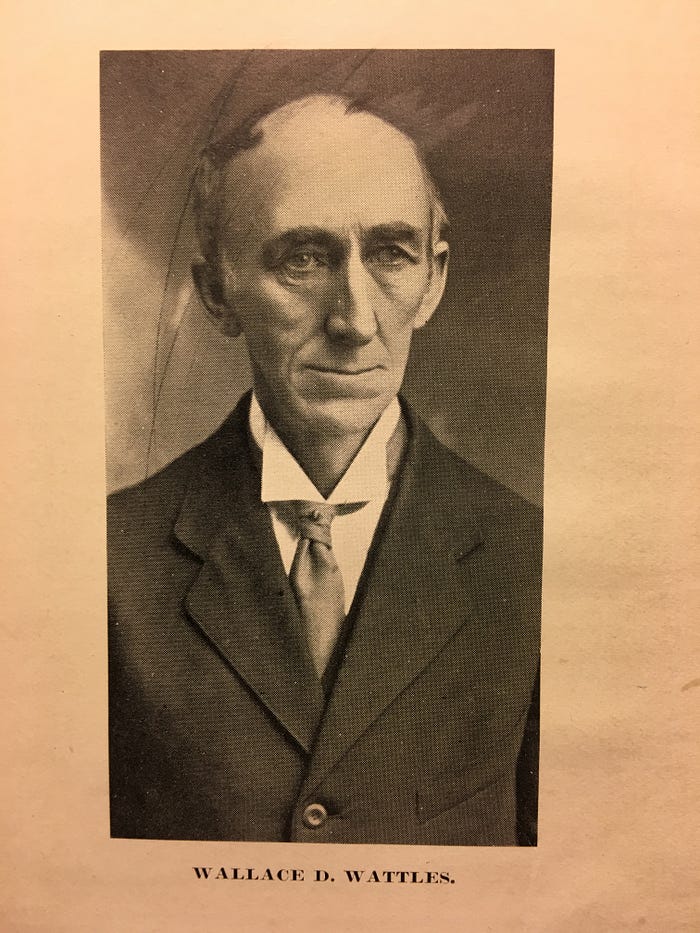
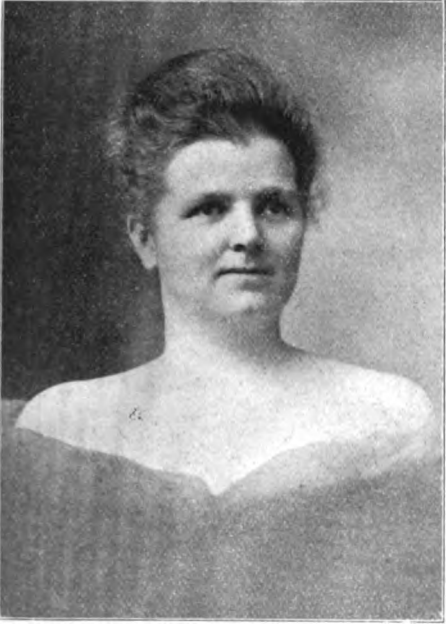
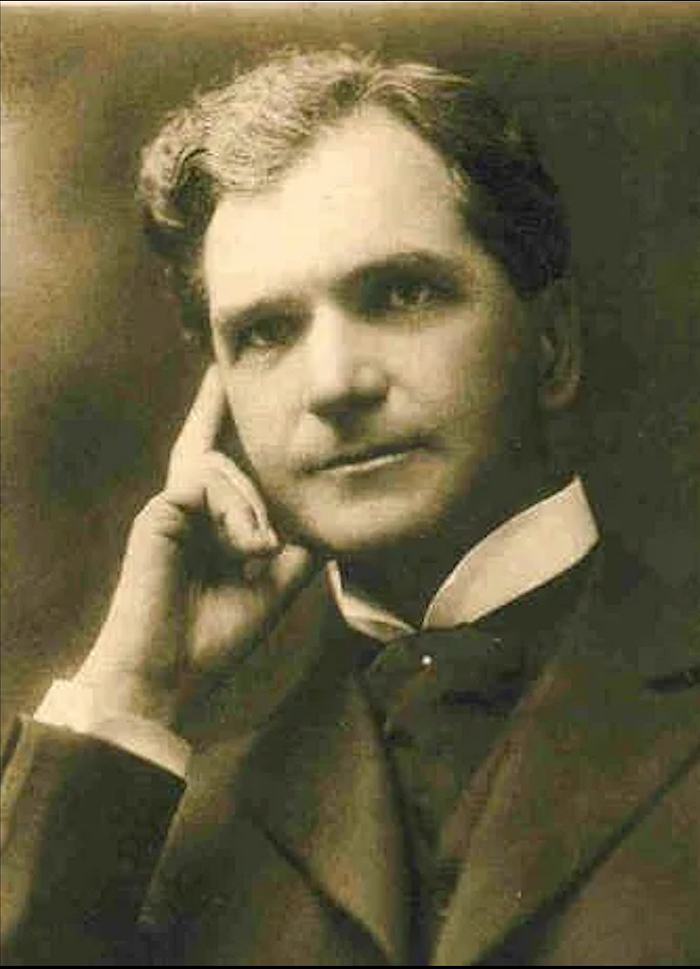
Wallace D. Wattles from a first edition of The Science of Getting Rich, 1910.
How a Quaker socialist revolutionized the prosperity gospel
The mind is its own place, and in it self
Can make a Heav’n of Hell, a Hell of Heav’n.
— Paradise Lost
Itbegan as the bleakest of Christmases at the Wattles home. In the Indiana winter of 1896, the family patriarch, Wallace, a rake-thin Methodist minister with a passion for defending workers and the poor, had been away in Chicago at a conference of social reformers. A Christian socialist, Wallace D. Wattles was already irritating the more conservative members of his congregation, some of whom were eyeing his dismissal.
Back home in La Port, Indiana, his family could not afford a Christmas tree; all they could muster was an evergreen branch decorated with a few smudgy tallow candles and strung with popcorn. Gifts were meager — the family spent the last of its holiday savings on a cuff box which waited for Wattles under the branch.
“Finally father came,” his daughter Florence recalled in a 1911 letter to his publisher Elizabeth Towne. “With that beautiful smile he praised the tree, said the cuff box was just what he had been wanting — and took us all in his arms to tell us of the wonderful social message of Jesus.”[1]
It was a critical turning point for Wattles. In Chicago, he had met a radical minister named George D. Herron (1862–1925). An ardent purveyor of the “social gospel,” Herron gained national prominence using the message of Christ to condemn the cruel mechanisms of an economic system that sent children to work in cotton mills. He impressed upon Wattles that Christ’s vision of social justice must be at the heart of the pastorate’s mission.
For Wattles, born in 1860 on an Illinois family farm, where he was still laboring at age 19 in the rural Nunda Township,[2] it was the final stroke in a spiritual philosophy he was developing himself. The minister had been imbibing metaphysical ideas that were bubbling up around him and combining them with his own experiments into the creative powers of thought.
As Wattles saw it, the individual was a prisoner to outer circumstance only to the degree that he or she was a prisoner of circumstance within. Free the mind, he concluded, and outer circumstance will follow. Reading Eastern philosophies along with Descartes, Spinoza, Leibnitz, Schopenhauer, Hegel, and Emerson, the seeker reasoned that if the mind — this magical, ethereal “thinking stuff” that molded the surrounding world — could be properly harnessed, there was no limit to what a person could achieve.
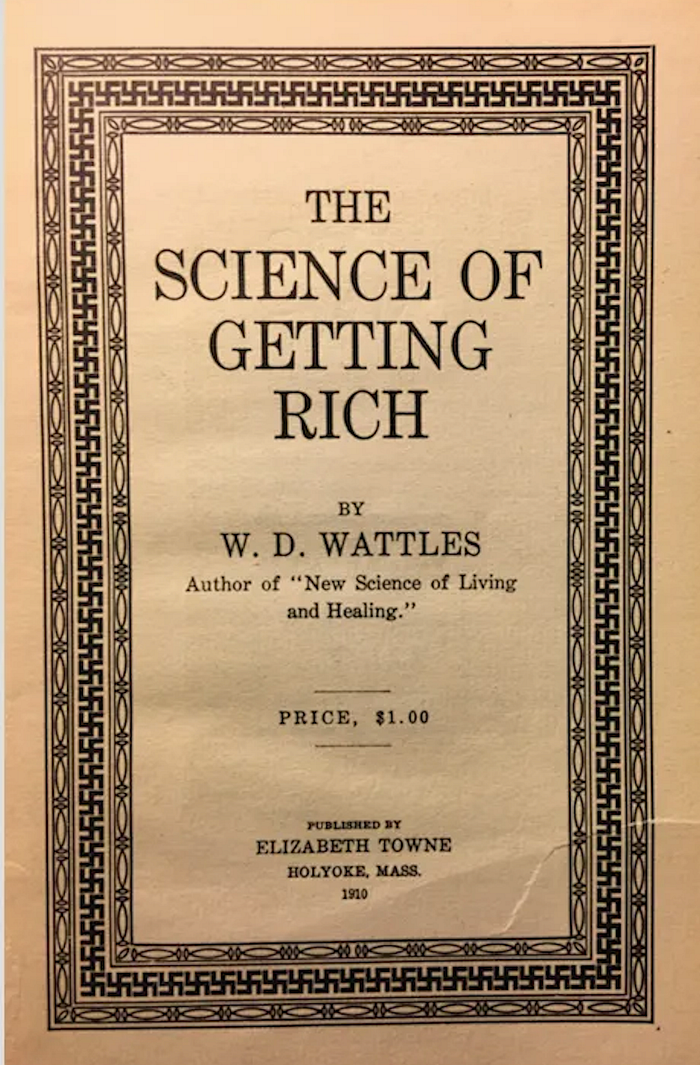
Title page of Wattles’ first edition of The Science of Getting Rich.
America in the late 19th century was suffused with influences from Spiritualism, Mesmerism, Christian Science, and Theosophy. Each, in its own fashion, imbued the nation’s spiritual culture with the conviction that divine mysteries existed not at the top rung of a cosmic ladder but within the settings of ordinary life.
And ordinary life was undergoing remarkable changes. As the 19th century closed, the fruits of modern science appeared everywhere: telegraphs, motor engines, electricity, wireless signals, X-rays, and automated production. In medicine, Pasteur’s germ theory was explaining illnesses that for years had resisted understanding. In biology, Darwin had theorized a gradual order in the development of all forms of life. In politics, Marx and Engels had classified economics as a matter of “science,” in which inevitable outcomes could be foreseen. In psychology, Freud had begun to codify childhood traumas that triggered adult neuroses while William James and F.W.H. Myers postulated the existence of a “subliminal mind” (later called the subconscious or unconscious), which was the driving engine of emotional life. Along with other luminaries, the pair founded the British and American Societies for Psychical Research which sought to scientifically test clairvoyance and mediumship. Hypnotists (more respectable versions of Mesmerists) claimed the power to alter behavior through autosuggestion and conditioning.
Caught in this onrush of currents, intellectual leaders from all walks of life — academia, clergy, business — reasoned that scientific principles were applicable to every aspect of existence. Why couldn’t there be a “science” of success, or even a “science” of religion — that is, a protocol of definable, rational steps that would produce a desired result?
Inspired by the possibilities, a group of religious thinkers and impresarios formed a loosely knit spiritual movement around this “scientific” religious concept. Thoughts, they argued, could be seen to produce actual events, such as health or sickness, wealth or poverty. They claimed Ralph Waldo Emerson as their founding prophet: “We know,” the Concord mystic wrote in “Spiritual Laws” in 1841, “that the ancestor of every action is a thought.” The Bible, in their reading, seemed to agree, particularly the Proverb: “As a man thinketh in his heart, so is he.” In an enthused leap of reasoning, the movement that came to be called New Thought maintained that the individual’s creative mind is synonymous with the creative force called God. As such, a person could literally think his dreams to life. It was America’s boldest — and most influential — attempt at what religious scholar John B. Anderson called “a practical use of the occult powers of the soul.”[3]
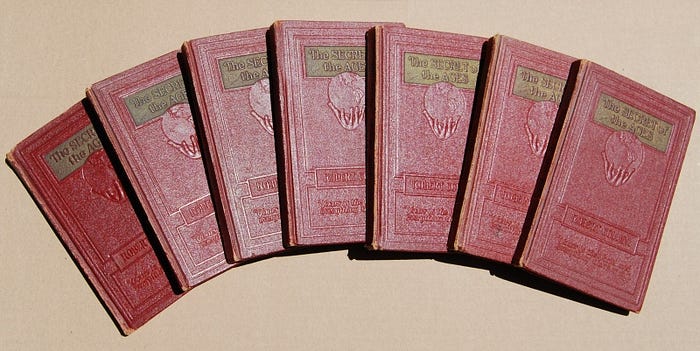
The metaphysical dimensions of New Thought could seem so magical, so unrestrained in their promise of limitless potential, that a 1926 bestseller by publisher Robert Collier (1885–1950) deemed New Thought, The Secret of the Ages.
Collier’s The Secret of the Ages, originally published in seven subscription volumes.
Many of the movement’s most popular writers and sermonizers re-imagined worldly acquisition as the very exercise of God’s will. In their hands, it was as if the entire object of Transcendentalism — that is, transcendence of earthly bonds and distractions — had been turned on its head. And here New Thought’s sense of ethics and seriousness as a religious movement fell open to question: What was to finally separate this philosophy from being anything other than a tool for pursuing one’s most random drives and selfish wants? Was this the endpoint of American religious innovation — the vaunted “secret of the ages?”
Onthis question hung the dilemma of Indiana minister Wattles. Although his books became central to a 21st century New Thought revival and served as a major influence behind the mega-selling book and movie The Secret, the social-gospel advocate had wanted the “occult powers of the soul” to serve a different end than worldly gain, or that alone.
It wasn’t that he eschewed New Thought’s emphasis on wealth building — indeed, he embraced such aims in his 1910 guide The Science of Getting Rich. But there was a critical difference in Wattles’ approach, one overlooked by those who later embraced his work: Wattles believed in using mind-power to wipe away barons of industry and overthrow the prevailing social order. Rather than a narrowly conceived iteration of success, The Science of Getting Rich was, in fact, a guidebook to personal utopia, where state and corporate dinosaurs are predicted to wither away, replaced by a cooperative system of widespread wealth and beneficent anarchy. The author taught that by “thinking in a Certain Way” you can at once personally succeed and counter oppressive economics, writing with emphasis in the original:
You are to become a creator, not a competitor; you are going to get what you want, but in such a way that when you get it every other man will have more than he has now.
I am aware that there are men who get a vast amount of money by proceeding in direct opposition to the statements in the paragraph above, and may add a word of explanation here. Men of the plutocratic type, who become very rich, do so sometimes purely by their extraordinary ability on the plane of competition…Rockefeller, Carnegie, Morgan, et al., have been the unconscious agents of the Supreme in the necessary work of systematizing and organizing productive industry; and in the end, their work will contribute immensely toward increased life for all. Their day is nearly over; they have organized production, and will soon be succeeded by the agents of the multitude, who will organize the machinery of distribution.
If Wattles’ more careful readers detected a tinge of socialist language, they were right. The author saw New Thought as a means to the kind of leisurely socialist utopia that had enthralled legions of readers of Edward Bellamy’s Victorian-era futuristic novel, Looking Backward. In A New Christ, published the same year as The Science of Getting Rich, Wattles envisioned a marriage of New Thought — America’s homegrown success philosophy — and Christian Socialism:
As we approach socialism, the millions of families who are now propertyless will acquire their own beautiful homes, with gardens and the land upon which to raise their food; they will own horses and carriages, automobiles and pleasure yachts; their houses will contain libraries, musical instruments, paintings and statuary, all that a man may need for the soul-growth of himself and his, he shall own and use as he will.
It was as though Karl Marx had imbibed the mother’s milk of American metaphysics. Within Wattles there existed a struggle to unite two mighty currents that were sweeping early 20th century America: social radicalism and mind-power mysticism. Was it possible, as Wattles dreamed, that these movements could be united into one radical whole? Could there be a revolution by mental power?
Bythe time he emerged as a New Thought leader, Wattles had already been forced to resign from his Methodist pulpit in North Judson, Indiana, in 1900.[4] He had gone too far in his social radicalism, at one point insisting that churches should refuse monetary offerings from businessmen who profited off sweatshop labor. Soon after, he announced his departure from Methodism and grew active in the more progressive environs of Quakerism.
Wallace gained allies in mind-power circles — particularly his trailblazing publisher Elizabeth Towne (1865–1960), a Massachusetts suffragette who ran his work in her New Thought journal Nautilus. Towne began the magazine in 1898, as a single mother with two children to support. Her marriage — which began when she dropped out of school at age 14 — finally ended in divorce in 1900.[5]
Towne in 1905 in The Business Woman’s Magazine.
Relying on temporary financial backing from her father of $30 a month for six months, Towne built Nautilus into a relative powerhouse of up to 90,000 monthly subscribers with some of her own books surpassing sales of 100,000 copies. Towne ran the journal until age 88 in 1953, making it one of the longest-running spiritual magazines in American history. Her career played out in the political arena, as well. In 1926, Towne was elected the first female alderman in Holyoke, Massachusetts. Two years later she mounted an unsuccessful independent bid for mayor. Towne and her second husband, William, were also active in Theodore Roosevelt’s 1912 Progressive Party campaign for president.
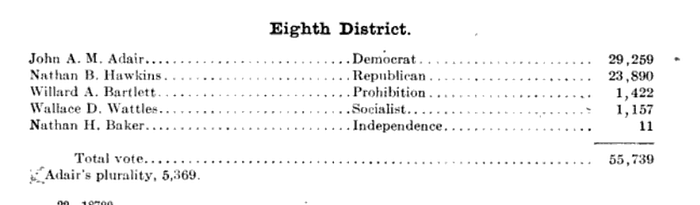
Taking inspiration from the presidential runs of socialist leader Eugene V. Debs (1855–1926), Wattles made his own upstart bids for public office, each time on Debs’ Socialist Party of America ticket. In his home state of Indiana, Wattles first campaigned for Congress in the Eighth Congressional District in 1908.
Wattles’ 1908 vote totals, Indiana Abstract of Vote.
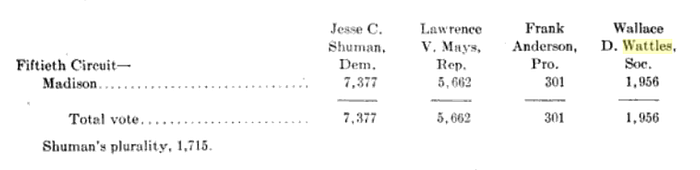
After distantly trailing, he ran the following year for mayor of his hometown of Elwood, Indiana, where he placed a surprisingly close second. Finally, in 1910 he ran for Prosecuting Attorney for Madison County, Indiana, coming in third.
Wattles’ 1910 vote totals, Indiana Vote By Counties.
During his 1909 mayoral campaign, the delicate-framed man stood before 1,300 striking workers during a heated showdown at a local tin mill and pledged them his support.[6]
“Trouble at Elwood” from the Fort Wayne Sentinel.
Seen in a certain light, these were heterodox activities, not only for Towne as a woman, but for both she and Wattles as New Thought leaders. The movement emphasized the ideal of action from within. Although several early New Thoughters, including author and publisher Helen Wilmans (1831–1907) and British writer James Allen (1864–1912), were active in reformist politics — pioneering Black nationalist Marcus Garvey (1887–1940) himself sounded New Thought themes[7]— too much notice of tragedy, poverty, or injustice, so went the New Thought gospel, served only to perpetuate such things.
Hence, Wattles could sometimes sound at war with himself. In one stroke he urged readers, “do not talk about poverty; do not investigate it, or concern yourself with it,” and at other times he spoke passionately before audiences of the squalor of Chicago tenements and the hopelessness of immigrant children living there. He admiringly quoted from the social-reform journalism of Elbert Hubbard (1865–1915), who had exposed child-labor abuses in turn-of-the-century cotton mills. Hubbard, as it happened, was another success prophet with a taste for social protest.
Hubbard was famous for his 1899 motivational essay, A Message to Garcia, in which he extolled the can-do heroics of a U.S. soldier during the Spanish-American War. Business leaders loved it. Yet Hubbard lost his life while hoping to end another war. In 1915, Hubbard and his wife Alice, a suffragette and New Thought enthusiast, died with nearly 1,200 civilians when a German U-boat torpedoed the passenger ship Lusitania in the waters off Ireland. Hubbard boarded the ship in New York on a self-styled peace mission to Europe where he declared plans to interview the German Kaiser and inveigh against the carnage of the Great War. “Big business has been to blame for this thing,” wrote the motivational hero before he left, “…let it not escape this truth — that no longer shall individuals be allowed to thrive through supplying murder machines to the mob.”[8]
Even the most popular New Thought prophet of the day, Ralph Waldo Trine (1866–1958), harbored a passion to unite mysticism and social reform. Trine gained a legion of followers through his 1897 mind-power book, In Tune with the Infinite. It was the book that every New Thought minister and writer seemed to have read and borrowed from. Industrialist Henry Ford kept copies in his office and would press it on guests. But beneath Trine’s placid, almost priestly exterior beat the heart of another social radical. A 1902 profile in the New Thought magazine Mind said Trine believed in the cooperative ethos of socialism, and that he planned to write a book “from the viewpoint of a socialist who is such because of his New Thought philosophy.”[9]
Ralph Waldo Trine, undated photo.
It is not clear that Trine ever wrote such a book, but something very close appeared under his byline in 1906: In the Fire of the Heart. While In Tune With the Infinite employed a gentle, folksy tone emphasizing gratitude and generosity, In the Fire of the Heart revealed different colors. The New Thought pioneer summoned a “great people’s movement to bring back to the people the immense belongings that have been taken away from them,” calling it “the supreme need of our time.” Trine inveighed against “predatory wealth,” advocated busting up monopolies, striking for higher wages, and placing essential utilities and industries into public hands. This was one book that Henry Ford didn’t give away to friends. In fact, Fire in the Heart and Trine’s 1910 followup Land of Living Menseemed to make little impact at all on his followers. By 1928, the spiritual writer was an honored guest in Ford’s office, where he engaged in an almost fawning interview with the automaker. Their conversation was turned into a popular book, The Power That Wins, which ranged from Ford’s love for avocados to his belief in reincarnation. Whatever Trine’s innermost commitments, he would never again be seen — nor succeed as — a political Jeremiah.
In1911, in what was to be Wattles’ last book, The Science of Being Great, he offered tribute, probably the only in all of motivational literature, to his socialist hero Debs, a fellow Hoosier who later went to federal prison for opposing U.S. entry into World War I:
To rid yourself of the old false ideas you will have to think a great deal about the value of men — the greatness and worth of a human soul. You must cease from looking at human mistakes and look at successes; cease from seeing faults and see virtues. You can no longer look upon men and women as lost and ruined beings that are descending into hell; you must come to regard them as shining souls who are ascending toward heaven. It will require some exercise of will power to do this, but this is the legitimate use of the will — to decide what you will think about and how you will think. The function of the will is to direct thought. Think about the good side of men; the lovely, attractive part, and exert your will in refusing to think of anything else in connection with them.
I know of no one who has attained to so much on this one point as Eugene V. Debs, twice the Socialist candidate for president of the United States. Mr. Debs reverences humanity. No appeal for help is ever made to him in vain. No one receives from him an unkind or censorious word. You cannot come into his presence without being made sensible of his deep and kindly personal interest in you. Every person, be he millionaire, grimy workingman, or toil worn woman, receives the radiant warmth of a brotherly affection that is sincere and true. No ragged child speaks to him on the street without receiving instant and tender recognition. Debs loves men. This has made him the leading figure in a great movement, the beloved hero of a million hearts, and will give him a deathless name. It is a great thing to love men so and it is only achieved by thought. Nothing can make you great but thought.
Wattles’ daughter, Florence, a budding socialist orator in her own right, insisted that her father’s earlier mayoral vote got rigged and the election had been stolen. “They voted not only the dead men in the cemeteries, but vacant lots as well,” 23-year-old Florence said in her 1911 address to a socialist convention in Kokomo, Indiana. “We were robbed of the election, but in 1912 we will carry the election. Mark that. And we’ll get the offices, too. We mean to do it through a thorough and completely effective organization.”[10]
Florence in The Barre Daily Times, April 1913.
On the stump, Florence exuded the same sense of biblical justice as her father, the man who told of the social gospel and the metaphysical powers of the mind. “We don’t want to vote merely because it is our right…,” she said in a 1916 speech in Indianapolis. “We don’t want to vote merely to get into practical politics. We don’t want to vote in order to sit in the legislature or on the bench. We want to vote on behalf of the struggling masses, and to do good for those about us.”[11]
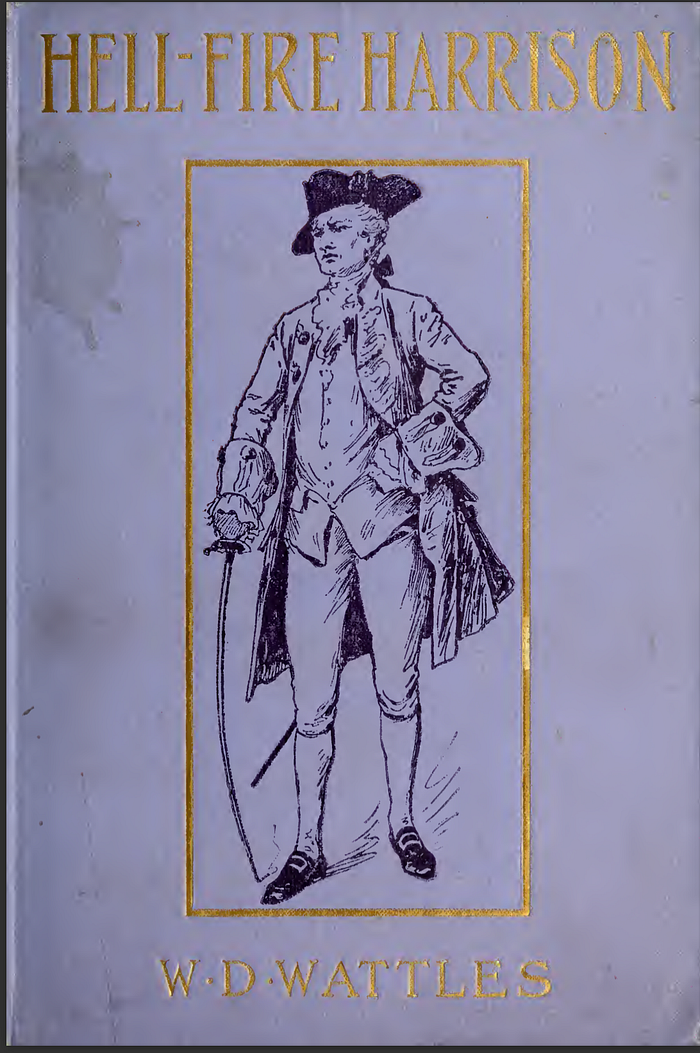
With Florence at her father’s side, her spirits fresh and ready for a fight, anything seemed possible. Yet within a week of Florence’s Kokomo speech, Wattles was dead. Though his writings had extolled the curative powers of thought, he had always been physically frail. His health collapsed on February 7, 1911, when he died of tuberculosis at age 50 while traveling to Ruskin, Tennessee, which had been home to the Ruskin Commonwealth Association, a socialist commune from 1894 to 1901. In addition to his numerous books and articles on mind metaphysics, Wattles left behind a sole novel published in 1910, Hell-Fire Harrison, about the adventures of an independent-minded American tobacco farmer and congressman in late-18th century England.
Wattles’ 1910 novel.
The Fort Wayne Sentinel, knowing the local author and organizer mostly as a political figure, noted “he was one of the best known socialists in Indiana.” And, almost as an afterthought, “He also wrote several books on scientific subjects.”[12]
For her part, Florence moved in 1917 to New York City, where she worked for publisher E.P. Dutton, becoming director of publicity in 1925. Losing none of her old fire, she wrote to Debs’ brother Theodore on company letterhead on January 30, 1930, addressing him as “Dear Comrade,” and seeking his input and records for a potential biography she hoped would be published on his brother.
“You will recall my father,” she wrote. “He was W.D. Wattles. And is buried in Elwood, Indiana. He and Comrade Hollingsworth” — Indiana social gospel minister J.H. Hollingsworth — “were very dear friends. Comrade H. knew father much better than you and ‘Gene ever knew him, but even you know of him and his work…He was a remarkable personality, and a beautiful spirit, which, to me, at least, has never died…”
“Dear Comrade,” Eugene V. Debs Collection, Special Collections Department. Indiana State University Library,
Wattles’ reputation and works experienced an extraordinary rebound nearly a century following his death. In 2007, word spread that The Science of Getting Rich was a source behind The Secret. The book began to hit bestseller lists. I published a paperback edition myself that reached number-one on the Bloomberg Businessweek bestseller list. My audio condensation later hit number-two on iTunes.
But what many of Wattles’ new generation of readers missed was his lifelong dedication to the ethic of collective advancement and creativity above brutal or underhanded competition; and his belief that competition itself was an outmoded idea, soon to be supplanted by the creative capacities of the mind . Once unlocked, he taught, these greater faculties would grant working people the keys to a life of prosperity for themselves and all around them.
Was Wattles’ vision of New Thought and social reform really so utopian? We live in an age of remarkable new discoveries of the mind’s power: physicians have performed successful placebo surgeries[13] and demonstrated the placebo response in weight loss[14] as well as in instances where placebos are transparently administered[15]; in the field called neuroplasticity, brain scans reveal that the brain’s neural pathways are actually “rewired” by thought patterns — a biological act of mind over matter[16]; quantum physics experiments pose extraordinary questions about causality between thought and object, with implications extending to the perceptual basis of reality itself[17]; and academic ESP research repeatedly demonstrates the nonphysical conveyance of data across boundaries of time, space, and mass in laboratory settings.[18] Wattles’ mission, now more than a century old, was to ask whether these extraordinary possibilities, which were only hinted at in the science of his day, can be applied and experimented with on the material and social scales of life.
Wattles did not live long enough to see the enduring influence of The Science of Getting Rich. But his calm certainty and profoundly confident yet gentle tone as a writer suggest that he understood the portent of what he was conveying.
Although The Science ofGetting Rich will always be his classic, a core runner up is his widely read The Science of Being Great. The final line of his opening chapter is: “You can become what you want to be.” That statement forms the heart of his career. Moreover, it is, in a sense, an encapsulation of American metaphysical ideals — the outlook of a still-young nation when Wattles wrote his books. His vision harmonized with the sense of limitless possibility that many Americans felt in the early 20th century when the nation’s growth and expansion seemed endless. This ethic still inspires people today.
Wattles’ work can bridge the divisions some seekers feel between pursuit of self-betterment and aspiration to something greater; for him, the two were synonymous. He believed, with no sense of personal conflict, that the potential of the individual must be expressed both socially and materially. “Man is formed for growth,” Wattles wrote in The Science of Being Great, “and he is under the necessity of growing. It is essential to his happiness that he should continually advance. Life without progress is unendurable.”
If you venture into his 1910 and 1911 books, I think you will discover Wattles’ complete philosophy of life: namely, that each person is run through by a capillary of immaterial influx — call it God, Nous (Ancient Greek for over-mind), or nonlocal intelligence — which can raise the individual to extraordinary heights of personal excellence, acts of creativity, and skills marked by virtuosity. But to fully place him or herself within this eternal, creative current, Wattles wrote, the individual must first be in alignment with generativity and reciprocity to other, like-created beings. (A different view of the author’s model, which I explore in The Miracle Cluband Daydream Believer, is that the psyche is capable of selecting — a term I prefer to manifesting — among different intersections of time, a concept considered by some quantum and string theorists.)
Self-refinement, Wattles concluded, is the key to transforming oneself into a vehicle for this Greater Principle of life, which yearns for expression through individual beings.
Everything that this good and thoughtful man believed necessary for a powerful life appears in these short and compelling books. He wished them to deliver readers to their greatest heights of achievement — and deepest sense of responsibility.
Notes
[1] The recollections of Florence Wattles appear in a letter that publisher Elizabeth Towne included in a reprint edition of Wallace D. Wattles’ The Science of Being Great (1911), which Towne retitled How to Be a Genius.
[2] United States Federal Census, 1880. Wattles’ birthdate is sometimes given as 1861 (“abt 1861” the census document reads, identifying him as a 19-year-old “farm laborer” born in Illinois). Consensus is 1860, hence I have used that date.
[3] John B. Anderson is quoted from New Thought, Its Lights and Shadows (Sherman, French & Company, 1911).
[4] “Leaves the Methodists,” Fort Wayne Sentinel, June 27, 1900.
[5] Sources on Towne include “What Women Are Doing Today” by Lucie M. Yager, The Business Woman’s Magazine, Vol. 4, May 1905; “Elizabeth Towne, Author, Leader in Religion, Dies,” North Adams Transcript, June 1, 1960; Mind Cure in New England: From the Civil War to World War I by Gail Thain Parker (University Press of New England, 1973); and “Pioneering Woman in Publishing and Politics”by Tzivia Gover, Historical Journal of Massachusetts, Vol. 37, Spring 2009.
[6] “Trouble at Elwood,” Fort Wayne Sentinel, July 12, 1909.
A middle-aged Scottish mathematician rises ahead of the sun to spend a couple of hours with Newton before the day punctuates her thinking with the constant interruptions of mothering four children and managing a bustling household. “A man can always command his time under the plea of business,” Mary Somerville (December 26, 1780–November 28, 1872) would later write in her memoir; “a woman is not allowed any such excuse.”
Growing up, Somerville had spent the daylight hours painting and playing piano. When her parents realized that the household candle supply had thinned because Mary had been staying up at night to read Euclid, they promptly confiscated her candles. “Peg,” she recalled her father telling her mother, “we must put a stop to this, or we shall have Mary in a strait jacket one of these days.” Mary was undeterred. Having already committed the first six books of Euclid to memory, she spent her nights adventuring in mathematics in the bright private chamber of her mind.
Mary Somerville (Portrait by Thomas Phillips)
Despite her precocity and her early determination, it took Somerville half a lifetime to come abloom as a scientist — the spring and summer of her life passed with her genius laying restive beneath the frost of the era’s receptivity to the female mind. When Somerville was forty-six, she published her first scientific paper — a study of the magnetic properties of violet rays — which earned her praise from the inventor of the kaleidoscope, Sir David Brewster, as “the most extraordinary woman in Europe — a mathematician of the very first rank with all the gentleness of a woman.” Lord Brougham, the influential founder of the newly established Society for the Diffusion of Useful Knowledge — with which Thoreau would take issue thirty-some years later by making a case for “the diffusion of useful ignorance,” comprising “knowledge useful in a higher sense” — was so impressed that he asked Somerville to translate a mathematical treatise by Pierre-Simon Laplace, “the Newton of France.” She took the project on, perhaps not fully aware how many years it would take to complete to her satisfaction, which would forever raise the common standard of excellence. All great works suffer from and are saved by a gladsome blindness to what they ultimately demand of their creators.
As the months unspooled into years, Somerville supported herself as a mathematics tutor to the children of the wealthy. One of her students was a little girl named Ada, daughter of the mathematically inclined baroness Annabella Milbanke and the only legitimate child of the sybarite poet Lord Byron — a little girl would would grow to be, thanks to Somerville’s introduction to Charles Babbage, the world’s first computer programmer.
When Somerville completed the project, she delivered something evocative of the Nobel Prize-winning Polish poet Wisława Szymborska’s wonderful notion of “that rare miracle when a translation stops being a translation and becomes… a second original” In The Mechanism of the Heavens, published in 1831 after years of work, Somerville hadn’t merely translated the math, but had expanded upon it and made it comprehensible to lay readers, popularizing Laplace’s esoteric ideas.
Solar System quilt by Ellen Harding Baker, begun in 1869 and completed in 1876 to teach women astronomy when they were barred from higher education in science. Available as a print and a face mask. (Smithsonian)
The book was an instant success, drawing attention from the titans of European science. John Herschel, whom Somerville considered the greatest scientist of their time and who was soon to coin the word photography, wrote her a warm letter she treasured for the rest of her days:
Dear Mrs. Somerville,
I have read your manuscript with the greatest pleasure, and will not hesitate to add, (because I am sure you will believe it sincere,) with the highest admiration. Go on thus, and you will leave a memorial of no common kind to posterity; and, what you will value far more than fame, you will have accomplished a most useful work. What a pity that La Place has not lived to see this illustration of his great work! You will only, I fear, give too strong a stimulus to the study of abstract science by this performance.
Somerville received another radiant fan letter from the famed novelist Maria Edgeworth, who wrote after devouring The Mechanism of the Heavens:
I was long in the state of the boa constrictor after a full meal — and I am but just recovering the powers of motion. My mind was so distended by the magnitude, the immensity, of what you put into it!… I can only assure you that you have given me a great deal of pleasure; that you have enlarged my conception of the sublimity of the universe, beyond any ideas I had ever before been enabled to form.
Edgeworth was particularly taken with a “a beautiful sentence, as well as a sublime idea” from Somerville’s section on the propagation of sound waves:
At a very small height above the surface of the earth, the noise of the tempest ceases and the thunder is heard no more in those boundless regions, where the heavenly bodies accomplish their periods in eternal and sublime silence.
Years later, Edgeworth would write admiringly of Somerville that “while her head is up among the stars, her feet are firm upon the earth.”
In 1834, Somerville published her next major treatise, On the Connexion of the Physical Sciences — an elegant and erudite weaving together of the previously fragmented fields of astronomy, mathematics, physics, geology, and chemistry. It quickly became one of the scientific best sellers of the century and earned Somerville pathbreaking admission into the Royal Astronomical Society the following year, alongside the astronomer Caroline Herschel — the first women admitted as members of the venerable institution.
When Maria Mitchell — America’s first professional female astronomer and the first woman employed by the U.S. government for a professional task — traveled to Europe to meet the Old World’s greatest scientific luminaries, her Quaker shyness could barely contain the thrill of meeting her great hero. She spent three afternoons with Somerville in Scotland and left feeling that “no one can make the acquaintance of this remarkable woman without increased admiration for her.” In her journal, Mitchell described Somerville as “small, very,” with bright blue eyes and strong features, looking twenty years younger than her seventy-seven years, her diminished hearing the only giveaway of her age. “Mrs. Somerville talks with all the readiness and clearness of a man, but with no other masculine characteristic,” Mitchell wrote. “She is very gentle and womanly… chatty and sociable, without the least pretence, or the least coldness.”
Months after the publication of Somerville’s Connexion, the English polymath William Whewell — then master of Trinity College, where Newton had once been a fellow, and previously pivotal in making Somerville’s Laplace book a requirement of the university’s higher mathematics curriculum — wrote a laudatory review of her work, in which he coined the word scientist to refer to her. The commonly used term up to that point — “man of science” — clearly couldn’t apply to a woman, nor to what Whewell considered “the peculiar illumination” of the female mind: the ability to synthesize ideas and connect seemingly disparate disciplines into a clear lens on reality. Because he couldn’t call her a physicist, a geologist, or a chemist — she had written with deep knowledge of all these disciplines and more — Whewell unified them all into scientist. Some scholars have suggested that he coined the term a year earlier in his correspondence with Coleridge, but no clear evidence survives. What does survive is his incontrovertible regard for Somerville, which remains printed in plain sight — in his review, he praises her as a “person of true science.”
Phases of Venus and Saturn by Maria Clara Eimmart, early 1700s. Available as a print.
Whewell saw the full dimension of Somerville’s singular genius as a connector and cross-pollinator of ideas across disciplines. “Everything is naturally related and interconnected,” Ada Lovelace would write a decade later. Maria Mitchell celebrated Somerville’s book as a masterwork containing “vast collections of facts in all branches of Physical Science, connected together by the delicate web of Mrs. Somerville’s own thought, showing an amount and variety of learning to be compared only to that of Humboldt.” But not everyone could see the genius of Somerville’s contribution to science in her synthesis and cross-pollination of information, effecting integrated wisdom greater than the sum total of bits of fact — a skill that becomes exponentially more valuable as the existing pool of knowledge swells. One obtuse malediction came from the Scottish philosopher Thomas Carlyle, who proclaimed that Somerville had never done anything original — a remark that the young sculptor Harriet Hosmer, herself a pioneer who paved the way for women in art, would tear to shreds. In a letter defending Somerville, she scoffed:
To the Carlyle mind, wherein women never played any conspicuous part, perhaps not, but no one, man or woman, ever possessed a clearer insight into complicated problems, or possessed a greater gift of rendering such problems clear to the mind of the student, one phase of originality, surely.
Somerville’s uncommon gift for seeing clearly into complexity came coupled with a deep distaste for dogma and the divisiveness of religion, the supreme blinders of lucidity. She recounted that as religious controversies swirled about her, she had “too high a regard for liberty of conscience to interfere with any one’s opinions.” She chose instead to live “on terms of sincere friendship and love with people who differed essentially” in their religious views. In her memoir, she encapsulated her philosophy of creed: “In all the books which I have written I have confined myself strictly and entirely to scientific subjects, although my religious opinions are very decided.”
Above all, Somerville possessed the defining mark of the great scientist and the great human being — the ability to hold one’s opinions with firm but unfisted fingers, remaining receptive to novel theories and willing to change one’s mind in light of new evidence. Her daughter recounted:
It is not uncommon to see persons who hold in youth opinions in advance of the age in which they live, but who at a certain period seem to crystallise, and lose the faculty of comprehending and accepting new ideas and theories; thus remaining at last as far behind, as they were once in advance of public opinion. Not so my mother, who was ever ready to hail joyfully any new idea or theory, and to give it honest attention, even if it were at variance with her former convictions. This quality she never lost, and it enabled her to sympathise with the younger generation of philosophers, as she had done with their predecessors, her own contemporaries.
Shortly after the publication of Somerville’s epoch-making book, the education reformer Elizabeth Peabody — who lived nearly a century, introduced Buddhist texts to America, and coined the term Transcendentalism — echoed the sentiment in her penetrating insight into middle age and the art of self-renewal.
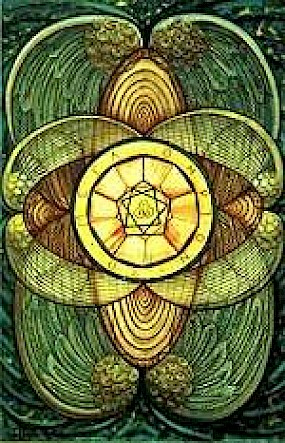
TheAce of Disks marks, on the everyday level, the start of a new project, which is likely to be successful. So it will come up to show a new job, or a new business venture. Usually this will be the sort of project that seems to continuously keep on growing, with each level of attainment producing – almost of itself – the next step in the journey.
Sometimes the Ace will come up to indicate a sudden change of material fortune, or a windfall – though either of these would have to be quite substantial to invoke the Ace. Aces are always big influences, marking the beginning of something new and important. So if we see the card coming up to represent a sudden input of funds, expect this to cause major changes in the querent’s life.
On a more spiritual level, this card relates to the Earth, and to the appreciation of Nature. It might mark a period where we draw closer to environmental issues, or where we engage in a period of study, contemplation and alignment with Earth forces.
One thing that we often miss, when considering spiritual development, is the way that each development grows out of the last. Anyone who has been involved in the search for spiritual truth will already have experienced the weirdly coincidental manner in which spiritual opportunities and teachers present themselves at the relevant stage in our growth.
There’s a saying – ‘The right teacher only appears when the student is ready’. It is as though we grow spiritually from the inside, the same way that trees do. And in so doing, maybe we develop inner rings – just like a tree’s trunk. The outer ring, just under the bark could not exist without all of the others it encircles.
We’re basically the same. The topic that we are exploring today has grown from all of the earlier topics we have looked into. Our experience is formed in layers, each of which is inter-dependent with the earlier ones. The Ace of Disks relates very closely with this method of human development – it shows us the way we grow. And warns us against trying to skip any of the stages!
New Thinking Allo • Mar 5, 2023 Jude Currivan, PhD, is a cosmologist and author of The Cosmic Hologram: In-Formation at the Center of Creation, CosMos (with Irvin Laszlo), The Eighth Chakra, The Wave, and The Thirteenth Step. Here she expands upon her insight that matter and consciousness are one and the same. Therefore, rather than say that we have consciousness, she maintains that we are consciousness. She refers to her early childhood experiences of supernormal awareness, and claims that this is the birthright of all individuals. We lose these natural abilities due to cultural conditioning. She also discusses James Lovelock’s Gaia hypothesis from the perspective of a conscious universe. Edited subtitles for this video are available in Russian, Portuguese, Italian, German, French, and Spanish. New Thinking Allowed host, Jeffrey Mishlove, PhD, hosted and co-produced the original Thinking Allowed public television series. He is a past vice-president of the Association for Humanistic Psychology; and is the recipient of the Pathfinder Award from that Association for his contributions to the field of human consciousness exploration. (Recorded on October 27, 2017)
“Our Constitution was made only for a moral and religious people. It is wholly inadequate to the government of any other.”
― John Adams
John Adams (October 30, 1835 – July 4, 1826) was an American statesman, attorney, diplomat, writer, and Founding Father who served as the second president of the United States from 1797 to 1801. Before his presidency, he was a leader of the American Revolution that achieved independence from Great Britain. Wikipedia
On Article 11 of the Treaty of Tripoli
In a late 18th century treaty reached by America with certain Muslim pirates of the African coast, one part of which, Article 11, states:
As the government of the United States of America is not in any sense founded on the Christian Religion,-as it has in itself no character of enmity against the laws, religion or tranquility of Musselmen,-and as the said States never have entered into any war or act of hostility against any Mehomitan nation, it is declared by the parties that no pretext arising from religious opinions shall ever produce an interruption of the harmony existing between the two countries.
It was ratified by the United States Senate unanimously without debate on June 7, 1797, taking effect June 10, 1797, with the signature of President John Adams. The treaty was broken by Tripoli, leading to the First Barbary War. A superseding treaty, the Treaty of Peace and Amity, was signed on June 4, 1805. (Wikipedia)
Install the following program from the Google Play Store. It will allow you to read the included book either manually or will read to you and save your place. You will also need to choose to Download the attached PDF. The eReader isn’t as intuitive as I’d like and may take a little getting used to, but it’s free. If you have any issues, please let me know. The book was published in 1924 and is in the public domain. The language is an older spiritual format, so I’m hoping it is understandable. There are very few western spiritual teachers that teach from this point of view and even fewer today (it seems). Anyway, I hope you get some value from it.
“Because all existence is founded upon the ever-present state of union, everything already exists in a state of tranquility. However, this state of tranquility is masked from us by our assumption that there is a separation, that there is a problem.”
Shunryu Suzuki (1904-1971) Zen Monk
AN OPPORTUNITY FOR DAILY REFLECTION BROUGHT TO YOU BY THE SCHOOL OF PRACTICAL PHILOSOPHY
Consciousness, spirituality, biography, sexuality, androgyny, futurism, space, the arts, science, astrology, democracy, humor, books, movies and more






 Dear Mrs. Somerville,