
| Practice |
 A little bear cub was confused about how to walk. “What do I do first?” he asked his mother. “Do I start with my right foot or my left? Or both front feet and then my back feet? Or do I move both feet on one side and then both feet on the other?” His mother answered, “Just quit thinking and start walking.” Author Unknown AN OPPORTUNITY FOR DAILY REFLECTION BROUGHT TO YOU BY THE SCHOOL OF PRACTICAL PHILOSOPHY |
Monthly Archives: February 2023
Review: In eloquent memoir, a grieving guard finds solace amid a leading museum’s artwork
By Ann Levin
February 20, 2023 Updated: February 20, 2023 (datebook.sfchronicle.com)
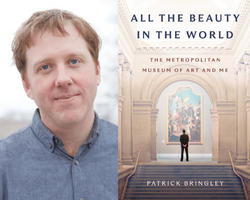
“All the Beauty in the World: The Metropolitan Museum of Art and Me” by Patrick Bringley. Photo: AP
When his older brother died of cancer at age 26, Patrick Bringley’s life was upended. Not even two years younger, Bringley quit his “high-flying desk job” at the New Yorker magazine and in a profound act of mourning, went to work as a guard at the Metropolitan Museum — “the most straight-forward job I could think of in the most beautiful place I knew.” Yes, a guard. Proud member of DC 37 Local 1503.
Bringley, who had fond memories of his first trip to the Met at age 11, back when visitors still wore brightly colored tin admission pins, ended up staying 10 years, long enough for the museum to work its magic and bring him back from the brink.
His reflections on that decade form the spine of his hauntingly beautiful memoir, “All the Beauty in the World: The Metropolitan Museum of Art and Me.” Elegant in its simplicity and dedicated to his brother, Tom, Bringley explores the way that great works of art can function as a balm for the soul, not unlike the immersive experience of travel to a foreign land.
Patrick Bringley is the author of “All the Beauty in the World.” Photo: Jason Wyche
“You dissolve almost. … You walk the streets alive to the exotic details, but even an ordinary pigeon flapping its wings is oddly vivid. There is a poetry about it, and as long as you glide through watchfully, the spell won’t break,” he writes. In front of Vermeer’s “Maid Asleep,” he perceives “a grandeur and holiness” in its intimate setting. Standing amid what one visitor calls the “Jesus pictures,” he is transfixed by a 14th century crucifixion, using it as “a kind of machine to aid in necessary and painful reflection” about suffering. As time goes by, he discovers that his broken heart has started to heal.
In some respects, Bringley’s debut is a classic workplace memoir, filled with stories about the Met’s collections, his fellow guards and some of the millions of visitors who have traipsed up the institution’s iconic stone steps overlooking 82nd Street and Fifth Avenue. Most of his insider stories are sweet and funny, including the tidbit that guards back in 2008 received an $80 annual “hose allowance” for socks. But Bringley’s primary interest is in the miracle of art, whether painting, sculpture or his own vocation, writing.
His intuition that the Met — a place of “soundless beauty” — would be a better place than a trendy magazine to pursue his craft turned out to be right. The humble union job gave him the time and space he needed to produce a work of art as luminous as the old masters paintings that comforted him in his grief.
Ann Levin is a freelance writer who contributes to the Associated Press.
Tarot Card for February 21: The Three of Disks
The Three of Disks
The Lord of Works indicates concentrated effort applied with great determination and diligence to a situation requiring your whole attention.
This is a card that often comes up to mark the achievement of goals in your working area, and teaches attainment through effort. It advises you to keep the pressure up so that you maintain momentum, and to pay attention to detail.
It will sometimes appear in a reading to reveal a period where you concentrate all your thoughts and aspirations on one target, and then channel all your energies into that project, to the exclusion of all else. Sometimes people do this in order to avoid facing emotional pain and distress. It’s worth looking for evidence of this when the Three of Disks comes up. Whilst it can be useful in the short-term to achieve something when you feel hurt, it can often be very damaging if you continue to hide from your own feelings.
The Lord of Works indicates high levels of professional ambition, and promises the drive and confidence to achieve these. There’s a good deal of dynamic energy attached to the card, and this is usually well-harnessed and put to good use.
Take the Three of Disks as a largely positive card, which shows that hard work and concentration can eventually gain you your highest objectives. But it’s important to remember that you need to be fully focused on the project in hand, allowing nothing to get in the way.
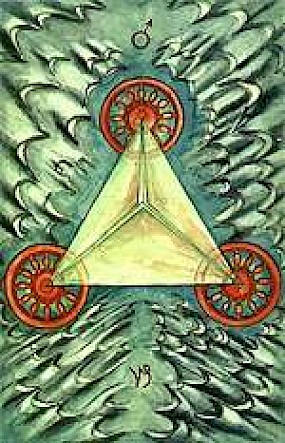
(Via angelpaths.com and Alan Blackman)
Magic and Science with Erik Davis
New Thinking Allowed with Jeffrey Mishlove • Feb 19, 2023 Erik Davis, PhD, a religious historian is author of TechGnosis: Myth, Magic and Mysticism in the Age of Information. His other books include Led Zeppelin IV; High Weirdness: Drugs, Esoterica, and Visionary Experience in the Seventies; Visionary State: A Journey Through California’s Spiritual Landscape; and Nomad Codes: Adventures in Modern Esoterica. This wide-ranging conversation covers many of the essential conundrums we have in society today. 00:00 Introduction 03:38 Historical context 17:59 Are we robots? 39:20 Parapsychology 47:27 What is real? 52:32 What is consciousness? 54:20 Future of religion 59:37 Conclusion Edited subtitles for this video are available in Russian, Portuguese, Italian, German, French, and Spanish. New Thinking Allowed host, Jeffrey Mishlove, PhD, is author of The Roots of Consciousness, Psi Development Systems, and The PK Man. Between 1986 and 2002 he hosted and co-produced the original Thinking Allowed public television series. He is the recipient of the only doctoral diploma in “parapsychology” ever awarded by an accredited university (University of California, Berkeley, 1980). He is also the Grand Prize winner of the 2021 Bigelow Institute essay competition regarding the best evidence for survival of human consciousness after permanent bodily death. (Recorded on January 31, 2023)
Book: “The Theory of Moral Sentiments”
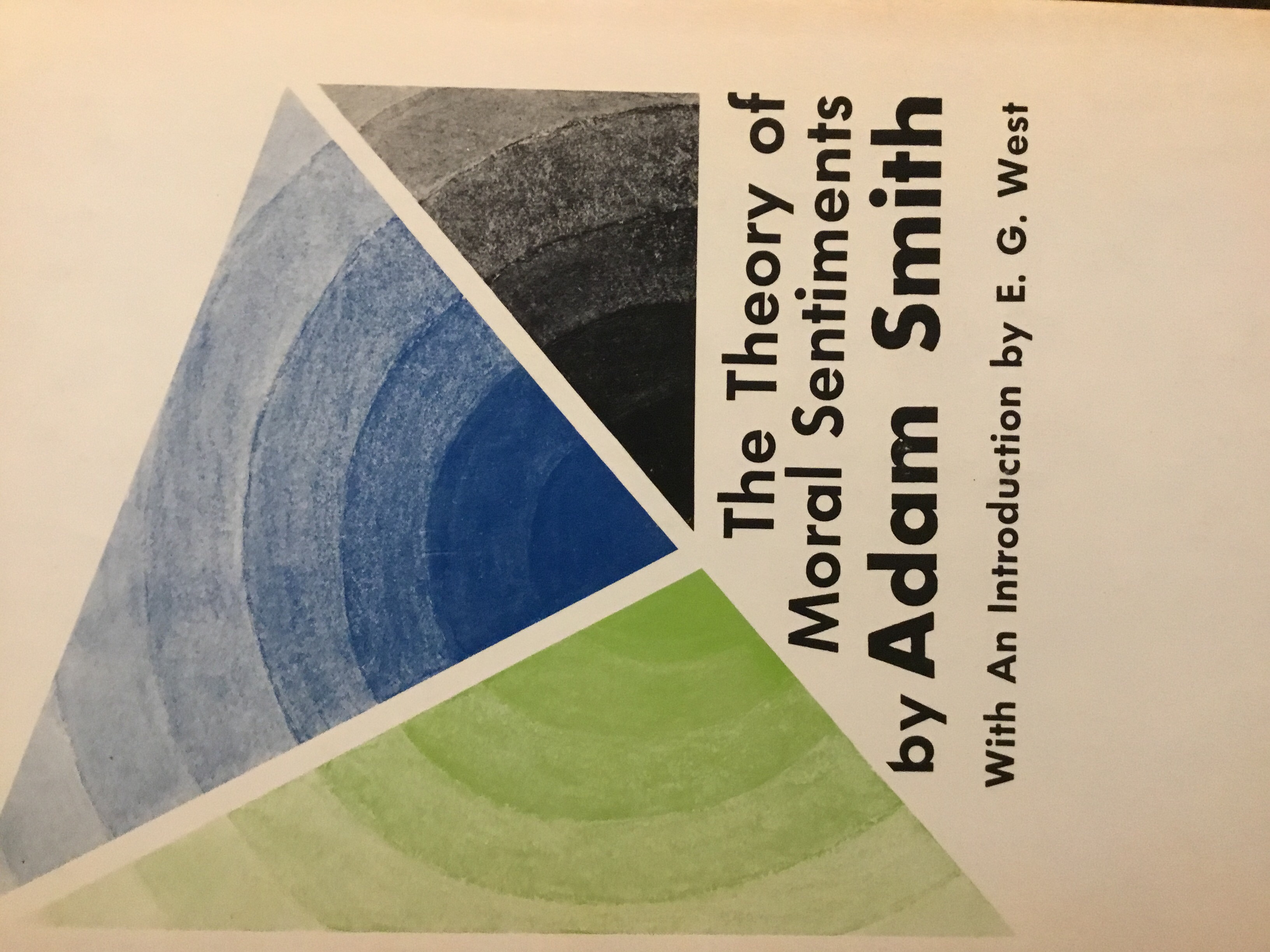
The Theory of Moral Sentiments
Adam Smith
The foundation for a general system of morals, this 1749 work is a landmark in the history of moral and political thought. Readers familiar with Adam Smith from will find this earlier book a revelation. Although the author is often misrepresented as a calculating rationalist who advises the pursuit of self-interest in the marketplace, regardless of the human cost, he was also interested in the human capacity for benevolence — as amply demonstrates.
The greatest prudence, Smith suggests, may lie in following economic self-interest in order to secure the basic necessities. This is only the first step, however, toward the much higher goal of achieving a morally virtuous life. Smith elaborates upon a theory of the imagination inspired by the philosophy of David Hume. His reasoning takes Hume’s logic a step further by proposing a more sophisticated notion of sympathy, leading to a series of highly original theories involving conscience, moral judgment, and virtue.
Smith’s legacy consists of his reconstruction of the Enlightenment idea of a moral, or social, science that embraces both political economy and the theory of law and government. His articulate expression of his philosophy continues to inspire and challenge modern readers.
(Goodreads.com)
Book: “Palo Alto: A History of California, Capitalism, and the World”

Palo Alto: A History of California, Capitalism, and the World
Malcolm Harris
The first comprehensive, global history of Silicon Valley, from railroad capitalists to microchip assemblers, showing how Northern California created the world as we know it
Palo Alto is nice. The weather is temperate, the people are educated, rich, healthy, enterprising. Remnants of a hippie counterculture have synthesized with high technology and big finance to produce the spiritually and materially ambitious heart of Silicon Valley, whose products are changing how we do everything from driving around to eating food. It is also a haunted toxic waste dump built on stolen Indian burial grounds, and an integral part of the capitalist world system.
In PALO ALTO, the first comprehensive, global history of Silicon Valley, Malcolm Harris examines how and why Northern California evolved in the particular, consequential way it did, tracing the ideologies, technologies, and policies that have been engineered there over the course of 150 years of Anglo settler colonialism, from IQ tests to the “tragedy of the commons,” racial genetics, and “broken windows” theory. The Internet and computers, too. It’s a story about how a small American suburb became a powerful engine for economic growth and war, and how it came to lead the world into a surprisingly disastrous 21st century. PALO ALTO is an urgent and visionary history of the way we live now, one that ends with a clear-eyed, radical proposition for how we might begin to change course.
(Goodreads.com)
Why Conservative Parts of the U.S. Are So Angry

Antlers, Oklahoma, on Jan. 29, 2022.
PHOTO BY MIKE MALES
Republican America is poorer, more violent, and less healthy than Democratic America. But Republicans’ blame is misplaced.
BY MIKE MALES
MAR 21, 2022 (yesmagazine.org)
Decades of political decisions and policies have created a massive and growing chasm between the economic and social disaster unfolding in small-town and rural parts of the United States, and the prosperity and safety of cities and suburbs. Many of those successful urban and suburban areas have reaped the rewards of electing largely moderate, competent Democratic leaders. Meanwhile, rural areas have elected Republicans drawn from a party that is increasingly incompetent, corrupt, and willing to engage in outright racism to win elections.
This disparity may affirm progressive ideas about successful and inclusive governance, but it also holds grave implications for the country as a whole.
Anger is roiling in Republican America, along with conspiratorial fabrications about who to blame for their condition. A harbinger of this trend is Antlers, Oklahoma, where I grew up: a once-thriving town in the southeastern part of the state, bordering the lush Ouachita foothills of dense forests, abundant agriculture, and lucrative tourism resources. The town rebuilt after a devastating 1945 tornado, but it has not weathered 21st century politics.
Racially and politically, Antlers is typical of much of rural Oklahoma, a state forged from the 19th century territory set aside for Native American tribes forcibly removed from other parts of the United States. Antlers is now 75% White and 22% Native American or mixed race, but with very few Latino, Asian, or Black residents. In 2020, Antlers and its county, Pushmataha—which supported former President Bill Clinton in 1996 and even Jimmy Carter over Ronald Reagan in 1980—voted for Republicans, 85% to the Democrats’ 14%, up from an 80% share for Republicans in 2016, 54% in 2000, and 34% in 1996.
Antlers’ social statistics are beyond alarming. Nearly one-third of its residents live in poverty. The median household income, $25,223, is less than half Oklahoma’s $55,557, which in turn is well below the national median of $74,099 in January 2022.
The best-off ethnic group in Antlers is Native Americans (median household income, $35,700; 48% with education beyond high school; 25% living in poverty). That’s still well below the national median, but the conditions of the White population are dismal: a median household income of $24,800, only 41% with any post-high school education, and 30% living in poverty.
In a growing nationwide trend, the median household incomes of people of color, according to the U.S. Census Bureau, now exceed those of White people in nearly 200 of the 1,500 Republican-trifecta counties—those in which the party controls the governor’s office and both legislative chambers of state government (see Figure 1). This is a visible factor that has fueled Trump voters’ complaints alleging White people’s diminished status.

In the most telling statistics, White people in Antlers are nearly twice as likely to die by guns as Native Americans (see Figure 2). Compared with Whites nationally, Antlers Whites suffer excessive death rates from drugs and alcohol (1.3 times the national average), suicide (1.5 times), all violent deaths (1.8 times), homicide (2.5 times), and gunfire (2.6 times).

The numbers on paper look bad enough. Seeing them on the ground is a new kind of scary. When I was growing up in Antlers 60 years ago and visited it 20 years ago, my family’s old block consisted of well-kept middle-class homes fronting yards for chickens and horses. On my latest visit in January 2022, I found the houses all boarded up or blowing open in the wind (see photo at top). There are hundreds of abandoned dwellings with collapsing roofs and walls and junk-filled empty lots alongside barely intact, yet still occupied, houses.
Antlers is not all devastation, however. It sports a gleaming Choctaw-built travel center financed by casino revenues, which are also invested in local Native Americans’ well-being. And there are some thriving neighborhoods, including a ritzy mansion suburb uphill from town. Antlers’ 2,300 residents can avail three liquor stores and seven new marijuana dispensaries.
A Widening Social and Economic Chasm
Across America, the partisan gap in gross domestic product per capita is also huge and growing: $77,900 in Democratic-voting areas, compared with $46,600 in Republican-voting areas. Antlers and Pushmataha County are hardly alone: 444 Republican counties have a GDP per capita of under $30,000, and 10 times as many people live in those counties than in the seven similarly low-GDP Democratic counties. Whites in about 40% of all Republican counties lost income over the past two decades. And Trump’s administration was no help to his base. During his presidency, the overall Democrat–Republican GDP per capita gap widened by another $1,800.
This is not simply an urban–rural divide. For the largest urbanized states, the three with Democratic control of all branches of government (California, New York, and Illinois) had GDPs per capita vastly higher than the three biggest Republican-controlled states (Texas, Florida, and Ohio).
The right-wing canard that hardworking White people subsidize welfare-grubbing cities is backward. Democrat-voting counties, with 60% of America’s population, generate 67% of the nation’s personal income, 70% of the nation’s GDP, 71% of federal taxes, 73% of charitable contributions, and 75% of state and local taxes.
Mirroring Antlers, White Republican America also suffers violent death rates, including from suicide, homicide, firearms, and drunken driving crashes, far higher than Whites in Democratic America and higher than non-White people everywhere. To top it off, Republican-governed Americans are substantially more likely to die from COVID-19. As the death gap between Republican and Democratic areas widens over time, the life expectancy for Whites in Republican-voting areas (77.6 years) is now three years shorter than that of Whites in Democratic areas (80.6 years), shorter than those of Asians and Latino people everywhere, and only a few months longer than Black and Native Americans in Democratic areas.
Misplaced Blame
Surveys and studies consistently find Trump’s generally older, White supporters enraged at “loss of status” and in fear of being “replaced” by non-White people. That White people are falling behind across key economic, health, and safety indexes is not due to victimization by immigrants and liberal conspiracies, however, but to victimization by other Whites and self-inflicted alcoholism, drug overdose, and suicide.
Is the solution to undividing America massive federal programs to improve Republican America’s struggling economies and troubled social conditions, then? Aside from the problem that Republican members of congress (and two recalcitrant Democrats) have sabotaged beneficial initiatives, former President Barack Obama already tried that. From 2010 to 2016, the Obama administration’s economic recovery measures fostered millions of new jobs and thousands of dollars in real median income growth for Whites in urban and most rural areas alike, reversing the recession under Republican George W. Bush’s presidency.
Yet, despite these gains, White voters vehemently rejected Democrats in successive elections. Today, Trump’s base voters are electing candidates who share their racial resentment and imagined victimization, not those who actually are advancing their safety and economic well-being.
Despite the superficial resemblance of the crumbling neighborhoods, junk-filled lots, and widespread poverty of Antlers and conditions in a devastated city of color like Camden, New Jersey, the origins of their devastations are very different. Camden is the product of systemic racism and industrial abandonment inflicted on poor, primarily non-White residents powerless to prevent their exploitation. Antlers is the predictable endgame of White majorities who had better options instead empowering incompetent, corrupt demagogues (segregationist Democrats in the past; nihilist Republicans today) who flatter White claims to racial and religious privilege while awarding largesse to rapacious outsiders.
Poverty in cities and on reservations requires mainly the sustained political will to work with populations who welcome the effort. In stark contrast, fixing rural White poverty against the angry, anti-democratic recalcitrance of most Whites themselves requires an entirely new political thinking we have yet to imagine.
| MIKE MALES is a senior researcher for the Center on Juvenile and Criminal Justice, the principal investigator for YouthFacts, and the author of five books on American youth. |
Meditation in Sunlight: May Sarton’s Stunning Poem About the Relationship Between Presence, Solitude, and Love
By Maria Popova (themarginalian.org)

May Sarton (May 3, 1912–July 16, 1995) was thirty-three when she left Cambridge for Santa Fe. She had just lived through a World War and a long period of personal turmoil that had syphoned her creative vitality — a kind of deadening she had not experienced before. Under the immense blue skies that had so enchanted the young Georgia O’Keeffe a generation earlier, she started coming back to life. Her white-washed room at the boarding house had mountain views, a rush of sunlight, and a police dog and “a very nice English teacher” for neighbors. As the sun rose over the mountains, she woke up each morning “simply on fire” with poetry — new poems she read to the English teacher, not yet knowing she was falling in love with her. Judy would become her great love, then her lifelong friend and the closest she ever had to family.
Among the constellation of Santa Fe poems composed during this creative renaissance is an especially beguiling reflection on the relationship between presence, solitude, and love, soon published in Sarton’s 1948 poetry collection The Lion and the Rose (public library) — her first in a decade — and read here for us by my longtime poetry co-invocator Amanda Palmer in her lovely oceanic voice:

MEDITATION IN SUNLIGHT
by May SartonIn space in time I sit
Thousands of feet above
The sea and meditate
On solitude on loveNear all is brown and poor
Houses are made of earth
Sun opens every door
The city is a hearthFar all is blue and strange
The sky looks down on snow
And meets the mountain-range
Where time is light not shadowTime in the heart held still
Space as the household god
And joy instead of will
Knows love as solitudeKnows solitude as love
Knows time as light not shadow
Thousands of feet above
The sea where I am now
Complement with Sarton on the cure for despair, how to live openheartedly in a harsh world, and her stunning ode to solitude, then revisit Amanda’s soulful readings of Jane Kenyon’s meditation on life with and after depression, Elizabeth Bishop’s timeless consolation for loss, Ellen Bass’s immense and intimate poem of perspective and possibility, and Mary Oliver’s “When I Am Among the Trees.”
Ray Bradbury finishes the script for John Huston’s “Moby Dick”
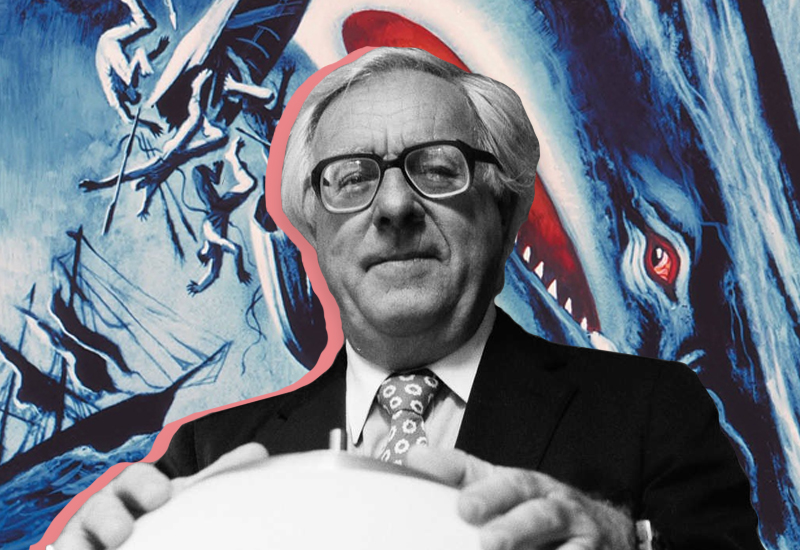
| Fun fact: Ray Bradbury wrote the screenplay for John Huston’s 1956 adaptation of Herman Melville’s Moby-Dick—but it wasn’t for the love of Melville. |
“I had fallen in love with John Huston’s work when I was in my twenties,” he told The Paris Review in 2010.
When I was twenty-nine I attended a film screening and John Huston was sitting right behind me. I wanted to turn, grab his hand, and say, I love you and I want to work with you. But I held off and waited until I had three books published, so I’d have proof of my love. I called my agent and said, Now I want to meet John Huston. We met on St. Valentine’s night, 1951, which is a great way to start a love affair. I said, Here are my books. If you like them, someday we must work together. A couple of years later, out of the blue, he called me up and said, Do you have some time to come to Europe and write Moby-Dick for the screen? I said, I don’t know, I’ve never been able to read the damn thing. So here I was confronted with a dilemma: Here’s a man that I love and whose work I admire. He’s offering me a job. Now, a lot of people would say, Grab it! Jesus, you like him, don’t ya? I said, Tell you what, I’ll go home tonight and I’ll read as much as I can, and I’ll come back for lunch tomorrow. By that time I will know how I feel about Melville. Because I’ve had copies of Moby-Dick around the house for years. So I went home and I read Moby-Dick. Strangely enough, a month earlier I’d been wandering around the house one night and picked up Moby-Dick and said to my wife, I wonder when I’m going to read this thing? So here I am sitting down to read it.
I dove into the middle of it instead of starting at the beginning. I came across a lot of beautiful poetry about the whiteness of the whale and the colors of nightmares and the great spirit’s spout. And I came upon a section toward the end where Ahab stands at the rail and says: “It is a mild, mild wind, and a mild looking sky; and the air smells now, as if it blew from a far-away meadow; they have been making hay somewhere under the slopes of the Andes, Starbuck, and the mowers are sleeping among the new-mown hay.” I turned back to the start: “Call me Ishmael.” I was in love! You fall in love with poetry. You fall in love with Shakespeare. I’d been in love with Shakespeare since I was fourteen. I was able to do the job not because I was in love with Melville, but because I was in love with Shakespeare. Shakespeare wrote Moby-Dick, using Melville as a Ouija board.
Needless to say, Bradbury took the gig—but it was a hard road. It took “eight long months of agonizing work, subconscious work” in Ireland until finally, he had a breakthrough:
I got out of bed one morning in London, looked in the mirror, and said, ‘I am Herman Melville!’ I sat down at the typewriter, and in eight hours of passionate, red-hot writing, I finished the screenplay of Moby Dick, and I ran across London, I threw the script in John Huston’s lap, and said, ‘There! It’s done!’ He read it and said, ‘My god, what happened?’ I said, ‘Behold: Herman Melville.’
The final script is dated February 22, 1954. For more, check out Bradbury’s 1992 novel Green Shadows, White Whale, a fictionalized account of his experiences writing the screenplay with Huston in Ireland.
Literary Hub (lithub@lithub.com)
‘Oh, What a Beautiful Mornin’’ | Gordon MacRae
Rodgers & Hammerstein • Mar 13, 2014 • #Oklahoma #Broadway #TheaterGordon MacRae sings ‘Oh, What a Beautiful Mornin’’ from the 1955 film of Rodgers & Hammerstein’s OKLAHOMA!.
(Courtesy of Dan Rather)