How ChatGPT conquered the tech world in 100 days

The artificial intelligence craze now sweeping the world began in the Mission District.

On Nov. 30, OpenAI announced a new tool from San Francisco’s Pioneer Building on 18th Street, a 100-year-old structure whose first life was a luggage factory.

Without much fanfare, the startup said its new AI chatbot, called ChatGPT, could interact with a user “in a conversational way, answer follow-up questions, admit its mistakes, challenge incorrect premises and reject inappropriate requests.”

Frenzy ensued. ChatGPT amassed more than a million users within five days of releasing its free app. By January, it had 13 million unique visitors every day and 100 million monthly active users. It is the most astounding product rollout since the dot-com era.

ChatGPT has proved to be a fun, if unnerving, tool. You could can use it to write poems, essays, wacky lyrics or draft business proposals. The excitement for a tool that writes and “thinks” much faster than most humans has touched nearly every realm: business, politics, education, the arts. It has turned the spotlight on artificial intelligence, a field born from Alan Turing’s theory of computation and that computer scientists have long predicted would transform the very nature of human existence.

“It exploded on the landscape,” Jef Loeb, creative director of the San Francisco advertising agency Brainchild Creative, told The Examiner. “San Francisco was definitely ground zero for this.”

Google’s AI fumble wipes out $100 billion in market cap

A glitch in Google’s AI chatbot rollout triggers a stock sell-off as competition in AI heats up.

When AI hibernated

“AI winter” is what the tech world calls the period when the quest for artificial intelligence technology, which began after World War II, seemed to be going nowhere — when funding dried up, research stalled and overall interest waned like they did in the 1970s-1980s and again in the mid-1990s.

But AI has been on a steady march forward since the start of the 21st century. The advance was propelled by more powerful chips, more sophisticated software and ever-expanding reach of the web.

AI reached a high point this winter in the San Francisco Bay Area, where a lot of these capabilities emerged — the chips, the software, the new approaches.

Google’s search engine blazed the trail for “machine learning,” which trains computers to solve problems by figuring out patterns. Eventually, Silicon Valley companies, including startups, turned to a new AI approach that offered even more impressive capabilities.

“Deep learning” uses artificial neural networks that can pick up, record and process data and signals that are then organized the way human memory operates. With deep learning, a computer can mimic the way the human brain works.

That computing firepower and more sophisticated algorithms made it possible to create pretty much anything — essays and letters, business proposals, paintings, videos. It’s called Generative AI.

And ChatGPT underscored its power.

Google unveils ChatGPT rival in AI counteroffensive

Google introduces its chatbot, Bard, as artificial intelligence rivalry heats up

Enter OpenAI

Sam Altman, CEO and co-founder of OpenAI, studied computer science at Stanford and served as president of YCombinator, the world-famous Mountain View startup accelerator that launched such famous names as Airbnb, Stripe and DoorDash.

Altman co-founded OpenAI in 2015, with tech pioneers like Tesla CEO (and now Twitter owner) Elon Musk, investor Peter Thiel and LinkedIn co-founder Reid Hoffman. The company started out as a nonprofit with a noble goal: to “advance digital intelligence in the way that is most likely to benefit humanity as a whole, unconstrained by a need to generate financial return.”

In February, Altman told Forbes, “I think capitalism is awesome. I love capitalism. Of all of the bad systems the world has, it’s the best one — or the least bad one we found so far. I hope we find a way better one.”

OpenAI and ChatGPT sparked a new wave of capitalist fervor. Suddenly, AI was the buzzword among investors. Every startup or tech company had to have an AI plan.

Asking about an AI strategy became a routine part of doing business, said Logan Allin, managing partner and founder of Fin Capital, a San Francisco venture investment firm. “When talking to people, I ask, ‘What is your answer to AI?’” he told The Examiner. “If you can’t answer that at the board level or the management level, you have a big problem.”

There was also a distinct shift in attitude among big institutions that invest in VC firms — pension funds, endowments and sovereign wealth funds — said Nicolai Wadstrom, founder and CEO of BootstrapLabs, another San Francisco VC firm focused mainly on AI.

People “we have known for a long time” and who weren’t exactly enthusiastic about AI suddenly “changed their minds” about the technology, Wadstrom said. “That’s a clear change in the past 100 days.”

That wasn’t surprising. ChatGPT astounded anyone who tried it. When Allin of Fin Capital asked ChatGPT for insights into investing in the growing segment of the financial tech industry called embedded finance, “the answer that came back was incredibly thoughtful,” he said.

“We were like, ‘Oh, boy, this is very disruptive,” he told The Examiner.

So disruptive, in fact, that just 10 weeks after it was introduced, ChatGPT actually sparked a major tech brawl. The technology was immediately tagged as a serious threat to Google, especially with OpenAI’s close relationship with Microsoft, one of the startup’s major investors.

The stakes became clear when Google fumbled the opening salvo of its AI counteroffensive in February. The tech giant introduced its own AI chatbot named Bard, but an ad for the new tool featured an incorrect response to a question on the James Webb Telescope. The error sent Alphabet’s stock plummeting, wiping out $100 billion in market value.

“Google comes out with Bard, which is a terrible name, and second of all, they completely dropped the ball,” Allin said. “The market reaction was definitely severe. But rightly so. This is the future of search.”

Can AI help fix homelessness in SF?

An AI-powered program is helping LA identify people at risk of becoming homeless before they hit the skids

The future of tech

But ChatGPT also raised questions about the future of tech.

Three days after it was introduced, Elon Musk tweeted to Altman: “ChatGPT is scary good. We are not far from dangerously strong AI.”

Altman agreed, tweeting back, The new technology “poses a huge cybersecurity risk” and as AI becomes more powerful “we have to take the risk of that extremely seriously.”

These risks became evident just days after ChatGPT was announced.

On Dec. 21, three weeks after ChatGPT’s release, a team of Check Point Software engineers in San Carlos and Tel Aviv flagged a user on an underground hacking forum who bragged about creating a phishing malware with help from ChatGPT. The hacker had zero coding skills.

A few days later, on New Year’s Eve, another user started a thread titled “Abusing ChatGPT to create Dark Web marketplace scripts.”

Sergey Shykevich, a Check Point threat intelligence manager, called the chatter on underground hacking forums “the beginning of the first step on possible future nightmares.” ChatGPT, he argued, became a resounding success “too fast.”

Beyond enabling criminal hackers on the Dark Web, other worries have emerged.

Schools braced themselves for the impact of ChatGPT’s use on campuses. At Stanford, some professors began overhauling their courses to get ahead of how the tool was used in assignments. An informal poll by Stanford Daily found “a large number of students” have used the tool to take final exams.

Generative AI came under fire when a brewing battle over how some companies used the work of artists exploded into the open. A group of artists filed a lawsuit in San Francisco federal court accusing three prominent AI imaging companies — Stability AI, Midjourney and DeviantArt — of copyright infringement and unlawfully appropriating their work. One of the artists, San Francisco illustrator Karla Ortiz, criticized what she described as “the deeply exploitative AI media models practices.”

“If misinformation and fake news was bad before, this is only really going to accelerate that times 10,” Chris McCann, a partner at San Francisco venture firm Race Capital, told The Examiner. “It’s going to be much, much, much harder to understand the provenance” of a creative work, “whether somebody actually made this themselves, not made by themselves, whether it’s augmented. It’s going to become way more confusing.”

But there were also those who touted ways by which AI can help creators.

In Palo Alto, Nikhil Abraham and Mohit Shah, founders of CloudChef, joined Indian chef Thomas Zacharias in introducing a new AI-based tool that can record the way a chef cooks — and use the digitized information to recreate their dishes. The technology “essentially codifies the chef’s intuition and helps us recreate the recipe,” Thomas told The Examiner.

Zacharias receives royalties from CloudChef, which sells his meals through an online marketplace, access to a new market and customers, he said, that “I could never have even dreamt of.”

Catching an essay written with AI … with help from AI

Catching an essay written with AI … with help from AI

OpenAI rolls out new tool to flag AI-written text, especially those created with its wildly successful ChatGPT.

The next cloud, the next internet

Silicon Valley legend John Chambers, the former CEO of Cisco, the San Jose tech giant, predicts that “AI will be the game changer for the high-tech industry.”

“AI will be the next cloud, the next internet.” And the important advances in AI, he told The Examiner, will “most likely come from a new player because that’s how it’s always occurred before.”

As in other major tech waves, that “new player” will likely come from the Bay Area.

Allin said he hopes the ChatGPT craze “creates a resurgence in R&D and the recognition that the heart of frontier R&D is still in San Francisco.”

Major tech companies have left. Startups are eyeing other states and regions to set up shop. But “San Francisco is still where the best ideas are being generated,” Allin said. “And obviously AI is a key part of that.”

Altman actually said pretty much the same thing two years ago, when the Bay Area and the whole world were reeling from the pandemic.

In December 2020, two years before ChatGPT turned his company into a household name, he tweeted, “It’s easy to not be in the Bay Area right now, because there’s not much to miss-out on.”

But he wasn’t giving up, he declared.

“If you want to have the biggest possible impact in tech, I think you should still move to the Bay Area,” Altman said. “The people here, and the network effects caused by that, are worth it. It’s hard to overstate the magic of lots of competent, optimistic people in one place.”

When AI is your sous chef

CloudChef recreates master chef cooking with AI

bpimentel@sfexaminer.com

@benpimentel

Why Black History Month Exists

These are stories not of Black America but of America, of a history we all must own.

A mixed-media illustration shows a sculptured row of chained Black fists hanging down, as if from the side of a ship, against a painted backdrop of rippling, dark blue water.
From “An American Story.”Credit…Dare Coulter

PICTURE BOOKS

Nikole Hannah-Jones Reviews Two Picture Books About Black History

In separate works, Tami Charles and Kwame Alexander tell a story not of Black America but of America, of a history we all must own.

From “An American Story.”Credit…Dare Coulter

Nikole Hannah-Jones

By Nikole Hannah-Jones

Nikole Hannah-Jones is the creator of “The 1619 Project,” which spawned her debut picture book, “Born on the Water.” The project’s documentary series premiered last month.

  • Feb. 16, 2023 (NYTimes.com)

How do you celebrate Black history in a time when books about Black history are being banned and curriculums about this nation’s racist past are being challenged? When Gov. Ron DeSantis of Florida has barred the new Advanced Placement course in African American studies from the state’s public schools. When legislatures are passing so-called “divisive concept” laws that further marginalize already marginalized histories, mandating that educators cannot teach about systemic racism or hold discussions about race that might cause students to feel “discomfort, guilt, anguish or any other form of psychological distress.” With my own work often at the center of the legislative bans, I’ve thought a lot about how the word “white” in front of “students” is implied in these laws. What about the discomfort of Black children that results from what isn’t taught, the distress Black children experience when searching for themselves in an American story from which their people are largely absent, a story in which they learn about the great white men who lived in the White House but not the enslaved Africans who built it?

This Black History Month, two picture books, “We Are Here” and “An American Story,” enter the literary landscape with a particular urgency. Both provide Black children with affirmation that their history — their people’s story of struggle and fight, resistance and resilience, joy and striving — is indeed worthy of explication; that the political challenges are about the people making the challenge and not about the merit of Black people. And they provide all children (plus adults) with a sense of what makes understanding the singular experiences of Black people so necessary to understanding our world.

In an abstract, collage-and-watercolor painting of the cosmos, sparkling planetary bubbles and luminescent circles filled with numbers are refracted through a young Black girl’s piercing brown eyes.
From “We Are Here.”Credit…Bryan Collier

WE ARE HERE (Orchard, 40 pp., $18.99, ages 4 to 8), written by Tami Charles and illustrated by the Caldecott Honoree Bryan Collier — a companion to their 2020 collaboration, “All Because You Matter,” created to address Charles’s then 5-year-old son’s questions — opens with an ancient legacy, one that stretches back to early astronomy and nods to African contributions to mathematics and scientific knowledge, and then links this past to modern innovations and toils of African-descended people, from creating hip-hop to marching for Black lives.

In storytelling dotted with words in Spanish and other languages, laid against Collier’s lush, gem-toned imagery, the book weaves a unifying and empowering narrative of Black people connected across bodies of water, bonded by a common identity that is “multidialectical, oh-so-intellectual,” one that is “one heart, uma alma … un esprit … muchas lenguas.”

What Is the 1619 Project?

Card 1 of 5

Acknowledging a historic moment. In August 2019, The New York Times Magazine launched the 1619 Projectspearheaded by Nikole Hannah-Jones. The project explored the history of slavery in the United States and was released to coincide with the anniversary of a ship carrying the first enslaved Africans to the English colonies.

The enslavement legacy. The project made a bold claim: that the experience of slavery is inextricable from American history. It prompted praise, criticism and debate.

The project’s impact. With its examination of how the legacy of slavery continues to shape life in the United States, the project started in-depth conversations about how American history is taught and written.

Awards and controversy. Ms. Hannah-Jones, who won a Pulitzer Prize in 2020 for the project’s opening essay, has faced backlash from conservative groups over her work. In 2021, some board members at the University of North Carolina reportedly opposed her appointment to tenure position due to her involvement in the 1619 Project.

Expanding the initiative’s reach. Since its launch, the 1619 Project has expanded to include a podcast on how slavery has transformed Americatwo books and a six-part documentary debuting on Hulu on Jan. 26.

In many ways, “We Are Here” feels like a love letter to Black children, and when one reaches the author’s note it becomes clear why.

Charles dedicates the book to the daughter she lost, calling it a “celebration” infused with the history of her people that she would have taught her baby girl.

ImageFrom “We Are Here.”Credit…Bryan Collier

In the book’s final pages, one can hear a mother whispering armor onto her child, girding her for a world that so often diminishes Blackness: “Because you and me, we have always been heroes. The same ones who sat to take a stand, the ones who ran so we could fly … So it’s no surprise, dear child, we are all of these things, and so much more … No matter what they say … Because someday, when it’s your turn to rule the world, people will be amazed and they will question the power of you.”

This is why Black History Month exists: not to exclude others but because the contributions of Black people have been, for most of the history of this country, contested and omitted from the narrative of America. Because too many Black children grow up with a sense that their people, and therefore they themselves, are somehow lacking.

ImageFrom “An American Story.”Credit…Dare Coulter

The poet and Newbery Medalist Kwame Alexander’s AN AMERICAN STORY (Little, Brown, 56 pp., $18.99, ages 4 to 8) feels like a direct answer to these times, asking, How do you tell the story of “copper dreams wrapped in iron chains”? Alexander channels the story of Black Americans through a Black teacher grappling with how to honestly teach the hard history of slavery to her students.

Alexander’s free verse and the illustrator Dare Coulter’s fantastic multitextured imagery — combining sculpture with painting and drawing — are unsparing in their depiction of the brutality and inhumanity of slavery and its perpetrators. Interspersed between color pictures of the past, charcoal sketches against yellow backgrounds transport us to a contemporary classroom and the musings of students who have not yet been taught to shrug at their history as just the way it was.

ImageFrom “An American Story.”Credit…Dare Coulter

Following several pages describing the horrors of slavery, hands fly up, paired with the outcry, “But you can’t sell people.” On another double-page spread, students sit, heads down. “That’s sad. Really, really sad, Ms. Simmons,” they say, while Alexander asks the question in the mind of every adult trying to teach hard histories: “How do you tell that story and not want to weep for the world?”

“An American Story” is exactly that, a story not of Black America but of America, a history we all must own. It is a book that respects children as capable of grappling honestly with our past while also respecting the challenges and discomfort adults feel in figuring out how to teach them the truth about an often hypocritical and conflicted nation founded both on ideals of liberty and on the barbaric practice of slavery. It is an argument against those who believe that the best way to protect our children is by hiding the truth from them.

After teaching her students about the suffering in the bowels of slave ships, about little girls waking to the moans of their mothers as their brothers are being sold away, the teacher falters. She wonders if she’s made a mistake, if this history is too painful.

“I shouldn’t have read this to you. I’m so sorry, children.”

The children’s response echoes those I have heard as I have discussed the legacy of slavery with young people across the country.

“But, don’t you tell us to always speak the truth, Ms. Simmons, even when it’s hard? When I’ve done something bad, my dad always says, ‘You can’t change the past, but you can do better in the future.’”


(Contributed by Michael Kelly, H.W.)

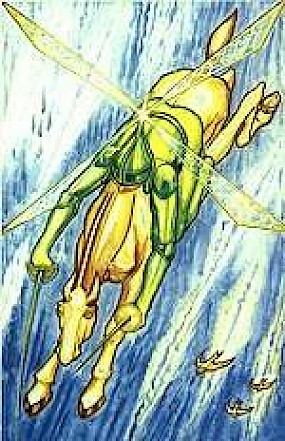
Tarot Card for February 20: The Knight of Swords

The Knight of Swords

When the Knight of Swords comes up to indicate a man, he will be intelligent, subtle and clever. His capacity for abstract thought will be well developed. He is also highly intuitive and perceptive.

His nature will be elusive and ethereal, yet he has a strength and fascination that is hard to deny. He compels attention, except when he doesn’t want it, and at those times you will not even notice him pass by.

Because of the enquiring and analytic nature of his mind, you will often find him involved in occult study, and following spiritual pursuits. Whilst tolerant of those who know less than him, he will not divulge his knowledge easily. Rather those who wish to learn from him must fight to see him clearly, rather than falling for the projections he readily casts around him.

If this man is badly dignified his subtlety turns to manipulation, and his fascination to glamour. In this way, he becomes unprincipled and self-seeking. There is a certain ruthlessness present in the Knight of Swords at all times.

Even when we meet him at his best, he makes a hard task master, and an acutely keen observer. The sword in his hand will quite often be used to cut to the heart of things – and sometimes we will not be comfortable with what is revealed.

When this card comes up to indicate a state of mind in a man not normally seen as a Knight of Swords, we are then dealing with quite another issue. Now we must address the darkest qualities of the card. This is an angry man, who has quite possibly been emotionally hurt, and may well be looking for revenge.

He has the potential to be physically violent and mentally cruel. He is a nasty enemy and somebody who needs to be treated with the utmost caution.

The Knight of Swords

(via angelpaths.com and Alan Blackman)

Rupert Spira on the distance from our self to our self

There is no distance from our self to our self and, therefore, no room for effort, practice or discipline. We simply remain as we are, before we seemed to be qualified by the content of experience..

–Rupert Spira

Rupert Spira (born March 13, 1960) is an English spiritual teacher, philosopher and author of the Direct Path based in Oxford, UK. Wikipedia

(newsletter@rupertspira.com)

Putin and the Presidents: Julia Ioffe and other interviews | FRONTLINE

FRONTLINE PBS | Official • Jan 31, 2023 • #FrontlineInterview #PutinJulia Ioffe is an American journalist who was born in Russia. She is a writer for and founding partner of the media company Puck. She previously reported on politics and world affairs for The Atlantic. The following interview was conducted by the Kirk Documentary Group’s Michael Wiser for FRONTLINE on Sept. 28, 2022. It has been edited for clarity and length. This interview is being published as part of FRONTLINE’s Transparency Project, an effort to open up the source material behind our documentaries. Explore the transcript of this interview, and others, on the FRONTLINE website: https://www.pbs.org/wgbh/frontline/in…

Putin and the Presidents: Timothy Snyder (interview) | FRONTLINE

Putin and the Presidents: John Bolton (interview) | FRONTLINE

Putin and the Presidents: William Taylor (interview) | FRONTLINE

Putin and the Presidents: Eugene Robinson (interview) | FRONTLINE

Putin and the Presidents: Marie Yovanovitch (interview) | FRONTLINE

Putin and the Presidents: Yevgenia Albats (interview) | FRONTLINE

Putin and the Presidents: Antony Blinken (interview) | FRONTLINE

Putin and the Presidents (full documentary) | FRONTLINE

Putin and the Presidents (full documentary) | FRONTLINE

Joseph Campbell on the sorrows of the world

Joseph Campbell

“Participate joyfully in the sorrows of the world. We cannot cure the world of sorrows, but we can choose to live in joy. The warrior’s approach is to say “yes” to life: “yea” to it all.”

― Joseph Campbell, The Hero With a Thousand Faces

Joseph John Campbell (March 26, 1904 – October 30, 1987) was an American writer. He was a professor of literature at Sarah Lawrence College who worked in comparative mythology and comparative religion. His work covers many aspects of the human experience. Wikipedia

Wonder & Awe – Premiere Episode

Moving Art • Streamed live on Aug 4, 2020 Welcome to the first episode of Wonder & Awe, a one-of-a-kind podcast that explores the intersection between art and science–all brought to you by Louie Schwartzberg and Moving Art. Powered by stunning visuals and mind-blowing ideas, the director of Fantastic Fungi hosted a conversation with the legendary mycologist Paul Stamets. He was joined by Merlin Sheldrake, a young artist, biologist, and the celebrated author of Entangled Life.

(Recommended by John Atwater, H.W.)

Book: “The Rise and Fall of the Great Powers: Economic Change and Military Conflict from 1500 to 2000”

The Rise and Fall of the Great Powers: Economic Change and Military Conflict from 1500 to 2000

Paul Kennedy

THE WIDELY ACCLAIMED BESTSELLER THAT BOLDLY AND LUCIDLY PUTS OUR CURRENT ECONOMIC AND POLITICAL DILEMMAS INTO THE PERSPECTIVE OF WORLD HISTORY.

“A work of almost Toynbeean sweep… When a scholar as careful and learned as Mr. Kennedy is prompted by contemporary issues to reexamine the great processes of the past, the result can only be an enhancement of our historical understanding…. When the study is written as simply and attractively as this work is, its publication may have a great and beneficient impact. It is to be hoped that Mr. Kennedy’s will have one, at a potentially decisive moment in America’s history.”
Michael Howard, The New York Times Book Review

“Important, learned, and lucid… Paul Kennedy’s great achievement is that he makes us see our current international problems against a background of empires that have gone under because they were unaible to sustain the material cost of greatness; and he does so in a universal historical perspective of which Ranke would surely have approved.”
James Joll, The New York Review of Books

“His strategic-economic approach provides him with the context for a shapely narrative….Professor Kennedy not only exploits his framework eloquently, he also makes use of it to dig deeper and explore the historical contexts in which some ‘power centers’ prospered….But the most commanding purpose of his project…is the lesson he draws from 15 centuries of statecraft to apply to the present scene….[The book’s] final section is for everyone concerned with the contemporary political scene.”
Christopher Lehmann-Haupt, The New York Times

“Kennedy gives epic meaning to the nation’s relative economic and industrial decline.”
Newsweek

(Goodreads.com)

Bio: Chief Joseph

From Wikipedia, the free encyclopedia

Chief Joseph
Hinmatóowyalahtq̓it
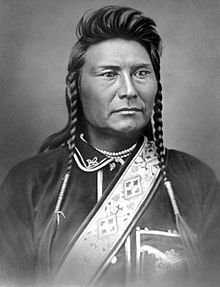
Chief Joseph in 1877
BornMarch 3, 1840
Wallowa Valley, Nez Perce territory (claimed as Oregon Country by the United States and as the Columbia District by the United Kingdom of Great Britain and Ireland)
DiedSeptember 21, 1904 (aged 64)
Colville Indian ReservationWashington, United States
Resting placeChief Joseph Cemetery
Nespelem, Washington
48°10′6.72″N 118°58′37.69″WCoordinates48°10′6.72″N 118°58′37.69″W
Other namesIn-mut-too-yah-lat-latChief JosephJoseph the YoungerYoung Joseph
Known forNez Perce leader
PredecessorJoseph the Elder (father)
SpousesHeyoon YoyiktSpringtime
ChildrenJean-Louise
ParentsTuekakas (father)Khapkhaponimi (mother)
RelativesSousouquee (older brother), Ollokot (younger brother), four sisters
Signature

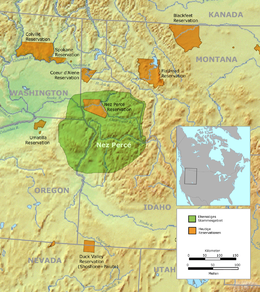
Original Nez Perce territory (green) and the reduced reservation of 1863 (brown)

Hin-mah-too-yah-lat-kekt (or Hinmatóowyalahtq̓it in Americanist orthography), popularly known as Chief JosephYoung Joseph, or Joseph the Younger (March 3, 1840 – September 21, 1904), was a leader of the Wal-lam-wat-kain (Wallowa) band of Nez Perce, a Native American tribe of the interior Pacific Northwest region of the United States, in the latter half of the 19th century. He succeeded his father Tuekakas (Chief Joseph the Elder) in the early 1870s.

Chief Joseph led his band of Nez Perce during the most tumultuous period in their history, when they were forcibly removed by the United States federal government from their ancestral lands in the Wallowa Valley of northeastern Oregon onto a significantly reduced reservation in the Idaho Territory. A series of violent encounters with white settlers in the spring of 1877 culminated in those Nez Perce who resisted removal, including Joseph’s band and an allied band of the Palouse tribe, to flee the United States in an attempt to reach political asylum alongside the Lakota people, who had sought refuge in Canada under the leadership of Sitting Bull.

At least 700 men, women, and children led by Joseph and other Nez Perce chiefs were pursued by the U.S. Army under General Oliver O. Howard in a 1,170-mile (1,900 km) fighting retreat known as the Nez Perce War. The skill with which the Nez Perce fought and the manner in which they conducted themselves in the face of incredible adversity earned them widespread admiration from their military opponents and the American public, and coverage of the war in U.S. newspapers led to popular recognition of Chief Joseph and the Nez Perce.

In October 1877, after months of fugitive resistance, most of the surviving remnants of Joseph’s band were cornered in northern Montana Territory, just 40 miles (64 km) from the Canadian border. Unable to fight any longer, Chief Joseph surrendered to the Army with the understanding that he and his people would be allowed to return to the reservation in western Idaho. He was instead transported between various forts and reservations on the southern Great Plains before being moved to the Colville Indian Reservation in the state of Washington, where he died in 1904.

Chief Joseph’s life remains an iconic event in the history of the American Indian Wars. For his passionate, principled resistance to his tribe’s forced removal, Joseph became renowned as both a humanitarian and a peacemaker.

Background

Chief Joseph was born Hinmuuttu-yalatlat (alternatively Hinmaton-Yalaktit or Hin-mah-too-yah-lat-kekt [Nez Perce: “Thunder Rolling Down the Mountain”], or Hinmatóoyalahtq’it [“Thunder traveling to higher areas”])[1] in the Wallowa Valley of northeastern Oregon. He was known as Young Joseph during his youth because his father, Tuekakas,[2] was baptized with the same Christian name and later become known as “Old Joseph” or “Joseph the Elder”.[3]

While initially hospitable to the region’s white settlers, Joseph the Elder grew wary when they demanded more Indian lands. Tensions grew as the settlers appropriated traditional Indian lands for farming and livestock. Isaac Stevensgovernor of the Washington Territory, organized a council to designate separate areas for natives and settlers in 1855. Joseph the Elder and the other Nez Perce chiefs signed the Treaty of Walla Walla,[4] with the United States establishing a Nez Perce reservation encompassing 7,700,000 acres (31,000 km2) in present-day Idaho, Oregon, and Washington. The 1855 reservation maintained much of the traditional Nez Perce lands, including Joseph’s Wallowa Valley.[5] It is recorded that the elder Joseph requested that Young Joseph protect their 7.7-million-acre homeland, and guard his father’s burial place.[6]

In 1863, however, an influx of new settlers, attracted by a gold rush, led the government to call a second council. Government commissioners asked the Nez Perce to accept a new, much smaller reservation of 760,000 acres (3,100 km2) situated around the village of Lapwai in western Idaho Territory, and excluding the Wallowa Valley.[7][8] In exchange, they were promised financial rewards, schools, and a hospital for the reservation. Chief Lawyer and one of his allied chiefs signed the treaty on behalf of the Nez Perce Nation, but Joseph the Elder and several other chiefs were opposed to selling their lands and did not sign.[9][10][11][12]

Their refusal to sign caused a rift between the “non-treaty” and “treaty” bands of Nez Perce. The “treaty” Nez Perce moved within the new reservation’s boundaries, while the “non-treaty” Nez Perce remained on their ancestral lands. Joseph the Elder demarcated Wallowa land with a series of poles, proclaiming, “Inside this boundary all our people were born. It circles the graves of our fathers, and we will never give up these graves to any man.”

Leadership of the Nez Perce

Joseph the Younger succeeded his father as leader of the Wallowa band in 1871. Before his death, the latter counseled his son:

“My son, my body is returning to my mother earth, and my spirit is going very soon to see the Great Spirit Chief. When I am gone, think of your country. You are the chief of these people. They look to you to guide them. Always remember that your father never sold his country. You must stop your ears whenever you are asked to sign a treaty selling your home. A few years more and white men will be all around you. They have their eyes on this land. My son, never forget my dying words. This country holds your father’s body. Never sell the bones of your father and your mother.”[13]

Joseph commented: “I clasped my father’s hand and promised to do as he asked. A man who would not defend his father’s grave is worse than a wild beast.”

The non-treaty Nez Perce suffered many injustices at the hands of settlers and prospectors, but out of fear of reprisal from the militarily superior Americans, Joseph never allowed any violence against them, instead making many concessions to them in the hope of securing peace. A handwritten document mentioned in the Oral History of the Grande Ronde recounts an 1872 experience by Oregon pioneer Henry Young and two friends in search of acreage at Prairie Creek, east of Wallowa Lake. Young’s party was surrounded by 40–50 Nez Perce led by Chief Joseph. The Chief told Young that white men were not welcome near Prairie Creek, and Young’s party was forced to leave without violence.[14]

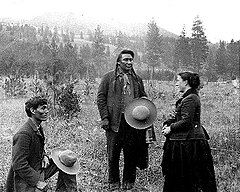
An 1889 photograph of Joseph speaking to ethnologist Alice Cunningham Fletcher and her interpreter James Stuart

In 1873, Joseph negotiated with the federal government to ensure his people could stay on their land in the Wallowa Valley. But in 1877, the government reversed its policy, and Army General Oliver O. Howard threatened to attack if the Wallowa band did not relocate to the Idaho reservation with the other Nez Perce. Joseph reluctantly agreed. Before the outbreak of hostilities, General Howard held a council at Fort Lapwai to try to convince Joseph and his people to relocate. Joseph finished his address to the general, which focused on human equality, by expressing his “[disbelief that] the Great Spirit Chief gave one kind of men the right to tell another kind of men what they must do.” Howard reacted angrily, interpreting the statement as a challenge to his authority. When Toohoolhoolzote protested, he was jailed for five days.

The day following the council, Joseph, White Bird, and Looking Glass all accompanied Howard to examine different areas within the reservation. Howard offered them a plot of land that was inhabited by whites and Native Americans, promising to clear out the current residents. Joseph and his chieftains refused, adhering to their tribal tradition of not taking what did not belong to them. Unable to find any suitable uninhabited land on the reservation, Howard informed Joseph that his people had 30 days to collect their livestock and move to the reservation. Joseph pleaded for more time, but Howard told him he would consider their presence in the Wallowa Valley beyond the 30-day mark an act of war.

Returning home, Joseph called a council among his people. At the council, he spoke on behalf of peace, preferring to abandon his father’s grave over war. Toohoolhoolzote, insulted by his incarceration, advocated war. In June 1877, the Wallowa band began making preparations for the long journey to the reservation, meeting first with other bands at Rocky Canyon. At this council, too, many leaders urged war, while Joseph continued to argue in favor of peace. While the council was underway, a young man whose father had been killed rode up and announced that he and several other young men had retaliated by killing four white settlers. Still hoping to avoid further bloodshed, Joseph and other non-treaty Nez Perce leaders began moving people away from Idaho.

More at: https://en.wikipedia.org/wiki/Chief_Joseph

Pisces New Moon, February 19 – 20, 2023

Wendy Cicchetti

Pisces New Moon

The New Moon in Pisces reminds us of our sensitivities and essential connections to one another. And being in an early degree, we are prompted to reflect on the lessons of Pisces. This compassionate Moon lends a reminder that when we hurt another, we also hurt ourselves. This idea’s rooted in the ancient Stoicism of Marcus Aurelius, and also in Buddhist philosophy, as echoed by monk and peace activist Thích Nhat Hanh, author of Taming the Tiger Within: “Punishing the other person is self-punishment. That is true in every circumstance.”

Marcus Aurelius’s chart features Venus in Pisces trine Saturn. His idea in his book Meditations is that “what injures the hive injures the bee” — if you hurt one person, you hurt the group as a whole. Upon reflection of the deeper wisdom, we may recall feeling badly when we hurt someone — at least later, if not in the moment. Or we may appreciate how we rely on one another in our various groups — families, communities, work hubs, etc. — and if something goes wrong because we hurt someone, then the group suffers too.

The Moon is conjunct dry, old Saturn, echoing an “uphill struggle” as we work to access compassion toward ourselves and others, whilst finding balance against the choppy sea of life that Piscean sensitivity will surely have us rocking around on!

Saturn is our teacher and governor as much as our strict parent or jailer — depending on what frustrating or limiting situation we may find ourselves in. Sometimes it is the simple framework of life, with its relentless march of time, that places us in such challenging circumstances. At others, we deal with individuals, groups, or institutions determined to stand in our way. But if we meet with the stony resistance of a concrete pillar in our midst, we can learn something from it! Maybe we need equally solid resources to mount our case and make progress — or we appreciate how forcing through such material with our delicate, human flesh simply hurts, and unless we relish cuts and bruises, we consider another path in our pursuit.

If our lessons and realizations seem painful along the way, at least we can take heart from the Moon’s slightly wide sextile to its North Node in Taurus, hinting at growth from our efforts, despite uncertainty of how or when it will manifest. Jupiter is in the more wilful, self-focused, and go-ahead sign of Aries. But before that sounds like a heap of trouble, we might notice that it is conjunct healing asteroid Chiron. It seems there is a need to do some of our own thing, whilst ideally finding a way that doesn’t threaten or harm others.

Besides, the pressing energy of Jupiter in Aries can make someone a generous leader, whilst fulfilling any internal desire for glorious accomplishment. Sir Bob Geldof from Irish band the Boomtown Rats — a Jupiter in Aries native — is famous for kicking off the Band Aid and Live 8 initiatives, and the massively successful 1985 Live Aid concert in London, raising over $200 million for charity in Africa — whilst earning a knighthood!

This article is from the Mountain Astrologer by Diana McMahon Collis