The small man Builds cages for everyone He knows. While the sage, Who has to duck his head When the moon is low, Keeps dropping keys all night long For the Beautiful Rowdy Prisoners. — Hafez
Hafiz became a poet at the court of Abu Ishak and also taught at a religious college. He is one of the most celebrated of the Persian poets, and his influence can be felt to this day.
How fortunate are you and I who’s home is timelessness. We who have wandered down from fragrant mountains of eternal now to frolic in such mysteries as birth and death a day, or maybe even less…
Edward Estlin Cummings, who was also known as E. E. Cummings, e. e. cummings and e e cummings (October 14, 1894 – September 2, 1962), was an American poet, painter, essayist, author and playwright. He wrote approximately 2,900 poems, two autobiographical novels, four plays, and several essays. Wikipedia
For God To make love, For the divine alchemy to work, The Pitcher needs a still cup. Why Ask Hafiz to say Anything more about Your most Vital Requirement?
Hafiz became a poet at the court of Abu Ishak and also taught at a religious college. He is one of the most celebrated of the Persian poets, and his influence can be felt to this day.
February 2023 is the silence before the storm. In March, Saturn enters Pisces, Pluto enters Aquarius, and Jupiter and Chiron meet up in Aries.
Until then, February gives us the chance to tie up loose ends and get ready to start on the right foot.
Let’s take a look at the most important transits of the month:
February 5th, 2023 – Full Moon In Leo
On February 5th, 2023 we have a Full Moon at 16° Leo.
Square Uranus, this is a “no compromise” Full Moon. Uranus in Taurus doesn’t fool around. If something doesn’t make sense at a visceral level, Uranus in Taurus (the intelligence of Gaia) will take action.
At the Full Moon in Leo, you will feel compelled to follow the truth, no matter what. Whatever needs to happen, will eventually happen.
February 11th, 2023 – Mercury Enters Aquarius
On February 11th, 2023 Mercury enters Aquarius, one of its favorite signs.
Aquarius is an Air sign, and Mercury loves air signs because Mercury and the Air element share similar qualities: communication, awareness, curiosity, and objectivity.
The upcoming weeks are great for any activities that involve the intellect: learning, reading, solving problems by connecting the dots, social networking, or doing group activities.
February 15th, 2023 – Venus Conjunct Neptune
On February 15th, 2023 we have a magical Venus-Neptune conjunction at 24° Pisces. Venus conjunct Neptune in Pisces is the most romantic transit you can get. What a treat for Valentine’s day!
Whether you’re in a relationship or not, this is a great time to connect with your heart from a “not knowing” place to receive its eternal wisdom and guidance.
February 16th, 2023 – Sun Conjunct Saturn
One day later, on February 16th, 2023, Sun and Saturn meet in a serious conjunction at 27° Aquarius. Energetically, Sun-Saturn can feel like the anticlimax of Venus-Neptune.
But it doesn’t have to be.
If Venus and Neptune’s dreams and ideals are based on higher, unconditional love, then Sun and Saturn will give them a solid 3D foundation.
If what we want (Venus) is in alignment with what the universe wants (Neptune), Saturn will give us the support we need.
February 19th, 2023 – Sun Enters Pisces
On February 19th, 2023 Sun enters Pisces. Happy birthday to all Pisces out there!
Pisces is the last sign of the zodiac. The Pisces season is when we complete the 12-month cycle, or one astrological year.
February and March (the time before the Aries equinox) have always been a good time to declutter the house, the body, the mind and the soul.
During the Pisces season, take some time to reflect on what this astrological cycle has meant for you, and what you are moving towards or inviting in the next Sun cycle.
February 20th, 2023 – New Moon In Pisces
On February 20th, 2023 we have a New Moon at 1° Pisces.
The New Moon is making an out of sign conjunction with Saturn (at 28° Aquarius) so this is a more serious New Moon, at least compared to previous, Neptune-infused New Moons in Pisces.
The New Moon will give us a taste of the upcoming Saturn in Pisces transit.
This New Moon in Pisces has great manifestation potential. The New Moon in Pisces will aim to make the intangible, tangible and to turn 5D dreams into 3D realities. Dreams DO come true IF we do the work (Saturn).
February 20th, 2023 – Venus Enters Aries
On February 20th, 2023 Venus enters Aries. In Aries, Venus knows what she wants and goes after what she wants. Venus in Aries can also make us prone to instant gratification “I want this and I want it NOW”.
The best quality of Venus in Aries is emotional honesty. When we tap into Venus in Aries’ boldness and aliveness with an open heart, we automatically connect with that part of us that is real and genuine.
Venus in Aries is a great transit to practice emotional honesty with yourself and others. Do you like pancakes? Own it. Do you dislike Madonna? Own that too.
Venus in Aries is not necessarily about broadcasting your feelings to the world – but about accepting and owning your feelings, values, likes and dislikes.
February 25th-28th, 2023 – Jupiter Conjunct Chiron In Aries
In the last week of February we don’t have any significant aspects, except for the applying Jupiter-Chiron conjunction. Jupiter is now at 11° Aries, Chiron at 13° Aries. The conjunction is slowly building up (and will become exact in March).
Pay attention to any feelings, events, or developments – anything that stirs inside you feelings of vulnerability.
Chiron is that “owie” we all feel, that wound we all share. And Jupiter will put the magnifying glass on it. Not to make us suffer – but to help us pay attention to what matters.
You may have flashbacks of old hurts back from your childhood. A parent who ignored you. A classmate who bullied you. A teacher who made you feel inadequate. An event where you felt exposed or ashamed in front of other people.
Old wounds will resurface to remind us of painful experiences we haven’t fully processed. This acknowledgment of the wound is a normal part of the healing process. Healing WILL come, but first, we need to make friends with the wound.
I will write a report about the Jupiter-Chiron conjunction closer to the date. Until then, have a great February!
It is a gladness to be able to call one’s daily work a labor of love, and to have that labor put food on the table the way any work does, dishwashing or dentistry. And yet such labors of diligence and devotion — the kind William Blake called “eternal work” — are somehow different, different and more vulnerable, for they enter the world in a singular spirit and are recompensed in a singular spirit, distinct from dentistry or dishwashing.
That spirit is the spirit of a gift — not the transaction of two commodities but the interchange of two mutual generosities, passing between people who share in the project of a life worth living.
A year before I was born, the poet Lewis Hyde taxonomized that vital and delicate distinction between work and labor in his eternally giving book The Gift: How the Creative Spirit Transforms the World (public library) — a timeless inquiry into what it takes to harmonize “the inner gift that we accept as the object of our labor, and the outer gift that has become a vehicle of culture.”
Work is what we do by the hour. It begins and ends at a specific time and, if possible, we do it for money. Welding car bodies on an assembly line is work; washing dishes, computing taxes, walking the rounds in a psychiatric ward, picking asparagus — these are work. Labor, on the other hand, sets its own pace. We may get paid for it, but it’s harder to quantify. “Getting the program” in AA is a labor. It is likewise apt to speak of “mourning labor”: when a loved one dies, the soul undergoes a period of travail, a change that draws energy. Writing a poem, raising a child, developing a new calculus, resolving a neurosis, invention in all forms — these are labors. Work is an intended activity that is accomplished through the will. A labor can be intended but only to the extent of doing the groundwork, or of not doing things that would clearly prevent the labor. Beyond that, labor has its own schedule. Things get done, but we often have the odd sense that we didn’t do them… We wake up to discover the fruits of labor.
At the heart of the distinction is the recognition that those fruits are offered to the world not as a service or a transaction but as a gift — “the gift we long for, the gift that, when it comes, speaks commandingly to the soul and irresistibly moves us.” The challenge arises when we try to reconcile the spiritual ecosystem of gifts with the material market economy within which they dwell — the economy of sustenance and solvency of which every modern person partakes just in the course of staying alive.
An epoch before Patreon and Kickstarter and Substack, Hyde issues a clarion call for honoring the gifts we receive:
If we really valued these gift labors, couldn’t we pay them well? Couldn’t we pay social workers as we pay doctors, pay poets as we do bankers, pay the cellist in the orchestra as we pay the advertising executive in the box seat? Yes, we could. We could — we should — reward gift labors where we value them. My point here is simply that where we do so we shall have to recognize that the pay they receive has not been “made” the way fortunes are made in the market, that it is a gift bestowed by the group. The costs and benefits of tasks whose procedures are adversarial and whose ends are easily quantified can be expressed through a market system. The costs and rewards of gift labors cannot.
Art by William Blake for Shakespeare’s A Midsummer Night’s Dream. (Available as a print.)
In a sentiment that gladdens those of us who offer the fruits of our labors freely and are sustained by what is given freely in return, he adds:
The spirit of a gift is kept alive by its constant donation… The gifts of the inner world must be accepted as gifts in the outer world if they are to retain their vitality.
New Thinking Allo • Jan 29, 2023 James Tunney, LLM, is an Irish barrister who has lectured on legal matters throughout the world. He is a poet, artist, scholar, and author of The Mystery of the Trapped Light: Mystical Thoughts in the Dark Age of Scientism plus The Mystical Accord: Sutras to Suit Our Times, Lines for Spiritual Evolution; also Empire of Scientism: The Dispiriting Conspiracy and Inevitable Tyranny of Scientocracy, TechBondAge: Slavery of the Human Spirit, and Human Entrance to Transhumanism: Machine Merger and the End of Humanity. His most recent book is Plantation of the Automatons. This interview focuses on the many controlling loops in which we are embedded. 00:00:00 Introduction 00:04:04 Loops and consciousness 00:12:56 Will vs. surrender 00:28:05 Danger of technology 00:33:52 Our dark age 00:37:43 Circularity of time 00:45:43 Is culture pluralistic 00:57:21 We are being frightened 01:05:35 Role of religions 01:15:40 Conclusion Edited subtitles for this video are available in Russian, Portuguese, Italian, German, French, and Spanish. New Thinking Allowed host, Jeffrey Mishlove, PhD, is author of The Roots of Consciousness, Psi Development Systems, and The PK Man. Between 1986 and 2002 he hosted and co-produced the original Thinking Allowed public television series. He is the recipient of the only doctoral diploma in “parapsychology” ever awarded by an accredited university (University of California, Berkeley, 1980). He is also the Grand Prize winner of the 2021 Bigelow Institute essay competition regarding the best evidence for survival of human consciousness after permanent bodily death. (Recorded on December 29, 2022)
There is a peculiar existential loneliness that entombs us whenever we lose our sense of connection to the web of being — the self begins to feel like a twig torn from the tree of life, and something inside us withers with longing. We are left without sanctuary — a word that comes from the Latin sanctorium: a repository for holy things. The word “holy” shares its own Latin root with “whole” and has its Indo-European origins in the notion of the interleaving of all things. When we lose that sense of connection, that sense of belonging to the sanctorium of life, we are left less whole.
Rootedness is a way of being in concert with the wilderness — and wildness — that sustains humans and all of life.
[…]
The word rooted’s own root is the Latin radix, the center from which all things germinate and arise. The radix is the radical — the intrinsic, organic, fervent heart of being and action. Rooted lives are radically intertwined with the vitality of the planet. In a time that evokes fear and paralysis, rooted ways of being-within-nature assure us that we are grounded in the natural world. Our bodies, our thoughts, our minds, our spirits are affected by the whole of the earthen community, and affect this whole in return. This is both a mystical sensibility and a scientific fact. It is an awareness that makes us tingle with its responsibility, its beauty, its poetry. It makes our lives our most foundational form of activism. It means everything we do matters, and matters wondrously.
For those of us who live with secular rationality and a tenderness for life, that sense of wonder and connection is a kind of spirituality — the fundament of the sacred, in which the everyday holiness of this world comes alive.
Haupt gives shape to the way in which “apprehension of life’s radical interconnection” — whether we call it rootedness, or belonging, or love — reclaims the meaning of “God” for us who don’t abide by religion:
When the fraught name God comes up in conversation or reading, I always remind myself that whatever the source or language used, we are at root on common ground — invoking the graced, unnamable source of life, the sacredness that cradles and infuses all of creation, on earth and beyond. I know that prayer is the lifting of our hearts, our thoughts, and even our bodies in conversation, or contemplation, or remembrance, or supplication, or gratitude within this whole, requiring no dogma, only openness. Hildegard counseled, “To be alive is to give praise.”
“It’s nervous work. The state you need to write in is the state that others are paying large sums of money to get rid of.”
–SHIRLEY HAZZARD
Shirley Hazzard (January 30, 1931 – December 12, 2016) was an Australian-American novelist, short story writer, and essayist. She was born in Australia and also held U.S. citizenship. Wikipedia
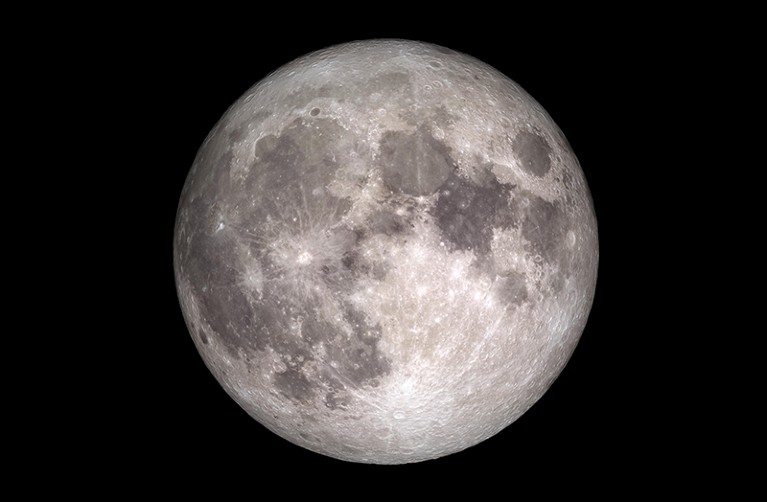
Scientists and space agencies have not yet agreed how to define lunar time.Credit: NASA Goddard
The coming decade will see a resurgence in lunar exploration — including dozens of missions and plans to establish permanent bases on the Moon. The endeavours pose myriad challenges. Among them is a subtle, but fundamental, question that metrologists worldwide are working to answer: what time is it on the Moon?
“We’re just starting to lay this out,” says Cheryl Gramling, an aerospace engineer who leads the position, navigation and timing team at NASA’s Goddard Space Flight Center in Greenbelt, Maryland.The $93-billion plan to put astronauts back on the Moon
The Moon doesn’t currently have an independent time. Each lunar mission uses its own timescale that is linked, through its handlers on Earth, to coordinated universal time, or UTc — the standard against which the planet’s clocks are set. But this method is relatively imprecise and spacecraft exploring the Moon don’t synchronize the time with each other. The approach works when the Moon hosts a handful of independent missions, but it will be a problem when there are multiple craft working together. Space agencies will also want to track them using satellite navigation, which relies on precise timing signals.
It’s not obvious what form a universal lunar time would take. Clocks on Earth and the Moon naturally tick at different speeds, because of the differing gravitational fields of the two bodies. Official lunar time could be based on a clock system designed to synchronize with UTC, or it could be independent of Earth time.
Representatives of space agencies and academic organizations worldwide met in November 2022 to start drafting recommendations on how to define lunar time at the European Space Research and Technology Centre of the European Space Agency (ESA) in Noordwijk, the Netherlands.
Decisions must be made soon, says Patrizia Tavella, who leads the time department at the International Bureau of Weights and Measures in Sèvres, France. If an official lunar time is not established, space agencies and private companies will come up with their own solutions, she says. “This is why we want to raise an alert now, saying let’s work together to take a common decision.”
Tracking satellites
The most pressing need for lunar time comes from plans to create a dedicated global satellite navigation system (GNSS) for the Moon, similar to how GPS and other satellite navigation networks enable precise location tracking on Earth. Space agencies plan to install this lunar GNSS from around 2030. ESA approved a lunar satellite navigation project called Moonlight at its ministerial council meeting on 22 and 23 November 2022 in Paris, and NASA established a similar project, called Lunar Communications Relay and Navigation Systems, last January.
Until now, Moon missions have pinpointed their locations using radio signals sent to large antennas on Earth at scheduled times. But with dozens of missions planned, “there’s just not enough resources to cover everybody”, says Joel Parker, an engineer who works on lunar navigation at the Goddard Center.
Image credit: NASA
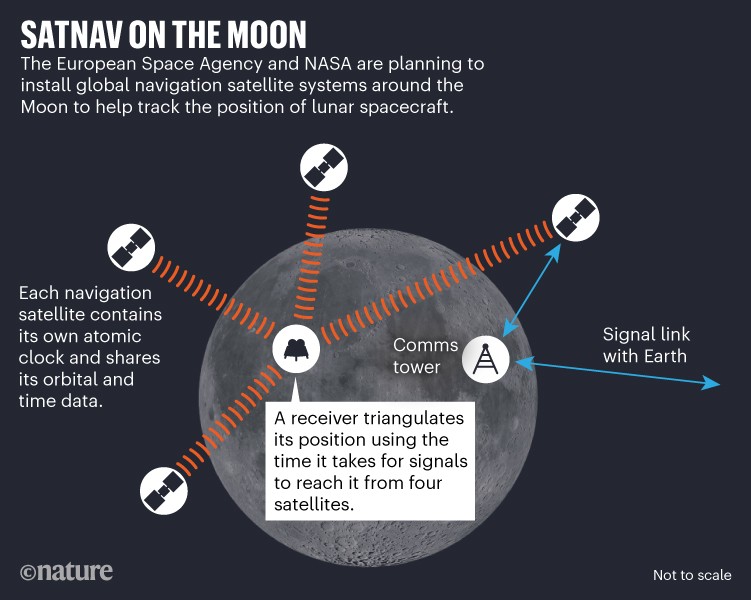
As a first step, from 2024, ESA and NASA will trial deriving positions on the Moon using faint satellite navigation signals from Earth-based craft. Next, the lunar GNSS projects plan to place dedicated satellites around the Moon, each containing their own atomic clock (see ‘Satnav on the Moon’). A receiver, for example on the Moon’s surface, will then triangulate its position using the time it takes for satellite signals to reach it. ESA has planned an initial constellation of four spacecraft that would cover navigation at the lunar south pole, which harbours much of the Moon’s water and is an important target for exploration, says Jörg Hahn, an engineer working on ESA’s Moonlight project.
Moon missions will also need an official lunar time to cooperate and communicate, says Hahn. “All this has to trace to one kind of a time reference, otherwise you have chaos and things do not work together.”
Another open question, says Hahn, is whether astronauts would use universal lunar time everywhere on the Moon. Although lunar time would remain the official timescale, its users might, as on Earth, want to offset it in time zones that link to the Sun’s position in the sky. This is less a question for metrologists and more one of convention. “When somebody really lives there on the Moon, I think it makes sense,” he says.
Characterizing time
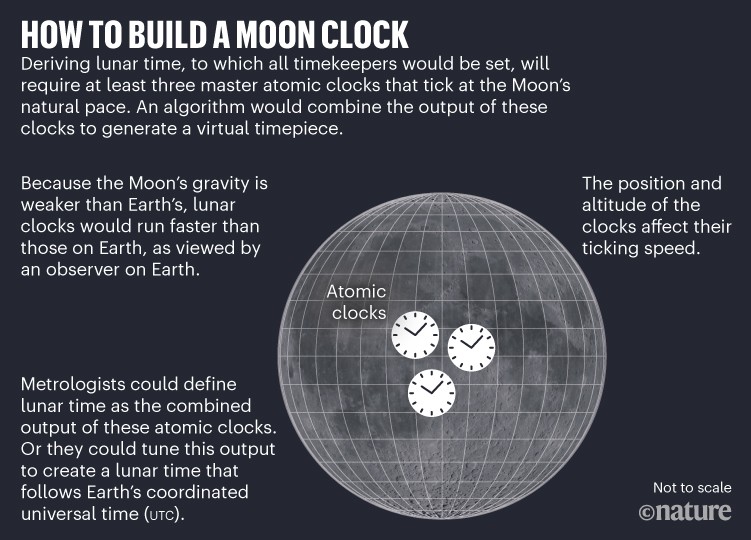
Defining lunar time is not simple. Although the definition of the second is the same everywhere, the special theory of relativity dictates that clocks tick slower in stronger gravitational fields. The Moon’s gravitational pull is weaker than Earth’s, meaning that, to an observer on Earth, a lunar clock would run faster than an Earth one. Gramling estimates that a lunar clock would gain about 56 microseconds over 24 hours. Compared with one on Earth, a clock’s speed would also subtly change depending on its position on the lunar surface, because of the Moon’s rotation, says Tavella. “This is a paradise for experts in relativity, because you have to take into account so many things,” she adds.
Defining a lunar standard, with which all clocks are compared, will involve installing at least three master clocks that tick at the Moon’s natural pace, and whose output is combined by an algorithm to generate a more accurate virtual timepiece (see ‘How to build a Moon clock’).
What happens then depends on which option metrologists choose. They might decide to base lunar time on UTC. In that case, this virtual lunar time would be synchronized regularly with terrestrial UTC. Between the check-ins, the lunar master clocks would keep marking time until the next synchronization. This has the advantage of being simple for users back on Earth to interact with.
Image credit: NASA
The alternative would be to use the synthesized output of the lunar atomic clocks as the Moon’s own independent, continuous time, and to track its relationship to UTC. That way, even if the connection with Earth is lost, clocks on the Moon will still agree with each other and allow safe navigation and communications, says Gramling. Establishing an independent time is a model that will also work for the more-distant planets that space agencies are ultimately targeting, such as Mars. Transmitting UTC there would be more complicated than to the Moon, she adds.
In this scenario, days on the Moon could even be defined differently from those on Earth, to account for the time from solar noon to solar noon taking an average of 29.5 Earth days. Earth days will always matter to astronauts, given the human need for sleep on a roughly 24-hour cycle. But the definition is something metrologists will need to agree on.NASA’s Orion spacecraft reaches the Moon — in pictures
Metrologists will also need to decide where on the Moon to place the master clocks. As on Earth, the devices’ altitude will affect ticking speed. The clocks could be in lunar orbit or on the surface, says Hahn. “This is what we are discussing right now with our NASA colleagues.”
Space agencies are also considering other necessary standards — such as which maps of the lunar terrain and coordinate systems to use for navigation — through the Interagency Operations Advisory Group, a council of national space agencies and the United Nations International Committee on GNSS. To make various countries’ systems interoperable, reference systems will have to be agreed internationally, says Gramling.
With ESA’s help, NASA is developing a framework called LunaNet, for which it hopes to get international buy-in. LunaNet consists of a set of rules that would enable all lunar satellite navigation, communication and computing systems to form a single network similar to the Internet, regardless of which nation installs them. Setting lunar time is part of a much bigger picture.
“The idea is to produce a Solar System internet,” says Gramling. “And the first part would be at the Moon.”
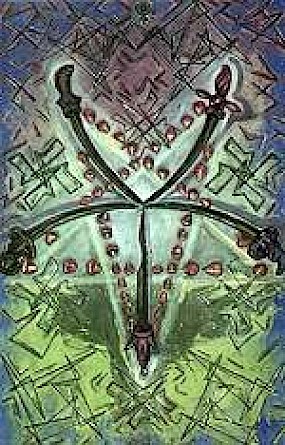
The Lord of Defeat is yet another of the unwelcome Sword cards. It generally appears to indicate that we are in for some disappointment or loss.
In a highly competitive world, we are bound to be defeated by some of the challenges we set ourselves. If we are not to limit ourselves so severely that we never compete for anything, then at some time this card will inevitably come up. And our response to its effect is very important. If we feel shattered and disillusioned, then we will start the process which leads inevitably to the Ten of Swords – Ruin.
The way we face the Five of Swords has a great deal to do with how much effect a setback can have on the whole of our life. If we are able to accept that we cannot be winners all the time, if we are to set our minds to learning from our experiences, if we are to struggle to be positive in the face of adversity, then we can overcome disappointment, and rob the Lord of Defeat of total triumph!
In occasional really bad cases the card can indicate external treachery – somebody deliberately attempting to undermine or damage us. In this case it will almost always come up with other Swords like the Nine of Swords, or the Eight of Swords. If the Ten of Swords appears further on in the reading, then we are in danger of being affected quite dramatically. In this case you would need to consider who you think your enemies are, and take appropriate steps to combat their illwill – never underestimate the power of other people’s malice. And don’t retaliate with more of the same!
At most times the Five of Swords will indicate much smaller matters than this – you won’t get the job you applied for; you won’t sell the manuscript this time; you won’t get the exam result you wanted; you won’t get the house you tried to buy. Look for surrounding cards that indicate the area of your life which will be affected.
It’s natural to feel down-hearted when we don’t get what we want. But it’s rare that every single thing in a person’s life is going badly at the same time. So count your blessings, pick yourself up and go and do something nice for yourself. And remind yourself of something – you tried, and can try again. And maybe next time your efforts will be met by the Lord of Success!!
(via angelpaths.com and Alan Blackman)
Consciousness, spirituality, biography, sexuality, androgyny, futurism, space, the arts, science, astrology, democracy, humor, books, movies and more









 Work is what we do by the hour. It begins and ends at a specific time and, if possible, we do it for money. Welding car bodies on an assembly line is work; washing dishes, computing taxes, walking the rounds in a psychiatric ward, picking asparagus — these are work. Labor, on the other hand, sets its own pace. We may get paid for it, but it’s harder to quantify. “Getting the program” in AA is a labor. It is likewise apt to speak of “mourning labor”: when a loved one dies, the soul undergoes a period of travail, a change that draws energy. Writing a poem, raising a child, developing a new calculus, resolving a neurosis, invention in all forms — these are labors. Work is an intended activity that is accomplished through the will. A labor can be intended but only to the extent of doing the groundwork, or of not doing things that would clearly prevent the labor. Beyond that, labor has its own schedule. Things get done, but we often have the odd sense that we didn’t do them… We wake up to discover the fruits of labor.