Tony Bravo June 25, 2022 (datebook.sfchronicle.com)
The COVID-19 pandemic has exacerbated mental health problems in the United States and around the world, according to the World Health Organization and the American Psychological Association. Psychologists reported that their referrals almost doubled from 2020 to 2021.Photo: Malte Mueller / Getty Images
I just found out my therapist of five years is retiring.
This probably sounds like the setup to a joke, but it’s not. If I were going to make a joke, which I was once told was a form of psychological deflection during a session, I would probably say something like, “Anyone who has had to listen to my Millennial frustrations for the past five years deserves a happy retirement.”
I’m grateful that I have access to mental health care through my insurance, which I know is not true for everyone. Living in San Francisco — or anywhere in the United States — in 2022 you see the results of a society with insufficient emphasis on and access to mental health care in an intimate way. Locally, we witness people suffering on the streets and self-medicating. Nationally, we are confronted by it in the form of the mass shooting phenomenon and in the ludicrous, mendacious rhetoric of the gaslighting wing of our culture.
There are so many times when I wish the world could just collectively get on the couch and work through some things.
I’ve always been a fan of the idea of check-ins with a therapist as a part of my emotional maintenance plan. Whether we’re talking about the Golden Gate Bridge, our bodies or our psyches, I’m a believer in maintenance and consulting experts. I’ve never understood why so many people think that seeking therapy is somehow a sign of weakness or that there’s some kind of mental fortitude or grit that comes with internalizing your emotions. I don’t cut my own hair or do my own dentistry, so why wouldn’t I enlist a professional for my mental health?
Lorraine Bracco stars as Dr. Melfi, a therapist, on “The Sopranos.”Photo: HBO
In the past 2½ years of pandemic existence, many people have found themselves living with new kinds of stresses and fears that have manifested in different ways. During that first year of the COVID-19 pandemic alone, global prevalence of anxiety and depression increased an estimated 25%, according to a scientific brief released by the World Health Organization in March. A 2021 survey from the American Psychological Association showed, not surprisingly, that psychologists reported referrals almost doubling from 2020, from 37% to 62%.
With my therapist’s retirement, it made me reflect on how little thanks mental health care providers get across the board. Because the needs and concerns of everyday life aren’t something that heal or get better in an obvious way, like a broken leg or physical illness, I think we’re bad about acknowledging their impact. I’m also not sure pop culture has ever accurately depicted the life benefits of therapy.
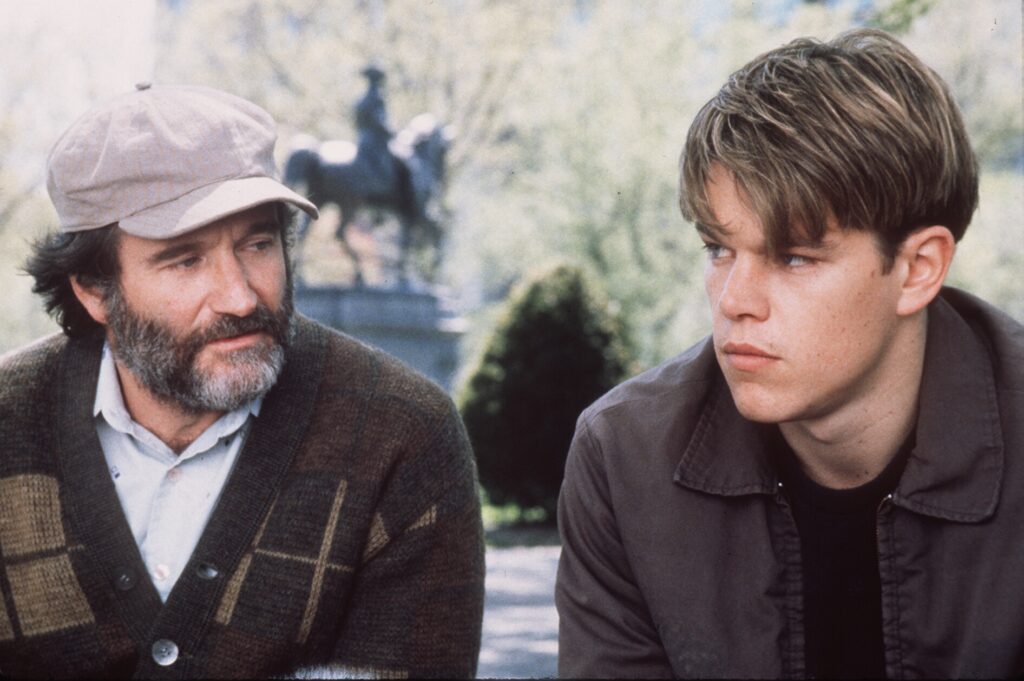
When you see therapy in movies and on television, its success is usually demonstrated with some big “aha” moment where the person is pushed to a cathartic breakthrough (think the “It’s not your fault” scene in “Good Will Hunting”). That possibly happens for some people, but for most of us, the work we do in session would be pretty boring conversations for an observer.
But that’s not to say that work isn’t essential.
Robin Williams (left) and Matt Damon in the movie “Good Will Hunting.” Williams plays Sean, a therapist trying to reach the brilliant but troubled Will, played by Damon.Photo: George Kraychyk
I’m not going to write about what my therapist and I have discussed these past five years in a column (please, I’m saving that for a book), but I will say I would not have fared as well without our time together. The calling to help people is obviously noble, but the calling to listen to people is particularly special.
I am grateful to all in the mental health care field who let us work through our stories.
Tony BravoTony Bravo’s column appears Mondays in Datebook. Email: tbravo@sfchronicle.com Twitter: @TonyBravoSF
Craig Hamilton Apr 2, 2020 Find more inspiring videos, audios, and articles at https://craighamiltonglobal.com When it seems as if the world around us is falling apart, it’s important to stay rooted in a deep source of spiritual equanimity.
Dragonflyer33 May 18, 2022 Shaq after a recent dinner with Brady admitted that he was a pretty man. This led to Chuck taking this to another level, and creating a segment for the ages Full segment: https://www.youtube.com/watch?v=Uoe67… Shaqtin’ A Fool segment: https://www.youtube.com/watch?v=Ivaqe… Below is a link for a FREE 30 day trial of Amazon prime https://amzn.to/3JfaIgr *This is an affiliate link* Follow me on IG: https://instagram.com/dragon_flyer33?… A comfortable and cheap gaming/office chair: https://amzn.to/3gHZPVh Cheap, Long lasting wireless headphones: https://amzn.to/3m74tA9 Thanks for watching, be sure to drop a like and subscribe for more content All clips belong to their respective owners, no copyright infringement intended This video is for entertainment
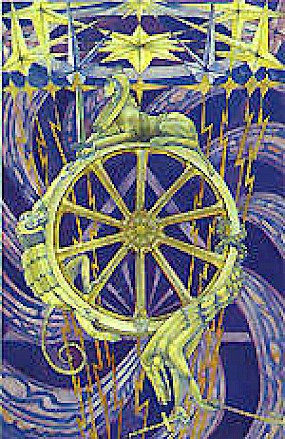
The Wheel of Fortune is numbered ten and is usually shown as a great wheel. Sometimes Fortuna is seen, turning the wheel for all eternity. There are people or animals on the Wheel – some are falling off to be crushed, some are struggling to stay on, while a solitary figure makes no attempt to maintain its position but succeeds anyway.
Fortune is not the same as luck. We make our own luck and follow our own destiny. Good fortune comes from the still centre which contains the very heart of ourselves. The seasons will continue to wheel, the sun will rise and set, the planets will move in their allotted courses – with or without us.
If we struggle against the flow of life, we become those struggling to ascend the Wheel, or even one of those crushed beneath it. However, if we realise our own power to create a beneficial future and then trust in that vision, we shall become the still figure, master of our own universe.
New Thinking Allowed with Jeffrey Mishlove Jun 26, 2022 James Tunney, LLM, is an Irish barrister who has lectured on legal matters throughout the world. He is a poet, a scholar, and author of The Mystery of the Trapped Light: Mystical Thoughts in the Dark Age of Scientism plus The Mystical Accord: Sutras to Suit Our Times, Lines for Spiritual Evolution; also Empire of Scientism: The Dispiriting Conspiracy and Inevitable Tyranny of Scientocracy, TechBondAge: Slavery of the Human Spirit, and Human Entrance to Transhumanism: Machine Merger and the End of Humanity. His website is http://www.jamestunney.com. Here James describes the contributions of the British writer, Evelyn Underhill (1875-1941), to our understanding of mysticism. During her lifetime, she wrote 39 books covering many aspects of the mystical path, including her 1911 classic, titled Mysticism. She also wrote about ancient Greek and Indian mysticism. While she was a student of esoteric, occult, and magical practices – she saw the great medieval mystics of Europe as exemplars of theurgy. New Thinking Allowed host, Jeffrey Mishlove, PhD, is author of The Roots of Consciousness, Psi Development Systems, and The PK Man. Between 1986 and 2002 he hosted and co-produced the original Thinking Allowed public television series. He is the recipient of the only doctoral diploma in “parapsychology” ever awarded by an accredited university (University of California, Berkeley, 1980). He is also the Grand Prize winner of the 2021 Bigelow Institute essay competition regarding the best evidence for survival of human consciousness after permanent bodily death. (Recorded on June 8, 2022)
In June 1816, five young people high on romance and rebellion — two still in their teens, one barely out, none beyond their twenties — found themselves in bored captivity at a rented villa on the shore of Lake Geneva as an unremitting storm raged outside for days. If they couldn’t have the dazzling spring days for which they had fled England, they would have long rambling nights of poetry readings and philosophical disquisitions, animated by wine and laudanum.
The Villa Diodati 200 years later.
So it is that, late one stormy night, one of them — Lord Byron: gifted, grandiose, violently insecure, “mad, bad, and dangerous to know,” in the words of one of his discarded lovers — pulled a French translation of some German ghost stories from their Airbnb’s bookshelf and read from it to the group. He then suggested that they each write a supernatural story of their own, share the results aloud, and vote a winner.
Of the five, one alone completed the challenge at the Villa Diodati and made of it something to outlast its marble columns. It was not His Lordship.
The idea came to her in a “waking dream” several nights later, Mary Shelley (August 30, 1797–February 1, 1851) would recall, looking back on the crucible of creativity — the dream she would sculpt, over the next year of ferocious writing and revision, into one of humanity’s most visionary works of literature.
Mary Shelley
There is no record of the exact night or the exact hour. But two centuries later, drawing on Mary’s account of the moment her idea finally arrived as she lay in bed restless with “the moonlight struggling to get through,” astronomers would use the phase of the Moon and its position in the sky over the Villa Diodati to determine that the only light bright enough to clear the hillside and shine through Mary’s shutters in the middle of the night was the gibbous of June 16, just shy of 2 A.M.
“Once a poem is made available to the public,” the teenage Sylvia Plath would tell her mother a century-some later, “the right of interpretation belongs to the the reader.” Like a great poem, Frankenstein; or, The Modern Prometheus would lend itself to infinite interpretations as it came to tower over the popular imagination for centuries to come, casting its long shadow over the fault lines of the future — the future that is now our present, in which so many of the ideas Mary Shelley contoured and condemned are realities both mundane and menacing: artificial intelligence and genetic engineering, racism and income inequality, the longing for love and the lust for power.
Rising above the multitude of possible readings is the overarching concern that unites them all: the responsibility of life to itself and the question of what makes a body a person; the clear sense that any life is a responsibility — one not to be taken lightly, not to be sullied with vanity and superstition, not to be used as a plaything of power.
Mary Shelley. Art from Literary Witches — an illustrated celebration of trailblazing women writers who have enchanted and transformed the world.
Victor Frankenstein creates a life out of vainglorious ambition and existential loneliness, and flees from his own creation in horror. Unable to love the life he has made, he fails to rise to the fundamental responsibility that parenting demands.
Deprived of that primary bond of love, which moors us to the seabed of being to weather life’s storms, the Creature — which Mary Shelley herself never calls a “monster,” a word applied to him only in later stagings of her masterwork — is savaged by such profound self-loathing that he ends up destroying numerous innocent passersby who cross his sad path. “I am malicious because I am miserable,” he roars in one the truest and most devastating lines in all of literature, in all the common record of our reckoning with human nature.
Mary Shelley’s warning rises from the story sonorous and clear as larksong: Life is not to be made, unless it can be tended with love — or else it dooms all involved to a living death.
“Oh! Stars and clouds and winds,” cries the Creature in his anguished wish for self-erasure, “if ye really pity me, crush sensation and memory” — anguish outmatched only by that of his creator. Wishing with every fiber of his being that he could unmake the life he made but knowing that he cannot, Victor Frankenstein goes through his own life as “a miserable wretch, haunted by a curse that shut up every avenue to enjoyment.”
The notion of reproductive rights was nowhere near the cultural horizon in Mary Shelley’s lifetime. Still beyond the horizon were most basic human rights for women. No woman could vote. No woman could attend university. In her entire century, only four women successfully obtained divorce, and only after demonstrating savage brutality from their husbands. Husbands were legally allowed to beat and rape their wives, who were their property. Women could not own property, including their own bodies.
This was the world Mary was born into, by a mother — the brilliant founding mother of what posterity christened feminism — who had died in giving birth to her. Mary herself — penniless, malnourished, and wearied by long mountain crossings in exile — would barely survive the births of the four children she bore before she was twenty-four, three of whom would die before reaching adolescence. She was eighteen and had already lost her firstborn when she wrote one of the farthest-seeing works of her time, of all time.
With an eye to his creation — “the living monument of presumption and rash ignorance which I had let loose upon the world” — Victor Frankenstein laments the responsibility to life, to other lives, that he had sidestepped in the sweep of his passion:
In a fit of enthusiastic madness I created a rational creature and was bound towards him to assure, as far as was in my power, his happiness and well-being.
This was my duty, but there was another still paramount to that. My duties towards the beings of my own species had greater claims to my attention because they included a greater proportion of happiness or misery.
So begins his quest to track down and vanquish the life he ought never to have created in the first place — a quest that ultimately ends in his own destruction.
A world without the option of abating an ill-conceived life before it has begun is a world that dooms millions to Victor Frankenstein’s fate. What a pause-giving thought: that a girl not yet nineteen, who lived two centuries ago, has a finer moral compass than the Supreme Court of the world’s largest twenty-first-century democracy.
Several years and several deaths later — including that of her young husband — Mary Shelley would write the mirror-image of these ideas into another novel, imagining a twenty-first-century world savaged by a deadly pandemic to consider what ultimately makes life worth living.
Benjamin Studebakeris a graduate teaching assistant in politics and international studies at the University of Cambridge and a teaching associate at Gonville and Caius College, Cambridge.
So you want to be excellent at something? You don’t just want to be OK at it, to be able to get by or make a living. It’s not even enough to be rich and famous. Nickelback is a big Canadian band and they’ve made a ton of money, but most people don’t think their music is excellent. They are undeniably successful – but excellent? Excellence is a whole different thing.
Most of the advice out there is either about how to survive, or how to be successful. It’s also pretty two-dimensional. On one side, there are the people who tell you to work hard and be productive. Then there’s the other side, the people who tell you to ‘practise self-care’ to avoid burnout. Many self-help writers have made a lot of money from taking one of these sides and trashing the other.
Those writers are successful, but the advice they’re giving people isn’t excellent. It’s obvious that if we spend all our time just trying to get through the day, we won’t grow. But it’s also obvious that if we become obsessed with perfect ideals, we’ll burn out. You need a sustainable balance, a workable distribution of your time and energy. But distributing your time effectively is just the first step. The second step is to use your time in a way that leads to excellence rather than mere success.
Plato and Aristotle can help
The Greek philosophers Plato and Aristotle were wealthy aristocrats who didn’t have regular jobs. Because they had plenty of time and plenty of money, they could spend their whole lives thinking about what excellence really means. They didn’t have to worry about survival, because they were born with an income. They weren’t interested in success because, when you’re born rich, it’s not hard to be successful. They wanted to pursue the highest good, and they wanted that pursuit to be the object of everything they did. Even though you’re likely not a wealthy Greek aristocrat, you still have much to learn from them about excellence.
The first thing they noticed about being human is that even rich people are not gods. Everyone has a body, and our bodies have needs. Plato tells a story about this in one of his dialogues called the Phaedrus. He imagines the human being as a flying chariot, pulled by winged horses. The chariot has three parts. There is the rider, interested in truth, goodness and beauty. He wants to fly the chariot high into the sky, above the clouds, where these ideals can be discovered. But the rider has no wings. To get to the heavens, he relies on two horses – one light, and one dark. The light horse wants to be well regarded, prizing honour and status above all things. It responds to blame and praise. The dark horse wants to enjoy the pleasures of the world. It wants food, sex, sleep and every kind of luxury. The dark horse has no shame, but it fears the rider’s whip. For just as the dark horse values pleasure, it fears pain.
The rider can come to know excellence only if he can get these horses to fly the chariot up above the clouds, but the horses have no deep interest in what’s up there. The rider must motivate them by giving the horses enough of what they want to get them to cooperate, but not so much as to allow them to become too strong and drag the chariot wherever they wish. Ignore the horses outright, and they grow weak and disobedient. Cater to the horses too much, and they run the show. To achieve a type of excellence that gets at genuine value, we have to go beyond pleasure and status, but we can’t leave pleasure and status behind entirely. This type of excellence incorporates our physical and social needs, but goes beyond them, approaching value itself as an abstract ideal. To get there, a balance is needed, but what does that balance look like?
Think it through
Find a good social environment
Bringing balance to the chariot is a big challenge for a person. But it’s not a challenge we face alone. For Plato, the community we live in helps us take care of our horses. We don’t all grow our own food, make our own shelter, and provide our own entertainment. Other people help us meet the needs of the dark horse. And how can the light horse be satisfied without other people to make us feel valued and worthy? Plato argues that some social roles help us fly the chariot better than others. He even tries to make a list and put them all in order. Some roles barely give us enough to survive, much less thrive. Others give us comfort but aren’t respected. Some are respected but give us little comfort. A few yield comforts and respect but leave us without enough time to properly strive for excellence. When you’re choosing your work, your friends and your relationships, you have to keep all three things in mind. Miss comfort, and you’ll find yourself controlled by the need to be comfortable. Miss respect, and you’ll be controlled by the need to be respected. If you don’t leave time to strive, all you’ll do is survive.
Distribute your time well
How do we manage to obtain all three things in just one life? In the Politics, Aristotle distinguishes between ‘leisure’ and ‘play’. For him, leisure is time we spend learning and contemplating, trying to achieve excellence. Play is about rest and recovery. It might help you to think of Aristotle’s leisure as ‘growth’ and Aristotle’s play as ‘recovery’. So, for Aristotle, we spend our days doing three things – work, growth and recovery. The difficult thing is that both work and growth cost time and energy. Growing is at least as energy-intensive as working. We need time to recover from both activities.
When the eight-hour workday was first achieved, there was a slogan that went along with it:
Image supplied by the author
It sounds like we’re getting all three things. The trouble is that the time we spend sleeping isn’t enough time to recover. When we get home from work, we’re usually too tired for growth, but not tired enough to go to bed. Instead, we try to have a little bit of fun. We try to recover. We feel bad about this. Those last eight hours are for what we will! Why can’t we will ourselves to grow? But more often than not, this leads to burnout. And that’s for those of us who are working only eight hours a day and getting eight hours of sleep a night. For many of us, even that is too much to hope for. (Aristotle’s own very bad answer to the question of how to acquire more time – slavery – need not detain us here.)
These days, most people have to wait for retirement, hoping to save up enough money to spend some time on growth in later life. But by then many of us are in poor health and don’t have the energy to grow. What we have the energy to learn we often lack the energy to put to good use.
Alternatively, we can try to grow while we’re young. Some of us are lucky enough to find an area in which we’d like to pursue excellence from a very early age. With the support of a strong family and a strong public school system, we can get the time and resources we need to develop. But good families and good schools aren’t available to everyone. Plato thought that nepotism was a big problem. He didn’t believe that excellence was straightforwardly heritable. Sometimes, children with great potential would be born to parents without the ability to help them realise that potential. Sometimes, parents with a lot of ability would have children without the talent necessary to take on their parents’ roles. In the Republic, he proposed eliminating the family and raising children collectively. Aristotle thought that Plato’s approach was unnatural, that families were an inevitable part of social life. But Aristotle believed in natural hierarchies. He didn’t worry about talented people being left behind.
For some people, families work, and for other people, they don’t. To make families work, we need to ensure that they have the ability to support children as they pursue excellence, and that means we need to ensure families have enough economic stability to give their children room to grow. For those who don’t have adequate families or find the family structure alienating, we need alternative support systems. Too often, children in dysfunctional family structures are left in poor conditions because of a lack of alternatives. For those children, excellence is often out of reach before they even get to learn what the word ‘excellence’ means.
Get an education that suits your talents
The kind of schools we need depend in large part on the kind of excellence we’re pursuing. The Greek philosophers call these different areas of specialisation technê, or ‘crafts’. If we aren’t given the kind of education that’s appropriate to our craft, we won’t be able to become excellent. Many countries have public schools that favour a uniform education focused on reading, writing and arithmetic. But these schools don’t always do a good job of allowing students to find an area in which to excel. Plato points out that the kind of education we receive sets us on our path. If that education fixates too rigidly on a narrow set of crafts, we risk thinking ourselves useless merely because our talents don’t fit into what we’re being taught. We might end up with gaps in our society where very few people are able to develop excellence.
So while youth is an excellent time to grow, in youth we’re also especially vulnerable to fortune. It matters greatly whether we end up in the right kind of family and in the right kind of school for our talents and inclinations. The same family or school might suit one person well and another not at all. This means that excellence requires a society that supplies young people not just with strong families and schools, but with families and schools capable of accommodating diverse talents. For some people, suitable families and schools might look like what we generally think of as ‘good’ families or ‘good’ schools but, for others, unconventional social structures will be needed. This means it’s necessary not just to support families and schools, but to support a plurality of viable paths.
For those who miss out on the right kind of education in youth, the situation isn’t hopeless. The internet has widened the set of nonconventional options for mature students. Depending on your craft, online subscription programmes such as MasterClass and the Great Courses might be useful, and cost much less than a return to university. If you face very serious financial barriers, YouTube is full to the brim with free advice, and public libraries remain an essential and indispensable aid. The trick is to find enough time: while it’s harder to do during your prime working years, it’s by no means impossible.
Develop your creativity
Let’s say you’ve managed to find the right resources for you. What next? For Aristotle, our education begins in the forming of good habits, habits that help us grow. These habits of behaviour are initially imposed upon us by teachers and mentors. Eventually, we reach a point where we begin to question these habits. What’s the point of them? Why do we bother? This is the critical moment. The student must now discover the reason behind the habits. If the student fails to see their purpose, the habits are jettisoned, and the student potentially falls into corruption and vice. If the student sees the purpose and sticks to the habits rigidly, a level of stability is maintained. But the truly excellent student will neither abandon the habits outright nor stick to them dogmatically. This student sees the purpose behind the habits, but also sees how the habits can be improved.
Imagine you’re trying to become an excellent musician. Early in your childhood, you develop an interest in music, and you’re fortunate enough to have parents who are willing and capable of supporting your interest. They start by sending you to music lessons, where you learn the habit of practice. You begin to develop the relevant virtues necessary to become truly excellent, and become diligent and conscientious. But, at some point, you start to wonder why you bother practising all the time. You wonder whether the music teachers your parents have assigned are really the best ones for you. Now you have a choice. You might decide that music doesn’t matter, that you’ve been wasting your time. So you stop going to music lessons, you stop practising, and you begin going to parties and indulging yourself. Perhaps you’ll find satisfaction in that, but you certainly won’t become an excellent musician.
Alternatively, you might continue to practise and continue to follow the lead of your parents and instructors to the letter. You become a very good musician, but your performances are somewhat mechanical and your compositions unoriginal. Eventually, you might end up employed as a music teacher, and you might go on to have a very satisfying life. But you won’t become a truly excellent musician. Excellent musicians reach a point where they question whether their parents and their teachers really know what excellent music is. They choose new teachers for themselves, and they spend time thinking about what makes music ‘good’, debating it with anyone who’ll listen. Eventually, excellent musicians begin to develop their own notion of what it means for music to be good, to apply the concept of ‘good’ to music in new and original ways. Now they begin to play in a distinctive way, to develop their own kind of sound.
Key points – How to be excellent
1. Excellence goes beyond survival and success. The world of self-help is awash in recommendations of how to work hard or practise self-care. But what about how to be truly excellent?
2. Plato and Aristotle can help. Looking back at the wisdom of the ancient Greeks provides some guidance about what excellence is – and how it might be achieved.
3. Find a good social environment. To be excellent at something, you need comfort, respect and time to develop your talents. Wherever possible, pick jobs, friends and partners who fit what you’re trying to do.
4. Distribute your time judiciously. Make a distinction between growth and recovery, and make sure you use your free time in a balanced way.
5. Acquire an education that suits you. Don’t get discouraged if you’ve had trouble in educational environments that weren’t oriented around your craft.
6. Develop your creativity. Articulate your own sense of what it means to do your craft well – even if it goes against received wisdom.
7. Contemplate your work. It’s crucial to give yourself space from your labour. Take a break from trying to be excellent and instead reflect on what excellence really means.
Why it matters
Achieving excellence for the first time is only the beginning. Once a distinctive sound is found, the excellent musician is driven to share it with others. Aristotle draws a distinction between ‘contemplation’ and ‘action’. When we contemplate, we think about what’s good, and what it means to apply the good to a craft. When we act, we apply these ideas of the good to our craft. In this way, we share the good with others through our craft. Our craft becomes our medium for expressing excellence, our way of bringing our understanding of the good to life in the world around us. Of course, when we act, we act in front of an audience. When we perform a craft, we make something for others to experience. This means that, once we begin acting, other people get a chance to decide for themselves whether they think we’ve really found a new and better way of reaching for the good, of expressing excellence.
Sometimes, other people will like what we’re doing, and sometimes they won’t. Plato thought that most people wouldn’t know what was excellent if it came right up and bopped them on the nose. For him, if everyone likes what you’re doing, that’s a good reason to think you might be doing the wrong thing. We all know people who feel this way about pop music. For these listeners, the fact that pop music is popular is itself an argument against its excellence. Plato understood the good to be very remote from ordinary human experience. For him, the good is the one, the unity of all things.
But we live in bodies, and we tend to spend too much of our time focused on what our bodies need instead of on what’s good for our families, our communities, and the Universe as a whole. The body invites us to separate the world into ‘me’ and ‘not-me’. We constantly categorise reality, always emphasising differentness and separateness. This prevents us from seeing how everything is connected, how everything is just another aspect of the one. Grasping this oneness requires us to get beyond the perspective that grows out of our bodies, and for Plato that can be achieved only through a lot of philosophical effort. Since most of us don’t spend our time on philosophy, most of us don’t discover this oneness, and that means our human concept of the good is just a pale imitation of true goodness. The music most people believe to be good is just the music they find pleasurable, not the music that helps people discover the reality of oneness. If Plato were around today, he might say that too many pop stars sing about antagonistic relationships with former lovers, a relatable experience but one that reinforces self-other distinctions.
Aristotle thought about it differently. For him, if most people like your music, you’re probably on the right track. Many of us might not have taken the time to discover how to play great music, but we can recognise it when we hear it. Aristotle’s understanding of the good was earthier than Plato’s. For Aristotle, if something is good, it’s just the end at which other things aim. We can therefore discover what’s good by observing nature, by observing what natural processes aim at. For Plato, excellence requires us to get beyond ordinary experience. But for Aristotle, excellence is readily discoverable in the world around us, if we’re willing to slow down and look at it. This is not to say that excellence is whatever the majority of people understand it to be, but if large numbers of people think that something is excellent, then that’s a piece of information about what the Universe is driving at that we must at least take into account.
Most of us aren’t precisely sure which of these accounts is right. Even Plato and Aristotle think that we must always return to contemplation to continue to refine our understanding of excellence, of the good and how it ought to be applied to our crafts. This means that our education cannot end. We can’t simply come to a point when we’re ready to act, to practise our craft, and go on doing it for the rest of our days. Instead, we need to oscillate between periods of acting and contemplating.
If you’re an excellent musician who has made a great album – whether it’s critically acclaimed or merely very popular – you’re then in a tough situation. There’s pressure on you to tour the world, playing concerts. And there’s pressure on you to make albums that are just as good, if not better. If you go along with this and spend all your time performing and composing, eventually you’ll run out of new things to do. Your music will start to sound stale and repetitive.
To avoid being labelled yesterday’s news, you might try to experiment with new kinds of music. But because you’re spending all your time running around performing, you won’t be able to come up with new music that’s truly excellent. The first or second time you make an album that’s too derivative or disastrously experimental, your fans and critics might give you a pass. Maybe you’ll find a niche audience who will follow you no matter what you make, on the strength of your old hits. But if you want to stay excellent, you must sooner or later take a break from performing and return to the contemplative activity that made you so great in the first place. This is why the really excellent musicians have to run away to isolated places where they can get back in touch with ‘the music’. In finding the music, they find the good – they rediscover what excellence means, and fall back in love with their craft.
This, then, is the final hurdle. We need to be able to take breaks from action and return to contemplation. This means that, at the height of our fame and success, we have to remember that the goal is excellence. Of course, it also means that we have to be successful enough to be in a position where we have the resources we need to enable us to take that break.
Links & books
The original Greek classics – the Nicomachean Ethics and the Politics by Aristotle, and the Phaedrus and the Republic by Plato – are all available to read online for free.
The podcast series ‘The History of Philosophy Without Any Gaps’ (2010-), hosted by the philosopher Peter Adamson, is also free to download, and does exactly what its title says.
Among the paid-for offerings online is MasterClass, which has video tutorials from the likes of Annie Leibovitz on photography and Alicia Keys on songwriting to Frank Gehry on architecture and Jeff Koons on art and creativity. Another paid-for option is the Great Courses, which offers subscribers lectures from university professors on all the scholarly subjects as well as less academic options such as cartooning and wine appreciation.
For a good discussion of how the education system perpetuates injustice, read the bookThe Cult of Smart (2020) by the US essayist Fredrik deBoer.
For more on the original thinkers behind pedagogy, there’s the bookIdeas of Education: Philosophy and Politics from Plato to Dewey (2013), edited by Christopher Brooke and Elizabeth Frazer.
Finally, the political theorist Tim Fowler’s bookLiberalism, Childhood and Justice (2020) discusses the ethical issues involved in children’s upbringing.
According to Janet Cornwell, President of the HIgh Watch, the Trustees of The Prosperos at their meeting on Sunday, June 19, decided on a new Dean well ahead of the scheduled election date at the annual meeting of the Trustees in September of this year.
A High Watch straw poll among the two active candidates (myself and William Fennie, H.W., M.) had been scheduled for the June 26 meeting of the High Watch, but the early selection of a new Dean makes that poll moot and avoids any possible embarrassment to the newly selected Dean.
Here’s the email I received from Janet earlier today:
Mike,
I hope by now you have been apprised that the Trustees made the decision on the Deanship at their meeting last Sunday.
Therefore, I believe a straw poll to be unnecessary at this point.
I was waiting to tell you this until I was reasonably sure you knew the reason, and had heard it from an official source.
I am sorry you did not hear sooner, but I’m sure you can understand my hesitation.
I hope you will continue to be involved in our meetings.
— Janet
No one from the trustees has yet to inform me, one of the two candidates directly involved, that a new dean has been selected. Anne Bollman of the Dean Search Committee (three people appointed by the President of the trustees) told me on June 24 that they had cancelled my dean candidacy. because I wouldn’t meet with them.. This was apparently five days after a new dean had been selected.
I am sorry to all the High Watch members who participated in the straw poll, whose opinions were asked for and then ignored.
I guess what they say about bullies is correct. When you stand up tp them, they hide behind other people.
Who made the world?
Who made the swan, and the black bear?
Who made the grasshopper?
This grasshopper, I mean—
the one who has flung herself out of the grass,
the one who is eating sugar out of my hand,
who is moving her jaws back and forth instead of up and down—
who is gazing around with her enormous and complicated eyes.
Now she lifts her pale forearms and thoroughly washes her face.
Now she snaps her wings open, and floats away.
I don't know exactly what a prayer is.
I do know how to pay attention, how to fall down
into the grass, how to kneel down in the grass,
how to be idle and blessed, how to stroll through the fields,
which is what I have been doing all day.
Tell me, what else should I have done?
Doesn't everything die at last, and too soon?
Tell me, what is it you plan to do
with your one wild and precious life?
—Mary Oliver
Mary Oliver (1935-2019) was a Pulitzer Prize winning poet. She published several poetry collections, including Dog Songs: Poems (Penguin Books, 2015).
“To the extent that we limit ourselves to being an ego, we also limit God to being a personal God.”
–Daniel Matt
New Thinking Allowed with Jeffrey Mishlove Jun 25, 2022 This video is a special release from the original Thinking Allowed series that ran on public television from 1986 until 2002. It was recorded in about 1996. Daniel Matt, Ph.D., is professor of Jewish spirituality at the Graduate Theological Union in Berkeley, California. He is author of God and the Big Bang, The Essential Kabbalah, and Zohar: The Book of Enlightenment. Here he discusses the theological implications of the “big bang” cosmological theory, which asserts that the entire universe exploded from an infinitessimally small point. He notes that while the big bang story is inconsistent with the biblical account of creation, it is in harmony with the teachings of prophets, kabbalists, chassids and mystics. Now you can watch all of the programs from the original Thinking Allowed Video Collection, hosted by Jeffrey Mishlove. Subscribe to the new Streaming Channel (https://thinkingallowed.vhx.tv/) and watch more than 350 programs now, with more, previously unreleased titles added weekly. New!! Free month of the classic Thinking Allowed streaming channel for New Thinking Allowed subscribers only. Use code THINKFREELY.
Consciousness, spirituality, biography, sexuality, androgyny, futurism, space, the arts, science, astrology, democracy, humor, books, movies and more




 In a fit of enthusiastic madness I created a rational creature and was bound towards him to assure, as far as was in my power, his happiness and well-being.