In “59 Seconds,” psychologist Professor Richard Wiseman presents a fresh approach to change that helps people achieve their aims and ambitions in minutes, not months. From mood to memory, persuasion to procrastination, and resilience to relationships, Wiseman outlines the research supporting this new science of rapid change, and describes how these quick and quirky techniques can be incorporated into everyday life. Think a little, change a lot.
“Discover why even thinking about going to the gym can help you keep in shape “
“Learn how pot plants make you more creative “
“Find out why putting a pencil between your teeth instantly makes you happier “
” “
‘At last, a self-help guide that is based on proper research. Perfect for busy, curious, smart people’ Simon Singh, author of Fermat’s Last Theorem
‘A triumph of scientifically proven advice over misleading myths of self-help. Challenging, uplifting and long overdue’ Derren Brown
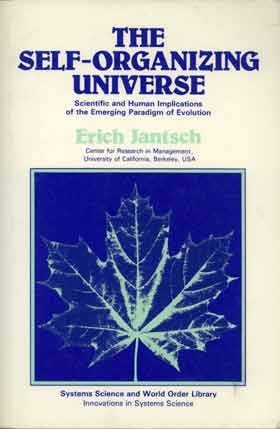
The evolution of the universe – ranging from cosmic and biological to sociocultural evolution – is viewed in terms of the unifying paradigm of self-organization. The contours of this paradigm emerge from the synthesis of a number of important, recently developed concepts, and provide a scientific foundation to a new world-view which emphasizes process over structure, nonequilibrium over equilibrium, evolution over permanency, and individual creativity over collective stabilization. The book, with its emphasis on the interaction of microstructures with the entire biosphere, ecosystems etc., and on how micro- and macrocosmos mutually create the conditions for their further evolution, provides a comprehensive framework for a deeper understanding of human creativity in a time of transition.
Deliberative democracy or discursive democracy is a form of democracy in which deliberation is central to decision-making. It adopts elements of both consensus decision-making and majority rule. Deliberative democracy differs from traditional democratic theory in that authentic deliberation, not mere voting, is the primary source of legitimacy for the law.
While deliberative democracy is generally seen as some form of an amalgam of representative democracy and direct democracy, the actual relationship is usually open to dispute.[1] Some practitioners and theorists use the term to encompass representative bodies whose members authentically and practically deliberate on legislation without unequal distributions of power, while others use the term exclusively to refer to decision-making directly by lay citizens, as in direct democracy.
The term “deliberative democracy” was originally coined by Joseph M. Bessette in his 1980 work Deliberative Democracy: The Majority Principle in Republican Government.[2]
Overview
Deliberative democracy holds that, for a democratic decision to be legitimate, it must be preceded by authentic deliberation, not merely the aggregation of preferences that occurs in voting. Authentic deliberation is deliberation among decision-makers that is free from distortions of unequal political power, such as power a decision-maker obtained through economic wealth or the support of interest groups.[3][4][5] If the decision-makers cannot reach consensus after authentically deliberating on a proposal, then they vote on the proposal using a form of majority rule.[citation needed]
The roots of deliberative democracy can be traced back to Aristotle and his notion of politics; however, the German philosopher Jürgen Habermas‘ work on communicative rationality and the public sphere is often identified as a major work in this area.[6]
Deliberative democracy can be practiced by decision-makers in both representative democracies and direct democracies.[7] In elitist deliberative democracy, principles of deliberative democracy apply to elite societal decision-making bodies, such as legislatures and courts; in populist deliberative democracy, principles of deliberative democracy apply to groups of lay citizens who are empowered to make decisions.[4] One purpose of populist deliberative democracy can be to use deliberation among a group of lay citizens to distill a more authentic public opinion about societal issues but not directly create binding law; devices such as the deliberative opinion poll have been designed to achieve this goal. Another purpose of populist deliberative democracy can be to serve as a form of direct democracy, where deliberation among a group of lay citizens forms a “public will” and directly creates binding law.[4][8] If political decisions are made by deliberation but not by the people themselves or their elected representatives, then there is no democratic element; this deliberative process is called elite deliberation.[9] According to Fishkin, this process attempts to indirectly filter the mass public opinion because representatives are better equipped with the knowledge of the common good than ordinary citizens.[10]
“Sports is a way we can play with the reptilian brain.”
–Matthew Fox
New Thinking Allowed with Jeffrey Mishlove Streamed live 2 hours ago Matthew Fox is a spiritual theologian, an Episcopal priest and an activist for gender justice and eco-justice. He has written 37 books. Among them are Original Blessing, The Coming of the Cosmic Christ, A Spirituality Named Compassion, The Reinvention of Work, The Hidden Spirituality of Men, Christian Mystics and The Pope’s War. Most recently, he has published Essential Writings on Creation Spirituality. He is founder of the University of Creation Spirituality in California.
The Nasa data scientist explains why inaction on the climate crisis pushed him to chain himself to an LA bank – and why trusting in the ‘people in charge’ is so dangerous
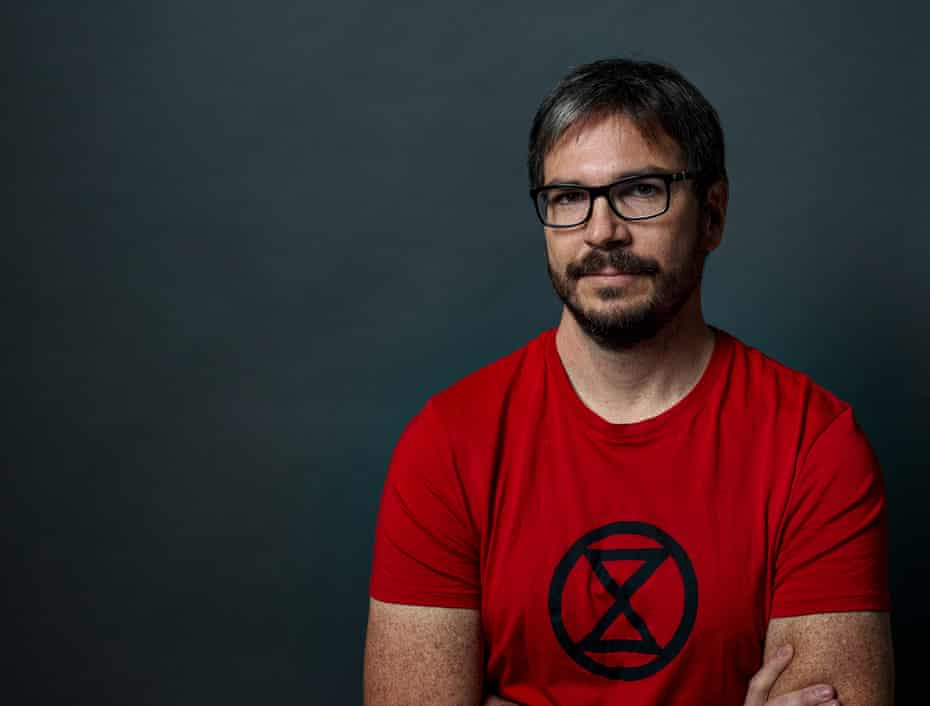
Peter Kalmus: ‘I desperately want to feel before I die that the future is going to be better.’ Photograph: Michelle Groskopf
Sat 21 May 2022 13.00 EDT
Last month a Nasa data scientist, Peter Kalmus, chained himself to the entrance doors of the JP Morgan Chase building in Los Angeles. A video of a short speech he gave about global heating before he was arrested was shared multiple times on social media. In the clip, voice faltering, he told the public: “I’m here because scientists are not being listened to … we are going to lose everything and we are not joking.” He spoke to the Observer in a personal capacity.
What drove you to nonviolent protest? It’s this mounting feeling that I need to do more. I have a sense of desperation, because of the wide gulf between what the science says society needs to do and how it feels like everything is heading in the opposite direction. World leaders and people not understanding that we’re in an emergency.Advertisement\
Then the question comes to me, if I’m sitting with the science every day, and I want to protect my kids and young people and non-humans, what do I do? I’ve been on this 16-year journey trying to answer that question, and civil disobedience seemed like something good to try. I’m ashamed to say that it took me this long.
Do you think more scientists should be talking directly to the public about how they feel? Oh, absolutely. Because we’re not just brains in a vat, we’re humans. The reason oceanologists, ecologists and climate scientists are studying these living systems is because they deeply love them and care about them. Uniformly, across the board, they’re all seeing these massive declines and they’re seeing these systems dying in front of their eyes. I know they’re feeling strong emotions.
Civil disobedience has been far more effective at communicating urgency than anything else I’ve tried.
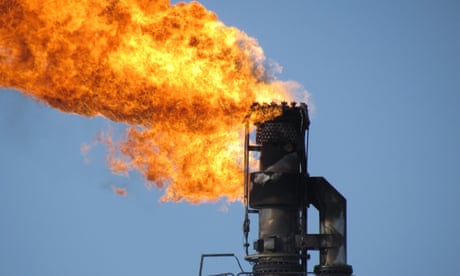
Last week the UK Met Office said there was a 50% chance that in one of the next five years, 1.5C of warming will be breached. The aviation industry was found to have met only one of 50 climate targets. And a Guardian investigative report revealed that fossil fuel companies are planning huge “carbon bomb” projectsthat will drive climate catastrophe. That’s a pretty standard week in the global heating news cycle… This has been just ramping up and ramping up over the years. It’s only going to get more intense as we go forward. That’s why I feel this desperation to end the fossil fuel industry as quickly as possible. Ending the fossil fuel industry is the main thing we need to do to take the pressure off the Earth system and to at least start to stabilise at where we’re at. Then, these news stories will likely start to stabilise as well. But yeah, it’s getting more intense, isn’t it? That’s where we’re at now. That’s a normal week for 2022. What is 2024 going to be like? What’s 2025 going to be like?
The fossil fuel CEOs are rubbing their hands in glee. They can’t believe their good fortune that Putin invaded Ukraine
The mean temperature on the planet keeps going up with every tonne of fossil fuel we burn. At some point you’re going to surpass all of these different milestones. It’s no secret that the fossil fuel industry has been planning to make as much profit as they can from extracting and selling fossil fuel, no matter what happens to the planet, to us, and to future generations. I don’t think we should just talk about future generations any more, because people are dying right now, all around the world. That’s going to happen more as we approach deadly human heat thresholds in certain regions that the human body can’t actually live through. It’s diabolical that these industrialists wish to take short-term profits at the expense of literally everything.
Are the agreements and pledges made at Cop meetings sufficient or effective? Last week the Guardianran a story revealing how few of the pledges have been acted on… The esteemed climate scientist Michael Mann, right after Cop26, wrote an op-ed where he proclaimed victory. He said Cop26 was not a failure. I wrote an op-ed the next day saying that it was absolutely a failure, and that it’s very dangerous not to recognise it as a failure, because that, again, decreases the urgency of dealing with the problem. If we consider that as not a failure, what happened at Cop26, then the public can sort of have this feeling that the “people in charge” are doing what they need to do, which is absolutely not the case. They’re not doing what they need to do.
The fossil fuel industry has deeply penetrated politics and even the Cop process itself. It will do everything it can to throw a monkey wrench in the works and to delay action. It’s up to the leaders of the world to stand up to that and to say: “A livable planet is more important than your profits. We are not going to allow this process of delay to continue.” What worries me is that, in this critical year between Cop26 and Cop27, every signal that we’re getting from world leaders is that fossil fuels will continue to expand.
President Biden is begging Opec to expand production. He’s opening new lands for drilling in the Gulf of Mexico and public lands of the US. Right now, what I’m seeing from world leaders, including Biden, is that they’re using the bully pulpit of their position to urge the expansion of fossil fuels. They’ve completely stopped talking about taking climate action.
The effects of the Ukraine war on energy prices offer a golden opportunity for massive investment in renewable energy and phasing out fossil fuels. But the political class doesn’t see it that way… The leaders of the world are squandering a historic opportunity to make that transition to renewables. Instead, they’re using it as an opportunity to expand the fossil fuel industry, and the fossil fuel CEOs are rubbing their hands in glee at what’s happening right now. They can’t believe their good fortune that Putin invaded Ukraine.Advertisement
Can you explain the stranglehold that the fossil fuel industry has over the American political system? Sometimes, as an outsider, you see the wildfires on the west coast, you see that Florida is sinking, and it doesn’t make sense… There’s this kind of equilibrium of corruption that has developed. They know which politicians’ campaigns to support for maximum return on their investment. For them, it’s a tiny investment. Then, somehow they’ve also managed to capture the media. They certainly have the Fox News network on their side, but somehow, even the non-conservative side hasn’t been reporting the story as it should, that this is an emergency for the planet. The public don’t sense any urgency from the media. Therefore, the politicians that are taking these campaign donations from the fossil fuel industry are not being held to account.
It runs deeper doesn’t it? The right to drive wherever and whenever is part of the American dream, any politician who challenges that gets massive pushback. The price of gas or petrol is an emotive issue. Three-quarters of global heating is caused by burning fossil fuels. Everything else we talk about – planting trees, carbon captures, carbon offsets – is just rearranging deckchairs.
The thing we’ve got to do to avoid hitting the iceberg is to end the fossil fuel industry as quickly as we can. The problem with not protecting the interest of the working class as we make this transition is that they would effectively rise up against any climate policies that made their lives unlivable because of high energy costs. We saw that happen a few years ago with the gilets jaunes [yellow vests] in France.
The only way we can get the working class on board is if the transition away from fossil fuels is effectively subsidised by the ultra rich, which means there does need to be a redistribution of wealth.
You are talking about systematic change leading to a new economic system. When people hear that, they hear “degrowth”. They feel it’s going to impact their standard of living. People need to understand that all degrowth really is, is a switch in the goal of the economic system. We need to change the goal of the system from the accumulation of capital to the flourishing of all people, not just people in the global north, also people in the global south, and the flourishing of all life on this planet, because our economic system is embedded in the biosphere. If we take down the biosphere, we lose everything, and we don’t have an economic system any more. That’s why we desperately need to change the goal of the system to the flourishing of everyone and all life on the planet.
But many individuals like driving, flying and eating beef. They feel the climate movement wants to take away things they enjoy… They do. There’s different kinds of pleasure in life, right? Like getting deeply involved in your community, or feeling like you’re involved in something deeply meaningful, like humanity getting on a better course and the future being better for your children.
I would argue that, through my experience, those kinds of pleasures are actually more sustaining. They’re deeply satisfying. They’re less superficial. But yeah, I know that it’s a hard sell. It almost takes a spiritual practice to be able to kind of come out of the addictions of modern life, which are very enticing.
That was the reason that I wrote my book [about reducing his carbon footprint by 90%], because I wanted to get the message out that there’s actually a lot of pleasure in making these kinds of changes. I didn’t know whether it would resonate with people or not. It turned out to resonate with a much smaller fraction of people than I expected.
Is there anyone in American politics that you look to, or a generation of younger representatives who might be able to articulate and sell this kind of vision? Not really, no, it’s pretty bleak. Bernie Sanders, he’s not young, but he was the closest one that I ever saw to articulating this vision. Just understanding that we’re at risk of losing everything. He would say things like: “I know my climate plan is expensive, but what’s the alternative?”
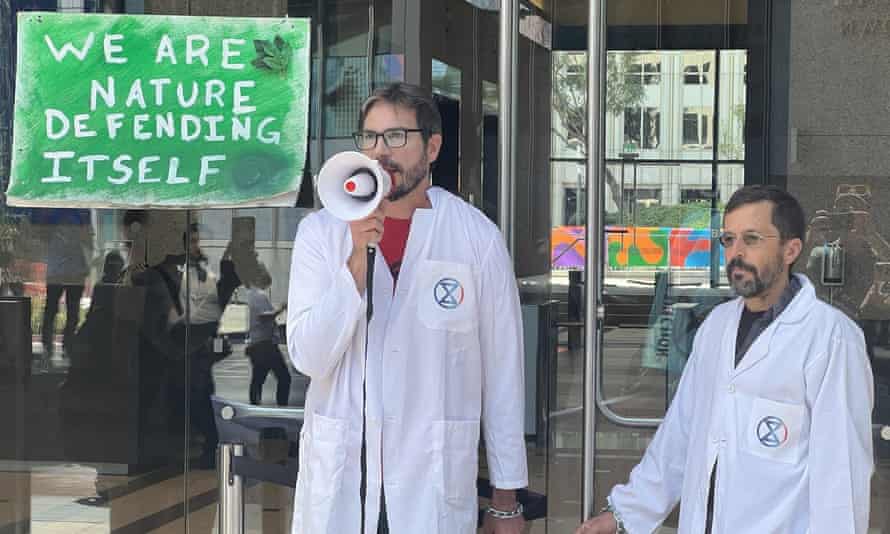
Peter Kalmus and colleague chained to the JP Morgan Chase building, Los Angeles, 6 April this year. Photograph: Brian Emerson
We have to do whatever it takes to save this planet. Because if we degrade the life support systems of this planet, we effectively lose everything. We’re going down this very dangerous slide and we don’t know exactly how far down it takes before we lose X, or before we lose Y, or before this system on the planet breaks down. But we know that the further down we slide, the more we’re going to start going past those sort of collapse points. Bernie Sanders got that. I’ve never seen anything that Joe Biden has said or done to convince me that he understands that. I don’t think he understands what grave danger we’re all in.Advertisement
Why don’t you run for office, Peter? Then, I’d have to stop being a scientist. There was a new poll where only 42% of Americans thought that climate change was a “very serious problem” – less than half of Americans. That’s a huge problem for electoral politics.
42% – that’s almost a half-full glass. Only a few more percent, you’re in business. I will say that whichever elected leader makes climate action their top priority and stops the degradation of Earth, they will be remembered by history as one of the most visionary leaders of all time. Nothing could be more clear to me than that.
I do think there’s a way to sell this kind of stuff I’m saying to the American people. Because the jobs that will be created are a tremendous economic opportunity.
There’s an incredible amount of stuff that we need to build, at least initially. We have to build alternative infrastructure, so that we can feed ourselves, and we can clothe ourselves, and we can transport ourselves without fossil fuels.
Do you feel your own mental health is suffering, because you’re so fluent in the data and the politics of global heating? I’m constantly fending off this sort of ocean of climate anxiety that’s in my brain. When that ocean rises to a high enough level, I can’t really function any more. I get stressed. I am not very fun to be around. My ability to write degrades hugely. The strongest practice I have to keep that ocean of anxiety at bay is a meditation practice, called Vipassana.
It takes two hours a day to do this practice. It takes a 10-day silent retreat once a year to kind of build up the batteries. But if I’m doing it, then I have zero climate anxiety. I’m fully aware of the emergency, but it unlocks my ability to be able to do everything I can, to work as hard as I can to sound the alarm, basically.
I used to take vacations in the High Sierra, to kind of recharge through nature, but it doesn’t work any more. Because last summer we took a five-day backpacking trip up there with my younger son and my partner, the three of us. It was too depressing to me, because in the two years that I’d walked on that trail, the John Muir trail, the tree mortality was just outrageous. There were so many dead trees all along the path. Streams and ponds that had once been flowing at that time of year, two years earlier, were bone dry, because of the drought. I can’t go. It’s just too painful for me now. When I’m in the mountains, I’m constantly feeling climate grief. That’s not a way for me to deal with my climate anxiety any more, unfortunately.Advertisement
Do you understand why some younger people are deciding not to have children, because of the climate crisis? If I were in their place, I would also choose not to have children. It’s a hard thing to say. It’s so heartbreaking to have this sense that the future is getting worse, and that it’s going to be worse for your kids. Now it feels like it’s getting worse at a very fast rate. One thing I desperately want before I die is to have a feeling that the future is going to be better.
That we’ve switched this corner and we’ve started to change the system towards flourishing for all, and we’ve come out of this madness of billionaires, and fossil fuel, and money in politics. That’s what I want to feel. I’ll feel grief from maybe the loss of the Amazon rainforest, and the loss of most of the world’s coral reefs, but mixed with that grief, I long for a feeling of solidarity. I long to feel a faith in humanity once again, because right now I’m not so sure. There’s some tremendous people out there, but it feels like, as a species, we’re just on autopilot and we’re not making the right decisions. I long to feel that we’re doing things better.
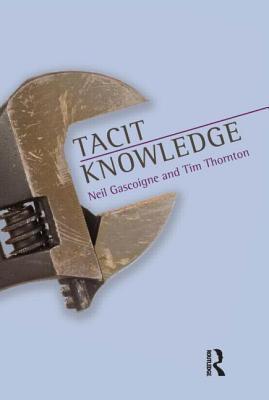
Tacit knowledge is invoked in a wide range of intellectual inquiries, from traditional academic subjects like psychology, sociology and linguistics to more pragmatically orientated investigations into the nature and transmission of skills and expertise. Notwithstanding its apparent pervasiveness, the notion of ‘tacit knowledge’ is a complex and puzzling one. What is its status as knowledge and what is its relation to explicit knowledge? What does it mean to say that knowledge is tacit? Can it be measured? Recent years has seen growing interest from philosophers in understanding the nature of tacit knowledge. Philosophers of science have discussed its role in scientific problem solving; philosophers of language have been concerned with the speaker’s relation to grammatical theories; and phenomenologists have attempted to describe the relation of explicit theoretical knowledge to a background understanding of matters that are taken for granted.
New Thinking Allowed with Jeffrey Mishlove May 21, 2022 This video is a special release from the original Thinking Allowed series that ran on public television from 1986 until 2002. It was recorded in about 1989. Jungian analysis focuses on unconscious archetypes that operate beneath our cultural conditioning. Transformation, says June Singer, must emerge from within, apart from any preconceptions of the analyst. Dr. Singer, a practicing Jungian analyst, is author of Boundaries of the Soul: The Practice of Jung’s Psychology. Now you can watch all of the programs from the original Thinking Allowed Video Collection, hosted by Jeffrey Mishlove. Subscribe to the new Streaming Channel (https://thinkingallowed.vhx.tv/) and watch more than 350 programs now, with more, previously unreleased titles added weekly.
“The stars are like letters inscribing themselves at every moment in the sky. Everything in the world is full of signs. All events are coordinated. All things depend on each other. Everything breathes together.” Plotinus (204-270) Roman Philosopher
AN OPPORTUNITY FOR DAILY REFLECTION BROUGHT TO YOU BY THE SCHOOL OF PRACTICAL PHILOSOPHY
Who’s funding it, why it’s inspired by Viktor Orban, and what it aims to achieve
Robert Reich May 19, 2022 (robertreich.substack.com)
Decades ago, America’s wealthy backed a Republican establishment that believed in fiscal conservatism, anti-communism, and constitutional democracy. But today’s billionaire class is pushing a radically anti-democratic agenda for America — backing Trump’s lie that the 2020 election was stolen, calling for restrictions on voting, and even questioning the value of democracy.
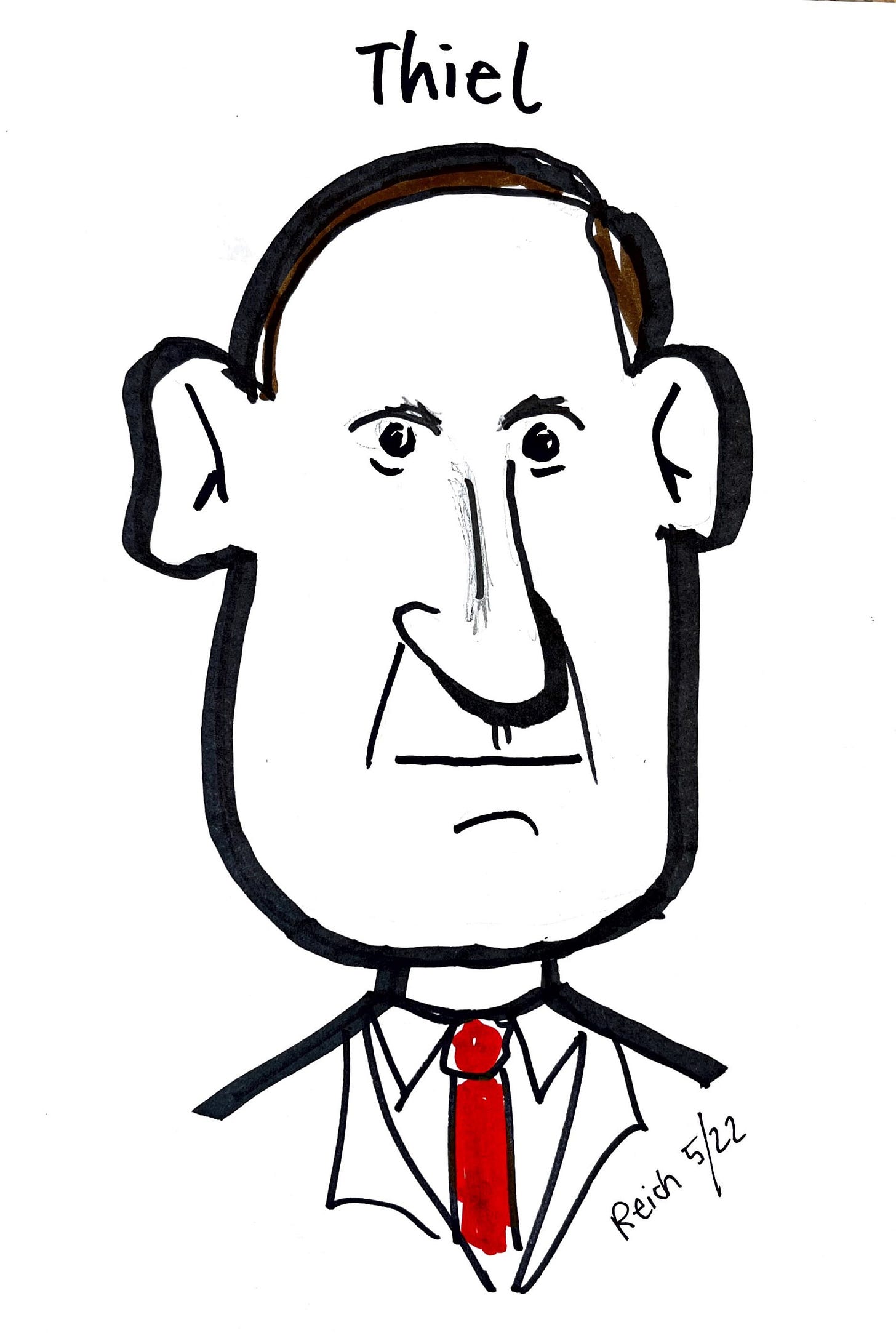
Peter Thiel, the billionaire tech financier who is among those leading the charge, writes “I no longer believe that freedom and democracy are compatible.”
Thiel is using his fortune to squelch democracy. He donated $15 million to the successful Republican Ohio senatorial primary campaign of J.D. Vance, who alleges that the 2020 election was stolen and that Biden’s immigration policy has meant “more Democrat voters pouring into this country.” And Thiel has donated at least $10 million to the Arizona Republican primary race of Blake Masters, who also claims Trump won the 2020 election and admires Lee Kuan Yew, the authoritarian founder of modern Singapore.
Subscribe
The former generation of wealthy conservatives backed candidates like Barry Goldwater, who wanted to conserve American institutions. Thiel and his fellow billionaires in the anti-democracy movement don’t want to conserve much of anything — at least not anything that occurred after the 1920s, including Social Security, civil rights, and even women’s right to vote. As Thiel wrote:
The 1920s were the last decade in American history during which one could be genuinely optimistic about politics. Since 1920, the vast increase in welfare beneficiaries and the extension of the franchise to women — two constituencies that are notoriously tough for libertarians — have rendered the notion of “capitalist democracy” into an oxymoron.
Rubbish. If “capitalist democracy” is becoming an oxymoron, it’s not because of public assistance or because women got the right to vote. It’s because billionaire capitalists like Thiel are drowning democracy in giant campaign donations to authoritarian candidates who repeat Trump’s big lie.
Not incidentally, the 1920s marked the last gasp of the Gilded Age, when America’s rich ripped off so much of the nation’s wealth that the rest had to go deep into debt both to maintain their standard of living and to maintain overall demand for the goods and services the nation produced. When that debt bubble burst in 1929, we got the Great Depression.
It was also the decade when Benito Mussolini and Adolph Hitler emerged to create the worst threats to freedom and democracy the modern world had ever witnessed.
If freedom is not compatible with democracy, what is it compatible with?
On Tuesday night, Doug Mastriano, a January 6 insurrectionist and Trump-backed Big Lie conspiracy theorist, won the Republican nomination for governor of Pennsylvania (the fourth largest state in the country, and the biggest state that flipped from 2016 to 2020). Mastriano was directly involved in a scheme to overturn the 2020 election by sending an “alternate” slate of pro-Trump electors to the Electoral College — despite the fact that Trump lost Pennsylvania by more than 80,000 votes. If Mastriano wins in November, he will appoint Pennsylvania’s secretary of state, who will oversee the 2024 election results in one of the most important battleground states in the country.
Meanwhile, the major annual event of the Conservative Political Action Conference (CPAC) — the premier convening organization of the American political right — starts today in Budapest. That’s no accident. The Hungarian prime minister Viktor Orban and his ruling Fidesz party have become a prominent source of inspiration for America’s anti-democracy movement. Stephen Bannon, Trump’s former adviser, describes Orban’s agenda as that of a “Trump before Trump.”
Orban has used his opposition to immigration, LGBTQ rights, abortion, and religions other than Christianity as cover for his move toward autocracy — rigging Hungary’s election laws so his party stays in power, capturing independent agencies, controlling the judiciary, and muzzling the press. He remains on such good terms with Vladimir Putin that he’s refused to agree to Europe’s proposed embargo of Russian oil.
Tucker Carlson — Fox News’s progenitor of white replacement theory — will be speaking at CPAC and broadcasting his show from Budapest. Trump’s former chief of staff Mark Meadows will also be speaking (although he refuses to speak to the House committee investigating the January 6 assault on American democracy).
If America and the world should have learned anything from the first Gilded Age and the fascism that began growing like a cancer in the 1920s, it’s that gross inequalities of income and wealth fuel gross inequalities of political power — which in turn lead to strongmen who destroy both democracy and freedom.
Peter Thiel may define freedom as the capacity to amass extraordinary wealth without paying taxes on it, but most of us define it as living under the rule of law with rights against arbitrary authority and a voice in what’s decided.
If we want to guard what’s left of our freedom, we’ll need to meet today’s anti-democracy movement with a bold pro-democracy movement that protects the institutions of self-government both from authoritarian strongmen like Trump and his wannabes, and from big money like Peter Thiel’s.
Seeing the system for what it is will empower you to join with others to change it for the better. Please share today’s post.
Consciousness, spirituality, biography, sexuality, androgyny, futurism, space, the arts, science, astrology, democracy, humor, books, movies and more