
| Sounds of Silence |
 Four monks decided to meditate silently without speaking for two weeks. Four monks decided to meditate silently without speaking for two weeks. By nightfall on the first day, a candle began to flicker and then went out. The first monk said, “Oh, no! The candle is out.” The second monk said, “Aren’t we not supposed to talk?” The third monk said, “Why must you two break the silence?” The fourth monk laughed and said, “Ha! I’m the only one who didn’t speak.” Zen Story |
Monthly Archives: May 2022
Now they’re commissioned!

Body positivity is fixated on beauty – here’s how to fix that

Photo by David Mercado/Reuters
Céline Leboeufis an assistant professor in the Department of Philosophy at Florida International University. Her academic research lies at the intersection of feminist philosophy, the philosophy of race, and 20th-century French and German philosophy. Her writing has appeared in Medium, Notre Dame’s Philosophy as a Way of Life blog and the Project Vox blog.
Edited by Sam Haselby
23 May 2022 (psyche.co)
Almost everyone has heard calls to make beauty bigger: ‘Beauty is in every body.’ ‘There is no wrong way to have a body.’ ‘You are more than a number on the scale.’ In the contemporary West, the slender, white, cisgender body, without any visible disabilities, has long reigned as an ideal of how beauty looks.
Enter body positivity – the movement to overcome the shame we suffer from these narrow standards. From the author Sonya Renee Taylor and the Instagram celebrity Megan Jayne Crabbe to the model Winnie Harlow and the singer-songwriter Lizzo, an increasing number of activists and celebrities urge us to unapologetically embrace our bodies. Their call has been heard: protesters have taken to the street and gone so far as to strip in front of a Victoria’s Secret shop in San Francisco, while online hashtags such as #BodyPositive, #CelebrateMySize and #MermaidThighs promote diverse representations of bodily beauty. The fashion industry has also taken note. For instance, Dove’s highly visible ‘Real Beauty’ campaign and Aerie lingerie’s #AerieREAL advertisements feature more ‘realistic’ body types than the towering and impossibly thin fashion models of the 1990s and early 2000s.
Yet some feminists have criticised the movement’s ‘all bodies are beautiful’ message. The blogger Kaila Prins explains that the focus on personal beauty risks harming women because it upholds the idea that they should prize themselves for their looks. Regardless of their body type, women will continue putting a premium on their appearance.
So we’re left in a bind. On the one hand, diverse representations of beauty can help release us from excessive body shame. On the other hand, if beauty is the only currency for valuing our bodies, we remain stuck in a paradigm that preserves sexist stereotypes. Is body positivity worth our support, or is it part of the problem?
But first, what role should bodily beauty play in our lives? Consider the perspective of the feminist philosopher Sandra Bartky. Forty years ago, she claimed that if we abandon body aesthetics, we jeopardise something – the value of personal beauty – that has shaped humanity. Adorning ourselves and enhancing the body’s appearance is integral to most, if not all, cultures. We derive pleasure from contemplating those who are beautiful and from beautifying ourselves. Not only that, but beauty work can be a source of community and a form of resistance to forms of oppression, such as racism and fat-phobia. In fact, celebrating bodies that do not fit rigid standards of beauty has often been part of fights for political recognition and freedom. Think of the ‘Black Is Beautiful’ movement that blossomed in the United States in the 1960s.
Instead of pursuing physical activities to achieve a certain appearance, we could value them for the pleasure they afford
Because beauty is so important to us, I don’t believe that we should entirely shun this component of body positivity. For example, we should continue pushing fashion companies to represent a wider range of body types. Nevertheless, the body is more than a (potential) object of beauty. Here, I believe that there is much to learn from the phenomenological movement in philosophy.
Phenomenology is premised on addressing philosophical problems by describing first-person experiences. What can we learn about the phenomenology of bodily experience? Take a moment to study your body from your own perspective. It is through your senses that you were reading this article just a moment ago. Right now, you may choose to look up from it or shift your body. In addition, even if you were not paying attention to your senses, you also felt many sensations – perhaps eyestrain from reading or the pressure of the chair you are sitting on. Each of these elements is part of the lived experience of your body.
As you learned from reflecting on your bodily experience, it is thanks to your body that you perceive the world and act on it. Moreover, your body is a location of sensations of pain and pleasure.
If we want to expand the notion of body positivity, can we integrate these first-personal aspects of embodiment and move beyond an overwhelming focus on beauty?
Inspired by phenomenology, recent research in feminist philosophy shows how we might develop a more expansive conception of body positivity. In ‘Anatomy of the Thigh Gap’ (2019), I propose that we can counteract alienating standards of thinness by appreciating the body from within. Physical activities, such as running or weight training, are ways to achieve this sensual awareness of our bodies. Instead of pursuing these activities to achieve a certain appearance, we could value them for the pleasure they afford. Besides exercise, forms of meditation that take as their object physical sensations could also sustain an inner appreciation of the body. Likewise, in The Body and Shame (2015), the philosopher Luna Dolezal advocates restorative physical practices, such as yoga, to overcome limiting body shame.
In my experience, developing a rich inner appreciation of my body helped loosen the grip of the thinness ideal
Outside of philosophy, the ‘body neutrality’ movement has formulated similar alternatives to body positivity. According to some strands in this thinking, we should value our bodies for what they can do – not for what they look like. Critics have pointed out the ableism – that is, prejudice in favour of the able-bodied – in body neutrality. Some people simply have limited physical capabilities. Still, body neutrality helps move us away from beauty-centric messaging.
These proposals to enjoy the body’s sensual character or capabilities dovetail with research by psychologists. For example, Ann Saffi Biasetti, an eating disorder specialist, uses the term ‘befriending your body’ to describe a multi-pronged strategy for recovering from such disorders. Instead of simply eliminating damaging behaviours (for example, restricting or binging), we can alter our overall relationship with our bodies. In particular, she describes physical exercises and meditation as a way of healing. Through these practices, we can embody kindness towards our bodies.
In my experience, developing a rich inner appreciation of my body helped loosen the grip of the thinness ideal. In college, I exercised to lose or maintain my weight: each minute on the treadmill compensated for a 10-calorie indiscretion. Later, during graduate school, when a knee injury barred me from treadmills, I considered weightlifting since I had heard that it could increase one’s metabolism, and I couldn’t forgo exercise altogether. Yet, things did not work out as planned. I enjoyed weightlifting for the challenge it placed on my body, for the fun of trying new exercises, and for the pride I drew in my progress. I began to cultivate strength for the sensations I had during and after my workouts – and not for a muscular look. I didn’t want to replace thinness with a new obsession. I not only became physically stronger but also gained the strength to oppose the standards of slenderness that once tyrannised me.
If we take the ideas of feminists, body neutralists and psychologists seriously, body positivity means more than expanding beauty norms. Rather, it could highlight the value of bodily pleasure and physical abilities. But does this proposal go far enough? Isn’t the focus on one’s own body narcissistic? Let’s say that I have ‘befriended my body’. What about the person at whose body I cast a disapproving glance in the gym locker room? What have I done for them?
Here again, the phenomenological tradition offers some help. Maurice Merleau-Ponty, a 20th-century phenomenologist, describes the body as a medium through which we encounter other humans. We relate to others through our senses and actions. If this is the case, could body positivity also encompass positive relations to the bodies of others? Could we challenge ourselves to view others, and more specifically those whose bodies are different from our own, with greater openness? This is precisely what the contemporary phenomenologist Alia Al-Saji has claimed in the case of race. In ‘A Phenomenology of Hesitation: Interrupting Racializing Habits of Seeing’ (2014), she says that affective environments, such as family and friends, can help us embody less hateful ways of perceiving others. This is a question that I have also examined in my work on mindfulness and racialised perception. In ‘Reforming Racialized Bodily Habits’ (2018), I survey empirical research suggesting that meditation may diminish our blinkered ways of perceiving others. While neither affective environments nor meditation can guarantee that we will completely change our biases, this research indicates that we’re not bound to view others negatively.
It’s worth considering, if we take into account our inner awareness of our bodies, our physical abilities and our relatedness to others, whether we are still discussing body positivity. Have we moved so far from mainstream messages that this proposal bears no relation to the everyday movement? Not quite. On my view, there are many ways besides beauty to develop positive relations to one’s own body and those of others. After all, we have to live with our bodies, so why not practise acceptance? One thing is clear, though, the road to body positivity needs for many us to go past shame and beyond beauty.
How to discover your authentic self — at any age
In a talk packed with wry wisdom, pop culture queen Bevy Smith shares hard-earned lessons about authenticity, confidence, mature success and why, if you put in the work, “life gets greater later.”Read transcriptThis talk was presented at an official TED conference. TED’s editors chose to feature it for you.
About the speaker
Bevy SmithPop culture queenSee speaker profile Fashion executive turned TV host Bevy Smith is here to tell it as she sees it. Get ready for some “Bevelations.”
Tarot Card for May 24: The Ace of Swords
The Ace of Swords
As a Suit, Swords are about thought, communication, and, sadly, often also about conflict and emotional turmoil. People often become confused about why that should be – this Suit contains more ‘bad’ cards than any of the others. But when you consider that one thing which inevitably happens when we are hurt and unhappy is that objectivity and clarity go out of the window, you might be able to understand why so many harsh cards turn up here.
Aces are always about the beginning of something – usually related to the Suit they are from. From that you can see that the Ace of Swords is about the ability to see things from a clear perspective. When this card rules, we are able to cut away the rubbish and confusion which tends to cloud out major issues. We can see what is important and worth fighting for. And we can also identify the red herrings that keep us from seeing clearly.
We become more able to make good decisions, more ready to see other points of view, more clear about what we really think about things. When this happens we often choose totally new directions for ourselves, reaching a point where we can transform and empower our experiences.
So when this card comes up in a reading, or to rule a day, then it means that we need to step back, and think rationally about everything which crosses our path. We need to cut away rubbish and clutter, so we can see the inner truth we seek.
There is a decisive and powerful energy which flows from this card, and engaging with it will allow us to understand ourselves, and others more thoroughly than before.
In a spiritual sense the appearance of the Ace of Swords will often mark a turning point or breakthrough into new clarity and wisdom
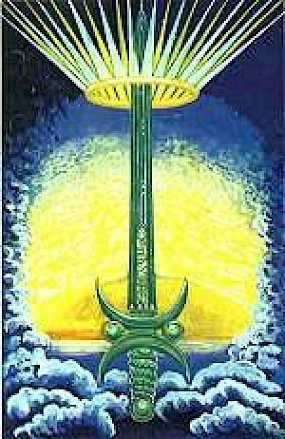
(via angelpaths.com and Alan Blackman)
Tarot Card for May 23: The Ten of Wands
The Ten of Wands
The Lord of Oppression is a hard card to come to grips with, for it indicates blocked or thwarted Will. We want something badly, and yet we seem to stand no chance of getting it. We feel frustrated, irritable and disappointed.
If a situation marked by the Ten of Wands goes on for too long, we will begin to feel trapped and deeply unhappy. We will begin to lose faith in ourselves, and our abilities to make our lives into what we want.
There are a couple of things to bear in mind if the influence of the Lord of Oppression is a fairly fleeting one – sometimes we have to wait for the right moment to get our heart’s desire.
However it’s worth bearing in mind, if you ever read on a specific situation, and this card comes up in the final result position, the reading is probably telling you not to waste any more effort on a conflict that you cannot win. Sometimes we are better off just walking away.
The long-term appearance of this card carries a warning with it that you really cannot ignore. If the Ten of Wands is a regular feature of your readings for some time, you are probably hurting yourself more than you care to admit. You are not fulfilling your needs, and you are leaving yourself open to negativity.
Time to get a little bit of Ace energy in there, and sort things out!

(via angelpaths.com and Alan Blackman)
Richard Wiseman on Lessons from Dale Carnegie, Mentalism, The Psychology of the Paranormal, and More
Tim Ferriss May 10, 2022 Richard Wiseman on Lessons from Dale Carnegie, How to Keep a Luck Diary, Mentalism, The Psychology of the Paranormal, Mass Participation Experiments, NLP, Remote Viewing, and Attempting the Impossible Brought to you by UCAN endurance products powered by SuperStarch® (http://ucan.co/tim), Headspace easy-to-use app with guided meditations (http://headspace.com/tim), and Helix Sleep premium mattresses (http://helixsleep.com/tim). Show notes: https://tim.blog/2022/05/10/richard-w… SUBSCRIBE: http://bit.ly/1dSzTkW LINK TO ALL SHOW TRANSCRIPTS: https://tim.blog/2018/09/20/all-trans… About Tim Ferriss: Tim Ferriss is one of Fast Company’s “Most Innovative Business People” and an early-stage tech investor/advisor in Uber, Facebook, Twitter, Shopify, Duolingo, Alibaba, and 50+ other companies. He is also the author of five #1 New York Times and Wall Street Journal bestsellers: The 4-Hour Workweek, The 4-Hour Body, The 4-Hour Chef, Tools of Titans and Tribe of Mentors. The Observer and other media have named him “the Oprah of audio” due to the influence of his podcast, The Tim Ferriss Show, which has exceeded 500 million downloads and been selected for “Best of Apple Podcasts” three years running.
Book: “The Physics of Angels: Exploring the Realm Where Science and Spirit Meet”
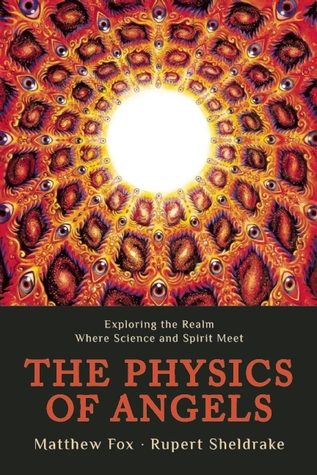
The Physics of Angels: Exploring the Realm Where Science and Spirit Meet
by Matthew Fox, Rupert Sheldrake
“Matthew Fox might well be the most creative, the most comprehensive, surely the most challenging religious-spiritual teacher in America.”—Thomas Berry
“Rupert Sheldrake continues to chart a new course in our understanding of the non-local mind that connects all of us.”—Deepak Chopra
Many people believe in angels, but few can define these enigmatic spirits. Now visionary theologian Matthew Fox and acclaimed biologist Rupert Sheldrake—pioneers in modern religious thinking and scientific theory—launch a groundbreaking exploration into the ancient concept of the angel and restore dignity, meaning, and joy to our time-honored belief in these heavenly beings.
(Goodreads.com)
Q&A: Talking God, science and religion with theoretical physicist Frank Wilczek

BY DEBORAH NETBURN STAFF WRITER MAY 19, 2022 (LATimes.com)
Frank Wilczek has a special fondness for rainbows.
It’s not just the show-stopping, full-arc-across-the-sky rainbows that catch the Nobel laureate’s eye. He’s equally transfixed by the array of color that shows up on soap bubbles, in sprays of water and in prisms.
“There are rainbows all over the place, once you start paying attention,” he said recently from his home in Concord, Mass.
In Judaism, rainbows serve as a reminder of the covenant God made with Noah to never again destroy the Earth. There is even a special prayer to recite when one encounters them. For Wilczek, 71, rainbows are both aesthetically “pretty” and serve as an invitation to launch into a scientific reverie about what makes the phenomenon possible: how the light is refracted, what the atoms are doing, how Sir Isaac Newton discovered the nature of color.
“My everyday life has been very much enhanced by occasionally reflecting on what’s going on under the hood,” he said.
As a theoretical physicist, Wilczek has been peeking under the hood of our perceived reality for more than 50 years. His insights and ideas have led to several revolutionary scientific discoveries, as well as an almost theological perspective on the nature of the world and our role in it that he shares in his myriad articles, books and talks for a general audience.
“In studying how the world works, we are studying how God works, and thereby learning what God is. In that spirit we can interpret the search for knowledge as a form of worship, and our discoveries as revelations,” he wrote in his most recent book, “Fundamentals: Ten Keys to Reality.”
It’s this articulation of the link between science and spirituality that led to Wilczek’s most recent high-profile award — the Templeton Prize — one of the world’s largest annual individual awards, valued at more than $1.3 million, which he received last week. The prize is given to those who use “the power of the sciences to explore the deepest questions of the universe and humankind’s place and purpose within it,” according to the Templeton Foundation.
Past recipients include Jane Goodall, the Dalai Lama, Desmond Tutu and St. Teresa of Kolkata.
Over the last 50 years, Wilczek’s ideas and insights have touched nearly every corner of physics. He won the Nobel Prize in 2004 for his theoretical description of the strong nuclear force, now a cornerstone of the Standard Model, which posits that everything in the universe is made of a few fundamental building blocks that interact with each other by no more than four fundamental forces — the strong force, the weak force, electromagnetic force and gravitational force.
In 1978 he predicted a new type of particle called an axion. Although yet to be detected, axions are among the leading explanations for dark matter, a mysterious substance that makes up most of the matter in the known universe, even though they are billions of times lighter than the electron.
More recently he introduced the idea of time crystals — a phase of matter that can sustain constant change without burning any energy — and anyons, particles that have a strange behavior when their positions are exchanged but can exist only in two-dimensional space.
“Really, in my opinion, these are all Nobel Prize-winning inventions,” said his friend and colleague Antti Niemi, professor of theoretical physics at Uppsala University in Sweden. “He is one of the few, I would say, that could easily get a second Nobel Prize.”
In addition to groundbreaking discoveries, Wilczek’s work has also led him to some of the same conclusions shared by mystics from all religions: the myth of separateness and the fundamental interconnectedness of all things.
As he wrote in “Fundamentals,” “Detailed study of matter reveals that our body and our brain — the physical platform of our ‘self’ — is, against all intuition, built from the same stuff as ‘not-self,’ and appears to be continuous with it.”
Other spiritual insights from his decades of scientific study include the idea of complementarity — that different ways of viewing the same thing can be informative, and valid, yet difficult or impossible to maintain at the same time, and that science teaches us both humility and self-respect.
“Within ourselves we have enormous resources,” he told an online audience last year. “We are small compared to the universe, but we are large compared to what it takes to have dynamic patterns and process them in time. Walt Whitman was right when he said he contains multitudes.”
Wilczek’s friends and students describe him as a kind and generous scientist who never lost his childlike wonder at the immense beauty of the world and how it all works.
“There’s a distinction between curiosity and wonder,” said Jordan Cotler, who studies theoretical physics at Harvard and who started working with Wilczek as a college undergraduate. “Curiosity is an intellectual outlook, but wonder suggests there is something in your soul that compels you to know more about the world. That’s something he embodies in a real, genuine way.”
Here Wilczek tells us more about his thoughts on religion, God, and how science has informed his perspective on life.
This interview has been edited for length and clarity.
Do you consider yourself an atheist, agnostic? Do you have a definition you’re comfortable with?
Not affiliated with any specific recognized church is certainly part of it, but I’m more comfortable saying that I’m a pantheist. I believe that the whole world is sacred and we should take a reverential attitude toward it.
Are science and religion in conflict with each other?
No, they are not in conflict with each other. There have been problems when religions make claims about how the world works or how things got to be the way they are that science comes to make seem incredible. For me, it’s very hard to resist the methods of science which are based on the accumulation of evidence.
On the other hand, science itself leads to the deep principle of complementarity, which means to answer different kinds of questions you may need different kinds of approaches that may be mutually incomprehensible or even superficially contradictory.
You’ve written that “in studying how the world works, we are studying how God works, and thereby learning what God is.” So, what do you think God is?
Let me lead into that by talking about two of the greatest figures in physics and their very different views of what God is. Sir Isaac Newton was very much a believing Christian and probably devoted as much time to studying Scriptures and theology as he did to physics and mathematics.
Einstein, on the other hand, often talked about God — sometimes he used that word, sometimes he said “the old one” — but his concept was much different. When he was asked seriously what he meant by that, he said he believed in the God of Spinoza, who identified God with reality, with God’s work.
That was Einstein’s view and that is very much closer to my spirit. I would only add to that that I think God is not only the world as it is, but the world as it should be. So, to me, God is under construction. My concept of God is really based on what I learn about the nature of reality.
Does that God have a will?
Not a will as we would ascribe to human beings, although I’m not saying that’s logically impossible. I would say it’s really a stretch, given what we know. The form of the physical laws seems to be very tight and doesn’t allow for exceptions.
The existence of human beings, as they are, is a very remote consequence of the fundamental laws. One thing that [the physicist] Richard Feynman said really sticks in my mind here. He said, “The stage is too big for the players.” If you were designing a universe around humans and their concerns, you could be a lot more economical about it.
Can God be detected, or is that the wrong question?
I think that’s the wrong question. God can be constructed. And that’s what I hope we’re doing in a murky way. As I said, God to me is the God of Spinoza and Einstein, supplemented with the idea that we play a role in making him.
While I was preparing for our interview, I came across a statement by the Catholic Bishops of California that said science cannot answer our deepest and most perplexing questions like, “Why am I here?” “What is the purpose of my life?” “Why have I suffered this loss?” “Why is God allowing this terrible illness?” They said these are religious questions. Do you agree?
Science doesn’t answer those questions. On the other hand, you ignore science at your peril if you are interested in those questions. There’s a lot you can learn from science by expanding your imagination and realizing the background over which those questions are posed. So, saying that science doesn’t have a complete answer is a very different thing than saying, “Go away, scientists; we don’t want to hear from you, leave it to us.”
Knowing what you know about fundamental rules, and the properties of matter — do you think this world is an illusion?
I wouldn’t say reality is an illusion. We experience it, but our naive models of reality, the ones we come to as children, don’t do it justice.
One of my favorite quotes in your book is this: “The world is big, but you are not small.” How has this truth affected your life?
Sometimes when I’m discouraged or some unpleasant thing has happened, I call that to mind. The world is big, so on cosmic scales, my little woes don’t matter. But they matter to me, and I should do something about them. But I shouldn’t let them get me down too much because the stakes on a cosmic scale, overall, are small.
Have some humility but also self-respect. That’s what the universe tells us.
Deborah Netburn covers faith, spirituality and joy for the Los Angeles Times. She started at The Times in 2006 and has worked across a wide range of sections including entertainment, home and garden, national news, technology and science.
Copyright © 2022, Los Angeles Times
Book: “Exploring the World of Lucid Dreaming”

Exploring the World of Lucid Dreaming
by Stephen LaBerge, Howard Rheingold (Goodreads Author)
“[A] solid how-to book…For amateur dream researchers, this is a must”
WHOLE EARTH REVIEW
This book goes far beyond the confines of pop dream psychology, establishing a scientifically researched framework for using lucid dreaming–that is, consciously influencing the outcome of your dreams. Based on Dr. Stephen LaBerge’s extensive laboratory work at Stanford University mapping mind/body relationships during the dream state, as well as the teachings of Tibetan dream yogis and the work of other scientists, including German psycholgist Paul Tholey, this practical workbook will show you how to use your dreams to: Solve problems; Gain greater confidence; improve creativity, and more.
(Goodreads.com)