Human life span may have no limit, analysis of supercentenarians suggests


CREDIT: PATRICK HAMILTON/AFP VIA GETTY IMAGESSOCIETY

In Review

Statistical methods predict that old-age record could reach 130 by century’s end

By Tom Siegfried 12.18.2021 (knowablemagazine.org)

Support sound science and smart stories
Help us make scientific knowledge accessible to all
Donate today


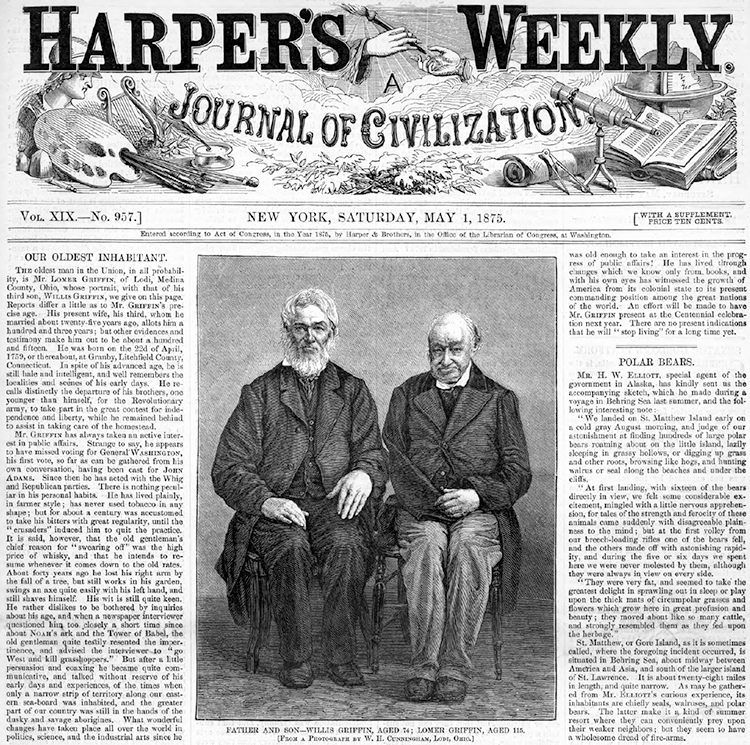
In 1875, Harper’s Weekly declared one Lomer Griffin of Lodi, Ohio, to be, “in all probability,” the oldest man in the union. His age, allegedly, was 116.

There were doubters. Lomer’s own wife, for instance, said he was only 103. And William John Thoms, an English author and demographer who had just written a book on human longevity, expressed skepticism of all such centenarian claims. A human’s maximum life span was about 100, Thoms asserted. Certainly no claim of an age over 110 had ever been verified.

“Evidence of any human being having attained the age, not of 130 or 140, but of 110 years … will be found upon examination utterly worthless,” he wrote.

Centuries of expert testimony (not to mention insurance company data) had established 100 years as the longest possible human lifetime, Thoms insisted — apart from a few “extremely rare” exceptions. He expressed bewilderment that some medical authorities still believed that a lifetime might exceed nature’s rigorously imposed limit.

Reproduction of the front page of Harper’s Weekly magazine dated May 1, 1875, shows a black-and-white photo of Lomer Griffin, aged 116, and his son Willis Griffin, aged 74, illustrating an article about.
In 1875, Harper’s Weekly identified Lomer Griffin as “the oldest man in the Union, in all probability.” Though his actual age was debatable, he was held up as an example of an extremely long life.CREDIT: HARPER’S WEEKLY / ARCHIVE.ORG

Yet even today, almost a century and a half after Lomer Griffin’s death in 1878 (at age 119 by some accounts), scientists still dispute what the oldest human age could ever be — and whether there is any limit at all. After all, more than a dozen people are alive today with validated ages over 110 (and many more that old are still around, just not documented). Yet in only one verified case has anyone lived beyond 120 — the French woman Jeanne Calment, who died in 1997 at age 122.

“The possible existence of a hard upper limit, a cap, on human lifetimes is hotly debated,” write Léo Belzile and coauthors in a paper to appear in Annual Review of Statistics and Its Application. “There is sustained and widespread interest in understanding the limit, if there is any, to the human life span.”

It’s a question with importance beyond just whether people lie about their age to get recognized by Guinness World Records. For one thing, absence of an upper age limit could affect the viability of social security and pension systems. And determining whether human lifetimes have an inviolate maximum might offer clues to understanding aging, as well as aiding research on prolonging life.

But recent studies have not yet resolved the issue, instead producing controversy arising from competing claims, note Belzile, a statistician at the business university HEC Montréal in Canada, and colleagues. Some of that controversy, they suggest, stems from incorrect methods of statistical analysis. Their own reanalysis of data on extreme lifetimes indicates that any longevity cap would be at least 130 years and possibly exceed 180. And some datasets, the authors report, “put no limit on the human life span.”

These analyses “suggest that the human life span lies well beyond any individual lifetime yet observed or that could be observed in the absence of major medical advances.”

Such conclusions contradict the old claims of Thoms and others that nature imposed a strict limit to lifetime. Thoms supported that view by quoting the 18th century French naturalist Georges-Louis Leclerc, Comte de Buffon. Lifetime extremes did not seem to vary much from culture to culture despite differences in lifestyles or diets, Buffon pointed out. “It will at once be seen that the duration of life depends neither upon habits, nor customs, nor the quality of food, that nothing can change the fixed laws which regulate the number of our years,” he wrote.

Thoms’ own investigation into reports of superlong lifetimes found that in every instance mistakes had been made — a father confused with a son, for instance, or a birth record identified with the wrong child. And of course, some people simply lied.

Even today, the lack of high-quality data confounds statistical attempts to estimate a maximum life span. “Age overstatement is all too frequent, as a very long life is highly respected, so data on supercentenarians must be carefully and individually validated to ascertain that the reported age at death is correct,” write Belzile and coauthors.

Fortunately, some collections provide verified data on the oldest of the old. One such collection, the International Data Base on Longevity, includes information from 13 countries on supercentenarians (those living to age 110 or beyond) and for 10 countries on semisupercentenarians (those reaching 105 but not making it to 110).

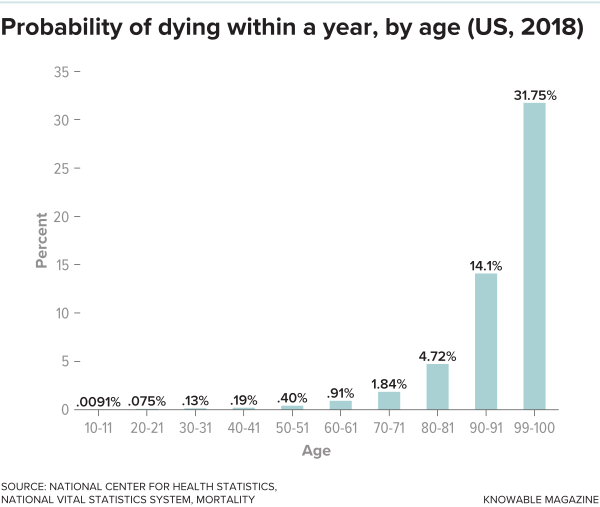
Analyzing such datasets requires skillful use of multiple statistical tools to infer maximum longevity. A key concept in that regard is called the “force of mortality,” or “hazard function,” a measure of how likely someone reaching a given age is to live a year longer. (A 70-year-old American male, for instance, has about a 2 percent chance of dying before reaching 71.)

Of course, the hazard of dying changes over time — youngsters are generally much more likely to live another year than a centenarian is, for instance. By establishing how death rates change with age, statistical methods can then be applied to estimate the maximum possible life span.

Bar graph compares the probability of death for someone aged 10 to 11 (0.0091%), 20 to 21 (0.075%), 30 to 31 (0.13%), 40 to 41 (0.19%), 50 to 51 (0.40%), 60 to 61 (0.91%), 70 to 71 (1.84%), 80 to 81 (4.72%), 90 to 91 (14.1%) up through 99 to 100 (31.75%).
The “hazard function” is a measure of how likely someone reaching a given age will live another year, shown here by looking at the probability of dying within the year. A 10-year-old faces a very small chance of dying before reaching 11, for example, compared with an 80-year-old’s chance of dying before 81. But the probability of dying among the very oldest people appears to level off. By establishing how death rates change with age, statistical methods can then be applied to estimate the maximum possible life span.

From age 50 or so onward, statistics show, the risk of death increases year by year. In fact, the death rate rises exponentially over much of the adult life span. But after age 80 or so, the rate of mortality increase begins to slow down (an effect referred to as late-life mortality deceleration). Equations that quantify changes in the hazard function show that it levels off at some age between 105 and 110. That means equations derived from lower age groups are unreliable for estimating life span limits; proper analysis requires statistics derived from those aged 105 and up.

Analyses of those groups suggest that by age 110 or so, the rate of dying in each succeeding year is roughly 50 percent (about the same for men as for women). And the data so far do not rule out an even smaller annual chance of death after that.

Depending on the details of the dataset (such as what age ranges are included, and for what country), a possible longevity cap is estimated in the range of 130–180. But in some cases the statistics imply a cap of at least 130, with no upper limit. Mathematically, that means the highest ages in a big enough population would be infinite — implying immortality.

But in reality, there’s no chance that anybody will beat Methuselah’s Biblical old age record of 969. The lack of a mathematical upper bound does not actually allow a potentially infinite life span.

“Every observed lifetime has been and always will be finite,” Belzile and coauthors write, “so careful translation of mathematical truths into everyday language is required.”

Stay in the Know
Sign up for the Knowable newsletter today

For one thing, a 50 percent chance of living to the next year makes the odds pretty slim that a 110-year-old will live to 130 — about one chance in a million. (That’s the equivalent of tossing coins and getting 20 heads in a row). Nevertheless, if the math is correct in indicating no true longevity cap, the old-age record could continue to climb to ages now unimaginable. Other researchers have pointed out that, with an increasing number of supercentenarians around, it’s conceivable that someone will reach 130 in this century. “But a record much above this will remain highly unlikely,” Belzile and colleagues note.

As for Lomer Griffin, claims of reaching age 119 were clearly exaggerated. By his (third) wife’s reckoning he was 106 when he died, and his tombstone agrees, giving his dates as 1772–1878. Alas, his birth record (recorded in Simsbury, Connecticut) shows that Lomer (short for his birth name, Chedorlaomer) didn’t really reach 106 at all. He was born April 22, 1774, making him a mere 104 at death. But he still may very well have been the nation’s oldest citizen, because anyone claiming to be older was probably lying about their age as well.

Editor’s note: Lomer Griffin is the writer’s great-great-great-great grandfather.

10.1146/knowable-121721-1

Tom Siegfried is a science writer and editor in the Washington, DC, area. His book The Number of the Heavens, about the history of the multiverse, was published in 2019 by Harvard University Press.

The universe could stop expanding ‘remarkably soon’, study suggests

By Brandon Specktor published about 5 hours ago (livescience.com)

In just 100 million years, the universe could start to shrink, new research suggests.

An artist's impression of star formation in the early universe, a few hundred million years after the Big Bang.

An artist’s impression of star formation in the early universe, a few hundred million years after the Big Bang. (Image credit: NASA)

After nearly 13.8 billion years of nonstop expansion, the universe could soon grind to a standstill, then slowly start to contract, new research published in the journal Proceedings of the National Academy of Sciences suggests.

In the new paper, three scientists attempt to model the nature of dark energy — a mysterious force that seems to be causing the universe to expand ever faster — based on past observations of cosmic expansion. In the team’s model, dark energy is not a constant force of nature, but an entity called quintessence, which can decay over time.

The researchers found that, even though the expansion of the universe has been accelerating for billions of years, the repellent force of dark energy may be weakening. According to their model, the acceleration of the universe could rapidly end within the next 65 million years — then, within 100 million years, the universe could stop expanding altogether, and instead it could enter an era of slow contraction that ends billions of years from now with the death — or perhaps the rebirth — of time and space.Sponsored LinksVideo from our partnersBrought to you by TaboolaNFL Star Rob Gronkowski Loves These ShoesWolf & Shepherd

And this could all happen “remarkably” quickly, said study co-author Paul Steinhardt, Director of the Princeton Center for Theoretical Science at Princeton University in New Jersey.

“Going back in time 65 million years, that’s when the Chicxulub asteroid hit the Earth and eliminated the dinosaurs,” Steinhardt told Live Science. “On a cosmic scale, 65 million years is remarkably short.”

Nothing about this theory is controversial or implausible, Gary Hinshaw, a professor of physics and astronomy at the University of British Columbia who was not involved in the study, told Live Science. However, because the model hinges on past observations of expansion alone — and because the present nature of dark energy in the universe is such a mystery — the predictions in this paper are currently impossible to test. For now, they can only remain theories.

Energy of the void

Since the 1990s, scientists have understood that the expansion of the universe is speeding up; the space between galaxies is widening faster now than it was billions of years ago. Scientists named the mysterious source of this acceleration dark energy — an invisible entity that seems to work contrary to gravity, pushing the universe’s most massive objects farther apart rather than drawing them together.

Though dark energy makes up approximately 70% of the total mass-energy of the universe, its properties remain a total mystery. A popular theory, introduced by Albert Einstein, is that dark energy is a cosmological constant — an unchanging form of energy that’s woven into the fabric of space-time. If that’s the case, and the force exerted by dark energy can never change, then the universe should continue expanding (and accelerating) forever.

However, a competing theory suggests that dark energy doesn’t need to be constant in order to fit with observations of past cosmic expansion. Rather, dark energy may be something called quintessence — a dynamic field that changes over time. (Steinhardt was one of three scientists who introduced the idea in a 1998 paper in the journal Physical Review Letters.)

Unlike the cosmological constant, quintessence can be either repulsive or attractive, depending on the ratio of its kinetic and potential energy at a given time. Over the last 14 billions years, quintessence was repulsive.  For most of that period, though, it contributed insignificantly compared to radiation and matter to the expansion of the universe. That changed about five billion years when quintessence became the dominant component and its gravitational repulsion effect caused the expansion of the universe to speed up.

“The question we’re raising in this paper is, ‘Does this acceleration have to last forever?'” Steinhardt said. “And if not, what are the alternatives, and how soon could things change?”

The death of dark energy

In their study, Steinhardt and his colleagues, Anna Ijjas of New York University and Cosmin Andrei of Princeton, predicted how the properties of quintessence could change over the next several billion years. To do this, the team created a physical model of quintessence, showing its repellent and attractive power over time, to fit with past observations of the universe’s expansion. Once the team’s model could reliably reproduce the universe’s expansion history, they extended their predictions into the future.

“To their surprise, dark energy in their model can decay with time,” Hinshaw said. “Its strength can weaken. And if it does so in a certain way, then eventually the antigravitational property of dark energy goes away and it transitions back into something that’s more like ordinary matter.”

According to the team’s model, the repellent force of dark energy could be in the midst of a rapid decline that potentially began billions of years ago.

In this scenario, the accelerated expansion of the universe is already slowing down today. Soon, perhaps within about 65 million years, that acceleration could stop altogether — then, within as few as 100 million years from now, dark energy could become attractive, causing the entire universe to start contracting. In other words, after nearly 14 billion years of growth, space could start to shrink.

“This would be a very special kind of contraction that we call slow contraction,” Steinhardt said. “Instead of expanding, space contracts very, very slowly.”

Initially, the contraction of the universe would be so slow that any hypothetical humans still alive on Earth wouldn’t even notice a change, Steinhardt said. According to the team’s model, it would take a few billion years of slow contraction for the universe to reach about half the size it is today.

The end of the universe?

From there, one of two things could happen, Steinhardt said. Either the universe contracts until it collapses in on itself in a big “crunch,” ending space-time as we know it — or, the universe contracts just enough to return to a state similar to its original conditions, and another Big Bang — or a big “bounce” — occurs, creating a new universe from the ashes of the old one.

In that second scenario (which Steinhardt and another colleague described in a 2019 paper in the journal Physics Letters B), the universe follows a cyclical pattern of expansion and contraction, crunches and bounces, that constantly collapse and remake it. If that’s true, then our current universe may not be the first or only universe, but just the latest in an infinite series of universes that have expanded and contracted before ours, Steinhardt said. And it all hinges on the changeable nature of dark energy.

How plausible is all this? Hinshaw said the new paper’s interpretation of quintessence is a “perfectly reasonable supposition for what the dark energy is.” Because all of our observations of cosmic expansion come from objects that are millions to billions of light-years away from Earth, current data can only inform scientists about the universe’s past, not its present or future, he added. So, the universe could very well be barreling toward a crunch, and we’d have no way of knowing until long after the contraction phase began.

“I think it really just boils down to how compelling do you find this theory to be and, more importantly, how testable do you find it to be?” Hinshaw added.

Unfortunately, there is no good way to test whether quintessence is real, or whether cosmic expansion has started to slow, Steinhardt admitted. For now, it’s just a matter of fitting the theory with past observations — and the authors do that capably in their new paper. Whether a future of endless growth or rapid decay awaits our universe, only time will tell.

Originally published on Live Science.

(Contributed by Sarah Flynn)

The Astrology Of May 2022 – Jupiter Enters Aries

Astro Butterfly May 1, 2022

With the Eclipse Season in full swing, Jupiter’s triumphal ingress into Aries, and Mercury retrograde, May 2022 is a month to remember.

May 2022 features one intense aspect after another.

After a dreamy April, we will now hit full speed, and will hardly get the chance to catch our breath!

In April we had Jupiter conjunct Neptune and a Pisces stellium. In May, most planets shift into Aries and Taurus, the first signs of the zodiac. If April was a good time to dream of a new vision of the future, May is the time to take decisive action toward turning these visions into realities.

Two past experiences popped to mind when I looked at the astrology of May 2022.

One is from an electronic alarm clock my mother gave me when I left my hometown to go to university. Like most people, I hate alarm clocks. But there was something about the sound of that alarm – it was a triumphal march song – that I loved and looked forward to in the morning.

Similarly, we know we’re on the right track with our lives when we love dreaming big but don’t stop at dreaming – we actually look forward to turning these dreams into realities.

Another one is the famous energy drink slogan “Red Bull Gives you Wings”. While the sweet Venus-Jupiter-Neptune conjunction in Pisces has given the Bull wings to fly high, the combo of Aries boldness and Taurus stamina will bring the Bull back to earth, ready for some real action.

Interesting fact: Dietrich Mateschitz, the Red Bull founder, has a Taurus stellium and a Mars-North Node conjunction ?

Even if we’re ready to act, things may not go as smoothly as we’d like them to go, since Mercury goes retrograde on May 10th. Yes, we may need to adjust here and there. Yes, we may need to wait a bit longer. There’s so much momentum building up that nothing can stop us from going for what we want.

Let’s have a look at the most important transits of the month:

May 2nd, 2022 – Venus Enters Aries

The Sleeping Beauty finally awakens as Venus enters Aries on May 2nd, 2022. Venus is still enthralled by the Jupiter-Neptune contact, but she also knows that the beautiful cloud 9 vision needs to be sustained by taking bold action.

When Venus is in Aries, we express our emotions straightforwardly. “I want this and I want it now”.

Of course, Venus in Aries can come with instant gratification. However, if we choose to tap into the boldness and aliveness of this energy with an open heart, we automatically connect with that part of us that is real and genuine. That part of us always has our best interest in mind.

May 3rd, 2022 – Jupiter Sextile Pluto

On May 3rd, Jupiter (at 28° Pisces) is sexile Pluto (at 28° Capricorn), further fueling us with some collective get-go energy to take action. Jupiter sextile Pluto is a message that the Universe is on our side.

There is a vibrant sense of flow that you’ll tap into, especially if you have planets in the last degrees of the Yin signs, Taurus, Cancer, Virgo, Scorpio, Capricorn, Pisces.

May 10th, 2022 – Mercury Goes Retrograde

On May 10th, 2022 Mercury Goes Retrograde at 4° Gemini. No one is a big fan of Mercury retrograde – not because it’s a bad transit, but because when Mercury is retrograde things don’t go as planned.

If you’re a Saturn type of person this transit can be particularly frustrating. But if you love learning by doing, going with the flow, you will appreciate the informative energy of this transit. Mercury retrograde only points to those things that need revision anyway, so it’s better to know what needs your attention before things escalate.

May 11th, 2022 – Jupiter Enters Aries

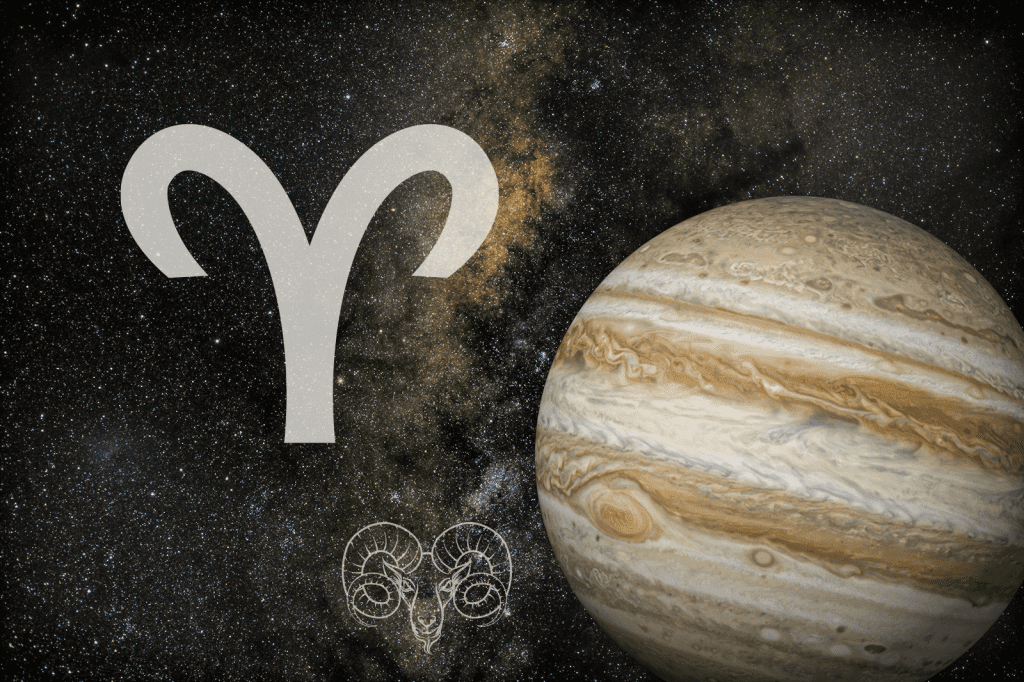
On May 11th, 2022 Jupiter enters Aries. This is undoubtedly one of the most important transits of the year, since Jupiter changes signs every 12 months on average.

When Jupiter changes signs, a whole new area of your life will come into focus. Suddenly something will require your attention, and not just for one week or two, but for an entire year. This area of your life (the house where Aries resides in your chart) is where you’ll experience Jupiter’s expansive energy.

Jupiter in Aries is big and bold. This is not your Mars in Aries “just do it” type of energy… this is a “let’s do it BIG” type of energy.

May 13th, 2022 – Sun Conjunct North Node In Taurus

On May 13th, 2022 the Sun is conjunct the North Node at 22° Taurus. Every year, the Sun-North Node conjunction reminds us of our purpose, pointing to how far – or how close – we are to who we’re meant to be.

The transit will not necessarily come with a clear “how-to” type of insight – but it will nevertheless awaken something inside you. Pay attention to what inspires you, to what draws you in. This is something you want to pay attention to, develop, and grow into.

May 15th, 2022 – Venus Conjunct Chiron In Aries

On May 15th, 2022 Venus is conjunct Chiron at 14° Aries.

Venus is our feelings and how we relate to others, and Chiron is the wounded healer. Chiron’s role is to bridge what needs integration, so we can find wholeness. To do that, Chiron will trigger repressed or unacknowledged feelings and emotions that require our attention.

When our emotional wounds move from the unconscious to the conscious, they also trigger the hurt associated with their sudden acknowledgment. But that’s a necessary – and unavoidable – part of the healing process.

Venus conjunct Chiron is our chance to heal the heart, embrace our feelings, become more compassionate, and experience real love.

May 16th, 2022 – Full Moon And Lunar Eclipse In Scorpio

On May 16th, 2022 we have a Full Moon and a Total Lunar Eclipse at 25° Scorpio. All eclipses have a fated feel – and this Lunar Eclipse is even more so. Why?

This is a total eclipse, and total eclipses are the most intense and life-changing type of eclipses.

This is a South Node eclipse – unlike North Node eclipses which come with opportunities – South Node eclipses are concerned with clearing our past karma.

Lastly, the Total Lunar Eclipse makes aspects with all slow-moving planets: it squares Saturn, trines Neptune and Jupiter, sextiles Pluto, and it’s 10 degrees away from an opposition to Uranus. Outer planets carry a collective energy, and when an Eclipse makes aspects with outer planets, the best approach is surrendering to what’s been offered, instead of taking a personal stand.

Whatever happens around this eclipse, it is meant to be. There’s nothing to fear. Be open to whatever comes.

May 18th, 2022 – Mars Conjunct Neptune In Pisces

On May 18th, 2022 Mars is conjunct Neptune at 24° Pisces.

When Mars, the planet of personal will is conjunct Neptune, the planet of divine guidance and surrender, the message is: don’t force your way through.

Listen to subtle messages, watch for serendipities and find a higher purpose for your actions. When we’re open to receiving divine guidance, our actions have meaning and impact.

May 21st, 2022 – Sun Enters Gemini, Sun Conjunct Mercury

On May 21st, 2022 Sun Enters Gemini – happy birthday to all Geminis out there! For you and everyone else, this is that time of the year to be a bit more like a Gemini – to be open-minded, curious, and cross-pollinate ideas, reflections, and insights.

Soon after the Sun ingresses into Gemini, it conjuncts Mercury. Sun-Mercury conjunctions (when Mercury is retrograde) mark the beginning of a new Mercury cycle. This particular Mercury cycle happens at 0° Gemini.

0° of any sign is a very powerful degree, because it carries a raw, new beginning energy. And 0° Gemini is perhaps the most important degree for Mercury since Mercury rules Gemini. If you have any Mercury projects in mind (writing, communication, trips, any type of media), this is a truly remarkable celestial opportunity to put them into motion.

May 25th, 2022 – Mars Enters Aries

On May 25th, 2022 Mars Enters Aries, the sign of his domicile. If you’ve been feeling a bit sluggish in the last few weeks when Mars was in Pisces, this will now change.

In Aries, Mars does what he knows best: takes action.

When Mars is in other signs, we always find reasons not to take action. Mars in Taurus? “It takes too long”. Mars in Gemini? “I can’t focus”. Mars in Cancer? “What if it hurts other people’s feelings?” Mars in Leo?” What if I make a fool of myself?”. Mars in Virgo? “What if it’s not perfect?”.

When Mars is in Aries, no more excuses. We naturally connect with that part of our psyche that is always ready for action.

The last time Mars was in Aries was July-December 2020. Themes connected to this particular time can again come into focus. If back in 2020 Mars was retrograde, this time, Mars is almost at its highest speed, so it will get things done quickly.

May 28th, 2022 – Venus Enters Taurus

On May 28th, 2022 Venus enters Taurus, her domicile sign. When Venus is in Taurus, we find it easier to connect and honor our feelings – without guilt or self-doubt.

This is a great transit for everyone, so take advantage of the upcoming weeks, and make sure you “do” Venus things: self-care, eat nutritious food, indulge in sensual experiences.

Another great thing about Venus’ ingress into Taurus is that we now have both Venus and Mars in the signs of their maximum strength, which is great news for relationships. If you’re single or if you just want more romance and excitement, you’ll really like what the combined energy of Venus and Mars has in store for you.

May 29th, 2022 – Mars Conjunct Jupiter In Aries

On May 29th, 2022 Mars is conjunct Jupiter at 3° Aries. Mars conjunct Jupiter is a bold, action-driven transit that will MAKE THINGS HAPPEN. Whatever you put into motion now will have a long-lasting impact.

Even if you’re a shy or “I take my time” type of person, when Mars is conjunct Mars, “the time to hesitate is through”. Take action – and not any type of action – MASSIVE action.

Of course, this is not an energy to mess around with or exploit for selfish, unhealthy reasons. With Mars conjunct Jupiter in Aries, you don’t want to put yourself in dangerous situations, get too flared up, or do things that may momentary give you an ego boost, but you know you’ll regret later.

May 30th, 2022 – New Moon In Gemini

On May 30th, 2022 we have a New Moon at 9° Gemini. This is our first lunation out of the Eclipse season window. Things are slowly getting back to normal.

The New Moon applies a wide sextile to the Mars-Jupiter conjunction in Aries, while the New Moon ruler, Mercury – now stationary and ready to turn direct – is trine Pluto and square Saturn.

There is a sense of “I’m there, but not quite there” with this New Moon. Mercury is drawing our attention to a big decision we need to make.

Things will soon clear up, when on June 3rd, Mercury goes direct. Until then, tap into the energy of the New Moon to get guidance on the best course of action.

Join The Age Of Aquarius Community

With so much going on astrologically, now it’s the best time to join Astro Butterfly’s Age Of Aquarius Community.

Every month, in the Age Of Aquarius Community you get access to personalized ascendant sign astrology forecast, free tarot mini-readings, New Moon rituals, member Zoom calls, astrology training, and Q&A in the Community forum, where Astro Butterfly and other astrologers answer your burning questions. 

If you love astrology, this is the best value community you’ll find. 

Every month we focus on a particular astrology topic. In May, the topic of the month is “Astrology Goddesses Archetypes” so we’ll focus on Juno, Ceres, Vesta, Pallas, Eris, Sedna, Lilith and other astrology Goddess archetypes.

Mid-May there’s a livestream focused on Jupiter’s ingress into Aries, and at the beginning of each week, you’ll get access to new interesting discussion topics in the Community forum. 

To give you a bit of a heads up, In June, the topic of the month is “Astrology and Mental Health”, in July “Karma and Family patterns” and so on. 

You have absolute freedom, and if you’re no longer interested in the Community you can easily cancel your membership from your account settings. 

Learn more about the Age Of Aquarius Community and join us here:

HTTPS://WWW.AGEOFAQUARIUS.COM/JOIN

The Far Right Is Salivating Over the Death of Our Democracies

By umair haque

Apr 29 · Medium.com

We’re All Becoming Targets for the Far Right Now, Thanks to Figures Like Elon Musk

Image Credit: Twitter

In the last few essays, I’ve tried to warn that the far right is taking over our societies — one institution, one norm, one office at a time. This is not a drill. It is a social collapse, in which democracy itself is under brutal and sustained assault. But what does the far right want?

There’s an easy way to answer that question — which is also an unsatisfying one. An abstract way. It wants a fascist society, a regressive one, a repressive one. It captures offices and perverts norms in order to bring about a change in society — a restoration of a cosmic moral order, in which the genetically and divinely ordained superior, true of faith and pure in blood, reign supreme again.

True — but not nearly personal enough to really help you understand. In a visceral way. So let’s try again.

What does the far right want? It wants the rest of us not to exist as people. Only as scapegoats.

Does that sound chilling? It should. But maybe not enough, to really convey the weight of my warning. So let me fill in the picture I’ve sketched out now.

The far right has a certain set of grievances. Its position in society has fallen, as downward mobility has become the norm. That’s true for more or less all of society, these days — our social contracts are not working anymore. Our institutions are broken. A better life seems totally out of reach — and just making ends meet it is a constant, heart-pounding struggle. What makes the far right different is that instead of seeking solutions — based on real causes — it just seeks scapegoats.

What’s alarming is how much, how fast, and how intensely this search for scapegoats has grown. Now, all of the rest of us who aren’t on the far right are scapegoats.

What was once normal to express and believe in — democratic values and norms — is now considered extremeAnd what was once extreme — anti-democratic values and norms, hate, violence, bigotry, rage, intimidation — is now acceptable. The Overton Window hasn’t just “shifted” — it’s shattered, and been rebuilt inside out and upside down.

What do I mean by “now all of the rest of us are scapegoats”? Think of the evolution of this wave of far rightism. I’ll use America as an example, but you can chart it in your own context. It began with Trumpism — and Trumpism was simple. America had fallen into disrepair. It had to be made Great Again. How to do that? Eliminate the impurity, the source of the problems. Who was that? Immigrants, especially Latinos. Trumpism was focused on this problem above all — hence, little Mexican kids were torn apart from their parents, and put in cages in camps. I’m oversimplifying for brevity’s sake — but only a bit.

Today, the scapegoats have expanded. Immensely. Who are they? They’re teachers, who read banned books to kids. They’re math professors, who write forbidden textbooks. They’re members of Congress, who are sent death threats. They’re gay people, who are smeared as pedophiles. They’re women, who pursue their own bodily autonomy. And even more chillingly, they’re anyone who helps all these people — “aiding and abetting” them. This is the goal of the new wave of laws the far right is passing, modelled under the Fugitive Slave Act — to create a society of vigilante-informants.

But a society of vigilante-informants also needs scapegoats. A lot of them. It must have people to hunt down, and satisfy its dumb, mindless rage. Hence, all of the rest of us are becoming scapegoats. Who among us — that’s sane — hasn’t “aided and abetted” a gay person or woman? Read a banned book? Taught our kids that being gay or different is OK? That women should have bodily autonomy? That refugees need help, not hate?

We all have. And in that way, we are all scapegoats of the far right now. That is why even expressing democratic views is now becoming something considered extreme — and expressing anti-democratic views, in anti-democratic ways, perfectly acceptable.

If you believe in the basic values of democracy — equality, truth, freedom, justice, goodness — increasingly, you’re painted as the extremist, the fanatic, the fascist. Think about how many people get attacked now for simply wearing masks, or being gay, or being women, or what have you. Those numbers have gone updramatically, as the far right has taken hold. They have seized control of our social and cultural institutions — and portrayed believing in democracy as fascism and extremism.

But how can that be? It’s obviously absurd. The reason they’re doing it is to gaslight everyone else. And the gaslighting works.

Think about where we really are these days. Saying the word gay is now a crime. Women are being hunted down for pursuing autonomy. Tip lines have been set up to report teachers. Anyone the far right — a public official, a teacher, a celebrity, an average person, whomever — doesn’t like is almost instantly attacked in the most vicious ways — smeared as a pedophile, mobbed, sent death and rape threats, relentlessly hounded, in concerted waves of brutality meant to literally drain away not just their sanity, but their personhood.

And all this has become normalbecause the gaslighting worksThink of a place like Florida. People are foolish enough to believe in all the scapegoats. Florida’s real threats? Climate change, inequality, mass extinction — it’s a bellwether for the planet, a state of the extreme rich, and an underclass, of sinking cities and political capture. And instead of addressing any of this, Floridians are stupid enough to believe that the real enemy is…gay people….gay teachers…women…kids’ books…kids. They became that way because they were bombarded with Big Lies over and over again, until their minds broke. And those Big Lies told them that all of these people were the scapegoats responsible for their woes.

The gaslighting works.

Worse, our side — the centre left — doesn’t fight back. It doesn’t say, often enough, or strongly enough, “Hey! This search for scapegoats is wrong. It is persecution and hate. The real problems are these. Our societies are democracies. And in them, we don’t scapegoat anyone, much less everyone.

Mallory McMorrow said that — and caused a brief stir…and then nobody cared. Joe Biden’s focused on Ukraine — which is fair. Kamala Harris is harder to find than Waldo. Barack Obama’s busy, stupidly, making movies with celebrities.

Our side is out to lunch.

And so the far right is winning. It is absolutely demolishing society like a wrecking ball through a sagging building. And they don’t even have to be “in power” to do it. Because our side, let me say it again, is not fighting back. The entire leadership of our side has basically accepted hate, intimidation, brutality, and violence as normal. They have let it become legitimised as a perfectly acceptable way to pursue social change. No, a committee moving at a glacial pace isn’t enough. A nation’s leaders have to speak out against all this — and ours don’t do it.

Why not? They’re afraid of being painted as “woke.” Because being woke these days is a political career-killer. But at some point the centre left has to change that. Because it’s just another smear. Wokeness is irritating and stupid. It goes too far without thinking — like when it renames women “pregnant people,” and that’s offensive to a lot of women. But just because you believe in, say, gay rights, books, teaching kids that being different isn’t wrong, doesn’t mean you’re woke. It just means you’re civilizedWokeness has come to mean any form of democratic expression at all — and the far right is using it, very effectively, as a cudgel now.

But to say that kids should learn about being gay or people’s bodily autonomy or that women should have rights or that slavery happened isn’t remotely the same as saying that everyone should share the same bathroom or changing room, or that “pregnant people” are women, or all the other extreme postures of wokeness.

The far right has conflated any form of democracy with wokeness, and gaslit the average person to believe in it, and increasingly, they do.

And under that guise, it is doing incredible, shocking damage to our democracy.

How so? What are the basic rights of democracy? Freedom of expression, association, movement, speech, privacy. All of these are under attack — for almost all of us. It’s not just “the woke” who don’t get to read certain books — it’s all of the kids in a given state. Women are losing the rights to even talk about their bodily autonomy — or the right to leave a given state. Minorities of all kinds are under threat. Gay people are worried about losing the hard won rights to marriage and adoption and just existing in the open.

We are all under attack from the far right. Have a gay friend? Know a woman? Know a kid? Work with a minority? Not exactly the world’s greatest church-goer yourself? Don’t believe in the Big Lies? Then you’re under attack too, because in the society the far right wants, these people aren’t human beings. They are just scapegoats. They don’t deserve rights. They just deserve to be punished if they don’t conform, because, pre-emptively, the idea is that society is to blame them for its woes, the woes of the pure and true.

Let’s do the example of kids, because it’s instructive. Why shouldn’t kids be allowed to read a book where two gay unicorns are friends? So what? The idea underlying all this is that kids are to blame for our societies’ woes. If they don’t grow up to be what we want them to be — the far right wants them to be — then they become the corrosion in society, too. Kids. Scapegoats. See how dangerous all this really is?

The far right is excising the basic freedoms of democracy from all of the rest of us with surgical precision. It knows what it’s doing. When it says that women can’t leave a state, that we can’t teach kids the rudimentary values of democracy — equality, justice, truth — when it says that gay people are responsible for our moral corrosion, not corrupt elites, when it says that anyone who believes in the basics of democracy is “woke,” and must want gender neutral bathrooms and all men to be pregnant, when it smears anyone it doesn’t like as a pedophile, when it can send death and rape threats and not even be punishedwe are all under attack.

Because all of us who are sane and normal believe those things and want those things. We might not believe in gender free locker rooms and the rest of the extreme positions of wokeness — who really does? — but we all believe in the basics of democracy, that people are equal, that they deserve to be treated with respect, that nobody deserves hate or intimidation.

And the woke don’t help, by the way, by saying that if you don’t agree with them, then you’re part of the far right, too. Wrong. It doesn’t make me part of the far right to say that hey, maybe using the term “pregnant people” isn’t helpful, and many women don’t like it. Because I’m not trying to take anyone’s basic rights away. Conflating these two things — taking people’s rights away and trying to do justice to complex issues — is the woke letting the far right smear everyone else, by painting those of us in the centre as out to get them, too. We are not. We are just thinking through issues which need a lot more thought than the childish approaches wokeness so often deploys. It is not “woke” to just want to stand up for a democracy. It’s just democratic, and there is a big, big difference here.

The far right is winning, my friends, for all these reasons. It is gaslighting our societies into believing that everyone should be a scapegoat. What are women and kids to the fascist project? Just genetic material, “resources,” with no autonomy. What are minorities? Infections, stains. What are teachers? Stewards of a totalitarian project. Sound familair? This is what we are becoming.

Because it has normalised painting everyone else as a scapegoat now — a marked evolution from the Trump years — basic rights are now under sustained, deadly assault. Huge groups in society are now beginning to lose the most basic rights of all. Expression, movement, association, thought. Women. Gay people. Kids. All this is justified by painting any resistance to it as the “really” extreme position, because it’s “woke.”

This context is why people are so upset about Elon Musk’s hostile takeover of Twitter. It’s yet another space where this process of scapegoating can grow, be extended to constantly, perpetually include everyone who isn’t the far right. Where smears and intimidation and threats can be thrown at anyone for simply expressing democratic values. Musk is happy to acquire it for the far right to have a playground to rub democracy’s nose in the dirt. But the rest of us are very concerned — and for good reason. The far right is gaslighting democracy when it cries about being banned from social media. The reason for that is eminently simple: they’d erase the rest of us from society, as human beings with full personhood. And democracy as we know it would cease to exist.

All of this is working. Because our side is not fighting back. It is just letting this happen. It isn’t speaking out and saying what it thinks. It isn’t checking its own fanatics, and asking them to calm down, reminding them that not everyone is going to agree with them. It isn’t reminding all of society that democracy is about basic freedoms — and they are being taken away, as we are all made into scapegoats.

We are being dehumanized, and our personhood removed. The excision of rights follows. Between the woke and the far right — and the leaders too cowed to stop this deadly cycle of hate, smears, stupidity, extremism, and lies — the rest of us are caught in a trap. We are all becoming the scapegoats a failed society is searching for. And hunting down.

Umair
April 2022

SID CAESAR: “This Is Your Life” Spoof on “Your Show of Shows” (Apr 3, 1954)


Sid Caesar: Your Show of Shows / Caesar’s Hour / Admiral Broadway Revue
This is my vote for the single funniest sketch I’ve ever seen, in any series of any era. Sid Caesar is the honoree in a sketch spoofing “This Is Your Life”. It’s funny from the first moment, but once Howard Morris shows up as Uncle Goopy, prepare to pee your pants. For more rare material like this, please click here to subscribe to the Sid Caesar channel: https://www.youtube.com/channel/UCaco…

(Courtesy of Dan Rather)

Getting in the groove

Getting in the groove | Aeon

Music reminds us that the mind is more than a calculator. We are resonant bodies as much as representing machinesElla Fitzgerald performing at Mister Kelly’s nightclub in Chicago in 1958. Photo by Yale Joel/The LIFE Picture Collection/Getty

Jenny Judge is a philosopher, musician and writer-at-large whose work has appeared in The Guardian, The Philosopher’s Magazine and Medium’s subscription programme. She holds a PhD in musicology from the University of Cambridge, and is currently working on a second PhD in philosophy at NYU. Her research interests include the philosophy of mind, cognitive science and aesthetics.

Edited by Sally Davies

15 January 2018 (aeon.co)

Love Aeon?

Support our workDONATE

The 55 Bar in Greenwich Village, with its bulging ceiling tiles and strings of fairy lights taped haphazardly to the walls, looks more like the clubhouse of a rural Irish sports team than a New York City jazz venue. Yet some of the musical experiences I’ve had in that dingy basement have bordered on the otherworldly. When I’m pinned to the back of my seat by the mind-warping rhythms of a drummer, or the harmonic ingenuity of an improvising guitarist, I often have the feeling that my body ‘gets’ things in a way my brain can’t. I find myself physically responding to nuances in the musical texture that have been and gone before I have time to formulate thoughts about them. I can speculate to some extent about what I’ve heard after the fact – that snare hit was perhaps a shade early; that cadence resolved just a fraction too late ­– but in the moment, I can’t quite articulate what it is that I’m reacting to. My grasp on what I’m hearing doesn’t seem cognitive. It seems visceral.

But talk of ‘visceral, non-cognitive grasping’ sounds hopelessly vague from a philosophical standpoint. In philosophy, it’s common to describe the mind as a kind of machine that operates on a set of representations, which serve as proxies for worldly states of affairs, and get recombined ‘offline’ in a manner that’s not dictated by what’s happening in the immediate environment. So if you can’t consciously represent the finer details of a guitar solo, the way is surely barred to having any grasp of its nuances. Claiming that you have a ‘merely visceral’ grasp of music really amounts to saying that you don’t understand it at all. Right?

Humans do, of course, represent features of the world, and perform mental operations on that information. We owe many of our most striking successes as a species to doing just that: it’s how we built aqueducts, and steam engines, and computers. But just as often, we allow ourselves to be borne along by the currents of what’s swirling around us without abstracting away from it. Getting swept up in a musical performance is just one among a whole host of familiar activities that seem less about computing information, and more about feeling our way as we go: selecting an outfit that’s chic without being fussy, avoiding collisions with other pedestrians on the pavement, or adding just a pinch of salt to the casserole. If we sometimes live in the world in a thoughtful and considered way, we go with the flow a lot, too.

I think it’s a mistake to dismiss these sorts of experiences as ‘mindless’, or the notion of a merely visceral grasp of something as oxymoronic. Instead, I think that the lived reality of music puts pressure on philosophers to broaden their conception of what the mind is, how it works, and to embrace the diversity of ways in which we can begin to grapple with the world around us.

Discussions about how we gain access to reality usually begin with perception. Yet philosophers of perception tend to be almost exclusively concerned with vision. Music, as a consequence, seldom makes it onto the agenda. This comes at a cost: not only has the immediate experience of events attracted far less philosophical attention than the experience of objects, but the role of the body in our experience of movement and change has been sidelined, too.

Now, the world contains many things that we can’t perceive. I am unlikely to find a square root in my sock drawer, or to spot the categorical imperative lurking behind the couch. I can, however, perceive concrete things, and work out their approximate size, shape and colour just by paying attention to them. I can also perceive events occurring around me, and get a rough idea of their duration and how they relate to each other in time. I hear that the knock at the door came just before the cat leapt off the couch, and I have a sense of how long it took for the cat to sidle out of the room.

Both objects and events have a structure. My desk lamp has parts – a square base, a hinged ‘neck’, a circular shade – which are related to each other in space in a particular way: the base is connected to the neck, which is connected to the shade, and so on. Similarly, events have temporal structure: they have parts that are related to each other in time (the knock at the door, for instance, is composed of three sequential raps roughly equivalent in duration). But events and objects differ in an important respect. If I want to examine the parts of my lamp, or figure out how exactly they fit together in space, I can squint at it, pick it up, or turn it around. But while the lamp obligingly submits to my investigations, events extend me no such courtesy. The ‘happenings’ in my environment are constantly sliding into the past, out of reach. And though I could chase after the lamp, were it suddenly to gather up its cable and flee, I can’t pursue a fleeting event to ‘get a good look’ at it.

You can experience a waltz as graceful without any idea that its grace arises via a distinctive temporal patterning

We can discern some coarse-grained properties of a drum-beat just by listening – the kick happens first, then a snare, with a hi-hat somewhere in the middle – but figuring out its precise temporal structure is much less straightforward. Was that snare slightly early, or was it slightly late? It’s like glimpsing the outlines of an intricate architectural filigree through a thick fog, without being able to clear the air. But even if fine-grained temporal structure is opaque to perception, it might not be entirely beyond our ken – because, fortunately, action is more sensitive to temporal detail than perception.

We can move our bodies in response to temporal details too fine for us to consciously experience. In a study published in 2000, the psychologist Bruno Repp at Yale University asked subjects to tap along with a rhythmic sequence of tones, delaying all the tones after a particular point in the sequence by the same tiny amount. He observed that subjects’ tapping patterns compensated rapidly for the change, despite the fact that they were unaware of it. Outside the lab, live performances often feature changes in temporal structure, such as small tempo increases, that even the players producing the sounds fail to notice even while they’re playing along.

Sometimes the temporal detail we’re tracking physically does manifest in our conscious awareness, in the guise of a characteristic ‘feel’. The beats played by the drummer Questlove on the album Voodoo (2000), by American songwriter and producer D’Angelo, have a distinctive temporal structure – the precise details of which we might fail to represent, but can experience as a kind of characteristic looseness, or trippiness. Likewise, you can experience a Viennese waltz as graceful without having any idea that its grace arises from its distinctive temporal patterning, where the first beat is lengthened, the second shortened, and the third given the barest of accents.

The subliminal tracking of temporal structure, which hovers around the fringes of conscious awareness, doesn’t just happen when we listen to and play music. It’s a core component of how we comprehend speech, too. In fact, everyday speech is saturated with fine-tuned musical features that are crucial to making ourselves understood. Say the following two sentences aloud:

I was happy.
was happy.

You probably lengthened the word ‘was’ the second time around. By doing so, you managed not only to convey ‘I was happy in the past,’ but also to imply ‘… though not any more.’ Detecting temporal structure in sound is key to grasping what other people mean, and also to conveying meaning ourselves.

But the success of a face-to-face conversation involves more than just processing an interlocutor’s utterance and emitting a series of comprehensible noises. Consider the following everyday exchange:

Good morning! How are you doing?
I’m very well, thanks. How are you?
I’m doing great. It’s a beautiful day out there.
It certainly is!

Now imagine this brief conversation happening again, but this time with each utterance beginning half a second before the previous one has finished. Or imagine each utterance happening 10 seconds after the previous one. It’s not just what you say that matters, or how you say it: the timing and rhythm matters, too.

A 2009 study by the sociologist Tanya Stivers at the University of California, Los Angeles, and her colleagues found that it’s the norm in most languages and cultures to avoid overlaps and to take turns in conversation, with some local variation. Delivering an affirmative response to a question within 36 milliseconds is judged ‘on-time’ in Japan, while in Denmark you can take 203 milliseconds and still be judged timely. Even though the ‘huge’ inter-turn Nordic silences observed by non-Nordic anthropologists aren’t all that large, such comments reveal that deviations from one’s own acculturated norms are seen as highly salient. In other words, what is experienced as a ‘delay’ – and thus as an indicator of dissent, since confirmations are generally delivered faster than opposing statements – differs across cultures. A congenial Danish tourist in Japan might well be puzzled to find herself taken for something of a contrarian.

Musical rhythms call for conscious movement in a way that visual, tactile and even spoken rhythms do not

Rhythmic turn-taking is not the only musical aspect of speech. Greetings and farewells are ordinarily delivered in the upper part of the vocal register (hence why it’s offputting when someone flatly intones: ‘Goodbye’). The difference between expressing sincerity or sarcasm – ‘Well, isn’t that just great!’ – boils down to differences of pitch, syllable duration and articulation. And it’s hard to address a small baby without finding oneself using hugely exaggerated pitch contours, not to mention repeating words ad nauseum (an instinct for which we shouldn’t punish ourselves, however, since there’s evidence that repetition and over-the-top prosodic features aid a child’s linguistic learning). The most stirring parts of political speeches often involve repetition, and sometimes even embryonic rhythms (‘we shall fight on the beaches, we shall fight on the landing grounds’). As Cicero put it in his History of Famous Orators, the would-be master of rhetoric needs to realise that ‘even in Speaking, there may be a concealed kind of music’.

There might also be a concealed kind of movement. In a 1970 study, the psychologist Adam Kendon noticed that when a speaker singles out an individual within a group, the person being addressed begins to move and nod. Kendon speculated that the addressee thereby ‘differentiates himself from the others present, and at the same time he heightens the bond that is being established between him and the speaker’. The addressee also tended to move in time with emergent rhythms in the utterances of the speaker (an observation that recent studies have confirmed). Kendon hypothesised that the coordination of movement between speaker and listener might enable the listener to time his own entry as a speaker, much as a musician might begin to move conspicuously with the music before she enters with her part.

Movement clearly plays a role in speech, yet its role is importantly different from the role it plays in music. If you were to draw your interlocutor’s attention to the ways in which you were timing your movements, everyone would start feeling a bit awkward and the whole communicative project would derail. But attending to musical movement does not destroy its effect. If anything, it heightens it: dancing becomes more enjoyable the more you pay attention to your movements, and the movement of those around you. Musical rhythms call for conscious (as opposed to unconscious) movement in a way that visual, tactile and even spoken rhythms do not: we seem not only to hear musical beats, but to feel them, too. So just how is it possible to feel a sound in the first place?

It’s 1665. The pressing need to find a reliable way of measuring longitude at sea has led to an arms race among astronomers and mathematicians, who are scrambling to find an accurate method of measuring duration. The Dutch astronomer Christiaan Huygens has recently been catapulted into pole position by the accuracy of his new invention, the pendulum clock.

On 22 February, Huygens writes to R F de Sluse to tell him about a curious phenomenon he has observed in his workshop. Having hung two of his clocks from a common wooden beam placed across the backs of two chairs, Huygens had gone about his business before returning to find the clocks showing an ‘odd sympathy’. The pendula had synchronised. Initially baffled, Huygens eventually realised that each clock was producing small vibrations in the wooden beam, and that it was the interaction of these two patterns of vibration that was responsible for the sympathetic movement.

The spontaneous synchronisation of oscillating systems has since become known as ‘entrainment’, and it has been observed in a vast array of physical and biological systems – from the illumination patterns of fireflies to the wingbeats of free-flying barnacle geese to the tendency of an applauding audience to start clapping in synchrony.

Movement to musical rhythms used to be cast in terms of computation: the listener extracts information from musical sounds, forms a temporal representation and transforms that into an action signal. But more recently, psychologists have begun to model rhythmic musical movement as a process of entrainment, whereby oscillations inside the listener become synchronised with rhythmic cues in the environment in a relatively automatic, spontaneous way. No intervening computations are required: the existence of natural resonances between brain, body and world is enough.

If we are the only speaking apes, we would appear to be the only dancing apes, too

Appealing to little oscillators inside us might seem worryingly occult until one recalls that the brain isn’t just an inert chunk of meat. The activity of neurons can give rise to macroscopic patterns as a consequence of how they’re connected to each other – in the same sort of way that individual spectators at a football match, sensitive to the movement of their neighbours, can collectively make a Mexican wave.

Studies have shown that neuronal groups in our brains do, indeed, entrain to rhythmic stimuli. Rhythm-processing involves increased coupling between auditory and premotor cortex, a part of the brain involved in planning and executing bodily movement. It also recruits the basal ganglia, a group of structures deep in the brain involved in motor control, action selection and learning. Intriguingly, even when subjects are instructed not to move in response to what they hear, the basal ganglia is recruited in the processing of auditory beats – though not when they are presented with regular visual rhythms. Patients with Parkinson’s disease, who suffer from impaired basal ganglia function, show deficits in duration-discrimination and the ability to synchronise their finger taps with auditory rhythms.

It seems that moving in response to temporal structure is not something we have to ‘work out’ how to do. Detecting and responding to temporal patterns, in music and elsewhere, is more likely a matter of allowing oneself to be borne along by the natural, spontaneous resonances that already exist between our bodies, our brains and the temporal contours of the sounding world.

Most creatures, even our nearest primate relatives, don’t seem to experience musical beats in quite the same movement-involving way that we do. If we are the only speaking apes, we would appear to be the only dancing apes, too. But we shouldn’t be too hasty in our self-congratulation. Entrainment to other rhythmic stimuli in the environment is ubiquitous in the animal kingdom – and the uses to which our fellow beasts can put environmental rhythms is impressive indeed.

Where do birds go in the winter months? The Ancient Greeks hypothesised that they hibernated in holes in the ground, or transformed into other species of birds; other civilisations thought that they became barnacles, or concealed themselves at the bottoms of lakes. Such bizarre theories are, in a way, less implausible than what we now know to be true: that creatures weighing less than a box of matches can fly non-stop for thousands of miles over land and sea with no navigational aids, consuming their own bodies as fuel, calculating their route with such precision that they often end up landing not only in the same tree, but on the same twig as they did the year before. And a few months later, they do it all again in reverse.

So-called ‘calendar birds’ migrate at the same time every year, regardless of weather. Magnetic sensitivity and the sense of smell are thought to be instrumental to the success of these voyages. But scientists also think that migrating birds are highly sensitive to time: both to elapsed duration, and also to the presence of circannual, or yearly, environmental rhythms. The ability of these birds to ‘know’ exactly when to depart is thought to rely on entrainment to patterns in the environment that repeat annually, such as changes in the light-dark cycle. Once they get to their winter breeding grounds, where the light-dark cycle is reversed, an internal ‘clock’ is thought to keep track of how much time has elapsed since their departure; a cascade of biological events, such as fat deposit and even the shrivelling of internal organs, begins in the weeks before it’s time to return home. Once the voyage is underway, in either direction, entrainment is what allows the bird to keep track of regularities in the Earth’s magnetic field, and the ‘clock’ keeps count of how long it has been flying on each ‘bearing’.

The tiny Northern wheatear doesn’t travel the 15,000 km from Alaska to southern Africa twice a year by consciously representing the route, or the environmental patterns by which it is calibrated. Maybe the bird blindly implements the instructions of its biological sat-nav like a computer executing code: there might be ‘nothing it’s like’ for the bird to be sensitive to circannual rhythms. However, the contrary is also possible: perhaps at least some of those environmental patterns ‘feel’ a certain way to the bird, much as particular rhythmic patterns feel ‘trippy’ to us despite our failure to represent their precise structure. In 1851, the English writer Henry Mayhew noted that, as the season for migration approaches, ‘the caged nightingale shows symptoms of great uneasiness, dashing himself against the wires of his cage or his aviary, and sometimes dying in a few days.’ It is difficult to read such accounts and not sense what it is like for a bird to feel the pull of the voyage.

Entrainment provides a powerful theoretical tool for exploring how we manage to resonate with the world, and each other, in real time. It offers an embryonic account of how we can act astutely even when there’s no time for conscious thought. And while many of the entrainment processes that regulate the functioning of our brains and bodies never make it into awareness, some of them – like viscerally ‘getting’ a guitar solo – arguably do.

Our conscious experience of time is philosophically puzzling. On the one hand, it’s intuitive to suppose that we perceive only what’s happening right now. But on the other, we seem to have immediate perceptual experiences of motion and change: I don’t need to infer from a series of ‘still’ impressions of your hand that it is waving, or work out a connection between isolated tones in order to hear a melody. These intuitions seem to contradict each other: how can I perceive motion and change if I am only really conscious of what’s occurring now? We face a choice: either we don’t really perceive motion and change, or the now of our perception encompasses more than the present instant – each of which seems problematic in its own way. Philosophers such as Franz Brentano and Edmund Husserl, as well as a host of more recent commentators, have debated how best to solve the dilemma.

But the experience of time involves more than just the perception of events occurring at a distance from us. We also experience time by instigating events through our actions, as well as encountering the actions of others. To relish the flow of a chat with a friend, or to feel the groove of a beat, is to have a distinctive kind of temporal experience where the observation of time becomes entwined with how one inhabits it – but in each case, the experience is less a matter of representing temporal structure than of entraining to it, resonating with it.

Reasoning is often a matter of being ‘struck’ by a thought, of having one’s intellect set in motion by ideas

Is resonance without representation always a mindless affair? Not necessarily. Reason wasn’t always thought of in terms of representation, for one thing. In 1769, the French philosopher Denis Diderot offered the following characterisation of the thinker, in his dialogue with his friend Jean Le Rond d’Alembert:

The sensitive vibrating string oscillates and results for a long time after one has plucked it. It’s this oscillation, this sort of inevitable resonance, that holds the present object, while our understanding is busy with the quality which is appropriate to it. But vibrating strings have yet another property – to make other strings quiver. And thus the first idea recalls a second, and those two a third, then all three a fourth, and so it goes, without our being able to set a limit to the ideas that are aroused and linked in a philosopher who meditates or who listens to himself in silence and darkness.

This is a far cry from the modern characterisation of the philosopher as one who contemplates propositions from a position of detachment, in order to reflect on the world without being moved by it. For Diderot, at least, the philosopher must listen keenly, and attune himself to the patterns that he seeks to understand. But even cursory introspection reveals that the processes of reason themselves are saturated with resonance. Reasoning is often a matter of being ‘struck’ by a thought, of having one’s intellect set in motion by ideas. We say that a speaker’s message ‘resonated’ with us when we not only comprehend it, but find it compelling. Far from being at odds with reflection, then, resonance might be its close companion.

Human attempts at making sense of the world often involve representing, calculating and deliberating. This isn’t the kind of thing that typically goes on in the 55 Bar, nor is it necessarily happening in the Lutheran church just down the block, or on a muddy football pitch in a remote Irish village. But gathering to make music, play games or engage in religious worship are far from being mindless activities. And making sense of the world is not necessarily just a matter of representing it.

Music is a reminder to philosophers of mind that perceptual experience isn’t exhausted by vision. It prompts the recognition that conscious experience is dynamic, encompassing motion and change. But music also nudges philosophers toward a conception of the mind as more than just a very sophisticated calculator. If humans are representing machines, we are resonant bodies, too.

If you’re in New York and would like to learn more about how music relates to mysticism, join us for an evening of Live Philosophy on 10 May 2022 at the Sophia Club, a new events program of immersive ideas and artistic performance from the publishers of Aeon and Psyche.

Music Cognition and intelligence Philosophy of mind

Astronomer’s Mind-Blowing Animation Shows The True Scale of Our Solar System

(@physicsJ/Twitter, NASA/JHUAPL/SwRI Imagery)SPACE

DAVID NIELD 30 APRIL 2022 (sciencealert.com)

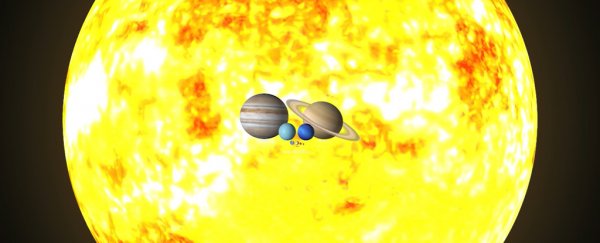
Sometimes it takes an animation on Twitter to truly comprehend – or at least begin to comprehend – the amazing diversity of worlds making up our Solar System.

Enter planetary astronomer James O’Donoghue from the Japan Aerospace Exploration Agency (JAXA). He tweeted out a brief animation that starts off with the Ceres dwarf planet, and moves up through Solar System objects by size (including Earth), before closing by zooming out to take in the Sun.

There’s a slightly higher-quality version of the same clip over at YouTube.

Even if you know the relative size of everything in the Solar System, it’s still quite a moment when Jupiter and the Sun swing into view – and you might never have realized quite how fast Jupiter spins relative to Earth either.

We’d recommend setting aside a bit of time to watch these spinning orbs. The video clip is only 45 seconds long, but it’s mesmerizing enough that you’re going to be watching it several times over – as we write this it’s been viewed some 8 million times.

The sizes, tilts, and rotations are all to scale in this clip, though of course the positioning has been changed – all of the planets and stars you see have been pushed closer together so they’ll fit inside the same video clip.

If you want to know some of the numbers behind the animation, our own planet is 12,742 kilometers or 7,918 miles wide. Jupiter, in contrast, has a diameter of 139,820 kilometers or 86,880 miles – that’s more than 10 times larger in diameter.

The diameter of the Sun is around 1.39 million kilometers (863,706 miles), so that’s around 10 times bigger in terms of distance than Jupiter, and more than 100 times bigger than Earth. To put it another way, about a million Earths could fit into the Sun.

James O’Donoghue has previous form for this too – he’s put together plenty of other videos showing the jaw-dropping scale of the Solar System, and we’re very grateful to have them.

(Contributed by Mchael Kelly, H.W.)

Kosmos: Artist Dustin Yellin Reads Walt Whitman’s Timeless Hymn to Human Nature as a Miniature of the Universe

By Maria Popova (themarginalian.org)

“We forget that nature itself is one vast miracle transcending the reality of night and nothingness,” Loren Eiseley wrote in his exquisite meditation on our search for meaning. “We forget that each one of us in his personal life repeats that miracle.” Meanwhile, the poetic physicist Richard Feynman was remembering the miracle while standing at the seashore, remembering that we are each “atoms with consciousness… matter with curiosity… a universe of atoms… an atom in the universe.”

A century before Eiseley and Feynman, Walt Whitman (May 31, 1819–March 26, 1892) became the poet laureate of this atomic miracle, reminding us again and again, across space and time, across confusion and erasure, that to cherish ourselves is to cherish the universe and to cherish the universe is to cherish ourselves.

Walt Whitman in the 1850s (Library of Congress)

He called himself a “kosmos,” spelled after the title of Humboldt’s epoch-making book, which had lit up Whitman’s formative imagination and had awakened humanity to the interconnectedness of nature with the poetically phrased proclamation that “in this great chain of causes and effects, no single fact can be considered in isolation.”

He called his most intimate poems, which were also his most universal, Song of Myself — a hymn to human nature itself, to its numberless and fathomless fractal manifestations in particular selves, reverberating with the eternal truth that “every atom belonging to me as good belongs to you.”

One of artist Margaret C. Cook’s illustrations for a rare century-old English edition of Leaves of Grass. (Available as a print.)

In the early spring of 2020, epochs after Whitman, with humanity furling into fetal position amid a global lockdown, feeling at once more fragile and more connected than ever before in our shared lifetime, Whitman’s ethos came alive anew, his cosmic songs resonant with tones we needed to hear more than ever — tones that both soothe and vivify the discomposed soul dwelling then in each of us fractals of the world-soul.

In the wake of the disorientation, as I endeavored to go on with the annual Universe in Verse — to preserve its spirit as a celebration of life in an atmosphere of deadly terror — I could think of no better person to inspirit Whitman’s poem “Kosmos” than my friend, neighbor, and co-dreamer of improbable dreams Dustin Yellin — a visionary artist animated by the questions of a physicist, or a child, and the answers of a poet, or a child; founder of Pioneer Works, without which there would be no Universe in Verse; composer of five-ton poems of glass, color, and stainless steel; a creature of unselfconscious multitudes: part Plato, part Frida Kahlo, part The Little Prince.

Psychogeographies by Dustin Yellin

Two springs later, as humanity slowly unfurls, newly awakened to the kosmos of connection that binds us to each other and to the great living poem of a reality in which not one atom can be considered in isolation, Whitman returns to remind us that each and every one of us is the survivor not only of a deadly pandemic but of myriad cataclysms stretching back to the Big Bang — a miraculous miniature of the universe itself.

KOSMOS
by Walt Whitman

Who includes diversity and is Nature,
Who is the amplitude of the earth, and the coarseness and sexuality of the earth, and the great charity of the earth and the equilibrium also,
Who has not look’d forth from the windows the eyes for nothing, or whose brain held audience with messengers for nothing,
Who contains believers and disbelievers, who is the most majestic lover,
Who holds duly his or her triune proportion of realism, spiritualism, and of the aesthetic or intellectual,
Who having consider’d the body finds all its organs and parts good,
Who, out of the theory of the earth and of his or her body understands by subtle analogies all other theories,
The theory of a city, a poem, and of the large politics of these States;
Who believes not only in our globe with its sun and moon, but in other globes with their suns and moons,
Who, constructing the house of himself or herself, not for a day but for all time, sees races, eras, dates, generations,
The past, the future, dwelling there, like space, inseparable together.

Complement with Emily Dickinson’s ode to the interconnectedness of nature, brought to life as an animated song, then revisit Meshell Ndegeocello’s enchanting performance of Whitman’s own ode to the interconnectedness of nature.