For players of fafi, dream interpretation is a vital skill

For players of fafi, dream interpretation is a vital skill | Psyche

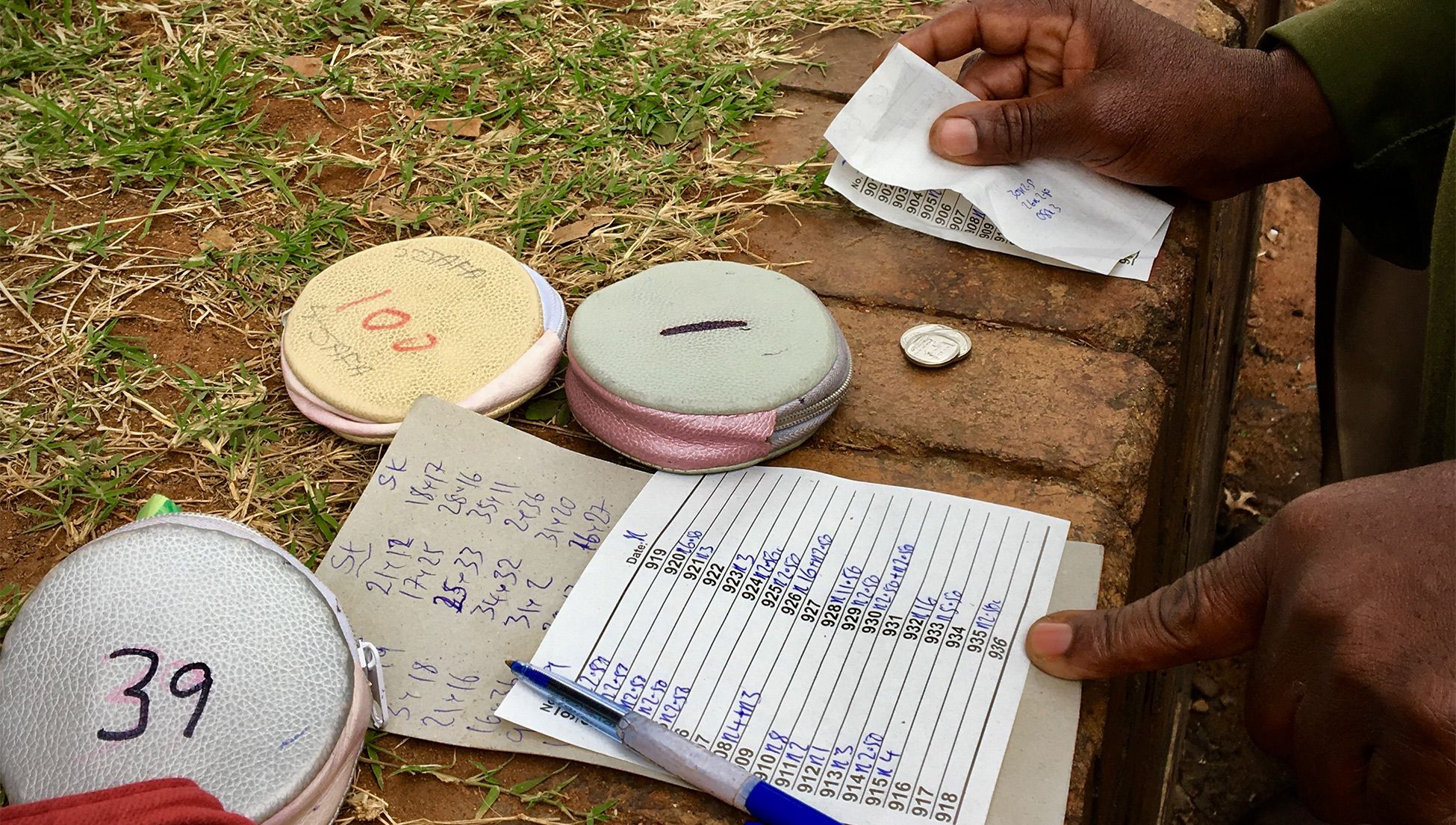
A fafi player consults the numbers. Photo supplied by the author

Brittany Birberickis a postdoctoral fellow at the University of Witwatersrand in Johannesburg and a visiting scholar at the University of California, San Diego. She specialises in South Africa, writing about urbanisation, aesthetics, mobility, and speculation.

Edited by Cameron Allan McKean

3 May 2022 (psyche.co)

I dreamed of a ruined laboratory. Inside the ruins, a single machine still worked: a device that could diagnose and fix whatever was wrong with your eyes. As I put my face up to the machine, my right eye was seized. I watched it being corrected by the device’s many small arms that manoeuvred tiny tools. As the machine slowly made my eye mechanical, the eye became the central image of the dream. The transformation was unsettling but not painful nor frightening. Instead, I seemed to anticipate the conversion. When it was complete, my eye looked the same, but I could feel that something had changed. I was told I could now see things more clearly.

I dreamed this eye-correcting dream one night in 2016 while living in Johannesburg, South Africa. I had come to research how this post-apartheid city was being transformed as it attempted to shed or redevelop the material infrastructure of its segregated past. It was during this research that I came upon fafi, a popular and informally regulated street-based lottery game played throughout the townships and urban areas of South Africa. The game is played by around 100,000 gamblers each day, primarily low-income Black South Africans on street corners throughout Johannesburg. Fafi, I would discover, is not a minor phenomenon. The Impact of Illegal Lotteries (2019), a report put out by a South African municipal government, suggests that fafi’s monthly turnover in one province alone is somewhere around 25 million rand (1.6 million US dollars) even though the average daily bet is only around R2 ($0.13). But what does any of this have to do with dreams of ruined laboratories and machine-corrected eyes?

Fafi is a game of chance, but playing it well involves more than simply choosing the right number, it requires careful interpretation of your dreams and the world around you. Through fafi, images from waking life and the world of dreams blur. The significance of a dream is equally weighted with a chance waking encounter – each produces meaningful data points through which a player can interpret winning numbers. What fafi offers is a way of thinking about how we interpret, calculate and anticipate the world.

The mechanics of the game are simple: it’s a lottery with 36 possible winning numbers. To play, gamblers bet on one of those numbers, which each correspond to a particular image or figure. These images range from the seemingly mundane (shoes, eggs, cat, car, birds flying) to the more sinister (dead woman, fire, police, thief, drunk man). One winning number is selected each time. For every R1 bet, winners receive a different amount depending on whether they’ve pooled their bets: if they are a serious gambler and betting ‘in their own bag’, they’ll receive R28 in return; if they are betting in someone else’s bag, they’ll receive only half that.

Image supplied by the author

From these simple basics, fafi quickly becomes complex through the cultural practices that surround it, including the way numbers are picked, the sites where gambling takes place, the placing of bets and the relationship between gamblers and those who run the game. These practices have evolved since the game became established in the 1930s. The precise origin of fafi is unknown, but it has ties to the Chinese community in South Africa, and these ties are rumoured to have connections to the Chinese mafia and Chinese migrants who arrived in South Africa in the early 1900s.

Dream images become wagers in the next game once they’ve been transformed into numerals through interpretation

The winning number is announced, or rather performed, in real time to a group of dedicated players on street corners across the city. The game I participated in has taken place for many years on a corner in Jeppestown, a neighbourhood just east of central Johannesburg. It has a morning and an afternoon ‘pull’ – when the winning fafi number is revealed by the ‘fafi man’ who delivers it in person by driving from spot to spot in a large truck with bulletproof windows (necessary to prevent robberies). There are always two people in the truck, and they approach the ‘bank’ – the designated spot where gamblers have assembled – only once the local manager (the ‘head runner’) of the fafi game arrives. In every pull I observed, all bets are finalised and bags collected by the runner before the truck arrives. Once the runner is in place, the fafi man approaches in his truck. The bags with bets and money wagered are exchanged for a small slip of paper with the winning number written on it. Then, the runner stands before the assembled gamblers and performs a gesture that correlates to one of the 36 numbers. Upon seeing the gesture, whispers of the winning number, cries of excitement or frustrated sighs can be heard among the players.

After a winning number is pulled in one gambling site, there’s a collective understanding that it will not be pulled again at that site for the next two days. If you know the last number pulled, the odds of a win slightly increase – but there are other ways to ‘get ahead of the fafi man’. The relationships between numbers and their correspondence to different images make up the cosmology of fafi. Within this web of meaning is a set of strategies used to divine what a player should bet on next.

There are many strategies for choosing numbers to bet on, but the most common is the interpretation of dreams. Through fafi’s elaborate number scheme, dream images become wagers in the next game once they’ve been transformed into numerals through interpretation. But fafi is not only about dreams being taken seriously. In the game of fafi, everything has the potential to be interpreted through the number scheme – everything can be interpreted like a dream.

One Sunday, at the park where my local fafi game was played, I watched a large dance competition. Another woman who played fafi, and who knew I had become interested in the game, grabbed me by the arm and pointed to the people who surrounded us. ‘Many people,’ she whispered in my ear. ‘Number 26.’ The image before me, of men in costumes performing dances and many more seated or standing to watch the performance, was to be interpreted as a sign of how to bet the following day. Images from dreaming and waking life were to be weighed alongside one another. What fafi offers is a way of thinking about how we interpret, calculate and anticipate the world – through the game and its strategies, we see a model for engaging the world and its meaning, one that encompasses our conscious and unconscious states.

To truly engage in fafi, one must freely share one’s dreams and experiences. Withholding details from a dream or failing to interpret correctly is believed to directly correspond to the money, or lack of money, in one’s gambling bag. The question remains though, how do players interpret their dreams? And how do they know which dreams to take seriously? Did my eye-changing machine mean anything?

What makes a ‘good number’ is a confluence of signs that suggest the next winner. Talk of dreams circulates at the fafi bank

Johannesburg is not the only place where gamblers bet on dream images. The prevalence of lottery games tied to images and dreaming is a phenomenon across the globe: la smorfia in Naples, Italy; hua-hui across China; and ‘the numbers’ in the US. In each iteration, dreams serve as guides for navigating a variety of variables – charts, patterns, number sequences or events of waking life – deemed significant for divining the near future, the winning bet.

The South African journalist and author Ufrieda Ho has written about her childhood as the daughter of a fafi man, which was not a prestigious position in the Chinese South African community during apartheid. It remains a precarious position today. Ho depicts her father, who was seen as a kind of gangster, moving between the worlds of her suburban Chinese community to the inner city and townships where Black South Africans congregated to witness him delivering the winning number. In her memoir Paper Sons and Daughters: Growing up Chinese in South Africa (2011), she writes in detail about the different processes of num ju (the practices of thinking up the winning fafi number) and cheow ju (recording the numbers of each of the players at the different banks):

Occasionally my dad could not settle on the number he wanted to play and then he would call on Lady Luck with everything from throwing a few dice to folding up pieces of paper with possible good numbers and then selecting a random number from the small origami of folded squares. But even when he did this, it was not all random; it was as if chance and luck had to be part of the perfect recipe to guide him to the right number to play. Sometimes we were asked about our dreams and my mother also told what she had dreamt about. Those dreams were meant to spark something meaningful for my father as he sat and tapped his feet, sucked hard on a cigarette and worked through the record books again; sometimes there was just no way to connect a pattern of coincidence.

Just like the gamblers who take careful note of past winning numbers, construct extravagant number schemes and consult their dreams, the fafi man also attends to a series of calculations and rituals to make his decision. He is betting directly against the fafi players on the other side of this equation. But the two opponents, Ho writes, ‘needed each other’. It’s important to remember that economic inequality is worse today than during the apartheid regime. For those living at the edges of the new economic order in South Africa, fafi provides an opportunity to make extra money. But the odds, of course, favour the fafi man, and he is no doubt making a profit off the low-income gamblers. But, despite the dismal odds, fafi players continue to track the numbers and interpret their dreams. For better or worse, in many South African communities, fafi remains tightly woven into the fabric of daily life.

Fafi is a pure lottery. To place a bet, you must have your own bag or access to someone else’s – someone who is willing to take your bet. These bag-owners often work as informal interpreters of dreams and numbers, a position once allocated exclusively to sangomas, traditional Zulu healers and herbalists. To receive a bag, the runner of the fafi game you want to play must deem you a reliable player: someone who will calculate the bets in their bag correctly and play consistently. Because players earn more if they have their own bag, those who are serious about fafi have their own bag (or multiple bags). Serious players also keep careful records of ‘good numbers’. What makes a ‘good number’ is a confluence of signs that suggest the next winner. For this reason, talk of dreams circulates at the fafi bank.

While sitting at a fafi bank on a street corner, waiting for the runner to appear so that I could turn in my bag, a veteran player, Mama kaseBuko, requested that I share not only my numbers but my dreams, too. ‘Tell us your dreams,’ she said, ‘we play around you.’ After I recounted my eye-correcting dream, she smiled. ‘Eyes. We will bet on eye numbers,’ but she did not begin to list these numbers (1, 9, 18, 21, 23, 26). Rather, she asked the other women she organised bags with what they thought: were these good numbers? Were any of them already being played? My dream became an additional data point in approximating the winning number.

Dream interpretation was once the role of sangomas, but dreaming and its interpretation, along with the tracking of numbers and charts, is now cultivated at the fafi bank. However, the dream interpretation used by fafi players still retains some trace of the sangomas’ practices and their training of initiates. At times, the discussion of dreams and patterns at fafi banks resembles the kind of dialogue between trainee and teacher that takes place during preparation to become a sangoma.

Mama kaseBuko, in asking me to retell my dream, was attempting to train me, and she was not shy about letting me know my shortcomings as a gambler. ‘You have good numbers but bad money,’ she would tell me, disappointed that I was not investing more in the game. After our exchange, I waited at the bank until the white truck of the fafi man pulled around the corner. I watched the fafi bags being handed off and the performance of the gesture correlating to the winning number: 9. Associated with the image of ‘a light’, 9 is also closely associated with the head and eyes. I had won – as had all the women who had listened and bet on eye numbers, too. I ran into Mama kaseBuko a few days later after another number corresponding to eyes had won the morning pull. ‘The winning number was 1 today. You are lucky with your eyes,’ she said.

But what does this tell us about dreaming? It means that dreams are interpreted through dialogue, through exchange. It means that only in those moments of exchange can we comprehend their significance to waking life or determine how seriously to take them. My dream of the eye-correcting machine, which seemed impossible to tether to my waking life, became meaningful the moment it was solicited by Mama kaseBuko and recounted to the women at the fafi bank. It was a dream about learning to see, learning to think with dreams. It is only through engagement, a training of sorts, that one learns what dreams mean – and which dreams to bet on.
DO THIS To Destroy Your Addictions TODAY! | Russell Brand

Commune This is Part 1 of a two-part interview with Russell Brand. Try Russell’s online course on recovery for free at https://www.onecommune.com/recovery Very few of us are free from some form of addiction — alcohol, sugar, sleeping pills, sex, Instagram, co-dependent relationships, the list goes on. Russell points out that all our addictions stem from a common problem: spiritual disconnection. But when we admit we have a problem, believe in real change, accept help from others, and hand over our will and control to a higher power, we can begin to find freedom from our addictions. To hear more from Russell, sign up for his upcoming Recovery course on Commune (onecommune.com/recovery) or check out his Luminary podcast, Under the Skin (luminary.link/russell @hearluminary). ABOUT RUSSELL Russell Brand is an award-winning comedian, actor, author, public thought leader and a passionate activist for mental health and drug rehabilitation. He is one of the most recognizable and best-loved comedy performers in the world, with a series of sold-out tours, best-selling DVDs, and a number of major film roles to his name. He is also the author of seven books, including Recovery: Freedom From Our Addictions, and Mentors: How to Help and Be Helped. ABOUT JEFF I have had a lot of jobs: co-founder & CEO of Commune and, co-founder and co-CEO of Wanderlust, board member at Pure Edge. I have authored books, built a wellness studio, developed a retreat center, and created video platforms. Oprah even selected me to be part of the SuperSoul 100, a group of top entrepreneurs. But aside from being a dad to three daughters, there is no job more humbling than hosting the Commune podcast. Every week, I interview people with esoteric expertise who are 10 times smarter than me. My nightstand has turned into a tower of books as I prepare for these interviews, learning everything from the neuro-chemistry of the brain to the inner workings of our justice system. It’s been an incredible challenge to deliver transformational content every Tuesday (and not embarrass myself). I hope you enjoy it! Chapters: 0:00 – 2:21: What is Addiction? 2:222:54 Is Addiction Spiritual Affliction? 2:555:07 What Does Recovery Look Like? 5:086:34 What Gives Recovery Meaning? 6:3512:45 The Importance of Mentorship 12:4616:05 The Ideal Conditions for Successful Mentorship 16:0619:39 The 12 Steps & Yoga 19:4021:18 How to Prevent Relapse 21:19 Outro ABOUT THE COMMUNE PODCAST Hosted by Jeff Krasno, the Commune podcast features thoughtful conversations for modern times. Not always comfortable but definitely needed, we explore both humanity and our human-ness. How can we live healthy, purpose-filled lives and be in service of something bigger? Guests include spiritual teachers, poets, scientists, philosophers, and activists for food sustainability, functional medicine, mental and physical health, and collective healing.

Tarot Card for May 4: The Knight of Cups

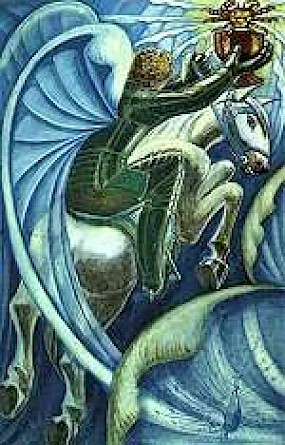
The Knight of Cups

This is the Lord of Waves and Water, often defined as the fiery aspect of water. As such, in many ways this card represents a contradiction. Most often when it appears, it will indicate an actual person who has influence. However sometimes it can also indicate a moodshift or a change of mode.

Since the Suit of Cups is all about love and loving relationships, it’s easy to see how the Knight can be regarded as the lover of the cards. When representing a moodshift, the card can indicate the period where a man falls in love.

When it represents a person he will be a complex and highly emotional being – creative and visionary, sensitive (and sometimes over-sensitive), romantic and intense. He will give the impression of being open and caring, though this is often misleading; the Knight of Cups is often subject to intense insecurity, needing constant re-assurance and attention.

He is attracted and attractive to women, and enjoys basking in their company. He will often be very charming, with a silver tongue and a powerful personal agenda. He will rarely manage practical matters well, tending to place rather more importance on buying two dozen red roses, than paying the bills. At his worst, he can be inconstant, unfaithful and selfish.

At his best, he is loving, generous with his emotions, supportive and tender. He can be capable of high levels of spiritual development, strong in intuition and warmly responsive. When he’s on form he is terrific company, having a good sense of humour and a keen interest in other people. He’s often an exciting and stimulating life partner and lover – but only at his best!

You see – I said he was contradictory!

The Knight of Cups

(via angelpaths.com and Alan Blackman)

Mysticism and War with James Tunney

New Thinking Allowed with Jeffrey Mishlove James Tunney, LLM, is an Irish barrister who has lectured on legal matters throughout the world. He is a poet, a scholar, and author of The Mystery of the Trapped Light: Mystical Thoughts in the Dark Age of Scientism plus The Mystical Accord: Sutras to Suit Our Times, Lines for Spiritual Evolution; also Empire of Scientism: The Dispiriting Conspiracy and Inevitable Tyranny of Scientocracy, TechBondAge: Slavery of the Human Spirit, and Human Entrance to Transhumanism: Machine Merger and the End of Humanity. His website is http://www.jamestunney.com. In this three-hour conversation, James reviews his background in international law. He shares his interest in the rights of indigenous people and how they conflict with the modern tendencies toward standardization. Tunney’s writings on mysticism (light) versus repressive technology (dark) emerges from the insight that there has been a failure of spiritual evolution. This is an inescapable issue and is directly and constantly relevant to questions of war and peace. With regard to the current global conflict and the risk of nuclear war, he maintains that it is important to view the situation through a wide historical lens. New Thinking Allowed host, Jeffrey Mishlove, PhD, is author of The Roots of Consciousness, Psi Development Systems, and The PK Man. Between 1986 and 2002 he hosted and co-produced the original Thinking Allowed public television series. He is the recipient of the only doctoral diploma in “parapsychology” ever awarded by an accredited university (University of California, Berkeley, 1980). He is also the Grand Prize winner of the 2021 Bigelow Institute essay competition regarding the best evidence for survival of human consciousness after permanent bodily death. (Recorded on April 20, 2022)

The Love Syllogism

Translators will know that Truth is that which is so. That which is not truth is not so. Therefore Truth is all there is.

Since Truth is all there is, there is nothing other than Truth, therefore Truth is One.

Another word for oneness is Love.

Therefore, Love is that which is so. That which is not love is not so. Therefore Love is all there is.

Where is the U.S. military aid heading to Ukraine making the most difference?

May 2, 2022 Heard on Morning Edition (npr.org)

NPR’s Rachel Martin talks to Barry Pavel of the Scowcroft Center for Strategy and Security at the Atlantic Council, about the mechanics of military aid to Ukraine and the prospect of a long conflict.

RACHEL MARTIN, HOST:

OK. We’re going to spend the next few minutes talking about the consequences of the foreign military aid going into Ukraine. And for that, I am joined by Barry Pavel. He is the director of the Scowcroft Center for Strategy and Security at the Atlantic Council. He worked on the National Security Council under Presidents Bush and Obama.

Thanks so much for being with us this morning.

BARRY PAVEL: Thank you, my pleasure.

MARTIN: Where do you see U.S. military aid going into Ukraine making the most substantive difference on the ground right now?

PAVEL: Well, I think we’re right now in what I would call sort of a manufacturing and resupply race at this point. The two sides are pretty entrenched. And to me, the key question is whether Russia can resupply and rearm its military forces faster than the United States, its NATO allies and others can supply, train, where it’s necessary, and enable the transport of weapons and ammunition so the Ukrainian forces can use those weapons. The weapons are changing also as the warfare terrain is changing. And so this is really a different phase than the initial phase. This is really about resupply, training and ensuring that each side gets – is using the weapons that it needs in this new terrain.

MARTIN: Explain what is so complicated and challenging about just getting the weapons into Ukraine, about those transfers.

PAVEL: Well, it’s a lot. And, you know, we don’t know the details, and we shouldn’t look to the details too much. But some of the systems the Ukrainians are already trained on, so they’re – especially the Soviet-era systems. And the U.S. and NATO allies have been supplying a lot of that. But there are some other systems where they do need some training. So that training needs to be conducted somewhere. The supply needs to be given to the Ukrainian forces somewhere.

And then the transport across the vast expanse of western Ukraine, which one would assume – there’s only a few options. It’s by air, where that’s necessary. But especially for heavy equipment, that’s not possible. So then it’s railway; and it’s roads. And so for railway – you know, each side knows what’s going on here. And so you’re seeing them try to weaken the other side’s efforts. You see Russia starting to attack railway hubs.

MARTIN: Yeah.

PAVEL: We’ve seen that over the last week. And to me, that’s very, very concerning. You’ve seen some fuel depots go up – you know, explosions at fuel depots in Russia, where, to me, it looks like the Ukrainians are targeting, you know, critical logistics hubs and lines and supplies. So how does Ukraine protect its railway hubs?

MARTIN: Right.

PAVEL: Is it missile defenses? Is it air defenses? Is there – are there other routes? So I think that’s really an important question going forward.

MARTIN: I want to ask – the U.K.’s Defense Ministry is out with a new assessment saying a quarter – 25% of Russian troops engaged in Ukraine are now, quote, “combat ineffective.” How did that happen?

PAVEL: The Ukrainians are just mounting a valiant and very agile defense. In the first phase, they were moving forces where they were needed. They were countering these Russian offensives. And so I think it’s just been a really effective – and no doubt, with some support from NATO and the West – but I think it’s been a very, very effective defense effort that has really stymied the Russians. But it’s – this is not over. And Russia has numerical superiority. But the Ukrainians, I think, have a lot more on their side. So I’m relatively optimistic that the Russians will not achieve their goals. And their goals are to push as far westward from where they are in the east as possible.

MARTIN: Let me ask you. Last week, Russia sent a letter to the U.S. And according to The Washington Post, the letter said that U.S. and NATO weapons shipments to Ukraine were, quote, “adding fuel to the conflict” and that there would be, quote, “unpredictable consequences.” I mean, Putin has said as much since the beginning of this war. Are you surprised that Russia hasn’t retaliated in a big way yet against countries militarily supporting Ukraine?

PAVEL: No, I’m not. I’m not one of those whose – there are many who are somewhat hysterical about all the Russian threats, including the nuclear threats. I’m not one of those. Putin knows what NATO military capabilities are. He respects NATO military capabilities. He’s got his hands full with fighting Ukraine. He does not want another fight with a much, much, much larger and more capable set of forces. So I think we should take those threats seriously. Don’t ignore them completely, but I don’t consider them to be significant and meriting a new type of response.

MARTIN: Barry Pavel of the Atlantic Council, thank you so much.

PAVEL: My pleasure.

Copyright © 2022 NPR. All rights reserved. Visit our website terms of use and permissions pages at www.npr.org for further information.

NPR transcripts are created on a rush deadline by an NPR contractor. This text may not be in its final form and may be updated or revised in the future. Accuracy and availability may vary. The authoritative record of NPR’s programming is the audio record.

(Contributed by Michael Kelly, H.W.)

Tarot Card for May 3: The Knight of Cups

The Knight of Cups

This is the Lord of Waves and Water, often defined as the fiery aspect of water. As such, in many ways this card represents a contradiction. Most often when it appears, it will indicate an actual person who has influence. However sometimes it can also indicate a moodshift or a change of mode.

Since the Suit of Cups is all about love and loving relationships, it’s easy to see how the Knight can be regarded as the lover of the cards. When representing a moodshift, the card can indicate the period where a man falls in love.

When it represents a person he will be a complex and highly emotional being – creative and visionary, sensitive (and sometimes over-sensitive), romantic and intense. He will give the impression of being open and caring, though this is often misleading; the Knight of Cups is often subject to intense insecurity, needing constant re-assurance and attention.

He is attracted and attractive to women, and enjoys basking in their company. He will often be very charming, with a silver tongue and a powerful personal agenda. He will rarely manage practical matters well, tending to place rather more importance on buying two dozen red roses, than paying the bills. At his worst, he can be inconstant, unfaithful and selfish.

At his best, he is loving, generous with his emotions, supportive and tender. He can be capable of high levels of spiritual development, strong in intuition and warmly responsive. When he’s on form he is terrific company, having a good sense of humour and a keen interest in other people. He’s often an exciting and stimulating life partner and lover – but only at his best!

You see – I said he was contradictory!

The Knight of Cups

(via angelpaths.com and Alan Blackman)

Eric Wargo: All Dreams are Precognitive

New Thinking Allowed with Jeffrey Mishlove Eric Wargo, PhD, an anthropologist, is author of Time Loops and, most recently, Precognitive Dreamwork and the Long Self: Interpreting Messages From Your Future. Here he explains that the Experiment With Time, written by J.W. Dunne in 1927, provides a protocol by which average people can demonstrate to themselves that our dreams contain as much information from the future as from the past. He offers a series of steps to aid viewers in discovering the truth about precognition (or reverse causation) for themselves. He describes the influence that J.W. Dunne had upon several notable writers in his own day – including C. S. Lewis and J. R. R. Tolkien. He explains the implications of this approach for an understanding of the “Long Self.” New Thinking Allowed host, Jeffrey Mishlove, PhD, is author of The Roots of Consciousness, Psi Development Systems, and The PK Man. Between 1986 and 2002 he hosted and co-produced the original Thinking Allowed public television series. He is the recipient of a doctoral diploma in “parapsychology” awarded by the University of California, Berkeley, 1980. He is also the Grand Prize winner of the 2021 Bigelow Institute essay competition on the best evidence for postmortem human survival. He is also the Grand Prize winner of the 2021 Bigelow Institute essay competition on the best evidence for postmortem human survival. (Recorded on April 14, 2022)

Book: “The Hidden Persuaders”

The Hidden Persuaders

The Hidden Persuaders

by Vance PackardMark Crispin Miller (Introduction) 

“One of the best books around for demystifying the deliberately mysterious arts of advertising.”–Salon

“Fascinating, entertaining and thought-stimulating.”–The New York Times Book Review

“A brisk, authoritative and frightening report on how manufacturers, fundraisers and politicians are attempting to turn the American mind into a kind of catatonic dough that will buy, give or vote at their command–The New Yorker

Originally published in 1957 and now back in print to celebrate its fiftieth anniversary, The Hidden Persuaders is Vance Packard’s pioneering and prescient work revealing how advertisers use psychological methods to tap into our unconscious desires in order to “persuade” us to buy the products they are selling.

A classic examination of how our thoughts and feelings are manipulated by business, media and politicians, The Hidden Persuaders was the first book to expose the hidden world of “motivation research,” the psychological technique that advertisers use to probe our minds in order to control our actions as consumers. Through analysis of products, political campaigns and television programs of the 1950s, Packard shows how the insidious manipulation practices that have come to dominate today’s corporate-driven world began. Featuring an introduction by Mark Crispin Miller, The Hidden Persuaders has sold over one million copies, and forever changed the way we look at the world of advertising.

Vance Packard (1914-1996) was an American journalist, social critic, and best-selling author. Among his other books were The Status Seekers, which described American social stratification and behavior, The Waste Makers, which criticizes planned obsolescence, and The Naked Society, about the threats to privacy posed by new technologies. 

(Goodreads.com)