
Monthly Archives: May 2022

Virginia Woolf on Being Ill as a Portal to Self-Understanding
By Maria Popova (themarginalian.org)

“The body provides something for the spirit to look after and use,” computing pioneer Alan Turing wrote as he contemplated the binary code of body and spirit in the spring of his twenty-first year, having just lost the love of his life to tuberculosis. Nothing garbles that code more violently than illness — from the temporary terrors of food poisoning to the existential tumult of a terminal diagnosis — our entire mental and emotional being is hijacked by the demands of a malcontented body as dis-ease, in the most literal sense, fills sinew and spirit alike. These rude reminders of our atomic fragility are perhaps the most discomfiting yet most common human experience — it is difficult, if at all possible, to find a person unaffected by illness, for we have all been or will be ill, and have all loved or will love someone afflicted by illness.
No one has articulated the peculiar vexations of illness, nor addressed the psychic transcendence accessible amid the terrors of the body, more thoughtfully than Virginia Woolf (January 25, 1882–March 28, 1941) in her 1926 essay “On Being Ill,” later included in the indispensable posthumous collection of her Selected Essays (public library).
Portrait of Virginia Woolf from Literary Witches.
Half a century before Susan Sontag’s landmark book Illness as Metaphor, Woolf writes:
Considering how common illness is, how tremendous the spiritual change that it brings, how astonishing, when the lights of health go down, the undiscovered countries that are then disclosed, what wastes and deserts of the soul a slight attack of influenza brings to view, what precipices and lawns sprinkled with bright flowers a little rise of temperature reveals, what ancient and obdurate oaks are uprooted in us by the act of sickness, how we go down into the pit of death and feel the waters of annihilation close above our heads and wake thinking to find ourselves in the presence of the angels and the harpers when we have a tooth out and come to the surface in the dentist’s arm-chair and confuse his “Rinse the mouth — rinse the mouth” with the greeting of the Deity stooping from the floor of Heaven to welcome us — when we think of this, as we are so frequently forced to think of it, it becomes strange indeed that illness has not taken its place with love and battle and jealousy among the prime themes of literature. Novels, one would have thought, would have been devoted to influenza; epic poems to typhoid; odes to pneumonia; lyrics to toothache. But no; with a few exceptions — De Quincey attempted something of the sort in The Opium Eater; there must be a volume or two about disease scattered through the pages of Proust — literature does its best to maintain that its concern is with the mind; that the body is a sheet of plain glass through which the soul looks straight and clear, and, save for one or two passions such as desire and greed, is null, and negligible and non-existent.
Five years earlier, the ailing Rilke had written in a letter to a young woman: “I am not one of those who neglect the body in order to make of it a sacrificial offering for the soul, since my soul would thoroughly dislike being served in such a fashion.” Woolf, writing in the year of Rilke’s death and well ahead of the modern scientific inquiry into how the life of the body shapes the life of the mind, rebels against the residual Cartesianism of the mind-body divide with her characteristic fusion of wisdom and wry humor, channeled in exquisite prose:

Art from the vintage science primer The Human Body: What It Is and How It Works.
“Is language the adequate expression of all realities?” Nietzsche had asked when Woolf was just genetic potential in her parents’ DNA. Language, the fully formed human argues as she considers the unreality of illness, has been utterly inadequate in conferring upon this commonest experience the dignity of representation it confers upon just about every other universal human experience:
In a passage Oliver Sacks could have written, Woolf pivots to the humorous, somehow without losing the profundity of the larger point:
And then, just like that, in classic Woolfian fashion, she fangs into the meat of the matter — the way we plunge into the universality of illness, so universal as to border on the banal, until we reach the rock bottom of utter existential aloneness:

Art by Nina Cosford from the illustrated biography of Virginia Woolf
In health, Woolf argues, we maintain the illusion, both psychological and outwardly performative, of being cradled in the arms of civilization and society. Illness jolts us out of it, orphans us from belonging. But it also does something else, something beautiful and transcendent: In piercing the trance of busyness and obligation, it awakens us to the world about us, whose smallest details, neglected by our regular societal conscience, suddenly throb with aliveness and magnetic curiosity. It renders us “able, perhaps for the first time for years, to look round, to look up — to look, for example, at the sky”:
But in the consolations of this transcendent communion with nature resides the most disquieting fact of existence — the awareness of an unfeeling universe, operating by impartial laws unconcerned with our individual fates:

Drawing from The Comet Book — a 16th-century pre-astronomical document of magical thinking about the laws of the universe.
It would take Woolf more than a decade to fully formulate, in a most stunning reflection, the paradoxical way in which these heartless laws are the very reason we are called to make beauty and meaning within their unfeeling parameters: “There is no Shakespeare, there is no Beethoven; certainly and emphatically there is no God; we are the words; we are the music; we are the thing itself,” she would write in 1939. Now, in her meditation on illness, she hones the anchor of these ideas:
[…]
It is only the recumbent who know what, after all, Nature is at no pains to conceal — that she in the end will conquer; heat will leave the world; stiff with frost we shall cease to drag ourselves about the fields; ice will lie thick upon factory and engine; the sun will go out.
This sudden awareness of elemental truth renders the ill person a sort of seer, imbued with an almost mystical understanding of existence, beyond any intellectual interpretation. Nearly a century before Patti Smith came to contemplate how illness expands the field of poetic awareness, Woolf writes:
Complement this portion of Woolf’s thoroughly fantastic Selected Essays with Roald Dahl on how illness emboldens creativity and Alice James — Henry and William James’s brilliant sister, whom Woolf greatly admired — on how to live fully while dying, then revisit Woolf on the art of letters, the relationship between loneliness and creativity, the creative potency of the androgynous mind, and her transcendent account of a total solar eclipse.
Julian of Norwich: Celebrating Mother Jesus
by Kittredge Cherry | Updated May 5, 2022 (qspirit.net)
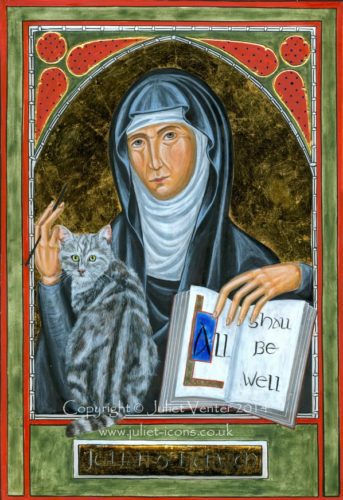
Julian of Norwich is a medieval English mystic who celebrated “Mother Jesus.” Her feast day, May 8, always falls near Mother’s Day.
It’s not known if Julian herself was queer, but some of her ideas were. Julian is often listed with LGBTQ saints because of her genderbending visions of Jesus and God. She wrote, “As truly as God is our Father, so truly is God our Mother.”
Her discussions of Jesus as a mother sound radical even now, more than 600 years later. Her omnigendered vision of the Trinity fits with contemporary feminist and queer theology.
Mother’s Day is also a great time to honor mothers whose love for their LGBTQ children helped launch organizations such as Parents, Families, and Friends of Lesbians and Gays (PFLAG), founded by Jeanne Manford and Adele Starr.

Julian of Norwich (c.1342-1416) is the first woman to write a book in English. The book, “Revelations of Divine Love,” recounts a series of 16 visions that she experienced from May 8-13, 1373 during a severe illness when she was 30 years old. The book includes Julian’s most famous saying, “All shall be well and all shall be well and all manner of things shall be well” — words spoken to her by God in one of Julian’s visions.
She appears with this quote and her cat companion in the icon at the top of this post by Juliet Venter.
A mug shows Julian with her cat and her best-loved quote: “All shall be well and all shall be well and all manner of things shall be well.” Available from the Drinklings Coffee Mugs Etsy shop.
Later Julian went on to become an anchoress, a type of recluse who lives in a cell attached to a church and does contemplative prayer. Her hermit’s cell was at the Church of St. Julian in Norwich. The cell had two windows, one opening to the church and the other opening to the street. She became known throughout England for the spiritual counseling that she gave there.
The queer side of Julian is explored in the chapter “Queer Touch Between Holy Women: Julian of Norwich, Margery Kempe, Birgitta of Sweden, and the Visitation” by Laura Saetveit Miles of the University of Bergen, Norway, in the 2019 scholarly book “Touching, Devotional Practices, and Visionary Experience in the Late Middle Ages.” It “takes a new approach to the well-known meeting between two late-medieval English visionary women, Margery Kempe and the anchoress Julian of Norwich,” thereby revealing “the full transgressive effect of queer touch between women—or even its unspoken possibility,” according to the chapter summary.
Julian wrote of God as mother
Julian is considered the first Catholic to write at length about God as mother. Her profound ideas speak powerfully today to women and queer people of faith.
Here are a few short quotes from Julian’s extensive writings about “Mother Jesus”:“So Jesus Christ who sets good against evil is our real Mother. We owe our being to him–and this is the essence of motherhood! –and all the delightful, loving protection which ever follows. God is as really our Mother as he is our Father.“ (Chapter 59)“So Jesus is our true Mother by nature at our first creation, and he is our true Mother in grace by taking on our created nature.” (Chapter 59)“A mother can give her child milk to suck, but our dear mother Jesus can feed us with himself, and he does so most courteously and most tenderly with the holy sacrament, which is the precious food of life itself… The mother can lay the child tenderly to her breast, but our tender mother Jesus, he can familiarly lead us to his blessed breast through his sweet open side….” (Chapter 60)
These quotes come from modern English translations of “Revelations of Divine Love” by Elizabeth Spearing and Clifton Wolters. Other saints who wrote about God as mother include Anselm of Canterbury.
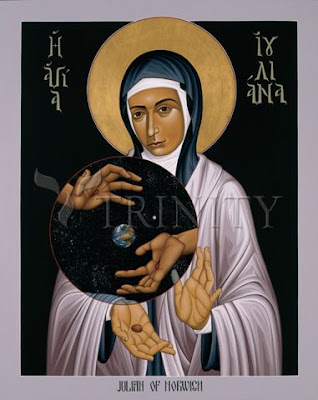
“Dame Julian’s Hazelnut” by Brother Robert Lentz, OFM, Prints available at Amazon or TrinityStores.com
Julian saw God’s love in ordinary life
The sacred feminine is just one of the many revelations that have endeared Julian to the public. She also uses objects from ordinary life to illustrate God’s loving, forgiving nature. For example, in one vision God shows Julian a small object like a hazel-nut in the palm of her hand. Julian writes:“I looked at it and thought, ‘What can this be?’ And the answer came to me, ‘It is all that is made.’ I wondered how it could last, for it was so small I thought it might suddenly disappear. And the answer in my mind was, ‘It lasts and will last forever because God loves it; and in the same way everything exists through the love of God’.” (Chapter 5)
A longstanding legend tells of Julian’s friendship with her cat companion, depicted in the painting at the top of this post. As an anchoress, Julian probably lived alone. It is said that the only other being to share her room was a cat — officially for the practical purpose of keeping it free from rats and mice.

“Julian of Norwich,” a memorial drawing for his cat Betty, by Douglas Blanchard
New York painter Douglas Blanchard shows the saint with the artist’s own cat Betty in a drawing done as a memorial tribute to a beloved feline companion who died in 2013. He includes a favorite quote from Julian:
“He that made all things for love,
by that same love keepeth them,
and shall keep them without end.”
Blanchard is best known for his epic series “The Passion of Christ: A Gay Vision,” which is now available as a book. He teaches art and art history at the Bronx Community College of the City University of New York.
“Julian of Norwich” by Brother Robert Lentz, OFM, Prints available at Amazon or TrinityStores.com
Another icon of Julian and her cat was created by Robert Lentz, a Franciscan friar based in New York. Known for his innovative icons, he was rebuked by the church for painting LGBTQ saints and God as female.

“Julian of Norwich” by Tobias Haller
An elderly “Julian of Norwich” was sketched against a lavender background by Tobias Haller, an iconographer, author, composer, and vicar of Saint James Episcopal Church in the Bronx. He is the author of “Reasonable and Holy: Engaging Same-Sexuality.” Haller enjoys expanding the diversity of icons available by creating icons of LGBTQ people and other progressive holy figures as well as traditional saints. He and his spouse were united in a church wedding more than 30 years ago and a civil ceremony after same-sex marriage became legal in New York.
Julian lived a long life. The date of her death is unknown, but records show that she was still alive at age 73 to receive an inheritance. She was never formally canonized, but Julian is considered a saint by popular devotion. The Episcopal and Lutheran Churches keep her feast day on May 8.
Many important writers have been influenced by Julian, including 20th-century British poet T.S. Eliot. He quotes her in his masterpiece “Four Quartets,” which led to him receiving the Nobel Prize for literature in 1948.
Julian of Norwich in song and prayer
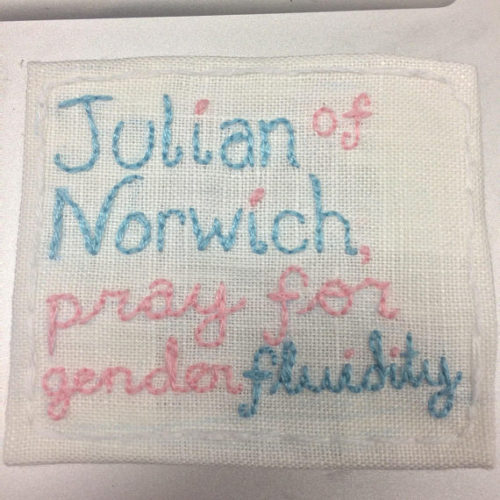
“Julian of Norwich, pray for gender fluidity” by Avery Smith of Sapphic Stiches
Various prayers related to Julian of Norwich are in circulation, including “Julian of Norwich, pray for gender fluidity.” The prayer was hand-sewn onto embroidered patch by artist Avery Smith of Louisville, Kentucky. Smith runs an Etsy shop called Sapphic Stitches that offers a variety of patches on LGBTA+ Christian and other themes.
“LGBTA+ Christians who choose to pray for the intercession of Saints deserve to have patrons whom they trust understand and support them,’ Smith affirms. “Whatever Saint or paired-Saint couple resonates with you as an LGBTA+ Christian can be made into a customizable patch.”
The prayer is incorporated into Q Spirit’s Litany of Queer Saints.
Julian’s famous words are set to music in the song “All Will Be Well” by Meg Barnhouse, a Texas-based Unitarian minister and singer/songwriter. The moving song comes from her album “Mango Thoughts in a Meatloaf Town” and is available on YouTube.https://www.youtube.com/embed/T-Ao9Wt_Vw4
A longer quotation from Julian, again including “All will be well,” was set to music by 20th-century Welsh composer William Matthias in his piece “As Truly as God is Our Father.” it is sung on video by Plymouth Choir of First Plymouth Church, Lincoln Nebraska.https://www.youtube.com/embed/_EFNzvWSWQM
___
To read this post in Spanish / en español, go to Santos Queer:
Juliana de Norwich: Celebración de la Madre Jesús (Santos Queer)
To read this article in Italian, go to:
Gesù come madre. La vita e il pensiero di Giuliana di Norwich (Gionata.org)
___
Related links for Mother’s Day:
Jeanne Manford: PFLAG founder loved her gay son
Adele Starr and others: Patron saints for straight allies of LGBTQ people
___
Top image credit:
Julian of Norwich icon by Juliet Venter.
___
This post is part of the LGBTQ Saints series by Kittredge Cherry. Traditional and alternative saints, people in the Bible, LGBTQ martyrs, authors, theologians, religious leaders, artists, deities and other figures of special interest to lesbian, gay, bisexual and transgender and queer (LGBTQ) people and our allies are covered.
This article was originally published on Q Spirit in May 2017, was expanded with new material over time, and was most recently updated for accuracy on May 4, 2022.
Copyright © Kittredge Cherry. All rights reserved.
Qspirit.net presents the Jesus in Love Blog on LGBTQ spirituality.
___
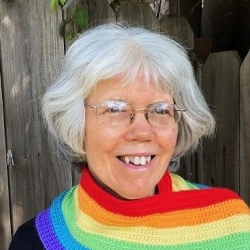
FollowKittredge CherryFounder at Q SpiritKittredge Cherry is a lesbian Christian author who writes regularly about LGBTQ spirituality.She holds degrees in religion, journalism and art history.She was ordained by Metropolitan Community Churches and served as its national ecumenical officer, advocating for LGBTQ rights at the National Council of Churches and World Council of Churches.
Free Will Astrology: Week of May 5, 2022
MAY 3, 2022 AT 6:45 AM BY ROB BREZSNY (newcity.com)

Photo: Oguz Can
ARIES (March 21-April 19): Poet Jennifer Willoughby writes, “I am so busy. I am practicing my new hobby of watching me become someone else. There is so much violence in reconstruction. Every minute is grisly, but I have to participate. I am building what I cannot break.” I wouldn’t describe your own reconstruction process during recent months as “violent” or “grisly,” Aries, but it has been strenuous and demanding. The good news is that you have mostly completed the most demanding work. Soon the process will become more fun. Congratulations on creating an unbreakable new version of yourself!
TAURUS (April 20-May 20): Rapper and entrepreneur Jay-Z tells us, “Don’t ever go with the flow. Instead, be the flow.” Here’s what I think he means: If we go with the flow, we adjust and accommodate ourselves to a force that is not necessarily aligned with our personal inclinations and needs. To go with the flow implies we are surrendering our autonomy. To claim our full sovereignty, on the other hand, we are wise to be the flow. We should create our own flow, which is just right for our unique inclinations and needs. I think this is the right approach for you right now, Taurus. Be the flow.
GEMINI (May 21-June 20): The Italian language used to be a dialect spoken in Tuscany. That area comprises less than eight percent of the country’s territory. How did such a dramatic evolution happen? Why did a local dialect supersede other dialects like Piedmontese, Neapolitan, Sicilian and others? In part, it was because three potent fourteenth-century writers wrote in the Tuscan dialect: Dante Alighieri, Francesco Petrarch and Giovanni Boccaccio. Another reason: Because Tuscany is centrally located in Italy, its dialect was less influenced by languages in France and other nearby countries. I offer this as a metaphor for you in the coming months. One of your personal talents, affiliations or inclinations could become more influential and widespread—and have more authority in your life.
CANCER (June 21-July 22): “Always strive to be more interested than interesting,” said actor and activist Jane Fonda. That may not be easy for you to accomplish in the near future, dear Cancerian. Your curiosity will be at peak levels, but you may also be extra compelling and captivating. So I’ll amend Fonda’s advice: Give yourself permission to be both as interested and as interesting as you can imagine. Entertain the world with your lively personality as you go in quest of new information, fresh perceptions and unprecedented experiences.
LEO (July 23-Aug. 22): “When in doubt, act like God,” proclaimed Leo singer-songwriter Madonna. I wouldn’t usually endorse that advice. But I’ll make an exception for you Leos during the next three weeks. Due to a divine configuration of astrological omens, you are authorized to ascend to new heights of sovereignty and self-possession—even to the point of doing a vivid God impersonation. For best results, don’t choose an angry, jealous, tyrannical deity to be your role model. Pattern yourself after a sweeter, funnier, more intimate type of celestial being.
VIRGO (Aug. 23-Sept. 22): My Virgo friend Amanda told me she felt tight and overwrought. She was overthinking and on the verge of a meltdown. With a rueful sigh, she added, “I adore anything that helps me decompress, unwind, simmer down, stop worrying, lighten up, compose myself and mellow out.” So I invited her to take deep breaths, close her eyes, and visualize herself immersed in blue-green light. Then I asked her to name influences she loved: people, animals, natural places, music, books, films, art and physical movements that made her feel happy to be alive. She came up with eight different sources of bliss, and together we meditated on them. Half an hour later, she was as relaxed as she had been in months. I recommend you try a comparable exercise every day for the next fourteen days. Be proactive about cultivating tranquil delight.
LIBRA (Sept. 23-Oct. 22): Author Anne Lamott is renowned for her tender approach to expressing her struggles with addiction, depression and other tribulations. One of her supreme tests was being a single mother who raised her son Sam. In this effort, she was her usual plucky self. Anytime she hosted playdates with Sam’s young friends at her home, she called on the help of crayons and paint and pens and clay and scissors. “When we did art with the kids, the demons would lie down,” she testified. I recommend a comparable strategy for you in the coming days, Libra. You will have extra power as you tame, calm or transform your demons. Making art could be effective, as well as any task that spurs your creativity and imagination.
SCORPIO (Oct. 23-Nov. 21): “My heart has developed a kind of amnesia, where it remembers everything but itself,” writes Scorpio poet Sabrina Benaim. If you suffer a condition that resembles hers, it’s about to change. According to my astrological analysis, your heart will soon not only remember everything; it will also remember itself. What a blissful homecoming that will be—although it may also be unruly and confounding, at least in the beginning. But after the initial surprise calms down, you will celebrate a dramatic enhancement of emotionally rich self-knowledge. You will feel united with the source of your longing to love and be loved.
SAGITTARIUS (Nov. 22-Dec. 21): “Just because things hadn’t gone the way I had planned didn’t necessarily mean they had gone wrong,” writes Sagittarian author Ann Patchett. Her thought may be helpful for you to meditate on. My guess is that you will ultimately be glad that things didn’t go the way you planned. God or your Higher Self or the Mysterious Forces of Destiny will conspire to lead you away from limited expectations or not-big-enough visions so as to offer you bigger and better blessings.
CAPRICORN (Dec. 22-Jan. 19): Novelist Jane Austen (1775–1817) confessed she was a “wild beast.” Really? The author who wrote masterfully about the complex social lives of wealthy British people? Here’s my theory: The wild beast in her made her original, unsentimental, humorous, and brilliant in creating her stories. How is your own inner wild beast, Capricorn? According to my reading of the astrological omens, now is an excellent time to give it fun, rich assignments. What parts of your life would benefit from tapping into raw, primal energy?
AQUARIUS (Jan. 20-Feb. 18): Aquarian poet Jack Gilbert wrote, “I lie in the dark wondering if this quiet in me now is a beginning or an end.” I don’t know how Gilbert solved his dilemma. But I suspect you will soon be inclined to pose a similar question. In your case, the answer will be that the quiet in you is a beginning. Ah! But in the early going, it may not resemble a beginning. You might be puzzled by its fuzzy, meandering quality. But sooner or later, the quiet in you will become fertile and inspirational. You will ride it to the next chapter of your life story.
PISCES (Feb. 19-March 20): The genre of poetry known as haiku often relies on unexpected juxtapositions. Critic R. H. Blyth observed, “In haiku, the two entirely different things that are joined in sameness are poetry and sensation, spirit and matter.” I suspect your life in the coming weeks will have metaphorical resemblances to haikus. You will be skilled at blending elements that aren’t often combined, or that should be blended but haven’t been. For inspiration, read these haikus by Raymond Roseliep. 1. in the stream / stones making half / the music. 2. horizon / wild swan drifting through / the woman’s body. 3. birthcry! / the stars / are all in place. 4. bathwater / down the drain / some of me. 5. grass / holding the shape / of our night. 6. campfire extinguished, / the woman washing dishes / in a pan of stars.
Homework: You can now make a change that has previously seemed impossible. What is it? Newsletter.FreeWillAstrology.com
May Astrology Forecast: Very Rare Mars-Jupiter-Neptune Conjunction!
Matthew Stelzner This month begins with the Venus-Jupiter-Neptune conjunction still in peak potency and the potential for major heart openings and joyful experience of love and pleasure in full force. The Jupiter-Neptune conjunction continues all year, and as I’ve explored in previous videos it is getting a series of inner-planet activations in April and May. This month, along with Venus, Mars conjoins the Jupiter-Neptune conjunction, bringing its qualities of force and movement to the energy. We I explore how this takes the Jupiter-Neptune themes of hopeful visions and big dreams, and brings Mars’ movement and action into the mix. If you’ve felt yourself opening to a big healing vision for your life, it’s time to take action towards manifesting that vision. It’s time to catch that wave and learn to flow with it. If there was ever a month to let go of hypervigilance and trust the flow of your intuitive movements, this is it! There will not be another alignment like this until the end of this century in 2098, so I hope you’ve got your surf boards ready for this very potent wave of healing energy. I hope you will paddle out to catch this wave that wants to carry you onto higher, more hopeful and more joyful, timelines. To check out more of my work, see my blog, and get information about my intuitive readings, visit my website at: http://stelz.biz/ Sign up for my mailing list here: http://stelz.biz/register-for-my-emai… If you sign up for my mailing list you will also receive my newsletter and special promotions. Check me out on Instagram where you will find unique content that is not shared here: @tarot_and_lola
Rupert Spira on peace
It is always still in the depths of the ocean; likewise,
the heart of awareness is always silent and at peace.
–Rupert Spira
Rupert Spira (born March 13, 1960) is an English teacher of the “direct path”, a method of spiritual self-enquiry through talks and writing, and a notable English studio potter with work in public and private collections. Wikipedia
Tarot Card for May 5: The Queen of Swords
The Queen of Swords
The Queen of Swords indicates a woman who is blessed (or cursed) with sharp perception, and highly honed intuition. She is acutely analytical, with a razor-sharp ability to get to the heart of a situation, seeing exactly what is, rather than what others would wish her to see.
She is a private woman, unwilling to let people too close to her until she is satisfied she thoroughly understands their motivations. But once won as a friend, she is unfailingly loyal, honest and supportive.
She’s usually very intelligent, with a dry sense of humour. Her penetrating insight will often reveal aspects of themselves to others that they had previously been unable to grasp – thus she is a capable therapist, teacher or leader.
The woman represented by this card will be experienced in the flow of life, understanding a great deal about both the great triumphs, and the deepest failings of the race. Her clarity and measured expression will be of great value at times of confusion and sadness.
Sometimes in a reading, this card will turn up to indicate a woman in a particular phase of her life, where she temporarily becomes a Sword as a result of what is happening to her. In that case the card is not quite so positively defined, for it can indicate a woman left alone, and perhaps embittered. She may be a widow, or a woman passing through the aftermath of divorce.
In this case we often see the more negative aspects of the Queen – coldness, judgementalism, criticism. At these times there is a certain sourness about her, with cynicism and sharpness making themselves felt.
It should be said that these qualities are inherent to the woman who is a Queen of Swords by nature too – if the woman concerned has not evolved sufficiently you will often find that the card represents a person who is hard and cold toward others.
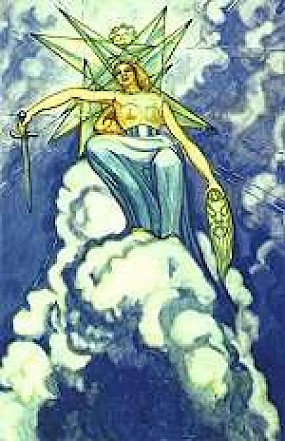
(via angelpaths.com and Alan Blackman)
UKRAINE EMERGENCY TRANSLATION GROUP
We have a Ukraine Emergency Translation Group meeting scheduled for this Friday, May 6, at 11:00 AM Pacific Time, noon Mountain time, 1pm Central time, 2pm Eastern time, 8pm Greece, 9pm Turkey.
We will share your Translation with the group, if you like. You can email your Translation to me at zonta1111@aol.com.
Or perhaps you have a sense testimony you’d like to share. Or other insights or comments you may have.
Open to all Translators. Translate whatever you like or don’t Translate anything at all. Your choice.
See you Friday.
Mike Zonta
Ukraine Emergency Translation Group
Prosperos Meetings is inviting you to a scheduled Zoom meeting.
Topic: Ukraine Emergency Translation Group
Time: May 6, 2022 11:00 AM Pacific Time (US and Canada)
Join Zoom Meeting: https://us02web.zoom.us/j/84023755291
Meeting ID: 840 2375 5291
One tap mobile
+19292056099,,84023755291# US (New York)
+13017158592,,84023755291# US (Washington DC)
Dial by your location
+1 929 205 6099 US (New York)
+1 301 715 8592 US (Washington DC)
+1 312 626 6799 US (Chicago)
+1 669 900 6833 US (San Jose)
+1 253 215 8782 US (Tacoma)
+1 346 248 7799 US (Houston)
Meeting ID: 840 2375 5291
Find your local number: https://us02web.zoom.us/u/kdNwwZt760
Swami Chitananda on the bliss of the self


Energised crowding

To understand why early cities thrived, look not to the temples of kings but to their subjects’ bustling neighbourhoodsAn old ‘hutong’ neighbourhood in Beijing, China. Photo by Yin Wenjie/Getty
Michael E Smith is professor of anthropology in the School of Human Evolution and Social Change at Arizona State University. His books include At Home with the Aztecs (2016), the co-authored The Geoarchaeology of a Terraced Landscape (2021), and Urban Life in the Distant Past: The Prehistory of Energized Crowding (forthcoming, 2023). He lives in Temple, Arizona.
Edited by Sam Haselby
3 May 2022 (aeon.co)
Love Aeon?
Support our workDONATE
All cities have neighbourhoods. This may not sound like much of an observation, but it is in fact a powerful claim for archaeologists of early cities. We now know that neighbourhoods are the only true urban universal – a feature found in every city that has ever existed, past and present. Other seemingly ‘urban’ traits, from streets and big buildings to markets and specialists, are absent from many cities and urban traditions. But neighbourhoods are playing a crucial role in the transformation of archaeological research on the earliest cities. Older views of cities focused on pyramids, tombs, greedy kings and oppressive states. In recent decades, archaeologists and others who study cities have turned to focusing on life and society in ancient cities. But now archaeologists have started to analyse these sites as cities, as urban settlements, comparable with cities in the modern world.
Neighbourhoods provide a good introduction to the different forces that shape cities. In them, we can see the ‘top-down’ forces, or the actions of governments, economies and other institutions that set the scene and circumscribe life. When planners – today and in the past – design cities from the ground up, they usually start by establishing neighbourhood units. Most neighbourhoods throughout history, on the other hand, were not planned by authorities; rather, they grew gradually or organically: what social scientists call from the ‘bottom up’ – through the daily activities of residents. It is the generative quality of these bottom-up processes that concerns most of the important scientific research on both ancient and contemporary cities today.
In their bestseller The Dawn of Everything (2021), David Wengrow and the late David Graeber claim that, by focusing on bottom-up, generative forces, they succeed in ‘overturning conventional wisdom on the origin of cities’. Early cities, they argue, could be organised by councils, using democratic methods based on egalitarian principles. Apart from the fact that such models have become rather common in archaeology over the past decade, this claim is dubious because the authors exhibit a very incomplete understanding of generative processes. They emphasise grass-roots actions, where people gather to make decisions together in small groups. But there is another type of generative process – spontaneous order – in which social change arises as the byproduct of interactions among individuals.
Walking to work, shopping for basic needs, making friends, attending religious ceremonies – these activities all lead to the concentration of social interactions in neighbourhoods on a scale much smaller than the city. Daily social activities within households and blocks, largely independent of governments and controlling institutions, are the building blocks of the spontaneous-order type of generative force. In his book The City Shaped (1991), the architectural historian Spiro Kostof described the totality of these social interactions and relations as ‘energised crowding’. This is now recognised as one of the most fundamental processes creating growth and change in cities. It is the centrepiece of my latest book, Urban Life in the Distant Past: The Prehistory of Energized Crowding, but it plays no part at all in The Dawn of Everything (forthcoming, 2023).
The early archaeologists – and travellers – devoted themselves to the monumental remains of ancient urban sites: tall pyramids, luxurious palaces and royal tombs with spectacular funerary offerings. They saw such monumental works as proof of the actions of powerful rulers who controlled large amounts of labour and resources. They were also a source of loot to carry off for museums. It would take two types of conceptual and methodological advances to allow these spectacular ruins to be analysed as urban settlements. One development was to transform the obsession with monuments and elites into more realistic models of the top-down processes that operated in early cities; the other was to supplement the focus on pyramids and kings with a new emphasis on generative processes.

The early archaeological fixation on palaces, tombs and pyramids fed into a story that all early rulers were cruel tyrants who ruled people with an iron fist until the Greeks invented democracy. This view has been overturned by the political scientist David Stasavage, and the archaeologists Richard Blanton and Lane Fargher. Their books show that early governments exhibited a wide range of forms, some more autocratic and some more collective or democratic. Autocratic kings ruled the Maya cities of Central America (200-900 CE), for example. These kings carved their portraits on stone billboards in public locations. When they died, their subjects buried them in luxurious tombs. These are signs of ancient autocratic government. Meanwhile, in central Mexico, archaeologists can’t even identify the presence of royalty at the huge metropolis of Teotihuacan. There are no royal tombs, and no public images of powerful individuals. Most archaeologists believe that Teotihuacan was ruled by a council or a coalition, not an autocratic king. This political distinction may help explain one of the notable differences between the Maya cities and Teotihuacan: the level of wealth inequality was much lower in Teotihuacan. Most commoners in that city were more prosperous, and ruling elites were less powerful and wealthy, than in the Maya cities.
Archaeologists turned away from temples and tombs and started excavating houses
Another advance is in the study of ancient economies. For decades, economic anthropology was locked into a sterile debate between two polarised positions. The formalists claimed that economic models of capitalist economies could be applied without modification to non-Western and ancient societies, whereas the substantivists countered that these systems were so radically different that they required their own economic models. This same debate raged in the field of Classics, between the ‘modernists’ and the ‘primitivists’. Of course, both positions were wrong, and methodological advances in archaeology paved the way for a more productive approach. I was part of a group of archaeologists who developed methods to identify markets and commercial economies in early societies. We found that most cities had commercial economies that were not capitalist. That is, they had money, markets and merchants, but wage labour and property markets were minimal.
Some ancient societies – most notably the Inka of Peru and Dynastic Egypt – had command economies, where the state dominated the economy. Command economies leave their traces in a proliferation of central storage facilities, and a lack of shops or marketplaces. These developments in political and economic analysis have led to more realistic models of the institutions and governments – the top-down forces – that structured life in early cities.
Beginning in the 1970s, archaeologists who wanted to study life and society in the past turned away from temples and tombs and started excavating houses. To interpret the new domestic remains, we drew on the flourishing field of household analyses in anthropology and history. The field of ‘household archaeology’ remains a vibrant approach to past social life in all parts of the world. My colleagues and I now have a much better grasp of the activities and social conditions of people in the past, both commoners and elites. In my excavations of households in a provincial area of the Aztec empire, I was surprised to find that these farmers and crafters had been quite prosperous. The trash-heaps behind each house yielded many fragments of imported goods (ceramics, obsidian, bronze tools), as well as many non-utilitarian goods, from incense burners and ritual figurines to musical instruments. I had expected to find these people had been poor, isolated and downtrodden; instead, they were prosperous and well connected. My colleagues and I have recently turned to studying wealth inequality, using the size of houses as a measure of household wealth. This quantification allows us to use measures from economics, such as the Gini index, which in turn permits rigorous comparisons of sites and regions.
While the household turn has been very productive, the lack of a theory about cities and city life – beyond simplistic views that rulers tried to control everything – has held back the recognition of ancient cities as urban places. While field archaeologists were busy excavating houses, Ian Hodder was building a postmodern approach known as ‘post-processual’ archaeology. Processual archaeology was the name of a movement in the 1960s, headed by Lewis Binford, to make archaeology more scientific. Hodder and the post-processualists drew on literary theory to reject scientific theory and hypothesis testing in favour of speculative interpretations of the ‘meaning’ of artefacts at individual sites. Post-processualism dominated archaeological theory – particularly in Great Britain – for decades, and its antagonism toward science and comparative analysis held back advances in understanding life and society in early cities.
In his pathbreaking book The Limits of Settlement Growth (1995), the archaeologist Roland Fletcher developed a model that relates the size of cities to their growth and characteristics. Fletcher noted that human settlements (cities, towns and villages, today and in the past) tend to grow, but if they grow too large – in terms of either absolute population numbers or population density – stress and social problems will set in. Fletcher identified several thresholds of size and density that he called ‘limits to settlement growth’. Once these limits are reached, if the people and society cannot make advances in technology and communication, social stress will lead to chaos and unrest, preventing additional city growth. For early urban centres to cross a threshold from villages to towns or cities (of approximately 10,000-20,000 people, living in around 1 sq km), they needed to develop communication methods such as writing, and architectural features that allowed privacy and the segregation of activities in different rooms or buildings. Excavations have vindicated the theory.
People created neighbourhoods to make urban life legible and social life more congenial
Fletcher applied his model of settlement growth quite widely, including the earliest sedentary villages (prior to the early cities), modern cities after the Industrial Revolution, and even cities going into the post-industrial future. However, because he limited his publications to an archaeological audience, his work remains poorly known in other disciplines. For our understanding of life in early cities, Fletcher’s central insight is that population size and density are crucial qualities of a city with vital implications in many social realms. Sociologists, economists, geographers and urban historians have all contributed to the case for a dynamic relation between threshold points and urban population size and density. There is wide support for the fact that size matters for cities and urban life, in ways that can hardly be exaggerated. For whatever reason, Graeber and Wengrow, in The Dawn of Everything, ridicule this finding and assert – without evidence – that cities with large populations can be governed effectively without rulers, managers or bureaucrats.
Population size structures urban life and society, in every city in history, by making neighbourhoods. People in cities do not want to interact and engage with tens of thousands of people on a daily basis. They instead created neighbourhoods to make urban life legible and social life more congenial. For cities, neighbourhoods create social order, they also provision services and facilitate the communication of information to residents. Of course, even though in some ways people live in a neighbourhood more than in a city, any given individual’s face-to-face social interactions may take place over the entire city. Social exchanges at one’s place of employment, walks in the park, purchases at a downtown store, conversations while commuting all offer transient contacts with strangers in public, in shops and other places.
Fletcher’s work rests on the fact that, as the population and density of a settlement increase, the number of potential interactions for each person increases exponentially. Energised crowding occurs when large numbers of social encounters take place within a settlement. In large settlements – cities – the joint effects create a ‘buzz’ whose consequences go far beyond the immediate results of individual interactions. These interactions among individuals have social and economic consequences. Perhaps Graeber and Wengrow’s refusal to acknowledge the role of spontaneous order and energised crowding is responsible for their claims that population size is not important in cities. Another contributing factor may be their distrust of both the natural sciences and the social sciences. Yet it is the methods and concepts of quantitative scientific research that are making the greatest advances in urban understanding today.
One of the true breakthroughs in understanding how population size affects other aspects of cities and settlements has come from the new field of settlement scaling research. In the 1990s, Geoffrey West, Brian Enquist and James Brown – scientists at the Santa Fe Institute (a think tank in the science of complexity) – had worked out a quantitative model that explains how the metabolic rates of mammalian species are predicted by their body size. After West – who trained as a physicist – had contributed to this advancement in biology, he turned his gaze to the social sciences. Could similar quantitative regularities be identified, and could they be predicted with a model? West gathered a group at the Santa Fe Institute that included the physicist Luís Bettencourt, the economist José Lobo and several others, and they decided to attack the problem of the size of cities.
West and his group quickly discovered two quantitative regularities: city population predicted both the area of a city, and its level of social and economic outputs. But how did this work? What were the underlying mechanisms that produced the observed patterns? In 2013, Bettencourt published a mathematical model that predicted these regularities based on social interactions in the urban built environment. Unlike the models of economists, which typically require wage labour, capitalist firms and the modern financial system, Bettencourt built his model on more fundamental assumptions: movement has a cost; social interactions have benefits; and interactions increase with the size and density of a city’s population. As a result, the size of a settlement is both cause and effect of the overall productivity of the settlement.
Bettencourt’s model predicts specific quantitative outcomes. Within a system of cities, quantities such as the area of the settlement, the amount of infrastructure and the economic outputs all increase exponentially with population, with very specific rates (as measured by an exponent). Area in structured settlements, for example, scales with population with an exponent of 5/6. In other words, with an exponent less than 1.0, area increases less rapidly than population, a pattern called sublinear scaling. A city with twice the population of another city will occupy less than twice the area. Another way of saying this is to note that – within a given urban system – larger cities are more dense than smaller cities. Because energised crowding is based on the number of persons and the population density, this means that the higher densities of larger cities will have greatly increased levels of energised crowding.
Population density and energised crowding lead to greater wealth creation in larger cities
A more surprising scaling relationship holds for economic outputs – GDP, the number of patents, income, as well as negative quantities such as the amount of crime or poverty. These quantities scale at a rate greater than one (7/6), called superlinear scaling. A city that is twice as large as another will have more than twice the GDP per capita, and more than twice the crime, compared with the first city. The scaling exponents predicted by Bettencourt’s model (5/6 and 7/6) were derived to explain the data from contemporary urban systems. Some of the measurable consequences of the population size of cities are quite regular and precise. Such results are examples of what economists call agglomeration effects – the advantages that come from the concentration of population and firms within settlements. These results led Bettencourt to coin the term ‘social reactors’ to characterise cities: social interactions generate outcomes that go beyond the sum of the individual encounters. In the words of the historian Fernand Braudel: ‘Towns are like electric transformers. They increase tension, accelerate the rhythm of exchange and constantly recharge human life.’
Scott Ortman – an archaeologist then at the Santa Fe Institute and now at the University of Colorado – realised that Bettencourt’s model is sufficiently general to apply to settlements in the ancient world. So, he took the next step by applying Bettencourt’s scaling formulae to an ancient settlement system. Archaeologists can easily measure the area of sites, but to estimate their population independently of the area is trickier. Ortman reworked published settlement pattern data from the Basin of Mexico archaeological survey project and found that the same scaling exponents reported by Bettencourt for modern urban systems held for pre-Spanish central Mexican sites as well. Was this a signal of fundamental similarities in urban processes through history? Or, was it a fluke, an accidental result?
To find out, Bettencourt, Ortman, Lobo and I established the Social Reactors Project in 2013. Our goal was to test the application of Bettencourt’s scaling model to settlements before the modern era. We have collaborated with groups of specialists, and investigated more than 15 early systems. My student Rudolf Cesaretti used historical records to show that that medieval towns in Europe exhibit sublinear scaling of area with population, as predicted. Using archaeological data, our group has identified superlinear scaling of wealth (house size) with population for many cases. That is, as the size of a settlement increases, the amount of wealth per capita (using house size as a measure of household wealth) goes up. Just as big cities today have higher GDP per capita than smaller cities, large settlements in the past had higher household wealth per capita than smaller settlements. Population density and energised crowding lead to greater wealth creation in larger cities, compared with smaller settlements, in the past and in the present.

Some of the results of the social reactors project have been surprising. For example, we found the same scaling results for a command economy as for commercial economies. Cities in these two types of economy differed in their layout and operation, so we wondered whether the scaling patterns identified for commercial economies would hold for command economies as well. While there are not enough settlements with data to analyse Egyptian settlements for scaling, we were able to use settlement pattern data for the Mantaro Valley of Peru, a pre-Inka settlement system likely organised as a command economy. The superlinear scaling of house size with population matched our cases with commercial economies rather precisely. Ortman then found the same results for two ancient village societies in the upper Great Plains of North America. This case shows that the measurable effects of energised crowding are evident not only in urban systems, but also in systems of smaller, village settlements.
That nearly identical scaling relationships exist for a wide variety of premodern settlement systems points to the importance of the underlying mechanism. Bottom-up social interactions, leading to energised crowding, have structured urban life and societies through the ages. This does not mean that cities or behaviour or social patterns were identical in all these cases. Medieval European cities, for example, differed from those of the pre-Inka Mantaro Valley of Peru. They were larger settlements, with many commercial institutions, and technology – in everything from wheeled transport to ironworking – was more advanced. Yet, underneath this great variation, and perhaps in spite of it, the basic processes by which social interactions and energised crowding led to patterns of population density and wealth creation must have been quite similar. This is a remarkable finding.
The results from the Social Reactors Project confirm the role of energised crowding in cities and settlements. Settlements with higher populations and higher densities have greater energised crowding, and this in turn changes urban life in three primary ways. First, energised crowding leads to neighbourhood formation. With too many people in a city, people create communities on a smaller scale – neighbourhoods – and energised crowding then continues to operate within those smaller units. Second, energised crowding leads to economic growth and development. This growth in per-capita outputs creates the superlinear scaling patterns described above. For archaeologists, economic growth is difficult to identify directly, and we therefore use the scaling results as a measure of growth. Finally, energised crowding also brings negative effects: stress and anxiety on the individual level, and crime and poverty on the city level.
Do the results of the settlement scaling research imply that cities and villages did not differ in ancient times? Not at all. Most archaeologists use one of two definitions to identify cities as settlements distinct from villages or towns: sociological, and functional. The sociological one borrows the sociologist Louis Wirth’s classic definition of a city as a permanent settlement with a large population, a high density, and evidence of social heterogeneity (social or economic variation). While this applies to the largest and most complex early settlements – eg, Rome, Chang-an, Teotihuacan – as cities, it leaves out most ancient centres that were not as big, dense or complex.
Works promote the idea that there was something wrong with the Maya. They flourished for centuries!
The functional one defines cities as settlements that are home to urban activities and institutions that shape a hinterland. This approach focuses on what cities do, not on what they look like. It has the advantage of placing cities into their specific geographies. Some cities defined this way will lack large populations, high density or social heterogeneity. The Classic-period cities of the Maya (200-900 CE) are a prime example. With small populations spread out at low urban densities, their influence extended beyond the capital. The kings whose palaces dominated Maya cities ruled petty kingdoms, and the towering temple-pyramids served hinterland populations. For archaeologists using the sociological approach to urban history, Maya cities like Tikal or Copán were simply too small to qualify. But if we look using the functional method of identifying cities, we see that these settlements indeed existed in a dynamic relation with a hinterland. Residents of nearby villages came into town to attend a market or witness a ceremony, and those organised activities constitute urban functions.
The spectacular collapse of these Maya cities has blinded scholars to their value for understanding cities and urbanism in scientific terms. Many archaeologists devote so much time looking for the reasons these cities collapsed that they have not bothered to analyse them as urban settlements. Cities collapsing naturally leads to many questions, including how long early cities lasted. Works such as Jared Diamond’s bestseller Collapse: How Societies Choose to Fail or Succeed (2004) promote the ideas that there was something wrong with the Maya, and that their cities were fragile and doomed to failure. Yet Tikal, Copán and the other Maya cities were in fact quite durable; they established themselves, and grew and persevered in a highly difficult jungle environment. They flourished for five to 10 centuries!
Why did some early cities persist for centuries while others lasted only decades? Questions of durability and sustainability bear on the pressing problem of how cities are adapting to the climate crisis today. Cities have responded to shocks and adversity over the entire range of urban history. Some survived for millennia (think of Rome or Beijing), and others only a few years (these tend to have names like Tx-LT-43). When archaeologists determine the reasons for the success and failure of individual cities in the past, that knowledge could be useful in plotting the course of urban change into the future.

Cities initially developed several thousand years ago and, since then, the level of urbanisation of the world (the percent of the population living in cities) has increased relentlessly. Our future will be an urban future. How can we best understand how cities work, what makes them grow and shrink, and what determines the quality of life of their residents? While past kings, priests and other leaders are part of the story, it is clear that in the past, as today, generative processes – the actions and interactions of people in cities – were the driving forces in the expansion and success of cities.