MODERN AMERICA’S MOST SUCCESSFUL SECESSIONIST MOVEMENT

In rural Oregon, voters fed up with their state’s leftward turn have embraced a simple and outlandish idea: What if we were just Idaho?By Antonia HitchensPhotographs by Jordan Gale
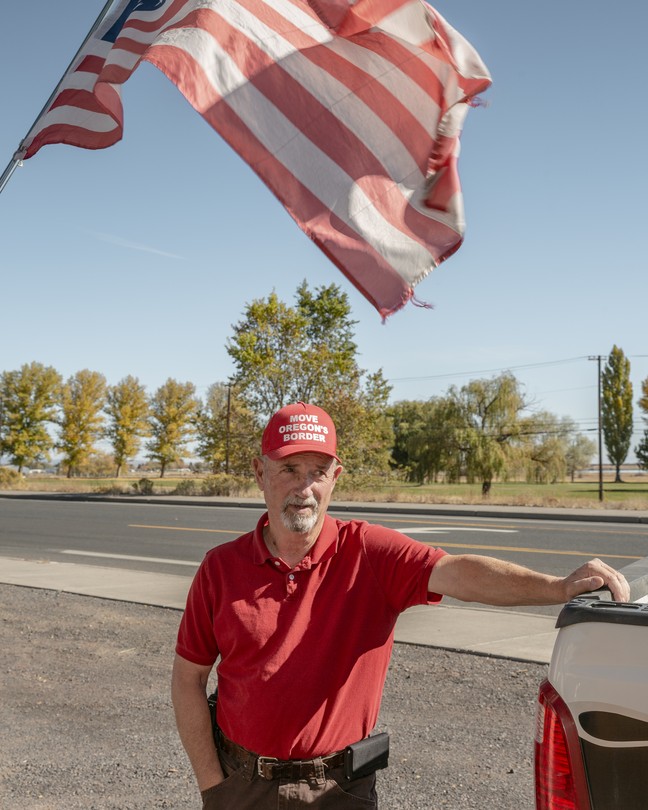
Mike McCarter, the head of Move Oregon's Border and Citizens for Greater Idaho, talks outside HC Sporting Goods ahead of a Move Oregon's Border meeting in Hines, Oregon, on October 16.
Mike McCarter, the head of Move Oregon’s Border and Citizens for Greater Idaho, talks outside HC Sporting Goods ahead of a Move Oregon’s Border meeting in Hines, Oregon, on Saturday, October 16.

DECEMBER 23, 2021 (theatlantic.com)

In the summer of 2015, a chimney sweep in Elgin, Oregon, redrew the map of the American West. “Imagine for a moment Idaho’s western border stretching to the Pacific Ocean,” Grant Darrow wrote in a letter to the editor of his local paper. Rural Oregon, he insisted, should break its ties with the urbanites of Portland and liberals of Salem, and join Idaho. “The political diversity in this state is becoming unpalatable,” he argued. “Rural Oregonians in general and Eastern Oregonians in particular are growing increasingly dismayed by the manner in which Oregon’s Legislature and Oregon’s urban dwellers have marginalized their values, demonized their lifestyle, villainized their resource-based livelihoods, and classified them as second-class citizens at best.”

In the half decade or so since Darrow’s diatribe, a simple and outlandish idea, percolating in rural Oregon since the 1960s—what if we were just Idaho?—has grown into a grassroots secession movement. Last month, Harney County, in the high desert of eastern Oregon, became the state’s eighth to pass a nonbinding ballot measure supporting Darrow’s proposal. move oregon’s border signs now dot the region’s empty highways, and Mike McCarter, a retired agricultural nurseryman and gun-club owner who runs a group pushing for the boundary reshuffle, travels the state in a bright-red trucker hat bearing the slogan. “We don’t care to move, because we’re tied to our land here,” he told me recently. “So why not just allow us to be governed by another state?” He mentioned a supporter so certain that her property will become part of Idaho that she already flies its state flag on her lawn. “We’re going to be Idaho,” she told him.

Scenes from Portland, where Black Lives Matter protesters have sparred with the Proud Boys in paintball brawls over the past year, and worries that liberal lawmakers in Salem will outlaw diesel fuel and artificial insemination of animals, have calcified many rural Oregonians’ sense of total alienation from the west side of the state. “This is not the Oregon I know,” Sandie Gilson, one of Move Oregon’s Border’s “county captains,” told me. “We were farmers and ranchers and loggers. None of those values are left.” Today, half of Oregon’s population lives in the Portland metropolitan area alone. In eastern Oregon, Gilson pays for two emergency helicopter-airlift insurance plans in case she has to go to a hospital hundreds of miles away in Bend or Boise. “That huge drift of country is pretty much nonexistent in the American imagination,” the author William Kittredge wrote about this part of the state in Hole in the Sky, his 1992 memoir of his family’s life on a ranch. “It is hard to exaggerate the vastness of that barren playa. The whole of it—Lake and Harney and Malheur counties in Oregon, each as large as some states in the East—is still populated by no more than a few thousand people.” The geographic point in the continental United States farthest from any interstate lies in Harney County, a contemporary frontier so remote that, in 1990, a pair of census takers went missing for four days in the sagebrush trying to find a person.

It’s easy to scoff at the idea of honoring the proposed borders of “Greater Idaho,” not least because it’s almost inconceivable that both Idaho’s and Oregon’s legislatures would sign off on the proposal and send it to Congress for the necessary approval. Many conversations about the subject focus on “freedom” and diesel fuel, breezily dismissing questions of staggering importance in the West—water rights, public lands, the rights of Indigenous people—as details that will be ironed out later. The Greater Idaho proposal would grant Idaho more than three-quarters of Oregon’s land, more than 870,000 of its residents, and access to the ocean; most specifics beyond this have yet to be envisioned. “Idaho fits with what I feel,” Mike Slinkard, a fifth-generation Oregonian who makes high-stealth hunting clothing, told me. “Oregon left us out in the cold. We don’t exist.”

The reasoning comes across as amorphous and quixotic, but the Greater Idaho referendums have passed in eight out of ten counties where they’ve been proposed, making Move Oregon’s Border the most electorally successful secessionist movement in America today. Two more counties will vote on the measure next year, and this month, state Senator Lynn Findley begrudgingly said he’d consider introducing legislation related to the border move. Over the past decade, every state has flirted with a secessionist petition of some sort. Two-thirds of Republicans in the South are in favor of secession; elsewhere, Illinois counties are asking to be free of their directorate in Chicago, and West Virginia has just offered to take in three conservative-leaning, rural Maryland counties. Even this part of Oregon is nestled between areas that some people hope will become entirely new states: the State of Jefferson, in California, and the Liberty State, a libertarian utopia pushed by former Representative Matt Shea, in Washington. The Greater Idaho solution appeals in part because of its political pragmatism; moving a border is hard, but it’s easier than creating a new state.
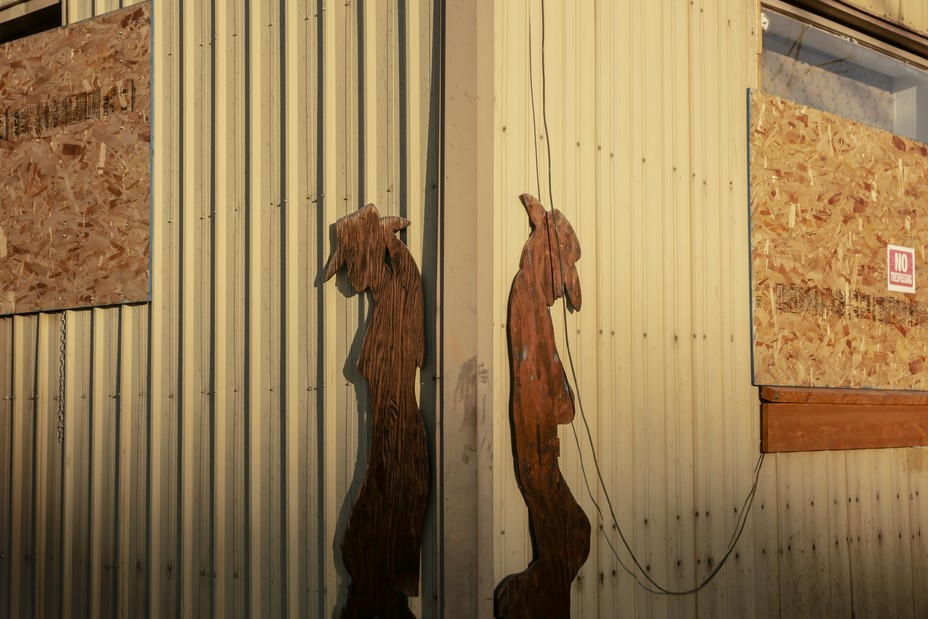
The corner of a boarded-up apartment complex in Hines, Oregon, on Saturday, October 16
The corner of a boarded-up apartment complex in Hines, Oregon, on October 16

Mccarter, the main organizer behind the ballot measures, lives in a mobile home in La Pine, half an hour south of Bend, the eco-chic outdoor-destination town in central Oregon. When I visited last month, a sign outside his property advertised his concealed-carry-permit business, and an American flag flew above the door. Jason Mraz played on Sirius radio from a TV flanked by two paintings of McCarter’s black Labrador; a Bible and a box of Milk Duds sat on the end table. If the border reflected the lines as McCarter envisions them, Bend, with its cashew milk and Teslas and mandatory masking at craft breweries, would be in a different American state from his home. For McCarter, such a severing is commonsense, and the map of Greater Idaho, carefully carving out Bend, doesn’t look any more puzzling than a gerrymandered congressional district. The urban-rural divide is so intense that separating the two is the most sensible path forward, he told me.

RECOMMENDED READING

Joining Idaho would keep rural Oregon the way America used to be, McCarter explained. In his narrative, Salem is the villain forcing eastern Oregon counties to comply with laws that seem irrelevant or offensive to their rural setting, rules that have no bearing on their lived reality. Recent redistricting only compounded the sense that representation would never skew in their favor; McCarter feels his supporters’ voices are drowned out by urban ones—the culture over the hill, across the Cascades. Portland is in the midst of its most violent year ever, including more than 1,000 shootings so far. Struggling economically and anticipating the full collapse of industries that used to sustain them, McCarter and his group clamor for popular sovereignty.

Move Oregon’s Border’s true purpose is threefold, McCarter told me: First, obviously, to move the border. Second, to send a message to the state legislature “that you’ve got some very unhappy people, and here are the reasons why.” But the third is more subtle: “It provides a vent for all this anger.” McCarter sees himself as a peaceful guy proximate to violent movements. When he retired from working in plant nurseries and started running a gun club, members of the Oath Keepers, the Three Percenters, and the Project Appleseed prepper group practiced at his shooting range. People’s Rights, the anti-government activist Ammon Bundy’s new far-right network, has asked him to speak at its events. “I know there’s some people that have talked about ‘If this continues on, people are going to pick up their guns,’” McCarter said. “Rural people—their values, the way they live, their faith, their freedom—are closely tied to what Idaho is, so why not adjust the border? Just let us go peacefully.”
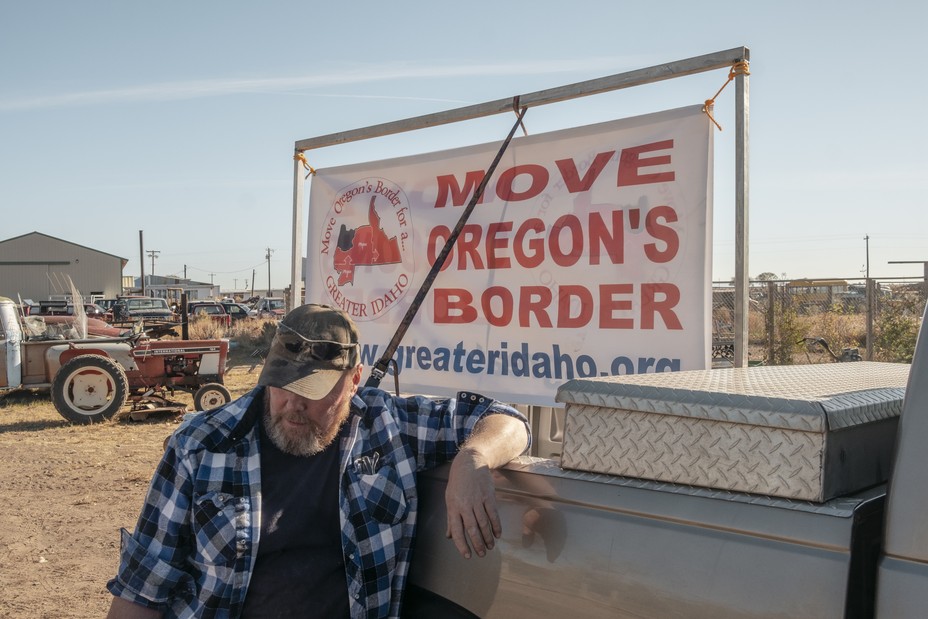
Gary Foster prepares a sign for a Move Oregon's Border meeting in Hines, Oregon, on Saturday, October 16.
Gary Foster prepares a sign for a Move Oregon’s Border meeting in Hines, Oregon, on October 16.

That this part of the world would find secession and separatism so compelling makes sense, Richard Kreitner, a historian and the author of Break It Up: Secession, Division, and the Secret History of America’s Imperfect Union, told me. The idea of separation as a solution to intractable political disputes is part of the history of Oregon; even at its formation, some were certain that it would eventually fragment or join California. Perhaps we needn’t be so precious about redrawing borders, Kreitner told me. “State lines aren’t written in stone, and the Oregon proposal shouldn’t be dismissed out of hand,” he said. “The idea of secession is being normalized in an unwinding and degrading country … This is considered a peace proposal, or a way to avoid war.”

Greater Idaho supporters I met often articulated the movement’s aims in the same terms McCarter and Kreitner used. “This is actually very American, choosing our own government,” Gilson, the county captain, told me. “It was all about choosing our government when we left England in the Revolutionary War.” Some proponents of Greater Idaho swiftly offer another American revolution—or another civil war—as the backup plan if moving the border doesn’t work out. The aesthetic of armed politics is still ingrained in recent memory in eastern Oregon; just five years ago, in Harney County, Bundy led a 41-day armed takeover of the Malheur National Wildlife Refuge that led to a standoff with the federal government. (The state police shot and killed LaVoy Finicum, a leader of the occupation, at a roadblock between the refuge and the nearby town of John Day; they claim he was reaching for a gun.) Eighty-five percent of people in Harney County carry a concealed weapon.

In McCarter and his allies’ eyes, they’re preserving a version of the last American frontier—lands still unfettered by the progressive ideas from cities such as Portland that are seeping into every place in America and threatening rural life. It’s a charming myth. “The frontier fantasy of armed white men who made the West and can remake it because they are autonomous or independent from political forces back east is something that really probably fires the imagination of a lot of people,” the historian Joe Lowndes, of the University of Oregon, told me. Localism, autonomy, and regionalism are entrenched in the literary imagination of Oregon—take, for example, Don Berry’s Trask and Ken Kesey’s Sometimes a Great Notion. Greater Idaho is adjacent to the bioregion of Cascadia and the environmental utopia of Ernest Callenbach’s Ecotopia, as well as to the “American Redoubt,” a supposed haven for survivalists in the sparsely populated lands of Montana, Idaho, and the eastern sides of Washington and Oregon—“the last refuge of the American patriot,” as a Redoubt-centric real-estate company describes it. (“Rural America gives you ultimate freedom and safety far away from the Sanctuary City,” the firm promises.)

Oregon was itself founded in dispossession. Its constitution banned free Black people from living in the state. “It’s difficult to disentangle the nonthreatening parts of this group from the threatening white-supremacist aspects, because the region gained a reputation as a safe home for these ideas,” Steven Beda, a historian at the University of Oregon, told me. “It’s about articulating a rural identity, a return to a rural past; and ruralness is frequently used as a synonym for whiteness. Nostalgia is often rooted in white-supremacist ideals—‘we were all better off before people of color started demanding rights.’” Most supporters I spoke with skewed toward retirement age; they diligently collected signatures at farmers’ markets and gun shows and chatted in small groups at thinly attended meetups in church basements, peddling a far-fetched cause among their neighbors. But McCarter mentioned to me in passing that some supporters had gone to Washington, D.C., on January 6. A conservative-leaning separatist movement isn’t definitionally exclusionary or violent, but movements like Greater Idaho can’t be entirely decoupled from the context of menacing and violent right-wing organizing in the region. The Patriot movement, a set of anti-government conspiracist militias, remains active today, and Timber Unity, a rural solidarity group with extremist connections, gives money and support to county-commissioner candidates, including many who go on to win.

Much of Oregon’s history was “driven by an understanding of violence as a commonplace method of solving problems,” Kittredge, the rancher memoirist, wrote. The Greater Idaho movement’s more avid supporters say Darrow’s idea is the only thing keeping them from an insurrection. “A flash point is coming,” Gilson told me. “People are ready to fight; I’m hoping that it’ll be a push for Move Oregon’s Border—that it won’t be violent. Moving the border is a civil answer. Eastern Oregon is known for its guns.”
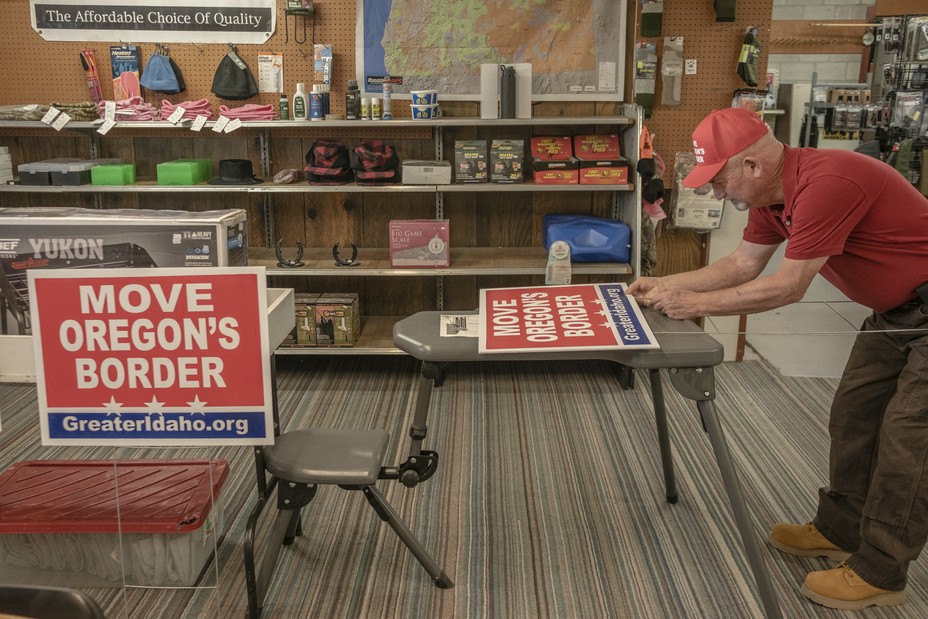
Mike McCarter, the head of Move Oregon's Border and Citizens for Greater Idaho, prepares yard signs ahead of a Move Oregon's Border meeting at HC Sporting Goods in Hines, Oregon, on Saturday, October 16.
Mike McCarter prepares yard signs ahead of a Move Oregon’s Border meeting at HC Sporting Goods in Hines, Oregon, on October 16.

The weekend before harney county voted on the referendum, McCarter held a rally at a sporting-goods store in Hines. He called to warn me not to expect a huge crowd. Midday on Saturday, he set up a round table with Black Rifle coffee and a neatly arranged array of Move Oregon’s Border hats and leaflets. He stood smiling in the empty shop with a pistol on his hip, surrounded by rifles and fishing gear. “Portland this year looks like when I rolled into Baghdad for the first time,” Dean Brizendine, a former cop who owns the shop, told me from behind the gun counter. Toni Foster, Move Oregon’s Border’s Harney County captain, made snickerdoodles and drove over from the auto wrecking yard in town, where her repair shop and mobile home sit amid rows of half-scrapped classic cars and trucks. Her husband, Gary, a former heavy-machinery operator, stood in the corner, scrolling on his phone. “They just overrun us on the other side of the mountain,” he said.

The first visitor to arrive was a woman wearing a shirt that said be more american who came to yell at McCarter, with her daughter and granddaughter in tow. “Idaho doesn’t want us—I moved out of Idaho for a reason!” she shouted, standing over the table. Her son has seizures and needs medical marijuana, which is legal in Oregon, but not Idaho. (Marijuana came up nearly as often as diesel fuel in my conversations about the border move.) “I’ll still vote for it, though, because of the values,” she said. She shook McCarter’s hand and went to buy a gun at the register. A few others filtered in and out over the next hour to either purchase a firearm or approach the table and ask about Greater Idaho. Nancy Cronin had driven down Highway 395 from where she lives on a ranch, retired and off the grid, to find out more about the movement and whether she would end up becoming a resident of Idaho. McCarter stood and talked with her. She said she was undecided.

“There’s no death tax in Idaho,” McCarter said.

“That’s a plus,” she responded.

“And Idaho has a balanced budget,” he said. Another plus.

She asked whether Idaho would accept her daughter’s beautician license. McCarter told her those are the sorts of questions they’d still have to work out.

“Is this going to happen in our lifetime?” Cronin asked. “Texas has been dealing with this for 20 years. I’m 70.”

“Look,” McCarter said, “it’s a vent, instead of people picking up their guns.”

“If it gives people a place to put our energy, our frustration—I’m for it,” she said.

Cronin turned to me. “And people are getting close!” she said. “Anarchy! Not just in Oregon. But what happened down on the refuge at Malheur is a symptom of it. It’s a passion of the people who live in rural Oregon—and this is an avenue for folks instead of doing something illegal that wouldn’t get you where you want.” She leaned on the counter.

“It’s not perfect,” McCarter said. “And it may morph into something else.”

“We just need to show the Oregon legislature that it’s possible,” Cronin said.

“They haven’t listened in 20 years,” McCarter responded.

“We have to reinstitute the Founding Fathers’ fire, because we’re back there again,” Cronin told me. “And this seems like a place to take intellectual ideas, instead of a violent way. It would finally feel like we have some control and stake.” She left with one of McCarter’s pamphlets featuring the map of Greater Idaho.
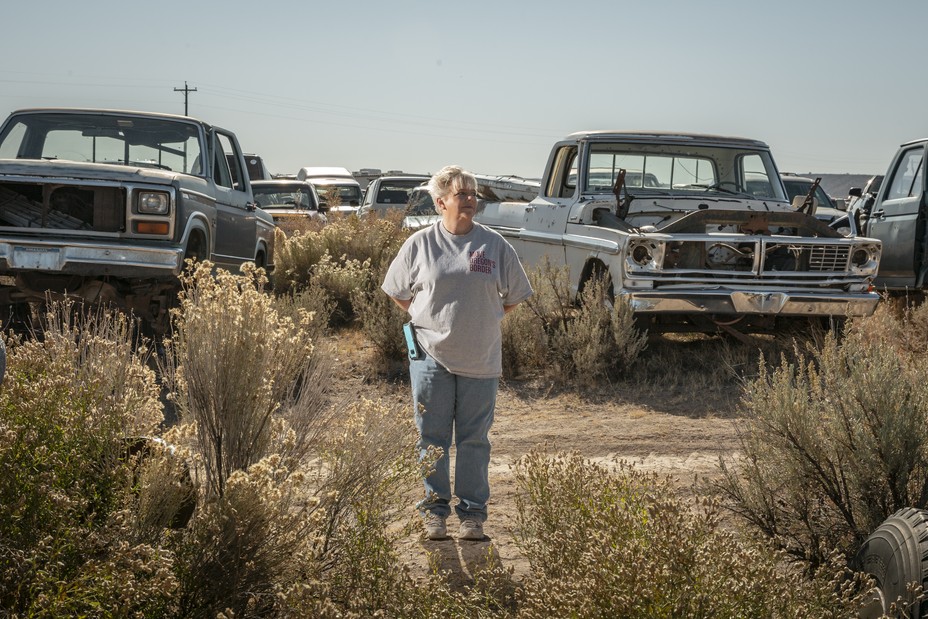
A portrait of Toni Foster, the county chair of the Move Oregon's Border movement, in Hines, Oregon, on Saturday, October 16
A portrait of Toni Foster, the county captain for the Move Oregon’s Border movement, in Hines, Oregon, on October 16

Plenty of rural oregonians balk at the suggestion of becoming Idahoans. I spoke with many who see themselves as the less vocal majority, and some who’d never even heard of the measure. “We would only lose by becoming part of Idaho,” Isabelle Fleuraud, a yoga teacher who helped establish the Harney County Democrats during the Bundy standoff, told me. “It’s like a John Wayne movie, that imaginary ideal past of Harney County.” She told me she was exhausted by Greater Idaho supporters’ tendency to blame faraway Democratic overlords—Oregon Governor Kate Brown in Salem, and the federal government in D.C.—for all of the region’s ills.

Joining Idaho is a “mind-bogglingly oversimplified” notion, Steve Grasty, a retired Harney County judge, told me. Counties such as Harney are hugely dependent on federal funding; Oregon’s second congressional district, which covers the entire eastern swath of the state, was the nation’s biggest recipient of Affordable Care Act funds. But even Grasty, who used to travel to Salem to advocate for the county, admitted that the legislature there didn’t seem interested in the stories and problems he brought from rural Oregon. “Over and over, I worked to put that rural perspective into focus, and it really didn’t get heard.” He could have changed parties, but stayed a Democrat just so people on the west side of the state would talk to him, he told me.

The border move might seem preposterous: a peaceful rebellion fantasized about by a handful of people sitting around a sporting-goods store eating cookies and practicing amateur cartography. But some are bluntly resigned to another conclusion—one of my last stops in Harney County was a visit to Ben Holloway, the owner of Spent Cartridge, the local gun shop. He thinks the border question “will probably boil more down to a revolution rather than even worrying about moving this and that,” he told me. “It would just be right out to war, a civil war or splitting her up.” He went on, “And that’s the rise and fall of every civilization in history. The United States has been at the top for a long time. We’re where Rome was when Rome was at its peak, and eventually everything comes crumbling down. It will be pretty much just like the Civil War back when, North versus South. It might be more East versus West, urban versus rural. It will be absolutely horrible and terrifying and frightening. A lot of people dying for no reason. But eventually they’re going to push a group far enough that they have no other recourse, in their mind.”Leading Successful TeamsProve your leadership ability and progress your career in 2022 with our fully-online Microcredential Course. It’s the perfect way to evidence your skills. Secure your place alongside executive professionals now. Eligible learners can get 20% off.SPONSORED BY UNIVERSITY OF GLASGOWSee More

I asked Holloway how it would feel if the border move somehow shook out—if at the end of a prolonged political process, he and I could factually say we were standing in Idaho, not Oregon, that afternoon.

“I don’t think it would hardly change a thing, to be honest with you,” he said.


This story was produced in partnership with the Pulitzer Center.


This story previously misdescribed how much of Oregon’s land would be ceded under the Greater Idaho proposal. It also said, incorrectly, that the measure would transfer 873,000 voters to Oregon. The border change would move about 873,000 residents—not all of them voters—to Idaho.
Rainer-Maria Rilke on the new year

“And now we welcome the new year. Full of things that have never been.” 

—RAINER MARIA RILKE

René Karl Wilhelm Johann Josef Maria Rilke, better known as Rainer Maria Rilke (December 4, 1875 – December29, 1926), was an Austrian poet and novelist. He is “widely recognized as one of the most lyrically intense German-language poets”. He wrote both verse and highly lyrical prose. Several critics have described Rilke’s work as “mystical”. Wikipedia

Capricorn New Moon January 2, 2022.

Wendy Cicchetti

Capricorn New Moon

The Capricorn New Moon hints at a new order coming into play — or the need for one. Capricorn’s cardinal nature makes this an initiatory New Moon — rather than waiting to see what unfurls, we begin something of the process ourselves. Executive ability couples with organizational skills and helps us plot ahead to where a new system could take us. We seem to manage this, even despite difficulties — a quality reflected in the mountain goat image of this sign, a reminder that even the toughest terrain can be handled by the slightest body. It is a lot about attitude, particularly persistence and resilience. Besides, maybe we can draw confidence from previous successes to help guide and propel us along.

This New Moon just separated from a trine to Uranus in earthy Taurus, emphasizing how an innovative idea or deed can be an inspiration. This connection brings to mind the determination of “Lucky” Ed Jackson, the former rugby player who sustained a severe spinal injury and diagnosis of quadriplegia. Despite being told he’d never walk again, he now climbs mountains and raises money for charitable causes along with awareness of the potential for meaningful and purposeful life after extreme injury. Uranus can sometimes defy accepted norms, even in terms of the body’s system — as reflected by planets in earth signs. Interestingly, Jackson has Jupiter at the anaretic 29° of Taurus, natally — which was squared by transiting Jupiter in Aquarius — Uranus’s sign — at the time his memoir, Lucky, was published (birth data: December 2, 1988, Bath, UK, time unknown — source: Wikipedia).

The New Moon is square Chiron in Aries, suggesting that the new initiative we feel pulled towards may have a healing motive. Perhaps we are just tired of struggling with something that has worn us down. We have borne the pain and strain and now it is time to take new action, so we can go one step beyond this and begin to experience proper healing.

Some would say that a physical health challenge might correlate with emotional issues, while others could say that an external, badly looping situation has some karmic element at its core. Whatever the case may be, there are numerous options to address such issues and discover ways to bring our system into greater balance. With Chiron in Aries, we may find a particular benefit in exploring an option that involves fire healing or taking an initiatory journey requiring us to summon up inner courage. It also doesn’t have to be so gung-ho if that’s not your style! Using incense for meditation, or smudging are as useful as fire walking or braving an ayahuasca quest. Other healing rituals could be simply lighting candles for connection and peace or using fire to cook a special meal. Bach Flower healing could direct us to Impatiens, or even the opposite — Scleranthus — to assist with that special balance.

Saturn in Aquarius is sextile Mars in Sagittarius during this New Moon. Again, there’s the sense of a ping or a poke into solid action! Sometimes it can seem as though anything in a fixed sign needs that extra nudge to create movement and change — and this seems to be one of those times. We should not let the LUNATIONS fire go out but, instead, strike while that proverbial iron is hot! This sextile remains within orb, suggesting we still have time; the momentum has not yet been lost.

Saturn and Uranus remain square one another; a reminder that old and new must somehow manage together, albeit with a possible battle between them. Perhaps one has the upper hand for a while. Uranus is retrograde for a further few weeks, while Saturn has been direct since last October. But when Uranus changes direction again on January 18, the power struggle could alter somewhat — and any call to take on the new could become louder. This may become even more pronounced around the end of January with a New Moon in Aquarius, which these planets co-rule. Momentum is surely building!

This article is from the Mountain Astrologer written by Diana McMahon Collis

Nietzsche on Why It Is Also Important to Forget

Vanessa Able (thedewdrop.org)

“The person who cannot set himself down on the crest of the moment, forgetting everything from the past, who is not capable of standing on a single point, like a goddess of victory, without dizziness or fear, will never know what happiness is.”

– Friedrich Nietzsche


What should we hold on to from the past and what is it good to let go of? That is the question at the heart of German Philosopher Friedrich Nietzsche’s 1870s essay, On the Use and Abuse on History for Life, which he begins by considering a state of mind in which ‘likes and dislikes are closely tied to the peg of the moment’, as is the case most clearly with animals. A being living in the present moment is not held back from the joy of that simple experience by the weight of past experience and the formations of one’s own history. Nietzsche argues that this principle applies at both a personal and societal level, and that the skill required of a person in order to live a happier life is one of knowing the ‘line which divides the observable brightness from the unilluminated darkness’ – essentially, knowing when to remember and when to forget.


Observe the herd which is grazing beside you. It does not know what yesterday or today is. It springs around, eats, rests, digests, jumps up again, and so from morning to night and from day to day, with its likes and dislikes closely tied to the peg of the moment, and thus neither melancholy nor weary. To witness this is hard for man, because he boasts to himself that his human race is better than the beast and yet looks with jealousy at its happiness. For he wishes only to live like the beast, neither weary nor amid pains, and he wants it in vain, because he does not will it as the animal does. One day the man demands of the beast: “Why do you not talk to me about your happiness and only gaze at me?” The beast wants to answer, too, and say: “That comes about
because I always immediately forget what I wanted to say.” But by then the beast has already forgotten this reply and remains silent, so that the man wonders on once more.

But he also wonders about himself, that he is not able to learn to forget and that he always hangs onto past things. No matter how far or how fast he runs, this chain runs with him. It is something amazing: the moment, in one sudden motion there, in one sudden motion gone, before nothing, afterwards nothing, nevertheless comes back again as a ghost and disturbs the tranquillity of each later moment. A leaf is continuously released from the roll of time, falls out, flutters away–and suddenly flutters back again into the man’s lap. For the man says, “I remember,” and envies the beast, which immediately forgets and sees each moment really perish, sink back in cloud and night, and vanish forever.

“The beast lives unhistorically, for it gets up in the present like a number without any odd fraction left over; it does not know how to play a part, hides nothing, and appears in each moment exactly and entirely what it is.”

Thus the beast lives unhistorically, for it gets up in the present like a number without any odd fraction left over; it does not know how to play a part, hides nothing, and appears in each moment exactly and entirely what it is. Thus a beast can be nothing other than honest. By contrast, the human being resists the large and ever increasing burden of the past, which pushes him down or bows him over. It makes his way difficult, like an invisible and dark burden which he can for appearances’ sake even deny, and which he is only too happy to deny in his interactions with his peers, in order to awaken their envy. Thus, it moves him, as if he remembered a lost paradise, to see the grazing herd or, something more closely familiar, the child, which does not yet have a past to deny and plays in blissful blindness between the fences of the past and the future. Nonetheless this game must be upset for the child. He will be summoned all too soon out of his forgetfulness. For he learns to understand the expression “It was,” that password with which struggle, suffering, and weariness come over human beings, so as to remind him what his existence basically is–a never completed past tense. If death finally brings the longed for forgetting, it nevertheless thereby destroys present existence and thus impresses its seal on the knowledge that existence is only an uninterrupted living in the past [Gewesensein], something which exists for the purpose of self-denial, self-destruction, and self- contradiction.

If happiness or if, in some sense or other, a reaching out for new happiness is what holds the living onto life and pushes them forward into life, then perhaps no philosopher has more justification than the cynic. For the happiness of the beast, like that of the complete cynic, is the living proof of the rightness of cynicism. The smallest happiness, if only it is uninterrupted and creates happiness, is incomparably more happiness than the greatest which comes only as an episode, as it were, like a mood, as a fantastic interruption between nothing but boredom, cupidity, and deprivation. However, with the smallest and with the greatest good fortune, happiness becomes happiness in the same way: through forgetting or, to express the matter in a more scholarly fashion, through the capacity, for as long as the happiness lasts, to sense things unhistorically.

“A person who wanted to feel utterly and only historically would be like someone who was forced to abstain from sleep, or like the beast that is to continue its life only from rumination to constantly repeated rumination.”

The person who cannot set himself down on the crest of the moment, forgetting everything from the past, who is not capable of standing on a single point, like a goddess of victory, without dizziness or fear, will never know what happiness is. Even worse, he will never do anything to make other people happy. Imagine the most extreme example, a person who did not possess the power of forgetting at all, who would be condemned to see everywhere a coming into being. Such a person no longer believes in his own being, no longer believes in himself, sees everything in moving points flowing out of each other, and loses himself in this stream of becoming. He will, like the true pupil of Heraclitus, finally hardly dare any more to lift his finger. Forgetting belongs to all action, just as both light and darkness belong in the life of all organic things. A person who wanted to feel utterly and only historically would be like someone who was forced to abstain from sleep, or like the beast that is to continue its life only from rumination to constantly repeated rumination. For this reason, it is possible to live almost without remembering, indeed, to live happily, as the beast demonstrates; however, it is generally completely impossible to live without forgetting. Or, to explain myself more clearly concerning my thesis: There is a degree of insomnia, of rumination, of the historical sense, through which living comes to harm and finally is destroyed, whether it is a person or a people or a culture.

In order to determine this degree of history and, through that, the borderline at which the past must be forgotten if it is not to become the gravedigger of the present, we have to know precisely how great the plastic force of a person, a people, or a culture is. I mean that force of growing in a different way out of oneself, of reshaping and incorporating the past and the foreign, of healing wounds, compensating for what has been lost, rebuilding shattered forms out of one’s self. There are people who possess so little of this force that they bleed to death incurably from a single experience, a single pain, often even from a single tender injustice, as from a really small bloody scratch. On the other hand, there are people whom the wildest and most horrific accidents in life and even actions of their own wickedness injure so little that right in the middle of these experiences or shortly after they bring the issue to a reasonable state of well being with a sort of quiet conscience.

“There is a line which divides the observable brightness from the unilluminated darkness, that we know how to forget at the right time just as well as we remember at the right time, that we feel with powerful instinct the time when we must perceive historically and when unhistorically.”

The stronger the roots which the inner nature of a person has, the more he will appropriate or forcibly take from the past. And if we imagine the most powerful and immense nature, then we would recognize there that for it there would be no frontier at all beyond which the historical sense would be able to work as an injurious overseer. Everything in the past, in its own and in the most alien, this nature would draw upon, take it into itself, and, as it were, transform into blood. What such a nature does not subjugate it knows how to forget. It is there no more. The horizon is closed completely, and nothing can recall that there still are men, passions, instruction, and purposes beyond it. This is a general principle: each living being can become healthy, strong, and fertile only within a horizon. If he is incapable of drawing a horizon around himself and too egotistical to enclose his own view within an alien one, then he wastes away there, pale or weary, to an early death. Cheerfulness, good conscience, joyful action, trust in what is to come–all that depends, with the individual as with a people, on the following facts: that there is a line which divides the observable brightness from the unilluminated darkness, that we know how to forget at the right time just as well as we remember at the right time, that we feel with powerful instinct the time when we must perceive historically and when unhistorically. This is the specific principle which the reader is invited to consider: that for the health of a single individual, a people, and a culture the unhistorical and the historical are equally essential.

Friedrich Nietzsche (1844-1900)
From: The Untimely Meditations

Plagues and empires

Plagues and empires | Aeon

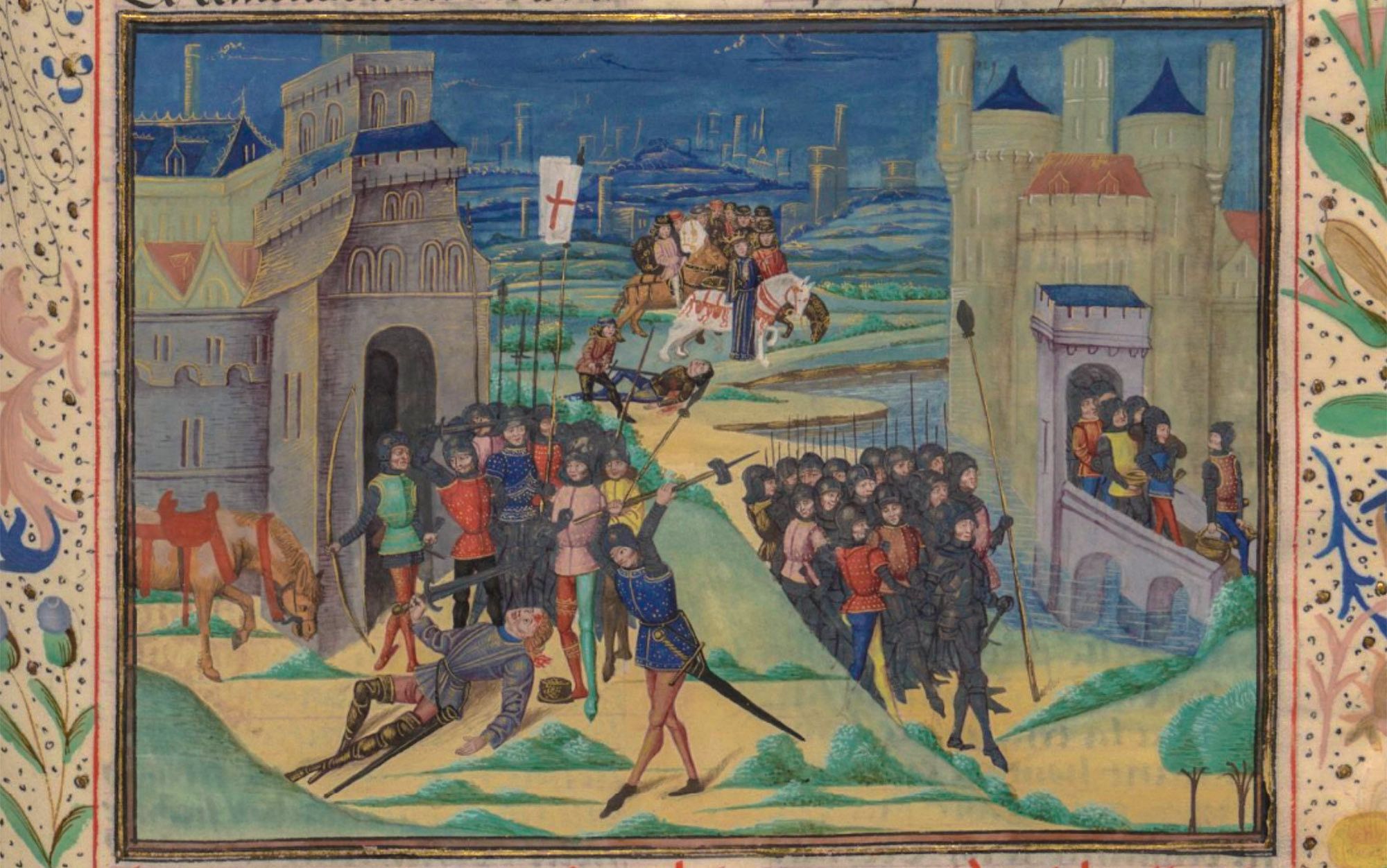
What can the decline of the Roman Empire and the end of European feudalism tell us about COVID-19 and the future of the West?The Peasants’ Revolt of 1381. The miniature illustrates, right, rebels entering London in 1381; left, the slaying of Sir Robert Salle by rebels at Norwich; and, centre background, the killing of Wat Tyler, the peasants’ leader, before the king at Smithfield. From Recueil des chroniques et anchiennes istories de la Grant Bretaigne by Jean de Wavrin. Courtesy Bibliothèque Nationale de France, MS français 78, f. 96r

John Rapley is a political economist at the University of Cambridge, as well as a senior fellow at the Johannesburg Institute for Advanced Study. His latest book is Twilight of the Money Gods: Economics as a Religion and How it all Went Wrong (2017). He lives in London and Johannesburg.

Edited by Sam Haselby

13 July 2021 (aeon.co)

Early in 2020, after a mysterious coronavirus emerged out of China and then raced across the globe, a quiet new year took a screeching turn. Stark images of ventilated patients in Italian hospital hallways soon filled our newsfeeds. Panic erupted across the West. One after another, governments that had been telling their citizens everything was fine suddenly screamed at everyone to shelter in place and avoid all human contact. It felt like the modern world had just met its Black Death.

With no living memory of such scenes, Western audiences reached for the timeless literature of apocalypse to make sense of it all. But whereas ancient traditions of end times blamed spiritual causes for the collapse of civilisations, we, being the moderns that we are, opted for what we imagined to be a ‘scientific’ discourse – the so-called genre of collapsology. Although some modern scholars, such as Edward Gibbon, Oswald Spengler and Arnold Toynbee, retained essentially spiritual explanations for civilisation decline, while embedding them in empirical ground, those who would shape our interpretation of COVID-19 came from a different tradition, one that took inspiration from Thomas Malthus’s 1798 thesis about the natural consequences of human development.

Neo-Malthusians credited environmental feedback loops, not moral failings, for regime collapse. In the 1960s and ’70s, works by Paul Ehrlich and Donella Meadows et al argued that the world’s population was growing so fast it would soon outstrip resource supplies, leading to (among other things) widespread food shortages. More recently, Jared Diamond wrote of the role that environmental depletion and diseases played in the fall of civilisations, and his theory that the collapse of Easter Island resulted from overexploitation of the natural environment has enjoyed particular resonance. For its part, the COVID-19 pandemic revived old theories about the role that diseases played in regime collapse, and we were reminded that plagues had laid low the Roman Empire and destroyed European feudalism.

Except, that wasn’t what happened. At least, not quite the way supposed.

The thesis that environmental stresses cause regime collapse remains a topic of great debate. We can start just with the cases mentioned above. The alarmist warnings in the 1970s about overpopulation soon gave way not to concerns about food shortages, but about the problems caused by global overproduction of food, which was driving down food prices and accelerating the urbanisation of the developing world. Regarding Diamond’s book about Easter Island, pretty much from the get-go it faced strong criticism for its questionable evidence. For similar reasons, many historians of the Roman Empire doubt that the plague played a part in its downfall. As for the Black Death, in much of Europe it didn’t end feudalism but actually reinforced it. More generally, measured by the scale of the loss in human life as a proportion of the total population in the affected areas, 19th-century epidemics of cholera, and the flu pandemic of 1918, all took a far greater toll in the Western world than COVID-19. Yet you’d be hard-pressed to find hints of regime stress in response to any of them.

Still, the scholars who make a case for the civilisational impact of epidemics might be on to something. For starters, the link between empires and disease is quite strong, with cholera, tuberculosis, syphilis, bubonic plague, smallpox and other diseases all fanning out across the trade routes of empire. Tellingly, when one contrasts the responses to the COVID-19 pandemic of, say, China and Western countries, it seems plausible that this pandemic could hasten the relative decline, if not the fall, of the West. But given that China and the West confronted the same plague, why have the outcomes differed so wildly? Fortunately, history offers some insights.

An exogenous shock must encounter a vulnerability to bring down a regime

Let’s return to the Black Death of 14th-century Europe. The thesis that the plague ended feudalism starts with the fact that Europe’s labour supply dropped suddenly and sharply. This then augmented the bargaining power of the labouring classes, altering their relations to the nobility. But as mentioned, in much of Europe, and particularly in the east, the nobility responded by then reinforcing feudal bonds. However, in other places, the legal system permitted the renegotiation of the relationship between lords and producers. For example, in England, the evolution of Common Law had created a framework that made it possible for land tenure to change from feudal to market-based relations. As a result, when the Black Death caused an agrarian crisis, English society produced new forms of tenancy, thereby accelerating the decline of feudalism. In effect, English feudalism had a vulnerability to exogenous shock that was not present in other parts of Europe.

As it happens, the thesis that an exogenous shock must encounter a vulnerability to bring down a regime happens to fit the case of the Roman Empire. Recent historiography attributes that empire’s fall not to plagues but to the Hunnish invasions. Importantly, though, the sudden incursion of the Huns didn’t itself signal the Roman Empire’s collapse. The Huns emerge into the historical record in the 4th century, but it would be another century before they toppled the empire – which is to say, the exogenous shock alone didn’t change anything. Until well into the 5th century, the Romans dealt with the Huns as they had always done with frontier invaders, using a combination of repression and negotiation to neutralise the threat. But in the mid-5th century, at around the time of the empire’s greatest economic output, its reckless expansionism multiplied the conflicts on its borders, such that it could no longer concentrate its firepower on one foe. Thus, the vulnerability did not result from Rome’s internal weakening, as the Gibbon thesis had maintained. It actually came at the point when the empire was at its peak in both economic output and, it would appear, hubris.

That an empire’s strength might actually be its weakness, creating vulnerabilities to exogenous shocks that didn’t exist in earlier stages of its history, bears consideration in light of the comparatively poor performance of Western countries in dealing with the COVID-19 pandemic. Even more importantly, it could help us chart the likely long-term geopolitical impacts of the pandemic. While far more devastating in human lives, the 1918 flu pandemic did little economic harm to Western societies. In contrast, COVID-19 plunged today’s West into an economic slump that will set back growth, in some cases by years, hastening its decline relative to China and much of the erstwhile global periphery. All told, the same exogenous shock, a very different outcome: COVID-19 seems to have found a vulnerability that did not exist in the West in 1918 – and does not exist in much of the Western world’s former periphery.

When the COVID-19 pandemic hit and countries went into lockdown, markets crashed. To keep their markets and economies afloat, Western governments began raining cash, borrowing trillions of dollars and adding an average fifth of gross domestic product to national debts. The result was dramatic. Instead of the feared New Great Depression, Western economies by and large experienced short recessions, followed by sharp rebounds. Markets, meanwhile, scaled unprecedented heights. The economic firepower of the Western world was shown to be seemingly limitless. When contrasted with the relatively modest expense incurred by governments in response to the 1918 flu pandemic, observers noted how much more Western countries could now do than before. Richer than ever, and with deep pools of capital, governments enjoyed the luxury of being able to spend heavily to protect their citizens and preserve their economies.

But if that appears to be a sign of strength, it might also reveal a weakness. Consider an analogy. I once had a conversation with an Irish colleague in which I marvelled at how, in the space of little more than a generation, Ireland had transformed from a poor country into a rich one. ‘Correction,’ he said, ‘we’re a high-income country, we’re not yet rich,’ going on to explain that it would take many more generations to actually accumulate the wealth in endowments, investment funds and the like that characterise rich countries. And the thing about wealth is that, when you have it, you have to keep spending to preserve it. Suppose, for example, that one year you earned $1 million. You could spend it, enjoying the high life, but running the risk alluded to by my colleague – that, if in the next year you lost your job or business, you’d be back down to zero. So instead, you could invest it, say, by building a house. That way you’d have capital you could live off if hard times returned. But you’d also have incurred other expenses – repair bills, utility charges, property taxes, decorating costs, and the need to buy and replace furnishings.

Empires also entail ongoing costs. The richer an empire becomes, the more it must spend to preserve that wealth. As the Roman Empire expanded into virgin lands, it built up the massive estates that enabled it to accumulate its endowment of capital, much of which survives to this day in roads, ruins and aqueducts. But those lands were virgin only to the Romans. Other people already lived there, and as they were beaten back or enslaved by the Romans, resistance to the empire inevitably grew. Rebellions were thus a constant feature of frontier life. That created the need for a standing military and the tax revenues to sustain it.

For most of the history of its empire, Rome was able to concentrate military forces on comparatively disorganised and weak opponents and, coupled with diplomatic measures such as subsidies, thereby neutralise the threats. However, as the empire grew richer, not only did it make more enemies, but those enemies had the capacity to more effectively withstand Roman assaults because they’d been increasingly exposed to Roman military and administrative technologies, and had accumulated wealth from trading across the imperial frontier (the Vindolanda tablets revealed just how much of a frontier garrison’s food was sourced from across the frontier). The very wealth of the empire was what had produced this vulnerability.

Today’s immigration bolsters Western capital, plugging the labour shortages that are emerging

The modern West shows a similar arc. At the time of the 1918 pandemic, most of the world outside Europe and its then ‘white dominions’ (Canada, Australia, New Zealand) and the former colonies of the United States were either colonies of one of the European empires, notionally independent but in an economically subservient status (China, Latin America), or struggling to resist Western assimilation (Japan, the Ottoman Empire). Nationalism was embryonic in the Asian and African colonies, but it would be the 1930s, and especially during the Second World War, before it began to significantly challenge European dominance. In terms of its share of global output, the West was still rising, its peak to come only after the war when the US used a set of institutions (NATO, the World Bank and IMF, the United Nations) to effectively unify Western countries into a confederal empire – a model not unlike that used in the late Roman Empire, in fact. The flow of capital in the world economy came from the global periphery to the West. Firms in New York, London, Paris and other Western cities banked the surpluses. Meanwhile, the population of the Western world was young and growing, meaning that the vast majority of its people were either in or about to enter the workforce. In short, the West was still ascendant, and busily accumulating its wealth.

At the turn of the millennium, the West (developed OECD countries) accounted for four-fifths of global economic output. Since then, with the erstwhile periphery of the global economy rapidly rising as the net flow of capital shifted in its favour for the first time, that share has been declining, suggesting that the highwater mark reached 20 years ago was in fact the peak of the West. Some contemporary commentators, recalling that the wealth of the peak Roman Empire attracted the barbarian invasions, warn that we face a similar fate today if we don’t act urgently. Spotting the foe among immigrants from the global periphery, Right-wing politicians who want to close the borders find support from scholars such as Niall Ferguson, who, in accounting for Islamist terrorism in Western countries, has written that immigrants today resemble the invaders of Rome in that they ‘have coveted [Europe’s] wealth without renouncing their ancestral faith … Like the Roman Empire in the early 5th century, Europe has allowed its defences to crumble.’ This, he says, ‘is exactly how civilisations fall’. It sounds reasonable but it’s not true.

Invasion was the proximate cause of one civilisation’s fall, not the underlying cause. To begin with, the argument that modern immigration amounts to an exogenous shock is feeble at best. The invasions that toppled Rome were large-scale military assaults organised by external actors. Today, aside from a very small share of illegal immigration, the influx is fragmented and managed almost entirely by the importing state. If you doubt how extensive that state’s control is, spend a day with an undocumented immigrant. More importantly, the invasions of antiquity seized capital, especially when the invaders obtained land and any loot they could find. Today’s immigration actually bolsters Western capital, plugging the labour shortages that are emerging amid ageing populations.

The more significant analogy is to the vulnerability to exogenous shock that comes from having accumulated so much wealth. The location of that vulnerability today is entirely different, though. Over the previous generation, as economic growth has slowed in Western countries, wealth has started growing faster than income. And whereas wealth once depended on income, now for much of the population income depends on wealth. This is especially true for the share of the population that is retired, which in Western societies averages around a fifth. Since a drop in wealth entails a loss of income for wealth-holders, that gives the state a very strong incentive to preserve the value of that wealth. This incentive is further strengthened by the fact that the retired share of the population tends to be the most engaged in politics (illustrating Machiavelli’s rule that today’s losers constitute a more formidable political constituency than tomorrow’s winners).

What threatens that wealth, which is held largely in real estate and pension funds, is not a foreign invasion whose purpose is to seize those assets, as happened to Rome. For all the talk of fearmongering and xenophobia, we would have to be facing something like organised raids by undocumented immigrants hacking into share-registries and appropriating the assets of pension funds for Ferguson’s analogy to be remotely apt. Nor for that matter is the threat a disease outbreak that reduces the agricultural income of land, as was the case for Europe’s medieval nobility. The coronavirus pandemic ravaged Western people and societies but, as has been much discussed, the performance of stock markets has continued to be great for owners. Nevertheless, in the response of markets to the year’s events, there might be a clue to the vulnerability of the West, one that COVID-19 helped to expose and possibly exacerbate.

Consider the difference between market crashes today and those of history. When in 1929 the stock market collapsed, the Great Depression followed. Then, after the massive government wartime spending that John Maynard Keynes himself said was the first major successful experiment with fiscal stimulus, the economy took off. But it wouldn’t be until the 1950s that the stock market returned to the levels it had reached in 1929.

In contrast, over the past 30 years or so, Western countries have used a different set of tools when addressing market crashes, be they in stocks, bonds or real estate. They have pumped monetary stimulus directly into asset markets, and have targeted fiscal stimulus less at protecting incomes than at preserving asset values by, for example, bailing out banks or providing tax breaks for property purchases. After all, governments had committed themselves to the neoliberal dogma of fiscal prudence and were, if anything, cutting spending. So, while the economy has chugged along sluggishly, asset markets have repeatedly bounced right back. Those two outcomes might not be unrelated to one another. By inflating asset values, monetary stimulus amid fiscal austerity raises fixed costs and steers investment away from productive activities, thereby inhibiting economic growth. In other words, whereas government stimulus programmes once kickstarted economic growth, today they tend to protect accumulated wealth. Western societies spend a lot of money just to stay rich.

COVID-19 did not topple the West. But it might have hobbled it in its competition with the global South

The massive fiscal and monetary response to the COVID-19 pandemic looks no different. When Western economies were forced into lockdown, their governments borrowed some $17 trillion in order to keep businesses and consumers afloat, and to shore up asset values. For now, the size of the tab doesn’t overly concern economists. Western countries have carried higher debt loads in the past and, with interest rates expected to remain ultra-low for years, the cost of servicing the debt remains very manageable. The problem, rather, is what the debt is used for.

Returning to the analogy of the million-dollar year and the house you built with it, the difference between fiscal stimulus then and fiscal stimulus now is arguably the difference between taking out a loan to add a sundeck or swimming pool to the house, and taking out a loan to repair flood damage. The first will augment the house’s value, the second merely preserves it. Last year’s massive stimulus was not designed for a new era of economic growth. It was heavily oriented towards just keeping businesses and the economy afloat. But the risk is that, by bailing out many firms that added little dynamism to the economy, Western countries will lock in a Japanification of the economy, a syndrome that first emerged after Japan’s 1989 crash, characterised by chronic anaemic economic growth. In the global periphery, debt-fuelled investment tends to increase output and productivity more than is the case in Western countries, where much borrowing is essentially geared to keeping us in the lifestyles to which we’ve grown accustomed. The odds are therefore good that the response to the pandemic will only reinforce the long-term trend, of future growth being increasingly skewed towards the periphery. COVID-19 did not topple the West. But it might have hobbled it in its competition with the rising economies of the global South, most of which were once colonies of, or subservient regimes to, Western countries.

The wealth of the Roman imperial economy lay in land. Owned by the 10th of society that comprised the nobility, its revenues were taxed to support the military, whose job it was to protect the asset from outsiders. The wealth of today’s Western economy lies in financial markets, and is owned mostly by the top 10th of society that belong to the global 1 per cent. A wider group than one might suppose, since it includes almost any homeowner with a defined benefit pension, this is effectively the modern nobility. Although it faces no threat from invasion, the cost to society of preserving it in its current state might be getting as onerous as that of the late Roman Empire.

Illness and diseaseNations and empiresGlobal history

Resolutions for a Life Worth Living: Attainable Aspirations Inspired by Great Humans of the Past

By Maria Popova (brainpickings.org)

If we abide by the common definition of philosophy as the love of wisdom, and if Montaigne was right — he was — that philosophy is the art of learning to die, then living wisely is the art of learning how you will wish to have lived. A kind of resolution in reverse.

This is where the wisdom of lives that have already been lived can be of immense aid — a source of forward-facing resolutions, borrowed from people who have long died, having lived, by any reasonable standard, honorable and generous lives, lives of beauty and substance, irradiated by ideas that have endured across the epochs to make other lives more livable.

Here are ten such ideas (after many more highlighted in years past) that make for life-expanding resolutions, and an extra eleventh as an overarching ethos.

HANNAH ARENDT: LOVE WITHOUT FEAR OF LOSS

We will lose everything we love, including our lives — so we might as well love without fear, for to fear a certainty is wasted energy that syphons life of aliveness.

Long before she became America’s preeminent philosopher, having arrived as a refugee, Hannah Arendt (October 14, 1906–December 4, 1975) was a young Jewish woman in Nazi-inflamed Germany, in love with an improbable beloved, writing a doctoral thesis about love that remains her least known but most soulful work: Love and Saint Augustine (public library) — an exquisite meditation on love and how to live with the fundamental fear of loss.

Tracing Saint Augustine’s debt to the Stoics, Arendt considers how our attachment to the illusion of permanence and security limits our lives, and writes:

In their fear of death, those living fear life itself, a life that is doomed to die… The mode in which life knows and perceives itself is worry. Thus the object of fear comes to be fear itself. Even if we should assume that there is nothing to fear, that death is no evil, the fact of fear (that all living things shun death) remains.

[…]

Fearlessness is what love seeks. Love as craving is determined by its goal, and this goal is freedom from fear… Such fearlessness exists only in the complete calm that can no longer be shaken by events expected of the future… Hence the only valid tense is the present, the Now.

TONI MORRISON: CHERISH YOUR BODY

Partway in time between Walt Whitman’s declamation that “the body… is the meaning, the main concern and includes and is the soul,” and its affirmation by modern neuroscience, which is revealing how the feeling-tone of the body scores the symphony of consciousnessToni Morrison (February 18, 1931–August 5, 2019) serenaded the unselfconscious body as the supreme instrument of self-regard — the deepest place where the statement “I celebrate myself” begins.

In her 1987 masterpiece Beloved (public library) — which made her the first writer ensouled in a body with black skin and XX chromosomes to receive the Nobel Prize — she writes:

Love your hands! Love them. Raise them up and kiss them. Touch others with them, pat them together, stroke them on your face… Love your mouth… This is flesh… Flesh that needs to be loved. Feet that need to rest and to dance; backs that need support; shoulders that need arms, strong arms… Love your neck; put a hand on it, grace it, stroke it and hold it up. And all your inside parts that they’d just as soon slop for hogs, you got to love them. The dark, dark liver — love it, love it, and the beat and beating heart, love that too. More than eyes or feet. More than lungs that have yet to draw free air. More than your life-holding womb and your life-giving private parts… love your heart. For this is the prize.

VIKTOR FRANKL: HAVE MORE MUSIC AND NATURE IN YOUR LIFE

PA century after Nietzsche proclaimed with his nihilistic grandiosity that “without music life would be a mistake” and a century after Walt Whitman observed with his life-affirming soulfulness that music is the profoundest expression of nature, the young Viennese neurologist and psychiatrist Viktor Frankl (March 26, 1905–September 2, 1997), having narrowly escaped death in a concentration camp, delivered a set of extraordinary lectures on moving beyond optimism and pessimism to find the deepest source of meaning. A lost companion to his classic Man’s Search for Meaning, these lectures were only recently published in English for the first time under the apt title, drawn from a line of Frankl’s, Yes to Life: In Spite of Everything (public library).

In one of them, Frankl speaks with passionate life-tested conviction to the two great pillars of aliveness that had helped him survive the Holocaust and that help so many of us, even in circumstances far less life-threatening, survive our lives — music and the natural world:

It is not only through our actions that we can give life meaning — insofar as we can answer life’s specific questions responsibly — we can fulfill the demands of existence not only as active agents but also as loving human beings: in our loving dedication to the beautiful, the great, the good. Should I perhaps try to explain for you with some hackneyed phrase how and why experiencing beauty can make life meaningful? I prefer to confine myself to the following thought experiment: imagine that you are sitting in a concert hall and listening to your favorite symphony, and your favorite bars of the symphony resound in your ears, and you are so moved by the music that it sends shivers down your spine; and now imagine that it would be possible (something that is psychologically so impossible) for someone to ask you in this moment whether your life has meaning. I believe you would agree with me if I declared that in this case you would only be able to give one answer, and it would go something like: “It would have been worth it to have lived for this moment alone!”

More than a century after Mary Shelley celebrated nature as a lifeline to sanity and survival in a world savaged by a deadly pandemic, Frankl adds:

Those who experience, not the arts, but nature, may have a similar response, and also those who experience another human being. Do we not know the feeling that overtakes us when we are in the presence of a particular person and, roughly translates as, The fact that this person exists in the world at all, this alone makes this world, and a life in it, meaningful.

LEO TOLSTOY: CHOOSE KINDNESS

One of the saddest tendencies in our present culture is an indignant intolerance for the basic humanity of being human. People of the past are harshly judged by the standards of the present (which their own difficult lives helped establish), and people of the present are harshly judged by impossible (and hypocritical, in the full context of any judger’s life) standards of uniform perfection across all regions of private and public existence. And yet the eternal test of character — our great moral triumph — is the ability to face our own imperfections with composure, reflecting on them with lucid and luminous determination to do better — an essential form of moral courage all the more difficult, and all the more important, amid a cultural atmosphere that mistakes self-righteousness for morality and suffocates the basic impulse toward betterment with punitive intolerance for human foible.

Luckily for Leo Tolstoy (September 9, 1828–November 20, 1910), and luckily for the generations of humans whose lives have been enriched and ennobled by his contribution to the common record of truth and beauty we call literature, he lived in a very different era. When he was approaching that era’s life-expectancy — which he would come to outlive nearly twofold — Tolstoy began reckoning with his own imperfect life, punctuated by the human inevitability of having acted unwisely and unlovingly in moments too mentally and emotionally threadbare to act otherwise, and set out to find the wisdom he had lacked along the way.

So began his Calendar of Wisdom: Daily Thoughts to Nourish the Soul, Written and Selected from the World’s Sacred Texts (public library) — a compendium of quotations by great thinkers of the past, annotated with Tolstoy’s own thoughts, which he compiled for two decades and published in the final ailing years of his life. (In some deep yet obvious sense, The Marginalian is my own lifelong version of such a compendium, commenced long before I first encountered Tolstoy’s book a decade ago.)

In the entry for January 7 — perhaps prompted by the creaturely severity and the heart-clenching bleakness of a Russian winter, or perhaps by the renewed resolve for moral betterment with which we face each new year — he writes:

The kinder and the more thoughtful a person is, the more kindness he can find in other people.

Kindness enriches our life; with kindness mysterious things become clear, difficult things become easy, and dull things become cheerful.

At the end of the month, in a sentiment Carl Sagan would come to echo in his lovely invitation to meet ignorance with kindness, Tolstoy writes:

You should respond with kindness toward evil done to you, and you will destroy in an evil person that pleasure which he derives from evil.

In the first days of February — the shortest, bleakest month, known in our part of the world as “the Little Ripper” — Tolstoy copies out two kindness-related quotations from Jeremy Bentham and John Ruskin, then reflects:

Kindness is for your soul as health is for your body: you do not notice it when you have it.

[…]

Nothing can make our life, or the lives of other people, more beautiful than perpetual kindness.

JAMES BALDWIN: HAVE TENDERNESS FOR HOW HARD IT IS TO BE HUMAN

Across epochs and cultures, in his famous indictment “it has always been much easier (because it has always seemed much safer) to give a name to the evil without than to locate the terror within,” James Baldwin (August 2, 1924–December 1, 1987) shone his piercing beam of truth upon the fundamental fact beneath Tolstoy’s insight that we only see as much kindness as we ourselves possess: We are untender with each other because we cannot bear the terrifying difficulty of being human, vulnerable and perishable as we are.

And yet, like Tolstoy, Baldwin thought deeply about what saves us — from ourselves and, in consequence, from each other — and, like Tolstoy, he recognized that, in the end, only love does. In his lifeline for the hour of despair — which remains one of his most penetrating and most personal essays, and one of his least known — he observes:

I have always felt that a human being could only be saved by another human being. I am aware that we do not save each other very often. But I am also aware that we save each other some of the time.

In the final essay from the same forgotten treasure, Baldwin revisits the subject in what can best be described as a prose poem of eternal truth:

The earth is always shifting, the light is always changing, the sea does not cease to grind down rock. Generations do not cease to be born, and we are responsible to them because we are the only witnesses they have.

The sea rises, the light fails, lovers cling to each other, and children cling to us. The moment we cease to hold each other, the moment we break faith with one another, the sea engulfs us and the light goes out.

But to hold each other in the faith of love is no small triumph for our fear-frayed hearts. In one of his final interviews, echoing Rilke’s insistence that “for one human being to love another: that is perhaps the most difficult of all our tasks,” Baldwin reflects:

Loving anybody and being loved by anybody is a tremendous danger, a tremendous responsibility.

And yet, as he told Margaret Mead in their historic conversation, it is a responsibility to our own humanity:

We’ve got to be as clear-headed about human beings as possible, because we are still each other’s only hope.

RACHEL CARSON: EMBRACE THE LONELINESS OF CREATIVE WORK

“Works of art are of an infinite loneliness,” Rilke wrote in reflecting on the lonely patience of creative work — patience needed not only in art but in every realm of creativity, including science, and perhaps nowhere more so than at the uncommon intersection of the two.

In her unexampled union of art and science, the marine biologist and poetic nature-writer Rachel Carson (May 27, 1907–April 14, 1964) neither romanticized nor rued the essential loneliness of creative absorption. Instead, she addressed it with the plain poetics of her lived experience.

Even after her lyrical writing about the science of the sea won her the nation’s highest honor of literary art and her 1962 book Silent Spring catalyzed the environmental movement, making her the era’s most revered science writer, Carson continued making time to respond to letters from readers. In this superhuman feat — one downright impossible in our age of email, when millions of readers can reach a single writer’s inbox with the unmediated tap of a virtual button — Carson hauled trunkfuls of letters home, prioritizing those from students and young women asking her advice on writing. Responding to one of them, she offered:

Writing is a lonely occupation at best. Of course there are stimulating and even happy associations with friends and colleagues, but during the actual work of creation the writer cuts himself off from all others and confronts his subject alone. He* moves into a realm where he has never been before — perhaps where no one has ever been. It is a lonely place, even a little frightening.

In another letter, writing to a young woman in whom Carson saw her younger self, she deepens and broadens the sentiment:

You are wise enough to understand that being “a little lonely” is not a bad thing. A writer’s occupation is one of the loneliest in the world, even if the loneliness is only an inner solitude and isolation, for that he must have at times if he is to be truly creative. And so I believe only the person who knows and is not afraid of loneliness should aspire to be a writer. But there are also rewards that are rich and peculiarly satisfying.

URSULA K. LE GUIN: CONVERSE IF YOU CARE

Let me be clear that no part of me idealizes the bygone agony of waiting three weeks for a letter from your lover to cross the Atlantic — a letter that might never arrive from a lover who might be dead by the time it does arrive. But let me also be clear that, in another century or two, if humanity is wise enough to survive and reconsider its compulsions, posterity will look back on us gobsmacked that put ourselves through the agony of the three pulsating dots.

It is hard enough for one consciousness to communicate itself to another even with every epistolary, verbal, and gestural language we have. It is borderline impossible with only the most expressionless and tenorless tool at hand. Texting, with its ready-made emojis and its immediacy, is a superb medium for communication of levity and logistics. But where it triumphs in time-sensitive matters, it fails abysmally in matters of emotional sensitivity — I don’t know of a single relationship that has been improved, repaired, or saved by texting in those vital and vulnerable moments of emotional misalignment and miscommunication, where the medium’s immediacy becomes a gauntlet of mutual reactivity and its two-way disembodiment a way of avoiding the evidence of one’s emotional impact on the other. Here, conversation triumphs. Here, I am always reminded of Ursula K. Le Guin (October 21, 1929–January 22, 2018) and her exquisite manifesto for the power of real human communication, in which she writes:

In most cases of people actually talking to one another, human communication cannot be reduced to information. The message not only involves, it is, a relationship between speaker and hearer. The medium in which the message is embedded is immensely complex, infinitely more than a code: it is a language, a function of a society, a culture, in which the language, the speaker, and the hearer are all embedded.

Reminding us that literacy is an incredibly nascent invention and still far from universal, Le Guin considers the singular and immutable power of spoken conversation in fostering a profound mutuality by syncing our essential vibrations:

Speech connects us so immediately and vitally because it is a physical, bodily process, to begin with. Not a mental or spiritual one, wherever it may end… The voice creates a sphere around it, which includes all its hearers: an intimate sphere or area, limited in both space and time.

Creation is an act. Action takes energy.

Sound is dynamic. Speech is dynamic — it is action. To act is to take power, to have power, to be powerful. Mutual communication between speakers and listeners is a powerful act. The power of each speaker is amplified, augmented, by the entrainment of the listeners. The strength of a community is amplified, augmented by its mutual entrainment in speech.

[…]

This is why utterance is magic. Words do have power. Names have power. Words are events, they do things, change things. They transform both speaker and hearer; they feed energy back and forth and amplify it. They feed understanding or emotion back and forth and amplify it.

SENECA: VANQUISH YOUR ANXIETY

Two millennia before the clinical concept of anxiety was coined, the great Roman Stoic philosopher Seneca (c. 4 BC–AD 65) offered a timeless salve for this elemental human anguish in his correspondence with his friend Lucilius Junior, later published as Letters from a Stoic (public library).

In the thirteenth letter, titled “On groundless fears,” Seneca writes:

There are more things … likely to frighten us than there are to crush us; we suffer more often in imagination than in reality.

With an eye to the self-defeating and wearying human habit of bracing ourselves for imaginary disaster, Seneca counsels his young friend:

What I advise you to do is, not to be unhappy before the crisis comes; since it may be that the dangers before which you paled as if they were threatening you, will never come upon you; they certainly have not yet come.

Accordingly, some things torment us more than they ought; some torment us before they ought; and some torment us when they ought not to torment us at all. We are in the habit of exaggerating, or imagining, or anticipating, sorrow.

But the greatest peril of misplaced worry, Seneca cautions, is that in constantly bracing for an imagined catastrophe, we keep ourselves from fully living — something on which he expounded in his most famous moral essay, On the Shortness of Life. He ends the letter with a quote from Epicurus illustrating this sobering point:

The fool, with all his other faults, has this also, he is always getting ready to live.

BERTRAND RUSSELL: BROADEN YOUR LIFE AS IT GROWS SHORTER

Two millennia after Seneca made his classic case for combating the shortness of life by living widely, the great British philosopher, mathematician, historian, and Nobel laureate Bertrand Russell (May 18, 1872–February 2, 1970) looked back on his eight decades of life — not yet knowing that he would live for nearly two more — to examine what makes it worth living.

In a short meditation titled “How to Grow Old,” later included in his altogether superb Portraits from Memory and Other Essays (public library), Russell places at the heart of a fulfilling life the dissolution of the personal ego into something larger. Drawing on the longstanding allure of rivers as existential metaphors, he writes:

Make your interests gradually wider and more impersonal, until bit by bit the walls of the ego recede, and your life becomes increasingly merged in the universal life. An individual human existence should be like a river — small at first, narrowly contained within its banks, and rushing passionately past rocks and over waterfalls. Gradually the river grows wider, the banks recede, the waters flow more quietly, and in the end, without any visible break, they become merged in the sea, and painlessly lose their individual being.

WALT WHITMAN: LIVE WITH ABSOLUTE ALIVENESS

Walt Whitman (May 31, 1819–March 26, 1892) was only thirty-six when he self-published, against a tide of indifference ruffled by a few mocking reviews, what would become his young country’s first great classic of original poetry.

In the preface to the first edition of Leaves of Grass (public library | public domain), penned decades before a paralytic stroke reaffirmed his credo of aliveness, the Brooklyn poet encapsulated in radiant prose the guiding spirit of his poems — an ethos certain to broaden and gladden any life at any stage in any era:

This is what you shall do: Love the earth and sun and the animals, despise riches, give alms to every one that asks, stand up for the stupid and crazy, devote your income and labor to others, hate tyrants, argue not concerning God, have patience and indulgence toward the people, take off your hat to nothing known or unknown or to any man or number of men, go freely with powerful uneducated persons and with the young and with the mothers of families, read these leaves in the open air every season of every year of your life, re-examine all you have been told at school or church or in any book, dismiss whatever insults your own soul, and your very flesh shall be a great poem and have the richest fluency not only in its words but in the silent lines of its lips and face and between the lashes of your eyes and in every motion and joint of your body.

AND ONE FROM ME: CHOOSE THE EYES OF LOVE

What we see is never raw reality, pure as spacetime — what we see is our interpretation of reality, filtered through the lens of our experience and our conditioned worldview. Always, the way we look at things shapes what we see; often, the lens we mistake for a magnifying glass turns out to be a warped mirror — we see others not as they are but as we are. (We know this the way the human animal best understands anything — by turning selfward: We all know that horrible, hollowing feeling of being seen by another not as we are but as they are, being achingly misunderstood and misinterpreted in our motives and the core of our being.)

It is a service to reality to see with greater charity of interpretation. It is a service to other human beings to look at them, confused and self-concerned as they may be, with the eyes of love and to resist for as long as possible letting the cataract of judgment occlude our view.

To place the wish to understand above the wish to be right — and to see, with Thich Nhat Hanh, that “understanding is love’s other name” — that is the greatest gift we can give one another.

In my neighborhood.

Estranged

Estranged | Aeon

When feeling good about ourselves matters more than filial duty, cutting off our parents comes to seem like a valid choicePhoto by Ascent Media/GettyJoshua Coleman

is a psychologist in private practice and senior fellow with the Council on Contemporary Families. His books include The Marriage Makeover (2004), The Lazy Husband (2005), When Parents Hurt (2007) and Rules of Estrangement (2021). He lives in the San Francisco Bay Area.

Edited byPam Weintraub

17 December 2020 (aoen.co)

Love Aeon?

Support our workDONATE

‘We haven’t heard from our son in five years. We thought, with the pandemic and all, that he’d finally reach out with just a “Hey, wanted to make sure you’re doing okay. Let me know.” But nothing. He hasn’t answered our emails checking to see how he or our grandkids are either. We just don’t understand.’
Parents of a 27-year-old

Afamily member’s reaction to the pandemic shines a light on the painful reality that some adult children want little or nothing to do with their parents. Reacting to the phenomenon of parental estrangement, I wrote my first book on the topic, When Parents Hurt (2007). Since then, I’ve worked with thousands of estranged parents in and outside the United States through therapy, in webinars, and in my survey of 1,600 respondents conducted with the University of Wisconsin Survey Center, forming the basis of my latest bookRules of Estrangement: Why Adult Children Cut Ties and How to Heal the Conflict (forthcoming, 2021).

Parental estrangement is a topic that evokes strong opinions and emotions. It invites people to reflect on their family experiences, to review whether they treated their own parents fairly; and to consider whether they failed their children or deserve their distance or contempt. A common perception is that parents become estranged only if they’ve behaved in an egregious fashion when raising their children or in the years since. Indeed, there are plenty who behave in ways that make estrangement seem like a reasonable if not a necessary solution for their grown children: parents who abused their children or neglected them; who vilify them for their gender identities or sexualities; who continue to degrade them for their religious or political beliefs.

Yet others become estranged for reasons that would mystify those in prior generations. For example, an adult child who wants to go ‘no contact’ to work on ‘co-dependency issues’ that they believe stem from the parent’s ‘over-parenting’. Or a daughter who wants to end the relationship because she can’t get her mother’s anxious voice out of her head.

The conditions under which estrangement might be considered acceptable depend on how cultures regard the obligations of parents and children to each other. Countries clearly differ in those considerations. For example, in the US, the idea that a society would require a grown child to pay for his father’s old-age care would be considered an intolerable infringement on his rights. However, a federal court in Germany in 2014 ruled in exactly that way against the son, despite the fact that his father had abandoned him four decades earlier and left his estate to his girlfriend. Similarly, in the US, there would be outrage if a law suddenly made it a crime not to visit your ageing parents, yet this is precisely what was prescribed by China’s ‘Elderly Rights Law’ in 2013.

Research on estrangement is still sparse and relatively new. As a result, it’s difficult to cite studies showing an increasing trend over time or to assess different rates of estrangement across cultures. However, studies suggest that parents in the US might be more at risk for estrangement than parents in other countries. For example, a large international study in 2010 of nearly 2,700 parents over the age of 65 found that parents in the US have almost twice as much conflict with their adult children compared with parents in Israel, Germany, England and Spain.

I believe that the strain in relationships between parents and their adult children in the US results partly from the profound social inequality that puts an enormous burden on American families, one that sometimes causes them to break. In addition, high rates of divorce and nonmarital childbearing in the US sometimes weaken ties between parents and their offspring by tempting one parent to blame the other and by inviting new people into the child’s life to compete for emotional or material resources. ‘I thought my father was a good father until he divorced my mother and left the home,’ said a young woman in my practice. ‘Even though I was grown, I can’t really forgive him for what he did to her so I basically haven’t spoken to him since.’ In a highly individualistic culture such as ours, divorce can also cause the child to see the parents more as individuals, with their own strengths and weaknesses, and less as a family unit of which they’re a part.

Some of the strain also results from the way that families have changed in late modernity. Today’s relationships occur in what the late sociologist Zygmunt Bauman described as liquid culture, a time when norms are constantly changing and the stakes that previously tied individuals together are no longer meaningful. As pathways to adulthood become more fraught and precarious, the psychological orientation needed to survive has been transformed in ways that affect how parents raise children and how their children later reflect on that parenting. Given these constraints, contact with parents becomes motivated less by a sense of obedience or duty – however problematic those expectations might be – than by the way in which the relationship makes the adult child feel about him- or herself. Does my parent limit my potential? My happiness? My distinctiveness? What does it say about me to stay in contact? The prevailing sentiment is sometimes Lose your parent, and find yourself. ‘I’ve just become clear that I don’t need the stress,’ said Robert, a 28-year-old graduate of an Ivy League school. ‘Since I’ve been in therapy, I’m learning to surround myself with people who don’t make me feel guilty about not being around as much as they want me to. My mom is really needy and I just don’t need that in my life.’

In a poll by Harvard University in 2015, 48 per cent of Americans under 30 said that the American Dream is dead. In 2018, a report by economists at the US Federal Reserve noted that, despite being the most educated generation to date: ‘Millennials are less well off than members of earlier generations when they were young, with lower earnings, fewer assets, and less wealth.’ In 2018, just a quarter of young Americans described themselves as happy – the lowest level recorded by the General Social Survey, a key barometric index of American social life, begun in 1972.

Overall, today’s young adults attain markers of adulthood far later than their parents did, and in a far less clear-cut sequence. Analysing US census data, one report found that, in 1960, more adults aged 18 to 34 lived with a spouse than with their parents; by 2014, more young adults lived with their parents than with a husband or wife. At a time when work and personal relationships are more and more fragile, when the traditional markers of a good adult life can no longer be counted on to be there – from a secure job to a secure marriage – it’s neither surprising nor unreasonable that this generation of adults is focused on the one thing they can still control: the pursuit of their own growth and life satisfaction. Estrangement is sometimes part of that effort.

According to a large study in 2015 by the family researchers Lucy Blake, Becca Bland and Susan Golombok in the UK, some of the most common reasons cited for estrangement by adult children were differences in values, mismatched expectations about family, and mental illness or emotional abuse on the part of the parent. Emotional abuse was one of the most common reasons given by adult children. As a young adult woman in my practice said:

I was always the black sheep in the family growing up. And nothing has really changed. Whenever I complain or try to get them to communicate differently, they just say that I need to grow up and stop being so sensitive. They treat me in ways that I wouldn’t treat my worst enemy. For the longest time, I assumed that it was all my fault that I walked around feeling so bad about myself. But I got tired of being gaslit by them and it’s not worth the pain. I feel a whole lot better since I don’t see them anymore.

In my practice, I have found that accusations of emotional abuse from the adult child are often the area of greatest confusion for parents. As Robert and Becky, two recently estranged parents, put it:

Emotional abuse? We gave our child everything. We read every parenting book under the sun, took her on wonderful vacations, went to all of her sporting events. Want to know who had an abusive childhood? I did. Violent, alcoholic father. Checked-out mother. I would’ve killed to have had a childhood like hers.

Part of this confusion might stem from a generational divide about whom to keep in or exclude from our lives. The psychologist Nick Haslam at the University of Melbourne notes that in the past three decades there has been an enormous expansion in behaviours described as harmful, traumatising or abusive. On the one hand, this ‘concept creep’, to use Haslam’s term, has refined our ability to detail our experiences and advocate for better and more sensitive treatment from others, parents included. It can help individuals explain to themselves and others the need to cut off contact with hurtful family members. On the other hand, greatly expanding what is considered harmful, abusive or traumatising behaviour has created an enormous expansion of psychiatric diagnoses and an inclusion of phenomena as pathological that could be considered normal and expectable forms of stress or suffering.

It’s an attempt to blame parents for outcomes better explained by class, genes, neighbourhood or luck

In my survey of 1,600 estranged parents and grandparents, I found, as have others, that parents explained their child’s estrangement for reasons often quite different from those commonly cited by estranged adult children. For example, while much has been written about the way that alcoholic or mentally ill parents affect children, a similarly diagnosed adult child might become estranged because of an inability to manage the normal slings and arrows of family life. While parents linked their child’s entering therapy to their estrangement, others reported that their child’s marriage or transition to parenthood created new opportunities for disruption. ‘We were really close to our son right up to the point that he got married,’ said parents in my practice. ‘But his wife basically told him to choose her or us, and he chose her.’

To complicate matters further, estrangement sometimes appears to be an attempt to blame parents for outcomes that could be better explained by class, genes, neighbourhood or luck. In her book Coming Up Short (2013), the sociologist Jennifer Silva details how often today’s young working-class adults locate their inability to find a secure path to adulthood in their dysfunctional families:

Family pathology is invoked both to explain (to themselves and to others) why they have not achieved traditional adult milestones and to map meaning, order, and progress onto their experiences of stagnation in the present … Their foundational belief that they are completely and unconditionally responsible for creating a good life leads young people to examine their personal traits and behaviours for signs of weakness that could explain their precarious lives.

As the sociologist Joseph E Davis at the University of Virginia explained to me in an email: ‘Blaming parents for emotional abuse or dysfunction misses the complex social predicament in which both they and their parents are embedded.’

This linkage between present struggle and family upbringing is easily absorbed from the steady broadcast of therapeutic narratives found in online forums, self-help, recovery groups and talk shows. When I asked one young adult about her chronic feelings of anxiety, she didn’t mention the long hours she worked for Uber in order make ends meet while she took classes at the local college, her difficulty finding affordable childcare for her toddler as a single mother, or her worry about her ability to finish college and have a career. Instead, she blamed her parents for her feelings of anxiety and insecurity.

Making parents culpable for how children turn out is especially unfair when applied to the poor and working classes, notes the historian Stephanie Coontz in The Way We Never Were (1992), since research shows that the social dynamics of poverty and low status give them less influence over their children in relation to peer groups than parents in other classes.

Economic insecurity and the current language of causality also strains and frays family relationships across the classes. ‘The social price we pay for pulling apart,’ writes the sociologist Marianne Cooper in Cut Adrift (2014), ‘is that economic inequality and economic insecurity become experienced as more about who we are or just how the world is and less as a social problem that needs to be solved.’ Believing that our current state is a function of who we are invites solutions that are psychological, rather than social, and are destined to fail.

Reflecting on one’s failures or unhappiness often leads to a therapist’s office. In today’s environment, where pull-yourself-up-by-your-bootstraps narratives predominate, therapists have become the new high priests providing moral legitimacy to decisions about whom to keep or lose in one’s life, parents included.

Some adult children, often with the aid of their therapists, criticise their parents for failing to provide them with a toolkit sufficient to navigate their lives. They suggest that, if parents had done their job, their offspring would enter adulthood free of anxieties and insecurities, fully equipped to make choices that would guarantee a happy life. This perspective – with roots not only in Sigmund Freud, but John Locke and Jean-Jacques Rousseau – implies that the self is born in an exemplary state, free of weaknesses or shortcomings. As the sociologist Eva Illouz at the Hebrew University of Jerusalem notes, therapeutic narratives have become our way of making sense of our lives and solving the dilemmas for where we find ourselves. ‘What is a dysfunctional family?’ she asks in Saving the Modern Soul (2008). ‘A family where one’s needs are not met. How does one know that one’s needs were not met in childhood? Simply by looking at one’s present condition.’

Prior to the 1960s, therapists were in line with a larger cultural emphasis on conformity. But today’s therapists are keen to remove any obstacles to personal achievement and the realisation of happiness. In his book Perpetual Euphoria (2011), the French philosopher Pascal Bruckner notes:

Democratic societies are characterised by a growing aversion to suffering. We are all the more scandalised by the latter’s persistence or spread because we can no longer resort to God for consolation. In that way, the Enlightenment gave rise to a certain number of contradictions from which we have still not emerged.

Today, emotions such as guilt or dispositions to help others become pathologised as ‘co-dependence’, ‘over-responsibility’ or ‘loving too much’. Therapists have accused parents who were highly involved of being emotionally incestuous or narcissistic, recasting historically high levels of parental involvement as self-serving rather than expressions of love or commitment.

Some know no other way to feel separate from their anxious and involved parents than to reject them

From this vantage point, cutting off contact with a parent is an attempt at purification. It’s a way of saying that the limitations in the individual were either put there by the parent or ‘triggered’ by parental contact. It allows one to hold on to a self-assessment as ideal and without limitations, attributing one’s problems to childhood experiences or chemical imbalances rather than larger societal influences.

For example, take Teresa, a 25-year-old woman who plays flute for the San Francisco Symphony (details changed to protect confidentiality). Throughout her childhood, her mother was intensely involved in her training – taking her to lessons and competitions, encouraging her to practise when she was young until she became old enough to do so without her help. The mother describes herself as following her daughter’s desire to get into a competitive conservatory and play with an orchestra, both of which the daughter happily achieved. Last year, Teresa suddenly went ‘no contact’ after her therapist suggested that her mother likely suffered from narcissistic personality disorder. To her mother, Teresa said:

You cared less about my happiness than my just being a little replica of you. I’ve realised that I’m a perfectionist and feel like nothing is ever good enough. If you had let me alone, I would be a lot happier. Being around you just reminds me of all of those years.

My work with the family didn’t confirm the diagnosis of the mother as a narcissist. Yet, the high level of parental involvement that parents typically undertook over the past four decades can create its own problems. In my practice, I find that some adult children estrange themselves because they know no other way to feel separate from their anxious and involved parents than to reject them.

Adult children might also want to distance themselves because the parent expects more intimacy or fulfilment than the adult child is able to bear. According to the survey ‘Culture of American Families’ (2012) conducted by the Institute for Advanced Studies in Culture, almost three-quarters of today’s parents of school-age children say they eventually want to be their children’s best friends; only 17 per cent disagree.

Prior generations were less preoccupied with being dutiful and conscientious parents – and in some ways that was a good thing. Before the 1960s, parents were far more involved in their own hobbies, neighbourhood activities and religious institutions, notes the political scientist Robert Putnam in Bowling Alone (2000). They also spent considerable time with their friends. Today, they spend more time than ever on parenting.

Viewed from that perspective, estrangement is sometimes an attempt to develop a sense of self separate from that curated or demanded by the often overinvolved parent. It might explain why the declaration ‘You need to respect my boundaries’ is one of the more common requests of parents that I hear from their adult children, estranged or not. The desire to label the parent as narcissistic or emotionally incestuous might be an attempt to feel less guilty for wanting to give less to the parent than the parent wants to receive.

But parents in the US have become much more worried and involved because they believe it’s the only way to secure their children’s future. In Love, Money, and Parenting (2019), the economists Matthias Doepke and Fabrizio Zilibotti write that, in countries with low social inequality, such as Japan, Germany and most of the northern European nations, parents are happier and more relaxed, prioritising their children’s independence and creativity. Conversely, in countries such as the US, the UK and China – countries with high rates of social inequality – parents are more likely to be anxious and restrictive, as often characterises today’s ‘helicopter parent’ or China’s ‘tiger mom’.

Social inequality is an important index because it reflects how much parents need to do without any support from government or their employers. Contrary to the view that it’s all up to the parents to make a happy life for their children, most other Western industrialised democracies believe that it’s all up to society to help the parents, by providing families with free or subsidised preschool, school lunches, free or subsidised college, health insurance, job training and pensions. If countries with low social inequality and greater supports tend to have higher indices of happiness (they do), it’s in no small measure because they have a lot more to be happy about.

For the adult child, estrangement is governed by powerful narratives of autonomy, individuality and the pursuit of happiness

We used to do more for families in the US. The political scientist Jacob Hacker noted a ‘great risk shift’ that occurred during the 1980s when government and corporations shifted healthcare, college expenses and other financial burdens on to the backs of parents. During that time, a narrative of ‘We’re all in this together’ changed to ‘Government is the problem’ and ‘You have no one to blame but yourself for your lack of success.’ References to ‘survival of the fittest’ in the media escalated considerably during that time.

Yet, a majority of Americans still believe that personal effort and grit are the biggest determinants of who succeeds, despite significant evidence to the contrary. This belief system creates enormous suffering and confusion, along with ongoing tension between being told you can be anyone you want, and living with a constant reminder that you’re not that person. It begs for a solution that reduces an ongoing self-assessment as flawed or shameful. Blame is its consequence. This might be especially true in middle- and upper-class families where the relentless pressure to be better than everyone else creates significant depression and anxiety for high-school and college students, as detailed by books such as Malcolm Harris’s Kids These Days (2017), Madeline Levine’s The Price of Privilege (2006), Daniel Markovits’s The Meritocracy Trap (2019) and William Deresiewicz’s Excellent Sheep (2014).

While studies show that most adult children think long and hard before cutting off a mother or father, parents are at a distinct disadvantage when faced with an adult child who is willing to end the relationship. For the adult child, estrangement is governed by powerful narratives of autonomy, individuality and the pursuit of happiness – of righting wrongs and pushing back against figures from one’s oppressive past.

For the parent, there is no upside to estrangement. It’s all downside: shame of failing at life’s most important task; grief from the loss of adult children and grandchildren; the constant undertow of guilt, sorrow and regret.

Freed from the institutional constraints that governed behaviour for millennia, today’s family relationships are ruled by a constant and ongoing assessment of one’s feelings in relation to the other, based on the principles of self-realisation and personal discovery. This dynamic creates the potential for new possibilities in relations between parent and adult child, many of which are positive: for example, studies show that many of today’s parents are in close and regular contact with their adult children, an arrangement that both generations describe as meaningful. In addition, in the same way that there is greater permission to leave abusive marriages, adult children are also no longer obliged to stay in contact with parents who are rejecting or hurtful.

However, in unmooring individuals from the commitments that guided generations for centuries – defining family relations as either a source of personal growth and happiness or an impediment to personal fulfilment – we have created the potential for enormous upheaval and disruption for individuals and for society at large. We ignore it at our own peril.

To read more on dealing with unhealthy perfectionism and repairing a family rift, visit Aeon’s sister site, Psyche, a new digital magazine that illuminates the human condition through psychological knowhow, philosophical understanding and artistic insight.

Family lifePsychiatry and psychotherapyLife stages