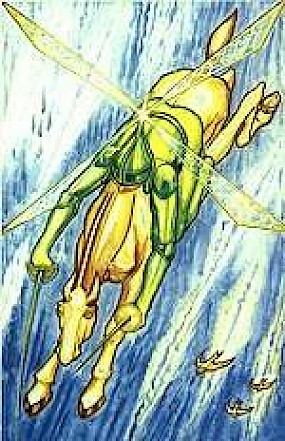
When the Knight of Swords comes up to indicate a man, he will be intelligent, subtle and clever. His capacity for abstract thought will be well developed. He is also highly intuitive and perceptive.
His nature will be elusive and ethereal, yet he has a strength and fascination that is hard to deny. He compels attention, except when he doesn’t want it, and at those times you will not even notice him pass by.
Because of the enquiring and analytic nature of his mind, you will often find him involved in occult study, and following spiritual pursuits. Whilst tolerant of those who know less than him, he will not divulge his knowledge easily. Rather those who wish to learn from him must fight to see him clearly, rather than falling for the projections he readily casts around him.
If this man is badly dignified his subtlety turns to manipulation, and his fascination to glamour. In this way, he becomes unprincipled and self-seeking. There is a certain ruthlessness present in the Knight of Swords at all times.
Even when we meet him at his best, he makes a hard task master, and an acutely keen observer. The sword in his hand will quite often be used to cut to the heart of things – and sometimes we will not be comfortable with what is revealed.
When this card comes up to indicate a state of mind in a man not normally seen as a Knight of Swords, we are then dealing with quite another issue. Now we must address the darkest qualities of the card. This is an angry man, who has quite possibly been emotionally hurt, and may well be looking for revenge.
He has the potential to be physically violent and mentally cruel. He is a nasty enemy and somebody who needs to be treated with the utmost caution.
New Thinking Allowed with Jeffrey Mishlove Gina Ruk, MS, is a former psychology professor at the University of Novi Sad in Serbia. Her work as an astrologer was the subject of a chapter Stephen E. Braude’s book, The Gold Leaf Lady. Here she describes her journey from a research psychologist to a professional astrologer. The economic conditions of the ten-year war forced her to find creative ways of supporting herself. She utilized an approach to astrology that incorporated Jungian psychology. Among her clients were the Serbian soccer team and the Serbian mafia. New Thinking Allowed host, Jeffrey Mishlove, PhD, is author of The Roots of Consciousness, Psi Development Systems, and The PK Man. Between 1986 and 2002 he hosted and co-produced the original Thinking Allowed public television series. He is the recipient of the only doctoral diploma in “parapsychology” ever awarded by an accredited university (University of California, Berkeley, 1980). His master’s degree is in criminology. He serves as dean of transformational psychology at the University of Philosophical Research. He teaches parapsychology for ministers in training with the Centers for Spiritual Living through the Holmes Institute. He has served as vice-president of the Association for Humanistic Psychology, and is the recipient of its Pathfinder Award for outstanding contributions to the field of human consciousness. He is also past-president of the non-profit Intuition Network, an organization dedicated to creating a world in which all people are encouraged to cultivate and apply their inner, intuitive abilities. His American Indian name, chosen at age eight, is Soaring Eagle. (Recorded on September 6, 2015)
New Thinking Allowed with Jeffrey Mishlove This video is a special release from the original Thinking Allowed series that ran on public television from 1986 until 2002. It was recorded in about 1988. Existential psychology emphasizes philosophic rather than psychopathological aspects of the human condition. In this program, reknowned author of Love and Will and Man’s Search for Himself proposes that genuine growth comes from confronting the pain of existence rather than excping into banal pleasures. Genuine joy, he says, emerges from an appreciation of life’s dilemmas. Now you can watch all of the programs from the original Thinking Allowed Video Collection, hosted by Jeffrey Mishlove. Subscribe to the new Streaming Channel (https://thinkingallowed.vhx.tv/) and watch more than 350 programs now, with more, previously unreleased titles added weekly. New!! Free month of the classic Thinking Allowed streaming channel for New Thinking Allowed subscribers only. Use code THINKFREELY.
Left unfinished by Kafka in 1922 and not published until 1926, two years after his death, The Castle is the haunting tale of K.’s relentless, unavailing struggle with an inscrutable authority in order to gain access to the Castle. Scrupulously following the fluidity and breathlessness of the sparsely punctuated original manuscript, Mark Harman’s new translation reveals levels of comedy, energy, and visual power, previously unknown to English language readers.
Lesson 137: When I am healed I am not healed alone.
Today’s idea remains the central thought on which salvation rests. For healing is the opposite of all the world’s ideas which dwell on sickness and on separate states. Sickness is a retreat from others, and a shutting off of joining. It becomes a door that closes on a separate self, and keeps it isolated and alone.
Sickness is isolation. For it seems to keep one self apart from all the rest, to suffer what the others do not feel. It gives the body final power to make the separation real, and keep the mind in solitary prison, split apart and held in pieces by a solid wall of sickened flesh, which it can not surmount.
The world obeys the laws that sickness serves, but healing operates apart from them. It is impossible that anyone be healed alone. In sickness must he be apart and separate. But healing is his own decision to be one again, and to accept his Self with all Its parts intact and unassailed. In sickness does his Self appear to be dismembered, and without the unity that gives It life. But healing is accomplished as he sees the body has no power to attack the universal Oneness of God’s Son.
Sickness would prove that lies must be the truth. But healing demonstrates that truth is true. The separation sickness would impose has never really happened. To be healed is merely to accept what always was the simple truth, and always will remain exactly as it has forever been. Yet eyes accustomed to illusions must be shown that what they look upon is false. So healing, never needed by the truth, must demonstrate that sickness is not real.
Healing might thus be called a counter-dream, which cancels out the dream of sickness in the name of truth, but not in truth itself. Just as forgiveness overlooks all sins that never were accomplished, healing but removes illusions that have not occurred. Just as the real world will arise to take the place of what has never been at all, healing but offers restitution for imagined states and false ideas which dreams embroider into pictures of the truth.
Yet think not healing is unworthy of your function here. For anti-Christ becomes more powerful than Christ to those who dream the world is real. The body seems to be more solid and more stable than the mind. And love becomes a dream, while fear remains the one reality that can be seen and justified and fully understood.
Just as forgiveness shines away all sin and the real world will occupy the place of what you made, so healing must replace the fantasies of sickness which you hold before the simple truth. When sickness has been seen to disappear in spite of all the laws that hold it cannot but be real, then questions have been answered. And the laws can be no longer cherished nor obeyed.
Healing is freedom. For it demonstrates that dreams will not prevail against the truth. Healing is shared. And by this attribute it proves that laws unlike the ones which hold that sickness is inevitable are more potent than their sickly opposites. Healing is strength. For by its gentle hand is weakness overcome, and minds that were walled off within a body free to join with other minds, to be forever strong.
Healing, forgiveness, and the glad exchange of all the world of sorrow for a world where sadness cannot enter, are the means by which the Holy Spirit urges you to follow Him. His gentle lessons teach how easily salvation can be yours; how little practice you need undertake to let His laws replace the ones you made to hold yourself a prisoner to death. His life becomes your own, as you extend the little help He asks in freeing you from everything that ever caused you pain.
And as you let yourself be healed, you see all those around you, or who cross your mind, or whom you touch or those who seem to have no contact with you, healed along with you. Perhaps you will not recognize them all, nor realize how great your offering to all the world, when you let healing come to you. But you are never healed alone. And legions upon legions will receive the gift that you receive when you are healed.
Those who are healed become the instruments of healing. Nor does time elapse between the instant they are healed, and all the grace of healing it is given them to give. What is opposed to God does not exist, and who accepts it not within his mind becomes a haven where the weary can remain to rest. For here is truth bestowed, and here are all illusions brought to truth.
Would you not offer shelter to God’s Will? You but invite your Self to be at home. And can this invitation be refused? Ask the inevitable to occur, and you will never fail. The other choice is but to ask what cannot be to be, and this can not succeed. Today we ask that only truth will occupy our minds; that thoughts of healing will this day go forth from what is healed to what must yet be healed, aware that they will both occur as one.
We will remember, as the hour strikes, our function is to let our minds be healed, that we may carry healing to the world, exchanging curse for blessing, pain for joy, and separation for the peace of God. Is not a minute of the hour worth the giving to receive a gift like this? Is not a little time a small expense to offer for the gift of everything?
Yet must we be prepared for such a gift. And so we will begin the day with this, and give ten minutes to these thoughts with which we will conclude today at night as well:
When I am healed I am not healed alone. And I would share my healing with the world, that sickness may be banished from the mind of God’s one Son, Who is my only Self.
Let healing be through you this very day. And as you rest in quiet, be prepared to give as you receive, to hold but what you give, and to receive the Word of God to take the place of all the foolish thoughts that ever were imagined. Now we come together to make well all that was sick, and offer blessing where there was attack. Nor will we let this function be forgot as every hour of the day slips by, remembering our purpose with this thought:
When I am healed I am not healed alone. And I would bless my brothers, for I would be healed with them, as they are healed with me.
A century before an encyclopedia titled Natural Wonders Every Child Should Know fell into Alan Turing’s child-hands and seeded the ideas that bloomed into the computing revolution, an encyclopedia titled Wonders of the World fell into the child-hands of Charles Darwin (February 12, 1809–April 19, 1882), seeding in him the passion for travel to remote wonderlands of nature that took him aboard the Beagle to make the observations that ultimately came abloom in his evolutionary revolution.
Charles Darwin, age 7. Portrait by Ellen Sharples, 1816.
Between lessons on Euclid, the teenage Darwin sat for hours reading poetry: Wordsworth, Coleridge, Shelley, Byron, Shakespeare, Milton. Later, when he could only carry a single book on his voyages, he carried Paradise Lost.
At twenty, after traveling to a “music meeting” in Birmingham, Darwin wrote to his cousin: “[It] was the most glorious thing I ever experienced.” His love of music grew so intense that, as he began formulating his ideas about evolutionary descent, he timed his thinking-walks to hear the choir at Kings College Chapel. “It gave me intense pleasure, so that my backbone would sometimes shiver,” he recalled in his old age, baffled that music could move him so deeply despite his own exceptionally bad ear for pitch. (Here Darwin falls victim to his time and training, looking for a physiological explanation before the birth of psychology and neuroscience, before we understood how music moves us not by sense-organ mechanics but by the lever of feeling — that supreme interpretive art of higher consciousness, so that “matter delights in music, and became Bach.”)
This feeling-tone of the beautiful, this delight in the native poetry and musicality of aliveness, accompanied Darwin as he dove deeper and deeper into science to emerge with nothing less than a new world order of understanding the natural world and our place in it. In the last months of finalizing On the Origin of Species, the forty-nine-year-old Darwin wrote in an ecstatic letter to his wife and great love, Emma:
I strolled a little beyond the glade for an hour and a half… the fresh yet dark green of the grand old Scotch firs, the brown of the catkins of the old birches, with their white stems, and a fringe of distant green from the larches, made an excessively pretty view… a chorus of birds singing around me, and squirrels running up the trees, and some woodpeckers laughing… it was as pleasant and rural a scene as ever I saw and did not care one penny how the beasts or birds had been formed.
Art by Jackie Morris from The Lost Words by Robert Macfarlane — a twenty-first-century act of poetic resistance to the erasure of nature from the human repertoire of ecstatic imagination.
When the Beagle took him to Brazil in his mid-twenties, Darwin gasped in his journal as he beheld the grandeur of the rainforest:
It is not possible to give an adequate idea of the higher feelings of wonder, admiration, and devotion, which fill and elevate the mind.
These “higher feelings” shaped his notion of divinity — he observed that the devotional experience people cite as their proof of God is based on the same “sense of sublimity” that nature’s grandeur stirs in the spirit, the same “powerful though vague and similar feelings excited by music.” (Two centuries later, the poet and naturalist Diane Ackerman would echo and harmonize this idea in her lovely notion of the Earth ecstatic as a personal religion.)
But then, as Darwin grew old, something happened — something he himself struggled to understand, something that caused him great sorrow: This radiant delight in aliveness through the transcendent experience of beauty — be it in spring’s symphony of songbirds or in a Bach sonata, in a Whitman poem or in the slant of sunlight on a centuries-old oak — grew dim, then was altogether extinguished. Darwin found himself mentally alert and active, but blind, deaf, dead to the life of feeling with which beauty inspirits us.
This gave him both his greatest regret and his greatest insight into the purpose of life.
In his final years, Darwin set aside an hour each afternoon to reflect on his life and to impart the private cosmogony of meaning he had discovered in his seven decades. In a set of autobiographical sketches he wrote for his children, bearing the heading “Recollections of the Development of My Mind and Character,” he considered what makes us human, what makes us happy, and what makes life worth living. After his death, finding in these notes immense insight and universal value, his children edited and published them as The Autobiography of Charles Darwin (public library).
In one of these recollections, the elderly Darwin writes:
My mind has changed during the last twenty or thirty years… Poetry of many kinds… gave me great pleasure… Pictures gave me considerable, and music very great delight… But now for many years I cannot endure to read a line of poetry…Music generally sets me thinking too energetically on what I have been at work on, instead of giving me pleasure. I retain some taste for fine scenery, but it does not cause me the exquisite delight which it formerly did.
In a sentiment of extraordinary lucidity and humility, and of immense foresight given what we have since learned about the brain, Darwin bends his mind into examining its own inner workings, illuminating the most essential nature of the human animal — a beast of feeling, wired not for brutality but for beauty:
My mind seems to have become a kind of machine for grinding general laws out of large collections of facts, but why this should have caused the atrophy of that part of the brain alone, on which the higher tastes depend, I cannot conceive. A man with a mind more highly organised or better constituted than mine, would not, I suppose, have thus suffered; and if I had to live my life again, I would have made a rule to read some poetry and listen to some music at least once every week; for perhaps the parts of my brain now atrophied would thus have been kept active through use. The loss of these tastes is a loss of happiness, and may possibly be injurious to the intellect, and more probably to the moral character, by enfeebling the emotional part of our nature.
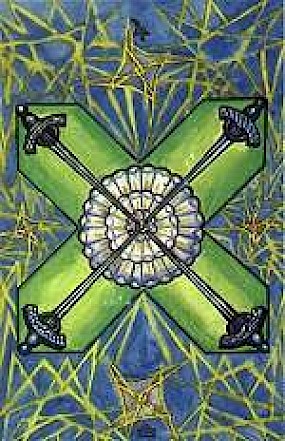
The Lord of Truce marks a period where we are able to rest and recover, after a difficult time in our lives. It will appear after trauma – the breakdown of a relationship; a troublesome and worrying time financially; an operation or major illness.
There will always have been conflict and stress beforehand, this card marks the kind of breathing space we often need in order to clarify our view of the situation, to gather our strength and to decide how best to move forward. When this card appears in a reading, the first thing it tells us is that it is time to rest, time to stop worrying about the things that have happened.
However, it must be noted that Truce is not peace. This is a respite – a down time in which we can catch our breath, ease our tension and relax for a brief time. But once that has been done, we need to recognise that there is still more to be done – the battle isn’t over yet. So when acting under the influence of this card, bear in mind that first you must take it easy, but then you must begin to plan your next step.
If we fail to do that, then when the effect of the Lord of Truce passes away, we shall be left high and dry, with no route planned for our future. And in that case the turmoil which preceded this card may well manifest again.
Sometimes, when the card comes up with a ‘person’ card, it indicates that a rift can begin to be mended between two people who have been at loggerheads previously. In this case, again, it is important to stress that this card does not indicate peace – as before, much more work will need to be done before the damage is entirely healed. We need to be on our guard, too, for other people running personal agendas which may mean that the ‘truce’ is more convenient than sincere.
Community Update December 2021 HERE’S WHAT’S HAPPENING!
Upcoming Classes Dear students and friends, First, RHS from Greece; then, for the first time in decades, a much-anticipated addition to our regular curriculum:The Prosperos presents Thane’s most transformational instruction in the long-awaited Pinnacle Class, Enhanced Crown Mysteries! (See box below.)Join us for a truly transformative culmination to our Fall Class Series!
RELEASING THE HIDDEN SPLENDOUR™ Monday, Dec. 6 – Tuesday, Dec. 7 – Zoë Robinson, H.W.,M., Monitor Learn how to use the enormous hidden potential of your memories, “how to make the unconscious conscious,” and release yourself to your true identity as One Whole Ontological Self. This class will employ Thane’s audio lessons, along with some live instruction. Please note that this class is scheduled using Eastern European time. USA Pacific Time is 10 hours earlier. For more information, please visit: https://www.theprosperos.org/prosperos-events/onl-202112-rhs-m-3. Learn more about all our classes at https://www.theprosperos.org/events. We look forward to seeing you soon!
* * * A REMARKABLE CLASS OFFERING! * * * >> Enhanced Crown Mysteries << After many years–a Prosperos Pinnacle Class! The Prosperos is pleased to present this eagerly awaited experience of Thane’s extraordinary advanced instruction, designed to reveal the “new heaven and a new earth” that lies within us, and bring forth the Ontological wholeness of Being – our own Reality Self. Dean Al Haferkamp will monitor two-and-a-half days of Thane’s transformative Ontological lessons. PLEASE NOTE: Students must have taken both Translation® and Releasing the Hidden Splendour™ in order to register for this class. Friday, December 10 – Sunday, December 12 For more information, and to register, please visit our website: https://www.theprosperos.org/prosperos-events/enhanced-crown-mysteries
Sunday Meetings Presenting talks by Prosperos Mentors and inspiring guests, these online events are open to all who are interested. There is no charge, although we do encourage contributions. Join the meetings at: https://us02web.zoom.us/j/332275676! Coming up this month:
SUNDAY, DECEMBER 19 (11:00 am PDT) “Holiest Day” Dean of the Prosperos, Al Haferkamp, fresh from monitoring the astounding Pinnacle Class the week before, will discuss his views on holiness and wholeness.Have you missed a meeting? Recordings of selected Sunday Meetings areavailable online. For information, please contact us at info@theprosperos.org.
Assembly 2022 Plans LABOR DAY WEEKEND, SEPT. 2-5, 2022 Yes, we’re still planning a major event next year! However, due to logistics, we may be changing the format. We’d love to get everyone together in the traditional way, but such a gathering may not be possible. We’ve asked everyone to tell us how you feel about different options, and we will be reporting on that as soon as your opinions and suggestions have been received and considered. Watch this space – we’ll keep you up to date here with all the Assembly news!
♦♦ Happy Holidays to all, & a Great New Year! ♦♦
MAY WE HELP YOU? High Watch Translation Service Need help with a problem? You can request Translation® for any issue: illness, relationships, professional difficulties, etc. Members of The Prosperos High Watch—students who have shown their understanding of Translation®—will work to reveal the Truth behind the appearance. Contributions are welcome; all information is confidential. Please post your request at: http://TheProsperos.org/community/hwts.
Personal Counseling Our Mentors (Teacher/Counselors) offer lay counseling based on the techniques of Translation® and Releasing the Hidden Splendour™ taught through The Prosperos. If you wish to arrange for personal counseling, or need questions answered about the techniques, or just want to talk, Prosperos Mentors are ready to help. For counselor names and contact information, please contact us at info@theprosperos.org.
Volunteer Opportunities
WEBSITE ASSISTANCE: We are currently seeking volunteers with experience in web design and social media. To offer your services, or request more information on how you can help, please write to info@theprosperos.org. Thank you!
FOR MORE INFORMATION…We invite you to visit our websites for information about the School, as well as for descriptions of our wide selection of printed, recorded, and online resources (many are free; others are available for purchase).
General Information – For our calendar, class descriptions and blogs, as well as other articles and information, please visit https://TheProsperos.org.
Audio Center – This site offers free podcasts, talks and lectures, plus a wealth of other recorded material for our students and friends. To see what’s available, please visit https://TheProsperos.com.
Theosophical Society This video is part of the Theosophical Society in America’s Classics Series. Presented on May 24, 2012 by Richard Smoley. Am I asleep? Many people have found themselves asking this question. The great spiritual teacher G. I. Gurdjieff said that human beings actually are asleep in day-to-day life, and that we habitually walk around in a low-grade hypnotic stupor. What is the nature of this waking sleep, and what is the way out of it? Available on DVD at https://questbooks.com/index.php?rout…
In times of trouble, religious and spiritual people often turn to their leaders for guidance, support, and comfort. What happens if/when those leaders abdicate their sacred responsibilities? Back in 2020 as the novel Coronavirus began to wreak havoc on everyday American lives, I remember too many responses that hinted at deep problems in a movement that I had been struggling to understand for a few years: organized spiritual metaphysics.
Since 2012 when I first stumbled into a metaphysical center/church, I have experienced equal parts joy and sorrow. In many ways, the period in my life from 2012 through today has been a journey of reconciling those extremes to find my place within the philosophy as well as a peace about it.
In the Spring of 2020, the world had more questions than answers about the Coronavirus, and it seemed that guessing wrong – especially in spiritual communities which tend to be older – had lethal consequences. For me this meant that the only reasonable option was to take maximum precautions.
Photo by Marisol Benitez, Unsplash
If we overshoot the precautions, we can come back together after it’s over and all have a good laugh at how paranoid we had been. The alternative – to keep gathering and not worry about it – seemed risky, dangerous, and out of alignment with the principle of Oneness (a principle hailed within New Thought as a core tenet).
Public health and the offering plate
My first go-round with a minister about the tension between public health and the offering plate was in March of 2020 after I emailed my friends who attended the local church and the minister. I suggested they consider suspending in-person services and classes for a while. ALL of these women are well into their 60’s and 70’s and the church was a small, poorly ventilated space.
Many agreed with me, but what happened next would turn out to be foreshadowing of behavior that I would see again and again. I received a response from the minister that began with “Thank you for your concern. And we still have an active community that needs your weekly financial support. Please consider making regular contributions through PayPal.”
Offerings, tithes, financial gifts – these were the FIRST concern.
Although I knew better, for a moment I hoped that this was one misguided person, and not representative of the larger movement. More than 18-months later I wish I could report that I see less evidence of that perspective.
In a recent social media post, I asked if the group (a private group focused on discussions around spiritual metaphysics) thought that ministers should be required to disclose their vaccination status. The responses were fascinating.
Illness is not possible
Several people indicated that this was indeed a good idea, but more people than I had hoped ALSO indicated that it should not be required. Private channel communications (e.g. not on social media) began to flow into my inbox. I watched as ministers and Practitioners posted that they should not have to report their vaccination status for many reasons, including because illness is not possible in an individualization of God and disease is not a spiritual idea in the Mind of God (a perspective I refer to as “fundamentalist religious science”).
At the same time, I began to hear stories of ministers (open anti-vaxxers) who are flouting local public health recommendations around masking, refusing to disclose their vaccination status – sometimes hiding behind privacy concerns – all while continuing “business-as-usual” on Sunday mornings, which includes hugging people and talking in close proximity to others.
I’m going to pause here to note that as of September 18, 2021, 672,689 American have died due to COVID-19.
How can an organization reconcile a goal of working to make the world work for everyone with actions like these among their recognized leaders at a time when so many have died from this virus?
A world that would work for everyone demands TRANSPARENCY in the face of real risks. People who attend a Sunday service, workshop, seminar, class, or meeting should be able to make that decision based on full disclosure of the information around risks to themselves and their families.
I am not suggesting that ministers be required to get vaccinated or lose their licenses (although I will pause here and point out that many Practitioners have lost licenses for MUCH LESS). I am suggesting that leaders in an organization that promotes itself as having the answers for how to create a world that works for everyone are acting in a way that is completely OPPOSITE that goal.
Sensible precautions
The world isn’t working for everyone if people can’t attend a Sunday service and have a reasonable assurance that every sensible public health precaution is being taken to keep them safe – including having the information they need to decide if it’s in their best interest to expose themselves to the group.
The world isn’t working for everyone when ONENESS is a marketing phrase but not an actual practice.
When it comes to this virus, ONENESS is an appropriate theme. We are all in this together. The virus does not discriminate. If an organization wants to promote itself as an organization that is the embodiment of Oneness their actions – not just their marketing – need to reflect it.
Oneness in the face of a global pandemic means that everyone – especially LEADERS – are open, honest, and transparent around their vaccine status. It means that leaders and local churches/centers not only implement but support in every way the local public health guidelines such as masking, social distancing and more.
It ALSO means that while some may believe that if their consciousness is in the “right place”, they cannot get sick, they understand that not everyone else is in that same place. Therefore, they act in ways that show care, love, and respect for all by behaving in ways that will keep EVERYONE safe – regardless of “consciousness”.
Hard decisions
Promoting an organization as “expert” in creating a world that works for every person requires hard decisions from the top. I would like to see more direct and relevant guidance from the same office that is busy printing rules for Practitioners on social media posts around this MUCH MORE IMPORTANT issue.
I’ll even make this easy for them by writing their draft copy:
For immediate dissemination:
Being a spiritual leader during a pandemic requires that you lead by example. Effective immediately all credentialed leaders in are expected to abide by the following:
Wear a mask and require it, as recommended by your local public health agencies, for Sunday services, classes, meetings and more;
Get vaccinated. If you have strong personal beliefs (or are ineligible) – make sure you’re transparent with EVERYONE so people coming to you/your center can make the best choice for themselves and their families;
Support in word and action the behaviors that MODEL our commitment to making the world work best for all.
In doing this we demonstrate the Oneness that we promote/teach by acting in a way that is truly respectful of all.
In the medical center and university where I work, employees who refuse to disclose their vaccine status or get a vaccine are at risk of losing their jobs, health insurance, and other benefits.
While I do not anticipate any bravery from the top ranks of the larger metaphysical organizations, I do have hope that the many people I see expressing concern and regard for others will exercise their rights to do what they can to force compliance: withhold their tithes, offerings and gifts from churches/centers and ministers that show a willful disregard for public health and a lack of care and concern for the people that they expect to support them.
We will get through this pandemic and find a new normal on the other side. Whether today’s spiritual organizations survive to have a chance in that new normal will rest largely on their ability to truly understand what it means to make that world that indeed works for all.
Rebecca Harmon is a healthcare professional, college educator, writer and popular speaker in her professional field. In 2019 she earned a credential as a licensed spiritual Practitioner but has decided not to renew those credentials due to concerns of integrity within the larger movement.
“I don’t shop at Hobby Lobby or eat at Chick-Fil A. For the same reasons, I will not be providing any support – financial, intellectual property or other – to an organization that acts in conflict to principles that I hold as important.” ~ Rebecca Harmon
Rebecca writes regularly about her spiritual journey. You can find more from her about that journey on her blog: Practitioner’s Path.
Consciousness, spirituality, biography, sexuality, androgyny, futurism, space, the arts, science, astrology, democracy, humor, books, movies and more





 I strolled a little beyond the glade for an hour and a half… the fresh yet dark green of the grand old Scotch firs, the brown of the catkins of the old birches, with their white stems, and a fringe of distant green from the larches, made an excessively pretty view… a chorus of birds singing around me, and squirrels running up the trees, and some woodpeckers laughing… it was as pleasant and rural a scene as ever I saw and did not care one penny how the beasts or birds had been formed.