Tarot Card for December 8: The Ten of Cups

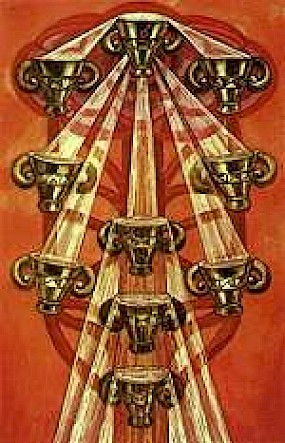
The Ten of Cups

The Lord of Satiety is a lovely card, indicating that we are full up with contentment and bliss. It is closely connected with the home environment, which is where we should expect a sense of repletion and joy.

When the card comes up, it indicates that life is ordered and fulfilling, that everything is in its proper place, and that things are unfolding as they should. There’s a placid sense of happiness here, which should be enjoyed open-heartedly and with a great deal of gratitude.

At the higher spiritual level, this card will often come up to indicate a period of close harmony with the Higher Powers, often after a time of struggle and trial. When this occurs, you will find yourself feeling at one with the Universe, in touch with the energy which flows through it in an unending stream.

Unfortunately there’s a word of warning (isn’t there always?) – when you are experiencing the influence of the Ten of Cups, ensure that you engage deeply with the energies around you. Don’t take them for granted, nor look for problems. Just make sure you enjoy what’s happening, and allow your sense of fulfilment to radiate from you.

The Ten of Cups

(via angelpaths.com and Alan Blackman)

Book: “Mirror of Simple Souls”

The Mirror of Simple Souls

The Mirror of Simple Souls
(Notre Dame Texts in Medieval Culture)

by Marguerite PoreteRobert E. Lerner (Preface), Ellen L. Babinsky (Translator/Introduction) 

The Classics series, which has inspired many less-successful imitations over the years, has fulfilled its promise and given us an invaluable resource of the soul. The Catholic Historical Review Marguerite Porete: The Mirror of Simple Souls translated and introduced by Ellen L. Babinsky preface by Robert E. Lerner LOVE: This Soul has within her the mistress of the Virtues, whom one calls Divine Love, who has transformed her completely into herself, is united to her, and which is why this Soul belongs neither to herself nor to the Virtues. Reason: But who are you, Love? says Reason. Are not you one of the Virtues with us even though you be above us? Love: I am God, says Love, for Love is God and God is Love, and this Soul is God by the condition of Love. Thus this precious beloved of mine is taught and guided by me, without herself, for she is transformed into me, and such a perfect one, says Love, takes my nourishment. Marguerite Porete (?-1310) We know very little about Marguerite Porete, only that she was a beguine from Hainaut who was burned at the stake as a relapsed heretic in 1310. She might have been a solitary itinerant beguine who expounded her teachings to interested listeners. She wrote The Mirror of Simple Souls in Old French sometime between 1296 and 1306. The format of the text is a dialogue among allegorical figures who represent the nature of the relation between the soul and God. The fundamental structure of the discourse is grounded in traditional Neoplatonist philosophy, and courtly language is used to express theological abstractions. The Mirror is a theological treatise which analyzes how love in human beings is related to divine love, and how the human soul by means of this relation may experience a lasting union of indistinct ion with God in this life. This is the first modern English translation of the complete text. The translation is based on a critical edition of the Old French and Latin versions of The Mirror. The introduction sets The Mirror in the maelstrom of political and ecclesiastical tensions and conflicts, and offers an analysis of the French beguine’s thought.

(Goodreads.com)

Marguerite Porete & The Mirror of Simple Souls

Let’s Talk Religion In this video we talk about the fascinating writer & possibly beguine Marguerite Porete (d. 1310). Support Let’s Talk Religion on Patreon: https://www.patreon.com/letstalkreligion Or through a one-time donation: https://www.paypal.com/paypalme/letst… Sources/Suggested Reading: “The Mirror of Simple Souls (From the 15th century translation of the French manuscript)”. Edited by C. Kirchberger. First printed in 1927. Soul Care Publishing, Vancover, Canada. (This is the primary source I used for the quotes in the video, it is a very old translation so I edited the quotes myself to make more sense in modern english). For a more modern translation I suggest: “Marguerite Porete: The Mirror of Simple Souls”. In the “Classics of Western Spirituality Series. Paulist Press. McGinn, Bernard (2001). “The Mystical Thought of Meister Eckhart”. The Crossroad Publishing Company. Tobin, Frank (Tranlsated & edited by) (1989). “Henry Suso: The Exemplar, with two German Sermons”. In the “Classics of Western Spirituality Series”. Paulist Press.

Beguines and Beghards

From Wikipedia, the free encyclopedia

The Beguines (/beɪˈɡiːnz, ˈbɛɡiːnz/) and the Beghards (/ˈbɛɡərdz, bəˈɡɑːrdz/) were Christian lay religious orders that were active in Western Europe, particularly in the Low Countries, in the 13th–16th centuries. Their members lived in semi-monastic communities but did not take formal religious vows; although they promised not to marry “as long as they lived as Beguines,” to quote one of the early Rules, they were free to leave at any time. Beguines were part of a larger spiritual revival movement of the 13th century that stressed imitation of Jesus‘ life through voluntary poverty, care of the poor and sick, and religious devotion.

Etymology

The term “Beguine” (LatinbeguinasDutchbegijn) is of uncertain origin and may have been pejorative.[2] Scholars no longer credit the theory expounded in the Encyclopædia Britannica Eleventh Edition (1911) that the name derived from Lambert le Bègue, a priest of Liège.[3] Other theories, such as derivation from the name of St. Begga and from a purported, reconstructed Old Saxon word *beggen, “to beg” or “to pray”, have also been discredited.[4] The origin of the movement’s name continues to be uncertain, as are the dates for the beginning of the movement itself.[5][6]

There is likewise no evidence that Beguines ever formed part of the Cathar heretical groups. Encyclopedias, when they mention this latter explanation at all, tend to dismiss it.[7][better source needed]

Beguines (laywomen)

Among Beguines who have become well-known representatives of the movement in contemporary literature are: Begijnhof (Amsterdam), Begijnhof (Breda), Begijnhof (Utrecht)Christina von StommelnDouceline of DigneHadewijchMarguerite PoreteMarie d’Oignies, and Mechthild of Magdeburg. Modern Beguines include Marcella Pattyn, and perhaps Dorothy Day.

Communities and status

A house in Bad Cannstatt formerly used as a beguinage. It was built in 1463 and restored in 1983.

At the start of the 12th century, some women in the Low Countries lived alone and devoted themselves to prayer and good works without taking vows. At first there were only a few, but in the course of the century, their numbers increased. Due to the structure of urban demographics and marriage patterns in the Low Countries, in the Middle Ages there were more women than men.[8] These women lived in towns, where they attended to the poor. During the 13th century, some of them bought homes that neighbored each other. These small communities of women soon attracted the attention of secular and clerical authorities.[9] Moved or inspired by the women’s commitment to prayer, the sacraments, and charitable service in the world, local clergy sought to channel and deploy the women’s spiritual fame in response to contemporary problems, especially the institutional church’s war on heresy.[10] Several clerics sought to promote these mulieres religiosae (or religious women) as saints after their deaths.[11] Probably the most famous instance of this was the relationship between James of Vitry and Marie d’Oignies, who is sometimes referred to as the prototypical Beguine.[12] Marie d’Oignies inspired James. She encouraged and improved his preaching and many of her miracles served to promote the sacramental program of Lateran IV.[13] After Marie’s death, James traveled to Rome on behalf of the “religious women” in the diocese of Liège, seeking papal permission for the women to live in common and incite one another to live good Christian lives.[14]

Beguines were not nuns, but they are sometimes conflated with nuns.[15] Beguines took personal, informal vows of chastity. Animated by the ideals of the vita apostolica—the same ideals that led to the formation of the mendicant orders—Beguines pursued a life of contemplative prayer and active service in the world.[16] As women, Beguines were forbidden to preach and teach, yet they actively exhorted their fellow Christians to live lives of penance, service, and prayer.[17]

Beguines were never recognized as an official, papally approved religious order. They did not follow an approved rule, they did not live in convents, and they did not give up their personal property. In fact, Beguines were free to abandon their religious vocation at any time since it was not enforced by any binding monastic vow. In many cases, the term “Beguine” referred to a woman who wore humble garb and stood apart as living a religious life above and beyond the practice of ordinary laypeople.[18]

In cities such as CambraiValenciennes, and Liège, local officials established formal communities for these women that became known as beguinages.[19] Beguinages (Begijnhoven in Dutch-speaking areas) tended to be located near or within town centers and were often close to the rivers that provided water for their work in the cloth industry.

While some women joined communities of like-minded lay religious women, adopting the label “Beguine” by virtue of entering a beguinage, many women lived alone or with one or two other like-minded women. Beguines engaged in a range of occupations to support themselves. Women in the Low Countries tended to work in the cities’ lucrative wool industry. Parisian Beguines were important contributors to the city’s burgeoning silk industry.[20]

Beguinages were not convents. There was no overarching structure such as a mother-house. Each beguinage adopted its own rule. The Bishop of Liège created a rule for Beguines in his diocese.[21] However, every community was complete in itself and fixed its own order of living. Later, many adopted the rule of the Third Order of Saint Francis.

Beguine communities varied in terms of the social status of their members; some of them only admitted ladies of high degree; others were reserved exclusively for persons in humble circumstances; others still welcomed women of every condition, and these were the most popular. Several, like the great beguinage of Ghent, had thousands of inhabitants. The Beguinage of Paris, founded before 1264, housed as many as 400 women.[22] Douceline of Digne (c. 1215-1274) founded the Beguine movement in Marseille; her hagiography, which was composed by a member of her community, sheds light on the movement in general.[23]

This semi-monastic institution was adapted to its age and spread rapidly throughout the land. Some Beguines became known as “holy women” (mulieres sanctae), and their devotions influenced religious life within the region. Beguine religious life was part of the mysticism of that age. There was a beguinage at Mechelen as early as 1207, at Brussels in 1245, at Leuven before 1232, at Antwerp in 1234, and at Bruges in 1244. By the close of the century, most communes in the Low Countries had a beguinage; several of the great cities had two or more.

Criticism and social response

As the 13th century progressed, some Beguines came under criticism as a result of their ambiguous social and legal status. As a conscious choice to live in the world but in a way that effectively surpassed (at least in piety) or stood out from most laypeople, Beguines attracted disapprobation as much as admiration. In some regions, the term Beguine itself denoted an ostentatiously, even obnoxiously religious woman; an image that quickly led to accusations of hypocrisy (consider the Beguine known as “Constrained Abstinence” in the Roman de la Rose). Some professed religious were offended by the assuming of “religious” status without the commitment to a rule, while the laity resented the implicit disapproval of marriage and other markers of secular life.[24] The women’s legal standing in relation to ecclesiastical and lay authorities was unclear. Beguines seemed to enjoy the best of both worlds: holding on to their property and living in the world as laypeople while claiming the privileges and protections of the professed religious.

On the other hand, admirers such as the secular cleric Robert de Sorbon (d. 1274) noted that Beguines exhibited far more devotion to God than even the cloistered, since they voluntarily pursued a religious life without vows and walls, surrounded by the world’s temptations.[25]

The power of the Beguine label is evident in the “watershed” moments of Beguine history, from its first appearance in the sermons of James of Vitry (the Beguine movement’s earliest and perhaps most famous promoter), to its reference in the trial of the doomed mystic Marguerite Porete (who was burned at the stake in Paris on charges of heresy in 1310), to its centrality in the condemnation of lay religious women at the Council of Vienne in 1311–1312.[26]

Marguerite Porete

Sometime during the early to mid-1290s, Marguerite Porete wrote a mystical book known as The Mirror of Simple Souls. Written in Old French, the book describes the annihilation of the soul, specifically its descent into a state of nothingness—of union with God without distinction. While clearly popular throughout the Middle Ages and beyond (perhaps dozens of copies circulated throughout late-medieval western Europe) the book provoked some controversy, likely because of statements such as “a soul annihilated in the love of the creator could, and should, grant to nature all that it desires,” which some took to mean that a soul can become one with God and that when in this state it can ignore moral law, as it had no need for the Church and its sacraments, or its code of virtues. This was not what Porete taught, since she explained that souls in such a state desired only good and would not be able to sin. Nevertheless, the book’s teachings, for some, were too easily misconstrued, particularly by the unlearned.[27]

At issue too was the way Porete disseminated her teachings, which was evocative of actions and behaviors some clerics were—at the time—finding increasingly problematic among lay religious women. Indeed, Porete was eventually tried by the Dominican inquisitor of France and burned at the stake as a relapsed heretic in 1310. In 1311—the year after Porete’s death—ecclesiastical officials made several specific connections between Porete’s ideas and deeds and the Beguine status in general at the Council of Vienne. One of the council’s decrees, Cum de Quibusdam, claimed that Beguines “dispute and preach about the highest Trinity and the divine essence and introduce opinions contrary to the catholic faith concerning the articles of the faith and the sacraments of the church.”[28]

More at: https://en.wikipedia.org/wiki/Beguines_and_Beghards#:~:text=to%20dismiss%20it.-,Beguines%20(laywomen),Oignies%2C%20and%20Mechthild%20of%20Magdeburg.

Who Rules America? The Dangerous Concentration of Power and Wealth in the American Upper Class

“Americans are all liberals, whether they call themselves Democrats or Republicans.”

–George William “Bill” Domhoff

The Film Archives July 1987 George William “Bill” Domhoff (born August 6, 1936) is a Distinguished Professor Emeritus and research professor of psychology and sociology at the University of California, Santa Cruz. His books: https://www.amazon.com/gp/search?ie=U… He is a founding faculty member of UCSC’s Cowell College. He is best known as the author of several best-selling sociology books, including Who Rules America? and its six subsequent editions (1967 through 2014). Domhoff received a Bachelor of Arts degree in psychology at Duke University (1958), where he finished freshman year as sixth in his class, wrote for the Duke Chronicle, played baseball as an outfielder, and tutored the student athletes. As an undergraduate, he also wrote for The Durham Sun and received his Phi Beta Kappa key.[2] He later earned a Master of Arts degree in psychology at Kent State University (1959), and a Doctor of Philosophy degree in psychology at the University of Miami (1962).[5] Domhoff was an assistant professor of psychology at California State University, Los Angeles for three years in the early 1960s. In 1965, he joined the founding faculty[7] of the University of California, Santa Cruz (UCSC) as an assistant professor at Cowell College; he became an associate professor in 1969, a professor in 1976, and a Distinguished Professor in 1993. After his retirement in 1994, he has continued to publish and teach classes as a research professor.[2][8] Over the course of his career at UCSC, Domhoff served in many capacities at various times: acting dean of the Division of Social Sciences,[9] chair of the Sociology Department, chair of the Academic Senate, chair of the Committee on Academic Personnel, and chair of the Statewide Committee on Preparatory Education.[2] In 2007, he received the University of California’s Constantine Panunzio Distinguished Emeriti Award, which honors the post-retirement contributions of UC faculty.[10] Domhoff’s first book, Who Rules America? (1967), was a 1960s sociological best-seller,[2] arguing that the United States is dominated by an elite ownership class, both politically and economically.[11] This work was partially inspired by Domhoff’s experience of the Civil rights movement and projects he assigned for his social psychology courses mapping how different organizations were connected.[2] It built on E. Digby Baltzell’s 1958 book Philadelphia Gentlemen: The Making of a National Upper Class, C. Wright Mills’ 1956 book The Power Elite, Robert A. Dahl’s 1961 book Who Governs? and Paul Sweezy work on interest groups, and Floyd Hunter’s 1953 book Community Power Structure and 1957 book Top Leadership, USA. Who Rules was followed by a series of sociology and power structure books like C. Wright Mills and the Power Elite (1968), Bohemian Grove and Other Retreats (1978), and three more best-sellers: The Higher Circles (1970), The Powers That Be (1979), and Who Rules America Now? (1983).[2] Domhoff has written seven updates to Who Rules America?; every edition has been used as a sociology textbook. He also has a “Who Rules America?” web site, hosted by UCSC.[12] In addition to his work in sociology, Domhoff has been a pioneer in the scientific study of dreams.[13][14] In the 1960s, he worked closely with Calvin S. Hall, who had developed a content analysis system for dreams. He has continued to study dreams up to the present day, and his latest research advocates a neurocognitive basis for future dream research.[15] He and his research partner, Adam Schneider, maintain two web sites dedicated to quantitative dream research: DreamResearch.net and DreamBank.net.[14] Selected Bibliography Who Rules America? 1967. Who Rules America? Englewood Cliffs, New Jersey: Prentice Hall https://amzn.to/3imPWQI 1983. Who Rules America Now? A View for the 80’s. New York: Simon and Schuster https://amzn.to/3on4Km1 1998. Who Rules America? Power and Politics in the Year 2000. 3rd Edition. Mountain View, CA: Mayfield Pub Co https://amzn.to/3onzMKH 2002. Who Rules America? Power and Politics. 4th Edition. New York: McGraw-Hill https://amzn.to/3D2SR9a 2005. Who Rules America? Power, Politics, and Social Change. 5th Edition. New York: McGraw-Hill https://amzn.to/3utkll0 2009. Who Rules America? Challenges to Corporate and Class Dominance. 6th Edition. New York: McGraw-Hill https://amzn.to/3D1lAey 2013. Who Rules America? The Triumph of the Corporate Rich. 7th Edition. New York: McGraw-Hill https://amzn.to/3imfNbE 2021. Who Rules America? The Corporate Rich, White Nationalist Republicans, and Inclusionary Democrats in the 2020s. 8th Edition. Routledge. https://amzn.to/39Wjfouhttps://en.wikipedia.org/wiki/G._Will…

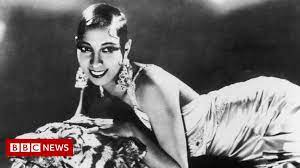
France elevated Josephine Baker to the Panthéon as a symbol of racial equality. Here’s the reality.

French racism was different than U.S. racism, but just as real

By Annette Joseph-Gabriel Today at 6:00 a.m. EST (WashingtonPost.com)

On Nov. 30, the American-born singer, actress and French Resistance heroine Josephine Baker became the first Black woman to be inducted into the Panthéon in Paris. She joins a select few of France’s national heroes handpicked by incumbent presidents as embodying the nation’s values. Baker’s rise to stardom on the stage of Paris’s famed cabaret music hall, the Folies Bergère, made her a symbol of wealth and freedom in the 1920s and ’30s. Today she is poised to become yet another symbol — this time, according to President Emmanuel Macron, of France as a land of racial equality.

But will that symbolism be accurate? Research suggests a more complex reality about racism in France, past and present. Between the two 20th-century world wars, the Black women who moved to France from the United States, the French Caribbean and Africa found that freedom from segregation and colonialism came at a price. In the eyes of many White French people, they were either invisible, blending into the landscape as low-wage workers, or else hypervisible, as exotic curiosities. In response to this discrimination, many tried to push France to go beyond the symbolic and make good on its claims of liberty, equality and fraternity for all.

How Black women transformed French identity

1932 was a good year for Josephine Baker. Her stage performances were critically acclaimed throughout Europe, and she was beginning to make her mark in cinema. That same year, the Martinican intellectual Paulette Nardal wrote a scathing condemnation of France’s treatment of Black women.

Like Baker, Nardal had arrived in Paris in the 1920s. She navigated life in the French capital as a Black woman among a cohort of other Black French and American students and artists. Her experience, however, was the opposite of Baker’s. As Nardal would later write in her 1932 essay “The Awakening of Race Consciousness,” Black women experienced a rude awakening as racism in Paris led them to feel uprooted and isolated.

In the pages of the Review of the Black World, the journal she co-founded, Nardal presented her vision for how France could live up to its promise of universalism. Her journal published an international cast of writers from across the African diaspora who highlighted Black people’s cultural, political and intellectual contributions on the global stage. Taken together, their work argued that the path to anti-racism lay not in Black people’s assimilation into a narrow and fixed idea of France, but rather in remaking France in their own image.

What would this look like concretely? For Paulette’s sister Andrée, it would require recognizing the technical sophistication of Afro-Creole art forms such as the Antillean beguine dance popularized by Baker in Parisian dance halls. Black American educator Clara Shepard identified the importance of the French language for Black students in the United States, not necessarily to learn about France but rather to connect the experiences of American sharecroppers to those of West African farmers. For Roberte Horth’s fictional character Léa, it was an imagined day when her Black skin would no longer be a marker of difference “in the land of her dreams” and would merely be “a thing of no importance.”

The Review of the Black World took an international approach to anti-racism. Its essays about anti-racist resistance through language, dance, poetry and the reclaiming of Black history presented the realities of racial discrimination in Africa, the Caribbean, France and the United States. In this way it illustrated what many researchers today argue: that White supremacy, as a global problem, cannot have a national solution.

In many ways, Baker hovered on the margins of Nardal’s world, colliding but not quite overlapping with the communities of Black students, writers and artists who passed through France between the 1920s and 1940s. At the same time her extraordinary life still illustrates the reality of racism in both France and the United States that Nardal revealed in the pages of her journal.

In the story that is today told about her life, Baker fled racism and segregation in the United States and found refuge in France, where liberty and equality enabled her rise from rags to riches. In reality, her predominantly White European audience’s colonial desire to consume all things exotic and “primitive” was simply another manifestation of the racism that Baker had supposedly left behind. Contrary to Macron’s speech casting France and the United States as opposites on matters of race, Baker’s experience shows that France was neither more nor less racist than the United States — just differently so. As another Black French thinker, the Martinican psychiatrist Frantz Fanon, argued, American racism was simply a continuation of European imperialism.

The France in which Nardal and the Black women who wrote for her journal lived was a far cry from the “place where one stopped dreaming of elsewhere, a promise of emancipation” that Macron described last week as he ushered Baker into the Panthéon. Last year’s large-scale protests against racialized policing in Paris show that emancipated France has still not yet come into being. Now that Baker is once again a symbol on the world stage, the Review of the Black World provides a useful international lens through which to see her life — not as a premature symbol of France’s race-blindness but instead as a reminder that the fight against racism transcends national borders and continues on all fronts.

Annette Joseph-Gabriel (@AnnetteJosephG) is an associate professor of French and francophone studies at the University of Michigan at Ann Arbor and the author of “Reimagining Liberation: How Black Women Transformed Citizenship in the French Empire” (University of Illinois Press, 2020).

A Course in Miracles: Lesson 138

Lesson 138 Heaven is the decision I must make.

In this world heaven is a choice, because here we believe there are alternatives to choose between. We think that all things have an opposite, and what we want we choose. If Heaven exists there must be hell as well, for contradiction is the way we make what we perceive, and what we think is real.

Creation knows no opposite. But here is opposition part of being “real.” It is this strange perception of the truth that makes the choice of Heaven seem to be the same as the relinquishment of hell. It is not really thus. Yet what is true in God’s creation cannot enter here until it is reflected in some form the world can understand. Truth cannot come where it could only be perceived with fear. For this would be the error truth can be brought to illusions. Opposition makes the truth unwelcome, and it cannot come.

Choice is the obvious escape from what appears as opposites. Decision lets one of conflicting goals become the aim of effort and expenditure of time. Without decision, time is but a waste and effort dissipated. It is spent for nothing in return, and time goes by without results. There is no sense of gain, for nothing is accomplished; nothing learned.

You need to be reminded that you think a thousand choices are confronting you, when there is really only one to make. And even this but seems to be a choice. Do not confuse yourself with all the doubts that myriad decisions would induce. You make but one. And when that one is made, you will perceive it was no choice at all. For truth is true, and nothing else is true. There is no opposite to choose instead. There is no contradiction to the truth.

Choosing depends on learning. And the truth cannot be learned, but only recognized. In recognition its acceptance lies, and as it is accepted it is known. But knowledge is beyond the goals we seek to teach within the framework of this course. Ours are teaching goals, to be attained through learning how to reach them, what they are, and what they offer you. Decisions are the outcome of your learning, for they rest on what you have accepted as the truth of what you are, and what your needs must be.

In this insanely complicated world, Heaven appears to take the form of choice, rather than merely being what it is. Of all the choices you have tried to make this is the simplest, most definitive and prototype of all the rest, the one which settles all decisions. If you could decide the rest, this one remains unsolved. But when you solve this one, the others are resolved with it, for all decisions but conceal this one by taking different forms. Here is the final and the only choice in which is truth accepted or denied.

So we begin today considering the choice that time was made to help us make. Such is its holy purpose, now transformed from the intent you gave it; that it be a means for demonstrating hell is real, hope changes to despair, and life itself must in the end be overcome by death. In death alone are opposites resolved, for ending opposition is to die. And thus salvation must be seen as death, for life is seen as conflict. To resolve the conflict is to end your life as well.

These mad beliefs can gain unconscious hold of great intensity, and grip the mind with terror and anxiety so strong that it will not relinquish its ideas about its own protection. It must be saved from salvation, threatened to be safe, and magically armored against truth. And these decisions are made unaware, to keep them safely undisturbed; apart from question and from reason and from doubt.

Heaven is chosen consciously. The choice cannot be made until alternatives are accurately seen and understood. All that is veiled in shadows must be raised to understanding, to be judged again, this time with Heaven’s help. And all mistakes in judgment that the mind had made before are open to correction, as the truth dismisses them as causeless. Now are they without effects. They cannot be concealed, because their nothingness is recognized.

The conscious choice of Heaven is as sure as is the ending of the fear of hell, when it is raised from its protective shield of unawareness, and is brought to light. Who can decide between the clearly seen and the unrecognized? Yet who can fail to make a choice between alternatives when only one is seen as valuable; the other as a wholly worthless thing, a but imagined source of guilt and pain? Who hesitates to make a choice like this? And shall we hesitate to choose today?

We make the choice for Heaven as we wake, and spend five minutes making sure that we have made the one decision that is sane. We recognize we make a conscious choice between what has existence and what has nothing but an appearance of the truth. Its pseudo-being, brought to what is real, is flimsy and transparent in the light. It holds no terror now, for what was made enormous, vengeful, pitiless with hate, demands obscurity for fear to be invested there. Now it is recognized as but a foolish, trivial mistake.

Before we close our eyes in sleep tonight, we reaffirm the choice that we have made each hour in between. And now we give the last five minutes of our waking day to the decision with which we awoke. As every hour passed, we have declared our choice again, in a brief quiet time devoted to maintaining sanity. And finally, we close the day with this, acknowledging we chose but what we want:

Heaven is the decision I must make.
I make it now, and will not change my mind,
because it is the only thing I want.

DID WE FAIL THE BLUE EYES, BROWN EYES EXPERIMENT—OR DID IT FAIL US?

A Half-Century Old Classroom Exercise Shows Americans’ Hunger for a Silver Bullet to ‘Cure Racism’

Did We Fail the Blue Eyes, Brown Eyes Experiment—Or Did It Fail Us? | Zocalo Public Square • Arizona State University • Smithsonian

A grammar school teacher in a recently integrated classroom in 1969. Courtesy of AP Photo

by STEPHEN G. BLOOM | DECEMBER 6, 2021 (ZocaloPublicSquare.org)

Today’s heated arguments about critical race theory shouldn’t surprise us because they aren’t new. Indeed, one of the best-known classroom experiments to combat racism remains a divisive subject more than a half-century after it was tried out in a rural Iowa elementary school.

You may not know Jane Elliott by name, but you likely have heard of the blue eyes/brown eyes experiment, which has been performed on hundreds of thousands of children and adults across the United States and around the world. Elliott was a schoolteacher in Riceville, Iowa, a small town with a population of 806, in 1968. Days after the assassination of Martin Luther King Jr., she pioneered an experiment to show her all-white class of third graders what it was like to be Black in America.

Elliott, who is white, separated the students into two groups—those with blue eyes and those with brown eyes.

On the first day of the two-day experiment, Elliott told the blue-eyed children that they were genetically inferior to the brown-eyed children. She instructed the blue-eyed kids not to play on the jungle gym or swings with the brown-eyed students. She told the blue-eyed kids that they’d have to use paper cups if they wanted to drink from the water fountain. The blue-eyed students wouldn’t be allowed second helpings in the cafeteria.

On the second day, Elliott switched the students’ roles. The brown-eyed kids would now be considered inferior.

Elliott’s commitment to the experiment was total, and it made an impact. Fistfights erupted on the school playground that she didn’t stop. In fact, Elliott encouraged them, based on the children’s newly granted superiority or inferiority. That was part of convincing the students that the experiment was real. She said she hoped that the gut-wrenching experiment would stay with the children for the rest of their lives.

It did, though not necessarily in the ways Elliott intended.

The experiment certainly changed Elliott’s life. Two months after trying it out, Elliott appeared on The Tonight Show with Johnny Carson, followed by an appearance in an award-winning network TV documentary, and a headline-making White House conference on education. Soon, multitudes of teachers around the world, looking for a magic bullet to erase racism, adopted the experiment and imported it into their own classrooms.

Elliott would play a role resembling that of the contemporary anti-racist author Robin DiAngelo today: a white woman who becomes a famous, international authority on bias. By 1984, Elliott left her public schoolteacher’s job and had taken the blue eyes/brown eyes experiment on the road.As for Elliott, the experiment that she popularized on unwitting students began to raise more and more questions as it was unveiled by more educators and trainers in more places.

She tried it on adults, not just in the United States and Canada, but in Europe, the Middle East, and Australia. She traveled to conferences and corporate workshops. She took the experiment to prisons, banks, schools, and military bases. She appeared on Oprah five times. Elliott became a standing-room-only speaker at hundreds of colleges and universities. In the process, she turned herself into America’s mother of diversity training.

During the 1970s and 1980s in the United States workshops such as Elliott’s gained popularity in and out of the corporate world. They went by names such as team-building, large group awareness training (LGAT), consciousness raising, management by objective, and transformative leadership training.

The blue eyes/brown eyes experiment, which could last one to three days, was at a glance similar to other human-potential-movement workshops of the era, including Werner Erhard’s est training, in that it focused on changing basic self-perceptions and behavior. While the heart of what Elliott did was racism abatement, she also began folding into her intense workshops issues of gender and age bias, along with prejudice based on conventional Western beauty standards. By the mid-1980s, Elliott had retooled herself as a New Age visionary.

Meanwhile, the blue eyes/brown eyes experiment had entered the psychological and educational canon. In 2004, the American publishing giant, McGraw Hill, created a poster suitable for classroom display that included Elliott alongside other venerated thinkers and teachers, including Plato, Maria Montessori, Booker T. Washington, and Horace Mann.

In Psychology and Lifea one-and-a-half-inch-thick standard textbook that hundreds of thousands of undergraduates still tote to classes, the eye experiment would be praised as “one of the most effective demonstrations of how easily prejudiced attitudes may be formed, and how arbitrary and illogical they can be.”

One of the textbook’s authors, Stanford professor Philip G. Zimbardo, described Elliott’s classroom activity as “a remarkable experiment, more compelling than many done by professional psychologists.”

That Zimbardo had been so struck with Elliott made sense. In 1971, when Elliott was pitting blue-eyed students against their brown-eyed counterparts, Zimbardo was conducting his own contentious research, known as the Stanford Prison Experiment, to show how easy it was to make thugs out of college students once they were given an overdose of power.

As for Elliott, the experiment that she popularized on unwitting students began to raise more and more questions as it was unveiled by more educators and trainers in more places. Today’s efforts to teach anti-racism through diversity, equity, and inclusion workshops face some of the same blowback.

In trying to teach the insidious impact of racism, did the experiment itself damage students?

Does simulating racism using fake-punitive methods work?

In 2004, Elliott invited me to write a biography of her. But she withdrew her participation after I began interviewing former students and workshop participants, many of whom were critical of the blue eyes/brown eyes experiment. Fifty years after she first tried the experiment, many former students and workshop participants still carry scars of the experience. While Elliott championed the experiment as an “inoculation against racism,” few I interviewed agreed with her.

The experience of being experimented upon, along with the fame (and money) her experiment earned for her, left hard feelings. When I interviewed Riceville residents, mentioning Elliott’s name generated outbursts of anger and anguish. Many still see the students and the town itself as victims of a human experiment to which they had not consented.

There were some objections to the experiment from the beginning, although none that convinced her to call if off. At least one student from Elliott’s third grade class in 1969 didn’t buy Elliott’s announced premise that blue-eyed people were “better” than their brown-eyed counterparts.

Digging deeper, I heard complaints about Elliott’s tactics in her later corporate trainings. In workshops Elliott led, there were indelible moments of joy and tears, affirmation and recrimination, hugging and screaming. Participants described her hurling insults at them, particularly those who were white and had blue eyes. This was by design: to hammer home the experiment’s anti-bias premise, Elliott made shocking allegations against participants.

Julie Pasicznyk, who had been working for telecommunications company US West in Minneapolis, was hesitant to enroll in Elliott’s workshop, but was told that if she wanted to succeed as a manager, she’d have to attend. Pasicznyk joined 75 other telecommunication employees for a training session that lasted three days in a Denver suburb during the mid-1980s.

“Right off the bat, she picked me out of the room and called me ‘Barbie,’” recalled Pasicznyk. “That’s how it started, and that’s how it went all day long. She had never met me and she accused me in front of everyone of using my sexuality to get ahead.”

“Barbie” had to have a Ken, so Elliott picked from the audience a tall, handsome man and accused him of doing the same things with his female subordinates, Pasicznyk said. Elliott went after “Ken” and “Barbie,” drilling, accusing, ridiculing them to make the point that white people make baseless judgments about Black people all the time.

“People left crying,” remembered Pasicznyk.

“She manipulated us,” recalled Sandy Juettner, another US West employee enrolled in a workshop. “It was an unbelievable breach of trust. It was obscene.”

Zimbardo’s Stanford Prison Experiment has been debunked, its findings shown to be the product of deceit. But the blue eyes/brown eyes experiment still retains a tentative foothold in some schools and work settings today.

Looking back, the experiment may have demonstrated to participants what bias felt like, but it failed to include any demonstration of how kindness, compassion, or empathy might play roles in reducing prejudice.

Certainly, the experiment demonstrated how hungry Americans are for a silver bullet to “cure” racism. But, if the experiment may teach us anything, it’s that no single classroom experiment, no one-day workshop, is equal to that task.

STEPHEN G. BLOOM is a professor of journalism at the University of Iowa and the author of Blue Eyes, Brown Eyes: A Cautionary Tale of Race and Brutality.

Kamala Harris is a ‘bully,’ former staffer tells the Washington Post

Eric Ting, SFGATE Dec. 6, 2021 (SFGate.com)

Vice President Kamala Harris speaks at the Tribal Nations Summit in the South Court Auditorium on the White House campus, Tuesday, Nov. 16, 2021, in Washington. 
Vice President Kamala Harris speaks at the Tribal Nations Summit in the South Court Auditorium on the White House campus, Tuesday, Nov. 16, 2021, in Washington. Patrick Semansky/AP

A week after several high-profile departures from the office of Vice President Kamala Harris, the Washington Post published a larger story on Harris’ management skills based on interviews with “18 people connected to Harris.”

Many former staffers did not have nice things to say.

Gil Duran, who worked for Harris when she was California attorney general in 2013, quit after only five months, and now writes for the San Francisco Examiner, went on the record with harsh criticism.

“One of the things we’ve said in our little text groups among each other is what is the common denominator through all this and it’s her,” he said. “Who are the next talented people you’re going to bring in and burn through and then have (them) pretend they’re retiring for positive reasons.”

The Washington Post reported that “one consistent problem” staffers referenced was the fact that “Harris would refuse to wade into briefing materials prepared by staff members, then berate employees when she appeared unprepared.” It was this phenomenon that prompted a particularly biting quote by an anonymous former staffer.

“It’s clear that you’re not working with somebody who is willing to do the prep and the work,” the staffer said. “With Kamala you have to put up with a constant amount of soul-destroying criticism and also her own lack of confidence. So you’re constantly sort of propping up a bully and it’s not really clear why.”

The story also contained a quote in defense of Harris from prominent Democratic strategist Sean Clegg, who most recently advised Gov. Gavin Newsom in September’s gubernatorial recall election. Clegg said that Harris faces a double standard as a woman.

“People personalize these things,” he said of those who were unhappy with Harris. “I’ve never had an experience in my long history with Kamala where I felt like she was unfair. Has she called bulls—t? Yes. And does that make people uncomfortable sometimes? Yes. But if she were a man with her management style, she would have a TV show called ‘The Apprentice.'”

The Washington Post story also touches on how those close to Harris fear that her style as a boss could complicate her future plans, which likely include another bid for the presidency in either 2024 or 2028. You can read the full report from the Washington Post.

Eric Ting is the editor of California Issues, SFGATE’s politics section. He is an East Bay native who has a Master’s degree in journalism from Stanford University. Eric did his undergrad at Pomona College, where he majored in politics and minored in economics. Email: eric.ting@sfgate.com