Dr Aidan Studying Shakespeare? Dr Aidan, PhD in Shakespeare Studies, provides you with the 10 most important quotes to unlock The Tempest and gain a better understanding of the play. Ideal for students, people going to see the play or anybody that wants to learn more about Shakespeare. Quick, relaxed, and informative, The Complete Guide to Shakespeare aims to make the plays accessible to everyone. Have any video requests? Post them in the comments or contact me here – Social Media Twitter: DrAidan1564 Music Credits: El Patio, Orquestra Arrecife, (Jamendo Licensing)
Thane Walker (top) and Al Haferkamp, H.W., M. (above)
Over the weekend from Friday, December 10, thru Sunday, December 12, The Prosperos held a successful online class called Enhanced Crown Mysteries.
Some 23 students (11 more disciples than Jesus) attended this rarely given class which was monitored by Al Haferkamp, H.W., M., the outgoing dean of The Prosperos, and presented via audiotape by Thane Walker (aka Thane of Hawaii), the late dean and co-founder of The Prosperos who died in July 1989.
This class was last given maybe some 15 years ago and is the traditional climax of the pinnacle classes traditionally given in the fall of the year following Cosmic Intention Therapy, Advance Seminar, Translation, Releasing the Hidden Splendour, Comprehensive Workshop, and Life class.
Crown Mysteries used to be presented at a remote location like the Del Coronado Hotel in San Diego so students could have an opportunity to get away from day-to-day life.
This class was presented via Zoom, as are most of our classes in this time of COVID.
Forged during the tumultuous but triumphant postwar years when America came of age as a world power, The Irony of American History is more relevant now than ever before. Cited by politicians as diverse as Hillary Clinton and John McCain, Niebuhr’s masterpiece on the incongruity between personal ideals and political reality is both an indictment of American moral complacency and a warning against the arrogance of virtue. Impassioned, eloquent, and deeply perceptive, Niebuhr’s wisdom will cause readers to rethink their assumptions about right and wrong, war and peace.
“[Niebuhr] is one of my favorite philosophers. I take away [from his works] the compelling idea that there’s serious evil in the world, and hardship and pain. And we should be humble and modest in our belief we can eliminate those things. But we shouldn’t use that as an excuse for cynicism and inaction. I take away . . . the sense we have to make these efforts knowing they are hard.”—President Barack Obama
“The supreme American theologian of the twentieth century.”—Arthur Schlesinger Jr., New York Times
“Niebuhr is important for the left today precisely because he warned about America’s tendency—including the left’s tendency—to do bad things in the name of idealism. His thought offers a much better understanding of where the Bush administration went wrong in Iraq.”—Kevin Mattson, The Good Society
“Irony provides the master key to understanding the myths and delusions that underpin American statecraft. . . . The most important book ever written on USforeign policy.”—Andrew J. Bacevich, from the Introduction
A humorous philosophical investigation into the existence of Santa—from a co-executive producer of The Big Bang Theory
Metaphysics isn’t ordinarily much of a laughing matter. But in the hands of acclaimed comedy writer and scholar Eric Kaplan, a search for the truth about old St. Nick becomes a deeply insightful, laugh-out-loud discussion of the way some things exist but may not really be there. Just like Santa and his reindeer.
Even after we outgrow the jolly fellow, the essential paradox persists: There are some things we dearly believe in that are not universally acknowledged as real. In Does Santa Exist? Kaplan shows how philosophy giants Bertrand Russell and Ludwig Wittgenstein strove to smooth over this uncomfortable meeting of the real and unreal—and failed. From there he turns to mysticism’s attempts to resolve such paradoxes, surveying Buddhism, Taoism, early Christianity, Theosophy, and even the philosophers at UC Berkeley under whom he studied. Finally, this brilliant comic writer alights on—surprise—comedy as the ultimate resolution of the fundamental paradoxes of life, using examples from The Big Bang Theory, Monty Python’s cheese shop sketch, and many other pop-culture sources.
Finally Kaplan delves deeper into what this means, from how our physical brains work to his own personal confrontations with life’s biggest questions: If we’re all going to die, what’s the point of anything? What is a perfect moment? What can you say about God? Or Santa?
There can be no wakeful and wholehearted devotion to standing for anything of substance — justice or peace or the myriad subtle ways we have of protecting all that is alive and therefore fragile — without wide-eyed, wonder-smitted wakefulness to every littlest manifestation of beauty and aliveness. “Envy those who see beauty in everything in the world,” the young Egon Schiele exhorted in a letter after being arrested for his radical art, hurtling toward an untimely death by the Spanish flu that would take the life of his young pregnant wife three days before taking his.
There can be no reverence for the timeless without tenderness for each moment beading the rosary of our mortal lives, and there is no place where we contact this more clearly than in our encounters with nature, be it in the majesty of a solar eclipse or in the miniature of a flowerpot. “The gardener digs in another time, without past or future, beginning or end,” the filmmaker and activist Derek Jarman wrote shortly after his HIV diagnosis and his father’s death as he began growing through grief amid the beauty of flowers. “Here is the Amen beyond the prayer.”
Suspended in time between Schiele and Jarman, ablaze with determination to counter the forces about to unworld the world with its deadliest war, George Orwell (June 15, 1903–January 21, 1950) devoted himself to a small, radical act of reverence for beauty.
George Orwell
In the spring of 1936 — while waiting for his beloved to arrive from London for their wedding, contemplating enlisting in the Spanish Civil War, and germinating the ideas that would bloom into Animal Farm and Nineteen Eighty-Four — Orwell planted some roses in the garden of the small sixteenth-century cottage that his suffragist, socialist, bohemian aunt had secured for him in the village of Wallington.
This poetic gesture with political roots inspirits the uncommonly wonderful Orwell’s Roses (public library). Like any Rebecca Solnit book, this too is a landmass of layered aboutness beneath the surface story — a book stratified with art and politics, beauty and ecology, mortality and what gives our lives meaning.
She writes:
If war has an opposite, gardens might sometimes be it, and people have found a particular kind of peace in forests, meadows, parks, and gardens.
In such a world, a rose is a requiem is a revolution.
On November 20, Orwell recorded in his diary:
Cut down the remaining phloxes, tied up some of the chrysanthemums which had been blown over. Difficult to do much these afternoons now it is winter-time. The chrysanths now in full flower, mostly dark reddy-brown, & a few ugly purple & white ones which I shan’t keep. Roses still attempting to flower, otherwise no flowers in the garden now. Michaelmas daisies are over & I have cut some of them down.
Even on that November day two big unruly rosebushes were in bloom, one with pale pink buds opening up a little and another with almost salmon flowers with a golden-yellow rim at the base of each petal. They were exuberantly alive, these allegedly octogenarian roses, living things planted by the living hand (and shovel work) of someone gone for most of their lifetime.
Transported into Orwell’s presence across time and expectation, Solnit reflects on the roses as levers of gladsome reorientation, reconsideration, and recalibration — not only of the venerated writer’s inner world but of an entire worldview:
[Orwell’s roses] rearranged my old assumptions… This man most famous for his prescient scrutiny of totalitarianism and propaganda, for facing unpleasant facts, for a spare prose style and an unyielding political vision, had planted roses. That a socialist or a utilitarian or any pragmatist or practical person might plant fruit trees is not surprising: they have tangible economic value and produce the necessary good that is food even if they produce more than that. But to plant a rose — or in the case of this garden he resuscitated in 1936, seven roses early on and more later — can mean so many things.
Regarding the roses as “invitations to dig deeper,” she adds:
They were questions about who he was and who we were and where pleasure and beauty and hours with no quantifiable practical result fit into the life of someone, perhaps of anyone, who also cared about justice and truth and human rights and how to change the world.
Rose painting and poem by the Civil Rights activist Sarah Mapps Douglass — the first surviving artwork signed by an African-American woman. (Available as a print and as a face mask.)
Orwell’s roses bloomed for the first time weeks after Harper’s published an essay titled “The Usefulness of Useless Knowledge” by the American educator and medical school reformer Abraham Flexner — a marvelously timeless admonition that “our conception of what is useful may… have become too narrow to be adequate to the roaming and capricious possibilities of the human spirit.” A rose is not even a form of knowledge, at least not directly.
A rose is useless in the rawest sense. To ask the utility of a rose is to ask the metric value of love or the meaning of a bird. I am much younger than Orwell’s roses, but I have lived long enough to know that some of our most useless experiences — experiences with no direct application to our chosen work or to the project of “self-improvement” or to world peace or to the conservation of species, experiences that might appear trivial, self-indulgent, even absurd to any outside judgment — are also the experiences that consecrate life with aliveness, the selfsame aliveness by which we make what we make and devote ourselves to justice, to peace, to conservation, to staying alive a little while longer so that we can devote ourselves a little more. Every artist, every deep-feeling and clear-thinking person, everyone who is truly alive, has the analogue of Orwell’s rose garden in their life. (For me, it is my cello. It is the forest. It is the Meyer lemon I grew from a seed, now thriving on my Brooklyn window sill.)
Orwell himself knew this. In his classic essay Why I Write, which inspired generationsofwriters to ponder the same, he articulated it with uncommon force of clarity:
Anyone who cares to examine my work will see that even when it is downright propaganda it contains much that a full-time politician would consider irrelevant. I am not able, and do not want, completely to abandon the world view that I acquired in childhood. So long as I remain alive and well I shall continue to feel strongly about prose style, to love the surface of the earth, and to take a pleasure in solid objects and scraps of useless information. It is no use trying to suppress that side of myself. The job is to reconcile my ingrained likes and dislikes with the essentially public, non-individual activities that this age forces on all of us.
Arriving at the same realization with magnified clarity amid Orwell’s roses, Solnit observes:
You might prepare for your central mission in life by doing other things that may seem entirely unrelated… Orwell seemed to have an instinct for this other work and a talent for giving it what it required. In the last phase of his life, he was both intent upon writing Nineteen Eighty-Four and devoting huge amounts of his time, energy, imagination, and resources to building up a garden verging on a farm, with livestock, crops, fruit trees, a tractor — and a lot of flowers — on the remote tip of a Scottish island. What is it that makes it possible to do the work that is of highest value to others and one’s central purpose in life? It may appear — to others, sometimes even to oneself — trivial, irrelevant, indulgent, pointless, distracted, or any of those other pejoratives with which the quantifiable beats down the unquantifiable.
Orwell feeding his goat, Muriel, 1939. (Photograph: Dennis Collings. British Library.)
In this unexpected Orwell she encountered in his garden, which soon became a miniature farm, Solnit found echoes of Thoreau — Thoreau, who paid tender attention to trees and saw nature as a form of prayer and had no qualms about getting jailed for justice as he laid the groundwork for civil disobedience. The young communist who visited Orwell in his final years and found that the author “bored him to death with endless descriptions of the habits of birds” had not yet learned to see the indelible connection between these two modes of paying attention to the world. It strikes me, in this context, that one measure of maturity might be attaining an awareness that there can be no genuine devotion to fighting the forces that unworld the world without genuine devotion to the littlest manifestations of beauty that make this planet a world and this existence a life.
Solnit finds a parallel mooring-post in one of the most famous slogans of the suffrage movement: “Bread for All, and Roses Too” — a phrase originating in a conversation the political activist Helen Todd had with a teenage farm-girl during her 1910 automobile tour of southern Illinois, which stayed with her for its uncommon poetic potency of political meaning. Writing in a magazine upon her return, Todd peered forward to a “time when life’s Bread, which is home, shelter and security, and the Roses of life, music, education, nature and books, shall be the heritage of every child that is born in the country, in the government of which she has a voice.” Solnit reflects:
It was a pretty slogan but a fierce argument that more than survival and bodily well-being were needed and were being demanded as a right. It was equally an argument against the idea that everything that human beings need can be reduced to quantifiable, tangible goods and conditions. Roses in these declarations stood for the way that human beings are complex, desires are irreducible, that what sustains us is often subtle and elusive.
1978 poster by artist Paul Davis, repurposing the suffragist slogan for the Civil Rights movement. (New York Public Library archives.)
The long arc of this recognition, rooted in that long-ago moment of world-reconfiguring change, reaches into our present to offer a mighty antidote to one of the gravest misconceptions of our culture — the tendency to mistake the solemn for the serious in assaying what makes a purposeful, meaningful, world-bettering life. Solnit — who is as present on frontlines as she is behind bylines — writes:
If roses represent pleasure, leisure, self-determination, interior life, and the unquantifiable, the struggle for them is sometimes not only against owners and bosses seeking to crush their workers but against other factions of the left who disparage the necessity of these things. The left has never been short on people arguing that it is callous and immoral to enjoy oneself while others suffer, and somewhere others will always be suffering. It’s a puritanical position, implying that what one has to offer them is one’s own austerity or joylessness, rather than some practical contribution toward their liberation.
Underlying all this is a utilitarian ideology in which pleasures and beauties are counterrevolutionary, bourgeois, decadent, indulgent, and the desire for them should be weeded out and scorned. Would-be revolutionaries often argue that only the quantifiable matters, and that human beings should be rational creatures content with what should matter and fit into how things should be, rather than what does matter and how things are. The roses in “bread and roses” constituted an argument not only for something more, but for something more nuanced and elusive… It was an argument that what makes our lives worth living is to some degree incalculable and unpredictable, and varies from person to person. In that sense, roses also mean subjectivity, liberty, and self-determination.
George Orwell
In a culture that too often sacrifices the timeless at the anger-stained altar of the urgent, thus shortchanging its own durational resiliency, Solnit’s insistence on the value of beauty — this elemental emissary of the eternal — is a countercultural act of courage and resistance, and a humanistic act of generosity to the future. She writes:
Art that is not about the politics of this very moment may reinforce a sense of self and society, of values and commitments, or even a capacity to pay attention, that equip a person to meet the crises of the day… The least political art may give us something that lets us plunge into politics… Pleasure does not necessarily seduce us from the tasks at hand but can fortify us. The pleasure that is beauty, the beauty that is meaning, order, calm. Orwell found this refuge in natural and domestic spaces, and he repaired to them often and emerged from them often to go to war on lies, delusions, cruelties, and follies.
In a sentiment of particular relevance to the type of durational sustenance we need for facing the ecological crisis before us, she adds:
A Vermeer painting makes the case for stillness or looking at canals or the color blue or the value of the domestic lives of the Dutch bourgeoisie or just for paying close attention. Close attention itself can be a kind of sustenance… These artworks and the pleasure that arises from them are like the watershed lands on which nothing commodifiable grows, but from which waters gather to fill the streams and rivers that feed the crops and people, or where wildlife lives that is part of the agrarian system — the insects that pollinate the crops, the coyotes who keep the gophers down. They are the wildlands of the psyche, the unexploited portion, preserving the diversity, the complexity, the systems of renewal, the larger whole as the worked land does not. Orwell defended both the literal green spaces of the countryside and the garden in which he spent so much time and the metaphysics of free thought and unpoliced creation.
In the fierce insistence “bread and roses” makes on the sovereignty and sanctity of our inner lives, there is also a prescient act of resistance to the assault on our privacy perpetrated by today’s algorithmic handmaidens of government and industry, which reduce human beings to datasets and extract that data with the same ruthlessness with which geological wonders are reduced to ores and old-growth forests to timber. Solnit writes:
A society seeking to reinvent human nature wants to reach down into every psyche and rearrange it. Bread can be managed by authoritarian regimes, but roses are something individuals must be free to find for themselves, discovered and cultivated rather than prescribed. “We know only that the imagination, like certain wild animals, will not breed in captivity,” Orwell declares at the end of “The Prevention of Literature,” and the roses in “bread and roses” mean a kind of freedom that flourishes with privacy and independence.
It may be that the highest form of freedom, the supreme grandeur of the human spirit, resides in the willingness to embrace our limitations as mortal and contradictory creatures — creatures, in Maya Angelou’s far-seeing words, “whose hands can strike with such abandon / that in a twinkling, life is sapped from the living / yet those same hands can touch with such healing, irresistible tenderness.” Noting how “the hideous and the exquisite often coexist” in Orwell’s work and worldview, Solnit cites an observation he recorded in the final and most creatively fertile years of his life, while visiting Germany to write about the end of WWII: By one of the last unbombed footbridges across a river, Orwell saw the dead body of a German soldier, his face waxy yellow, his chest covered with a bouquet that one of the living had made of the lilacs in wild bloom all over the war-savaged city. Solnit reflects on this sight of terror and tenderness that Orwell chose to record:
The lilacs don’t negate the corpse or the war but they complicate it, as the specific often does the general. So does the unseen hand that had laid a bouquet on a soldier and the news that lilacs were blooming in Stuttgart, which in 1945 was shards and rubble from the thousands of tons of bombs dropped on it by British airplanes in the course of the war. The flowers say that this person a British reader would look upon as the enemy was someone’s friend or beloved, that this corpse had a personal as well as a political history.
Nature itself is immensely political, in how we imagine, interact with, and impact it, though this was not much recognized in [Orwell’s] era.
The German corpse has something to tell us, and it’s about war and nationalism, and about an encounter with death. The flowers also have something to tell us in that sentence, perhaps that there’s something beyond the war, just as there’s cyclical time, the time of nature as seasons and processes imagined until recently as outside historical time. A human being lives in both, as a political actor, a citizen of this place or that, a seat for a mind with opinions and beliefs, but also as a biological entity, eating and sleeping and excreting and breeding, ephemeral like flowers.
“Of all lies, art is the least untrue. Try to love it with a love that is exclusive, ardent, devoted. It will not fail you.”
–GUSTAVE FLAUBERT
Born this week in 1821
Gustave Flaubert (December 12, 1821 – May 8, 1880) was a French novelist. Highly influential, he has been considered the leading exponent of literary realism in his country. Wikipedia
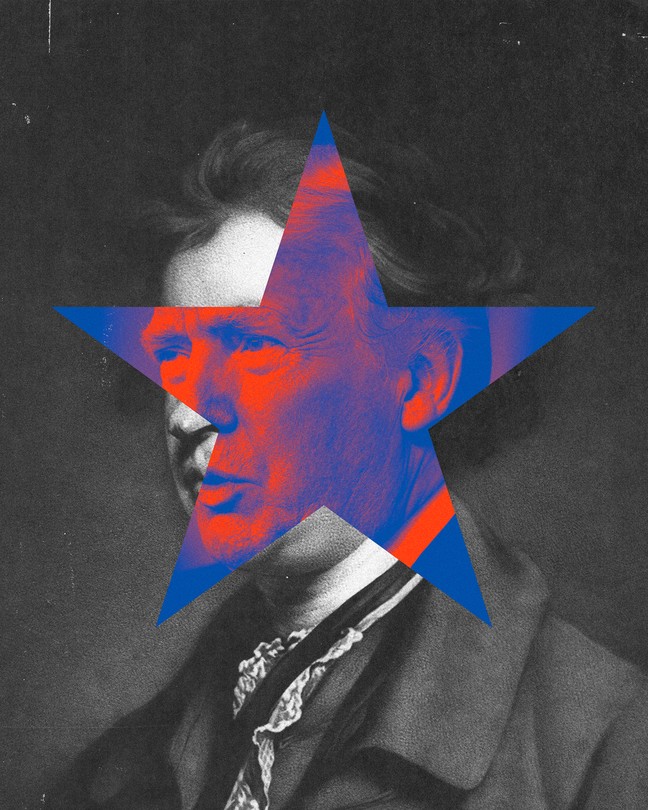
Illustration by Michael Houtz. Sources: Stefani Reynolds / CNP / Bloomberg / Getty; Sepia Times / Universal Images Group / Getty
DECEMBER 8, 2021
I fell in love with conservatism in my 20s. As a politics and crime reporter in Chicago, I often found myself around public-housing projects like Cabrini-Green and the Robert Taylor Homes, which had been built with the best of intentions but had become nightmares. The urban planners who designed those projects thought they could improve lives by replacing ramshackle old neighborhoods with a series of neatly ordered high-rises.
But, as the sociologist Richard Sennett, who lived in part of the Cabrini-Green complex as a child, noted, the planners never really consulted the residents themselves. They disrespected the residents by turning them into unseen, passive spectators of their own lives. By the time I encountered the projects they were national symbols of urban decay.
Back then I thought of myself as a socialist. But seeing the fallout from this situation prompted a shocking realization: This is exactly what that guy I read in college had predicted. Human society is unalterably complex, Edmund Burke argued. If you try to reengineer it based on the simplistic schema of your own reason, you will unintentionally cause significant harm. Though Burke was writing as a conservative statesman in Britain some 200 years earlier, the wisdom of his insight was apparent in what I was seeing in the Chicago of the 1980s.
I started reading any writer on conservatism whose book I could get my hands on—Willmoore Kendall, Peter Viereck, Shirley Robin Letwin. I can only describe what happened next as a love affair. I was enchanted by their way of looking at the world. In conservatism I found not a mere alternative policy agenda, but a deeper and more resonant account of human nature, a more comprehensive understanding of wisdom, an inspiring description of the highest ethical life and the nurturing community.
What passes for “conservatism” now, however, is nearly the opposite of the Burkean conservatism I encountered then. Today, what passes for the worldview of “the right” is a set of resentful animosities, a partisan attachment to Donald Trump or Tucker Carlson, a sort of mental brutalism. The rich philosophical perspective that dazzled me then has been reduced to Fox News and voter suppression.
I recently went back and reread the yellowing conservatism books that I have lugged around with me over the decades. I wondered whether I’d be embarrassed or ashamed of them, knowing what conservatism has devolved into. I have to tell you that I wasn’t embarrassed; I was enthralled all over again, and I came away thinking that conservatism is truer and more profound than ever—and that to be a conservative today, you have to oppose much of what the Republican Party has come to stand for.
This essay is a reclamation project. It is an attempt to remember how modern conservatism started, what core wisdom it contains, and why that wisdom is still needed today.
Our political categories emerged following the wars of religion of the 16th, 17th, and early 18th centuries. It was a time of bitterness, polarization, and culture war—like today, but a thousand times worse. The Reformation had divided Europe into hostile Catholic and Protestant camps. The wars were a series of massacres and counter-massacres, vicious retributions, and even more vicious counter-retributions. Blaise de Monluc, a French commander, was a characteristic figure. In 1562, as Sarah Bakewell recounts in her book How to Live, he was sent to pacify the city of Bordeaux after a Protestant mob had attacked the town hall during a riot. Monluc’s method was mass murder. He hanged Protestants in the street without trial. His suppression was so bloodthirsty that his troops ran out of gallows and had to hang people from trees. So many Protestants were killed and thrown into a well that their bodies entirely filled the deep shaft. In 1571, Monluc was shot in the face, and he spent the rest of his life behind a mask—a disfigured man from a disfigured age.
Eventually many Europeans became exhausted and appalled. The urgent task was this: how to construct a society that wouldn’t devolve into bitter polarization and tribal bloodbaths. One camp, which we associate with the French Enlightenment, put its faith in reason. Some thought a decent social order can be built when primitive passions like religious zeal are marginalized and tamed; when individuals are educated to use their highest faculty, reason, to pursue their enlightened self-interest; and when government organizes society using the tools of science.
Another camp, which we associate with the Scottish or British Enlightenment of David Hume and Adam Smith, did not believe that human reason is powerful enough to control human selfishness; most of the time our reason merely rationalizes our selfishness. They did not believe that individual reason is powerful enough even to comprehend the world around us, let alone enable leaders to engineer society from the top down. “We are afraid to put men to live and trade each on his own private stock of reason, because we suspect that this stock in each man is small,” Burke wrote in Reflections on the Revolution in France.
This is one of the core conservative principles: epistemological modesty, or humility in the face of what we don’t know about a complex world, and a conviction that social change should be steady but cautious and incremental. Down the centuries, conservatives have always stood against the arrogance of those who believe they have the ability to plan history: the French revolutionaries who thought they could destroy a society and rebuild it from scratch, but who ended up with the guillotine; the Russian and Chinese Communists who tried to create a centrally controlled society, but who ended up with the gulag and the Cultural Revolution; the Western government planners who thought they could fine-tune an economy from the top, but who ended up with stagflation and sclerosis; the European elites who thought they could unify their continent by administrative fiat and arrogate power to unelected technocrats in Brussels, but who ended up with a monetary crisis and populist backlash.
If conservatives don’t think reason is strong enough to order a civilization, what human faculty do they trust enough to do the job? Here we have to resort to a classic 18th-century concept—the “sentiments.” An early book of Burke’s was on aesthetics. When you look at a painting, you don’t have to rationally calculate its beauty or its power, the sadness or the joy it inspires. Sentiments are automatic aesthetic and emotional judgments about things. They assign value. They tell you what is beautiful and what is ugly, what to want and what is worth wanting, where to go and what to aim for.
Rationalists put a lot of faith in “I think therefore I am”—the autonomous individual deconstructing problems step by logical step. Conservatives put a lot of faith in the latent wisdom that is passed down by generations, cultures, families, and institutions, and that shows up as a set of quick and ready intuitions about what to do in any situation. Brits don’t have to think about what to do at a crowded bus stop. They form a queue, guided by the cultural practices they have inherited.
The most important sentiments are moral sentiments. Conservatism certainly has an acute awareness of sin—selfishness, greed, lust. But conservatives also believe that in the right circumstances, people are motivated by the positive moral emotions—especially sympathy and benevolence, but also admiration, patriotism, charity, and loyalty. These moral sentiments move you to be outraged by cruelty, to care for your neighbor, to feel proper affection for your imperfect country. They motivate you to do the right thing.
Your emotions can be trusted, the conservative believes, when they are cultivated rightly. “Reason is, and ought only to be the slave of the passions,” David Hume wrote in his Treatise of Human Nature. “The feelings on which people act are often superior to the arguments they employ,” the late neoconservative scholar James Q. Wilson wrote in The Moral Sense.
The key phrase, of course, is cultivated rightly. A person who lived in a state of nature would be an unrecognizable creature, scarcely fit for life in society, locked up within and slave to his own unruly desires. The only way to govern such an unformed creature would be through a prison state. If a person has not been trained by a community to tame his passions from within, then the state would have to continuously control him from without.True conservatism’s great virtue is that it teaches us to be humble about what we know; it gets human nature right.
Fortunately, people do not generally bring themselves up alone. The state of nature as imagined by John Locke or Jean-Jacques Rousseau has never existed. People are raised within families and communities, traditions and nations—within the civilizing webs of a coherent social order. Over time, humans have evolved arrangements, traditions, and customs that not only help them address practical problems, but also help them form their children into decent human beings. The methods and mores that have stood the test of time have usually endured for good reason. “The world is often wiser than any philosopher,” the journalist Walter Bagehot wrote in the mid-19th century.
Some of the wisdom passed down through the ages is transmitted through books and sermons. But most of the learning happens by habituation. We are formed within families, churches, communities, schools, and professional societies. Each institution has its own stories, standards of excellence, ways of doing things. When you join the Marines, you don’t just learn to shoot a rifle; you absorb an entire ethos that will both help you complete the tasks you will confront and mold you into a certain sort of person: fierce against foes, loyal to friends, faithful to the Corps.
If someone asked you how to treat a woman whose husband has just died, your instinctive response would probably not be “Induce her to host an open house for the next week.” But the Jewish shiva customs are a brilliant set of practices to help people collectively deal with grief, in part by giving everybody something basic and purposeful to do. The shiva rituals nurture a certain way of caring for one another, instantiate a certain sort of family life. They help turn individuals into a people. Institutions instill habits, habits become virtues, virtues become character.
Burkean conservatism inspired me because its social vision was not just about laws, budgets, and technocratic plans; its vision was about soulcraft, about how we build institutions that produce good citizens—people who are moderate in their zeal, sympathetic to the marginalized, reliable in their diligence, and willing to sacrifice the private interest for public good. Conservatism resonated with me because it recognized that culture is more important than the state in driving history. “Manners are of more importance than laws,” Burke wrote.
Upon them, in a great measure, the laws depend. The law touches us but here and there, and now and then. Manners are what vex or soothe, corrupt or purify, exalt or debase, barbarize or refine us, by a constant, steady, uniform, insensible operation, like that of the air we breathe in. They give their whole form and color to our lives. According to their quality, they aid morals, they supply them, or they totally destroy them.
Conservatives thus spend a lot of time defending the “little platoon[s],” as Burke called them, the communities and settled villages that are the factories of moral and emotional formation. If, as Burke believed, reason alone cannot find the one true answer to any social problem, each community must improvise its own set of solutions to intricate human concerns. The conservative seeks to defend this wonderful heterogeneity from the forces of bigness and the centralizing arrogance of rationalism—to protect these little platoons when government tries to perform roles best done in families, when the federal government takes power from local government, when big corporations suck the vitality out of local economies.
True conservatism’s great virtue is that it teaches us to be humble about what we think we know; it gets human nature right, and understands that we are primarily a collection of unconscious processes, deep emotions, and clashing desires. Conservatism’s profound insight is that it’s impossible to build a healthy society strictly on the principle of self-interest. It’s an illusion, as T. S. Eliot put it, to think that a society in which people don’t have to be good can thrive. Life is essentially a moral enterprise, and the health of your community will depend on how well it does moral formation—how well it nurtures ordered inner lives and helps balance sentiments, desires, and motivations. Finally, conservatism welcomes you into a great procession down the ages. Society “is a partnership in all science,” Burke wrote,
a partnership in all art; a partnership in every virtue, and in all perfection. As the ends of such a partnership cannot be obtained in many generations, it becomes a partnership not only between those who are living, but between those who are living, those who are dead, and those who are to be born.
By the early 1990s, I was living in Brussels, covering Europe, Africa, and the Middle East for The Wall Street Journal and continuing my conservative self-education. I became fascinated by a British statesman named Enoch Powell. If you were to design the perfect conservative, Powell would seem to be it—a classics scholar, veteran, poet, and man of faith, and the product of the finest Tory training grounds the U.K. had to offer. And yet in 1968, Powell had given his notorious “Rivers of Blood” speech, which was blatant in its racism and shocking in its anti-immigrant message. How, I wondered, had conservatism, which was developed in response to sectarian war, produced a statesman who was trying to start one?
I realized that every worldview has the vices of its virtues. Conservatives are supposed to be epistemologically modest—but in real life, this modesty can turn into a brutish anti-intellectualism, a contempt for learning and expertise. Conservatives are supposed to prize local community—but this orientation can turn into narrow parochialism, can produce xenophobic and racist animosity toward immigrants, a tribal hostility toward outsiders, and a paranoid response when confronted with even a hint of diversity and pluralism. Conservatives are supposed to cherish moral formation—but this emphasis can turn into a rigid and self-righteous moralism, a tendency to see all social change as evidence of moral decline and social menace. Finally, conservatives are supposed to revere the past—but this reverence for what was can turn into an abject deference to whoever holds power. When I looked at conservatives in continental Europe, I generally didn’t like what I saw. And when I looked at people like Powell, I was appalled.
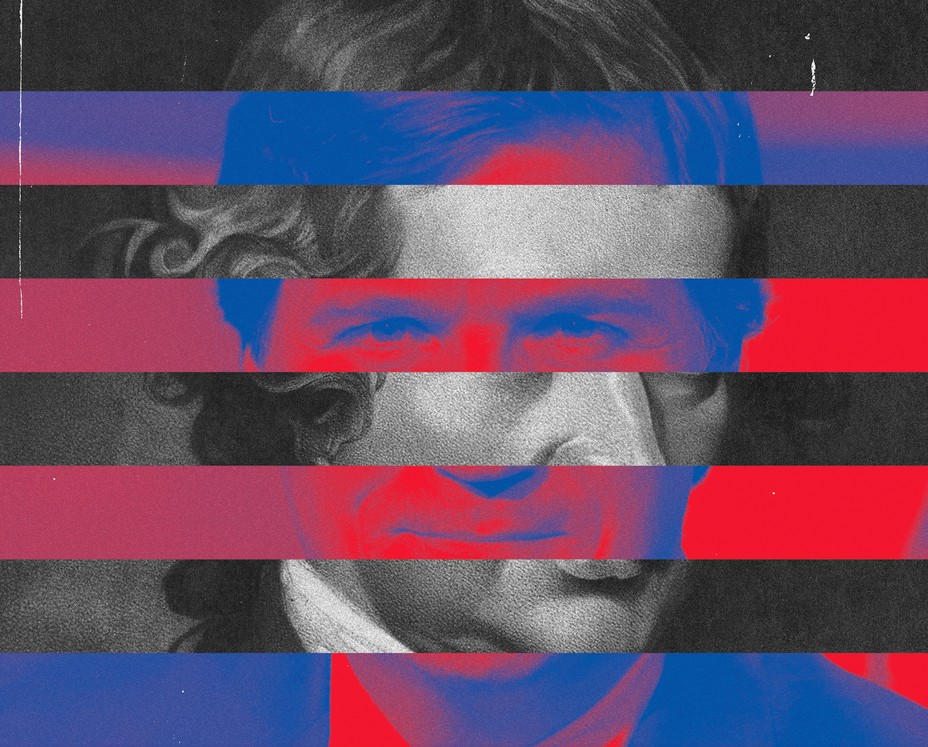
Illustration by Michael Houtz. Sources: Richard Drew / AP; Sepia Times / Universal Images Group / Getty
Fortunately, I didn’t have to live within the confines of blood-and-soil European conservatism; I had the American kind. Because conservatism is so rooted in the local manners and mores of each community, there is no such thing as international conservatism. Each society has its own customs and moral practices, and so each society has its own brand of conservatism.
American conservatism descends from Burkean conservatism, but is hopped up on steroids and adrenaline. Three features set our conservatism apart from the British and continental kinds. First, the American Revolution. Because that war was fought partly on behalf of abstract liberal ideals and universal principles, the tradition that American conservatism seeks to preserve is liberal. Second, while Burkean conservatism puts a lot of emphasis on stable communities, America, as a nation of immigrants and pioneers, has always emphasized freedom, social mobility, the Horatio Alger myth—the idea that it is possible to transform your condition through hard work. Finally, American conservatives have been more unabashedly devoted to capitalism—and to entrepreneurialism and to business generally—than conservatives almost anywhere else. Perpetual dynamism and creative destruction are big parts of the American tradition that conservatism defends.
If you look at the American conservative tradition—which I would say begins with the capitalist part of Hamilton and the localist part of Jefferson; extends through the Whig Party and Abraham Lincoln to Theodore Roosevelt; continues with Eisenhower, Goldwater, and Reagan; and ends with Mitt Romney’s 2012 presidential campaign—you don’t see people trying to revert to some past glory. Rather, they are attracted to innovation and novelty, smitten with the excitement of new technologies—from Hamilton’s pro-growth industrial policy to Lincoln’s railroad legislation to Reagan’s “Star Wars” defense system.
American conservatism has always been in tension with itself. In its prime—the half century from 1964 to 2012—it was divided among libertarians, religious conservatives, small-town agrarians, urban neoconservatives, foreign-policy hawks, and so on. And for a time, this fractiousness seemed to work.
American conservatives were united, during this era, by their opposition to communism and socialism, to state planning and amoral technocracy. In those days I assumed that this vibrant, forward-looking conservatism was the future, and that the Enoch Powells of the world were the receding roar of a sick reaction. I was wrong. And I confess that I’ve come to wonder if the tension between “America” and “conservatism” is just too great. Maybe it’s impossible to hold together a movement that is both backward-looking and forward-looking, both in love with stability and addicted to change, both go-go materialist and morally rooted. Maybe the postwar American conservatism we all knew—a collection of intellectuals, activists, politicians, journalists, and others aligned with the Republican Party—was just a parenthesis in history, a parenthesis that is now closing.
Donald trump is the near-opposite of the Burkean conservatism I’ve described here. How did a movement built on sympathy and wisdom lead to a man who possesses neither? How did a movement that put such importance on the moral formation of the individual end up elevating an unashamed moral degenerate? How did a movement built on an image of society as a complex organism give rise to the simplistic dichotomies of manipulative populism? How did a movement based on respect for the wisdom of the past end up with Trump’s authoritarian campaign boast “I alone can fix it,” perhaps the least conservative sentence it is possible to utter?
The reasons conservatism devolved into Trumpism are many. First, race. Conservatism makes sense only when it is trying to preserve social conditions that are basically healthy. America’s racial arrangements are fundamentally unjust. To be conservative on racial matters is a moral crime. American conservatives never wrapped their mind around this. My beloved mentor, William F. Buckley Jr., made an ass of himself in his 1965 Cambridge debate against James Baldwin. By the time I worked at National Review, 20 years later, explicit racism was not evident in the office, but racial issues were generally overlooked and the GOP’s flirtation with racist dog whistles was casually tolerated. When you ignore a cancer, it tends to metastasize.
Second, economics. Conservatism is essentially an explanation of how communities produce wisdom and virtue. During the late 20th century, both the left and the right valorized the liberated individual over the enmeshed community. On the right, that meant less Edmund Burke, more Milton Friedman. The right’s focus shifted from wisdom and ethics to self-interest and economic growth. As George F. Will noted in 1984, an imbalance emerged between the “political order’s meticulous concern for material well-being and its fastidious withdrawal from concern for the inner lives and moral character of citizens.” The purpose of the right became maximum individual freedom, and especially economic freedom, without much of a view of what that freedom was for, nor much concern for what held societies together.American conservatism began with the capitalist part of Hamilton and the localist part of Jefferson and ended with Mitt Romney in 2012.
But perhaps the biggest reason for conservatism’s decay into Trumpism was spiritual. The British and American strains of conservatism were built on a foundation of national confidence. If Britain was a tiny island nation that once bestrode the world, “nothing in all history had ever succeeded like America, and every American knew it,” as the historian Henry Steele Commager put it in 1950. For centuries, American and British conservatives were grateful to have inherited such glorious legacies, knew that there were sacred things to be preserved in each national tradition, and understood that social change had to unfold within the existing guardrails of what already was.
By 2016, that confidence was in tatters. Communities were falling apart, families were breaking up, America was fragmenting. Whole regions had been left behind, and many elite institutions had shifted sharply left and driven conservatives from their ranks. Social media had instigated a brutal war of all against all, social trust was cratering, and the leadership class was growing more isolated, imperious, and condescending. “Morning in America” had given way to “American carnage” and a sense of perpetual threat.
I wish I could say that what Trump represents has nothing to do with conservatism, rightly understood. But as we saw with Enoch Powell, a pessimistic shadow conservatism has always lurked in the darkness, haunting the more optimistic, confident one. The message this shadow conservatism conveys is the one that Trump successfully embraced in 2016: Evil outsiders are coming to get us. But in at least one way, Trumpism is truly anti-conservative. Both Burkean conservatism and Lockean liberalism were trying to find ways to gentle the human condition, to help society settle differences without resort to authoritarianism and violence. Trumpism is pre-Enlightenment. Trumpian authoritarianism doesn’t renounce holy war; it embraces holy war, assumes it is permanent, in fact seeks to make it so. In the Trumpian world, disputes are settled by raw power and intimidation. The Trumpian epistemology is to be anti-epistemology, to call into question the whole idea of truth, to utter whatever lie will help you get attention and power. Trumpism looks at the tender sentiments of sympathy as weakness. Might makes right.
On the right, especially among the young, the populist and nationalist forces are rising. All of life is seen as an incessant class struggle between oligarchic elites and the common volk. History is a culture-war death match. Today’s mass-market, pre-Enlightenment authoritarianism is not grateful for the inherited order but sees menace pervading it: You’ve been cheated. The system is rigged against you. Good people are dupes. Conspiracists are trying to screw you. Expertise is bogus. Doom is just around the corner. I alone can save us.
What’s a Burkean conservative to do? A lot of my friends are trying to reclaim the GOP and make it a conservative party once again. I cheer them on. America needs two responsible parties. But I am skeptical that the GOP is going to be home to the kind of conservatism I admire anytime soon.
Trumpian Republicanism plunders, degrades, and erodes institutions for the sake of personal aggrandizement. The Trumpian cause is held together by hatred of the Other. Because Trumpians live in a state of perpetual war, they need to continually invent existential foes—critical race theory, nongendered bathrooms, out-of-control immigration. They need to treat half the country, metropolitan America, as a moral cancer, and view the cultural and demographic changes of the past 50 years as an alien invasion. Yet pluralism is one of America’s oldest traditions; to conserve America, you have to love pluralism. As long as the warrior ethos dominates the GOP, brutality will be admired over benevolence, propaganda over discourse, confrontation over conservatism, dehumanization over dignity. A movement that has more affection for Viktor Orbán’s Hungary than for New York’s Central Park is neither conservative nor American. This is barren ground for anyone trying to plant Burkean seedlings.
I’m content, as my hero Isaiah Berlin put it, to plant myself instead on the rightward edge of the leftward tendency—in the more promising soil of the moderate wing of the Democratic Party. If its progressive wing sometimes seems to have learned nothing from the failures of government and to promote cultural stances that divide Americans, at least the party as a whole knows what year it is. In 1980, the core problem of the age was statism, in the form of communism abroad and sclerotic, dynamism-sapping bureaucracies at home. In 2021, the core threat is social decay. The danger we should be most concerned with lies in family and community breakdown, which leaves teenagers adrift and depressed, adults addicted and isolated. It lies in poisonous levels of social distrust, in deepening economic and persisting racial disparities that undermine the very goodness of America—in political tribalism that makes government impossible.
There is nothing intrinsically anti-government in Burkean conservatism. “It is perhaps marvelous that people who preach disdain for government can consider themselves the intellectual descendants of Burke, the author of a celebration of the state,” George F. Will once wrote. To reduce the economic chasm that separates class from class, to ease the financial anxiety that renders life unstable for many people, to support parenting so that children can grow up with more stability—these are the goals of a party committed to ameliorating, not exploiting, a growing sense of hopelessness and alienation, of vanishing opportunity. Daniel Patrick Moynihan’s brilliant dictum—which builds on a Burkean wisdom forged in a world of animosity and corrosive flux—has never been more worth heeding than it is now: The central conservative truth is that culture matters most; the central liberal truth is that politics can change culture.
This article appears in the January/February 2022 print edition with the headline “I Remember Conservatism.” When you buy a book using a link on this page, we receive a commission. Thank you for supporting The Atlantic.David Brooks is a contributing writer at The Atlantic and a columnist for The New York Times. He is the author of The Road to Character and The Second Mountain: The Quest for a Moral Life.
Kate PriceKate Price Disclaimer: I do not own this! Es ist ein Ros entsprungen, most commonly translated to English as Lo, How a Rose E’er Blooming, is a Christmas carol of German origin. The text is thought to be penned by an anonymous author, and the piece first appeared in print in the late-16th century. The hymn has been used by both Catholics and Protestants, with the focus of the song being Mary or Jesus, respectively.[citation needed] In addition, there have been numerous versions of the hymn, with varying texts and lengths. The tune most familiar today appears in the Speyer Hymnal (printed in Cologne in 1599), and the familiar harmonization was written by German composer Michael Praetorius in 1609. The tune was used by Johannes Brahms as the basis for a chorale fantasy for organ, later transcribed for orchestra by Erich Leinsdorf, and by Hugo Distler as the basis for his 1933 oratorio Weihnachtsgeschichte (“Christmas story”). The English translation “Lo, How a Rose E’er Blooming” was written by Theodore Baker in 1894. A translation of the first two verses of the hymn as “A Spotless Rose” was written by Catherine Winkworth and this was set as a SATB anthem by Herbert Howells in 1919. Another Christmas hymn “A Great and Mighty Wonder” is set to the same tune as this carol and may sometimes be confused with it; it is, however, a hymn by St. Germanus, 734 (Μέγα χαί παράδοξον θαυμα), translated from Greek to English by John M. Neale, 1862. German original Es ist ein’ Ros’ entsprungen, aus einer Wurzel zart. Wie uns die Alten sungen, von Jesse war die Art. Und hat ein Blüm’lein ‘bracht; mitten im kalten Winter, wohl zu der halben Nacht. Das Röslein, das ich meine, davon Jesaia sagt: hat uns gebracht alleine Marie die reine Magd. Aus Gottes ew’gem Rat, Hat sie ein Kind geboren, Und blieb ein reine Magd. or: Welches uns selig macht. Das Blümelein, so kleine, das duftet uns so süß; mit seinem hellen Scheine vertreibt’s die Finsternis. Wahr’r Mensch und wahrer Gott! Hilft uns aus allem Leide, rettet von Sünd’ und Tod. Literal Translation A rose has sprung up, from a tender root. As the old ones sang to us, Its lineage was from Jesse. And it has brought forth a floweret In the middle of the cold winter Right upon midnight. The rosebud that I mean, Of which Isaiah told Is Mary, the pure, Who brought us the floweret. At Gods immortal word, She has borne a child Remaining a pure maid. or: Who makes us blessed. The floweret, so small That smells so sweet to us With its clear light Dispels the darkness. True man and true God! He helps us from all trouble, Saves us from sin and death. English Lyrics Lo, how a rose e’er blooming, From tender stem hath sprung. Of Jesse’s lineage coming, As men of old have sung; It came, a flow’ret bright, Amid the cold of winter, When halfspent was the night. Isaiah ’twas foretold it, The Rose I have in mind, With Mary we behold it, The virgin mother kind; To show God’s love aright, She bore to men a Savior, When halfspent was the night. O Flower, whose fragrance tender With sweetness fills the air, Dispel with glorious splendour The darkness everywhere; True man, yet very God, From Sin and death now save us, And share our every load. Winkworth’s English Version A Spotless Rose is growing, Sprung from a tender root, Of ancient seers’ foreshowing, Of Jesse promised fruit; Its fairest bud unfolds to light Amid the cold, cold winter, And in the dark midnight. The Rose which I am singing, Whereof Isaiah said, Is from its sweet root springing In Mary, purest Maid; Through God’s great love and might The Blessed Babe she bare us In a cold, cold winter’s night.
The Lovers is numbered six and is a card of innocence, trust, exhileration and joy. The couple (often seen intertwined or standing side by side) are soulmates, each being one half of a perfect union. The figure flying above them is Cupid, blessing them with the might of Universal Love.
The Lovers are the embodiment of the harmony of opposites. This is how we are before the fear and prejudices of life intervene. We give our love freely to others and we need no other to make us whole.
Love is much misunderstood. It is subjective and the word ‘love’ is so overused that it has almost lost its original meaning. We are all capable of the immense power of deep feelings. Love happens when we step out of the darkness of fear, pain and doubt into the light. Love can move mountains. Love breeds love – a happy smile breaking through another’s melancholy proves this.
Loving ourselves is the first step to touching the mighty power of Universal Love. We must live each moment as though it were the only one – rejoicing and celebrating, loving the soul within us rather than fighting with the reflection the rest of the world sees.
Great Art Explained Please consider supporting this channel on Patreon, thanks! https://www.patreon.com/user?u=53686503 I would like to thank all my Patreon supporters, in particular Alexander Velser, Bria Nicole Art, David Abreu, Christa Sawyer Eric Mann, Louise Tait, Pawel Juszczyk. Great art explained. James Payne discusses ‘The Kiss’. I started “Great Art Explained” during lockdown. My aim is to make videos which focus on one great artwork. I want to present art in a jargon free, entertaining, clear and concise way with no gimmicks. Subscribe and click the bell icon to get more arts content. Each video takes me about three weeks to a month, so I download at least once a month: https://www.youtube.com/channel/UCePD… By the end of the 19th century, Vienna, an uptight, stuffy and conservative city, was changing. A group of artists, architects, musicians and social scientists, were experimenting in ways that would transform their individual fields. On the one hand, Vienna was the traditional city of academic art, Johann Strauss, and the Hapsburg empire, but on the other, it was the home of radical artists such as Gustav Klimt and Egon Schiele who were shocking audiences with explorations of sexual themes. Architects Otto Wagner and Adolf Loos were challenging imperial design, while Gustav Mahler was transforming the musical life of the city. And Sigmund Freud was about to change forever the way we think about the human mind. Vienna was experiencing a new golden age. It was a city at the forefront of modernity, and it would shape the 20th century. CREDITS All the videos, songs, images, and graphics used in the video belong to their respective owners and I or this channel does not claim any right over them. Copyright Disclaimer under section 107 of the Copyright Act of 1976, allowance is made for “fair use” for purposes such as criticism, comment, news reporting, teaching, scholarship, education and research. Fair use is a use permitted by copyright statute that might otherwise be infringing. Title Sequence by the brilliant Brian Adsit (instagram https://instagram.com/brian_vfx?utm_m… and Behance www.behance.com/badsit88) The Kiss by Gustav Klimt – The artist died in 1918, so this work is in the public domain in its country of origin and other countries and areas where the copyright term is the author’s life plus 100 years or fewer. Chinese subtitles by Charles Xue Dutch Subtitles by Ana Glyph FOOTAGE St. Vitale – https://www.youtube.com/watch?v=RWBWo… BOOKS, CATALOGUES AND ESSAYS KLIMT BY GILLES NERET Gustav Klimt Complete Paintings by MR Tobias Gustav Klimt and the Vienna Secessionists by Michael Kerrigan El beso (los enamorados) de Gustav Klimt. Un ensayo de iconografía, Editorial Lulu.com, 2008 Klimt Schiele Drawings (RA catalogue) – Various Gustav Klimt, Modernism in the making (National Gallery of Canada Catalogue) – Various
Consciousness, spirituality, biography, sexuality, androgyny, futurism, space, the arts, science, astrology, democracy, humor, books, movies and more


 If war has an opposite, gardens might sometimes be it, and people have found a particular kind of peace in forests, meadows, parks, and gardens.