
AllanWo Stephen Sondheim teaches students from the Guildhall School
Monthly Archives: December 2021
Yuval Noah Harari | 21 Lessons for the 21st Century | Talks at Google
Talks at Google Yuval Noah Harari, macro-historian, Professor, best-selling author of “Sapiens” and “Homo Deus,” and one of the world’s most innovative and exciting thinkers, discusses his newest work, “21 Lessons for the 21st Century.” Described as a “truly mind-expanding” journey through today’s most pressing issues, “21 Lessons for the 21st Century” reminds us to maintain our collective focus in the midst of dizzying and disorienting change. Moderated by Wilson White. Get the book: https://goo.gl/CVDJzG Visit Yuval Noah Harari’s YouTube channel: https://www.youtube.com/user/YuvalNoa…
Parmenides
From Wikipedia, the free encyclopedia
| Parmenides | |
|---|---|
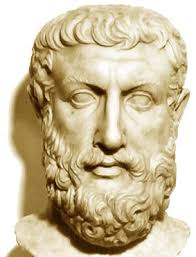
| Bust of Parmenides discovered at Velia, thought to have been partially modeled on a Metrodorus bust.[1] | |
| Born | c. 515 BC[2] Elea, Magna Graecia |
| Era | Pre-Socratic philosophy |
| Region | Western philosophy |
| School | Eleatic school |
| Notable students | Socrates |
| Main interests | Metaphysics (ontology) |
| Notable ideas | “Thought and being are the same”[3] The truth–appearance distinction Nothing comes from nothing Being |
| showInfluences | |
| showInfluenced |
Parmenides of Elea (/pɑːrˈmɛnɪdiːz … ˈɛliə/; Greek: Παρμενίδης ὁ Ἐλεάτης; fl. late sixth or early fifth century BC) was a pre-Socratic Greek philosopher from Elea in Magna Graecia (meaning “Great Greece,” the term which Romans gave to Greek-populated coastal areas in Southern Italy). He is thought to have been in his prime (or “floruit“) around 475 BC.[a]
Parmenides has been considered the founder of ontology or metaphysics and has influenced the whole history of Western philosophy.[5][b] He was the founder of the Eleatic school of philosophy, which also included Zeno of Elea and Melissus of Samos. Zeno’s paradoxes of motion were to defend Parmenides’ view.
The single known work by Parmenides is a poem whose original title is unknown but which is often referred to as On Nature. Only fragments of it survive, but its importance lies in the fact that it contains the first sustained argument in the history of Western philosophy. In his poem, Parmenides prescribes two views of reality. In “the way of truth” (a part of the poem), he explains how all reality is one, change is impossible, and existence is timeless, uniform, and necessary. In “the way of opinion”, Parmenides explains the world of appearances, in which one’s sensory faculties lead to conceptions which are false and deceitful, yet he does offer a cosmology.
Parmenides’ philosophy has been explained with the slogan “whatever is is, and what is not cannot be”. He is also credited with the phrase out of nothing nothing comes. He argues that “A is not” can never be thought or said truthfully, and thus despite appearances everything exists as one, giant, unchanging thing. This is generally considered one of the first digressions into the philosophical concept of being, and has been contrasted with Heraclitus‘s statement that “No man ever steps into the same river twice” as one of the first digressions into the philosophical concept of becoming. Scholars have generally believed that either Parmenides was responding to Heraclitus, or Heraclitus to Parmenides.
Parmenides’ views have remained relevant in philosophy, even thousands of years after his death. Alexius Meinong, much like Parmenides, defended the view that even the “golden mountain” is real since it can be talked about. The rivalry between Heraclitus and Parmenides has also been re-introduced in debates in the philosophy of time between A theory and B theory.
Biography
Parmenides was born in the Greek colony of Elea (now Ascea), which, according to Herodotus,[7] had been founded shortly before 535 BC. He was descended from a wealthy and illustrious family.[8] It was said that he had written the laws of the city.[9]
His dates are uncertain; according to doxographer Diogenes Laërtius, he flourished just before 500 BC,[10] which would put his year of birth near 540 BC, but in the dialogue Parmenides Plato has him visiting Athens at the age of 65, when Socrates was a young man, c. 450 BC,[11] which, if true, suggests a year of birth of c. 515 BC.
Parmenides was the founder of the School of Elea, which also included Zeno of Elea and Melissus of Samos. His most important pupil was Zeno, who according to Plato was 25 years his junior, and was regarded as his eromenos.[c]
Influences
He was said to have been a pupil of Xenophanes,[13] and regardless of whether they actually knew each other, Xenophanes’ philosophy is the most obvious influence on Parmenides.[14] Eusebius quoting Aristocles of Messene says that Parmenides was part of a line of philosophy that culminated in Pyrrhonism. This line begins with Xenophanes and goes through Parmenides, Melissus of Samos, Zeno of Elea, Leucippus, Democritus, Protagoras, Nessas of Chios, Metrodorus of Chios, Diogenes of Smyrna, Anaxarchus, and finally Pyrrho.[15]
Though there are no obvious Pythagorean elements in his thought, Diogenes Laërtius describes Parmenides as a disciple of “Ameinias, son of Diochaites, the Pythagorean”. According to Sir William Smith, in Dictionary of Greek and Roman Biography and Mythology (1870): “Others content themselves with reckoning Parmenides as well as Zeno as belonging to the Pythagorean school, or with speaking of a Parmenidean life, in the same way as a Pythagorean life is spoken of.”[16]
The first purported hero cult of a philosopher we know of was Parmenides’ dedication of a heroon to his Ameinias in Elea.[17]
On Nature
Parmenides is one of the most significant of the pre-Socratic philosophers. His single known work, a poem conventionally titled On Nature, has survived only in fragments. Approximately 160 verses remain today from an original total that was probably near 800.[5] The poem was originally divided into three parts:
- A proem (Greek: προοίμιον), which introduced the entire work,
- A section known as “The Way of Truth” (aletheia, ἀλήθεια), and
- A section known as “The Way of Appearance/Opinion” (doxa, δόξα).
The proem is a narrative sequence in which the narrator travels “beyond the beaten paths of mortal men” to receive a revelation from an unnamed goddess (generally thought to be Persephone or Dikē) on the nature of reality. Aletheia, an estimated 90% of which has survived, and doxa, most of which no longer exists, are then presented as the spoken revelation of the goddess without any accompanying narrative.
Parmenides attempted to distinguish between the unity of nature and its variety, insisting in the Way of Truth upon the reality of its unity, which is therefore the object of knowledge, and upon the unreality of its variety, which is therefore the object, not of knowledge, but of opinion. In the Way of Opinion he propounded a theory of the world of seeming and its development, pointing out, however, that, in accordance with the principles already laid down, these cosmological speculations do not pretend to anything more than mere appearance.
Proem
In the proem, Parmenides describes the journey of the poet, escorted by maidens (“the daughters of the Sun made haste to escort me, having left the halls of Night for the light”),[18] from the ordinary daytime world to a strange destination, outside our human paths.[19] Carried in a whirling chariot, and attended by the daughters of Helios the Sun, the man reaches a temple sacred to an unnamed goddess (variously identified by the commentators as Nature, Wisdom, Necessity or Themis), by whom the rest of the poem is spoken. The goddess resides in a well-known mythological space: where Night and Day have their meeting place. Its essential character is that here all opposites are undivided, or one.[20] He must learn all things, she tells him – both truth, which is certain, and human opinions, which are uncertain – for though one cannot rely on human opinions, they represent an aspect of the whole truth.
Welcome, youth, who come attended by immortal charioteers and mares which bear you on your journey to our dwelling. For it is no evil fate that has set you to travel on this road, far from the beaten paths of men, but right and justice. It is meet that you learn all things — both the unshakable heart of well-rounded truth and the opinions of mortals in which there is not true belief. (B 1.24–30)
The Way of Truth
The section known as “the way of truth” discusses that which is real and contrasts with the argument in the section called “the way of opinion,” which discusses that which is illusory. Under the “way of truth,” Parmenides stated that there are two ways of inquiry: that it is, on the one side, and that it is not on the other side.[21] He said that the latter argument is never feasible because there is no thing that can not be: “For never shall this prevail, that things that are not, are.”[22]
Thinking and the thought that it is are the same; for you will not find thinking apart from what is, in relation to which it is uttered. (B 8.34–36)
For to be aware and to be are the same. (B 3)
It is necessary to speak and to think what is; for being is, but nothing is not. (B 6.1–2)
Helplessness guides the wandering thought in their breasts; they are carried along deaf and blind alike, dazed, beasts without judgment, convinced that to be and not to be are the same and not the same, and that the road of all things is a backward-turning one. (B 6.5–9)
Only one thing exists, which is timeless, uniform, and unchanging:
How could what is perish? How could it have come to be? For if it came into being, it is not; nor is it if ever it is going to be. Thus coming into being is extinguished, and destruction unknown. (B 8.20–22)
Nor was [it] once, nor will [it] be, since [it] is, now, all together, / One, continuous; for what coming-to-be of it will you seek? / In what way, whence, did [it] grow? Neither from what-is-not shall I allow / You to say or think; for it is not to be said or thought / That [it] is not. And what need could have impelled it to grow / Later or sooner, if it began from nothing? Thus [it] must either be completely or not at all. (B 8.5–11)
[What exists] is now, all at once, one and continuous… Nor is it divisible, since it is all alike; nor is there any more or less of it in one place which might prevent it from holding together, but all is full of what is. (B 8.5–6, 8.22–24)
And it is all one to me / Where I am to begin; for I shall return there again. (B 5)
Perception vs. Logos
Parmenides claimed that there is no truth in the opinions of the mortals. Genesis-and-destruction, as Parmenides emphasizes, is a false opinion, because to be means to be completely, once and for all. What exists can in no way not exist.
For this view, that That Which Is Not exists, can never predominate. You must debar your thought from this way of search, nor let ordinary experience in its variety force you along this way, (namely, that of allowing) the eye, sightless as it is, and the ear, full of sound, and the tongue, to rule; but (you must) judge by means of the Reason (Logos) the much-contested proof which is expounded by me. (B 7.1–8.2)
The Way of Opinion
After the exposition of the arche (ἀρχή), i.e. the origin, the necessary part of reality that is understood through reason or logos (that [it] Is), in the next section, the Way of Appearance/Opinion/Seeming, Parmenides gives a cosmology. He proceeds to explain the structure of the becoming cosmos (which is an illusion, of course) that comes from this origin.
The structure of the cosmos is a fundamental binary principle that governs the manifestations of all the particulars: “the aether fire of flame” (B 8.56), which is gentle, mild, soft, thin and clear, and self-identical, and the other is “ignorant night”, body thick and heavy.
The mortals lay down and decided well to name two forms (i.e. the flaming light and obscure darkness of night), out of which it is necessary not to make one, and in this they are led astray. (B 8.53–4)
The structure of the cosmos then generated is recollected by Aetius (II, 7, 1):
For Parmenides says that there are circular bands wound round one upon the other, one made of the rare, the other of the dense; and others between these mixed of light and darkness. What surrounds them all is solid like a wall. Beneath it is a fiery band, and what is in the very middle of them all is solid, around which again is a fiery band. The most central of the mixed bands is for them all the origin and cause of motion and becoming, which he also calls steering goddess and keyholder and Justice and Necessity. The air has been separated off from the earth, vapourized by its more violent condensation, and the sun and the circle of the Milky Way are exhalations of fire. The moon is a mixture of both earth and fire. The aether lies around above all else, and beneath it is ranged that fiery part which we call heaven, beneath which are the regions around the earth.[23]
Cosmology originally comprised the greater part of his poem, him explaining the world’s origins and operations. Some idea of the sphericity of the Earth seems to have been known to Parmenides.[24]
Parmenides also outlined the phases of the moon, highlighted in a rhymed translation by Karl Popper:[25]
Bright in the night with the gift of his light,
Round the earth she is erring,
Evermore letting her gaze
Turn towards Helios’ rays
Smith stated:[16]
Of the cosmogony of Parmenides, which was carried out very much in detail, we possess only a few fragments and notices, which are difficult to understand, according to which, with an approach to the doctrines of the Pythagoreans, he conceived the spherical mundane system, surrounded by a circle of the pure light (Olympus, Uranus); in the centre of this mundane system the solid earth, and between the two the circle of the milkyway, of the morning or evening star, of the sun, the planets, and the moon; which circle he regarded as a mixture of the two primordial elements.
The fragments read:[5]
You will know the aether’s nature, and in the aether all the/ signs, and the unseen works of the pure torch/ of the brilliant sun, and from whence they came to be,/ and you will learn the wandering works of the round-eyed moon/ and its nature, and you will know too the surrounding heaven,/ both whence it grew and how Necessity directing it bound it/ to furnish the limits of the stars. (Fr. 10) …how the earth and sun and moon/ and the shared aether and the heavenly milk and Olympos/ outermost and the hot might of the stars began/ to come to be. (Fr. 11)
The Sect of Pythagoras
From Wikipedia, the free encyclopedia
Pythagoreanism originated in the 6th century BC, based on the teachings and beliefs held by Pythagoras and his followers, the Pythagoreans. Pythagoras established the first Pythagorean community in Crotone, Italy. Early Pythagorean communities spread throughout Magna Graecia.
Pythagoras’ death and disputes about his teachings led to the development of two philosophical traditions within Pythagoreanism. The akousmatikoi were superseded in the 4th century BC as a significant mendicant school of philosophy by the Cynics. The mathēmatikoi philosophers were absorbed into the Platonic school in the 4th century BC.
Following political instability in Magna Graecia, some Pythagorean philosophers fled to mainland Greece while others regrouped in Rhegium. By about 400 BC the majority of Pythagorean philosophers had left Italy. Pythagorean ideas exercised a marked influence on Plato and through him, on all of Western philosophy. Many of the surviving sources on Pythagoras originate with Aristotle and the philosophers of the Peripatetic school.
As a philosophic tradition, Pythagoreanism was revived in the 1st century BC, giving rise to Neopythagoreanism. The worship of Pythagoras continued in Italy and as a religious community Pythagoreans appear to have survived as part of, or deeply influenced, the Bacchic cults and Orphism.
History
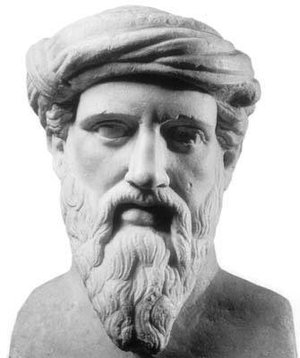
The Plimpton 322 tablet records Pythagorean triples from Babylonian times.[1]Animation demonstrating the simplest Pythagorean triple, 32 + 42 = 52.Bust of Pythagoras, Musei Capitolini, Rome.
Pythagoras was already well known in ancient times for the mathematical achievement of the Pythagorean theorem.[2] Pythagoras had been credited with discovering that in a right-angled triangle the square of the hypotenuse is equal to the sum of the squares of the other two sides. In ancient times Pythagoras was also noted for his discovery that music had mathematical foundations. Antique sources that credit Pythagoras as the philosopher who first discovered music intervals also credit him as the inventor of the monochord, a straight rod on which a string and a movable bridge could be used to demonstrate the relationship of musical intervals.[3]
Much of the surviving sources on Pythagoras originated with Aristotle and the philosophers of the Peripatetic school, which founded historiographical academic traditions such as biography, doxography and the history of science. The surviving 5th century BC sources on Pythagoras and early Pythagoreanism are void of supernatural elements, while surviving 4th century BC sources on Pythagoreas’ teachings introduced legend and fable. Philosophers who discussed Pythagoreanism, such as Anaximander, Andron of Ephesus, Heraclides and Neanthes had access to historical written sources as well as the oral tradition about Pythagoreanism, which by the 4th century BC was in decline. Neopythagorean philosophers, who authored many of the surviving sources on Pythagoreanism, continued the tradition of legend and fantasy.[4]
The earliest surviving ancient source on Pythagoras and his followers is a satire by Xenophanes, on the Pythagorean beliefs on the transmigration of souls.[5] Xenophanes wrote of Pythagoras that:
Once they say that he was passing by when a puppy was being whipped,
And he took pity and said:
“Stop! Do not beat it! For it is the soul of a friend
That I recognized when I heard it giving tongue.”[5]
In a surviving fragment from Heraclitus, Pythagoras and his followers are described as follows:
Pythagoras, the son of Mnesarchus, practised inquiry beyond all other men and selecting of these writings made for himself a wisdom or made a wisdom of his own: a polymathy, an imposture.[6]
Two other surviving fragments of ancient sources on Pythagoras are by Ion of Chios and Empedocles. Both were born in the 490s, after Pythagoras’ death. By that time he was known as a sage and his fame had spread throughout Greece.[7] According to Ion, Pythagoras was:
… distinguished for his manly virtue and modesty, even in death has a life which is pleasing to his soul, if Pythagoras the wise truly achieved knowledge and understanding beyond that of all men.[7]
Empedocles described Pythagoras as “a man of surpassing knowledge, master especially of all kinds of wise works, who had acquired the upmost wealth of understanding.”[8] In the 4th century BC the Sophist Alcidamas wrote that Pythagoras was widely honored by Italians.[9]
Today scholars typically distinguish two periods of Pythagoreanism: early-Pythagoreanism, from the 6th till the 5th century BC, and late-Pythagoreanism, from the 4th till the 3rd century BC.[10] The Spartan colony of Taranto in Italy became the home for many practitioners of Pythagoreanism and later for Neopythagorean philosophers. Pythagoras had also lived in Crotone and Metaponto, both were Achaean colonies.[11] Early-Pythagorean sects lived in Croton and throughout Magna Graecia. They espoused to a rigorous life of the intellect and strict rules on diet, clothing and behavior. Their burial rites were tied to their belief in the immortality of the soul.[10]
Early-Pythagorean sects were closed societies and new Pythagoreans were chosen based on merit and discipline. Ancient sources record that early-Pythagoreans underwent a five year initiation period of listening to the teachings (akousmata) in silence. Initiates could through a test become members of the inner circle. However, Pythagoreans could also leave the community if they wished.[12] Iamblichus listed 235 Pythagoreans by name, among them 17 women whom he described as the “most famous” women practitioners of Pythagoreanism. It was customary that family members became Pythagoreans, as Pythagoreanism developed into a philosophic traditions that entailed rules for everyday life and Pythagoreans were bound by secrets. The home of Pythagoras was known as the site of mysteries.[13]
Pythagoras had been born on the island of Samos at around 570 BC and left his homeland at around 530 BC in opposition to the policies of Polycrates. Before settling in Croton, Pythagoras had traveled throughout Egypt and Babylonia. In Croton, Pythagoras established the first Pythagorean community, described as a secret society, and attained political influence. In the early 5th century BC Croton acquired great military and economic importance. Pythagoras emphasized moderation, piety, respect for elders and of the state, and advocated a monogamous family structure. The Croton Council appointed him to official positions. Among others Pythagoras was in charge of education in the city. His influence as political reformer reputably extended to other Greek colonies in southern Italy and in Sicily. Pythagoras died shortly after an arson attack on the Pythagorean meeting place in Croton.[14]
The anti-Pythagorean attacks in c. 508 BC were headed by Cylon of Croton.[14][15] Pythagoras escaped to Metapontium. After these initial attacks and the death of Pythagoras, Pythagorean communities in Croton and elsewhere continued to flourish. At around 450 BC attacks on Pythagorean communities were carried out across Magna Graecia. In Croton, a house where Pythagoreans gathered was set on fire and all but two of the Pythagorean philosophers burned alive. Pythagorean meeting places in other cities were also attacked and philosophic leaders killed. These attacks occurred in the context of widespread violence and destruction in Magna Graecia. Following the political instability in the region, some Pythagorean philosophers fled to mainland Greece while others regrouped in Rhegium. By about 400 BC the majority of Pythagorean philosophers had left Italy. Archytas remained in Italy and ancient sources record that he was visited there by young Plato in the early 4th century BC. The Pythagorean schools and societies died out from the 4th century BC. Pythagorean philosophers continued to practice, albeit no organized communities were established.[14]
According to surviving sources by the Neopythagorean philosopher Nicomachus, Philolaus was the successor of Pythagoras.[16] According to Cicero (de Orat. III 34.139), Philolaus was teacher of Archytas.[17] According to the Neoplatonist philosopher Iamblichus, Archytas in turn became the head of the Pythagorean school about a century after the Pythagoras’ death.[18] Philolaus, Eurytus and Xenophilus are identified by Aristoxenus as the teachers of the last generation of Pythagoreans.[17]
Philosophic traditions
Following Pythagoras’ death, disputes about his teachings led to the development of two philosophical traditions within Pythagoreanism in Italy: akousmatikoi and mathēmatikoi. The mathēmatikoi recognized the akousmatikoi as fellow Pythagoreans, but because the mathēmatikoi allegedly followed the teachings of Hippasus, the akousmatikoi philosophers did not recognise them. Despite this, both groups were regarded by their contemporaries as practitioners of Pythagoreanism.[19]
The akousmatikoi were superseded in the 4th century BC as significant mendicant school of philosophy by the Cynics. Mathēmatikoi philosophers were in the 4th century BC absorbed into the Platonic school of Speusippus, Xenocrates and Polemon. As a philosophic tradition, Pythagoreanism was revived in the 1st century BC, giving rise to Neopythagoreanism.[20] The worship of Pythagoras continued in Italy in the two intervening centuries. As a religious community Pythagoreans appear to have survived as part of, or deeply influenced, the Bacchic cults and Orphism.[21]
The akousmatikoi
Pythagoreans celebrate sunrise, 1869 painting by Fyodor Bronnikov.
The akousmatikoi believed that humans had to act in appropriate ways. The Akousmata (translated as “oral saying”) was the collection of all the sayings of Pythagoras as divine dogma. The tradition of the akousmatikoi resisted any reinterpretation or philosophical evolution of Pythagoras’ teachings. Individuals who strictly followed most akousmata were regarded as wise. The akousmatikoi philosophers refused to recognize that the continuous development of mathematical and scientific research conducted by the mathēmatikoi was in line with Pythagoras’s intention. Until the demise of Pythagoreanism in the 4th century BC, the akousmatikoi continued to engage in a pious life by practicing silence, dressing simply and avoiding meat, for the purpose of attaining a privileged afterlife. The akousmatikoi engaged deeply in questions of Pythagoras’ moral teachings, concerning matters such as harmony, justice,[22] ritual purity and moral behavior.[23]
The mathēmatikoi
The mathēmatikoi acknowledged the religious underpinning of Pythagoreanism and engaged in mathēma (translated as “learning” or “studying”) as part of their practice. While their scientific pursuits were largely mathematical, they also promoted other fields of scientific study in which Pythagoras had engaged during his lifetime. A sectarianism developed between the dogmatic akousmatikoi and the mathēmatikoi, who in their intellectual activism became regarded as increasingly progressive. This tension persisted until the 4th century BC, when the philosopher Archytas engaged in advanced mathematics as part of his devotion to Pythagoras’ teachings.[22]
Today, Pythagoras is mostly remembered for his mathematical ideas, and by association with the work early Pythagoreans did in advancing mathematical concepts and theories on harmonic musical intervals, the definition of numbers, proportion and mathematical methods such as arithmetic and geometry. The mathēmatikoi philosophers claimed that numbers were at the heart of everything and constructed a new view of the cosmos. In the mathēmatikoi tradition of Pythagoreanism the Earth was removed from the center of the universe. The mathēmatikoi believed that the Earth, along with other celestial bodies, orbited around a central fire. This, they believed, constituted a celestial harmony.[24]
Rituals
Pythagoreanism was a philosophic tradition as well as a religious practice. As a religious community they relied on oral teachings and worshiped the Pythian Apollo, the oracular god of Delphic Oracle. Pythagoreans preached an austere life.[25] They believed that the soul was buried in the body, which acted as a tomb for the soul in this life.[26] The highest reward a human could attain was for the soul to join in the life of the gods and thus escaped the cycle of reincarnation in another human body.[27] Like the practitioners of Orphism, a religious tradition that developed in parallel to Pythagorean religious practice, Pythagoreanism believed that the soul was buried in the body as a punishment for a committed offense and that the soul could be purified.[28] Aside from conducting their daily lives according to strict rules Pythagorean also engaged in rituals to attain purity.[29] The 4th century Greek historian and sceptic philosopher Hecataeus of Abdera asserted that Pythagoras had been inspired by ancient Egyptian philosophy in his use of ritual regulations and his belief in reincarnation.[2]
Philosophy
Early Pythagoreanism was based on research and the accumulation of knowledge from the books written by other philosophers.[6] Pythagoras’ philosophic teachings made direct reference to the philosophy of Anaximander, Anaximenes of Miletus and Pherecydes of Syros.[6] Of the Pythagorean philosophers, Hippasus, Alcmaeon, Hippon, Archytas and Theodorus, written sources have survived.[30]
Arithmetic and numbers
The first six triangular numbers
Pythagoras in his teachings cultivated mathematics and numbers, engaging in a combination of philosophic theorizing and deductive provable methodology. Numbers were in the Greek world of Pythagoras’ days natural numbers – that is positive integers. But unlike their Greek contemporaries, the Pythagorean philosophers represented numbers graphically, not symbolically through letters. Pythagoreans used dots, also known as psiphi (pebbles), to represent numbers in triangles, squares, rectangles and pentagons. This enabled a visual comprehension of mathematics and allowed for a geometrical exploration of numerical relationships. Pythagorean philosophers investigated the relationship of numbers exhaustively. They defined perfect numbers as those that were equal to the sum of all their divisors. For example: 28 = 1 + 2 + 4 + 7 + 14.[31] The theory of odd and even numbers was central to Pythagorean arithmetic. This distinction was for the Pythagorean philosophers direct and visual, as they arranged triangular dots so that the even and odd numbers successively alternate: 2, 4, 6, … 3, 5, 7, …[32]
Early-Pythagorean philosophers such as Philolaus and Archytas held the conviction that mathematics could help in addressing important philosophical problems.[33] In Pythagoreanism numbers became related to intangible concepts. The one was related to the intellect and being, the two to thought, the number four was related to justice because 2 * 2 = 4 and equally even. A dominant symbolism was awarded to the number three, Pythagoreans believed that the whole world and all things in it are summed up in this number, because end, middle and beginning give the number of the whole. The triad had for Pythagoreans an ethical dimension, as the goodness of each person was believed to be threefold: prudence, drive and good fortune.[34]
Geometry
The Pythagoreans engaged with geometry as a liberal philosophy which served to establish principles and allowed theorems to be explored abstractly and mentally. Pythagorean philosophers believed that there was a close relationship between numbers and geometrical forms. Early-Pythagorean philosophers proved simple geometrical theorems, including “the sum of the angles of a triangle equals two right angles”. Pythagoreans also came up with three of the five regular polyhedra: the tetrahedron, the cube and the dodecahedron. The sides of a regular dodecahedron are regular pentagons, which for Pythagoreans symbolized health. They also revered the pentagram, as each diagonal divides the two others at the golden ratio.[32] When linear geometrical figures replaced the dots, the combination of Babylonian algebra and Pythagorean arithmetic provided the basis for Greek geometric algebra. By attempting to establish a system of concrete and permanent rules, Pythagoreans helped to establish strict axiomatic procedures of solving mathematical problems.[35]
Music
Medieval woodcut by Franchino Gaffurio, depicting Pythagoras and Philolaus conducting musical investigations.
Pythagoras pioneered the mathematical and experimental study of music. He objectively measured physical quantities, such as the length of a string, and discovered quantitative mathematical relationships of music through arithmetic ratios. Pythagoras attempted to explain subjective psychological and aesthetic feelings, such as the enjoyment of musical harmony. Pythagoras and his students experimented systematically with strings of varying length and tension, with wind instruments, with brass discs of the same diameter but different thickness, and with identical vases filled with different levels of water. Early Pythagoreans established quantitative ratios between the length of a string or pipe and the pitch of notes and the frequency of string vibration.[35]
Pythagoras is credited with discovering that the most harmonious musical intervals are created by the simple numerical ratio of the first four natural numbers which derive respectively from the relations of string length: the octave (1/2), the fifth (2/3) and the fourth (3/4).[35] The sum of those numbers 1 + 2 + 3 + 4 = 10 was for Pythagoreans the perfect number, because it contained in itself “the whole essential nature of numbers”. Werner Heisenberg has called this formulation of musical arithmetic as “among the most powerful advances of human science” because it enables the measurement of sound in space.[36]
Pythagorean tuning is a system of musical tuning in which the frequency ratios of all intervals are based on the ratio 3:2.[37] This ratio, also known as the “pure” perfect fifth, is chosen because it is one of the most consonant and easiest to tune by ear and because of importance attributed to the integer 3. As Novalis put it, “The musical proportions seem to me to be particularly correct natural proportions.”[38]
The fact that mathematics could explain the human sentimental world had a profound impact on the Pythagorean philosophy. Pythagoreanism became the quest for establishing the fundamental essences of reality. Pythagorean philosophers advanced the unshakable belief that the essence of all thing are numbers and that the universe was sustained by harmony.[36] According to ancient sources music was central to the lives of those practicing Pythagoreanism. They used medicines for the purification (katharsis) of the body and, according to Aristoxenus, music for the purification of the soul. Pythagoreans used different types of music to arouse or calm their souls.[39]
Harmony
For Pythagoreans, harmony signified the “unification of a multifarious composition and the agreement of unlike spirits”. In Pythagoreanism, numeric harmony was applied in mathematical, medical, psychological, aesthetic, metaphysical and cosmological problems. For Pythagorean philosophers, the basic property of numbers was expressed in the harmonious interplay of opposite pairs. Harmony assured the balance of opposite forces.[40] Pythagoras had in his teachings named numbers and the symmetries of them as the first principle, and called these numeric symmetries harmony.[41] This numeric harmony could be discovered in rules throughout nature. Numbers governed the properties and conditions of all beings and were regarded the causes of being in everything else. Pythagorean philosophers believed that numbers were the elements of all beings and the universe as a whole was composed of harmony and numbers.[34]
Cosmology
According to a collection of ancient philosophical texts by Stobaeus in the 5th century AD, Philolaus believed there was a “Counter-Earth” (Antichthon) orbiting a “central fire” but not visible from Earth.[42]Main article: Pythagorean astronomical system
The philosopher Philolaus, one of the most prominent figures in Pythagoreanism,[43] was the precursor of Copernicus in moving the earth from the center of the cosmos and making it a planet.[43] According to Aristotle’s student Eudemus of Cyprus, the first philosopher to determine quantitatively the size of the known planets and the distance between them was Anaximander, a teacher to Pythagoras, in the 6th century BC. Historic sources credit the Pythagorean philosophers with being the first to attempt a clarification of the planet sequence.[44] The early-Pythagorean philosopher Philolaus believed that limited and unlimited things were the components of the cosmos and these had existed ever since. The center of the universe, according to Philolaus, was the number one (hēn), which equated to the unity of Monism. Philolaus called the number one an “even-odd” because it was able to generate both even and odd numbers. When one was added to an odd number it produced an even number, and when added to an even number it produced an odd number. Philolaus further reasoned that the fitting together of the earth and the universe corresponded to the construction of the number one out of the even and the odd. Pythagorean philosophers believed that the even was unlimited and the odd was limited.[45]
Aristotle recorded in the 4th century BC on the Pythagorean astronomical system:It remains to speak of the earth, of its position, of the question whether it is at rest or in motion, and of its shape. As to its position, there is some difference of opinion. Most people–all, in fact, who regard the whole heaven as finite–say it lies at the center. But the Italian philosophers known as Pythagoreans take the contrary view. At the centre, they say, is fire, and the earth is one of the stars, creating night and day by its circular motion about the center. They further construct another earth in opposition to ours to which they give the name counterearth.[46]
It is not known whether Philolaus believed Earth to be round or flat,[47] but he did not believe the earth rotated, so that the Counter-Earth and the Central Fire were both not visible from Earth’s surface, or at least not from the hemisphere where Greece was located.[43] But the conclusion of Pythagorean philosophers that the universe is not geocentric was not based on empirical observation. Instead, as Aristotle noted, the Pythagorean view of the astronomical system was grounded in a fundamental reflection on the value of individual things and the hierarchical order of the universe.[44]
Pythagoreans believed in a musica universalis. They reasoned that stars must produce a sound because they were large swiftly moving bodies. Pythagoreans also determined that stars revolved at distances and speeds that were proportional to each other. They reasoned that because of this numerical proportion the revolution of the stars produced a harmonic sound.[44] The early-Pythagorean philosopher Philolaus argued that the structure of the cosmos was determined by the musical numerical proportions of the diatonic octave, which contained the fifth and fourth harmonic intervals.[45]
Justice
Pythagoreans equated justice with geometrical proportion, because proportion ensured that each part receives what it is due.[48] Early-Pythagoreans believed that after the death of the body, the soul would be punished or rewarded. Humans could accomplish, through their conduct, that their soul was admitted to another world. The reincarnation in this world equated to a punishment. In Pythagoreanism life in this world is social[49] and in the realm of society justice existed when each part of society received its due. The Pythagorean tradition of universal justice was later referenced by Plato. For Pythagorean philosophers the soul was the source of justice and through the harmony of the soul, divinity could be achieved. Injustice inverted the natural order. According to the 4th century BC philosopher Heraclides Ponticus, Pythagoras taught that “happiness consists in knowledge of the perfection of the numbers of the soul.[48] A surviving fragment from the 3rd century BC by the late-Pythagorean philosopher Aesara reasoned that:
I think human nature provides a common standard of law and justice for both the family and the city. Whoever follows the paths within and searches will discover; for within is law and justice, which is the proper arrangement of the soul.[50]
Body and soul
See also: Pythagoras § Metempsychosis
Pythagoreans believed that body and soul functioned together, and a healthy body required a healthy psyche.[51] Early Pythagoreans conceived of the soul as the seat of sensation and emotion. They regarded the soul as distinct from the intellect.[52] However, only fragments of the early Pythagorean texts have survived and it is not certain whether they believed the soul was immortal. The surviving texts of the Pythagorean philosopher Philolaus indicate that while early Pythagoreans did not believe that the soul contained all psychological faculties, the soul was life and a harmony of physical elements. As such the soul passed away when certain arrangements of these elements ceased to exist.[53] However, the teaching most securely identified with Pythagoras is metempsychosis, or the “transmigration of souls”, which holds that every soul is immortal and, upon death, enters into a new body.[54][55][56][57][58]
Vegetarianism
Pythagoras and faba beans, French, 1512/1514.[citation needed] Pythagoreans refused to eat beans. Already in antique times there was much speculation about the reason for this custom.[59]
Some Medieval authors refer to a “Pythagorean diet”, entailing the abstention from eating meat, beans or fish.[60] Pythagoreans believed that a vegetarian diet fostered a healthy body and enhanced the search for Arete. The purpose of vegetarianism in Pythagoreanism was not self-denial; instead, it was regarded as conductive to the best in a human being. Pythagoreans advanced a grounded theory on the treatment of animals. They believed that any being that experienced pain or suffering should not have pain inflicted on it unnecessarily. Because it was not necessary to inflict pain on animals for humans to enjoy a healthy diet, they believed that animals should not be killed for the purpose of eating them. The Pythagoreans advanced the argument that unless an animal posed a threat to a human, it was not justifiable to kill an animal and that doing so would diminish the moral status of a human. By failing to show justice to the animal, humans diminish themselves.[51]
Pythagoreans believed that human beings were animals, but with an advanced intellect and therefore humans had to purify themselves through training. Through purification humans could join the psychic force that pervaded the cosmos. Pythagoreans reasoned that the logic of this argument could not be avoided by killing an animal painlessly. The Pythagoreans also thought that animals were sentient and minimally rational.[61] The arguments advanced by Pythagoreans convinced numerous of their philosopher contemporaries to adopt a vegetarian diet.[51] The Pythagorean sense of kinship with non-humans positioned them as a counterculture in the dominant meat-eating culture.[61] The philosopher Empedocles is said to have refused the customary blood sacrifice by offering a substitute sacrifice after his victory in a horse race in Olympia.[44]
Late-Pythagorean philosophers were absorbed into the Platonic school of philosophy and in the 4th century AD the head of the Platonic Academy Polemon included vegetarianism in his concept of living according to nature.[62] In the 1st century AD Ovid identified Pythagoras as the first opponent to meat-eating.[61] But the fuller argument Pythagoreans advanced against the maltreatment of animals did not sustain. Pythagoreans had argued that certain types of food arouse the passions and hindered spiritual ascent. Thus Porphyry would rely on the teachings of the Pythagoreans when arguing that abstinence from eating meat for the purpose of spiritual purification should be practiced only by philosophers, whose aim was to reach a divine state.[63]
Female philosophers
The biographical tradition on Pythagoras holds that his mother, wife and daughters were part of his inner circle.[64] Women were given equal opportunity to study as Pythagoreans and learned practical domestic skills in addition to philosophy.[65]Illustration from 1913 showing Pythagoras teaching a class of women.
Many of the surviving texts of women Pythagorean philosophers are part of a collection, known as pseudoepigrapha Pythagorica, which was compiled by Neopythagoreans in the 1st or 2nd century. Some surviving fragments of this collection are by early-Pythagorean women philosophers, while the bulk of surviving writings are from late-Pythagorean women philosophers who wrote in the 4th and 3rd century BC.[10] Female Pythagoreans are some of the first female philosophers from which texts have survived.
Theano of Croton, the wife of Pythagoras, is considered a major figure in early-Pythagoreanism. She was noted as distinguished philosopher and in the lore that surrounds her, is said to have taken over the leadership of the school after his death. Text fragments have also survived from women philosophers of the late-Pythagorean period. These include Perictione I, Perictione II, Aesara of Lucania and Phintys of Sparta.[12]
Scholars believe that Perictione I was an Athenian and contemporary of Plato, because in On the Harmony of Woman she wrote in Ionic and used the same terms of virtues as Plato had done in his Republic: andreia, sophrosyne, dikaiosyne and sophia.[12] In On the Harmony of Woman Perictione I outlines the condition that enable women to nurture wisdom and self-control. These virtues will, according to Perictione I, bring “worthwhile things” for a woman, her husband, her children, the household and even the city “if, at any rate, such a woman should govern cities and tribes”. Her assertion that a wife should remain devoted to her husband, regardless of his behavior, has been interpreted by scholars as a pragmatic response to the legal rights of women in Athens.[66] The woman Pythagorean philosopher Phyntis was Spartan and is believed to have been the daughter of a Spartan admiral killed in the battle of Arginusae in 406 BC.[12] Phyntis authored the treatise Moderation of Women, in which she assigned the virtue of moderation to women, but asserted that “courage and justice and wisdom are common to both” men and women. Phyntis defended the right of women to philosophize.[66]
Influence on Plato and Aristotle
Pythagoras’ teachings and Pythagoreanism influenced Plato‘s writings on physical cosmology, psychology, ethics and political philosophy in the 5th century BC. However, Plato adhered to the dominant Greek philosophy, and the Platonic philosophy suppressed the combination of experimental method and mathematics which was an inherent part of Pythagoreanism.[67] The influence of Pythagoreanism extended throughout and beyond antiquity because the Pythagorean doctrine of reincarnation was recounted in Plato’s Gorgias, Phaedo, and Republic, while the Pythagorean cosmology was discussed in Plato’s Timaeus. The possible influence of Pythagoreanism on Plato’s concept of harmony and the Platonic solids has been discussed extensively. Plato’s dialogues have become an important surviving source of Pythagorean philosophic arguments.[68] Plato referenced Philolaus in Phaedo and wrote a Platonic adaptation of Philolaus’ metaphysical system of limiters and unlimiteds. Plato also quoted from one of the surviving Archytas fragments in the Republic. However, Plato’s views that the primary role of mathematics was to turn the soul towards the world of forms, as expressed in Timaeus, is regarded as Platonic philosophy, rather than Pythagorean.[33]
Aristotle in the 4th century BC rejected mathematics as a tool for investigation and understanding of the world. He believed that numbers constituted simply a quantitative determinant and had no ontological value.[67] Aristotle’s discussion of Pythagorean philosophy is difficult to interpret, because he had little patience for Pythagorean philosophic arguments, and Pythagoreanism does not fit with his philosophic doctrine.[69] In On the Heavens, Aristotle refuted the Pythagorean doctrine on the harmony of the spheres.[70] Nevertheless, he wrote a treatise on the Pythagoreans of which only fragments survive, in which he treats Pythagoras as a wonder-working religious teacher.[71]
Neopythagoreanism
Main article: Neopythagoreanism
The Neopythagoreans were a school and a religious community. The revival of Pythagoreanism has been attributed to Publius Nigidius Figulus, Eudorus of Alexandria and Arius Didymus. In the 1st century AD Moderatus of Gades and Nicomachus of Gerasa emerged as leading teachers of Neopythagoreanism.[72][73] The most significant Neopythagorean teacher was Apollonius of Tyana in the 1st century AD, who was regarded as a sage and lived as ascet. The last Neopythagorean philosopher was Numenius of Apamea in the 2nd century. Neopythagoreanism remained an elite movement which in the 3rd century merged into Neoplatonism.[72]
Neopythagoreans combined Pythagorean teachings with Platonic, Peripatetic, Aristotelian and Stoic philosophic traditions. Two tendencies within Neopythagorean philosophy emerged, one that owed much to Stoic monism and another that relied on Platonic dualism. Neopythagoreans refined the idea of God and located him beyond the finite so that God could not come into contact with anything corporeal. Neopythagoreans insisted on a spiritual worship of God and that life had to be purified through abstinence.[72]
Neopythagoreans manifested a strong interest in numerology and the superstitious aspects of Pythagoreanism. They combined this with the teachings of Plato’s philosophic successors. Neopythagorean philosophers engaged in the common ancient practice of ascribing their doctrines to the designated founder of their philosophy and by crediting their doctrines to Pythagoras himself, they hoped to gain authority for their views.[68]
Later influence
On early Christianity
Heavily annotated copy of De Sphaera of Sacrobosco.
Christianity in the 1st century was influenced by a Christianized form of Platonism, which had been set out in the four books of the Corpus Areopagiticum or Corpus Dionysiacum: The Celestrial Hierarchy, The Ecclesiastical Hierarchy, On Divine Names and The Mystical Theology. Having been attributed to Pseudo-Dionysius the Areopagite, the books explained the relationship among celestrial beings, humans, God and the universe. At the heart of the explanation were numbers. According to The Celestrial Hierarchy, the universe consisted of a threefold division: heaven, earth and hell. Sunlight lit up the universe and was proof of God’s presence.[74] In the Middle Ages this numerological division of the universe was credited to the Pythagoreans, while in the 1st century it was regarded as an authoritative source of Christian doctrine by Photius and John of Sacrobosco. The Corpus Areopagiticum or Corpus Dionysiacum was to be referenced in the late Middle Ages by Dante and in the Renaissance a new translation of it was produced by Marsilio Ficino.[75]
Early Christian theologians, such as Clement of Alexandria, adopted the ascetic doctrines of the neopythagoreans.[72] The moral and ethical teachings of Pythagorean influenced early Christianity and assimilated into early Christian texts. The Sextou gnomai (Sentences of Sextus), a Hellenistic Pythagorean text modified to reflect a Christian viewpoint, existed from at least the 2nd century and remained popular among Christians well into the Middle Ages. The Sentences of Sextus consisted of 451 sayings or principles, such as injunctions to love the truth, to avoid the pollution of the body with pleasure, to shun flatterers and to let one’s tongue be harnessed by one’s mind. The contents of the Sentences of Sextus was attributed by Iamblichus, the 1st century biographer of Pythagoras, to Sextus Pythagoricus. The assertion was repeated subsequently by Saint Jerome. In the 2nd century many of the Sentences of Sextus were cited by Plutarch as Pythagorean aphorisms. The Sentences of Sextus were translated into Syriac, Latin and Arabic, then the written language of both Muslims and Jews, but only in the Latin world did they become a guide to daily life that was widely circulated.[76]
On numerology
Pythagoras is credited with having devised the tetractys,[77] an important sacred symbol in later Pythagoreanism.[78][79]
In the 1st century treatises of Philo and Nicomachus popularised the mystical and cosmological symbolism Pythagoreans attributed to numbers. This interest in Pythagorean views on the importance of numbers was sustained by mathematicians such as Theon of Smyrna, Anatolius and Iamblichus. These mathematicians relied on Plato‘s Timaeus as source for Pythagorean philosophy.[80]
In the Middle Ages studies and adaptations of Timaeus solidified the view that there was a numerical explanation for proportion and harmony among learned men. Pythagoreanism, as mediated in Plato’s Timaeus, spurned increasingly detailed studies of symmetry and harmony. Intellectuals pondered how knowledge of the geometry in which God had arranged the universe could be applied to life. By the 12th century Pythagorean numerological concepts had become a universal language in Medieval Europe and were no longer recognized as Pythagorean.[80] Writers such as Thierry of Chartres, William of Conches and Alexander Neckham referenced classical writers that had discussed Pythagoreanism, including Cicero, Ovid and Pliny, leading them to believe that mathematics was the key to understanding astronomy and nature. Another important text on Pythagorean numerology was Boethius‘s De arithmetica, which was widely reproduced in the West. Boethius had relied on Nicomachus‘s writings as a source of Pythagoreanism.[81]
In the Byzantine world the influential professor of philosophy Michael Psellus in the 11th century popularised Pythagorean numerology in his treatise on theology, arguing that Plato was the inheritor of the Pythagorean secret. Psellus also attributed arithmetical inventions by Diophantus to Pythagoras. Psellus thought to reconstruct Iamblichus’ 10 book encyclopedia on Pythagoreanism from surviving fragments, leading to the popularisation of Iamblichus’ description of Pythagorean physics, ethics and theology at the Byzantine court. Psellus was reputably in the possession of the Hermetica, a set of texts thought to be genuinely antique and which would be prolifically reproduced in the late Middle Ages. Manuel Bryennios introduced Pythagorean numerology to Byzantine music with his treatise Harmonics. He argued that the octave was essential in attaining perfect harmony.[82]
In the Jewish communities the development of the Kabbalah as esoteric doctrine became associated with numerology. It was only in the 1st century that Philo of Alexandria, developed a Jewish Pythagoreanism. In the 3rd century Hermippus popularised the belief that Pythagoras had been the basis for establishing key dates in Judaism. In the 4th century this assertion was further developed by Aristobulus. The Jewish Pythagorean numerology developed by Philo held that God as the unique One was the creator of all numbers, of which seven was the most divine and ten the most perfect. The medieval edition of the Kabbalah focused largely on a cosmological scheme of creation, in reference to early Pythagorean philosophers Philolaus and Empedocles, and helped to disseminate Jewish Pythagorean numerology.[83]
Tractatus Logico-Philosophicus

From Wikipedia, the free encyclopedia
| Title page of first English-language edition, 1922 | |
| Author | Ludwig Wittgenstein |
|---|---|
| Original title | Logisch-Philosophische Abhandlung |
| Translator | Original English translation by Frank P. Ramsey and Charles Kay Ogden |
| Country | Austria |
| Language | German |
| Subject | Ideal language philosophy, logic and metaphysics |
| Publisher | First published in W. Ostwald’s Annalen der Naturphilosophie |
| Publication date | 1921 |
| Published in English | Kegan Paul, 1922 |
| Media type | |
| Pages | 75 |
| Text | Tractatus Logico-Philosophicus at Wikisource |
The Tractatus Logico-Philosophicus (widely abbreviated and cited as TLP) is a book-length philosophical work by the Austrian philosopher Ludwig Wittgenstein which deals with the relationship between language and reality and aims to define the limits of science.[1] Wittgenstein wrote the notes for the Tractatus while he was a soldier during World War I and completed it during a military leave in the summer of 1918. It was originally published in German in 1921 as Logisch-Philosophische Abhandlung (Logical-Philosophical Treatise). In 1922 it was published together with an English translation and a Latin title, which was suggested by G. E. Moore as homage to Baruch Spinoza‘s Tractatus Theologico-Politicus (1670).
The Tractatus is written in an austere and succinct literary style, containing almost no arguments as such, but consists of altogether 525 declarative statements, which are hierarchically numbered.
The Tractatus is recognized by philosophers as a significant philosophical work of the twentieth century and was influential chiefly amongst the logical positivist philosophers of the Vienna Circle, such as Rudolf Carnap and Friedrich Waismann and Bertrand Russell‘s article “The Philosophy of Logical Atomism”.
Wittgenstein’s later works, notably the posthumously published Philosophical Investigations, criticised many of his earlier ideas in the Tractatus.
Description and context
The Tractatus Logico-Philosophicus (widely abbreviated and cited as TLP) is the only book-length philosophical work by the Austrian philosopher Ludwig Wittgenstein which was published during his lifetime. The project had a broad goal: to identify the relationship between language and reality and to define the limits of science.[2] The work was originally published in German in 1921 as Logisch-Philosophische Abhandlung (Logical-Philosophical Treatise). In 1922 it was published together with an English translation; the English text and that book bear the Latin title, which was suggested by G. E. Moore as homage to Baruch Spinoza‘s Tractatus Theologico-Politicus (1670).[3]
Wittgenstein wrote the notes for the Tractatus while he was a soldier during World War I and completed it during a military leave in the summer of 1918.[4]
The Tractatus employs an austere and succinct literary style. The work contains almost no arguments as such, but rather consists of declarative statements, or passages, that are meant to be self-evident. The statements are hierarchically numbered, with seven basic propositions at the primary level (numbered 1–7), with each sub-level being a comment on or elaboration of the statement at the next higher level (e.g., 1, 1.1, 1.11, 1.12, 1.13). In all, the Tractatus comprises 525 numbered statements.
The Tractatus is recognized by philosophers as a significant philosophical work of the twentieth century and was influential chiefly amongst the logical positivist philosophers of the Vienna Circle, such as Rudolf Carnap and Friedrich Waismann. Bertrand Russell‘s article “The Philosophy of Logical Atomism” is presented as a working out of ideas that he had learned from Wittgenstein.[5]
Wittgenstein’s later works, notably the posthumously published Philosophical Investigations, criticised many of his earlier ideas in the Tractatus.[6]
Main theses
Illustration of the structure of the Tractatus. Only primary and secondary statements are reproduced, while the structure of the rest is indicated pictorially.
There are seven main propositions in the text. These are:
- The world is everything that is the case.
- What is the case (a fact) is the existence of states of affairs.
- A logical picture of facts is a thought.
- A thought is a proposition with a sense.
- A proposition is a truth-function of elementary propositions. (An elementary proposition is a truth-function of itself.)
- The general form of a proposition is the general form of a truth function, which is: {\displaystyle [{\bar {p}},{\bar {\xi }},N({\bar {\xi }})]}
. This is the general form of a proposition.
- Whereof one cannot speak, thereof one must be silent.
More at: https://en.wikipedia.org/wiki/Tractatus_Logico-Philosophicus
Henry Thomas audition for E.T. “OK kid, you got the job”.
UniversalPicsSweden E.T. The Extra-Terrestrial släpps på Blu-ray för första gången 31 oktober. I restaurerat skick med nytt bonusmaterial.
On happiness



.jpg)


Part 1 of John Cleese & Dr Iain McGilchrist on Creativity, Humour and the Meaning of Life
Dr Iain McGilchrist Part 1 of 2 of John Cleese and Dr Iain McGilchrist on Creativity, Humour and the Meaning of Life: Creativity and Meaningfulness For updates on Iain’s upcoming new platform go to https://channelmcgilchrist.com ‘Creativity: A Short and Cheerful Guide’ by John Cleese ▶︎https://www.amazon.co.uk/Creativity-S… ‘The Master and His Emissary’ by Dr Iain McGilchrist: ▶︎https://www.amazon.co.uk/Master-His-E…
Word-Built World: Zenosyne
How Leonardo da Vinci Changed the World
People Who Changed the World Leonardo da Vinci, the famous Italian artist and polymath who lived during the high renaissance changed the world in a huge way. He is best known for his painting the Mona Lisa, which is the most famous piece of art in the world. Many believe Leonardo da Vinci – Polymath to be one of the greatest artists and painters ever to live, and this is probably true. But Leonardo da Vinci was so much more than just one of the greatest artists. He was an architect, an astronomer, a botanist, a cartographer, an engineer, a geologist, a hydrodynamicist, a mathematician, a musician, a theatre producer, a scientist, an inventor and much, much more. Leonardo was a pioneer in so many different areas and he truly was a genius. Born in 1452, Leonardo da Vinci lived for 67 years, dying in 1519. Most people only think of him in the context of the Mona Lisa, but he gave the world so much more than just one of the world’s greatest paintings. His notebooks are stuffed full of so much amazing information, observations and inventions that we’re still learning from them today, over 500 years later. Leonardo daVinci was a polymath in its purest form and embodied everything great about the renaissance. He produced art that was easily comparable and often better than Michelangelo, Raphael, Donatello or Botticelli whilst also being a leading intellectual making discoveries in so many different areas. Leonardo da Vinci was perhaps one of the greatest, most talented people ever to live. Many people ask Did Leonardo da Vinci do this or Was Leonardo da Vinci that… well in this video I do my best to answer many of the most popular questions about Leonardo, whilst exploring his life and asking the question How Did Leonardo da Vinci Change the World? —————- Leonardo da Vinci (Polymath) Documentary about his life and impact on the world. Looking at his artwork (art), notebooks (notes), inventions, discoveries and ideas changed the world. People Who Changed the World uploads videos about people from history and present day that have somehow changed our world in a meaningful and impactful way. —————- Leonardo da Vinci by Walter Isaacson [Book] (2017) – https://www.simonandschuster.com/book…