The slow transition from internal combustion engines to electric cars won’t be the silver bullet America needs to escape the deadly grip of climate change unless cities reversing decades of car-first development, a new study says.
The respected Institute for Transportation and Development Policy says that only full electrification of cars — and more importantly, the expansion of public transit and the development of “compact cities” that encourage residents to get out from behind the wheel — will reduce travel-induced greenhouse gas emissions in urban areas by 80 percent over the next 30 years.
“When we design our cities, we’ve been putting moving cars ahead of moving people,” said Heather Thompson, CEO of the Institute, which released the study, “The Compact City Scenario — Electrified,” on Thursday. “It doesn’t have to be that way.”
The alternative gets people out of their cars by guaranteeing they live in walkable, bikable utopias where they can get to work, go shopping, or grab a bite to eat without having to travel more than 15 minutes from their home. The combination of EVs and that form of development would be enough to offset the damage we’ve already done and possibly alter humanity’s direction away from the dying hell towards which we are moving.
“We absolutely need to get fossil fuels out, but that will only take us so far,” Thompson said. “We need to develop cities in compact ways, to make sure people don’t need to get behind the wheel.”
In the United States, that means reshaping cities like Houston or Dallas to grow up instead of out, trading sprawl for dense, mixed-used centers that don’t require expensive cars to get around. And in rapidly growing areas in Asia, Africa and South America, it demands getting ahead of development there to ensure it doesn’t, for lack of a better term, go off the rails.
According to the study, urban passenger transport was responsible for 10 percent of all of humankind’s greenhouse gas emissions worldwide in 2015, and that number will only grow if nothing is done — setting us down a path for climate disaster. It predicted that electrification of cars alone will help, as would the development of compact cities alone, but only the two together would come close to hitting the emission goals set by the 2015 Paris Climate Accord.
“Strategically, electric vehicles and compact cities make a great pair,” Thompson said. “Compact cities could reduce our energy demand by 40 percent, making it easier to ramp up renewable electricity in time to meet our climate goals.”
Thompson pointed to Paris as an example of city that is trying to keep people moving using anything but 4,000-pound gas-guzzlers on four wheels. She cited Paris Mayor Anne Hidalgo’s re-election promise to make sure residents there can get essential services within a 15-minute walk or bike ride of their front doors as evidence that even a city already considered compact can do more.
“They are making improvements and investments to help them become a true 15-minute city,” she said.
And it isn’t as if cities have never been conceptualized with the idea of moving people ahead of cars in the past.
At the turn of the 20th century, before America was rebuilt to accommodate cars, transportation infrastructure in cities featured clean multi-passenger electric trains and trolleys — not single-passenger cars and trucks.
“Los Angeles is a classic example of a city where there was so much investment in rail, and they took it all away,” she said. “We need to go back to the development patters we originally started with.”
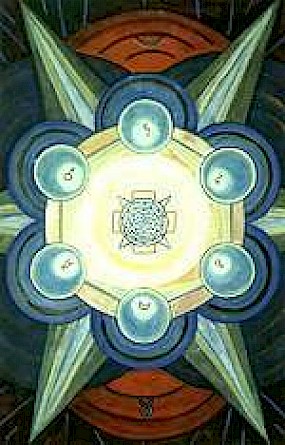
The Lord of Success is a card full of the promise of bounty. When we have achieved a degree of inner confidence and self-belief, we release new streams of energy which create a powerful and rewarding reality around ourselves. New ideas are easy to implement. New projects are fruitful. We are energised and enthusiastic about the work we have in hand.
This level of productive harmony comes from a deep-rooted trust in the self. Once we simply allow our power to flow, we find ourselves capable of high levels of success and fulfilment. These things flow naturally as a reward for the hard work we have invested in ourselves.
When the card comes up in a reading to indicate everyday matters, it promises that projects currently in hand will be lucrative and abundant. We will do exactly what we had hoped we might – and probably receive even more than we had hoped for. Financial and material matters will be positive and prosperous, allowing us to gain a stable and comfortable position.
There is often, during a period like this, such good fortune that we end up with more than we actually need. If this happens to you, make sure that you continue to allow money (which is after all only energy) to keep flowing. Use the abundance that comes to you, and be generous with your bounty. Ensure that others benefit appropriately from your abundance. That’s the best way that you can thank the Universe for flowing with you.
The Sistine Chapel (/ˌsɪsˈtiːn ˈtʃæpəl/; Latin: Sacellum Sixtinum; Italian: Cappella Sistina[kapˈpɛlla siˈstiːna]) is a chapel in the Apostolic Palace, in Vatican City and the official residence of the pope. Originally known as the Cappella Magna (‘Great Chapel’), the chapel takes its name from Pope Sixtus IV, who built it between 1473 and 1481. Since that time, the chapel has served as a place of both religious and functionary papal activity. Today, it is the site of the papal conclave, the process by which a new pope is selected. The fame of the Sistine Chapel lies mainly in the frescoes that decorate the interior, most particularly the Sistine Chapel ceiling and The Last Judgment, both by Michelangelo.
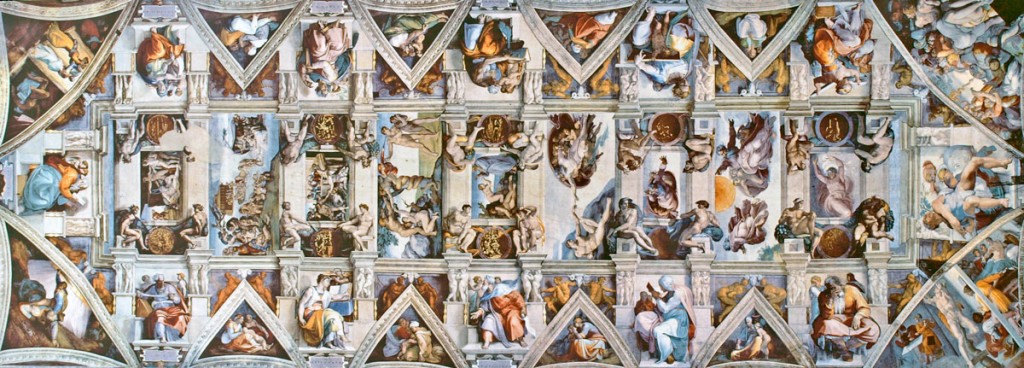
Between 1508 and 1512, under the patronage of Pope Julius II, Michelangelo painted the chapel’s ceiling, a project which changed the course of Western art and is regarded as one of the major artistic accomplishments of human civilization.[5][6] In a different political climate, after the Sack of Rome, he returned and, between 1535 and 1541, painted The Last Judgment for Popes Clement VII and Paul III.[7] The fame of Michelangelo’s paintings has drawn multitudes of visitors to the chapel ever since they were revealed five hundred years ago.
History
While known as the location of papal conclaves, the primary function of the Sistine Chapel is as the chapel of the Papal Chapel (Cappella Pontificia), one of the two bodies of the papal household, called until 1968 the Papal Court (Pontificalis Aula). At the time of Pope Sixtus IV in the late 15th century, the Papal Chapel comprised about 200 people, including clerics, officials of the Vatican and distinguished laity. There were 50 occasions during the year on which it was prescribed by the Papal Calendar that the whole Papal Chapel should meet.[8] Of these 50 occasions, 35 were masses, of which 8 were held in basilicas, in general St. Peter’s, and were attended by large congregations. These included the Christmas Day and Easter masses, at which the Pope himself was the celebrant. The other 27 masses could be held in a smaller, less public space, for which the Cappella Maggiore was used before it was rebuilt on the same site as the Sistine Chapel.
The Cappella Maggiore derived its name, the Greater Chapel, from the fact that there was another chapel also in use by the Pope and his retinue for daily worship. At the time of Pope Sixtus IV, this was the Chapel of Pope Nicholas V, which had been decorated by Fra Angelico. The Cappella Maggiore is recorded as existing in 1368. According to a communication from Andreas of Trebizond to Pope Sixtus IV, by the time of its demolition to make way for the present chapel, the Cappella Maggiore was in a ruinous state with its walls leaning.[9]The Sistine Chapel as it may have appeared in the 15th century (19th-century drawing)Sistine Chapel in 2017
The present chapel, on the site of the Cappella Maggiore, was designed by Baccio Pontelli for Pope Sixtus IV, for whom it is named, and built under the supervision of Giovannino de Dolci between 1473 and 1481.[1] The proportions of the present chapel appear to closely follow those of the original. After its completion, the chapel was decorated with frescoes by a number of the most famous artists of the High Renaissance, including Sandro Botticelli, Domenico Ghirlandaio, Pietro Perugino, and Michelangelo.[9]
The first mass in the Sistine Chapel was celebrated on 15 August 1483, the Feast of the Assumption, at which ceremony the chapel was consecrated and dedicated to the Virgin Mary.[10]
The Sistine Chapel has maintained its function to the present day and continues to host the important services of the Papal Calendar, unless the Pope is travelling. There is a permanent choir, the Sistine Chapel Choir, for whom much original music has been written, the most famous piece being Gregorio Allegri‘s Miserere.[11]
One of the functions of the Sistine Chapel is as a venue for the election of each successive pope in a conclave of the College of Cardinals. On the occasion of a conclave, a chimney is installed in the roof of the chapel, from which smoke arises as a signal. If white smoke, which is created by burning the ballots of the election, appears, a new Pope has been elected. If no candidate receives the required two-thirds vote, the cardinals send up black smoke—created by burning the ballots along with wet straw and chemical additives—it means that no successful election has yet occurred.[12]
The first papal conclave to be held on the Sistine Chapel was the conclave of 1492, which took place from 6 to 11 August of the same year and in which Pope Alexander VI, also known as Rodrigo Borja, was elected.
Canopies for each cardinal-elector were once used during conclaves—a sign of equal dignity. After the new Pope accepts his election, he would give his new name; at this time, the other Cardinals would tug on a rope attached to their seats to lower their canopies. Until reforms instituted by Saint Pius X, the canopies were of different colours to designate which Cardinals had been appointed by which Pope. Paul VI abolished the canopies altogether, since, under his papacy, the population of the College of Cardinals had increased so much to the point that they would need to be seated in rows of two against the walls, making the canopies obstruct the view of the cardinals in the back row. In the wake of a conclave taking place to preserve the integrity of the marble floor on the Sistine Chapel, carpenters install a slightly elevated wooden floor alongside a wooden ramp in the entrance for those Cardinals who for one reason or another need to be transported in a wheelchair.
Architecture
Structure
Exterior of the Sistine Chapel
The chapel is a high rectangular building, for which absolute measurements are hard to ascertain, as available measurements are for the interior: 40.9 metres (134 ft) long by 13.4 metres (44 ft) wide.
Its exterior is unadorned by architectural or decorative details, as is common in many Italian churches of the Medieval and Renaissance eras. It has no exterior façade or exterior processional doorways, as the ingress has always been from internal rooms within the Apostolic Palace (Papal Palace), and the exterior can be seen only from nearby windows and light-wells in the palace. Subsidence and cracking of masonry such as must also have affected the Cappella Maggiore has necessitated the building of very large buttresses to brace the exterior walls. The accretion of other buildings has further altered the exterior appearance of the chapel.
The building is divided into three stories of which the lowest is a very tall basement level with several utilitarian windows and a doorway giving onto the exterior court. Internally, the basement is robustly vaulted to support the chapel. Above is the main space, the Sistine Chapel, the vaulted ceiling rising to 20.7 metres (68 ft). The building had six tall arched windows down each side and two at either end, several of which have been blocked. Above the vault is a third story with wardrooms for guards. At this level, an open projecting gangway was constructed, which encircled the building supported on an arcade springing from the walls. The gangway has been roofed as it was a continual source of water leaking in to the vault of the chapel.
Interior of the Sistine Chapel
The general proportions of the chapel use the length as the unit of measurement. This has been divided by three to get the width and by two to get the height. Maintaining the ratio, there were six windows down each side and two at either end. Defined proportions were a feature of Renaissance architecture and reflected the growing interest in the Classical heritage of Rome.A reconstruction of the appearance of the west Wall chapel in the 1480s, prior to the painting of the ceilingDrawing by Pinturicchio of Perugino’s lost Assumption in the Sistine Chapel.Raphael tapestries in the Sistine Chapel
The ceiling of the chapel is a flattened barrel vault springing from a course that encircles the walls at the level of the springing of the window arches. This barrel vault is cut transversely by smaller vaults over each window, which divide the barrel vault at its lowest level into a series of large pendentives rising from shallow pilasters between each window. The barrel vault was originally painted brilliant-blue and dotted with gold stars, to the design of Piermatteo Lauro de’ Manfredi da Amelia.[9] The pavement is in opus alexandrinum, a decorative style using marble and coloured stone in a pattern that reflects the earlier proportion in the division of the interior and also marks the processional way from the main door, used by the Pope on important occasions such as Palm Sunday.
A screen or transenna in marble by Mino da Fiesole, Andrea Bregno, and Giovanni Dalmata divides the chapel into two parts.[15] Originally these made equal space for the members of the Papal Chapel within the sanctuary near the altar and the pilgrims and townsfolk without. However, with growth in the number of those attending the Pope, the screen was moved giving a reduced area for the faithful laity. The transenna is surmounted by a row of ornate candlesticks, once gilt, and has a wooden door, where once there was an ornate door of gilded wrought iron. The sculptors of the transenna also provided the cantoria or projecting choir gallery.
Decoration
Diagram of part of the vertical fresco decoration of the Sistine Chapel
History
The first stage in the decoration of the Sistine Chapel was the painting of the ceiling in blue, studded with gilt stars,[9] and with decorative borders around the architectural details of the pendentives. This was entirely replaced when Michelangelo came to work on the ceiling in 1508.
Of the present scheme of frescos, the earliest part is that of the side walls. They are divided into three main tiers. The central tier of the walls has two cycles of paintings, which complement each other, The Life of Moses and The Life of Christ. They were commissioned in 1480 by Pope Sixtus IV and executed by Domenico Ghirlandaio, Sandro Botticelli, Pietro Perugino, Cosimo Rosselli and their workshops. They originally ran all round the walls, but have since been replaced on both end walls.
The project was perhaps supervised by Perugino, who arrived at the chapel prior to the Florentines. It is probable that the commission of Ghirlandaio, Botticelli and Roselli was part of a reconciliation project between Lorenzo de’ Medici, the de facto ruler of Florence, and Pope Sixtus IV. The Florentines started to work in the Sistine Chapel in the spring of 1481.
Beneath the cycles of The Life of Moses and The Life of Christ, the lower level of the walls is decorated with frescoed hangings in silver and gold. Above the narrative frescos, the upper tier is divided into two zones. At the lower level of the windows is a Gallery of Popes painted at the same time as the Lives. Around the arched tops of the windows are areas known as the lunettes which contain the Ancestors of Christ, painted by Michelangelo as part of the scheme for the ceiling.
The ceiling was commissioned by Pope Julius II and painted by Michelangelo between 1508 and 1512. The commission was originally to paint the twelve apostles on the triangular pendentives which support the vault; however, Michelangelo demanded a free hand in the pictorial content of the scheme. He painted a series of nine pictures showing God’s Creation of the World, God’s Relationship with Mankind, and Mankind’s Fall from God’s Grace. On the large pendentives he painted twelve Biblical and Classical men and women who prophesied that God would send Jesus Christ for the salvation of mankind, and around the upper parts of the windows, the Ancestors of Christ.
In 1515, Raphael was commissioned by Pope Leo X to design a series of ten tapestries to hang around the lower tier of the walls.[16] The tapestries depict events from the Life of St. Peter and the Life of St. Paul, the founders of the Christian Church in Rome, as described in the Gospels and the Acts of the Apostles. Work began in mid-1515. Due to their large size, manufacture of the hangings was carried out in Brussels, and took four years under the hands of the weavers in the shop of Pieter van Aelst.[17] Raphael’s tapestries were looted during the Sack of Rome in 1527 and were either burnt for their precious metal content or were scattered around Europe. In the late 20th century, a set was reassembled from several further sets that had been made after the first set, and displayed again in the Sistine Chapel in 1983. The tapestries continue in use at occasional ceremonies of particular importance. The full-size preparatory cartoons for seven of the ten tapestries are known as the Raphael Cartoons and are in London.[18]
At this point, the decorative scheme displayed a consistent iconographical pattern. The tier of Popes, which, in the scheme intended by Pope Julius, would have appeared immediately below the Twelve Apostles, would have emphasised the apostolic succession. It has been argued that the present scheme shows the two Biblical Testaments merged in order to reveal the Old predicting and framing the New, synthesizing, the logic of the Christian Bible.[19]
This was disrupted by a further commission to Michelangelo to decorate the wall above the altar with The Last Judgment, 1537–1541. The painting of this scene necessitated the obliteration of two episodes from the Lives, the Nativity of Jesus and the Finding of Moses; several of the Popes and two sets of Ancestors.
Michelangelo was commissioned by Pope Julius II in 1508 to repaint the vault, or ceiling, of the chapel.[20] The work was completed between 1508 and late 1512.[21] He painted the Last Judgment over the altar, between 1535 and 1541, on commission from Pope Paul III Farnese.[22]
Michelangelo was intimidated by the scale of the commission, and made it known from the outset of Julius II’s approach that he would prefer to decline. He felt he was more of a sculptor than a painter, and was suspicious that such a large-scale project was being offered to him by enemies as a set-up for an inevitable fall. For Michelangelo, the project was a distraction from the major marble sculpture that had preoccupied him for the previous few years.[23]Comparison between Michelangelo’s sketch of the Sistine ceiling’s architectural outline (Archivio Buonarroti, XIII, 175v) and a view from below of the ceiling. Comparison by Adriano Marinazzo (2013).[20][24]
The sources of Michelangelo’s inspiration are not easily determined; both Joachite and Augustinian theologians were within the sphere of Julius’ influence.[25]
To be able to reach the ceiling, Michelangelo needed a support; the first idea was by Julius’ favoured architect Donato Bramante, who wanted to build for him a scaffold to be suspended in the air with ropes. However, Bramante did not successfully complete the task, and the structure he built was flawed. He had perforated the vault in order to lower strings to secure the scaffold. Michelangelo laughed when he saw the structure, and believed it would leave holes in the ceiling once the work was ended. He asked Bramante what was to happen when the painter reached the perforations, but the architect had no answer.
The matter was taken before the Pope, who ordered Michelangelo to build a scaffold of his own. Michelangelo created a flat wooden platform on brackets built out from holes in the wall, high up near the top of the windows. Contrary to popular belief, he did not lie on this scaffolding while he painted, but painted from a standing position.[26]
Michelangelo used bright colours, easily visible from the floor. On the lowest part of the ceiling he painted the ancestors of Christ. Above this he alternated male and female prophets, with Jonah over the altar. On the highest section, Michelangelo painted nine stories from the Book of Genesis. He was originally commissioned to paint only twelve figures, the Apostles. He turned down the commission because he saw himself as a sculptor, not a painter. The Pope offered to allow Michelangelo to paint biblical scenes of his own choice as a compromise. After the work was finished, there were more than three hundred figures. His figures showed the creation, Adam and Eve in the Garden of Eden, and the Great Flood.
The painted area is about 40 m (131 ft) long by 13 m (43 ft) wide. This means that Michelangelo painted well over 5,000 square feet (460 m2) of frescoes.[27]
The Last Judgement was painted by Michelangelo from 1535 to 1541, between two important historic events: the Sack of Rome by mercenary forces of the Holy Roman Empire in 1527, and the Council of Trent which commenced in 1545. The work was designed on a grand scale, and spans the entire wall behind the altar of the Sistine Chapel. The painting depicts the second coming of Christ on the Day of Judgment as described in the Revelation of John, Chapter 20. High on the wall is the heroic figure of Christ, with the saints clustered in groups around him. At the bottom left of the painting the dead are raised from their graves and ascend to be judged. To the right are those who are assigned to Hell and are dragged down by demons.
The Last Judgement was an object of a bitter dispute between Cardinal Carafa and Michelangelo. Because he depicted naked figures, the artist was accused of immorality and obscenity. A censorship campaign (known as the “Fig-Leaf Campaign”) was organized by Carafa and Monsignor Sernini (Mantua‘s ambassador) to remove the frescoes.
The Pope’s Master of Ceremonies Biagio da Cesena said “it was most disgraceful that in so sacred a place there should have been depicted all those nude figures, exposing themselves so shamefully, and that it was no work for a papal chapel but rather for the public baths and taverns.”[29] In response Michelangelo worked da Cesena’s semblance into the scene as Minos, judge of the underworld. It is said that when he complained to the Pope, the pontiff responded that his jurisdiction did not extend to hell, so the portrait would have to remain. Michelangelo also painted his own portrait, on the flayed skin held by St Bartholomew.
The genitalia in the fresco were later covered by the artist Daniele da Volterra, whom history remembers by the derogatory nickname “Il Braghettone” (“the breeches-painter”).
Sharing the humanist and rational outlook of the Western Enlightenment of the same time period, the thinkers of the Scottish Enlightenment asserted the importance of human reason combined with a rejection of any authority that could not be justified by reason. In Scotland, the Enlightenment was characterised by a thoroughgoing empiricism and practicality where the chief values were improvement, virtue, and practical benefit for the individual and society as a whole.
The Scottish Enlightenment had effects far beyond Scotland, not only because of the esteem in which Scottish achievements were held outside Scotland, but also because its ideas and attitudes were carried all over Great Britain and across the Western world as part of the Scottish diaspora, and by foreign students who studied in Scotland.
Background
Union with England in 1707 meant the end of the Scottish Parliament. The parliamentarians, politicians, aristocrats, and placemen moved to London. Scottish law remained entirely separate from English law, so the civil law courts, lawyers and jurists remained in Edinburgh. The headquarters and leadership of the Church of Scotland also remained, as did the universities and the medical establishment. The lawyers and the divines, together with the professors, intellectuals, medical men, scientists and architects formed a new middle class elite that dominated urban Scotland and facilitated the Scottish Enlightenment.[3][4]
At the union of 1707, England had about five times the population of Scotland and about 36 times as much wealth, but there were five Scottish universities (St. Andrews, Glasgow, Edinburgh, and Aberdeen’sKing’s College and Marischal College) against two in England. Scotland experienced the beginnings of economic expansion that allowed it to close this gap.[5] Contacts with England led to a conscious attempt to improve agriculture among the gentry and nobility. Although some estate holders improved the quality of life of their displaced workers, enclosures led to unemployment and forced migrations to the burghs or abroad.[6] The major change in international trade was the rapid expansion of the Americas as a market.[7] Glasgow particularly benefited from this new trade; initially supplying the colonies with manufactured goods, it emerged as the focus of the tobacco trade, re-exporting particularly to France. The merchants dealing in this lucrative business became the wealthy tobacco lords, who dominated the city for most of the eighteenth century.[8] Banking also developed in this period. The Bank of Scotland, founded in 1695 was suspected of Jacobite sympathies, and so a rival Royal Bank of Scotland was founded in 1727. Local banks began to be established in burghs like Glasgow and Ayr. These made capital available for business, and the improvement of roads and trade.[9]
The humanist-inspired emphasis on education in Scotland culminated in the passing of the Education Act 1496, which decreed that all sons of barons and freeholders of substance should attend grammar schools.[10] The aims of a network of parish schools were taken up as part of the Protestant programme in the 16th century and a series of acts of the Privy Council and Parliament in 1616, 1633, 1646 and 1696 attempted to support its development and finance.[11] By the late 17th century there was a largely complete network of parish schools in the Lowlands, but in the Highlands basic education was still lacking in many areas.[12] One of the effects of this extensive network of schools was the growth of the “democratic myth”, which in the 19th century created the widespread belief that many a “lad of pairts” had been able to rise up through the system to take high office, and that literacy was much more widespread in Scotland than in neighbouring states, particularly England.[12] Historians are now divided over whether the ability of boys who pursued this route to social advancement was any different than that in other comparable nations, because the education in some parish schools was basic and short, and attendance was not compulsory.[13] Regardless of what the literacy rate actually was, it is clear that many Scottish students learned a useful form of visual literacy that allowed them to organise and remember information in a superior fashion.[14][15]
By the 17th century, Scotland had five universities, compared with England’s two. After the disruption of the civil wars, Commonwealth and purges at the Restoration, they recovered with a lecture-based curriculum that was able to embrace economics and science, offering a high quality liberal education to the sons of the nobility and gentry.[12] All saw the establishment or re-establishment of chairs of mathematics. Observatories were built at St. Andrews and at King’s and Marischal colleges in Aberdeen. Robert Sibbald (1641–1722) was appointed as the first Professor of Medicine at Edinburgh, and he co-founded the Royal College of Physicians of Edinburgh in 1681.[16] These developments helped the universities to become major centres of medical education and would put Scotland at the forefront of new thinking.[12] By the end of the century, the University of Edinburgh’s Medical School was arguably one of the leading centres of science in Europe, boasting such names as the anatomist Alexander Monro (secundus), the chemists William Cullen and Joseph Black,[17] and the natural historianJohn Walker.[18] By the 18th century, access to Scottish universities was probably more open than in contemporary England, Germany or France. Attendance was less expensive and the student body more socially representative.[19] In the eighteenth century Scotland reaped the intellectual benefits of this system.[20]
Intellectual climate
In France, the Enlightenment was based in the salons and culminated in the great Encyclopédie (1751–72) edited by Denis Diderot and (until 1759) Jean le Rond d’Alembert (1713–84) with contributions by hundreds of leading intellectuals such as Voltaire (1694–1778), Rousseau (1712–78)[21] and Montesquieu (1689–1755). Some 25,000 copies of the 35-volume set were sold, half of them outside France. In Scottish intellectual life the culture was oriented towards books.[clarification needed][22] In 1763 Edinburgh had six printing houses and three paper mills; by 1783 there were 16 printing houses and 12 paper mills.[23]
Intellectual life revolved around a series of clubs, beginning in Edinburgh in the 1710s. One of the first was the Easy Club, co-founded In Edinburgh by the Jacobite printer Thomas Ruddiman. Clubs did not reach Glasgow until the 1740s. One of the first and most important in the city was the Political Economy Club, aimed at creating links between academics and merchants,[24] of which noted economist Adam Smith was a prominent early member.[25] Other clubs in Edinburgh included The Select Society, formed by the younger Allan Ramsay, a prominent artist, and philosophers David Hume and Adam Smith[26] and, later, The Poker Club, formed in 1762 and named by Adam Ferguson for the aim to “poke up” opinion on the militia issue.[27]
Historian Jonathan Israel argues that by 1750 Scotland’s major cities had created an intellectual infrastructure of mutually supporting institutions, such as universities, reading societies, libraries, periodicals, museums and masonic lodges. The Scottish network was “predominantly liberal Calvinist, Newtonian, and ‘design’ oriented in character which played a major role in the further development of the transatlantic Enlightenment”.[20][28] Bruce Lenman says their “central achievement was a new capacity to recognize and interpret social patterns.”[29]
The first major philosopher of the Scottish Enlightenment was Francis Hutcheson (1694–1746), who was professor of moral philosophy at Glasgow from 1729 to 1746. He was an important link between the ideas of Shaftesbury and the later school of Scottish Common Sense Realism, developing Utilitarianism and Consequentialist thinking.[30] Also influenced by Shaftesbury was George Turnbull (1698–1748), who was regent at Marischal College, Aberdeen, and who published pioneering work in the fields of Christian ethics, art and education.[31]
In contrast to Hume, Thomas Reid (1710–96), a student of Turnbull’s, along with minister George Campbell (1719–96) and writer and moralist James Beattie (1735–1803), formulated Common Sense Realism.[34] Reid set out his theories in An Inquiry into the Human Mind on the Principles of Common Sense (1764).[35] This approach argued that there are certain concepts, such as human existence, the existence of solid objects and some basic moral “first principles”, that are intrinsic to the make up of man and from which all subsequent arguments and systems of morality must be derived. It can be seen as an attempt to reconcile the new scientific developments of the Enlightenment with religious belief.[36]
Major literary figures originating in Scotland in this period included James Boswell (1740–95), whose An Account of Corsica (1768) and The Journal of a Tour to the Hebrides (1785) drew on his extensive travels and whose Life of Samuel Johnson (1791) is a major source on one of the English Enlightenment’s major men of letters and his circle.[37]Allan Ramsay (1686–1758) laid the foundations of a reawakening of interest in older Scottish literature, as well as leading the trend for pastoral poetry, helping to develop the Habbie stanza as a poetic form.[38] The lawyer Henry Home, Lord Kames (1696–1782) made a major contribution to the study of literature with Elements of Criticism (1762), which became the standard textbook on rhetoric and style.[39]
Hugh Blair (1718–1800) was a minister of the Church of Scotland and held the Chair of Rhetoric and Belles Lettres at the University of Edinburgh. He produced an edition of the works of Shakespeare and is best known for Sermons (1777–1801), a five-volume endorsement of practical Christian morality, and Lectures on Rhetoric and Belles Lettres (1783). The former fused the oratorical arts of humanism with a sophisticated theory on the relationship between cognition and the origins of language.[40] It influenced many leading thinkers of the Scottish Enlightenment, including Adam Smith and Dugald Stewart.
Blair was one of the figures who first drew attention to the Ossian cycle of James Macpherson to public attention.[41] Macpherson (1736–96) was the first Scottish poet to gain an international reputation. Claiming to have found poetry written by the ancient bard Ossian, he published “translations” that were proclaimed as a Celtic equivalent of the Classicalepics. Final, written in 1762, was speedily translated into many European languages, and its appreciation of natural beauty and treatment of the ancient legend has been credited more than any single work with bringing about the Romantic movement in European, and especially in German literature, through its influence on Johann Gottfried von Herder and Johann Wolfgang von Goethe.[42] Eventually it became clear that the poems were not direct translations from the Gaelic, but flowery adaptations made to suit the aesthetic expectations of his audience.[43]
Before Robert Burns (1759–96) the most important Scottish language poet was Robert Fergusson (1750–74), who also worked in English. His work often celebrated his native Edinburgh and Enlightenment conviviality, as in his best known poem “Auld Reekie” (1773).[44] Burns, an Ayrshire poet and lyricist, is now widely regarded as the national poet of Scotland and became a major figure in the Romantic movement. As well as making original compositions, Burns also collected folk songs from across Scotland, often revising or adapting them.[45] Burns’s poetry drew upon a substantial familiarity with and knowledge of Classical, Biblical, and English literature, as well as the Scottish Makar tradition.[46]
Economics
Adam Smith developed and published The Wealth of Nations, the starting point of modern economics.[47] This study, which had an immediate impact on British economic policy, still frames discussions on globalisation and tariffs.[48] The book identified land, labour, and capital as the three factors of production and the major contributors to a nation’s wealth, as distinct from the Physiocratic idea that only agriculture was productive. Smith discussed potential benefits of specialisation by division of labour, including increased labour productivity and gains from trade, whether between town and country or across countries.[49] His “theorem” that “the division of labor is limited by the extent of the market” has been described as the “core of a theory of the functions of firm and industry” and a “fundamental principle of economic organization.”[50] In an argument that includes “one of the most famous passages in all economics,”[51] Smith represents every individual as trying to employ any capital they might command for their own advantage, not that of the society,[52] and for the sake of profit, which is necessary at some level for employing capital in domestic industry, and positively related to the value of produce.[53] Economists have linked Smith’s invisible-hand concept to his concern for the common man and woman through economic growth and development,[54] enabling higher levels of consumption, which Smith describes as “the sole end and purpose of all production.”[55][56]
Sociology and anthropology
Scottish Enlightenment thinkers developed what leading thinkers such as James Burnett, Lord Monboddo (1714–99) and Lord Kames called a science of man,[57] which was expressed historically in the work of thinkers such as James Burnett, Adam Ferguson, John Millar, William Robertson and John Walker, all of whom merged a scientific study of how humans behave in ancient and primitive cultures, with an awareness of the determining forces of modernity. Modern notions of visual anthropology permeated the lectures of leading Scottish academics like Hugh Blair,[58] and Alan Swingewood argues that modern sociology largely originated in Scotland.[59]James Burnett is most famous today as a founder of modern comparative historical linguistics. He was the first major figure to argue that mankind had evolved language skills in response to his changing environment and social structures.[60] He was one of a number of scholars involved in the development of early concepts of evolution and has been credited with anticipating in principle the idea of natural selection that was developed into a scientific theory by Charles Darwin and Alfred Russel Wallace.[61]
Mathematics, science and medicine
One of the central pillars of the Scottish Enlightenment was scientific and medical knowledge. Many of the key thinkers were trained as physicians or had studied science and medicine at university or on their own at some point in their career. Likewise, there was a notable presence of university medically-trained professionals, especially physicians, apothecaries, surgeons and even ministers, who lived in provincial settings.[62] Unlike England or other European countries like France or Austria, the intelligentsia of Scotland were not beholden to powerful aristocratic patrons and this led them to see science through the eyes of utility, improvement and reform.[63]
Colin Maclaurin (1698–1746) was appointed as chair of mathematics by the age of 19 at Marischal College, and was the leading British mathematician of his era.[30] Mathematician and physicist Sir John Leslie (1766–1832) is chiefly noted for his experiments with heat and was the first person to artificially create ice.[64]
Other major figures in science included William Cullen (1710–90), physician and chemist, James Anderson (1739–1808), agronomist. Joseph Black (1728–99), physicist and chemist, discovered carbon dioxide (fixed air) and latent heat,[65] and developed what many consider to be the first chemical formulae.[66]
James Hutton (1726–97) was the first modern geologist, with his Theory of the Earth (1795) challenging existing ideas about the age of the earth.[67][68] His ideas were popularised by the scientist and mathematician John Playfair (1748–1819).[69] Prior to James Hutton, Rev. David Ure then minister to East Kilbride Parish was the first to represent the shells ‘entrochi’ in illustrations and make accounts of the geology of southern Scotland. The findings of David Ure were influential enough to inspire the Scottish endeavour to the recording and interpretation of natural history and Fossils, a major part of the Scottish Enlightenment.[70][71]
Edinburgh became a major centre of medical teaching and research.[72]
Significance
Representative of the far-reaching impact of the Scottish Enlightenment was the new Encyclopædia Britannica, which was designed in Edinburgh by Colin Macfarquhar, Andrew Bell and others. It was first published in three volumes between 1768 and 1771, with 2,659 pages and 160 engravings, and quickly became a standard reference work in the English-speaking world. The fourth edition (1810) ran to 16,000 pages in 20 volumes. The Encyclopaedia continued to be published in Edinburgh until 1898, when it was sold to an American publisher.[73]
In March 1964, Steve Allen invited Lenny Bruce to make his 3rd appearance on his show. Before introducing him on stage, Allen spent four minutes explaining and warning his viewers on what they were about to witness on his show. Lenny Bruce had already made two previous appearances, so why the need to give him such a dedicated introduction? He explained that Bruce is not a comedian who just told dirty and foul jokes, but instead;
“He deals with [the] subject matter which many people consider off limits. Religion. Sex from the philosophical viewpoint. Things that will shock you.” — Steve Allen
A great example that comes to mind that backs Allen’s statement, is of one of the first skits I listened to when I discovered Lenny Bruce. He talks about mixed race marriages — which at the time was illegal due to many states passing “anti-miscegenation statute”, in previous decades and it was only until the case for Loving vs Virginia was presented to the supreme court that on June 12th 1967, two months after it was presented and argued, the supreme court ruled Virginia’s anti-miscegenation as unconstitutional of the 14th amendment’s “Equal Protection Clause”. Years before, Bruce — who was a civil rights activist, said in a performance “You have a choice of spending 15 years being married to a woman, a black woman or white woman”, a simplified skit that showed how ridiculous any anti-miscegenation argument was, and flattened it in just 30 seconds.
Lenny Bruce defeats the stance on anti-miscegenation in the early 60’s.
Allen explained to the viewers that Lenny Bruce was going to use a four letter word on television that will shock the viewers to their very core. Allen urged any viewer who found themselves to be easily offended or didn’t want to be shocked, to go away and do something else which didn’t involve them watching his show for the next 10 minutes. Why was Allen making such a big deal about this? Why the four minute introduction? Could he really be thatbad?!
When he first appeared on the show in 1959, Allen described him as “the most shocking comedian of our time, a young man who is skyrocketing to fame”. Two years later, on February 3rd 1961, New York city was midway through it’s worst blizzard in its history, successfully halting the city to a stand still— the city wouldn’t be hit by such a blizzard until 2011. On that day, Lenny Bruce was making his debut appearance at Carnegie Hall, a sold out performance. People flocked from all over the city, and across the snow to see his performance. It was recorded and said to be one of the greatest performances made in the venue’s history. It’s clear that his demographic audience existed, people who wanted to see him and listen to what he had to say.
New York blizzards. 2011 (left) and 1961 (right).
His performance at Carnegie Hall took place two years before his 3rd appearance on The Steve Allen Show. But at that time of recording, Lenny Bruce was under litigation for ‘obscenity’ by New York’s [then] District Attorney (D.A.), Frank Hogan. At the time of recording the episode, he was restricted by the authorities for using obscene language during his acts. This didn’t phase him. Lenny Bruce was going to do his performance and say that four letter word, no matter what!
Throughout his career Lenny Bruce said whatever he wanted on stage. Most of his acts took place in the underground scenes; jazz bars, strip clubs etc. He couldn’t say any offensive word without getting heat from the authorities. Words such as; shit, fuck, piss, cu — I could go on…even the word schmuck was labelled as obscene and landed him in jail, but Lenny Bruce didn’t care. He was walking on to that stage, knowing that his shocking four letter word could land him behind bars the moment he walked off stage. He gave zero fucks.
Lenny Bruce walks on stage. Looking at the camera, Bruce talks very briefly about his reputation and the first amendment, the freedom of speech and how a law abiding citizen get’s offended by his freedom of speech, but the irony is that he is within his own constitutional right to say whatever he likes, and that there is no law saying that he can not do so. He reiterates what Allen stated, that his current litigation was surrounded by a four letter word that started with an ‘S’ and ended with a ‘T’. He turns his back to the camera “this way, you don’t know who said, the band said it”, he’s timing himself, preparing to say that shocking, obscene, foul, four letter word…he immediately turns around to the camera…
Lenny Bruce on the Steve Allen show, in 1964.
“And that word is ‘Snot’” — Lenny Bruce.
Immediately, Bruce defused the stigma and obscenity of the word “shit”, and transferred it to another harmless four letter word beginning with an “S” and ending with a “T”. He played around with the word, using it in the same context as he would do if the word was “shit”. The audience reacted positively. Lenny had proven his point — words are only offensive because society allows that particular word to be offensive. However, that episode of the Steve Allen Show was eventually shelved by the censors, it was never aired.
Below is a famous segment that was recorded in an underground bar, Bruce performs his “Are there any nigger’s here tonight?” skit. He explains again that words are only offensive because society makes it that way, and it shouldn’t be the case at all. It was performed in front of a diverse audience in a jazz club, which he explains his point perfectly at the end. The skit can also be seen in the movie “Lenny”, performed by Dustin Hoffman who portrays Bruce.
Dustin Hoffman performance in the movie “Lenny”.
At the end of his act, Bruce exasperates that the suppression of the word came from the power that people gave to the word. If you make it a taboo to use that word, it’ll give that word a powerful meaning. Well guess what…people who want to offend, they’ll use it to cause harm and offence to whoever feeds up to it. And as a society, we continue to go around in circles.
“’til nigger didn’t mean anything anymore, then you could never make some six-year-old black kid cry because somebody called him a nigger at school.” — Lenny Bruce.
I speak of a personal experience. I heard two men, in their 50’s, one brown and the other white, refer to their 3rd friend (who was also brown) as the “the paki”. They said it in a light hearted way. When I heard them use the word, I took it in a light hearted way and asked “Whoa! Why did you call him that?!”, they looked confused and replied with “He’s our mate, we always call him ‘the paki’”. Their 3rd friend wasn’t phased by the nickname at all. “I love them, we’ve been friends for god knows how long. I don’t care what they call me because at the end of the day, we’re there for each other”. He explained that he didn’t care what people thought about the nickname because “they aren’t there to understand”. It all comes down to context, not the word. Words may stay the same, context is always going through evolution.
Towards the end of his life, Lenny was constantly caught up in bust ups with the authorities. Bars and theatres were either cancelling his gigs or not booking him at all, out of fear that the police will storm in, arrest Lenny and close the location down indefinitely…he had no income, and whatever money he did have, was spent towards his legal fees obsessively defending his basic right to freedom of speech.
Police allowed journalists & photographers to enter his home for an hour until the morgue arrived.
50 years ago, Lenny Bruce was found dead on his bathroom floor, up in the Hollywood Hills. Only two years after his “Snot” act on the Steve Allen show. He died of an accidental drug overdose. He was 40 years old.
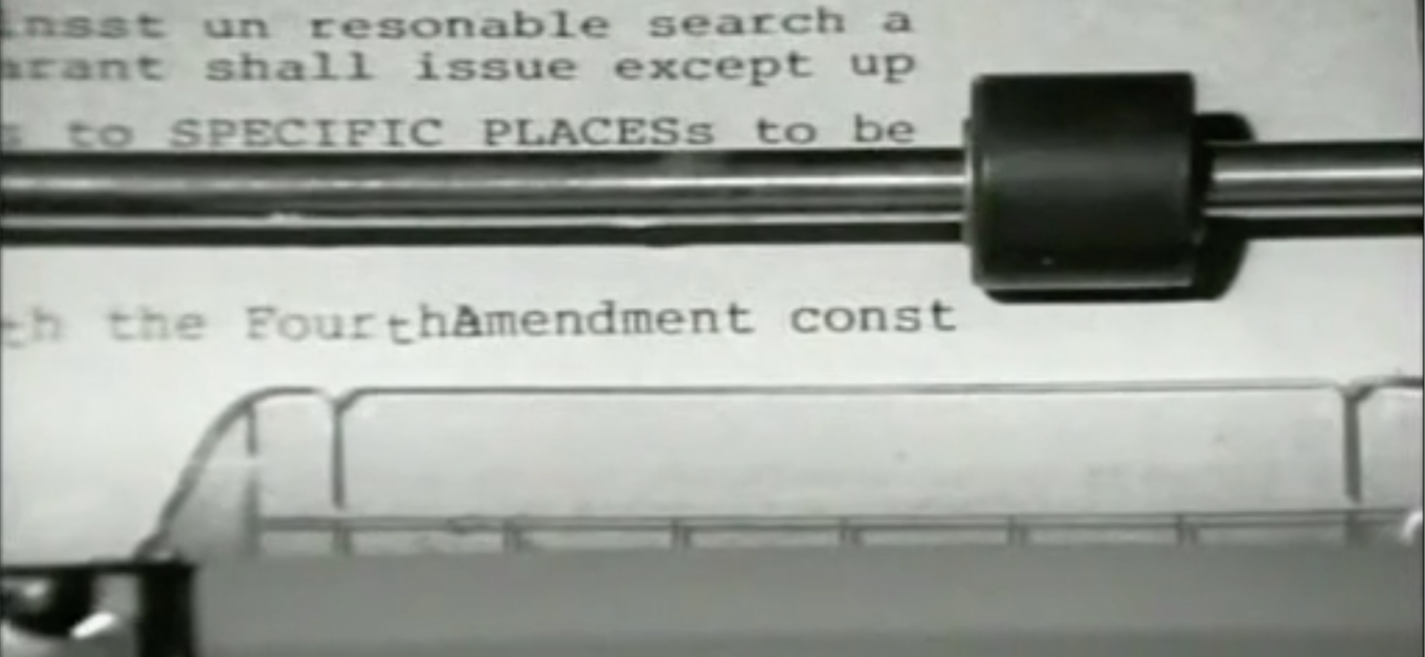
Even up to his last moments, Bruce never backed down from fighting for what he believed in. He never gave up on his first amendment right, freedom of speech. Before Lenny left his typewriter, he was midway through the word “Constitutes”.
“Conspiracy to interfere with the fourth amendment const” — Lenny Bruce.
After Lenny’s death, never would a comedian stand trial for the use of obscene language.
I know words have power. For example, the word “nigger”, represents a time of slavery, extreme racism and social injustice at a basic human rights level. But it comes down to society and yourself as an individual to take that powerful word that is currently suppressed, and change it so that it becomes normalised, just like the word “shit”. It’s important to remember one thing; everything we have created as a species; language, laws, monetary, institutions etc, was appointed by a manmade meaning. Fundamentally, everything we have created, came from nothing thus, meaning that nothing has a meaning. We are nothing at all. We’re simply trying to make our ride, the best ride possible with what we’ve got. It makes no sense to restrict our ride because of what “was”.
Lenny Bruce wanted to point out that your interpretation of that word, will be different from another person’s. It’s deep within yourself who is offended by that particular word, not the word itself. Ultimately, it’s more of a spiritual and philosophical outlook approach that would be required to try and understand within yourself and truly trying to understand the perspective of the person using offending word(s)- “Why did I find this offensive? Why did they choose that word?”.
“Let me tell you the truth. The truth is ‘what is’, and what ‘should be’ is a fantasy…a terrible, terrible lie that someone gave to the people long ago.” — Lenny Bruce.
Lenny Bruce was way ahead of his time. He went on to influence future comedians such as; Bill Hicks, George Carlin, Jon Stewart, Marc Maron, Louis C.K, Richard Pryor, the list goes on. He challenged the status quo, the hypocrisy and corruption of his own government.
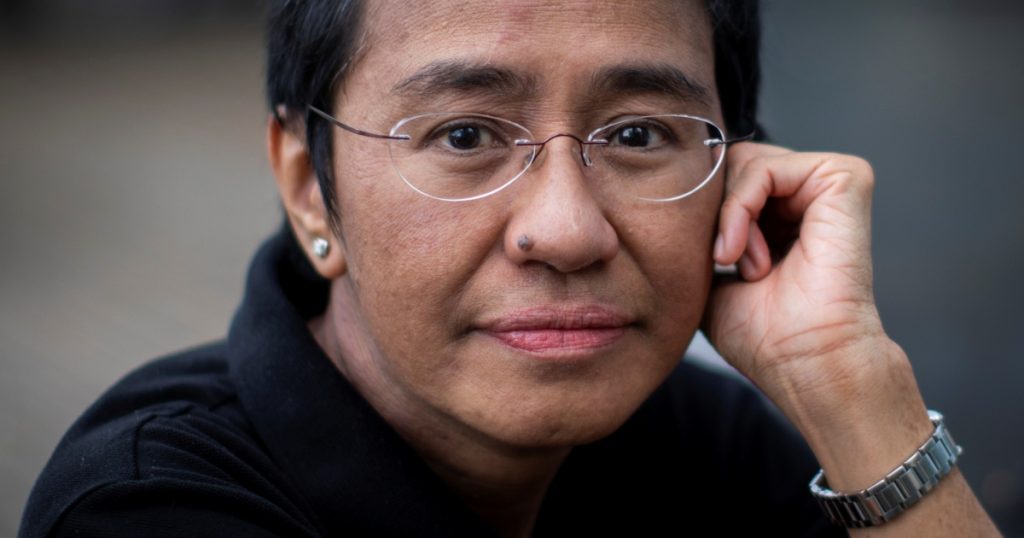
Filipina journalist Maria Ressa and Russian journalist Dmitry Muratov accepted the Nobel Peace Prize Friday for their “efforts to safeguard freedom of expression.” “There are so many more journalists persecuted in the shadows with neither exposure nor support, and governments are doubling down with impunity,” said Ressa in her acceptance speech at Friday’s Nobel ceremony, which we play in full.
Transcript
This is a rush transcript. Copy may not be in its final form.
AMY GOODMAN: The Nobel Peace Prizes were awarded today during a ceremony in Oslo, Norway, on the [57th] anniversary of when Dr. Martin Luther King came to Oslo to accept the Nobel Peace Prize.
REV. MARTIN LUTHER KING JR.: I accept the Nobel Prize for Peace at a moment when 22 million Negroes of the United States of America are engaged in a creative battle to end the long night of racial injustice. I accept this award on behalf of a civil rights movement which is moving with determination and a majestic scorn for risk and danger to establish a reign of freedom and a rule of justice
AMY GOODMAN: That’s Dr. Martin Luther King accepting the Nobel Peace Prize. Today, the 2021 Nobel Peace Prize laureates, Filipina journalist Maria Ressa and Russian reporter Dmitry Muratov, accepted their awards during a ceremony in Oslo for, quote, “their efforts to safeguard freedom of expression, which is a precondition for democracy and lasting peace.” The other 2021 laureates in medicine, physics, chemistry, literature and economics all received their diplomas and medals in their home countries and gave their Nobel lectures online. This is Maria Ressa’s Nobel Prize acceptance speech, which was just delivered in Oslo as we went to air.
MARIA RESSA: Your Majesties, Your Royal Highnesses, distinguished members of the Norwegian Nobel Committee, Your Excellencies, distinguished guests, ladies and gentlemen: I stand before you, a representative of every journalist around the world who is forced to sacrifice so much to hold the line, to stay true to our values and mission: to bring you the truth and hold power to account.
I remember the brutal dismemberment of Jamal Khashoggi; the assassination of Daphne Caruana Galizia in Malta; my friend Luz Mely Reyes in Venezuela; Roman Protasevich in Belarus, whose plane was literally hijacked so he could be arrested; Jimmy Lai languishing in a Hong Kong prison; Sonny Swe, who, after getting out of more than seven years in jail, started another news group and now is forced to flee Myanmar; and in my own country, 23-year-old Frenchie Mae Cumpio, still in prison after nearly two years, and just 36 hours ago the news that my former colleague Jess Malabanan was killed with a bullet to his head.
There are so many to thank for keeping us safer and working, the #HoldTheLine Coalition of more than 80 global groups defending press freedom, and the human rights groups that help us shine the light. There are costs for you, as well. At least 63 lawyers — more lawyers have been killed than journalists in the Philippines, at least 63 compared to the 22 journalists murdered after President Rodrigo Duterte took office in 2016. Since then, Karapatan, a member of our #CourageON human rights coalition, has had 16 people killed, and Senator Leila de Lima, because she demanded accountability, is serving her fifth year in jail. Or ABS-CBN, our largest broadcaster, a newsroom that I once led, which last year lost its franchise to operate.
I helped create a startup, Rappler, turning 10 years old in January — we’re getting old — our attempt to put together two sides of the same coin that shows everything wrong with our world today: the absence of law and democratic vision for the 21st century. That coin represents our information ecosystem, which determines everything else about our world. Journalists, that’s one side, the old gatekeepers. The other is technology, with its god-like power, the new gatekeepers. It has allowed the virus of lies to infect each of us, pitting us against each other, bringing out our fears, anger, hate, and setting the stage for the rise of authoritarians and dictators around the world.
Our greatest need today is to transform that hate and violence, the toxic sludge that’s coursing through our information ecosystem, prioritized by American internet companies that make more money by spreading that hate and triggering the worst in us. OK, well, that just means we have to work harder. You know, in order to be the good, we have to believe there is good in the world. Right? An old T-shirt from Rappler from 2014.
I’ve been a journalist for more than 35 years. I’ve worked in conflict zones and warzones in Asia, reported on hundreds of disasters. And while I’ve seen so much bad, I’ve also documented so much good, when people who have nothing offer you what they have. Part of how we at Rappler have survived the last five years of government attacks is because of the kindness of strangers. And the reason they help, despite the danger, is because they want to, with little expectation of anything in return. This is the best of who we are, the part of our humanity that makes miracles happen. This is what we lose in a world of fear and violence.
You’ve heard that the last time a working journalist was given this award was in 1936, awarded in 1935. He was supposed to come and get it in 1936. Carl von Ossietzky never made it to Oslo because he languished in a Nazi concentration camp. So, we’re here, hopefully a little bit ahead. We are both here.
By giving this to journalists today — thank you — the Nobel Committee is signaling a similar historical moment, another existential point for democracy. Dmitry and I are lucky because we can speak to you now — yea for court approvals — but there are so many more journalists persecuted in the shadows with neither exposure nor support, and governments are doubling down with impunity. The accelerant is technology, when creative destruction takes new meaning.
You’ve heard from David: We are standing on the rubble of the world that was. And we must have the foresight and courage to imagine what might happen if we don’t act now, and instead, please, create the world as it should be: more compassionate, more equal, more sustainable. To do that, please ask yourself the same question we at Rappler had to confront five years ago: What are you willing to sacrifice for the truth?
I’ll tell you how I lived my way into the answer in three points: first, my context and how these attacks shaped me; second, by the problem we all face; and, finally, finding the solution — because we must!
In less than two years, the Philippine government filed 10 arrest warrants against me. I’ve had to post bail 10 times just to do my job. Last year, I and a former colleague were convicted of cyber libel for a story we published eight years earlier at a time the law we allegedly violated didn’t even exist. All told, the charges I face could send me to jail for about a hundred years. But the more I was attacked for my journalism, the more resolute I became. I had firsthand evidence of abuse of power. What was meant to intimidate me and Rappler only strengthened us.
At the core of journalism is a code of honor. And mine is layered on different worlds — from how I grew up, the Golden Rule, what’s right and wrong; from college and the honor code I learned there; and my time as a reporter and the code of standards and ethics I learned and helped write. Add to that the Filipino idea of utang na loob — literally, the debt from within — at its best is a system of paying it forward.
Truth and ethical honor intersected like an arrow into this moment where hate, lies and divisiveness thrive. As only the 18th woman to receive this prize, I need to tell you how gendered disinformation is a new threat and is taking a significant toll on the mental health and physical safety of women, girls, trans and LGBTQ people all around the world. Women journalists are at the epicenter of risk. This pandemic of misogyny and hatred needs to be tackled now. Even there, though, we can find strength. After all, you don’t really know who you really are until you’re forced to fight for it.
Now, let me pull out so we’re clear about the problem we all face and how we got here. The attacks against us in Rappler began five years ago, when we demanded an end to impunity on two fronts: Rodrigo Duterte’s drug war and Mark Zuckerberg’s Facebook. Today, it has only gotten worse, and Silicon Valley’s sins came home to roost in the United States on January 6 with mob violence on Capitol Hill.
What happens on social media doesn’t stay on social media. Online violence is real-world violence. Social media is a deadly game for power and money, what Shoshana Zuboff calls surveillance capitalism, extracting our private lives for outsized corporate gain, our personal experiences sucked into a database, organized by AI, then sold to the highest bidder. Highly profitable micro-targeting operations are engineered to structurally undermine human will. I’ve repeatedly called it a behavior modification system in which we are all Pavlov’s dogs, experimented on in real time with disastrous consequences in countries like mine, Myanmar, India, Sri Lanka, so many more. These destructive corporations have siphoned money away from news organizations, and now they pose a foundational threat to markets and elections.
Facebook is the world’s largest distributor of news, and yet studies have shown that lies laced with anger and hate spread faster and further than facts. These American companies controlling our global information ecosystem are biased against facts, biased against journalists. They are, by design, dividing us and radicalizing us.
I’ve said this repeatedly over the last five years: Without facts, you can’t have truth. Without truth, you can’t have trust. Without trust, we have no shared reality, no democracy, and it becomes impossible to deal with the existential problems of our times: climate, coronavirus, now the battle for truth.
When I first was arrested in 2019, the officer said, “Ma’am, trabaho lang po,” — “Ma’am, I’m only doing my job.” Then he lowered his voice to almost a whisper as he read my Miranda rights. He was really uncomfortable, and I almost felt sorry for him — except he was arresting me because I’m a journalist! This officer was a tool of power and an example of how a good man can turn evil — and how great atrocities happen. Hannah Arendt wrote about the banality of evil when describing men who carried out the orders of Hitler, how career-oriented bureaucrats can act without conscience because they justify what they’re doing because that they’re only following orders. This is how a nation — and a world — loses its soul.
You have to know what values you’re fighting for. You have to draw the lines early, but if you haven’t done so, please do it now: where on this side, you’re good; this side, you’re evil. Some governments may be lost causes, and if you’re working in tech, I’m talking to you. How can you have election integrity if you don’t have integrity of facts?
That’s the problem facing countries with elections next year — among them, Brazil, Hungary, France, the United States and my Philippines, where we are at a do-or-die moment with presidential elections on May 9th. Thirty-five years after the People Power revolt ousted Ferdinand Marcos and forced his family into exile, his son, Ferdinand Marcos Jr., is the front-runner for president. And he has built an extensive disinformation network on social media, which Rappler exposed in 2019. It’s literally changing history in front of our eyes.
To show how disinformation is both a local and global problem, take the Chinese information operations taken down by Facebook in September 2020, a year ago. It was creating fake accounts using AI-generated photos for the U.S. elections, polishing the image of the Marcoses in the Philippines, campaigning for the daughter of Duterte, of President Duterte, and attacking me and Rappler. Chinese information operations.
So, what are we going to do? An invisible atom bomb has exploded in our information ecosystem, and the world must act as it did after Hiroshima. Like that time, we need to create new institutions, like the United Nations, and new codes stating our values, like the Universal Declaration of Human Rights, to prevent humanity from doing its worst. It’s an arms race in our information ecosystem. To stop that requires a multilateral approach that all of us must be part of.
It begins by restoring facts. We need information ecosystems that live and die by facts. We do this by shifting social priorities to rebuild journalism for the 21st century while regulating and outlawing the surveillance economics that profit from hate and lies.
We need to help independent journalism survive, first by giving greater protection to journalists and standing up against states which target journalists. Then we need to address the advertising model of journalism. This is part of the reason that I agreed to co-chair the International Fund for Public Interest Media, which is trying to raise money from overseas development assistance funds. Right now, while journalists are under attack on every front, only 0.3% of ODA funds is spent on journalism. If we nudge that to just 1%, we can raise a billion dollars a year for news organizations. That will be crucial for the Global South.
Journalists must embrace technology. That’s why, with the help of Google News Initiative, Rappler rolled out a new platform two weeks ago designed to build communities of action. It won’t be as viral as what the tech platforms built, but the North Star is not profit alone. It is facts, truth and trust.
Now for legislation. Thanks to the EU for taking leadership with its Democracy Action Plan. For the U.S., reform or revoke Section 230, the law that treats social media platforms like utilities. It’s not a comprehensive solution, but it gets the ball rolling, because these platforms put their thumbs on the scale of distribution. So, while the public debate is here, down here, on content moderation downstream, the real sleight of hand happens further upstream, where algorithms of amplification, algorithms of distribution have been programmed by humans with coded bias. Their editorial agenda is profit-driven, carried out by machines at scale. The impact is global, with cheap armies on social media rolling back democracy, tearing it down in 81 countries around the world. That impunity must stop.
Democracy has become a woman-to-woman, man-to-man defense of our values. We’re at a sliding door moment, where we can continue down the path we’re on and descend further into fascism, or we can each choose to fight for a better world. To do that, please ask yourself: What are you willing to sacrifice for the truth?
I didn’t know if I was going to be here today. Every day, I live with the real threat of spending the rest of my life in jail because I’m a journalist. When I go home, I have no idea what the future holds, but it’s worth the risk.
The destruction has already happened. Now it’s time to build — to create the world we want. So, please, with me, just close your eyes for just a moment and imagine the world as it should be: a world of peace, trust and empathy, bringing out the best that we can be. Open your eyes. Now go. We have to make it happen. Please, let’s hold the line, together. Thank you.
AMY GOODMAN: That’s Filipina journalist Maria Ressa accepting the Nobel Peace Prize today in Oslo, Norway, along with Russian reporter Dmitry Muratov.
Autism is one of the strangest diagnoses I’ve received, in that everybody purports to be an expert in what it means – or at the very least to have some very strongly held beliefs about it. When I started researching autism a few years ago, as I began my own diagnosis process, I realised how prevalent and deep-seated misinformation is and how often well-known stereotypes are used to enact harm.
Despite a growing neurodiversity movement, by and large, the way in which society behaves towards and understands autistic people does not appear to be improving. Everybody seems to think they know what autism is – and everybody seems to agree that it’s a bad thing. This is evident in studies and therapies that aim to “cure” autism. It’s explicit in the casual use of “autistic” as an insult, a shorthand for awkward and socially inept. It’s even visible in something as simple and apparently benign as the way we use language to discuss autism.
Most autistic people have been told at some point by a non-autistic person that they should use person-first language (“person with autism”, “person with a disability”) to describe themselves. While better intentioned than those who make “autistic” explicitly synonymous with a social deficit, these people often refuse to acknowledge that not only do many studies demonstrate that identity-first language (“autistic person”, “disabled person”) is preferred by the majority of the autistic community, but that refusing to use it contributes to disableist discrimination. The implication, of course, in using person-first language, is that autistic is not an identity anybody would want to own – instead, it makes autism sound like a disease.
Treating autism as a ‘disease’, rather than a neurotype that exists as a result of natural biological variation, paves the way for a level of discrimination and stigmatisation that would not be acceptable if it were applied to other minority groups. At worst, it raises serious fears of eugenics. But the traditional understanding of autism as a deficit also plays a huge role in day-to-day discrimination against autistic people, and perhaps explains why research shows that “neurotypical (non-autistic) peers are less willing to interact with those with autism based on thin slice [quick, ill-informed] judgements”.
Essentially, the proliferation of knee-jerk assumptions about autistic people – the idea that we are inherently wrong, rather than just different – is stopping non-autistic people from making an effort to engage with us and hindering the building of a world where autistic people would be valued members of society, safe from harm and free from isolation. Autistic researcher Dr Damian Milton describes this as ‘the double empathy problem’. When people with very different experiences of the world interact, they will inevitably struggle to empathise with each other, Milton explains. Currently, autistic people are expected to span the entire gulf between our perspective and the neurotypical perspective. In order to improve the lives of autistic people, non-autistic people must begin to shift their view of us and try to understand the way that we experience the world. Suggesting we are inherently faulty puts the onus solely on us to change or be cured, rather than encouraging neurotypicals to meet us halfway.
We don’t want to be ‘cured’.
Throughout history, the message that autistic people must adjust their behaviour – or have it adjusted for them – to match that of non-autistic people has remained constant, with “cures” for autism ranging from chemical castration and bleach enemas to behavioural therapy. Even in research settings – where you would hope misinformation would be tackled, not spread – autistic people are routinely pathologised and dehumanised. Today, in 2021, the ‘gold standard’ treatment for autistic children remains applied behaviour analysis (ABA), a type of therapy that uses operant and respondent conditioning to – in the words of its founder, 1960s psychologist Ole Ivar Lovaas – try to make autistic people “normal”.
ABA is increasingly controversial within the autistic community, with opposition to its use growing all the time, as many autistic adults share their personal experience of being harmed by the treatment as a child. Academics have backed this up, saying the treatment “manifests systematic violations of the fundamental tenets of bioethics” and places a burden on autistic people by “defining therapeutic success primarily in terms of autists’ ability to fit into normal societal structures”. But despite increasing evidence that these therapies don’t work and may cause mental health conditions including PTSD, families desperate to support their children may feel they have no other option when there is shockingly little support available.
Given the marginalisation, discrimination and brutal treatment that autistic people face from childhood, it is no wonder autistic adults have repeatedly been found to be more vulnerable to many different negative life events than non-autistic people, and to be at increased risk of violent victimisation.
Discrimination is also never applied equally. Autistic people experiencing multiple forms of oppression – whether that’s through, for example, being multiply disabled, a woman or a person of colour – are often even more marginalised. This is exacerbated by the myth that autism is only prevalent amongst white men, a common misconception that creates barriers to diagnosis for BAME people, women and anyone else who doesn’t fit the stereotype, preventing access to support. As disability justice educator and organiser Lydia K Brown writes, “we can’t address disability without addressing race”.
Research shows that in the UK alone thousands of autistic women and girls are going undiagnosed due to gender bias, causing untold damage to their mental health. Understanding that something about your experience of the world is different, while being unable to understand what that thing is – often compounded by having your thoughts about what it might be invalidated by both medical and non-medical sources – can lead to an intense urge, or even an unconscious decision, to suppress your natural behaviours in order to fit into wider society. Altering autistic behaviour for this reason is commonly known as ‘camouflaging’ or ‘masking’ and is linked to increased suicide risk.
It’s time for non-disabled people to learn how to make the world more accommodating for disabled people and to fight to have these accommodations implemented wherever possible, challenging the Tories’ devastating blows to UK health and social care. Shifting the cultural understanding and treatment of autism, as well as curating academic research to meet the real priorities of autistic people and their families, is an essential task in this fight.
Non-autistic people must meet us halfway, because, despite the obstacles stacked against us, we don’t want to change. In a survey of thousands of autistic people, the majority (whether speaking, non-speaking, with or without an intellectual disability) said that they wouldn’t take a cure for autism if one were created. I don’t want to claim that living as an autistic person is never difficult, but I do want to emphasise in every possible way that every autistic person is deserving of a life – a life where we’re valued, just as we are.
Jodie Hare is an autistic freelance journalist who writes about languages and translation, feminism, disability, and jellyfish. She can be found at @jodslouise.
The Ace of Cups represents the beginning of love, fertility and creativity. It is a card to inspire confidence and happiness. When it turns up a reading of an everyday nature it can indicate the start of a loving relationship (of either the romantic or friendship variety); it can represent the beginning of a project in which a great deal of loving energy is invested (rather like the beginning of angelpaths); or sometimes it can reveal conception – the beginning of a new life.
If you are looking at the Ace of Cups indicating a new relationship, then there will also be people cards up. If it is a romantic relationship, expect to see other good Cups, and perhaps the Lovers. Friendship will be more indicated by Wand type good cards.
The beginning of a project will normally have something like the Star or the Priestess, and Disks around it. These will help you to determine the viability of the project.
But at a spiritual level the Ace of Cups is even more important. The chalice depicted on most versions of this card is taken to be the Holy Grail, or in pagan terms, the Cauldron of Kerridwyn – source of inspiration and granter of wishes and dreams.
In this interpretation of the card then, we are examining a major spiritual step forward – a period where the deepest and most heartfelt spiritual desires of the querent come to the surface, and may be identified and pursued.
When this card comes up with the Hierophant, The Sun,The Moon or sometimes with Death, we must see ourselves as entering into a major transformational period from which we will emerge totally changed by the power of the Universe. During periods such as these we touch the very essence of spiritual power, and hopefully, we succeed in growing toward it, and allowing a little more of its light within us.


 Location on a map of Vatican City


.jpg)





 (Pietro Garrone / Novara Media)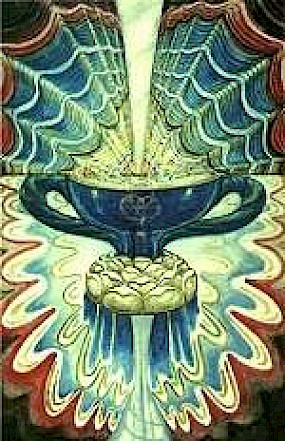


.jpg)
.jpg)

.jpg)

.jpg)


