A historian of fascism offers a guide for surviving and resisting America’s turn towards authoritarianism.
On November 9th, millions of Americans woke up to the impossible: the election of Donald Trump as president. Against all predictions, one of the most-disliked presidential candidates in history had swept the electoral college, elevating a man with open contempt for democratic norms and institutions to the height of power.
Timothy Snyder is one of the most celebrated historians of the Holocaust. In his books Bloodlands and Black Earth, he has carefully dissected the events and values that enabled the rise of Hitler and Stalin and the execution of their catastrophic policies. With Twenty Lessons, Snyder draws from the darkest hours of the twentieth century to provide hope for the twenty-first. As he writes, “Americans are no wiser than the Europeans who saw democracy yield to fascism, Nazism and communism. Our one advantage is that we might learn from their experience.”
Twenty Lessons is a call to arms and a guide to resistance, with invaluable ideas for how we can preserve our freedoms in the uncertain years to come.
DECEMBER 14, 2021 AT 7:00 AM BY ROB BREZSNY (newcity.com)
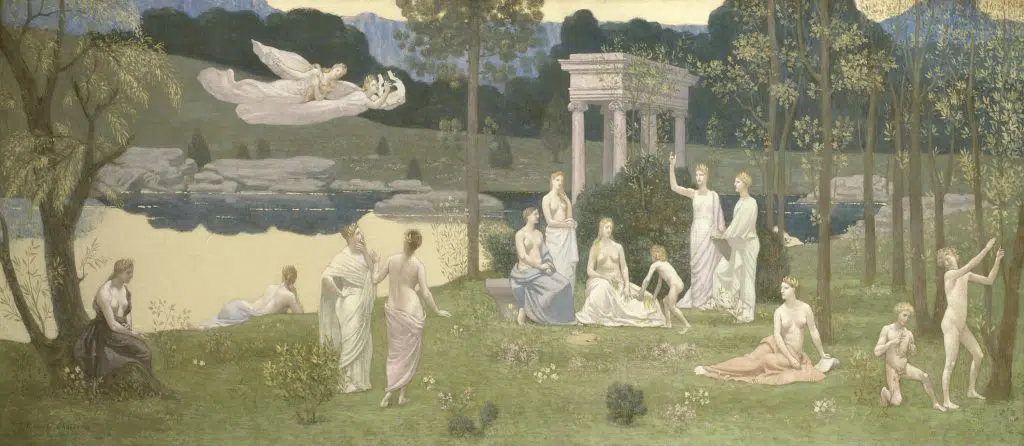
Pierre Puvis de Chavannes, “The Sacred Grove, Beloved of the Arts and the Muses,” Potter Palmer Collection/courtesy Art Institute of Chicago
ARIES (March 21-April 19): Key questions for you, beginning now and throughout 2022: 1. What do you need to say, but have not yet said? 2. What is crucial for you to do, but you have not yet done? 3. What dream have you neglected and shouldn’t neglect any longer? 4. What sanctuary is essential for you to visit, but you have not yet visited? 5. What “sin” is it important for you to forgive yourself for, but you have not yet forgiven yourself? 6. What promise have you not yet fulfilled, even though it’s getting late (but not too late!) to fulfill? 7. What secret have you hidden so well that you have mostly concealed it even from yourself?
TAURUS (April 20-May 20): Taurus novelist Anthony Trollope (1815–1882) took one of his manuscripts to a publishing company, hoping it would be made into a book and sold to the public. A few weeks later, he got word by mail that his masterpiece had been rejected. He took a train to the publisher’s office and retrieved it. On the train ride home, he turned the manuscript over and began writing a new story on the back of each page. He spent no time moping. That’s the spirit I recommend you embody in the coming weeks, dear Taurus.
GEMINI (May 21-June 20): “John Coltrane was an addict,” wrote author Cornel West about the renowned jazz saxophonist and composer. “Billie Holiday was an addict. [Nobel Prize-winning author] Eugene O’Neill was an addict. What would America be without addicts and post-addicts who make such grand contributions to our society?” I welcome West’s sympathetic views toward addicts. Many of us who aren’t addicts understand how lucky we are not to have the genetic predisposition or the traumatic experiences that addicts often struggle with. We unaddicted people may also have been spared the bigotry and abuse that have contributed to and aggravated some addicts’ addictions. Having acknowledged these truths, I nevertheless hope to do whatever I can to help you convert any addictive tendencies you might have into passionate obsessions. Now is an excellent time to launch a new phase of such work. Invitation: Make a list of three things you can do in the coming months to nurture the process.
CANCER (June 21-July 22): Actor and model Kate Beckinsale unleashed a cryptic boast: “My best feature is unfortunately a private matter, although I’m told it is spectacular. But you can’t really walk it down the red carpet. What can I say?” Are you imagining what I’m imagining? I bring this oddity to your attention in the hope that I can convince you to be more forthright and expressive about your own wonderful qualities. It’s time to be less shy about your beauty, less secretive about your deep assets. Show the world why you’re so lovable.
LEO (July 23-Aug. 22): Leo-born Edna Ferber (1885–1968) was a celebrated author who won a Pulitzer Prize. She was witty and outspoken. Her stories featured strong women and characters struggling against discrimination. “I never would just open a door and walk through,” she said about her career. “I had to bust it down for the hell of it. I just naturally liked doing things the hard way.” At least in the coming weeks, Leo, I urge you NOT to adopt Ferber’s attitude. In my view, you’ll be wise to do everything possible to open doors rather than bust them down. And the best way to do that is to solicit help. Cultivate your ability to ask for what you need. Refine your practice of the arts of collaboration, synergy and interweaving.
VIRGO (Aug. 23-Sept. 22): “No one has ever written, painted, sculpted, modeled, built, or invented except literally to get out of hell,” wrote Virgo dramatist Antonin Artaud. That’s a ridiculous generalization, in my opinion. For example, I occasionally generate songs, stories and horoscopes to help me escape from a momentary hell. But most of my creations are inspired by my love of life and a desire to inspire others. I’m very sure that in the coming weeks, your own motivations to produce good things will be far closer to mine than to Artaud’s. You’re in a phase when your quest for joy, generosity, blessings and fun could be fierce and productive.
LIBRA (Sept. 23-Oct. 22): Author Barbara Sher offered this wise counsel: “Imaginary obstacles are insurmountable. Real ones aren’t.” I bring this to your attention because I believe the coming weeks will be an excellent time to identify the imaginary obstacles you’ve erected in your inner world—and then smash them or burn them or dispose of them. Once you’re free of the illusory interference, I think you’ll find you have at least twice as much power to neutralize the real obstacles.
SCORPIO (Oct. 23-Nov. 21): Prolific author Ray Bradbury liked to give advice to those with a strong need to express their imaginative originality. Since I expect you will be a person like that in 2022, I’ll convey to you one of his exhortations. He wrote, “If you want to create, you must be the most sublime fool that God ever turned out and sent rambling. I wish you a wrestling match with your Creative Muse that will last a lifetime. I wish craziness and foolishness and madness upon you.” Keep in mind that Bradbury was referring to constructive craziness, wise foolishness, and divine madness.
SAGITTARIUS (Nov. 22-Dec. 21): The coming months will be a favorable time for you to redefine the meaning of the term “sacred” and to deepen your relationship with sacredness. To spur your imagination, I offer four quotes: 1. “Recognizing the sacred begins when we are interested in every detail of our lives.” —Buddhist teacher Chögyam Trungpa 2. “When you notice something clearly and see it vividly, it then becomes sacred.” —poet Allen Ginsberg 3. “Holiness begins in recognizing the face of the other.” —philosopher Marc-Alain Ouaknin 4. “Modern culture, in its advertising of sex, is in a misguided fashion advertising its longing for the sacred.” —teacher Sobonfu Somé
CAPRICORN (Dec. 22-Jan. 19): Capricorn author E. M. Forster wrote, “The only books that influence us are those for which we are ready, and which have gone a little further down our particular path than we have yet gone ourselves.” I propose we universalize that statement: “The only people, information, and experiences that influence us are those for which we are ready, and which have gone a little further down our particular path than we have yet gone ourselves.” I believe this principle will be especially fruitful for you to embrace during the next three months. Prepare yourself for lessons that are vital for you to learn—and on the frontier of your understanding.
AQUARIUS (Jan. 20-Feb. 18): Among America’s Founding Fathers was Aquarian William Whipple (1730-1785). He was one of fifty-six men who signed the Declaration of Independence in 1776, instigating war with Great Britain. Unlike many of his colleagues, however, Whipple believed it was hypocritical to enslave human beings while fighting for freedom. That’s why he emancipated the person who had been in bondage to him. The coming months will be a favorable time to make comparable corrections, Aquarius. If there are discrepancies between your ideals and your actions, fix the problem.
PISCES (Feb. 19-March 20): According to Piscean author Ryunosuke Akutagawa, “People sometimes devote their lives to a desire that they are not sure will ever be fulfilled.” So true! I can personally attest to that behavior. Is such a quest misguided? Delusional? Naive? Not in my view. I see it as glorious, brave and heroic. Akutagawa did too. He said that those who refrain from having inspirational desires are “no more than mere spectators of life.” In any case, I recommend you think big in 2022, Pisces. From an astrological angle, this could be the year you home in on and refine and upgrade the single most important desire you will ever have.
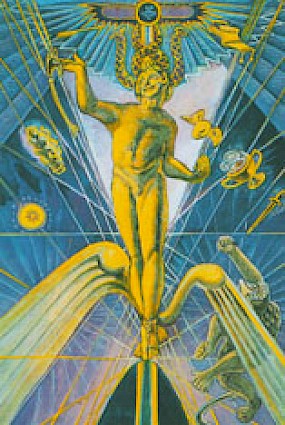
The Magician is normally numbered one and is sometimes called the Magus. The Magician is usually depicted as a powerful adept, a master of the four elements. He is able to shift events in his favour – to make the World change around him according to his Will.
He is highly skilled, highly powerful and hence a highly dynamic and charismatic figure. He is that part of us which we harness to control our own lives. When we are the Magician we make what we want happen.
However, you can be sure that we receive exactly what we ask for – “be careful what you pray for, you might just get it”! The Magician knows where to throw the pebble into the pool of the Universe in order to get exactly the ripples he wants. If we choose happiness and joy and put our Will behind them, that is what we can achieve.
Rick Steves’ Europe Five hundred years ago, Martin Luther kicked off the Protestant Reformation, which contributed to the birth of our modern age. In this one-hour special — filmed on location in Europe — Rick Steves tells the story of a humble monk who lived a dramatic life. Rick visits key sites relating to the Reformation (including Erfurt, Wittenberg, and Rome) and explores the complicated political world of 16th-century Europe — from indulgences to iconoclasts, and from the printing press to the Counter-Reformation. It’s a story of power, rebellion, and faith that you’ll never forget.
Big Think How America Got Divorced from Reality: Christian Utopias, Anti-Elitism, Media Circus Watch the newest video from Big Think: https://bigth.ink/NewVideo Join Big Think Edge for exclusive videos: https://bigth.ink/Edge ———————————————————————————- Since a boat of religious fanatics with buckles on their hats hit the shores near Plymouth Rock and claimed that this was their utopia, America has always been a little bit crazy. It’s this kind of wide-eyed “anything can happen if you believe” mentality that, at its best, can produce incredible art. But at its worst, it can be cruel and conspiratorial. We live in a country where people refuse to believe vaccination can help you and where a White House is spinning “alternative — but Kurt Andersen is here to say that this is nothing now. At the time of the Civil War, society had become split by two sides that refused to listen to each other. Back then, the political and social divide is stoked by a hyperbolic partisan media where anyone could publish whatever they wanted in a pamphlet without fact-checking. Sound familiar? It definitely should. Kurt’s latest book is appropriately titled Fantasyland: How America Went Haywire. ———————————————————————————- KURT ANDERSEN: Kurt Andersen, host of Studio 360 on NPR, is a journalist and the author of the novels Hey Day, Turn of the Century, The Real Thing, and his latest non-fiction book Fantasyland: How America Went Haywire: A 500-Year History. He has written and produced prime-time network television programs and pilots for NBC and ABC, and co-authored Loose Lips, an off-Broadway theatrical revue that had long runs in New York and Los Angeles. He is a regular columnist for New York Magazine, and contributes frequently to Vanity Fair. He is also a founder of Very Short List. Andersen began his career in journalism at NBC’s Today program and at Time, where he was an award-winning writer on politics and criminal justice and for eight years the magazine’s architecture and design critic. Returning to Time in 1993 as editor-at-large, he wrote a weekly column on culture. And from 1996 through 1999 he was a staff writer and columnist for The New Yorker. He was a co-founder of Inside.com, editorial director of Colors magazine, and editor-in-chief of both New York and Spy magazines, the latter of which he also co-founded. From 2004 through 2008 he wrote a column called “The Imperial City” for New York (one of which is included in The Best American Magazine Writing 2008). In 2008 Forbes. com named him one of The 25 Most Influential Liberals in the U.S. Media. Anderson graduated magna cum laude from Harvard College, and is a member of the boards of trustees of the Cooper-Hewitt National Design Museum, the Pratt Institute, and is currently Visionary in Residence at Art Center College of Design in Pasadena. He lives with his family in New York City.
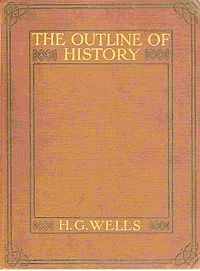
The Outline of History, subtitled either “The Whole Story of Man” or “Being a Plain History of Life and Mankind”, is a work by H. G. Wells chronicling the history of the world from the origin of the Earth to the First World War.
It appeared in an illustrated version of 24 fortnightly installments beginning on 22 November 1919 and was published as a single volume in 1920. It sold more than two million copies, was translated into many languages, and had a considerable impact on the teaching of history in institutions of higher education. Wells modeled the Outline on the Encyclopédie of Denis Diderot.
In the years leading up to the writing of The Outline of History Wells was increasingly preoccupied by history, as many works testify. (See, for example, The New Machiavelli, Marriage, An Englishman Looks at the World, The Wife of Sir Isaac Harman, Mr. Britling Sees It Through, etc.) During World War I, he tried to promote a world history to be sponsored by the League of Nations Union, of which he was a member.
But no professional historian would commit to undertake it, and Wells, in a financially sound position thanks to the success of Mr. Britling Sees It Through and believing that his work would earn little, resolved to devote a year to the project. His wife Catherine (Jane) agreed to be his collaborator in typing, research, organisation, correspondence, and criticism. Wells relied heavily on the Encyclopaedia Britannica (11th ed., 1911), and standard secondary texts.
He made use of the London Library, and enlisted as critical readers “a team of advisers for comment and correction, chief among them Ernest Barker, Harry Johnston, E. Ray Lankester, and Gilbert Murray. The sections were then rewritten and circulated for further discussion until Wells judged that they had reached a satisfactory standard.” The bulk of the work was written between October 1918 and November 1919.
Biography Interviews with two of H.G. Wells’s grandsons and his granddaughter jump us back in time and flesh out this chronicle of the life of the author who pioneered 20th century science fiction in Season 1, Episode 8. #Biography Dive deeper into Biography on our site: http://www.biography.com Follow Biography for more surprising stories from fascinating lives: Facebook – https://www.facebook.com/Biography Instagram – https://www.instagram.com/biography Twitter – https://twitter.com/biography Biography highlights newsworthy personalities and events with compelling and surprising points-of-view, telling the true stories from some of the most accomplished non-fiction storytellers of our time.
Through its service, the Alliance has proven its spiritual integrity. It can universalize your vision, increase your wealth of fellowship with kindred minds and make you aware that you are a part of a great spiritual movement.
You can lend strength and support through financial gifts, your prayers and treatments, talents and time, and through your promotion and participation in INTA’s purposes.
You can take steps to insure the continuance of this Alliance, not only now, but through bequests of money, personal property, real estate, or through trust arrangements.
INTA is incorporated under the laws of the District of Columbia as a religious, not for profit organization.
The INTERNATIONAL NEW THOUGHT ALLIANCE…
…promotes spiritual inspiration and guidance for New Thought ministers, practitioners, teachers, laity, ministries, and groups;
…offers Annual World Congresses and local programs throughout the world designed to aid understanding of New Thought and to promote interest in it;
…is a democratic, umbrella organization whose goal is to be a vehicle for disseminating timeless universal Truths to spiritually awaken, empower, transform, and connect individuals globally;
…encourages educational excellence throughout the New Thought movement;
…preserves New Thought’s rich heritage through archival and other work, promotes the effectiveness of New Thought practices, encourages the constant rethinking of its theoretical foundations, helps all New Thought adherents to grow in their awareness of the One Presence and One Power of Good, the Infinite Good, and stands in service to the world in achieving peace, prosperity, and wellness in all dimensions of existence.
Joe Biden enters the room before his address to the Summit for Democracy at the Eisenhower Executive Office Building in Washington, DC, on December 9.
During the opening speech at Thursday’s Summit for Democracy, President Joe Biden told the assembled international leaders that the stakes of their meeting were nothing less than existential: that the survival of democracy itself depended on what his audience did next.
“We stand at an inflection point in our history,” Biden said. “The choices we make at this moment are going to fundamentally determine the direction our world is going to take in the coming decades.”
No one other than Secretary of State Antony Blinken was in the room to hear Biden’s call to action. The summit is a fully virtual affair due to the pandemic, with leaders of democratic countries speaking to each other via videoconference.
Absent the applause and pageantry of an in-person event, Biden’s words rang strangely hollow. It was as if he was issuing a dire warning to no one in particular.
This is a decent metaphor for the current American approach to democracy where it counts the most — at home.
There is no doubt that democracy in the United States is at serious risk. The year began with an attack on the Capitol designed to thwart the transition of power; instead of repudiating this violence, Republicans doubled down on the lie that Trump won the election and are working, right now, to rig the system in their favor. Neither Democrats nor the general public are doing much of anything to stop them.
Several pieces of legislation on voting rights have been stopped cold by the filibuster, as neither Sen. Kyrsten Sinema (D-AZ) nor Sen. Joe Manchin (D-WV) seems willing to make an exception to the archaic Senate rule in order to protect democracy. Meanwhile, the voters who care are mostly Republicanpartisans, believers in Trump’s lies about 2020. An October poll found that 71 percent of Republicans believe democracy is facing a “major threat,” as compared to just 35 percent of Democrats.
Experts on democracy warn that America is sleepwalking toward a disaster, a situation where the electoral playing field is so tilted in the GOP’s favor that America’s people no longer have a meaningful voice in who rules them. “We’ll wake up one day, and it’ll become clear that Democrats can’t win,” says Tom Pepinsky, a political scientist at Cornell University.
In theory, the Summit for Democracy is supposed to be the crown jewel of Biden’s global democracy agenda. It kicks off an international “year of action” where countries across the world, including the United States, work to strengthen democracy at home and abroad. In his speech, Biden called for the passage of two laws — the Freedom to Vote Act and the John Lewis Voting Rights Act — as a way for America could fulfill this promise.
But so far, neither his government nor the public in general is doing much to force these bills through. It’s a state of affairs that raises a grim question: Is this what it looks like when a democracy dies and nobody cares?
We need a mass pro-democracy movement. It doesn’t exist.
Across the world, there are many cases of democratic “backsliding” — where a once-stable democracy starts buckling, taking on characteristics of an authoritarian system. Sometimes, as in modern Venezuela or Hungary, this ends in a full-tilt slide away from democracy. Other times you get “near misses,” cases where democracy beat back the authoritarian threat. Some notable cases include Finland in 1932, Colombia in 2010, and South Korea in the mid- to late 2010s — countries that are all participating in Biden’s democracy summit.
When you read about these near misses, two factors prove decisive again and again: when a society’s elite stands up to an authoritarian faction, using their power to beat it back, and when the mass public organizes and demonstrates in favor of democracy.
In the United States, we are experiencing failures on both the elite and mass public level. Republican elites, unlike Svinhufvud, have chosen to normalize the violence committed by their extreme right flank on January 6 — and pass legislation, like Georgia’s SB 202, that actually enable Republican partisans to subvert the 2024 election.
Many elite Democrats are fully aware of the problem. Some, like Sen. Raphael Warnock (GA) and the activist group Indivisible, have worked to try to sound the alarm. But at the very highest levels of the party, democracy has become something of a side issue rather than a top priority.
“Democracy will be on trial in 2024. A strong and clear-eyed president, faced with such a test, would devote his presidency to meeting it,” the Atlantic’s Barton Gellman writes. “Biden knows better than I do what it looks like when a president fully marshals his power and resources to face a challenge. It doesn’t look like this.”
There’s a similar asymmetry on the mass public level. The Trump faithful are gearing up for a fight in 2024, organizing at the very local level to influence the outcome of future elections. A September ProPublica investigation documented the emergence of a “precinct strategy,” beginning with a call to action on Steve Bannon’s radio show, in which Republicans have begun flooding local voting precincts with volunteers who could shape the counting process in the next election cycle.
“ProPublica contacted GOP leaders in 65 key counties, and 41 reported an unusual increase in signups since Bannon’s campaign began. At least 8,500 new Republican precinct officers (or equivalent lowest-level officials) joined those county parties,” the outlet explains. “We also looked at equivalent Democratic posts and found no similar surge.”
A pro-voting rights demonstration in Washington, DC, on December 7.
Republicans, at both the elite and mass public level, are actively organizing against democracy — with largely ineffectual pushback from Democratic elites and partisans. There is no evidence of a mass movement to save democracy in America today.
Why?
Broadly speaking, it looks like elites and the mass public are locked in a mutually reinforcing democratic disinterest loop. The party leadership has chosen a political strategy that deprioritizes democracy reform, making partisans less likely to care about the issue. At the same time, Democratic partisans are less interested in the issue with Trump out of power, making them less likely to push their leaders to act.
“The Democratic coalition is focused on normal coalition politics and governing, which is understandable in some ways but also neglects the gathering threat,” explains Brendan Nyhan, a Dartmouth political scientist and the co-director of the pro-democracy group Bright Line Watch. “Covid and the economy have sucked up a lot of oxygen and Trump is receiving a tiny fraction of his past coverage. Diffuse threats to democracy don’t command the same level of attention.”
In this sense, the politics of saving democracy look like a sped-up version of the politics of climate change. In theory, everyone on the Democratic side knows it’s important. In practice, the threat feels remote and abstract — far enough removed from their everyday concerns that they aren’t willing to change their behavior to avert looming catastrophe.
I asked Rob Lieberman, an expert on the history of American democracy at Johns Hopkins University, about what social forces could take us off this current path. His first thought was pointing to the summer of 2020, where Americans across the country organized against racism and galvanized successful police reform efforts across the country. That energy, he thinks, could be harnessed in democracy’s defense.
“If the Democrats, or the Black Lives Matter movement, or some coalition on [the pro-democracy] side can mobilize around the idea of multiracial democracy, and a vision that embraces that, maybe that’s a possibility,” he said.
That the prospect feels so remote at this late hour suggests just how serious our situation is — how difficult it will be, in the coming years, for America to remain a democratic model for the world.
Consciousness, spirituality, biography, sexuality, androgyny, futurism, space, the arts, science, astrology, democracy, humor, books, movies and more


/cdn.vox-cdn.com/uploads/chorus_image/image/70251134/1358067475.0.jpeg)
:no_upscale()/cdn.vox-cdn.com/uploads/chorus_asset/file/23076263/1237070103.jpg)
