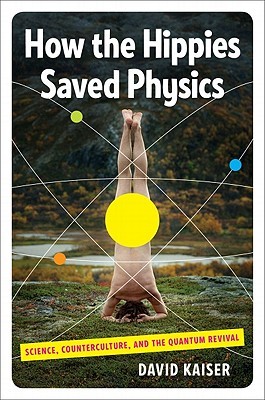
The surprising story of eccentric young scientists who stood up to convention-and changed the face of modern physics.
Today, quantum information theory is among the most exciting scientific frontiers, attracting billions of dollars in funding and thousands of talented researchers. But as MIT physicist and historian David Kaiser reveals, this cutting-edge field has a surprisingly psychedelic past. How the Hippies Saved Physics introduces us to a band of freewheeling physicists who defied the imperative to “shut up and calculate” and helped to rejuvenate modern physics.
For physicists, the 1970s were a time of stagnation. Jobs became scarce, and conformity was encouraged, sometimes stifling exploration of the mysteries of the physical world. Dissatisfied, underemployed, and eternally curious, an eccentric group of physicists in Berkeley, California, banded together to throw off the constraints of the physics mainstream and explore the wilder side of science. Dubbing themselves the “Fundamental Fysiks Group,” they pursued an audacious, speculative approach to physics. They studied quantum entanglement and Bell’s Theorem through the lens of Eastern mysticism and psychic mind-reading, discussing the latest research while lounging in hot tubs. Some even dabbled with LSD to enhance their creativity. Unlikely as it may seem, these iconoclasts spun modern physics in a new direction, forcing mainstream physicists to pay attention to the strange but exciting underpinnings of quantum theory.
A lively, entertaining story that illuminates the relationship between creativity and scientific progress, How the Hippies Saved Physics takes us to a time when only the unlikeliest heroes could break the science world out of its rut.
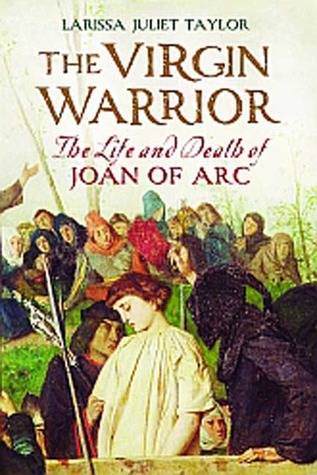
France’s great heroine and England’s great scourge: whether a lunatic, a witch, a religious icon, or a skilled soldier and leader, Joan of Arc’s contemporaries found her as extraordinary and fascinating as the legends that abound about her today. But her life has been so endlessly cast and recast that we have lost sight of the remarkable girl at the heart of it—a teenaged peasant girl who, after claiming to hear voices, convinced the French king to let her lead a disheartened army into battle. In the process she changed the course of European history.
In TheVirgin Warrior, Larissa Juliet Taylor paints a vivid portrait of Joan as a self-confident, charismatic and supremely determined figure, whose sheer force of will electrified those around her and struck terror into the hearts of the English soldiers and leaders. The drama of Joan’s life is set against a world where visions and witchcraft were real, where saints could appear to peasants, battles and sieges decided the fate of kingdoms and rigged trials could result in burning at the stake. Yet in her short life, Joan emboldened the French soldiers and villagers with her strength and resolve. A difficult, inflexible leader, she defied her accusers and enemies to the end. From her early years to the myths and fantasies that have swelled since her death, Taylor teases out a nuanced and engaging story of the truly irresistible “ordinary” girl who rescued France.
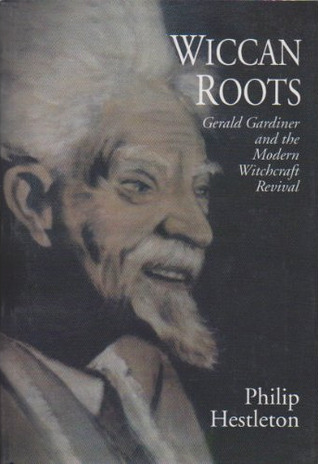
“…dispels many of the myths associated with Gerald Gardner and the development of modern Wicca. Heselton’s research is excellent and his findings are well presented. This book is essential reading for anyone interested in, or practising, Wicca today.” Graham King, The Museum of Witchcraft This book reveals a remarkable picture of the revival of witchcraft in England during the 1930s and 40s. Through years of research, the author has pieced together the story of how retired civil servant, Gerald Gardner, became involved in the worlds of naturism and folklore, which led him to discover a strange theatre run by an esoteric magical group known as the Crotona Fellowship. Here he made contact with a family of hereditary witches, whom the author has been able to identify, whose lineage dates back to Napoleonic times. The personalities of two key figures in the story, ‘Old Dorothy’ Clutterbuck, in whose house Gardner was initiated, and Dafo, his High Priestess, are brought to life, and photographs appear for the first time. Whatever the truth about Dorothy’s involvement with witchcraft, extracts from her diaries, never before made public, reveal her as a pagan at heart. New light is shed on the momentous ritual the witches carried out in 1940 when invasion threatened, including the probable identity of those who gave their lives in the cause. Few witches, pagans or other students of modern religious movements will fail to be fascinated by the carefully researched revelations in this important book.
Enochian (/ɪˈnoʊkiən/ə-NOH-kee-ən) is an occult language or languages, claimed to be angelic, recorded in the private journals of John Dee and his colleague Edward Kelley in late 16th-century England.[3] Kelley was a spirit medium who worked with Dee in his magical investigations. The men claimed that the language was revealed to them by the Enochian angels. The language is integral to the practice of Enochian magic.
The language found in Dee’s and Kelley’s journals encompasses a limited textual corpus, only some of it with translation. Several linguists, notably Donald Laycock, have studied the Enochian journals, and argue against any extraordinary features in the language. The untranslated language of the Liber Loagaeth manuscript recalls the patterns of glossolalia. The language of the Calls, which are translated, may be more like an artificial language. The phonology is thoroughly English; the grammar seems to be less so, but the translations are not sufficient to work out much grammar.[4]
Dee’s journals did not describe the language as “Enochian”, instead preferring descriptors like “Angelical”, the “Celestial Speech”, the “Language of Angels”, the “First Language of God-Christ”, the “Holy Language” or “Adamical” because, according to Dee’s Angels, it was used by Adam in Paradise to name all things. The term “Enochian” comes from Dee’s assertion that the Biblical PatriarchEnoch had been the last human (before Dee and Kelley) to know the language.
Dee’s Angelic language
According to Tobias Churton in his text The Golden Builders,[5] the concept of an Angelic or antediluvian language was common during Dee’s time. If one could speak the language of Angels, it was believed one could directly interact with them.
In 1581, Dee mentioned in his personal journals that God had sent “good angels” to communicate directly with prophets. In 1582, Dee teamed up with the seerEdward Kelley, although Dee had used several other seers previously.[6] With Kelley’s help as a scryer, Dee set out to establish lasting contact with the angels. Their work resulted, among other things, in the reception of the Enochian or Angelical language.
According to Laycock’s linguistic analysis, the syntax of the Enochian calls is almost identical with that of English.[4] Also, the very scant evidence of Enochian verb conjugation seems quite reminiscent of English, more so than with Semitic languages as Hebrew or Arabic, which Dee claimed were debased versions of the original Angelic language.[4] There are only two known verbs with conjugations, one of which, “to be,” is highly irregular.[7] While some phonetic features of Enochian show a connection to glossolalia, others show similarities to the English language.
The reception of Enochian started on March 26, 1583, when Kelley reported visions in the crystal of the twenty-one lettered alphabet characteristic of the language. A few days later, Kelley started receiving what became the first corpus of texts in the purported Angelic language. This resulted in the book Liber Loagaeth (“Book [of] Speech from God”). The book consists of 49 great letter tables, or squares made of 49 by 49 letters (however, each table has a front and back side—making 98 49×49 tables in all).[8] Dee and Kelley said the angels never translated the texts in this book.
The other set of Enochian texts was received through Kelley about a year later, in Kraków, where both alchemists stayed for some time at the court of King Stefan Batory. These come with English translations, thus providing the basis for the Enochian vocabulary. The texts comprise 48 poetic verses, which in Dee’s manuscripts are called “Claves Angelicae”, or “Angelic Keys”. The Keys are assigned certain functions within the magical system. Dee was apparently intending to use these Keys to “open the 49 Gates of Wisdom/Understanding” represented by the 49 magic squares in Liber Loagaeth:
I am therefore to instruct and inform you, according to your Doctrine delivered, which is contained in 49 Tables. In 49 voices, or callings: which are the Natural Keys to open those, not 49 but 48 (for one is not to be opened) Gates of Understanding, whereby you shall have knowledge to move every Gate…[9]— The angel Nalvage
But you shall understand that these 19 Calls are the Calls, or entrances into the knowledge of the mystical Tables. Every Table containing one whole leaf, whereunto you need no other circumstances.[10]— The angel Illemese
While these texts contain most of the vocabulary, dozens of further words are found hidden throughout Dee’s journals, and thousands of undefined words (effectively a second Enochian language) are contained in the Liber Loagaeth.
Alphabet
The Enochian script is written from right to left, and may include diacritical marks. Different documents have slightly different forms of the script. Some of the letter names are pronounced as they would be in English, but many are pronounced differently. The Enochian letters have English letter equivalents.[11] A number of different fonts for the Enochian alphabet are available, which use the English letter equivalents to access the Enochian glyphs.[12][13][14][15]
The Enochian letters are read from right to left, as written in John Dee’s diary.[16]
The Enochian alphabet is a substitution cipher for the English alphabet. The English equivalents, letter forms and letter names are as follows:[11][17] Letters and combinations of letters are pronounced as in English, with all its irregularities.[18]
“The beatific vision of divine beauty is the knowledge of Pure Interval, of harmonious relationship apart from the things related.”
– Aldous Huxley
In his essay, Heaven and Hell, Aldous Huxley recounts sitting on a beach with a friend when, “suddenly, my consciousness was lighted up from within and I saw in a vivid way how the whole universe was made up of particles of material which, no matter how dull and lifeless they might seem, were nevertheless filled with this intense and vital beauty.” Such a dynamic experience of beauty is what he is referring to in this extract from Seven Meditations, a brief exploration of being, beauty, love, peace, holiness, grace and joy. He talks about the beatific vision of divine beauty that resides in Pure Interval, or harmonious relationship. Like Galway Kinnell’s insight into the beauty of a sow, Huxley suggests we can experience the divine through architecture, music, sacred geometries and human relationships.
Beauty arises when the parts of a whole are related to one another and to the totality in a manner which we apprehend as orderly and significant. But the principle of order is God, and God is the final, deepest meaning of all that exists. God, then, is manifest in the relationship which makes things beautiful. He resides in that lovely interval which harmonizes events on all the planes, where we discover beauty. We apprehend Him in the alternate voids and fullnesses of a cathedral; in the spaces that separate the salient features of a picture; in the living geometry of a flower, a sea shell, an animal; in the pauses and intervals between the notes of music, in their differences of tone and sonority; and finally, on the plane of conduct, in the love and gentleness, the confidence and humility, which give beauty to the relationships between human beings.
Such then, is God’s beauty, as we apprehend it in the sphere of created things. But it is also possible for us to apprehend it, in some measure at least, as it is in itself. The beatific vision of divine beauty is the knowledge, so to say, of Pure Interval, of harmonious relationship apart from the things related.
“A material figure of beauty-in-itself is the cloudless evening sky, which we find inexpressibly lovely, although it possesses no orderliness of arrangement, since there are no distinguishable parts to be harmonized.”
A material figure of beauty-in-itself is the cloudless evening sky, which we find inexpressibly lovely, although it possesses no orderliness of arrangement, since there are no distinguishable parts to be harmonized. We find it beautiful because it is an emblem of the infinite Clear Light of the Void. To the knowledge of this Pure Interval we shall come only when we have learned to mortify attachment to creatures, above all to ourselves.
Moral ugliness arises when self-assertion spoils the harmonious relationship which should exist between sentient beings. Analogously, aesthetic and intellectual ugliness arise when one part in a whole excessive or deficient. Order is marred, meaning distorted, and, for the right, the divine relation between things thoughts, there is substituted a wrong relation—a relationship that manifests symbolically, not the immanent and transcendent source of all beauty, but that chaotic disorderliness which characterizes creatures when they try to live independently of God.
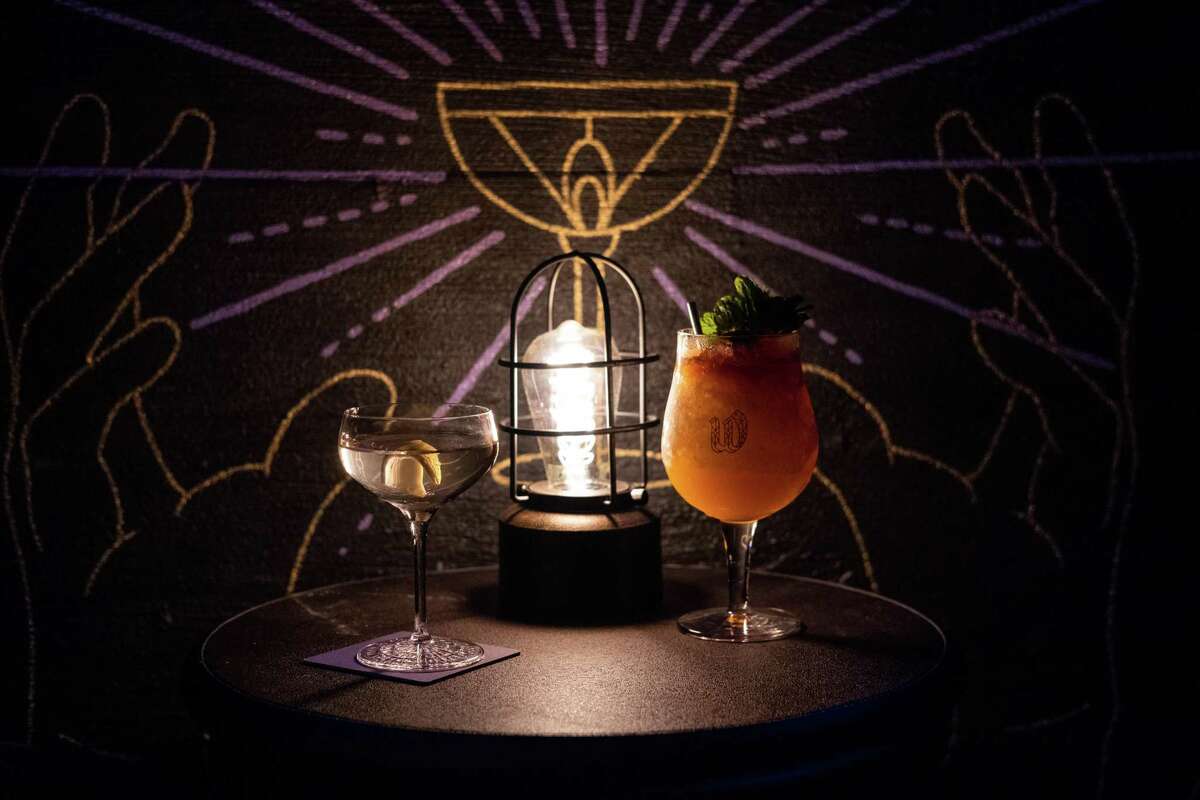
1of3A martini and Valiant Quest cocktail served at Wunderbar in San Mateo.Courtesy Stephanie Amberg
The Peninsula is now home to a moody new speakeasy bar serving creative cocktails on a menu inspired by tarot cards.
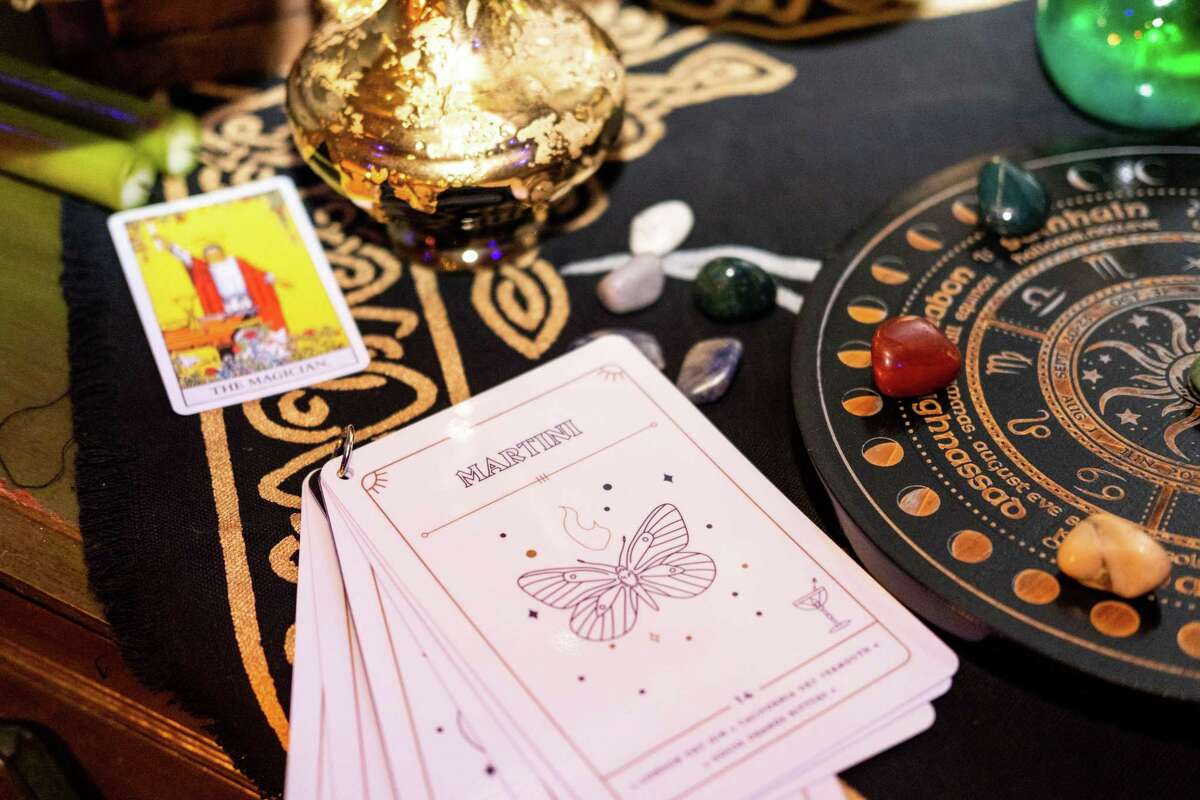
Wunderbar is a reservations-only spot located in the basement of downtown San Mateo restaurant Wursthall, at 310 Baldwin Ave. Customers order from tarot cards; on one side is a classic cocktail, like an old fashioned or martini, and on the back side are bar manager Kiernan Moran’s riffs. Take, for example, his dirty martini, made with dashi.
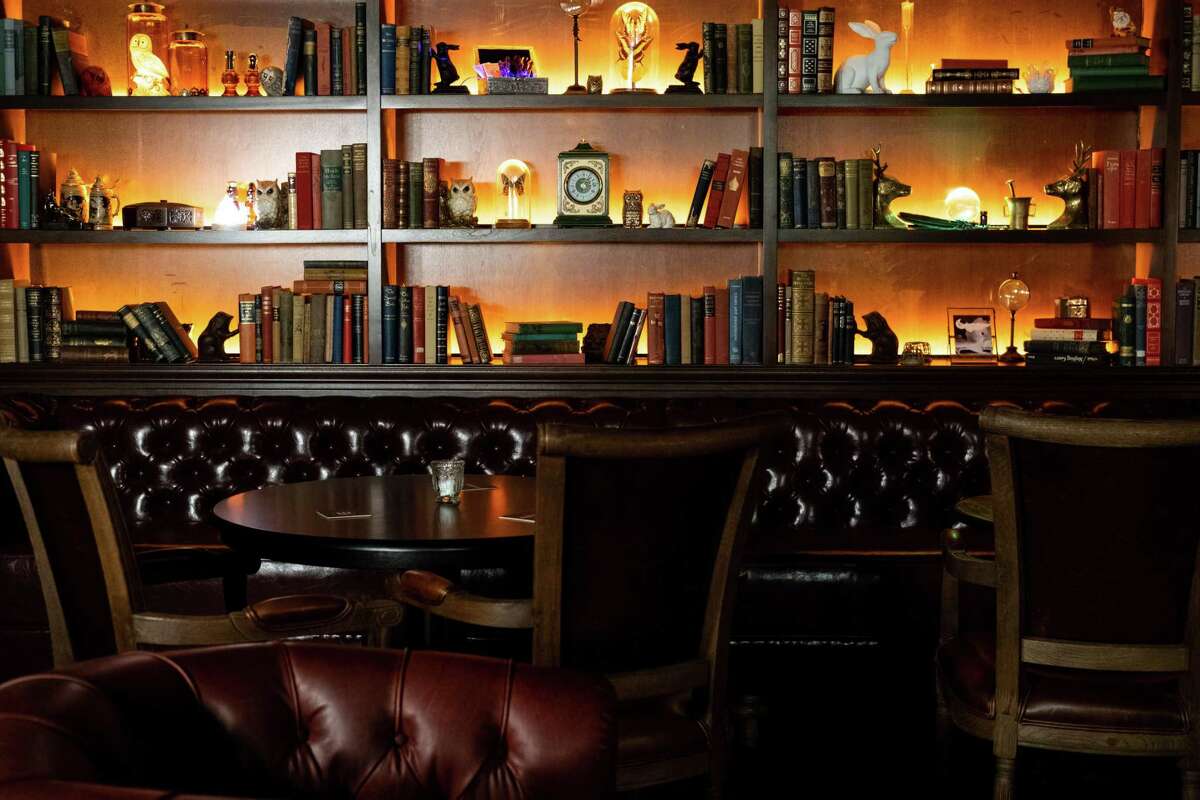
Visitors enter the underground bar through a separate entrance from Wursthall. The space has 40 seats, including a semi-private nook with purple velvet chairs, and is decorated like an “whimsical underground lair,” general manager Xian Choy said. Think backlit dark wood bookshelves, deep red leather chairs and animal statues inspired by Grimm’s Fairy Tales. Framed tarot cards hang on the walls.
Moran, a San Mateo native, brings his bar experience from San Francisco’s Gibson and San Mateo’s Sixtos Cantina to Wunderbar. He likes to play with savory ingredients, like guajillo chiles or sage, that are more likely to show up in a restaurant dish than a cocktail. He and Choy spent as much time creating their ideal version of the traditional cocktails as their own interpretations, including blind-tasting whiskeys for the Manhattan for an entire week.
For wine, Wunderbar is focused on bottles made with minimal intervention, from organically produced to the more extreme zero zero, meaning nothing is added. There are also local canned beers — plus Miller High Life, “because sometimes you just need an obscenely carbonic palate refresher,” Choy said. There’s no food, but a custom machine will churn out buttered popcorn as a snack.
Wunderbar has been years in the making; the owners’ goal was to bring a thoughtful cocktail bar to the Peninsula. The planned 2020 opening was delayed by more than a year due to the pandemic. The bar is soft opening now and will fully open on Dec. 1.
Read on for a deep dive on four cocktails served at Wunderbar.
Sidewinder’s Fang: This tiki drink was born at the long-closed San Mateo bar the Lanai, which was reportedly frequented by members of the Rat Pack and visiting football teams playing against the San Francisco 49ers. Moran makes a classic version with two kinds of rum, passionfruit and fresh lime and orange juice. His spin on it comes with nutty Amontillado sherry, umeboshi (Japanese pickled plum) and orgeat, a sweet almond syrup.
Mirror Mirror: Moran’s rendition on the Old Fashioned gets more complexity from two different kinds of amaro — one bitter and one sweet, with notes of molasses — and cocoa bitters. He’s obsessed with amaro, and the Italian liqeuer shows up throughout the menu.
Siren’s Song: For an up-leveled dirty martini, try this drink. Instead of olive brine, they’re using dashi made from scratch using cookbook author and Wursthall opening partner Kenji Lopez-Alt’s recipe. The rich kombu broth gets mixed with sake, gin and makrut lime. The aromatic citrus adds “lemony, Fruit Loop-y” notes, Moran said.
Wise Woman: With his riff on a French 75, Moran wanted to create a drink that challenges vodka’s reputation as a flat, boring alcohol. He adds amaro from Lo-Fi Aperitifs, infused with ginger, anise and grapefruit, as well as blackberry and sage.
Elena Kadvany joined The San Francisco Chronicle as a food reporter in 2021. Previously, she was a staff writer at the Palo Alto Weekly and its sister publications, where she covered restaurants and education and also founded the Peninsula Foodist restaurant column and newsletter.VIEW COMMENTSTop of the News
A deforested area close to Sinop, in the Brazilian state of Mato Grosso, in August 2020. (Florian Plaucheur/AFP/Getty Images)
By Ellen Francis and Gabriela Sá Pessoa November 19, 2021 | WashingtonPost.com
Brazil’s Amazon rainforest lost more trees over the past year than in any year since 2006.
Satellite data revealed that deforestation rose by nearly 22 percent from the last period to reach its highest level in 15 years, the National Institute for Space Research found, in a country that is home to most of the world’s largest rainforest.Complete coverage from the COP26 U.N. climate summit
Brazilian President Jair Bolsonaro, who had made campaign promises to open the Amazon to business development, missed the climate summit in Glasgow, though his country joined the global pledge to save the world’s trees.
With the rate of destruction not slowing, critics questioned whether Brazil can meet its target, and some accused Bolsonaro’s administration of delaying the release of the latest deforestation benchmark until after the U.N. summit — an allegation the environment minister denied.
The Amazon in Brazil lost more than 5,000 square miles of rainforest from August 2020 to July 2021,the government research center said in a report that was dated Oct. 27 and shared on Thursday. It was the fourth year in a row that the rate of deforestation rose, it said.
Climate activists have warned of the risks of letting the global pledge fall short: The devastation of forests drives up greenhouse gas emissions, and Global Forest Watch found the world lost 411 million hectares of forest between 2001 and 2020 — roughly half the size of the United States.
The rainforest in Latin America’s largest country, under pressure from farming, logging and wildfires, is at the heart of the struggle to limit emissions. Trees absorb carbon dioxide when they grow, slowing global warming, but release it into the atmospherewhen they decay, or are cut or burned.
Brazil’s Environment Minister Joaquim Leite called the new figures on Thursday “unacceptable” and said the cabinet would do more. At a news conference, he said the data did not reflect recent curbs on environmental crimes.
However, advocacy groups such as the Climate Observatory blamed policies such as road expansion and cuts to environmental fines for making “the world’s largest rainforest disappear before our eyes.” It accused the state of delaying the report’s publication.
“This is the real Brazil that the Bolsonaro administration is trying to hide with its fantasy speeches and greenwashing,” the World Wildlife Fund said in a statement.
The Brazilian president has faced such accusations before. In 2019, he described deforestation data from the National Institute for Space Research as a lie. The head of the research agency was dismissed after he criticized the president and maintained that the data was accurate.
The Ministry of Science and Technology did not immediately respond to a request for comment on the allegation. While the research agency’s workers union said that the government would have known about the annual report, which was ready in October, Leite, the environment minister, told reporters that he had only seen the data this week: “Exactly like you.”
Effective December 31, 2021 at midnight, Al Haferkamp, H.W., M., will step down as Dean of The Prosperos.
And it was decided at today’s Prosperos Trustees meeting that William Fennie, H.W., M. will become the Acting Dean at that same date and time at least until the annual Trustee’s Meeting over Labor Day Weekend, 2022.
New Thinking Allowed with Jeffrey Mishlove James Tunney, LLM, is an Irish Barrister who has lectured on legal matters throughout the world. He is a poet, a visual artist, and author of The Mystery of the Trapped Light: Mystical Thoughts in the Dark Age of Scientism plus The Mystical Accord: Sutras to Suit Our Times, Lines for Spiritual Evolution. His website is http://www.jamestunney.com. Here he acknowledges that he is approaching this topic as a mystic and a scholar, but not as a practitioner of ceremonial magic. He reviews various historical cases of conjuring, particularly that of John Dee, the court astrologer to Elizabeth I. He points out that laws against conjuring were established by Elizabeth’s father, Henry VIII. He describes various dangers associated with conjuring, including possession. He contrasts the magical practice of conjuring with the mystical journey that necessitates letting go of egotistical attachments. (Recorded on October 10, 2020)
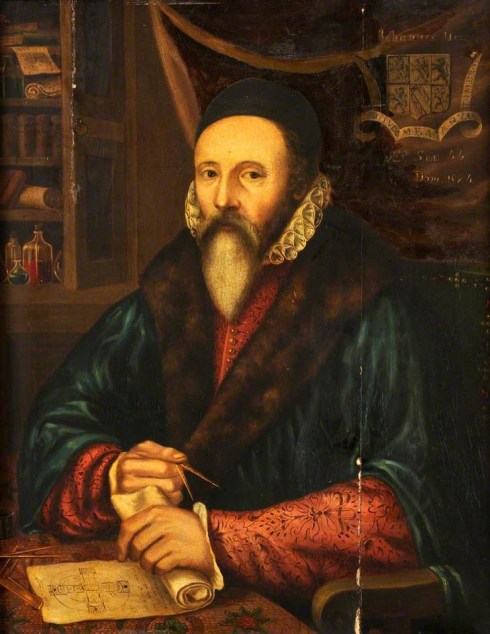
(c) Wellcome Library; Supplied by The Public Catalogue Foundation
In the 16th century the English were at war with the Spanish. Queen Elizabeth I needed information about her enemies for the empire she was starting to build. And she needed a spy to get it. Dr John Dee, a philosopher, alchemist and mathematician was introduced to her, and became her most trusted and brilliant advisor. He was the man who inspired Shakespeare to create the character of Prospero from The Tempest, and the inspiration for Ian Flemings James Bond…
He was the man who inspired Shakespeare to create the character of Prospero from The Tempest.
Queen Elizabeth I was an ambitious monarch who wished to see her country grow in influence. Spain, however, was the most powerful country in the world. The Spanish already had colonies in America and ruled the seas. And the country that ruled the seas ruled the world. For England to prosper, Elizabeth first of all had to get rid of the Spanish.
But she needed information about her enemies. She wanted to know what their plans were and what strategies they would use. A network of espionage emerged. English informers in Europe and in the New World would be her spies. Dr John Dee was to lead this new secret service.
He was born in 1557 by the River Thames in the village of Mortlake, now in West London. Dee was a brilliant scholar, indeed a genius. After studying philosophy and maths at Cambridge University, he went on to develop sea navigation on mathematic principles. He created maps of the most important routes to the new colonies. He was a man with many interests. His library at Mortlake was the greatest of its day, containing 4,000 books (the library at Cambridge University contained only 450!).
John Dee was also an alchemist. Alchemy was regarded as a science in those days. Alchemists believed that by studying the material world, the real truths of the spiritual world would be revealed. Dee, like all alchemists, believed that base metals like lead could be turned into gold. His experiments in this subject became famous among the rich and fashionable of the day. He was a friend of Englands most famous sailor, Sir Francis Drake, and the man that brought tobacco and potatoes to Europe, Sir Walter Raleigh.
But Dee was famous outside England, too. When visiting Queen Elizabeth in 1580, Count Adalbert Laski of Poland was so impressed by Dee that he invited him back to his home in Cracow. From there he travelled to Prague. The Czech capital was believed to be the centre of Catholic plots and intrigue against the Protestants. Was John Dee there to send back information to Elizabeth concerning the intentions of the Catholic powers, such as Spain?
Spain was at the height of its power in the late 16th century. Its only rival was England. If the Spanish could destroy the Elizabethan navy, then the seas would be safe for their ships. King Philip II of Spain thought that the Protestant English were heretics, and he personally hated Elizabeth. The final showdown between the two countries occurred in May 1588 when King Philip sent 125 of his best ships to attack his enemies in the English Channel.
When the Spanish ships approached the coast of southern England, Dee suggested waiting before attacking. He had correctly predicted that terrible storms would destroy the mighty Spanish fleet, therefore it would be best to keep the English ships at bay. Afterwards, most of the Spanish ships were lost or damaged, and the rest were attacked. The English ships easily disposed of their enemy. What little remained of the Spanish Armada, as historians call it, tried to escape by sailing through the Channel into the North Sea and thence around the British Isles over Scotland and by Ireland. But they sailed into more storms, and violent seas crashed into them. Many Spanish sailors were shipwrecked in Scotland and along the west coast of Ireland.
Some believed that it was the alchemist Dr John Dee who put a spell on the Spanish and sent the huge waves crashing down on their ships. It is more likely, however, that because he knew about meteorology, he had anticipated the storm scientifically. By skill, luck or magic the world was now safer for the British to build their Empire. Dr John Dee, scientist, or maybe magician, was crucial to the victory. It was Dees finest patriotic moment!
It is this episode in Dees life in particular that is said to have inspired William Shakespeare to write The Tempest (Burza) and base the character of Prospero on the Elizabethan genius.
Dee travelled constantly. On a visit to the University of Louvain in Belgium, he smuggled back new astrological instruments and two globes of the known world, the latest in navigation technology. When on a mission for Her Majesty, the communiqués to his sovereign were signed with a secret code. It told her that the letter was from him and no one else: For your eyes only…
The two circles symbolise John Dees own eyes as the eyes of Queen Elizabeth. The 7 is the alchemists lucky number. It was when the author of the Bond novels, Ian Fleming, was reading a biography of Dee that he came upon the 007 figures. This was perfect for his character. This is what signified that Bond was licensed to kill.
Sir John Dee killed nobody, though. But like James Bond, Dee seems to have been popular with the ladies. Unlike Bond, however, he married twice, in fact. His first wife died only a year after their marriage in 1557. Strangely, no mention of this woman, or the marriage to her, was ever made in Dees diaries. And even more strangely, on the day of her death Dee was seen entertaining Queen Elizabeth at his home in Mortlake, as if nothing had happened. Suspicious? He later married one of Queen Elizabeths top servants, Jane Frommond. No children came from either marriage.
Today Dee is remembered as an important man in English history. He was partly responsible for the growth of the British Empire and contributed much to scientific study. But towards the end of his life he was forgotten by most of his friends. In Elizabethan England, science and magic were seen as the same thing. But the occult was taboo, and throughout his life Dee had suffered accusations of sorcery and witchcraft from time to time. Still, there is no doubt about John Dees ubiquitous influence during the Elizabethan age.
After Elizabeth died and James I came to the throne, however, Dees ideas on magic were no longer appreciated. King Jamess attitude towards the occult was the opposite of Elizabeths, and Dees influence faded. He died in 1608, impoverished and alone.
Nevertheless, thanks to Ian Fleming, the popularity of James Bond has ensured that a new audience will become acquainted with Dr John Dee, one of Englands first ever spies and Britains original 007.
by Peter Gentle (woe.edu.pl)
Consciousness, spirituality, biography, sexuality, androgyny, futurism, space, the arts, science, astrology, democracy, humor, books, movies and more



 ©2021 Hearst




.svg)


