Free Will Astrology for week of Nov. 4, 2021

Life will improve for those who are actively involved in seeking remedies to psychological wounds. (Shutterstock)

Life will improve for those who are actively involved in seeking remedies to psychological wounds. (Shutterstock)

Aries, now’s the time to connect with allies to generate healing

.

ARIES (March 21-April 19): Are you still hoping to heal from psychological wounds that you rarely speak about? May I suggest that you consider speaking about them in the coming weeks? Not to just anyone and everyone, of course, but rather to allies who might be able to help you generate at least a partial remedy. The moment is ripe, in my opinion. Now is a favorable time for you to become actively involved in seeking cures, fixes, and solace. Life will be more responsive than usual to such efforts.

TAURUS (April 20-May 20): “The delights of self-discovery are always available,” writes author Gail Sheehy. I will add that those delights will be extra accessible for you in the coming weeks. In my view, you’re in a phase of super-learning about yourself. You will attract help and support if you passionately explore mysteries and riddles that have eluded your understanding. Have fun surprising and entertaining yourself, Taurus. Make it your goal to catch a new glimpse of your hidden depths every day.

GEMINI (May 21-June 20): Gemini novelist and philosopher Muriel Barbery says, “I find this a fascinating phenomenon: the ability we have to manipulate ourselves so that the foundation of our beliefs is never shaken.” In the coming weeks, I hope you will overcome any tendency you might have to manipulate yourself in such a way. In my view, it’s crucial for your mental and spiritual health that you at least question your belief system‚ and perhaps even risk shaking its foundation. Don’t worry: Even if doing so ushers in a period of uncertainty, you’ll be much stronger for it in the long run. More robust and complete beliefs will be available for you to embrace.

CANCER (June 21-July 22): In her book “Mathilda,” novelist Mary Shelley (1797-1851) has the main character ask, “What had I to love?” And the answer? “Oh, many things: there was the moonshine, and the bright stars; the breezes and the refreshing rains; there was the whole earth and the sky that covers it.” I bring this to your attention in the hope of inspiring you to make your own tally of all the wonders you love. I trust your inventory will be at least ten times as long as Mathilda’s. Now is a favorable time for you to gather all the healing that can come from feeling waves of gratitude, even adoration, for the people, animals, experiences, situations and places that rouse your interest and affection and devotion.

LEO (July 23-Aug. 22): Our memories are always changing. Whenever we call up a specific remembrance, it’s different from the last time we visited that same remembrance‚ colored by all the new memories we have accumulated in the meantime. Over time, an event we recall from when we were 9 years old has gone through a great deal of shape-shifting in our memory so much so that it may have little resemblance to the first time we remembered it. Is this a thing to be mourned or celebrated? Maybe some of both. Right now, though, it’s to be celebrated. You have extra power to declare your independence from any memories that don’t make you feel good. Why hold onto them if you can’t even be sure they’re accurate?

VIRGO (Aug. 23-Sept. 22): In 1962, astronaut John Glenn became the first American to orbit the Earth in a spacecraft. His flight marked the first time that NASA, the agency in charge of spaceflight, had ever used electronic computers. Glenn, who was also an engineer, wanted the very best person to verify the calculations, and that was Virgo mathematician Katherine Johnson. In fact, Glenn said he wouldn’t fly without her involvement. I bring this to your attention, Virgo, because I believe the coming months will be a favorable time for you to garner the kind of respect and recognition that Katherine Johnson got from John Glenn. Make sure everyone who needs to know does indeed know about your aptitudes and skills.

LIBRA (Sept. 23-Oct. 22): According to an Apache proverb, “It is better to have less thunder in the mouth and more lightning in the hand.” If you act on that counsel in the coming weeks, you will succeed in doing what needs to be done. There is only one potential downfall you could be susceptible to, in my view, and that is talking and thinking too much about the matter you want to accomplish before you actually take action to accomplish it. All the power you need will arise as you resolutely wield the lightning in your hands.https://d981df92f7dcf7dd5bd7f17a80331352.safeframe.googlesyndication.com/safeframe/1-0-38/html/container.html

SCORPIO (Oct. 23-Nov. 21): To encourage young people to come to its shows, the English National Opera has offered a lot of cheap tickets. Here’s another incentive: Actors sing in English, not Italian or French or German. Maybe most enticing for audiences is that they are encouraged to boo the villains. The intention is to make attendees feel relaxed and free to express themselves. I’m pleased to give you Scorpios permission to boo the bad guys in your life during the coming weeks. In fact, I will love it if you are extra eloquent and energetic about articulating all your true feelings. In my view, now is prime time for you to show the world exactly who you are.

SAGITTARIUS (Nov. 22-Dec. 21): “If we’re not careful, we are apt to grant ultimate value to something we’ve just made up in our heads,” said Zen priest Kosho Uchiyama. In my view, that’s a problem all of us should always be alert for. As I survey my own past, I’m embarrassed and amused as I remember the countless times I committed this faux pas. For instance, during one eight-month period, I inexplicably devoted myself to courting a woman who had zero interest in a romantic relationship with me. I bring this to your attention, Sagittarius, because I’m concerned that right now, you’re more susceptible than usual to making this mistake. But since I’ve warned you, maybe you’ll avoid it. I hope so!

CAPRICORN (Dec. 22-Jan. 19): Capricorn author Asha Sanaker writes, “There is a running joke about us Capricorns that we age backwards. Having been born as burdened, cranky old people, we become lighter and more joyful as we age because we have gained so much practice in wielding responsibility. And in this way we learn, over time, about what are our proper burdens to carry and what are not. We develop clear boundaries around how to hold our obligations with grace.” Sanaker’s thoughts will serve as an excellent meditation for you in the coming weeks. You’re in a phase when you can make dramatic progress in embodying the skills she articulates.

AQUARIUS (Jan. 20-Feb. 18): As author Denise Linn reminded us, “The way you treat yourself sends a very clear message to others about how they should treat you.” With that advice as your inspiration, I will ask you to deepen your devotion to self-care in the coming weeks. I will encourage you to shower yourself with more tenderness and generosity than you have ever done in your life. I will also urge you to make sure these efforts are apparent to everyone in your life. I am hoping for you to accomplish a permanent upgrade in your love for yourself, which should lead to a similar upgrade in the kindness you receive from others.

PISCES (Feb. 19-March 20): You have at your disposal a prodigiously potent creative tool: your imagination. If there’s a specific experience or object you want to bring into your world, the first thing you do is visualize it. The practical actions you take to live the life you want to live always refer back to the scenes in your mind’s eye. And so every goal you fulfill, every quest you carry out, every liberation you achieve, begins as an inner vision. Your imagination is the engine of your destiny. It’s the catalyst with which you design your future. I bring these ideas to your attention, dear Pisces, because November is Celebrate Your Imagination Month.

Homework: Describe what actions you’ll take in the next six months to make your world a more fun, holier place. Newsletter: FreeWillAstrology.com.

Scorpio New Moon, November 4, 2021

Wendy Cicchetti

Scorpio New Moon

The New Moon in Scorpio continues the rather dense and intense atmosphere that abides now, especially with both the Sun and Mars already in Scorpio. Difficult themes — including jealousy, suspicion, insecurity, and vindictiveness — may be super-pronounced at this time. With Mars near the New Moon, intense feelings may be hard to screen out, particularly lust, anger, and hurt. We can literally feel these burning in some way — perhaps through the heat of passion or the height of irritation! Passion may seem less of a problem, unless it leads into inappropriate or unhelpful actions — in which case, it might be a good time to take a deeper look at what is driving this.

In the case of anger or hurt, it is worth remembering that emotions don’t come out of nowhere. There will — most likely — have been an intervening thought process, which led to registering those difficult feelings. In which case, our first remedial action might be to check whether the thoughts were actually true. And upon reflection, we may realize it possibly wasn’t and can decide to focus on a more positive line of thinking.

As the New Moon is closely opposed by Uranus in Taurus, there is the sense of something coming from out of the blue. In this situation, there might be the need for a judgment call about prompt action. Perhaps it truly will be needed to stem a problem or to help a situation develop positively. But note that Uranus continues retrograde, which suggests that a situation could remain unsettled. It could be that we need to take more than one step to manage a set of circumstances — like the Oasis song title goes, we might need to “Roll With It”!

The New Moon–Mars opposition to Uranus forms part of the larger t-square pattern with Saturn in Aquarius. The focal position of this planet basically means it is located at the midpoint of the opposition — a place we might consider useful for mediation between the other planets and the energies, people, or situations they represent.

Frank Clifford, in Getting to the Heart of Your Chart (Flare, 2012), describes t-squares like pressure-cookers — that underneath the lid, “There’s a huge amount of tension needing to be released — stress from parts of ourselves that are at odds with each other … T-Squares demand resolution, action and discharge.” Anyone who has read this column for a while knows that t-squares involving the Moon’s phases are not unusual. Therefore, the need to go through this type of recognition and release process can be a fairly common experience, part of the normal ebb and flow of life. We shouldn’t’t fear that anything insurmountable or world-rocking is the likely outcome, even though our feelings may make it seem that way!

Saturn, in particular, can make situations feel extra heavy and feed the fear factor. If our first response to a new challenge brought along by shock-giver Uranus is to freeze, then that may be the right reaction. Fear can have that kind of power — at least temporarily. For when we pause, we don’t make a serious mistake or launch ourselves headlong into a dangerous scenario.

It seems that Saturn’s emphasis on caution — whether driven from deep-seated terror, a need to do the right thing, or adhere to some rules and regulations — is there to protect us. It might be emphasizing the need to slow down and consider all options before taking action.

This is probably helpful in more ways than one, given that the Moon is disposited by both rash, abrasive Mars and obsessive, paranoid Pluto! We could easily operate from an angry, distrusting place only to realize down the line that the situation was not as grim as we first thought.

There is a wide (almost 8°) trine between the Moon and Neptune, and normally we might dismiss this, preferring a 6° orb. But with so much tension otherwise present in the opposition and squares — including Pluto square to Eris in Aries, emphasizing a great intensity of purpose — the trine to escapist, gentle Neptune seems almost soothing! We may need a little break here and there from the driving and striving bound up in these hard aspects to dress wounds, replenish hunger and thirst, or catch up on revitalizing sleep to help us prepare for the next round!

This article is from the Mountain Astrologer written by Diana McMahon Collis

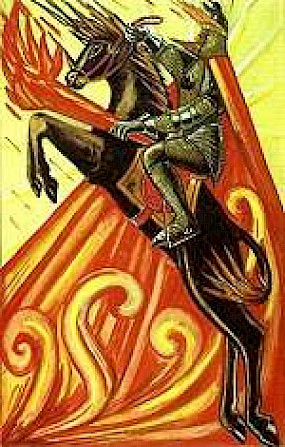
Tarot Card for November 3: The Knight of Wands


The Knight of Wands

The man represented by the Knight of Wands will be a loving and open-hearted person, with a strong sense of morality and a great sense of humour. He will be active, energetic and willing to help. You often find these types of men in the healing professions, or in other areas where they are required to assist, guide and support others.

He’s a man with a deep respect for life and all living things, attuned to Nature and to the creatures of the earth. He has a deep well of compassion which spills over readily to anyone who needs his help, but he also has the restraint to know when too much assistance is a bad thing. Then he will act to enable and empower, rather than to assisting.

He’s a faithful, and dedicated family man, being fully engaged in the domestic situation. His life reflects his high ethical standards, though he is not given to sermonising, nor standing in judgement on others. He could be defined as an idealistic realist – accepting the frailties of the race, whilst doing his best to strengthen it.

His faults spring from his good points – for instance, he dislikes causing pain, and will therefore delay when he needs to act if he thinks it will hurt other people. He will sometimes remain in limiting or painful circumstances because of this. His sense of rightness and duty is intense, and sometimes drives him to make foolish choices and decisions. He will shy away from conflict and unpleasant situations, especially when these arise as a result of his own needs, though he will never walk away from a struggle on behalf of somebody else.

If you are regarding this card as a spiritual change, then see it as an indication that the warrior of right and light is required – you’ll need to stand up for something that matters, and which is unable to defend itself.

The Knight of Wands

(via angelpaths.com and Alan Blackman)

Bernardo Kastrup – Buddha at the Gas Pump Interview

BuddhaAtTheGasPump Also see https://batgap.com/bernardo-kastrup/ Bernardo Kastrup has a Ph.D. in Computer Engineering and has worked as a scientist in some of the world’s foremost research laboratories, including the European Organization for Nuclear Research (CERN) and the Philips Research Laboratories (where the “Casimir Effect” of Quantum Field Theory was discovered). He has authored many scientific papers and four philosophy books: Rationalist Spirituality, Dreamed up Reality, Meaning in Absurdity, and Why Materialism Is Baloney. This latter book is a grand synthesis of his metaphysical views. Bernardo has also been an entrepreneur and founder of two high-tech businesses. Today, he holds a managerial position in the high-tech industry. In parallel, he maintains a philosophy blog, an audio/video podcast, and continues to develop his ideas about the nature of reality. Bernardo has lived and worked in four different countries across continents. Books: Why Materialism Is Baloney: How True Skeptics Know There Is No Death and Fathom Answers to life, the Universe, and Everything Meaning in Absurdity: What bizarre phenomena can tell us about the nature of reality Dreamed Up Reality: Diving into the Mind to Uncover the Astonishing Hidden Tale of Nature Rationalist Spirituality: An exploration of the meaning of life and existence informed by logic and science Website: bernardokastrup.com Interview recorded 7/12/2014

Bay Area rage rooms are helping residents relieve stress

Linda Childers Nov. 2, 2021 (SFGate.com)

Customers smash items in a Bay Area rage room.
Customers smash items in a Bay Area rage room.Yelp / Miguel M.

To say the past year has been stressful is an understatement. A global pandemic combined with differing opinions on everything from politics to the coronavirus vaccine has left many of us feeling frustrated and angry. There’s even an unofficial term to describe our feelings: pangry.  

I know it’s important to manage stress so that it doesn’t affect your health, but I’ve always found it challenging to meditate. When I heard of a new rage room that opened in San Francisco, I figured it was worth a try. Spend a half hour in a private room destroying televisions, computers and furniture? That sounds more like it.  

The origin of rage rooms, also known as smash or anger rooms, can be traced back to Japan in 2008. The launch of The Venting Place in Tokyo coincided with Japan’s economy falling into a recession and it offered locals a place where they could relieve stress by smashing dishes and throwing plates.  

The trend slowly caught on in other parts of the world, and this month, Miguel Moises of Marin County opened San Francisco’s first smash room. Tucked away in a basement below a nail salon on Market Street, Bay Area Smash Room features four private rooms where individuals and groups can destroy everything from kitchen appliances to electronics. 

Moises had his first smash room experience several years ago in Miami, Florida. When he returned home and was unable to find a similar venue in the Bay Area, he decided to open his own. In October of last year, he launched his first smash room location in Fairfield. 

“Most people don’t know what to expect the first time they visit a smash room,” Moises admits. “Guests are welcome to bring in personal items they want to smash, or they can use a Sharpie and write the name of someone like an ex, or their boss, on objects prior to destroying them.” 

Safety is a priority at smash rooms. Moises advises all guests to wear closed-toed shoes, pants and long sleeves and equips each participant with goggles, hard hats and gloves. 

After guests are suited up, they’re invited to choose a “weapon” from a selection that includes baseball bats, golf clubs, crowbars and hammers. On a recent weekend, I decided to channel my inner Harley Quinn and chose an aluminum baseball bat.  

Once in the smash room, my son and I are greeted by a car’s windshield, a computer, a bookcase and an assortment of bowls and plates. Moises points out speakers in the room and invites us to select our own music.  

We get 30 minutes to demolish the contents of the room, and we don’t waste any time. I destroy a wooden bookcase with a force that surprised me. One of my beloved dogs died suddenly the week before and I realize anger is one of the five stages of grief, and I haven’t fully processed my feelings. In a matter of minutes, all that is left of the bookcase are a few wooden shelves on the ground. 

Once the bookcase has been annihilated, I decide to purge my stress by taking it out on an old computer.  

On the other side of the room, my son is destroying a car’s windshield. College midterms are approaching, and he’s also grieving our family dog. His baseball bat hits the glass with a powerful swing I feel certain would make the San Francisco Giants proud. 

Next up are bowls, which we casually toss into the air, relishing the sound of glass connecting with aluminum. We discover the plates are infinitely more satisfying to destroy, thanks to their size and the rewarding thunk sound they make when they hit the wall.  

At the end of 30 minutes, I feel a sense of calm. Not only have I released a lot of tension, but it was also a great workout.  

Moises offers an appreciative chuckle when he enters the room and sees our destruction. Fortunately, he has an ample supply of breakable items, thanks to weekly donations from thrift stores and others. 

As an avid supporter of mental health, Moises is working with local community groups to spread the word on smash rooms. “We have an Autism Day coming up and we hope to host more neurodivergent groups in the future,” he says.

Moises says he would like to open a splash room for children who are too young to smash, allowing them to ease their frustrations by releasing their inner Picasso and throwing paint at walls. He says he also hopes to open smash rooms in other Bay Area locations and eventually franchise the business. 

The mother in me feels compelled to move the pile of broken china into a pile with my shoes, but Moises waves us away. Part of the appeal of smash rooms is also being able to demolish items without consequences. There’s no clean-up and no judgment. 

I can’t wait to return. 

Linda Childers is a Bay Area native and freelance writer. Her work has appeared in The Washington Post, The Boca Raton Observer, Shondaland, and many other media outlets.

PHILOSOPHER: PANPSYCHISM IS NOT IN CONFLICT WITH PHYSICS AT ALL

Responding to criticism from physicists Sabine Hossenfelder and Sean Carroll, Philip Goff points out that panpsychism is not a dualist perspective

October 31, 2021 (mindmatters.ai)

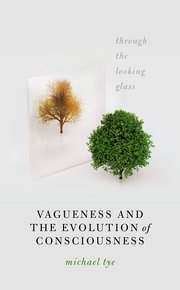
At IAI.tv, University of Durham philosophy prof Philip Goff tells us that “The world of academic philosophy has been rocked by the conversion of one of the most influential materialists of the last thirty years, Michael Tye, to a form of panpsychism (panprotopsychism) in his latest book. And the main annual UK philosophy conference held a plenary panel on panpsychism this year for the first time in its history.” That’s part of a pattern in which philosophy and science are warming to panpsychism, the belief that either all entities or all living entities participate in consciousness.

More on Michael Tye

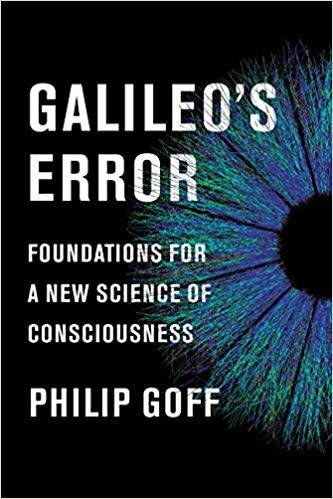
Dr. Goff, author of Galileo’s Error: Foundations for a New Science of Consciousness, offers some thoughts on what panpsychism is and isn’t:

Panpsychism is the view that consciousness is a fundamental and ubiquitous feature of the physical world. It is the view that the basic building blocks of the physical universe – perhaps fundamental particles – have incredibly simple forms of experience, and that the very sophisticated experience of the human or animal brain is rooted in, derived from, more rudimentary forms of experience at the level of basic physics.

PHILIP GOFF, “WHAT PHYSICISTS GET WRONG ABOUT CONSCIOUSNESS” AT [PUBLICATION](27 OCTOBER 2021)

He responds to two recent critics, well known in physics: Sabine Hossenfelder and Sean Carroll.

Hossenfelder dismisses panpsychism because, she argues, it clashes with the Standard Model of physics. Carroll dismisses it because it clashes with Core Theory (the Standard Model + the weak limit of General Relativity).

But, Goff argues:

Hossenfelder simply misunderstands panpsychism. She interprets panpsychism as a form of dualism: there are the physical properties of the particles (mass, spin, charge) and then, in addition, certain non-physical consciousness properties. But panpsychists are not dualists. According to panpsychism, an electron doesn’t have two kinds of property: physical and non-physical. Rather, it’s physical properties (mass, spin, charge) are forms of consciousness. Consciousness is the ultimate nature of the physical.

PHILIP GOFF, “WHAT PHYSICISTS GET WRONG ABOUT CONSCIOUSNESS” AT [PUBLICATION](27 OCTOBER 2021)

Goff’s central point is that physics offers a purely mathematical description of reality. As with any purely mathematical description, there are questions it cannot address:

If you’re doing physics, it doesn’t feel like you’re studying networks of conscious entities. But that’s because when you’re doing physics you’re just interested in mathematical structure, not in what, if anything, underlies that mathematical structure. The latter question is one for philosophers.

PHILIP GOFF, “WHAT PHYSICISTS GET WRONG ABOUT CONSCIOUSNESS” AT [PUBLICATION](27 OCTOBER 2021)

From his perspective, panpsychism is a philosophical interpretation of physics. It conflicts with interpretations like that of Max Tegmark, who argues that, at bottom, reality is “purely mathematical” and that of dualists like Angus Menuge who argues that reality has both physical and non-physical elements. Goff sees panpsychism as simpler than dualism.

Okay but, for science, why not just accept materialism, pure and simple? Because, as analytical philosopher Galen Strawson has pointed out, the one thing we are each most certain of is our own consciousness. Materialism, pressed for an answer, insists that consciousness is an illusion that “science will get to the bottom of.”

But what then? Remember Egnor ’s Principle: If your hypothesis is that your mind is an illusion, then you do not have a hypothesis.

The panpsychists want to have a hypothesis. They want to include consciousness as a real fact in nature while avoiding dualism. Assuming that every entity participates in consciousness in some way, however minimal (with the human mind as the most complex development), enables them to affirm the reality of the mind without adopting an explicitly immaterial approach to it.

The growth in the respectability of panpsychism stems largely from the inability of materialism to adequately address key questions about consciousness.

Note: On November 2, 2021, Goff, along with University of Sheffield philosopher Keith Frankish, will debate these questions with materialist physicist Sean Carroll at MindChat on YouTube.


You may also wish to read more about how panpsychism is gaining a firmer foothold in science: Scientific American explores panpsychism… respectfully. This is a major change. At one time, a science mag would merely ridicule the idea of a conscious universe. Make no mistake, panpsychism—as Goff elucidates it—is a purely naturalist view (“nothing supernatural or spiritual”). But, unlike the village atheist, he goes on to ask, but then what IS nature? Matter is all there is? But what IS matter? It turns out, no one really knows.

Why would a neuroscientist choose panpsychism over materialism? It seems to have come down to a choice between “nothing is conscious” and “everything is conscious.”

How a materialist philosopher argued his way to panpsychism. Galen Strawson starts with the one fact of which we are most certain — our own consciousness. To Strawson, it makes more sense to say that consciousness is physical — and that electrons are conscious — than that consciousness is an illusion.

Theoretical physicist slams panpsychism Electrons cannot be conscious Sabine Hossenfelder’s view because they cannot change their behavior. Hossenfelder’s impatience is understandable but she underestimates the seriousness of the problem serious thinkers about consciousness confront. There is a reason that some scientists believe that the universe is conscious: It would be more logically coherent to say that you think the universe is conscious than to say that your own consciousness is an illusion. With the first idea, you may be wrong. With the second idea, you are not anything.

and

Why is science growing comfortable with panpsychism (“everything is conscious”)? At one time, the idea that “everything is conscious” was the stuff of jokes. Not any more, it seems. A recent article at New Scientist treats panpsychism as a serious idea in science. That’s thanks to the growing popularity of neuroscientist Giulio Tonioni’s Integrated Information Theory (IIT), which offers the opportunity for mathematical modeling, along with the implication that inanimate matter and/or the universe may be conscious. If IIT continues to gain a sympathetic hearing, panpsychism could become, over time, a part of normal science.

MIND MATTERS NEWS

Breaking and noteworthy news from the exciting world of natural and artificial intelligence at MindMatters.ai.

(Contributed by Gwyllm Llwydd)

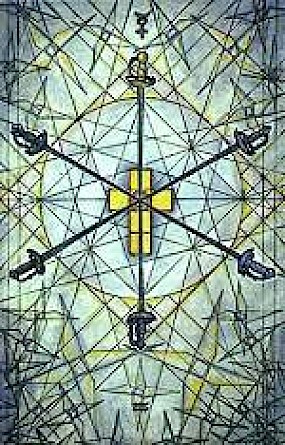
Tarot Card for November 2: The Six of Swords


The Six of Swords

The Lord of Science appears in a reading when we have passed through a stormy or difficult time, and into the safety of a sheltered harbour, where we can recuperate, and consider the difficulties which have arisen around us.

Often we will have passed through a period of dreadful confusion – and frequently a time of emotional suffering. But this card indicates that, at least for the moment, pressure has eased, and we can try to sort out what we really feel. Frequently we need first to rest until we feel refreshed, but eventually we will be required to assess events and make new decisions for our future.

Because we will find ourselves seeing things more clearly, difficult and demanding decisions will be easier to make. We will find ourselves with a more clear overview of the issues we are facing. And we will be able to make choices which bring us peace of mind and happiness.

Expect to find greater objectivity, clarity and new perspectives as a result of the 6 of Swords. This is a card that indicates a healthy balance between the emotions and the intellect, where we can think through even delicate situations, with detached impartiality.

The Six of Swords

(via angelpaths.com and Alan Blackman)

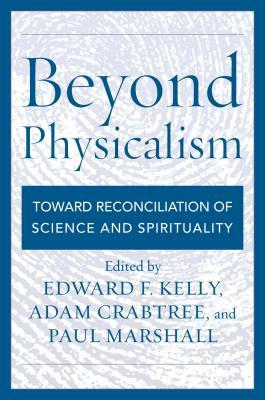
Book: “Beyond Physicalism: Toward Reconciliation of Science and Spirituality”

Beyond Physicalism: Toward Reconciliation of Science and Spirituality

Beyond Physicalism: Toward Reconciliation of Science and Spirituality

by Edward F. Kelly (Editor), Adam Crabtree (Goodreads Author) (Editor), Paul Marshall (Goodreads Author) (Editor), Harald Atmanspacher (Contributor), Loriliai Biernacki (Contributor), Bernard Carr (Contributor), Wolfgang Fach (Contributor), Michael Grosso (Contributor), more… 

The rise of modern science has brought with it increasing acceptance among intellectual elites of a worldview that conflicts sharply both with everyday human experience and with beliefs widely shared among the world s great cultural traditions. Most contemporary scientists and philosophers believe that reality is at bottom purely physical, and that human beings are nothing more than extremely complicated biological machines. On such views our everyday experiences of conscious decision-making, free will, and the self are illusory by-products of the grinding of our neural machinery. It follows that mind and personality are necessarily extinguished at death, and that there exists no deeper transpersonal or spiritual reality of any sort. Beyond Physicalism is the product of an unusual fellowship of scientists and humanities scholars who dispute these views. In their previous publication, Irreducible Mind, they argued that physicalism cannot accommodate various well-evidenced empirical phenomena including paranormal or psi phenomena, postmortem survival, and mystical experiences. In this new theory-oriented companion volume they go further by attempting to understand how the world must be constituted in order that these rogue phenomena can occur. Drawing upon empirical science, metaphysical philosophy, and the mystical traditions, the authors work toward an improved big picture of the general character of reality, one which strongly overlaps territory traditionally occupied by the world s institutional religions, and which attempts to reconcile science and spirituality by finding a middle path between the polarized fundamentalisms, religious and scientific, that have dominated recent public discourse.”

(Goodreads.com)

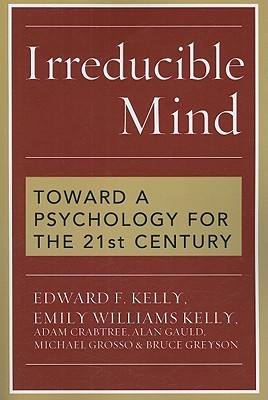
Book: “Irreducible Mind: Toward a Psychology for the 21st Century”

Irreducible Mind: Toward a Psychology for the 21st Century

Irreducible Mind: Toward a Psychology for the 21st Century

by Edward F. KellyEmily Williams KellyAdam Crabtree (Goodreads Author), Alan GauldMichael Grosso 

Current mainstream opinion in psychology, neuroscience & philosophy of mind holds that all aspects of mind & consciousness are generated by physical processes occurring in brains. Views of this sort have dominated recent scholarly publication. The present volume, however, demonstrates empirically that this reductive materialism isn’t only incomplete but false. The authors systematically marshal evidence for a variety of psychological phenomena that are extremely difficult, & in some cases clearly impossible, to account for in conventional physicalist terms. Topics addressed include phenomena of extreme psychophysical influence, memory, psychological automatisms & 2ndary personality, near-death experiences & allied phenomena, genius-level creativity, & mystical states of consciousness both spontaneous & drug-induced. The authors further show that these rogue phenomena are more readily accommodated by an alternative ‘transmission’ or ‘filter’ theory of mind/brain relations advanced over a century ago by a largely forgotten genius, F.W.H. Myers, & developed further by his friend & colleague Wm James. This theory, moreover, ratifies the commonsense conception of humans as causally effective conscious agents, & is fully compatible with leading-edge physics & neuroscience. The book should command the attention of all open-minded persons concerned with the still-unsolved mysteries of the mind.