
New Thinking Allowed with Jeffrey Mishlove James Tunney, LLM, is an Irish Barrister who has lectured on legal matters throughout the world. He is a poet, a visual artist, and also author of The Mystical Accord: Sutras to Suit Our Times, Lines for Spiritual Evolution. In addition, he has written two dystopian novels — Blue Lies September, and Ireland I Don’t Recognize Who She Is. His website is http://www.jamestunney.com. Here he shares his interest, as a legal scholar, in understanding issues related to globalization — as it effects economics, the rights of indigenous peoples, intellectual property law, and national sovereignty. Of particular concern is the issue of governance and the protection of individual rights. He notes that various social movements have goals regarding the establishment of a global order under their jurisdiction. These include Catholicism, Islam, and Communism. The most dangerous competitor for world domination, and most likely to succeed, he believes, is scientism. New Thinking Allowed host, Jeffrey Mishlove, PhD, is author of The Roots of Consciousness, Psi Development Systems, and The PK Man. Between 1986 and 2002 he hosted and co-produced the original Thinking Allowed public television series. He is the recipient of the only doctoral diploma in “parapsychology” ever awarded by an accredited university (University of California, Berkeley, 1980). (Recorded on January 17, 2020)
Monthly Archives: November 2021
Shakespeare on the devil citing Scripture

“The devil can cite Scripture for his purpose.
An evil soul producing holy witness
Is like a villain with a smiling cheek,
A goodly apple rotten at the heart.
O, what a goodly outside falsehood hath!”
― William Shakespeare, The Merchant of Venice
Book: “Religion and the Rebel”
Religion and the Rebel
by Colin Wilson
Religion and the Rebel, Colin Wilson’s second volume from his internationally acclaimed Outsider Cycle, is a casebook about and for rebels. With inspirational wisdom and engaging clarity, Wilson shows us that the purpose of religion, of our personal relationship with the sacred and the all-pervading mystery of existence, is to expand our consciousness and intensify our sense of life. Wilson heroically claims that the power to create meaning resides in our mental and spiritual discipline.
Examining the lives and works of Nietzsche, Kierkegaard, Rilke, Shaw, Pascal, Swedenborg, Rimbaud and Scott Fitzgerald, among others, Wilson explores the main existential questions and shows how these remarkable writers, scientists, philosophers and poets faced their need for transcendence. Like many of us, they were driven by a need to become more than men.
Religion and the Rebel is an outstanding and enjoyable book that combines philosophical analysis, historical interest, and religious insight.
(Goodreads.com)
FREE WILL ASTROLOGY | NOV. 18, 2021
Nov 17, 2021 | Free Will Astrology, Lifestyle, Rob Brezsny | vcreporter.com

© COPYRIGHT 2021 ROB BREZSNY
ARIES (March 21-April 19): Aries poet and philosopher Friedrich Hölderlin (1770–1843) had many ups and downs. He was one of Germany’s greatest poets and philosophers, but he also endured more emotional distress than most people. His biographer wrote, “Sometimes this genius goes dark and sinks down into the bitter well of his heart, but mostly his apocalyptic star glitters wondrously.” You may have been flirting with a milder version of a “bitter well of the heart,” Aries. But I foresee that you will soon return to a phase when your star glitters wondrously — and without the “apocalyptic” tinge that Hölderlin harbored.
TAURUS (April 20-May 20): Author David Foster Wallace felt sad about how little of our mind’s intense activity can be shared with others. So much of what goes on inside us seems impossible to express. Or if it is possible to express, few of our listeners are receptive to it or able to fully understand it. That’s the bad news, Taurus. But here’s the good news: In the coming weeks, I believe you will experience much less of this sad problem than usual. I’m guessing you’ll be especially skilled at articulating your lush truth and will have an extra receptive audience for it.
GEMINI (May 21-June 20): “I never resist temptation,” declared playwright George Bernard Shaw. Why did he dare to utter such an outlandish statement? “Because I have found that things that are bad for me do not tempt me,” he said. I propose that you aspire to embody his attitude during the next eight weeks, Gemini. Make it your aspiration to cultivate a state of mind wherein you will only be tempted to engage with influences that are healthy and educational and inspiring. You can do it! I know you can!
CANCER (June 21-July 22): While still a teenager, Cancerian cowboy Slim Pickens (1919–1983) competed in the rodeo, a sporting event in which brave athletes tangle with aggressive broncos and bulls. When America entered World War II, Pickens went to a recruiting office to sign up for the military. When asked about his profession, Pickens said “rodeo.” The clerk misheard and instead wrote “radio.” Pickens was assigned to work at an armed forces radio station in the American Midwest, where he spent the entire war. It was a safe and secure place for him to be. I foresee a lucky mistake like that in your near future, Cancerian. Maybe more than one lucky mistake. Be alert.
LEO (July 23-Aug. 22): To create your horoscope, I’ve borrowed ideas from four famous Leos. They all address your current astrological needs. First, here’s Leo author P. L. Travers: “More and more I’ve become convinced that the great treasure to possess is the unknown.” Second, here’s Leo author Sue Monk Kidd: “There is no place so awake and alive as the edge of becoming.” Third, Leo poet Philip Larkin: “Originality is being different from oneself, not others.” Finally, Leo author Susan Cheever: “There is no such thing as expecting too much.”
VIRGO (Aug. 23-Sept. 22): I encourage you to adopt the perspective expressed by spiritual author Ann Voskamp. She wrote, “I want to see beauty. In the ugly, in the sink, in the suffering, in the daily, the moments before I sleep.” I understand that taking this assignment seriously could be a challenging exercise. Most of us are quick to spot flaws and awfulness, but few have been trained to be alert for elegance and splendor and wondrousness. Are you willing to try out this approach? Experiment with it. Treat it as an opportunity to reprogram your perceptual faculties. Three weeks from now, your eyes and ears could be attuned to marvels they had previously missed.
LIBRA (Sept. 23-Oct. 22): Libran educator and anthropologist Johnnetta Cole wrote, “The first sign of an educated person is that she asks more questions than she delivers answers.” I agree and would also say this: A prime attribute of an intelligent, eager-to-learn person is that she asks more questions than she delivers answers. I encourage you to be like that during the coming weeks, Libra. According to my astrological estimation, you are scheduled to boost your intelligence and raise your curiosity. An excellent way to meet your appointments with destiny will be to have fun dreaming up interesting questions.
SCORPIO (Oct. 23-Nov. 21): “Some people become so expert at reading between the lines they don’t read the lines,” wrote author Margaret Millar. That’s not a common problem for you Scorpios. You are an expert at reading between the lines, but that doesn’t cause you to miss the simple facts. Better than any other sign of the zodiac, you are skilled at seeing both secret and obvious things. Given the astrological omens that will be active for you during the rest of 2021, I suspect this skill of yours will be a virtual superpower. And even more than usual, the people in your life will benefit from your skill at naming the truth.
SAGITTARIUS (Nov. 22-Dec. 21): Storyteller and mythologist Michael Meade believes that each of us has an inner indigenous person — a part of our psyche that can love and learn from nature, that’s inclined to revere and commune with the ancestors, that seeks holiness in the familiar delights of the earth. The coming weeks will be a favorable time for you to cultivate your relationship with your inner indigenous person. What other experiences might be available to you as you align your personal rhythms with the rhythms of the earth? What joys might emerge as you strive to connect on deeper levels with animals and plants and natural forces?
CAPRICORN (Dec. 22-Jan. 19): Capricorn novelist Haruki Murakami writes, “I was always hungry for love. Just once, I wanted to know what it was like to get my fill of it — to be fed so much love I couldn’t take any more. Just once.” Most of us feel that longing, although few of us admit it. But I will urge you to place this desire in the front of your awareness during the next two weeks. I’ll encourage you to treat your yearning for maximum love as a sacred strength, a virtue to nurture and be proud of. I’ll even suggest you let people know that’s what you want. Doing so may not result in a total satisfaction of the longing, but who knows? Maybe it will. If there will ever be a time when such fulfillment could occur, it will be soon.
AQUARIUS (Jan. 20-Feb. 18): An article published in the journal Scientific American declared, “Most people don’t know when to stop talking.” Conversations between strangers and between friends typically go on too long. A mere two percent of all dialogs finish when both parties want them to. That’s the bad news, Aquarius. The good news is that in the coming weeks, your sensitivity about this issue will be more acute than usual. As a result, your talk will be extra concise and effective — more persuasive, more interesting, and more influential. Take advantage of this subtle superpower! (Further info: tinyurl.com/WhenToStop)
PISCES (Feb. 19-March 20): Since 1996, Ira Glass has produced the renowned radio series This American Life. In 2013, as a reward for his excellence, he was offered a raise in his annual salary from $170,000 to $278,000. He accepted it for one year, but then asked that it be lowered to $146,000. He described the large increase in pay as “unseemly.” What?! I appreciate his modesty, but I disapprove. I’m always rooting for Pisceans like Ira Glass to embrace the fullness of their worth and to be aggressive about gathering all the rewards they’re offered. So I’m inclined, especially right now, to urge you NOT to be like Glass. Please swoop up all the kudos, benefits, and blessings you deserve.
Homework. Tell how everyone in the world should be more like you. https://Newsletter.FreeWillAstrology.com
Rebecca Solnit’s newest book pays homage to George Orwell
A combination of deep scholarship, pointed politics and poetically precise prose
By Paul Wilner Special to The Examiner • November 16, 2021 (SFExaminer.com)

By Paul Wilner
Special to The Examiner
Everyone — well, almost everyone — knows of George Orwell, whose classic dystopian parable, Nineteen Eighty-Four, is regularly summoned upon as commentary on the political climate of the day.
Leave it to Rebecca Solnit to cast new light on our understanding of the British author. Solnit’s new book, “Orwell’s Roses,” takes a seemingly quotidian but little-known aspect of his life — the great pleasure he took in gardening at his country home in Wallington — as a way of deepening our view of the nature of activism, and of writing.
Written with her signature combination of deep scholarship, pointed politics and poetically precise prose, the work is arguably her best — no small achievement from the writer who brought the term “mansplaining” into the modern vocabulary and whose 20 books span everything from memoir to environmental journalism and the arts. She was awarded the 2004 National Book Critics Circle Award in Criticism for “River of Shadows: Eadweard Muybridge and the Technological Wild West,” which combined a portrait of photographer/ inventor Muybridge, with the important changes his work presaged in Hollywood and Silicon Valley.
In “Orwell’s Roses,” she once again helps us see outwardly familiar sights in different, eye-opening ways. With deceptive simplicity she begins: “In the year 1936 a writer planted roses.” She goes on to trace Orwell’s journey into British coal mines to bear witness to the dangerous conditions there; his decision to join the fight against fascism in the Spanish Civil War; and his fierce opposition, illustrated in both “Nineteen Eighty-Four” and “Animal Farm,” to shibboleths of the left — Stalin and Soviet authoritarianism — as well as the right.
While clearly allied with progressive values, Solnit has a bone to pick with the dogmatism that often accompanies the fight for abstract “justice.” Citing Orwell’s sardonic response to a letter writer who complained that he was “a defender of roses,” she writes:
“The left has never been short on people arguing that it is callous and immoral to enjoy yourself while others are suffering… It’s a puritanical position, implying that what one has to offer them is one’s own austerity or joylessness rather than some practical contribution toward their liberation.”

“Orwell’s Roses” (Viking) – San Francisco-based writer Rebecca Solnit’s 20th tome offers fresh insights into the famous British author.
By way of illustration, she cites the early 20th-century suffragist cry, “Bread for all, and Roses, too,” bringing us back into the present (the Marin County-based rights organization, Bread & Roses, founded in 1974 by singer-activist Mimi Fariña is still going strong) and enlarging our understanding of the past.
In doing so, Solnit reclaims Orwell’s legacy from advocates like the late British polemicist Christopher Hitchens, who wrapped themselves in his political mantle without noticing his larger concerns. (Hitchens goes unmentioned in “Orwell’s Roses,” and one doubts the absence is unintentional.)
Solnit’s passion for justice burns through as she travels — audaciously — to Colombia, to see firsthand the operations of a huge rose factory outside Bogotá where employees have the slogan, “The lovers get the roses, but we workers get the thorns.”
The greenhouse sends 6 million roses to the United States for Valentine’s Day and another 6 million for Mother’s Day, but it’s a joyless undertaking for the workers at these “invisible factories of visual pleasure,” as she describes them. (She recalls Orwell’s observation that his countrymen enjoyed the heat and coal brought to their homes with no thought of the miners breaking their backs to deliver them.)
It’s the range and force of such far-reaching connections that make Solnit’s work a delight even when her subjects are outwardly grim. The San Francisco-based writer has a deeper, more humanistic perspective than former Californians like Susan Sontag, who seemed more comfortable with theories than people or, for that matter, Joan Didion, known for her acerbic wit.
Solnit is an American original; Orwell could not have asked for a more eloquent interlocutor. As she writes: “Rereading a significant book is like revisiting an old friend; you find out how you’ve changed when you encounter them again; you see differently because you’re different… What struck me this time around was how much lushness and beauty and pleasure are in “Nineteen Eighty-Four.” They’re endangered, furtive, corrupted, but they exist.”
A film about Carl Sagan, Annie Druyan and a love letter they sent to the stars
In the summer of 1977, NASA sent Voyager 1 and Voyager 2 on an epic journey into interstellar space. Each of the Voyager probes carries a golden record, a compilation of images and sounds meant to represent our planet to any distant civilisations that should encounter them. ‘The launching of this bottle into the cosmic ocean says something very hopeful about life on this planet,’ said Carl Sagan, the golden record’s co-creator. Sagan met and fell madly in love with his future wife Ann Druyan while working on the golden record. The project became their love letter to humankind and to each other.
Director: Penny Lane 20 December 2013 (filmsforaction.org)
James Tunney on Group Privilege and Group Blame
By James Tunney
My family were involved in politics quite a bit. Dealing with political parties, nothing is what it seems. There are secret groups everywhere and secret objectives. That is why i propose that the next mass movement should be careful not to associate because every group will eventually be taken over and assimilated into the dominant structure.
Coming from Ireland which was one of the only real colonies in Europe and suffered a lot, I am not taking someone else’s blame and even then to punish someone for someone else’s action is unethical and even is inconsistent with the spirit of international law whereby a group should not be punished.
These ideologies are purely to separate people by manipulating identity to create fragmentation, especially from the groups that have been the greatest adversary of power within colonial power systems. Left and right are both materialists that lead to technocracy with a managerial elite sharing global power through a Party and the benefits of life extension technology and slavery of the subjects increasingly automatised.
I believe everyone should be accepted as equal as a person irrespective of everything else and that spiritual evolution which allows us explore individually is the only hope for forming a critical mass of aware people who are mature enough to be able to fly like a murmuration in loose synchronicity.
I imagine it requires a mass of distributed individuals who are diverse and incapable of easy smothering. I despise discrimination and prejudging anyone on the basis of skin colour or sexuality or gender is wrong and despicable as part of a policy calculated not to elevate equality but to subdue the growth of nodes of opposition to the unified techtyranny coming.
–James Tunney (with permission)
About James Tunney:
I left a successful academic career in law to focus on spiritual and artistic development. Having published plenty of academic articles and reports, consulted internationally, as well as presenting talks on various aspects of globalisation in many countries around the world – I am now writing about Mysticism and Scientism. I have also been painting from my studio in Sweden and exhibited in several countries for more then a decade.
To hear me talk on issues related to my writing, visit New Thinking Allowed, YouTube channel where I have done multiple interviews with Dr Mishlove. All interviews are also listed and linked on the Interview section of this site, including interviews on other channels.
I am glad to announce that Human Entrance to Transhumanism, my follow-up to Empire of Scientism and TechBondAge is available.
Seneca on True and False Friendship
“Ponder for a long time whether you shall admit a given person to your friendship; but when you have decided to admit him, welcome him with all your heart and soul.”
BY MARIA POPOVA (themarginalian.org)


“Friendship is unnecessary,” C.S. Lewis wrote, “like philosophy, like art, like the universe itself… it has no survival value; rather it is one of those things which give value to survival.” Darwinian caveats aside, the truth of this beautiful sentiment resonates deeply for anyone whose life has been enriched or even saved by the existence of a genuine friend. And yet today, as we face the commodification of the word “friend,” what do we even mean — what should we mean — by this once-sacred term, now vacated of meaning by chronic misuse?
That’s what the great first-century Roman philosopher Seneca examines in a series of correspondence with his friend Lucilius Junior, later published as Letters from a Stoic (public library) — the indispensable trove of wisdom that gave us Seneca’s famous letter on overcoming fear and inoculating yourself against misfortune.

Eighteen centuries before Emerson wrote in his meditation on the two pillars of friendship that “a friend is a person with whom [one] may be sincere,” Seneca considers the uses and misuses of the term in a magnificent letter titled “On True and False Friendship”:
If you consider any man a friend whom you do not trust as you trust yourself, you are mightily mistaken and you do not sufficiently understand what true friendship means… When friendship is settled, you must trust; before friendship is formed, you must pass judgment. Those persons indeed put last first and confound their duties, who … judge a man after they have made him their friend, instead of making him their friend after they have judged him. Ponder for a long time whether you shall admit a given person to your friendship; but when you have decided to admit him, welcome him with all your heart and soul. Speak as boldly with him as with yourself… Regard him as loyal and you will make him loyal.
In another letter, titled “On Philosophy and Friendship,” Seneca examines the common bases upon which friendships are formed and admonishes against the tendency, particularly common today, toward seeing others as utilitarian tools that help advance one’s personal goals. Observing that some people form so-called friendships by estimating how much a potential friend can help them in a moment of need, he writes:
He who regards himself only, and enters upon friendships for this reason, reckons wrongly. The end will be like the beginning: he has made friends with one who might assist him out of bondage; at the first rattle of the chain such a friend will desert him. These are the so-called “fair-weather” friendships; one who is chosen for the sake of utility will be satisfactory only so long as he is useful. Hence prosperous men are blockaded by troops of friends; but those who have failed stand amid vast loneliness their friends fleeing from the very crisis which is to test their worth. Hence, also, we notice those many shameful cases of persons who, through fear, desert or betray. The beginning and the end cannot but harmonize. He who begins to be your friend because it pays will also cease because it pays. A man will be attracted by some reward offered in exchange for his friendship, if he be attracted by aught in friendship other than friendship itself.
With an eye to such arrangements of convenience and favor, which he condemns as “a bargain and not a friendship,” Seneca adds:
One who seeks friendship for favourable occasions, strips it of all its nobility.

In another letter, Seneca cautions against mistaking flattery for friendship — an admonition all the more urgent today, in the Age of Likes, when the forms of flattery and the channels of positive reinforcement have proliferated to a disorienting degree:
How closely flattery resembles friendship! It not only apes friendship, but outdoes it, passing it in the race; with wide-open and indulgent ears it is welcomed and sinks to the depths of the heart, and it is pleasing precisely wherein it does harm.
He turns the beam of his wisdom toward the only valid and noble reason for forming a friendship:
For what purpose, then, do I make a man my friend? In order to have someone for whom I may die, whom I may follow into exile, against whose death I may stake my own life, and pay the pledge, too.
Illustration by Maurice Sendak from a vintage ode to friendship by Janice May Udry
In another letter, Seneca suggests that such genuine friendship extends its rewards beyond the personal realm and becomes the civilizational glue that holds humanity together:
Friendship produces between us a partnership in all our interests. There is no such thing as good or bad fortune for the individual; we live in common. And no one can live happily who has regard to himself alone and transforms everything into a question of his own utility; you must live for your neighbour, if you would live for yourself. This fellowship, maintained with scrupulous care, which makes us mingle as men with our fellow-men and holds that the human race have certain rights in common, is also of great help in cherishing the more intimate fellowship which is based on friendship… For he that has much in common with a fellow-man will have all things in common with a friend.
Letters from a Stoic remains a timelessly rewarding read. Complement this particular portion with Eudora Welty on friendship as an evolutionary mechanism for language, Irish poet and philosopher John O’Donohue on the ancient Celtic ideal of friendship, and the epistolary record of Mozart and Haydn’s beautiful and selfless friendship, then revisit Seneca on the antidote to the shortness of life and the key to resilience in the face of loss.
Tarot Card for November 18: The Lovers
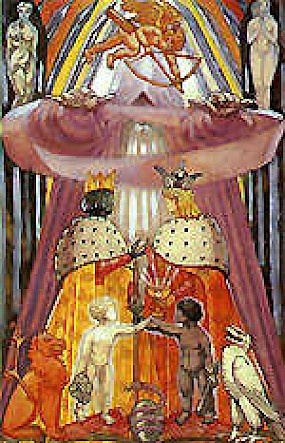
The Lovers
The Lovers is numbered six and is a card of innocence, trust, exhileration and joy. The couple (often seen intertwined or standing side by side) are soulmates, each being one half of a perfect union. The figure flying above them is Cupid, blessing them with the might of Universal Love.
The Lovers are the embodiment of the harmony of opposites. This is how we are before the fear and prejudices of life intervene. We give our love freely to others and we need no other to make us whole.
Love is much misunderstood. It is subjective and the word ‘love’ is so overused that it has almost lost its original meaning. We are all capable of the immense power of deep feelings. Love happens when we step out of the darkness of fear, pain and doubt into the light. Love can move mountains. Love breeds love – a happy smile breaking through another’s melancholy proves this.
Loving ourselves is the first step to touching the mighty power of Universal Love. We must live each moment as though it were the only one – rejoicing and celebrating, loving the soul within us rather than fighting with the reflection the rest of the world sees.
(via angelpaths.com and Alan Blackman)
Taurus Lunar Eclipse, November 19, 2021

Taurus Lunar Eclipse at 12:57 am PST on the 19th
The partially eclipsed Full Moon in Taurus forms a t-square and, though the planet lineup is different, re-fl ects certain tensions rather than the previous lunation did. To begin with, the Moon in Taurus has a grounding quality, and feelings may be pinned more to solid, external situations than merely to the ebb and flow of our thoughts and imagination. Because there is an opposition involved in the Full Moon setup, some of what we only imagined before now may seem totally real and not actually the outcome we wanted in every case – particularly underlined by the partial eclipse. There can, however, be a willingness with Taurus to take clear action to manage even the least-desired scenario, once it is obvious that action is, indeed, required.
Once again, we see the relevant planets of the t-square all located in signs of a fixed nature. Except, instead of Saturn in Aquarius at the apex, we now see Jupiter in Aquarius as the focal point of an opposition across the Taurus/Scorpio axis. Since Jupiter has a naturally more expansive inclination than Saturn, the idea seems to be that whatever tensions we are now up against are there to help us grow — or to aid in a situation we are involved in.
This is not the moment, therefore, to shrink back or attempt to be any smaller than whatever we face, but rather to stand tall and see how we can reach higher! Along with Mercury, which is now conjunct the Sun in Scorpio (and opposite the Moon), Jupiter is one of the key planets that helps us to network and communicate with others, and its extra advantage over Mercury is to allow this type of process to move across distance boundaries, hopping over territorial borders of one kind or another. We may well have the potential to reach into other countries and cultures, or to build connections with families and organizations quite different from those we have known before.
What Jupiter in Aquarius can show us is that there is a larger network in operation — an interplay that somehow protects and nurtures us, whether or not we are aware of it. This is rather like the way in which trees support one another underground, and healthy, microbial activity in the soil invisibly supports, almost magically, the roots that can’t manage to reach far enough alone. In our human lives, too, there are channels of support available — pathways of nurturance and protection that operate for us in the background! We may not be aware of them initially, and then slowly but surely they emerge and we realize that we truly are not alone. Where we need feeding, we will be fed. Where we need love, love springs forth. It may not always come from the sources we seek or the places we assume we will nd it, but it is there.
The Jupiter connection may be particularly helpful to anyone who has recently leapt into a new activity or environment, or is considering doing so soon. We might be offered something equivalent to angel wings or even fairy godmother energy, to help us make the necessary inroads toward acceptance and success. We could, thereby, be able to release some of the angst and insecurity that planets in Taurus and Scorpio suggest we might have been holding onto.
For those interested in attaining better health or restoring a sense of well being, such developments may mean that we have less cortisol running around in our systems and more of the happy hormones like endorphins, serotonin, and dopamine circulating in our bodies. These kinds of changes — according to expert research — may help with a better internal balance, which can ultimately have many positive effects on how our entire system functions. (More information can be found in health journalist Crystal Raypole’s article at Healthline: https://www.healthline. com/health/happy-hormone)
The Taurus Moon is also trine Pluto in Capricorn, which helps us to be more fl uid and active going forward. Sticking points can become happily unstuck, and we fi nally pinpoint the answer to an issue that has seemingly just stumped us before. With Venus also in Capricorn, it seems we are ready to approach a relationship or creative venture from a more mature angle and to head forth more confi dently with any responsibilities we face.
This article is from the Mountain Astrologer written by Diana McMahon Collis