Rob Brezsny’s Astrology Newsletter (freewillastrology@substack.com)

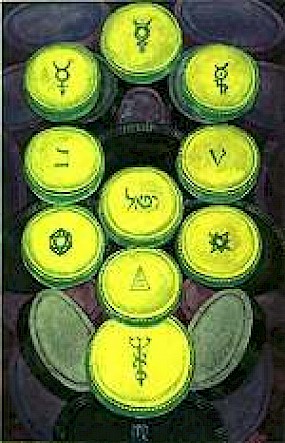
The Lord of Wealth talks not only about material wealth and its appropriate use, but about the inner wealth and resources that we all have. This is a card that teaches us that the harvest we gather in our lives is the end result of all that we have put into living – and more importantly, how we have used the riches at our disposal.
We make our own realities with every thought, every deed, every wish. And when we direct our energies positively we shall arrive – as a perfectly natural consequence – at the Ten of Disks. Of course, if we direct our energies negatively we’ll find ourselves with the Ten of Wands, or the Ten of Swords – neither of which are happy cards!
There is a warning connected to this card though. When we have created sufficient wealth to make ourselves comfortable and contented, if we have a surplus, then we must make that surplus work. We cannot expect energy to flow freely in our lives if we hoard it, and try to hang on to it. This is as pointless as trying to save up the breeze so that it will blow on a stuffy day! There are some things in life you cannot clutch tight in the hand without crushing their value out of them.
If this card comes up in an everyday reading, it re-assures that financial and material matters are proceeding well, and that there is no cause for concern.
If it comes up in a more spiritually based reading, then we need to be applying the underlying principles to our lives – so in this case, we need to be letting our inner wealth show, in order to manifest that into our lives.
(via angelpaths.com and Alan Blackman)
| by Astro Butterfly Iastrobutterfly.com) |
On September 6th (in the US) or September 7th (the rest of the world), we have a highly auspicious New Moon in Virgo.
The New Moon is at 14° Virgo and it is exactly trine Uranus at 14° Taurus. I love tight aspects because tight aspects make things happen. A New Moon in Virgo is by definition a great time to make things happen. Virgo is probably the most productive sign of the zodiac!

And when Virgo is in agreement with the God of the sky, the right things happen.
We don’t just do “stuff”, we do the right kind of “stuff”. We’re no longer a mouse on the treadmill – running and running, and going anywhere. We have a purpose. Uranus gives us CLARITY on how whatever it is that we’re doing fits into the greater cosmic order.
The ruler of the New Moon, Mercury, is trine Saturn. Mars is trine Pluto. And Venus, now at home in Libra, is trine Jupiter. It’s difficult to find something negative about this New Moon.
We do have a Venus-Pluto square, which is normally a bit tense, but since both Venus and Pluto also make harmonious aspects with other planets, the inherent tension of the square will rather propel us forward, so we can achieve whatever we have set out to do!
Keep in mind that a New Moon is in effect for the whole 29.5-day lunar cycle. So it’s not that things will happen exactly on the 7th of September. The New Moon in Virgo energy will influence us until October 6th, when we have the New Moon in Libra.
We all know that Virgo is hard-working, productive, service-oriented, with an obsession for detail and perfection. Virgo is the last personal sign (from Libra onwards we enter the realm of the Other) so in Virgo, we achieve some sort of perfection as individuals. We are the best possible version of ourselves.
Virgo is ruled by Mercury, and is one of the 4 “knowledge” signs (the others are Gemini, Sagittarius, and Pisces). Virgo plays a very important role in the process of conveying knowledge.
Gemini (Air sign ruled by Mercury) is the process of capturing information. Mercury is a very curious sign, and its role is to ‘notice’ things, to gather and assimilate as much information as possible, indiscriminately. Gemini doesn’t put a value judgement, Gemini just does the research, the information collection. Gemini’s highest virtue is its beginner’s mind.
Virgo (Earth sign, also ruled by Mercury) is the process of analyzing information. Not all the Gemini information is worth keeping. Virgo’s role is to understand whether a piece of information is useful or not. Is it really worth remembering what you had for dinner on August 23rd? Probably not.
If something is useful, if it serves a purpose, Virgo will keep it (and Scorpio, whose glyph is very similar to Virgo’s, will eliminate all the debris). Virgo will not only keep what is useful, it will also put it in the right mental folder, so it can be easily found.
That’s precisely why Virgo also rules routines, habits and rituals. We would never ever achieve mastery if it was not for Virgo’s ability to cluster and categorize information, to make it relevant and accessible.
We need both the Gemini Mercury and the Virgo Mercury. When I write something I engage my Mercury brain first. I just put it all on paper, without making any judgment of whether it makes sense or not.
And it’s only when I engage my Virgo brain, that I start to remove superfluous words, rearrange the paragraphs, break the information into categories, and find an overall flow.
Gemini and Virgo are Mercury signs. The other 2 knowledge signs are Jupiter-ruled Sagittarius and Pisces. Thanks to Sagittarius (Knowledge) we then connect the Virgo dots and find the big picture, while in Pisces we find an even higher, cosmic order and attain true Wisdom.
Coming back to our New Moon in Virgo. The New Moon in Virgo is a great time to embody Virgo’s role. And Virgo’s role is to find what is useful, to find what is relevant. To apply discernment.
The New Moon in Virgo will help us answer some very important questions.
Does (…)/your project serve a purpose? Does it make your life better? Does it help you grow? Does it help you become the next best version of yourself? Uranus will bring us the clarity we need to see things for what they truly are.
At the time of the New Moon, make sure you write down your intentions for this lunar month, because you really want to take advantage of this energy. Within the fertile Virgo soil, you CAN make things happen.
PS: Astro Butterfly’s 10-week natal chart certification program “Astro Butterfly Wings” will open for enrollment on Thursday, September 9th. If you’re interested in the program, make sure you read the announcement email on Thursday.
From Wikipedia, the free encyclopedia
| Phineas Parkhurst Quimby | |
|---|---|
| Born | Phineas Parkhurst Quimby February 16, 1802 Lebanon, New Hampshire, United States |
| Died | January 16, 1866 (aged 63) Belfast, Maine, United States |
| Nationality | American |
| Occupation | Mesmerist, clockmaker, inventor |
| Known for | Founder of New Thought |
| Signature | |
| Part of a series of articles on |
| New Thought |
|---|
| showBeliefs |
| showMovement |
| showPeople |
| showRelated ideas |
| showCategories |
| Religion portal |
| vte |
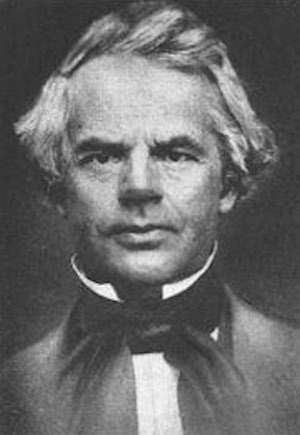
Phineas Parkhurst Quimby (February 16, 1802 – January 16, 1866) was an American clockmaker, mentalist and mesmerist. His work is widely recognized as foundational to the New Thought spiritual movement.[1]
Born in the small town of Lebanon, New Hampshire, Quimby was one of seven children and the son of a blacksmith and his wife. As was customary for his social and economic class at that time, Quimby received little formal education. He later wrote that he suffered from consumption (now called tuberculosis or TB) in his youth, a disease that then had no cure, and was prescribed calomel by his doctor. The calomel was no cure, and began to rot his teeth.
Quimby began experimenting with his own ideas for a cure. He found that intense excitement (such as galloping on his horse) alleviated his pain for brief periods of time, and he became interested in the mind’s ability to affect the body. He claimed to have cured himself of TB by his methods.[2]
About 1836 Charles Poyen came to Maine from France on an extended lecture tour in New England about mesmerism, also widely known as hypnotism.[3] He was a French mesmerist who followed in the tradition of Armand-Marie-Jacques de Chastenet, Marquis of Puységur. The McClure’s magazine 1907 biographical serial of Mary Baker Eddy written by Willa Cather & Georgine Milmine started the misunderstanding that Quimby was a follower of Poyen and followed him around—which is not supported by the Quimby family or Quimby’s writings. In fact, Quimby wrote about seven years later about hearing Poyen lecture: “Mesmerism was introduced into the U[nited] State[s] by M. Charles Poyen, a French gentleman, who did not appear to be highly blest with the powers of magnetising to the satisfaction of his audience in his public lectures. I had the pleasure of listening to one of his lectures, & pronounced it a humbug as a matter of course. And that his remarkable experiments, which were related, were, in my belief, equally true with witch craft—I had never been a convert to witch craft, nor had even had any personal interviews[?] with ghosts or hobgoblins & therefore considered all stories bordering on the marvelous as delusive—“.[4] Instead it appears that it was Robert H. Collyer, another practitioner of animal magnetism, who visited Belfast in 1841, who attracted Quimby’s interest:
“Next came Dr Collyer, who perhaps did more to excite a spirit of enquirey throughout the community than any who have succeeded.”
(Quimby’s son George stated in New England Magazine, March, 1888, that “a gentleman visited Belfast, about the year 1838,” but an extensive search of Belfast newspapers during that time period finds no visit by Poyen mentioned in 1838, even though Poyen was quite newsworthy. 1838 is too early for Robert Collyer. 1836 appears to be the correct year for Poyen.)
About 1842 Quimby encountered Lucius Burkmar, a local youth who was particularly susceptible to hypnosis. Finding him useful to work with, Quimby and Burkmar developed a tour of their own. Quimby demonstrated mesmeric practice with Burkmar in front of large crowds.[5]
Later Quimby and Burkmar stopped touring. Quimby claimed to heal people of ailments which doctors could not cure. Quimby told his patients that disease was caused by false beliefs, and that the cure was in the explanation of this.[citation needed] Quimby published a flyer, “TO THE SICK,” that was used about late 1850s to early 1860s and read as follows.[6] It is an important statement of his beliefs:
“DR. P. P. QUIMBY would respectfully announce to the citizens of [blank space to be filled in] and vicinity, that he will be at the [blank space to be filled in] where he will attend to those wishing to consult him in regard to their health, and, as his practise is unlike all other medical practise, it is necessary to say that he gives no medicines and makes no outward applications, but simply sits down by the patients, tells them their feelings and what they think is their disease. If the patients admit that he tells them their feelings, &c., then his explanation is the cure; and, if he succeeds in correcting their error, he changes the fluids of the system and establishes the truth, or health. The Truth is the Cure. This mode of practise applies to all cases. If no explanation is given, no charge is made, for no effect is produced. His opinion without an explanation is useless, for it contains no knowledge, and would be like other medical opinions, worse than none. This error gives rise to all kinds of quackery, not only among regular physicians, but those whose aim is to deceive people by pretending to cure all diseases. The sick are anxious to get well, and they apply to these persons supposing them to be honest and friendly, whereas they are made to believe they are very sick and something must be done ere it is too late. Five or ten dollars is then paid, for the cure of some disease they never had, nor ever would have had but for the wrong impressions received from these quacks, or robbers, (as they might be called,) for it is the worst kind of robbery, tho’ sanctioned by law. Now, if they will only look at the true secret of this description, they will find it is for their own selfish objects—to sell their medicines. Herein consists their shrewdness!—to impress patients with a wrong idea, namely—that they have some disease. This makes them nervous and creates in their minds a disease that otherwise would never have been thought of. Wherefore he says to such, never consult a quack: you not only lose your money, but your health.
He gives no opinion, therefore you lose nothing. If patients feel pain they know it, and if he describes their pain he feels it, and in his explanation lies the cure. Patients, of course, have some opinion as to what causes pain—he has none, therefore the disagreement lies not in the pain, but in the cause of the pain. He has the advantage of patients, for it is very easy to convince them that he had no pain before he sat down by them. After this it becomes his duty to prove to them the cause of their trouble. This can only be explained to patients, for which explanation his charge is [blank space to be filled in] dollars. If necessary to see them more than once, [blank space to be filled in] dollars. This has been his mode of practice for the last seventeen years. For the past eight years he has given no medicines, nor made any outward applications.
There are many who pretend to practice as he does, but when a person while in “a trance,” claims any power from the spirits of the departed, and recommends any kind of medicine to be taken internally or applied externally beware! believe them not, “for by their fruits ye shall know them.”
Quimby married in 1827 and had a family of four children. One of his sons, George, was a follower and strong defender of him, working to differentiate his work from that of Mary Baker Eddy, a patient who later founded Christian Science. His son owned his father’s writings, which were mostly not released until the 1920s, after the son’s death.
By trade Quimby was a watch and clockmaker.[7] He also was a daguerreoptypist, and he invented items and held several patents for a variety of unrelated, larger mechanical devices.[8][9](d) Phineas P. Quimby is listed as patentee for “US Patent: 8,232X: Sawing timber: Chain saw for sawing timber, wood, metal, marble, etc.”, 3 June 1834.[10] As of 21 September 2007, no records have been found for any of the patent numbers ranging from X5475 to X5497 inclusive — i.e., from 30 April 1829 to 11 June 1829).[original research?]
Among the people who claimed to be cured by Quimby were Julius Dresser and his wife Annetta Dresser, from what sickness it is unclear.[11] Their son, Horatio Dresser, wrote extensively on Quimby’s theories. He edited and collected many of Quimby’s papers in his book Health and the Inner Life: An Analytical and Historical Study of Spiritual Healing and Theories (1906) (reissued as a 2009 paperback by Forgotten Books). He also edited and published selected Quimby papers in the book, The Quimby Manuscripts (1921; reprinted in 2008 paperback by Forgotten Books).
Barry Morton, a scholar of faith healing, has said that Quimby’s constant practice of his mind cure method led him to make important discoveries related to curing psychosomatic illnesses. Although Quimby did not publish his findings, he trained many others in his methods. In effect, he started a “gnostic” healing tradition. Some of his methods were adopted by John Alexander Dowie, who revolutionized Christian faith healing in the 1880s.[12]
Warren Felt Evans was a Methodist minister who was moving over to Swedenborgianism about the time that he visited Quimby twice about 1863. While he was reputed to be a student of Quimby, modern scholarship has shown that he considered himself an equal of Quimby and not a student.[13]
Mary Baker Eddy, the founder of Christian Science, was a patient of Quimby’s for a short time. Later, claims were made that she was at least partially inspired by Quimby in her theology. However, both Quimby’s son[14] and Christian Scientists[15] have pointed out major differences between Quimbyism and Christian Science. Biographer Gillian Gill[16] and others[17] agreed, pointing out that because of its theism, Christian Science differs considerably from the teachings of Quimby, who did not base his work in religion.
More at: https://en.wikipedia.org/wiki/Phineas_Parkhurst_Quimby

by Henry James
This brilliant satire of the women’s rights movement in America is the story of the ravishing inspirational speaker Verena Tarrant and the bitter struggle between two distant cousins who seek to control her. Will the privileged Boston feminist Olive Chancellor succeed in turning her beloved ward into a celebrated activist and lifetime companion? Or will Basil Ransom, a conservative southern lawyer, steal Verena’s heart and remove her from the limelight?
“The Bostonians has a vigor and blithe wit found nowhere else in James,” writes A. S. Byatt in her Introduction. “It is about idealism in a democracy that is still recovering from a civil war bitterly fought for social ideals . . . [written] with a ferocious, precise, detailed—and wildly comic—realism.”
(Goodreads.com)
From Wikipedia, the free encyclopedia
| Brook Farm | |
| U.S. National Register of Historic Places | |
| U.S. National Historic Landmark | |
 Show map of MassachusettsShow map of the United StatesShow all Show map of MassachusettsShow map of the United StatesShow all | |
| Location | 670 Baker Street, Boston, Massachusetts |
|---|---|
| Coordinates |  42°17′28.90″N 71°10′26.71″WCoordinates: 42°17′28.90″N 71°10′26.71″W 42°17′28.90″N 71°10′26.71″WCoordinates: 42°17′28.90″N 71°10′26.71″W |
| Area | 188 acres (0.76 km2)[2] |
| Built | 1841 |
| Architect | Brook Farm Community |
| NRHP reference No. | 66000141[1] |
| Significant dates | |
| Added to NRHP | October 15, 1966 |
| Designated NHL | July 23, 1965[3] |
| Part of a series on |
| Socialism in the United States |
|---|
| showHistory |
| showPeople |
| showActive organizations |
| showDefunct organizations |
| showLiterature |
| showRelated topics |
| Socialism portal United States portal |
| vte |
Brook Farm, also called the Brook Farm Institute of Agriculture and Education[4] or the Brook Farm Association for Industry and Education,[5] was a utopian experiment in communal living in the United States in the 1840s. It was founded by former Unitarian minister George Ripley and his wife Sophia Ripley at the Ellis Farm in West Roxbury, Massachusetts (9 miles outside of downtown Boston) in 1841 and was inspired in part by the ideals of transcendentalism, a religious and cultural philosophy based in New England. Founded as a joint stock company, it promised its participants a portion of the profits from the farm in exchange for performing an equal share of the work. Brook Farmers believed that by sharing the workload, ample time would be available for leisure activities and intellectual pursuits.
Life on Brook Farm was based on balancing labor and leisure while working together for the benefit of the greater community. Each member could choose to do whatever work they found most appealing and all were paid equally, including women. Revenue for the community came from farming and from selling handmade products like clothing as well as through fees paid by the many visitors to Brook Farm. The main source of income was the school, which was overseen by Mrs. Ripley. A pre-school, primary school, and a college preparatory school attracted children internationally and each child was charged for his or her education. Adult education was also offered.
The community was never financially stable and had difficulty profiting from its agricultural pursuits. By 1844, the Brook Farmers adopted a societal model based on the socialist concepts of Charles Fourier and began publishing The Harbinger as an unofficial journal promoting Fourierism. Following his vision, the community members began building an ambitious structure called the Phalanstery. When the uninsured building was destroyed in a fire, the community was financially devastated and never recovered. It was fully closed by 1847. Despite the experimental commune’s failure, many Brook Farmers looked back on their experience positively. Critics of the commune included Charles Lane, founder of another utopian community called Fruitlands. Nathaniel Hawthorne was a founding member of Brook Farm, though he was not a strong adherent of the community’s ideals. He later fictionalized his experience in his novel The Blithedale Romance (1852).
After the community’s failure, the property was operated for most of the next 130 years by a Lutheran organization as first an orphanage, and then a treatment center and school. The buildings of the Transcendentalists were destroyed by fire over the years. In 1988 the State of Massachusetts acquired 148 acres (60 ha) of the farm, which is now operated by the Massachusetts Department of Conservation and Recreation as a historic site. Brook Farm was one of the first sites in Massachusetts to be listed on the National Register of Historic Places and be designated a National Historic Site. In 1977, the Boston Landmarks Commission designated Brook Farm a Landmark, the city’s highest recognition for historic sites.[6]
George Ripley founded Brook Farm based on Transcendental ideals.
In October 1840, George Ripley announced to the Transcendental Club that he was planning to form a Utopian community.[7] Brook Farm, as it would be called, was based on the ideals of Transcendentalism; its founders believed that by pooling labor they could sustain the community and still have time for literary and scientific pursuits.[8] The experiment was meant to serve as an example for the rest of the world, based on the principles of “industry without drudgery, and true equality without its vulgarity”.[9] At Brook Farm, as in other communities, physical labor was perceived as a condition of mental well-being and health. Brook Farm was one of at least 80 communal experiments active in the United States throughout the 1840s, though it was the first to be secular.[10] Ripley believed his experiment would be a model for the rest of society. He predicted: “If wisely executed, it will be a light over this country and this age. If not the sunrise, it will be the morning star.”[4] As more interested people began to take part in planning, Ripley relocated meetings from his home to the West Street bookshop operated by Elizabeth Palmer Peabody.[11]
Ripley and his wife Sophia formed a joint stock company in 1841 along with 10 other initial investors.[8] He sold shares of the company $500 apiece with a promise of five percent of the profits to each investor.[7] Shareholders were also allowed a single vote in decision-making and several held director positions.[4] The Ripleys chose to begin their experiment at a dairy farm owned by Charles and Maria Mayo Ellis in West Roxbury, Massachusetts, near the home of Theodore Parker.[12] They began raising money, including holding a meeting at Peabody’s bookshop to raise $10,000 for the farm’s initial purchase.[13] The site was eventually purchased on October 11, 1841, for $10,500.[14] though participants had begun moving in as early as April.[15] The 170-acre (0.69 km2) farm about eight miles (13 km) from Boston was described in a pamphlet as a “place of great natural beauty, combining a convenient nearness to the city with a degree of retirement and freedom from unfavorable influences unusual even in the country”.[12] The purchase also covered a neighboring Keith farm, approximately 22 acres (89,000 m2), “consisting altogether of a farm with dwelling house, barn, and outbuildings thereon situated”.[14]
The first major public notice of the community was published in August 1841. “The Community at West Roxbury, Mass.” was likely written by Elizabeth Palmer Peabody.[16] Though they began with 10 investors, eventually some 32 people would become Brook Farmers.[8][17] Writer and editor Margaret Fuller was invited to Brook Farm[18] and, though she never officially joined the community, she was a frequent visitor, often spending New Year’s Eve there.[19] Ripley received many applications to join the community, especially from people who had little money or those in poor health, but full-fledged membership was granted only to individuals who could afford the $500 share of the joint stock company.[20]
One of the initial founders of Brook Farm was author Nathaniel Hawthorne. Hawthorne did not particularly agree with the ideals of the experiment, hoping only that it would help him raise enough money to begin his life with his wife-to-be Sophia Peabody.[9] She considered moving there as well and even visited in May 1841, though Hawthorne sent her away.[21] Ripley was aware of Hawthorne’s motivations, and tried to convince him to get involved more fully by appointing him as one of four trustees, specifically overseeing “Direction of Finance”.[14] After requesting his initial investment be returned, Hawthorne officially resigned from Brook Farm on October 17, 1842.[22] He wrote of his displeasure with the community: “even my Custom House experience was not such a thraldom and weariness; my mind and heart were freer …Thank God, my soul is not utterly buried under a dung-heap.”[23]
Brook Farm was reorganized to follow the work of Charles Fourier.
In the late 1830s Ripley became increasingly engaged in “Associationism“, an early socialist movement based on the work of Charles Fourier. Horace Greeley, a New York newspaper editor, and others began to pressure the Brook Farm experiment to follow more closely the pattern of Charles Fourier[24] at a time when the community was struggling to be self-sufficient.[20] Albert Brisbane, whose book The Social Destiny of Man (1840) had been an inspiration to Ripley,[25] paid Greeley $500 for permission to publish a front-page column in the New York Tribune which ran in several parts from March 1842 to September 1843. Brisbane argued in the series, titled “Association: or, Principles of a True Organization of Society”, how Fourier’s theories could be applied in the United States.[20] Brisbane published similar articles in 1842 in The Dial, the journal of the Transcendentalists.[26] Fourier’s societal vision included elaborate plans for specific structures and highly organized roles of its members.[24] He called this system for an ideal community a “Phalanx”.[27]
To meet this vision, now under the name “Brook Farm Association for Industry and Education”,[5] Brook Farmers committed themselves to constructing an ambitious communal building known as the Phalanstery. Construction began in the summer of 1844 and the structure would provide accommodations for 14 families and single people as well.[28] It was planned to be 175 feet (53 m) by 40 feet (12 m) and include, as Ripley described, “a large and commodious kitchen, a dining-hall capable of seating from three to four hundred persons, two public saloons, and a spacious hall or lecture room”.[29]
Ripley and two associates created a new constitution for Brook Farm in 1844, beginning the experiment’s attempts to follow closely Fourier’s Phalanx system.[30] Many Brook Farmers supported the transition; at a dinner in honor of Fourier’s birthday, one member of the group proposed a toast to “Fourier, the second coming of Christ”.[31] Others, however, did not share in the enthusiasm and some left the commune altogether.[31] One of those who left was Isaac Hecker, who converted to Catholicism and went on to become the founder of the first American-based order of priests, the Paulist Fathers, in 1858.[32] In particular, many Brook Farmers thought the new model was too rigid and structured and too different from the carefree aspects that they had been attracted to.[33] Both supporters and detractors referred to the early part of Brook Farm’s history as the “Transcendental days”.[31] Ripley himself became a celebrity proponent of Fourierism and organized conventions throughout New England to discuss the community.[34]November 7, 1846, issue of The Harbinger, printed at Brook Farm
In the last few months of 1844, Brook Farmers were offered the possibility of taking over two Associationism-inspired publications, Brisbane’s The Phalanx and John Allen’s The Social Reformer. Four printers were part of Brook Farm at the time and members of the community believed it would elevate their status as leaders of the movement as well as provide additional income.[35] Ultimately, the Brook Farmers published a new journal combining the two, The Harbinger.[28] The journal’s first issue was published June 14, 1845, and was continuously printed, originally weekly, until October 1847, when it was relocated to New York City, still under the oversight of George Ripley and fellow Brook Farmer Charles Anderson Dana.[36] Naming the publication, however, turned out to be a difficult task. Parke Godwin offered advice when it was suggested to keep the name The Phalanx:
Call it the Pilot, the Harbinger, the Halycon, the Harmonist, The Worker, the Architect, The Zodiac, The Pleiad, the Iris, the Examiner, The Aurora, the Crown, the Imperial, the Independent, the Synthesist, the Light, the Truth, the Hope, the Teacher, the Reconciler, the Wedge, the Pirate, the Seer, the Indicator, the Tailor, the Babe in the Manger, the Universe, the Apocalypse, the Red Dragon, the Plant, Beelzebub—the Devil or anything rather than the meaningless name Phalanx.[37]
Brook Farm began to decline rapidly after its restructuring. In October 1844, Orestes Brownson visited the site and sensed that “the atmosphere of the place is horrible”.[38] To save money, “retrenchments”, or sacrifices, were called for, particularly at the dinner table.[39] Meat, coffee, tea, and butter were no longer offered, though it was agreed that a separate table with meat be allowed in December 1844.[38] That Thanksgiving, a neighbor had donated a turkey.[28] Many Brook Farmers applied for exceptions to these rules and soon it was agreed that “members of the Association who sit at the meat table shall be charged extra for their board”.[40] Life on Brook Farm was further worsened by an outbreak of smallpox in November 1845; though no one died, 26 Brook Farmers were infected.[28] Ripley attempted to quell the financial difficulties by negotiating with creditors and stockholders, who agreed to cancel $7,000 of debts.[41]
Construction on the Phalanstery was progressing well[28] until the evening of March 3, 1846, when it was discovered that the Phalanstery had caught fire. Within two hours, the structure had completely burned down;[42] firefighters from Boston arrived too late.[43] The fire was likely caused by a defective chimney. One participant noted, “Ere long the flames were chasing one another in a mad riot over the structure; running across long corridors and up and down the supporting columns of wood, until the huge edifice was a mass of firework”.[44] The financial blow from the loss of the uninsured building was $7,000 and it marked the beginning of the end of Brook Farm.[43]
George Ripley, who had begun the experiment, made an unofficial break with Brook Farm in May 1846.[45] Many others began to leave as well, though the dissolution of the farm was slow. As one Brook Farmer said, the slow decline of the community was like apple petals drifting slowly to the ground, making it seem “dreamy and unreal”.[43] On November 5, 1846, Ripley’s book collection, which had served as Brook Farm’s library, was auctioned to help cover the association’s debts.[46] By the end, Brook Farm had a total debt of $17,445.[47] Ripley told a friend, “I can now understand how a man would feel if he could attend his own funeral”.[46] He took a job with the New York Tribune and it took him 13 years to pay off the Brook Farm debt, which he did in 1862.[48]

A king heads to the bar in Charleroi, Belgium. Photo by Stephen VanFleteren/Panos
Brian Treanoris the Charles S Casassa Chair in Social Values and professor of philosophy at Loyola Marymount University in Los Angeles, California. His latest book is Melancholic Joy: On Life Worth Living (2021).
Edited by Matt Huston
September 6, 2021 (psyche.co)
It’s a challenging time to be an optimist. Climate change is widespread, rapid and intensifying. The threat of nuclear war is more complex and unpredictable than ever. Authoritarianism is resurgent. And these dangers were present even before we were beset by a historic pandemic.
Nevertheless, in a 2016 piece for Wired magazine, the then US president Barack Obama wrote (with characteristic optimism): ‘[T]he truth is, if you had to choose any time in the course of human history to be alive, you’d choose this one. Right here in America, right now.’ The following year, in his book C’était mieux avant! (‘It was better before!’), the French philosopher Michel Serres lauded the successes of science and reason while playfully mocking our tendency to view the past through the rose-tinted and selective lenses of nostalgia. Serres reminds us that ‘before’ there was more work, in more difficult conditions, with less support from technology. There was poor sanitation and less effective healthcare. There was more conflict, more violence. The ‘good ol’ days’ were, perhaps, not so good compared with the present. The Canadian psychologist Steven Pinker would defend a similar view just a year later in his book Enlightenment Now. The idea that the world is getting worse, he argued, is misguided, ‘not just a little wrong – wrong wrong, flat-Earth wrong’.
The data clearly show that Obama, Serres and Pinker are right about certain objective measures of wellbeing – yet many people feel dissatisfied. In some places, including the US, self-reported happiness has actually been on the decline. So how should we view the state of the world: with optimism or pessimism? In answering, we must contemplate the broad sweep of both the world’s goodness and its evils.
One can acknowledge that things have improved dramatically and still be more circumspect about our current situation and future prospects. The Israeli historian Yuval Noah Harari agrees with Pinker, but thinks he paints an incomplete picture: ‘Things for humans are better than ever,’ he said in conversation with Pinker in 2019. ‘Things are still quite bad. And things can get much, much worse.’ All those qualifiers are important: ‘for humans’ (consider the Sixth Mass Extinction), ‘quite bad’ (consider COVID-19), ‘much, much worse’ (consider climate change). And, to be fair, Pinker’s argument is that things have improved, not that things will necessarily continue to improve in the future.
Most people stumble through life coping with the darker side of reality through some mixture of ignorance, indifference and avoidance
More importantly, while historical advances should be celebrated, they can, if we’re not careful, distract us from dealing with difficult facts; and failing to come to terms with these difficult facts can prevent us from living well. When we look at the human condition, what things are more or less certain, whether we are rich or poor, young or old? Most obviously, death. In addition, there is the inevitability of suffering – both for us and, more disturbingly, for our loved ones. These things weigh on the consciousness of most people at some point. Many people experience the aching aloneness of life, our inability to ever fully communicate our experience to others or understand theirs. And despite various forms of progress, rampant injustices remain, even for those of us lucky enough to live in relatively stable societies.
Any more reflective souls also recognise our ultimate impotence in the grand scheme of things, even for the most successful people. The ephemeral nature of our projects and accomplishments, few of which endure for any meaningful length of time. Which leads us, in turn, to grapple with the uncertain meaning of it all, and the possibility that none of it means anything.
Of course, all else being equal, more life is a good thing. So is less poverty and less violence. But no matter how many extra years of life medical technology buys us, if a person is living a life she feels to be meaningless – or meaningful in a shallow way – extra years of life do not translate into extra years of satisfaction, much less fulfilment or joy. We know this is true on some abstract level, but we have a hard time facing up to it or understanding it. Instead, most people stumble through life coping with the darker side of reality through some mixture of ignorance, indifference and avoidance.
Perhaps the most compelling example of a person who fails to give the difficult facts of reality their due until it is too late is the protagonist of Leo Tolstoy’s novella The Death of Ivan Ilyich (1886). Ivan achieves everything we are taught to desire and pursue: education, social regard, financial stability, professional success. Ivan’s life ‘was most simple and uneventful’, Tolstoy writes, ‘and yet most terrible’. Struck down by a mysterious illness in the prime of life, Ivan comes to recognise that his life, obsessed as it was with keeping up appearances and trivial distractions such as whist, never gave him time to think seriously about the fact of his mortality, and his inability to control it.
So, one very obvious reason we ought to think more about the harsh reality of life is that we can’t avoid it. Facts have a funny way of imposing themselves on us. No amount of progress or wealth will allow us to ignore them forever. Eventually, our unwillingness to see reality for what it is leads to additional forms of suffering as a result of misaligned priorities: ‘midlife crises’ rooted in a lifetime of pursuing the wrong goals, or deathbed panic attacks like Ivan’s. Better to view reality with open eyes from the get-go, and order our priorities based on a clear assessment of things.
Yes, the world is full of suffering, marked by death, rent by entropy; but it is also filled with beauty, wonder and opportunities for love and compassion
Ignorance and avoidance also skew our evaluation of the wider world. When, distracted by our good fortune (health, wealth, security), we ignore harsh realities that we cannot ultimately avoid in our own life, we also tend to disregard the harsh realities that beset the lives of others, some of which can be avoided. We will never eliminate loss, decay, suffering and death from the world. However, if we simply accept the world as it is – whether because theodicy tells us it is perfect, or because the German philosopher Friedrich Nietzsche tells us we must say ‘yes’ to every ‘unspeakably small’ detail, or for some other reason – we are likely to act callously or indifferently towards particular instances of evil. For example, not the fact of loss itself, which is unavoidable, but the loss of this species or ecosystem to anthropogenic climate change. Not the fact of death, which is unavoidable, but the death of this refugee from avoidable hunger or disease. Purchasing happiness at the price of wilful ignorance or indifference ought to be beneath us.
The point is not to give in to despair or to dwell obsessively on the ways in which reality is not what it could be. That is no more advisable than closing one’s eyes to the world’s flaws. The point, rather, is to give reality its due. When we do, we find more than just catastrophe. If open eyes allow us to see the shipwrecks of the world more clearly, they also show us something else. As the author Annie Dillard observes in Pilgrim at Tinker Creek (1974):
Cruelty is a mystery, and the waste of pain. But if we describe a world to compass these things, a world that is a long, brute game, then we bump up against another mystery: the inrush of power and light, the canary that sings on the skull … [T]here seems to be such a thing as beauty, a grace wholly gratuitous.
Yes, the world is full of suffering, marked by death, rent by entropy; but it is also, equally undeniably, filled with beauty, wonder and opportunities for love and compassion. And we ought to actively acknowledge both facts.
If a clear-eyed honesty about things brings an end to naive or innocent happiness, it opens up the possibility for something more mature. Humans, so far as we can tell, are the only beings who, in addition to experiencing things as good in relation to our own desires, interests and goals, can also appreciate them as good-in-themselves, good regardless of their relationship to us, good independent of our very being. As a consequence, we have the possibility of looking at the world and being grateful for it – not pleased by it or happy about it, but thankful. We can look into the night sky and feel more than just the silent, infinite space that terrified the French philosopher Blaise Pascal. We can experience reality, and the astonishing and improbable chance we have to be here and appreciate it, as a gift.
In the end, both the optimist and the pessimist have it wrong, because each is looking at only part of the evidence. When we open our eyes to the fullness of reality, what we find is a chiaroscuro canvas of both darkness and light. The totality of evidence elicits in us something like ‘melancholic joy’: a grateful and uninhibited joy for the goodness of being, but one tinged by sadness at the pervasiveness of evil and melancholy because it all comes to an end. Seeing the evil in the world helps us to live well while we can, because death is coming for us all, and entropy is gnawing at the fringes of our existence. And seeing the goodness helps us to live gratefully, softening the sting of reality.
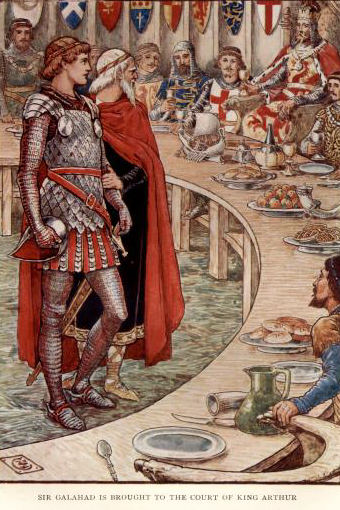
PRONUNCIATION: (GAL-uh-had)
MEANING: noun: One who is known for integrity, courteousness, and nobility.
ETYMOLOGY: After Sir Galahad, the noblest of the Knights of the Round Table, in the British legend of King Arthur. Earliest documented use: 1854.
Prosperos Roundtable: weekly listening and dialogue group to discuss, share our concerns, feelings, thoughts, sense testimony, conclusions and anything else you’d like to bring up about.COVID-19 and other world issues on Fridays at 5:30 p.m. Pacific time. Moderated by Rick Thomas and Pam Rodolph. Zoom link: https://zoom.us/j/579891643


.jpg)


.jpg)
