Shulamite in Song of Songs: Gay, lesbian or queer Biblical love poem?

by Kittredge Cherry | Sep 6, 2021 (qspirit.net)

Song of Songs

Some scholars believe the Biblical Song of Songs was originally written as same-sex love poetry. Paul R. Johnson translated it as “a gay love poem” and Angela Yarber sees it as erotic poetry between a woman and her female lover.  Others are “queering” the scripture in a wide variety of creative or scholarly projects.

The song celebrates erotic love between two lovers. They do not have proper names, but the central figure is called “the Shulamite” in Song 6:13. This obscure Hebrew term is often understood to mean a person from Jerusalem.

Traditional theologians present the Song of Songs as a heterosexual love story. They explain away the eroticism of the Bible’s sexiest book as an allegory for love between God and a human soul, Yahweh and the Israelites or Christ and the church.

The song salutes not only sexuality in general, but black beauty in particular. In a popular line that didn’t make it into the lectionary, the scripture affirms, “I am black and beautiful.” (Song of Songs 1:5).

Many Protestant churches read Song of Songs (also called Song of Solomon or Canticles) 2:8-13 as the lectionary reading  on Aug. 29, 2021. This is the only passage from Song of Songs that appears in the three-year lectionary cycle.

Book Song of Songs by Falk

It’s actually confusing to identify who is saying what in the original Hebrew text for the Song of Songs. The gender of the speakers is uncertain in many cases, and the number of speakers is also unclear.

The two main characters are traditionally identified as Bride and Groom or the Beloved and King Solomon. Nobody knows who wrote the Song of Songs, but authorship is traditionally attributed to Solomon, who reigned in the tenth century BCE.  He was the son of David, whose same-sex love with Jonathan is well documented.

Most translations of the Songs of Songs impose a heterosexual interpretation. One version that is not cluttered with hetero commentary is “The Song of Songs: Love Lyrics from the Bible,” translated by Marcia Falk, a feminist scholar who did her doctoral thesis on Song of Songs. Its meditative design leaves lots of white space and even includes the Hebrew text on facing pages.

While queer scholars wrestle with the Song of Songs, others create events such as Urban Adamah’s “Song of Songs Seder: Celebrating Queer Sexuality” or use it to inspire contemporary LGBTQ art and poetry.

Song of Songs translated as a gay love poem

Evangelical minister and scholar Paul Robert Johnson took the gay understanding to new heights in his revolutionary book “Ancient Answers to Modern Gay Problems: A New Discovery of Old Manuscripts: The Song of Songs, a Gay Love Poem?”

After 20 years studying the original Hebrew text, he concluded that both the Shulamite and the Shulamite’s lover were male. His translation reflects their same-sex love. In his version, the Shulamite is Asher, a black son of Solomon, and his beloved is a man named Caleh, a shepherd-soldier. Here is how Johnson translated Song of Songs 4:10-11:

“How delightful you are Caleh, My lover-man, my other half.
Your pleasing masculine love is better than wine.
The smell of your body is better than perfume.
Your moustache is waxed with honeycomb
Honey and milk are under your tongue.
The scent of your clothing is like the smell of Lebanon.”

Johnson’s book on the Song of Songs was published in 1990 by Fidelity Press, but is out of print and extremely hard to find. Online it has been known primarily through an often-republished 1995 review by Jim Kepner, founder of the International Gay and Lesbian Archives, and co-founder of ONE Institute. There is also a critical article debunking Johnson’s approach. Q Spirit founder Kittredge Cherry managed to track down a partial copy of the book for this article, with help from Hunter Flournoy of spiritjourneys.com.Song of Songs by Paul R Johnson covers
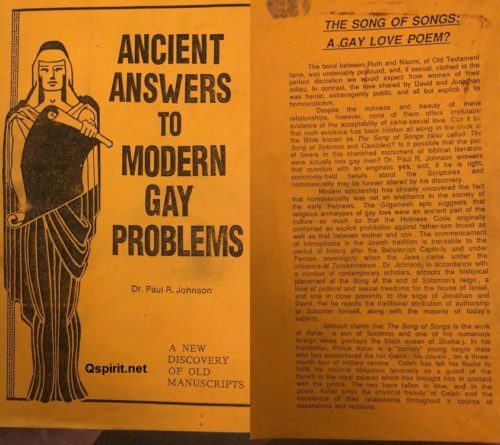
“Ancient Answers to Modern Gay Problems: The Song of Songs, a Gay Love Poem?” by Paul R. Johnson is out of print and hard to find.

To translate the Song of Songs, Johnson relied on fragmentary pre-Masoretic texts. He found that editors had covered up the original same-sex love in Song of Songs. They made it appear to be heterosexual by hiding the Shulamite’s male name and changing the gender of the lover and beloved in many passages. Johnson tracked down an earlier, more accurate version on several scraps of the song with the Dead Sea Scrolls in Qumram cave #4.

The back cover of the book explains that the love between Jonathan and David or Ruth and Naomi implies acceptance of homosexuality during Biblical times, but does not provide irrefutable proof. The cover text continues:

“Can it be that such evidence has been hidden all along in the book of the Bible known as The Song of Songs (also called The Song of Solomon and the Canticles)? Is it possible that the pair of lovers in this cherished monument of biblical literature were actually two gay men? Dr. Paul R. Johnson answers that question with a resounding YES…. Johnson claims that The Song of Songs is the work of Asher, a son of Solomon and one of his numerous foreign wives (perhaps the black queen of Sheba). In his translation, Prince Asher is a ‘comely’ young negro male who has encountered the fair Caleh, his cousin, on a three-month tour of military service. Caleh has left his flocks to fulfill his national obligation (probably as a guard of the harem in the royal palace) which has brought him in contact with the prince. The two have fallen in love, and in the poem, Asher sings the physical beauty of Caleh and the excellence of their relationship throughout a course of separations and reunions.”
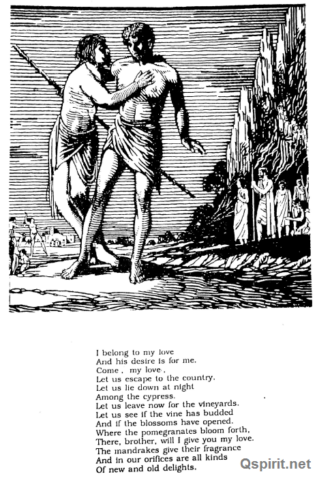
Song of Songs by Paul R Johnson WM page I belong to my love

Love between men is pictured on a page from Johnson’s gay translation of Song of Songs 7:10-13: “I belong to my love and his desire is for me…”

Kepner’s review of the book concludes, “The Song of Songs now stands as the most explicit homoerotic love poem in the Bible, with clear naming of this thing going into that thing. Johnson’s small book is a must for all Jewish or Christian gays, though many might be too timid to abandon conventional hetero mistranslations.”

In a long and illustrious career, Johnson served as chairman of the board of the Lambdas, an early gay Christian organization dedicated to “informing our Christian and Jewish friends about the true nature of homosexuality as it relates to the church of our day,” and general moderator of Fidelity, “an association of gay, lesbian and homophile fundamentalists.” He pastored churches in Georgia, Illinois, New Jersey, and Washington state before moving to southern California. He then held various positions, including counselor and information director at the Los Angeles Gay and Lesbian Community Services Center. Johnson wrote many books, pamphlets and articles about Christianity and LGBTQ issues for the Advocate and other magazines. His other books include “Homosexuality and the Biblical Texts” and “Gays and the New Right: A Debate on Homosexuality.”

Claiming the Shulamite and her female lover in Song of Songs

Scholar and Baptist minister Angela Yarber’s research led her to the opposite conclusion.  She believes that the Shulamite and her lover were probably both women.

Christian feminists generally see Song of Songs as an exemplary text with some of the Bible’s most positive representations of womanhood. The Shulamite is held up as a female role because she boldly affirms her body, her sexuality and erotic pleasure for its own sake. In contrast to other parts of the Bible, the Shulamite is honored for her sexuality, not attacked as a whore or forced into motherhood.Shulamite by Angela Yarber
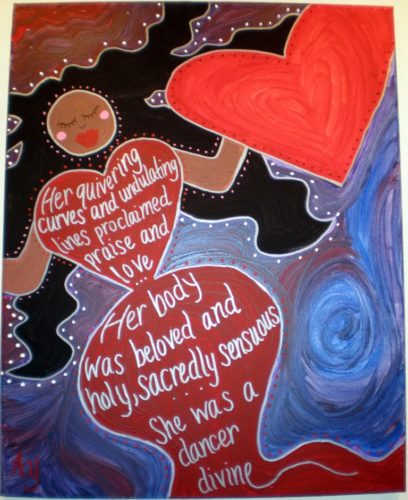
“Shulamite” by Angela Yarber

Yarber takes it further with her lesbian interpretation of the Song of Songs. She has done in-depth study of the Shulamite, painted her portrait and written extensively about her.

She explained her thinking in an interview with the Jesus in Love Blog / Q Spirit:

“The Shulamite is a dancer in Song of Songs 7, which says in part, ‘How beautiful are your sandaled feet, O prince’s daughter. The curves of your (quivering) thighs like jewels crafted by artist hands.’  I first discovered her when a dance historian mentioned her dance as a form of bellydance. This passing reference led me to translate, exegete, and publish an article about the Shulamite’s bellydance called ‘Undulating the Holy.’ Since bellydance is historically a dance performed by women in the context women, men were rarely permitted to witness bellydance. In other words, it would be an anachronism to propose that the lover doting upon the Shulamite was male. Additionally, many of the women in all female harems performed bellydance and engaged in same-sex relations with other women in the harems. Consequently, the queer history of bellydance, combined with the absence of male pronouns in the poem describing the Shulamite in Song of Songs 7 led me to conclude that the Shulamite’s lover was likely another female. What is more, the idea of homo and heterosexuality are not transhistorical essences, but instead are relatively recent socio-historical constructs. To say that there were strict sexual binaries in the ancient world in which the Shulamite lived would also be an anachronism. Sexuality was much more fluid. This dance and the poem describing the Shulamite are also very affirming of the female body. In these ways, the Shulamite is holy and empowering not just for women in general, but also for lesbians in particular.”

Her claims are backed up by solid scholarly research. She wrote her master’s thesis, “Embodied Liberation: Women in Ancient Israelite Dance,” at McAfee School of Theology in Atlanta, Georgia. Her Ph.D. dissertation at the Graduate Theological Union in Berkeley, California was on “Dancing Feet Find Holy Ground: Embodying the Feminine in the Dances of the World’s Religions.” She is founder and creative director of the Tehom Center (formerly called Holy Women Icons Project).

Yarber is also an artist, and she echoes the bellydance scripture in her icon of the Shulamite: “Her quivering curves and undulating lines proclaimed praise and love. Her body was beloved and holy, sacredly sensuous. She was a dancer divine.” The Shulamite is one of more than 100 voluptuous, vibrantly alive and life-giving women who appear Yarber’s colorful contemporary Holy Women Icons series. Since 2009, Yarber has painted more than 100 Holy Women Icons. These colorful, folk feminist icons are displayed in homes and galleries all over the world. They can also be found in her book “Holy Women Icons.”

Yarber shares more of her research and her own woman-centered translation of the passage about the quivering thighs (Song of Songs 7:1-4) in an article on the Feminism and Religion blog.

Song of Songs inspires LGBTQ people

Over the centuries the Song of Songs has been a touchstone for a wide variety of LGBTQ writers and theologians:

Bernard of Clairvaux, a medieval French abbot who had a passionate same-sex friendship, wrote a series of 86 sermons on the Song of Songs.

Victorian poet and painter Simeon Solomon, who was arrested in 1873 for sexual behavior with a man, found coded ways to connect the Song of Songs with male-male eroticism. His work is a popular topic with queer scholars today.

Front Runner cover

The Song of Songs plays a small but important role in one of the all-time most popular gay novels, “The Front Runner” by Patricia Nell Warren. The 1974 novel is a love story between a track coach and his star athlete. It became the first contemporary gay fiction book to hit the New York Times bestseller list, selling 10 million copies in seven languages.

Articles about “The Front Runner” almost always fail to mention the coach’s gay Christian side. The novel describes this bedroom scene of the gay lovers: “Before going to sleep we often lay propped in bed, reading…. I often read the Bible, letting its comfort and truth sink into me. Jesus had said that the last would be first. Society said that we were the last. It could be Jesus had meant the gays.”

Later the men create their own wedding service to make a formal public declaration of their love: “It consisted simply of quotes, each of us alternating. In his soft voice, Billy read from the teachings of Buddha… Then I read from the Bible, mostly the Song of Songs.”

For some LGBTQ people of faith, the dance of intimacy in Song of Songs may symbolize their feelings as they wonder whether to respond to God’s love while fearing rejection over their sexual orientation or gender identity.Song of Songs meme You are altogether beautiful

LGBTQ Christian meme based on Song of Songs

A meme circulated on social media in 2021 generated some controversy even in the LGBTQ community by implying that the Song of Songs was a metaphor for Christ’s love of the LGBTQ community. Even a gay man called it “just pure blasphemy” when he first read:

“Words of Jesus to the
rainbow community:
You are altogether
beautiful, my darling;
in you there is no flaw.
— Song of Songs 4:7”

Queer Bible scholars explore Song of Songs

An almost overwhelming amount of queer Bible scholarship examines the Song of Songs. Here is a sampling of some chapters and articles:

Chapter on Song of Songs by Christopher King in “Queer Bible Commentary,” edited by Deryn Guest), Robert Goss, Mona West and Thomas Bohache.

“The Song of Songs for difficult queers: Simeon Solomon, Neil Bartlett, and A Vision of Love Revealed in Sleep” by Duc Dau, a chapter in “Queer Difficulty in Art and Poetry: Rethinking the Sexed Body in Verse and Visual Culture.”

“The Song of Songs in the History of Sexuality,” a chapter in “God’s Beauty Parlor: And Other Queer Spaces in and Around the Bible” by Stephen D. Moore.

Biblical Drag: Performing Gender with the Song of Songs” by Max Brumberg-Kraus (United Theological Seminary)

“Penderecki’s Iron Maiden: Intimacy and Other Anomalies in Canticum canticorum Salomonis” by Heidi Epstein, a chapter in “Bible Trouble: Queer Reading at the Boundaries of Biblical Scholarship

“Promethea’s Song of Songs” by Yael Klangwisan, a chapter with a bisexual interpretation in “Sexuality, Ideology and the Bible: Antipodean Engagements

Queer Readings of the Song of Songs” by Karin Hügel (Journal of the European Society of Women in Theological Research)
___
Top image credit: A heart shaped shadow is cast on a Bible open to the Song of Solomon in “Book of Love” by Jonathan Thorne (Wikipedia)
___
This post is part of the LGBTQ Saints series by Kittredge Cherry. Traditional and alternative saints, people in the Bible, LGBT and queer martyrs, authors, theologians, religious leaders, artists, deities and other figures of special interest to lesbian, gay, bisexual and transgender and queer (LGBTQ) people and our allies are covered.

This article was originally published on Q Spirit in September 2021.

Copyright © Kittredge Cherry. All rights reserved.
Qspirit.net presents the Jesus in Love Blog on LGBTQ spirituality.

Kittredge Cherry

FollowKittredge CherryFounder at Q SpiritKittredge Cherry is a lesbian Christian author who writes regularly about LGBTQ spirituality.She holds degrees in religion, journalism and art history.She was ordained by Metropolitan Community Churches and served as its national ecumenical officer, advocating for LGBTQ rights at the National Council of Churches and World Council of Churches.


Augustine of Hippo: Saint who rejected his bisexual past, defended intersex people

by Kittredge Cherry | Aug 28, 2021 (qspirit.net)

Augustine by Carlo_Crivelli

After a sexually active and probably bisexual youth, Augustine of Hippo became an influential early Christian theologian who was sex-negative but argued that God created intersex people. This contradictory queer saint’s feast day is Aug. 28 in western Christianity.

LGBTQ people may appreciate Augustine’s passionate friendship with another man and his relatively compassionate recognition of gender diversity. Augustine is also often blamed for the misogynist, anti-sex attitude that runs through much of church history. His life and work show that Christians have wrestled with questions of sexuality and gender identity since antiquity.

Augustine is one of the most important Christian thinkers, perhaps second only to Saint Paul of Tarsus. Both are famous converts with a possible same-sex attraction and a sex-negative Christian theology adapted from a classical education.

From 396 to 430 Augustine served as bishop in the North African city of Hippo in present-day Algeria. He also organized a community of men who lived together there like monks and inspired the foundation of a monastic religious order.

 Augustine called himself “a slave to lust”

Augustine’s best-known book is “Confessions,” a vivid tell-all memoir that has fascinated and perhaps titillated readers for centuries. Completed in the year 400, “Confessions” is considered the first Western autobiography. This honest account describes his religious development, emotional life and sexual history as a self-proclaimed “slave to lust.”

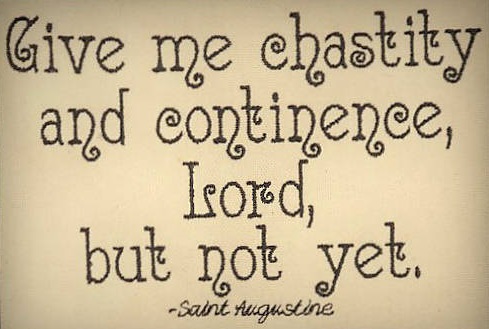
In addition to the section about his possible male lover, he writes at length of illicit affairs with women and fathering a child with his live-in concubine. It was during this sexually active period that he uttered the humorously human prayer that has become famous, living on as a slogan on mugsT-shirts and such: “God, give me chastity and moderation — but not yet.”Augustine quote

Augustine’s “Give me chastity” prayer was a framed embroidery at Etsy

Augustine’s antagonism toward sex is legendary. He was among the first to claim that Sodom was destroyed for the sin of homosexuality. Earlier understandings, even within the Bible itself, identified the sin of Sodom as abusing strangers. He condemned “sodomy” and his own “past foulnesses and carnal corruptions.” But he was less extreme than some of his contemporaries because Augustine conceded that there was some acceptable sex (for procreation within marriage).

His own preference showed when he wondered why God even created women. “How much more agreeable for companionship in a life shared together would be two male friends rather than a man and a woman,” he wrote.

He encouraged intimacy between men in his advice on how to do the kiss of peace after the Eucharist:  “When your lips draw near to those of your brother, do not let your heart withdraw from his,” he wrote.

Augustine was born and raised in Africa

Augustine grew up in Roman culture where homosexuality was accepted as normal.  Aurelius Augustinus, known as Augustine, (Nov. 13, 354 – Aug. 28, 430) was born in the Roman city of Thagaste in Algeria to a Romanized family with Berber (Amazigh) heritage. No record of his appearance exists, but because he was African there is reason to believe he had dark skin. He has been portrayed as black at various times and places throughout art history and in contemporary works by artists such as John Nava and Bruce Herman.Augustine

Saint Augustine, artist unknown

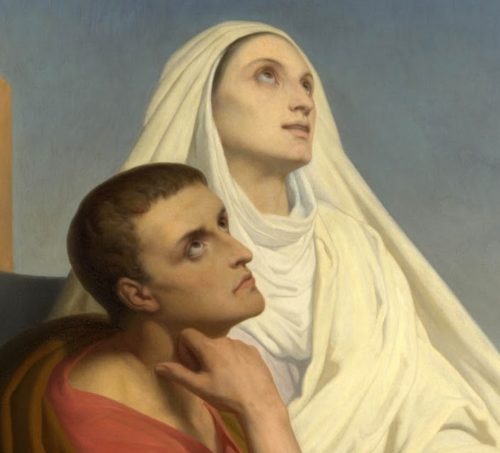
His father, Patricius, was a pagan landowner with Roman roots and his mother, Monica, was a pious Christian who was canonized later as a Catholic saint. Monica has been proposed as a patron saint for parents of LGBTQ people.Augustine and Monica by Ary Scheffer

Augustine appears with his mother Monica before they were saints in an 1846 painting by Ary Scheffer (Wikipedia)

A brilliant student, he received a classical Latin education and then became a rhetoric professor. Like most men in his culture, he had a stronger emotional connection to other men than to women, except his mother.

“Although it is debatable to what extent, if any, these passionate friendships were homoerotic, they express a sensibility that today is probably to be found, at least in Western industrial societies, only among gay men,” wrote Toronto historian Brad Walton in “Gay and Lesbian Literary Heritage.”

Augustine and the man he loved

Many see self-incriminating proof of Augustine’s homosexual affairs in his own statements about his youth in Book 3.1 (translated by Carolinne White):

“To love and also be loved in return was what excited me, especially if I could enjoy my lover’s body. So I polluted the stream of friendship with the filth of lust and obscured its brightness with foul passions. But despite this shameful and degrading behavior, in my excessive vanity I hoped to be regarded as elegant and civilized.”

“Saint Augustine of Hippo: Lord, Make Me Pure, But Not Yet” by Sarah Talbot (available on Etsy)

One same-sex relationship stands out in particular. As he wrote in “Confessions,” Augustine fell completely in love with an unnamed young man when they were both in their late teens. His beloved was a fellow student who had grown up with him. This “most dear friend” was “sweet to me above all sweetness… I felt that my soul and his soul were ‘one soul in two bodies,’ ” Augustine wrote. Many have interpreted their relationship as homosexual.

But the friend developed a fever and died. Augustine was devastated by grief, which he described in dramatic terms that echo across the ages. Here is just part of his lengthy description of his turmoil:

“When my friend died, grief darkened my heart and wherever I looked, all I could see was death. My home town was a torture to me and my family home a place of misery. All that I had shared with my friend became excruciating without him. I hated everything because he was absent; nowhere I went could say to me, ‘Look, here he is,’ as it did when he was alive but not with me….

“I wept bitterly and found consolation in my bitterness…. I was amazed that other people were alive when the man I had loved as if he were immortal was dead. I was even more amazed that I was alive when he was dead, since I was his second self. Someone expressed it well when he called his friend ‘half of his soul,’ for I felt that my soul and my friend’s had been one soul in two bodies.” (Book 4.4-6)

These quotes come from a translation by Carolinne White in the first modern illustrated edition of the “Confessions.” Her translation is enhanced by medieval and Renaissance art from manuscripts at the British Library.

There are many other English translations of “Confessions.” Two versions that are recommended by Q Spirit for accuracy and readability are by Henry Chadwick in 2009 or Maria Boulding in 2002.

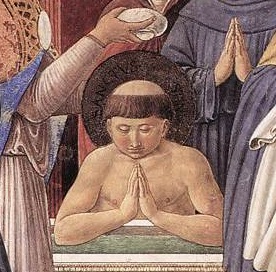
Augustine decided to leave Thagaste to escape the torment of missing his deceased friend. At age 17, he moved to Carthage in Tunisia, marking a spiritual turning point that eventually led to Christian conversion and baptism in Milan when he was 32.

Baptism of Augustine by Benozzo Gozzoli, 1464-65 (Wikipedia)

“Odd it is to note that the most famous conversion in Christian history, after that of St. Paul, originated in one man’s love for another,” writes historian Paul Halsall in his online Calendar of LGBT Saints. His essay also includes the full set of quotations in which Augustine describes his relationship with his beloved male friend.

Augustine said God created gender diversity

Many contemporary LGBTQ people reject Augustine’s teachings on sexual activity, but his ideas about gender diversity are much more in tune with contemporary queer theology.

He wrote a section affirming intersex people as part of God’s creation in “City of God,” a major book of Christian philosophy. The book is regarded as “a masterpiece of Western culture” by Encyclopedia Britannica and many others. Writing in Latin, Augustine used the terms “hermaphrodite” or “androgyne” to denote an intersex person.  In Book 16 of “City of God” he writes:

“God, the Creator of all, knows where and when each thing ought to be, or to have been created, because He sees the similarities and diversities which can contribute to the beauty of the whole…. As for the Androgyni, or Hermaphrodites, as they are called, though they are rare, yet from time to time there appears persons of sex so doubtful, that it remains uncertain from which sex they take their name,”

This quote and other aspects of Augustine’s theology of gender are examined in the 2015 book “Sex Difference in Christian Theology: Male, Female, and Intersex in the Image of God” by theologian Megan DeFranza.

Gabrielle M.W. Bychowski provides a full in-depth analysis of Augustine’s writings on gender diversity in her article “The Sites of Hermaphrodites: Intersex in the Greco-Roman World.” She teaches transgender and intersex history at Case Western Reserve University in Cleveland. She writes:

“The idea that hermaphrodites are monsters that signal failures of embodiment that should be eschewed to the margins is condemned by Augustine as heretical and small-minded. Whether or not intersex is a human person or another race of people entirely, they are members of God’s world. To call hermaphrodites disordered in their embodiment is to critique God their creators. Augustine writes, “What if God has seen fit to create some races in this way, that we might not suppose that the monstrous births which appear among ourselves are the failures of that wisdom whereby He fashions the human nature, as we speak of the failure of a less perfect workman?” (Augustine XVI.viii).

Looking carefully at each line in Augustine’s text, Bychowski goes on to say:

…The problem is not in the true lives of the hermaphrodites but in the environment that misunderstands them and fears sharing the world with them. “But He who cannot see the whole is offended by the deformity of the part,” writes Augustine, “because he is blind to that which balances it, and to which it belongs.” (Augustine XVI.viii).

In a section that may relate to transgender people, Augustine criticized the pagan cult of the Great Mother goddess Cybele for having castrated eunuch priests who were “neither changed into a woman nor allowed to remain a man.” (City of God VII.xxiv)

Augustine’s impact on understanding of sexual orientation and gender identity is also explored in “Sexual Dissidence: Augustine to Wilde, Freud to Foucault” by Jonathan Dollimore.

Augustine canonized by popular acclaim

Augustine’s extensive career in the church came to a close when he died of illness at age 75 during the siege of Hippo by Germanic Vandals. He was canonized by popular acclaim, and later honored as a doctor of the church. His feast is celebrated on Aug. 28 by western churches and June 15 in the Orthodox tradition.

In an updated queer iteration of the canonization process, Augustine is included on the Advocate’s “30 LGBT Saints” list.Augustine by Philippe de Champaigne

Saint Augustine by Philippe de Champaigne, 1645-50 (Wikipedia)

Most images of Augustine show him in old age as a bishop dressed in splendid vestments. The standard iconography pictures him holding a flaming heart and/or a book. The heart in his hands is not the usual Sacred Heart of Jesus that often appears in Christian icons. Augustine holds his OWN flaming heart. Experts explain that this symbolizes the intensity of his own heart on fire with love of God — or how the heart may burn with “lascivious and harmful loves” until it is given to God.

The conflict between Augustine’s sexuality and spirituality is expressed particularly well in a portrait by French Baroque artist Philippe de Champaigne.  In this painting, Augustine looks away from his flaming heart and holds it at arms length like a hot potato, touching it with only his fingertips to avoid getting burned.

In addition to his honored role in the church, Augustine has entered the popular imagination. He even appears on a mug at the DrinklingsCoffeeMugs Etsy shop.with one of his best-known quotes: “The world is a book and those who do not travel read only a page.”

Saint Augustine’s face appears with one of his most famous quotes on mugs available at Etsy.

Other popular quotes by Augustine include:

“You have made us for yourself, O God, and our heart is restless until it rests in you.”

“This very moment I may, if I desire, become the friend of God.”

“There is no saint without a past, no sinner without a future.” (later paraphrased by celebrated gay writer Oscar Wilde)

LGBTQ-Liberation Prayer to Augustine

Canadian gay theologian Donald Boisvert wrote a prayer to Augustine and the Apostle Paul from an LGBTQ-liberation perspective. The prayer is included in his 2004 book “Sanctity and Male Desire: A Gay Reading of Saints.” His chapter on Paul and Augustine draws parallels between the two saints. They are both intellectuals who had dramatic conversion experiences and wrote influential sex-negative theology. Here is his prayer:

Blessed Paul and Augustine, doctors and defenders of the faith, men of integrity, architects of an inhuman theology of sexuality, you have done us harm. We are grateful for the beauty and passion of your words, but we also pray that our common brotherly love will shield us from their poison. You have been misused to condemn us and our desires for the affections and bodies of other men. We think you understood us. We need you now to stand with us. Inspire and motivate the leaders of our faith to see the hatred they spread against us in your name. Convert them as you were once converted. Be our strength, our bold and born-again guides. Amen.

___
Top image credit:
Detail from “St Jerome and St Augustine” by Carlo Crivelli, c. 1490 (Wikiepdia)

This post is part of the LGBTQ Saints series by Kittredge Cherry. Traditional and alternative saints, people in the Bible, LGBT and queer martyrs, authors, theologians, religious leaders, artists, deities and other figures of special interest to lesbian, gay, bisexual and transgender and queer (LGBTQ) people and our allies are covered.

This article was originally published in August 2019 and was updated for accuracy and expanded with new material on Aug. 27, 2021.

Copyright © Kittredge Cherry. All rights reserved.
Qspirit.net presents the Jesus in Love Blog on LGBTQ spirituality.

Kittredge Cherry

Kittredge Cherry Founder at Q Spirit Kittredge Cherry is a lesbian Christian author who writes regularly about LGBTQ spirituality.She holds degrees in religion, journalism and art history.She was ordained by Metropolitan Community Churches and served as its national ecumenical officer, advocating for LGBTQ rights at the National Council of Churches and World Council of Churches.
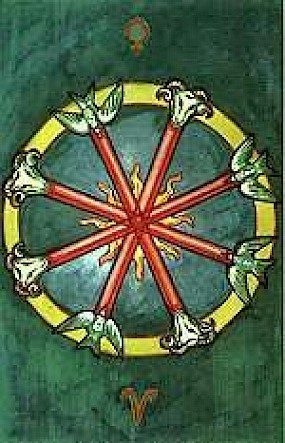
Tarot card for September 7: The Four of Wands

The Four of Wands

The Lord of Completion marks a point where a circle has been completed. It can apply to work projects, personal situations – even phases of life. In some respects it’s like a lesser reflection of the Universe, the final Major Arcana card.

Another aspect of the Four of Wands associate it with the Major Arcanum of Adjustment, or Justice. This is because this Wand indicates the manifestation of balanced forces, resulting in the fulfilment of earlier hopes, ideas and dreams. The balance aspect, combined with the overall morality of Wands, brings us to think about injustice being resolved, inequity acknowledged and set right.

This is a good card, promising not only the sense of natural satisfaction which arises when we follow our ideas through to their logical conclusion, but also the opportunity to start new things off.

If we stop when we have achieved a goal along the way, we begin to stagnate. We need to take the sense of contentment and channel it into the stage on our journey – that way we continually grow.

The Four of Wands

(via angelpaths.com and Alan Blackman)

The Quest of Rose – The Cosmic Keys of Our Future Becoming


The Chopra Well
The Quest of Rose – The Cosmic Keys of Our Future Becoming – Book 1 of the Future Humans Trilogy by Dr. Anneloes Smitsman & Dr. Jean Houston. A conversation with Deepak Chopra, Jean Houston and Anneloes Smitman, leading pioneers in the fields of human development, consciousness research, and systems sciences. Written as an allegory, The Quest of Rose guides you through an experiential transformation journey that weaves together real-life events that are at the forefront of what’s happening in our world right now, with cutting-edge insights from the new sciences, indigenous wisdom, and consciousness teachings for discovering the greater possibilities of our future becoming. Already referred to by many world-renowned luminaries as: “a masterpiece”, “epic and unlike any other”, “one of the most important books of our catalytic time”, and “a true gift to humanity.” Website – https://www.futurehumans.world/ Follow Future Humans on YouTube – https://www.youtube.com/channel/UCIZY…

Book: “Universal Human: Creating Authentic Power and the New Consciousness”

Universal Human: Creating Authentic Power and the New Consciousness

Universal Human: Creating Authentic Power and the New Consciousness

by Gary Zukav

The author of the legendary #1 New York Times bestseller The Seat of the Soul shows us step-by-fascinating-step how to create a life of love and where that now leads.

Internationally acclaimed author and teacher, Gary Zukav, shares a new vision of power and hope in this time of extraordinary transformation. Universal Human gives us new tools to grow spiritually and shows us how to transform everyday experiences of hopelessness, emptiness, and pain into fulfillment, meaning, and joy. It points us toward a startling new destination—a species that is beyond culture, religion, nation, ethnic group, and gender, a species whose allegiance is to Life first and all else second—and shows us how to get there. Universal Human examines our disintegrating social structures and the new social structures that are replacing them. It shows us a new creation story—our new creation story—as we create it with our choices, our deeds, and our words.

A new human consciousness is replacing the old human consciousness. Authentic power—the alignment of the personality with soul—is replacing external power, the ability to manipulate and control. Zukav explains that the potential of a new era of humanity based on love instead of fear is upon us, but only we can bring it into being. Universal Human shows us how. It is a book that you will never forget.

(Goodreads.com)

Scientific Approaches to Spirituality – Dr Rupert Sheldrake, PhD

Jesus didn’t become aware of his direct intimate connection with God, the Father, through going to a rabbinical seminary. He had an overwhelming mystical experience at the moment of his baptism when he was immersed in the river Jordan by John the Baptist and came up out of the waters again. And I think this kind of immersion by baptism produced a sort of near-death experience through drowning. So I think Jesus had an overwhelmingly powerful mystical experience. And then went on a 40-day vision quest fasting in the wilderness.

–Dr. Rupert Sheldrake

The Weekend University Get early access to our latest psychology lectures: http://bit.ly/new-talks5 Dr. Rupert Sheldrake is a biologist and author of more than 85 scientific papers and 14 books. He is a leading researcher into anomalous phenomena and was named among the top 100 Global Thought Leaders for 2013. He studied biology and biochemistry at Cambridge University where he earned his Ph.D., followed by a fellowship at Harvard where he spent a year studying philosophy and history. In this session, we discuss Rupert’s latest work on scientific approaches to spirituality, why they work, how they improve psychological wellbeing, and how you can use them – even if you do not identify with any kind of religion. This interview was recorded as part of our 2020 Holistic Change Summit, which featured sessions with 25 world leading psychologists, neuroscientists and authors, who shared their latest evidence based approaches to behaviour change. If you’re interested in getting lifetime access to all 25 sessions, please click here for more info: http://bit.ly/hcs-2020

D.H. Lawrence beginning an R.H.S.* of his publisher

Curse the blasted, jelly-boned swines, the slimy, the belly-wriggling invertebrates, the miserable sodding rotters, the flaming sods, the sniveling, dribbling, dithering palsied pulse-less lot that make up England today. They’ve got white of egg in their veins, and their spunk is that watery, it’s a marvel they can breed. They are nothing but frog-spawn—the gibberers! God, how I hate them! God curse them, funkers. God blast them, wish-wash. Exterminate them, slime.”

D.H. LAWRENCE

  –D.H. LAWRENCE, AFTER SONS AND LOVERS WAS REJECTED BY A PUBLISHER

Born this week in 1885

(lithub.com)

*RHS is short for Releasing the Hidden Splendour. Go to “Prosperos Classes” page on this website for more information.

Alice B. Toklas moves in with Gertrude Stein

Alice B. Toklas moves in with Gertrude Stein.

Alice B. Toklas moves in with Gertrude Stein.

On September 9, 1910, almost exactly three years after they met, Alice B. Toklas moved in with famous comma-hater Gertrude Stein at 27 rue de Fleurus in Paris—that would be in the 6th arrondissement on the Rive Gauche, of course (as the saying goes, “La Rive Gauche pense, et la Rive Droite dépense”). Their relationship, and their place at the very center of the Parisian avant-garde scene, would become the stuff of legends—not least because of Stein’s most popular book, The Autobiography of Alice B. Toklas—though it was only later that Toklas would find her own voice as a food writer (with a legendary recipe for hash brownies, no less).

Maira Kalman, who illustrated a recent edition of The Autobiography of Alice B. Toklas, explained that she was drawn to the project because of the relationship between the two writers. “Neither one of them could have flourished without the other,” she told Literary Hub. “They are eccentric, electric, artistic, domestic. Unique in so many ways. Determined. Unapologetically opinionated. The intersection of art and domesticity speaks to me as well—how do you create a grounded home as a jumping off point for your work? That is something that I have sought in my life.”

Toklas, the much less assuming (and much less famous) of the two, was often referred to as Stein’s “secretary-companion,” though by all accounts, Toklas had her own special power. “People have told me that when this small ugly woman was in a room they were keenly aware of her, before they even recognized her as Miss Toklas,” wrote M.F.K. Fisher in the foreword to a recent edition of The Alice B. Toklas Cookbook. “She seemed to send out waves of inaudible sound, like bells clanging somewhere in another space than ours.” No wonder that Stein, in tune with many of the secret spaces of the world, instantly claimed that they would be together forever only a few minutes after they met. And in fact, they were: the two stayed together until Stein’s death in 1946. They are buried side by side in Paris’s Père Lachaise Cemetery.

In the 1970s, three-fourths of Americans reported having trust in medical professionals. Today, only about a quarter report confidence in the healthcare system, according to the New England Journal of Medicine. As medicine continues to advance, so does the need to listen to patients with narrative competency. Columbia University’s Master of Science in Narrative Medicine prepares health professionals, writers, advocates, and scholars to apply the skills and values of narrative understanding to improve outcomes for both patients and caregivers, and to investigate issues pertinent to health and healthcare in a rigorous transdisciplinary setting. This flagship graduate program is the first of its kind, and is a worldwide leader. Graduates are poised to become educators and leaders in healthcare and beyond. RSVP to learn more today.

MORE ON TOKLAS + STEIN

The Haunting of Alice B. Toklas

The Haunting of Alice B. Toklas

The US Tour That Made Gertrude Stein a Household Name

The US Tour That Made Gertrude Stein a Household Name

The Creative Communities That Changed Literature Forever

The Creative Communities That Changed Literature Forever

AN ARGUMENT FOR CLOSE ATTENTION

“I always say that you cannot tell what a picture really is or what an object really is until you dust it every day and you cannot tell what a book is until you type it or proof-read it. It then does something to you that only reading it never can do.”

–GERTRUDE STEIN
The Autobiography of Alice B. Toklas

September 5, 2021 (lithub@lithub.com)

Joseph Campbell On Experiencing Mystery

Vanessa Able (thedewdrop.org)

“One way to deprive yourself of an experience is to expect it. Another is to have a name for it before you have the experience.”

– Joseph CampbellTweet


Joseph Campbell’s passion for comparative mythology and the study of world religions has put him at the forefront of writing about the significance of myth and metaphor and what we lose when we eschew our culture’s popular mythologies. The collection Thou Art That is composed of Campbell’s writings about the mythologies and images of Christianity in an attempt to highlight their metaphoric properties and discourage literal interpretation. In this extract he takes on the notion of experiencing mystery and considers how religious narratives can actually stymie the expansive human experience of transcendence.


The primary purpose of a dynamic mythology, which we may underscore as its properly religious function, is to awaken and maintain in the person an experience of awe, humility, and respect in recognition of that ultimate mystery that transcends every name and form, “from which,” as we read in the Upanişads, “words turn back.” In recent decades, theology has been often concentrated on a literary exercise in the explanation of archaic texts that are made up of historically conditioned, ambiguous names, incidents, sayings, and actions, all of which are attributed to “the ineffable.” Faith, we might say, in old-fashioned scripture or faith in the latest science belong equally at this time to those alone who as yet have no idea of how mysterious, really, is the mystery of themselves.

Into how many of us has the weight described by the physicist Erwin Schrödinger been born that “this life of yours that you are living is not merely a piece of the entire existence, but is, in a certain sense the whole; only the whole is not so constituted that it can be surveyed in one simple glance. This is what the Brahmins express in that sacred, mystic formula that is yet really so simple and so clear: Tat tvam asi, that is you.”

This is the basic insight of all metaphysical discourse, which is immediately known—as knowable to each alone-only when the names and forms, what I call the masks of God, have fallen away. Yet, as many have observed, including William of Occam, Immanuel Kant, and Henry Adams, the category, or name, of unity itself is of the mind and may not be attributed to any supposed substance, person, or “Ground of Being.”

“Faith in old-fashioned scripture or faith in the latest science belong equally at this time to those alone who as yet have no idea of how mysterious, really, is the mystery of themselves.

Who, then, may speak to you, or to any of us, of the being or nonbeing of God, unless by implication to point beyond his words and himself and all he knows, or can tell, toward the transcendent, the experience of mystery.

The question sometimes arises as to whether the experience of mystery and transcendence is more available to those who have undergone some kind of religious and spiritual training, for whom, as I have said, it has all been named completely. It may be less available to them precisely because they have got it all named in the book. One way to deprive yourself of an experience is indeed to expect it. Another is to have a name for it before you have the experience. Carl Jung said that one of the functions of religion is to protect us against the religious experience. That is because in formal religion, it is all concretized and formulated. But, by its nature, such an experience is one that only you can have. As soon as you classify it with anybody else’s, it loses its character. A preconceived set of concepts catches the experience, cutting it short so that it does not come directly to us. Ornate and detailed religions protect us against an exploding mystical experience that would be too much for us.


There are two orders of religious perspective. One is ethical, pitting good against evil. In the biblically grounded Christian West, the accent is on ethics, on good against evil. We are thus bound by our religion itself to the field of duality. The mystical perspective, however, views good and evil as aspects of one process. One finds this in the Chinese yin-yang sign, the dai-chi.

We have, then, these two totally different religious perspectives. The idea of good and evil absolutes in the world after the fall is biblical and as a result you do not rest on corrupted nature. Instead, you correct nature and align yourself with the good against evil. Eastern cults, on the other hand, put you in touch with nature, where what Westerners call good and evil interlock. But by what right, this Eastern tradition asks, do we call these things evil when they are of the process of nature?

“The experience of mystery comes not from expecting it but through yielding all your programs, because your programs are based on fear and desire. Drop them and the radiance comes.

I was greatly impressed when I was first in Japan to find myself in a world that knew nothing of the Fall in the Garden of Eden and consequently did not consider nature corrupt. In the Shinto scriptures one reads that the processes of nature cannot be evil. In our tradition, every natural impulse is sinful unless it has been purified in some manner.

In some artistic representations, one sees the Deity and at His right stand the three Graces. The muses are clothed because art clothes mystery. The final revelation is the naked mystery itself. The first of the three Graces is Euphrosyne, or rapture, sending forth the energy of Apollo into the world. The second is Aglaia, splendor, bringing the energy back. Then, embracing the two, we find Thalia, abundance. One recognizes that these are the functions of the Trinity in the Christian biblically based tradition in which these same powers are given a masculine form.

Finally, it does not matter whether you are going to name them male and female. Transcendence is beyond all such naming. This symbol refers to what might simply be called total meditation. Father is Thalia, the abundance who unites the other two. The Son is Euphrosyne, the rapture of love that pours itself into the world. The Holy Spirit, the Paraclete, is Aglaia, who carries us back. The energy itself stems from Apollo, who in the Christian tradition is the one Divine substance of which the three of the Trinity are personalities.

The experience of mystery comes not from expecting it but through yielding all your programs, because your programs are based on fear and desire. Drop them and the radiance comes.

Joseph Campbell (1904-1987)
From – Thou Art That: Transforming Religious Metaphor