Book: “Christian Science Class Instruction”

Christian Science Class Instruction

Christian Science Class Instruction

by Arthur Corey

This volume is the only publication of Christian Science Class Instruction authorized by a duly accredited practitioner while in good standing with the Church. As such, this book has great value not only to the students of Mary Baker Eddy’s teachings but the historian, the philosopher, the metaphysician as well as the critic. Many valuable and historic sources are quoted in this work. This is one of those rare volumes that has as much pertinence today as when it was first published in 1945.

(Goodreads.com)

The Kappeler Institute for the Science of Being USA

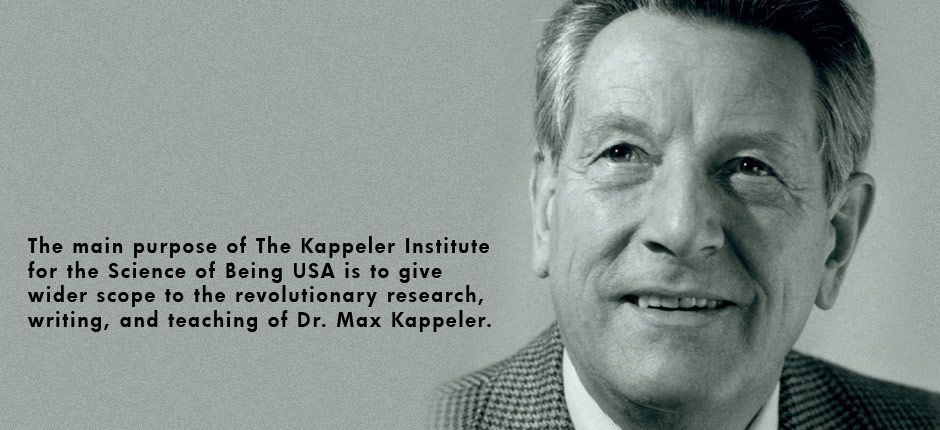
Max Quote - The Main purpose of the Kappeler Institute for the Science of Being USA, is to give wider scope to the revolutionary research, writing and teaching of Max Kappeler.

MaxBench300x218

Welcome to Kappeler Institute!

The main purpose of the Kappeler Institute for the Science of Being is to give wider scope to the revolutionary research, writing, and teaching of Dr. Max Kappeler, Switzerland (1910–2002). Our mission is to publish, protect, and promote Max Kappeler’s works on the Science of Christian Science, and to assist interested students in their study.

Dr. Kappeler’s work represents a divine philosophy, with specific research into a spiritually scientific approach to both the Bible and Science and Health with Key to the Scriptures by Mary Baker Eddy. This subject has been termed “the Science of Christian Science,” “the Science of Being,” or simply “Science.”

This study appeals to the metaphysical or philosophical thinker. Those seeking to understand the one Being through its ontological divine root categories and its divinely cybernetic laws, orders, rules, system, structure and multi-dimensional workings—along with the transforming implications that such an understanding brings—will find these teachings among the most profound works of our present age.

Kappeler Institute, USA is proud to have been granted the sole rights to all of Dr. Kappeler’s works in English – published and unpublished. We are honored to act, according to his last will and testament, as Dr. Kappeler’s “sole promoter and protector” for all of these works.

Max Kappeler’s work is not associated with, nor endorsed by, any religious organization. The Kappeler Institute, USA, claims no exclusive rights to the terms “the Science of Christian Science” or “the Science of Being,” and does not present itself as an authority to endorse, control, or regulate the work in the subject of Science.

(kappelerinstitute.org)

Free Will Astrology for Sept. 9, 2021

Roman emperor Caligula disproved a prediction by a renowned seer by managing to ride his favorite horse Incitatus from one shore to the other across a bay. (Shutterstock)

Roman emperor Caligula disproved a prediction by a renowned seer by managing to ride his favorite horse Incitatus from one shore to the other across a bay. (Shutterstock)https://2e6bf186691e8eaa8f08bd9754c0810f.safeframe.googlesyndication.com/safeframe/1-0-38/html/container.html

Virgo, now is the time to focus on a curse you want to undo

.

ARIES (March 21-April 19): “We need to become more unreasonable but in an intelligent way,” says Aries politician Jerry Brown. Yes! I agree! And that’s especially true for you right now, Aries. To Brown’s advice, I will add this message from Aries fashion designer Vivienne Westwood: “Intelligence is composed mostly of imagination, insight—things that have nothing to do with reason.” Here’s one further suggestion to help you take maximum advantage of cosmic rhythms, courtesy of Aries historian Arnold J. Toynbee: “The supreme accomplishment is to blur the line between work and play.”

TAURUS (April 20-May 20): “I have become whole and complete, like a thundering cloudburst in summer,” wrote Taurus poet Miklós Radnóti. I love that metaphor for fullness: not an immaculate icon of shiny, sterile perfection, but rather a primal, vigorous force of nature in all of its rumbling glory. I hope you like this symbol as much as I do, and I hope you use it to fuel your creative spirit in the coming weeks. P.S.: Keep in mind that many indigenous people welcome rainstorms as a source of fertility and growth.

GEMINI (May 21-June 20): “Pandiculation” is a word that refers to when you stretch and yawn at the same time. According to my understanding of the astrological omens, you will benefit from doing a lot of pandiculations in the coming days. I also recommend gazing lazily out the window and looking at the sky a lot. Keep your shoes off as much as possible, get a massage or three, and let yourself sleep more than you customarily do. Did you know that sighing deeply is good for your lungs’ health? Here’s your homework: Dream up all the things you can do to relax and renew yourself. It’s prime time to indulge in generous acts of self-healing.

CANCER (June 21-July 22): The ancient Roman author Pliny’s 10-volume “Natural History,” written in the first century, was a monumental encyclopedia of the natural world, unprecedented in its own time and for centuries afterward. It offered compilations of facts about astronomy, geography, zoology, botany, mineralogy and many other subjects. There was one big problem with it, however. It contained a great deal of erroneous information. For example, Pliny described in detail many non-existent animals, including dragons, flying horses and giant serpents that swallowed bulls and snatched birds out of the sky. My reason for telling you this is to inspire you to be extra discerning in the coming weeks. Be especially skeptical of authorities, experts and other know-it-alls who are very confident despite being inaccurate or erroneous. It’s time for you to increase your trust in your own authority.

LEO (July 23-Aug. 22): “There are those fortunate hours when the world consents to be made into a poem,” writes Leo poet Mark Doty. That’s great for a poet. But what about for everyone else? My variation on Doty’s comment is this: There are fortunate hours when the world consents to be made into a holy revelation or a lyrical breakthrough or a marvelous feeling that changes our lives forever. I expect events like those to come your way at least twice in the immediate future.

VIRGO (Aug. 23-Sept. 22): Between 37 and 41 BCE, Virgo-born Caligula served as third Emperor of Rome. To do so, he had to disprove the prophecy of a renowned astrologer, Thrasyllus of Mendes. Years earlier, Thrasyllus had predicted that Caligula, despite being well-connected, “had no more chance of becoming emperor than of riding a horse across the Bay of Baiae” — a distance of two miles. Once in power, Caligula arranged to have a series of pontoon boats arrayed across the bay, enabling him to ride his favorite horse Incitatus from one shore to the other across the Bay of Baiae. I foresee the possibility of a comparable turn of events for you, Virgo. Is there a curse you want to undo? A false prophecy you’d like to cancel? Someone’s low expectation you would love to debunk? The coming weeks will be a favorable time.

LIBRA (Sept. 23-Oct. 22): College student Amelia Hamrick studied the right panel of Hieronymus Bosch’s 15th-century painting “The Garden of Earthly Delights.” It depicts a hellish scene. Cities are on fire. Weird beasts devour sinful humans. There are demons and torture chambers. Hamrick did what no one in the history of art had ever done: She transcribed the musical score that the artist had written on a man’s naked hindquarters. Her work inspired a composer to create a recording entitled “500-Year-Old Butt Song from Hell.” In the coming weeks, I invite you to perform feats comparable to Hamrick: 1. Explore the past for useful, overlooked clues. 2. Find or create redemptive transformations out of stressful situations. 3. Have fun telling stories about your past misadventures.

SCORPIO (Oct. 23-Nov. 21): Born on one of the Galapagos Islands, Diego is a giant tortoise who has lived for over 100 years. He’s a member of the Hood Island species, which had dwindled to a population of 15 by 1977. That’s when he and his tortoise colleague, whose name is E5, became part of a breeding program with 12 female tortoises. E5 was reserved in his behavior, but Diego was a showboat who vocalized loudly as he enjoyed public mating rituals. Together the two males saved their species—producing over 2,000 offspring in subsequent years. According to my astrological analysis, you could be as metaphorically fertile as Diego and E5 in the coming months—even if you prefer to adopt an approach more akin to E5’s.

SAGITTARIUS (Nov. 22-Dec. 21): “The meaning of my existence is that life has addressed a question to me,” wrote psychologist Carl Jung. “Or, conversely, I myself am a question that is addressed to the world, and I must communicate my answer, for otherwise, I am dependent upon the world’s answer.” These are superb meditations for you Sagittarians during the coming weeks. Between now and Oct. 1, I invite you to keep a journal where you write about two subjects: 1. What is the main question that life asks you? 2. What is the main question that your life asks the world?

CAPRICORN (Dec. 22-Jan. 19): North Korea’s Capricorn leader Kim Jong-un has an amazing résumé. Official reports say he learned to drive at age 3 and was an accomplished sailor at 9. As an adult, he developed the power to control the weather. He’s a skilled musician and artist, as well as a scientist who developed a miracle drug to cure AIDs, Ebola, cancer, heart disease and the common cold. Most impressively, Kim is an archaeologist who discovered a lair where magical unicorns live. Is it possible you have unexpressed powers like these, Capricorn? If so, the coming weeks will be a favorable time to identify them and start tapping into their potential. It’s time to develop your dormant talents.

AQUARIUS (Jan. 20-Feb. 18): Aquarian author Toni Morrison testified, “I think of beauty as an absolute necessity. I don’t think it’s a privilege or an indulgence. It’s almost like knowledge, which is to say, it’s what we were born for.” I urge you to adopt her perspective during the next four weeks, Aquarius. In my astrological opinion, a devoted quest for beauty will heal exactly what most needs to be healed in you. It will teach you everything you most need to know.

PISCES (Feb. 19-March 20): Poet and translator Anne Carson periodically joins with her husband Robert Currie to teach a workshop called “EgoCircus.” It’s an ironic title, because the subject they teach is the art of collaboration. To develop skills as a collaborator, of course, people must lay aside at least some of their egos’ needs and demands. In accordance with current astrological potentials, I encourage you to stage your own version of EgoCircus in the coming weeks. The time is ripe for you to hone your creative togetherness and synergistic intimacy.

Homework: Tell me the most important lesson you’ve learned since 2021 began. Newsletter@FreeWillAstrology.com.

How threats of hellfire helped keep ‘immodest’ women in their place – from the ancient world to ‘My Unorthodox Life’

September 8, 2021 8.23am EDT (theconversation.com)

Author

  1. Meghan HenningAssociate Professor of Christian Origins, University of Dayton

Disclosure statement

Meghan Henning has received a Jacob K. Javitts award.

Partners

University of Dayton

University of Dayton provides funding as a member of The Conversation US.

View all partners

CC BY NDWe believe in the free flow of information
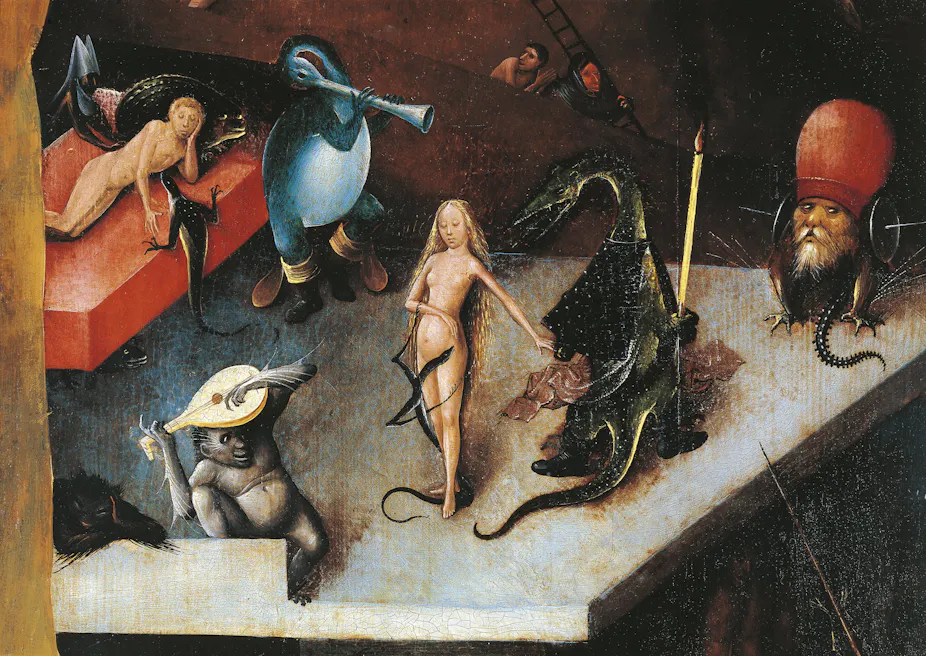
A woman stands between monsters in "The Last Judgement," a painting by 15th-century Dutch artist Hieronymus Bosch.
For centuries, societies have used visions of the afterlife to discipline people’s behavior. DEA / G. Nimatallah/De Agostini via Getty Images

In the opening of Netflix’s popular new show “My Unorthodox Life,” fashion mogul Julia Haart explains that she grew up thinking that dressing provocatively had eternal consequences:

“It was your mother’s responsibility to teach you modesty. … If any of your body parts were uncovered, there’s a very special form of hell that is reserved for both you and your mother. In this hell, your mother would dip your clothes in acid, put them on your body, and so throughout the day your body would decompose from the acid. And then the next morning it would start all over again, for thousands of years, or however many years hell lasts. When you learn this as a child, and everyone around you believes it, you believe it.”

Haart grew up in an Orthodox Jewish community she describes as “fundamentalist,” though critics have questioned how the show portrays it. In both Christianity and Judaism, views on the afterlife are diverse – and most Jews in the U.S. today put less emphasis on what happens after death than what happens now.

As a scholar of early Christianity whose work focuses on depictions of hell, I see this education as rooted in two millennia of ideas about gender, bodies, sin and punishment that influence our society today – particularly for women.

Some ancient Jewish and Christian depictions of the afterlife provide graphic depictions of sinners and their punishments. Many of these punishments are seen as “fitting” for the sin committed: They follow the ancient legal standard of “measure for measure” punishment, known as lex talionis.

Punishments for women, like the one that Haart describes, follow the norms of the ancient and medieval cultures that first created them, including drastically different expectations for men and women. In these texts, the “immoral” clothes that brought women to hell become the instruments of their own torment – threatening images used to keep them in their place.

‘Fitting’ the crime

Clothing is only the beginning. Women in hell hang by their breasts in several medieval Jewish texts known as the Isaiah fragments because they uncovered their hair, tore their veil or nursed their children in the marketplace “in order to attract the gaze of men.” In the Gedulat Moshe, a Jewish text written sometime around the 13th century that describes Moses visiting hell, he sees women who uncovered themselves hanged by their breasts and their hair.

These frightening visions were drawn from attitudes toward real women and were used to control them, as well. In a third-century rabbinic legal text, the Mishnah Sotah, a woman who has committed adultery is sentenced to have her breasts and hair uncovered. The public humiliation is considered “fitting,” because her body led to her sin.

But this idea of justice or retribution did not originate with the rabbis and is certainly not exclusive to Judaism. The punishments in these Jewish texts closely mirror the second-century Apocalypse of Peter, a Christian text that describes women hanging by their hair and neck because their intricate hairstyles seduced married men.

It is difficult to say whether it was Jews or Christians who first brought these gendered ideas about the body into their images of hell. But the earlier Christian visions of hell certainly elaborate on them more than medieval Jewish ones do. For example, only young women were punished for being unchaste in early Christian depictions of hell – even those like the Apocalypse of Paul, in which male and female sinners were punished equally for other sins.

In the earliest Christian descriptions of hell, women and men were both held accountable for parenting-related sins, such as abortion or abandoning an infant. After a few centuries, however, women alone were held responsible for having children and nurturing them. In one medieval account of hell, the Latin Vision of Ezra, women were not only responsible for parenting their own children but punished for failing to nurse orphaned infants. Their punishment? Hanging in fire while serpents suck their breasts.

These sins and punishments reflect several different but interwoven ancient ideas about the body: that women’s hair was a sexual organ, that female grooming is tied to adultery, that women’s main role is child rearing and that their bodies should not be seen in public.

Double standards today

Although these ideas were not included in the Jewish or Christian Bible, societies often used them to define religious crimes and control their bodies.

It is easy to look at these ancient hellscapes and dismiss them as long-ago. But ideas about women’s bodies being problematic and in need of control persist, with or without religion. And in “My Unorthodox Life,” Haart invites the audience to look at gender double standards in the fashion world up close.

Julia Haart speaks to the audience at the July 15, 2021, premiere of the Netflix series 'My Unorthodox Life,' at Hudson Yards in New York City.
Julia Haart, CEO of Elite World Group, speaks at the premiere of ‘My Unorthodox Life,’ a Netflix series about her fashion career and journey away from observant Judaism. Noam Galai/Getty Images Entertainment via Getty

Haart, who has left her Orthodox community, calls herself “very proud to be a Jew” and determined “to show people that there are all sorts of Jews.” Now CEO of Elite World Group, the parent company of a major modeling agency, she draws viewers’ attention to the industry’s sexual abuse, unequal standards for men and women, and its tendency to cater to male desire. She describes her mission as “cleaning up” modeling and “rooting out” its sexual abuse – a vow a former supermodel has recently called on her to uphold.

Though “My Unorthodox Life” has been mocked for its soap opera style, I believe it carries a serious message: Ideas about objectifying and controlling women’s bodies shape our society more than we’d like to admit – with or without religion.

[Get the best of The Conversation, every weekend. Sign up for our weekly newsletter.]

Beth Daley

Editor and General Manager

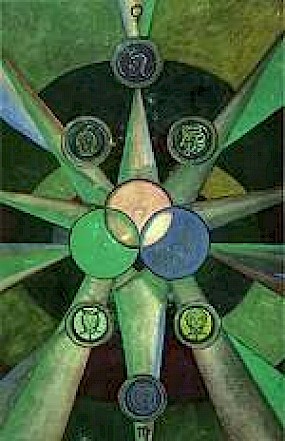
Tarot card for September 9: The Nine of Disks

The Nine of Disks

The Lord of Gain is one of the cards which usually receives a hearty welcome when it comes up in a reading. At the mundane level it indicates the financial rewards which come from working diligently and dedicatedly on an important project, so it will often mark a stage of completion. In the workplace it will show that hard work is rewarded both by appreciation and an increase of salary. Sometimes it can indicate promotion (though rarely a total change of workplace) earned as a result of loyalty and attention to detail.

As you’ll remember, Disks not only deal with our financial area, but also with day-to-day security in the family environment. So sometimes the Lord of Gain can come up to indicate consolidation and achievement at home. Perhaps an emotional conflict has finally been resolved, or a long-standing problem finally dealt with.

At the spiritual level, this card talks a lot about the principle that what we give to life is what we get back. And here we have confirmation that we have lived as much as we are able in the moment, appreciating the things that come our way, and celebrating the bounty we have. As a result, more abundance flows in.

The card rarely indicates windfalls, or unexpected sources of income. Here we have worked hard to create something rewarding, and the Lord of Gain indicates the results of our efforts.

The Nine of Disks

(via angelpaths.com and Alan Blackman)

Zohar

From Wikipedia, the free encyclopedia

The Zohar (Hebrew: זֹהַר‎, lit. “Splendor” or “Radiance”) is a foundational work in the literature of Jewish mystical thought known as Kabbalah.[1] It is a group of books including commentary on the mystical aspects of the Torah (the five books of Moses) and scriptural interpretations as well as material on mysticism, mythical cosmogony, and mystical psychology. The Zohar contains discussions of the nature of God, the origin and structure of the universe, the nature of souls, redemption, the relationship of Ego to Darkness and “true self” to “The Light of God”. Its scriptural exegesis can be considered an esoteric form of the rabbinic literature known as Midrash, which elaborates on the Torah.

Language

The Zohar is mostly written in what has been described as a cryptic, obscure style of Aramaic.[2] Aramaic, the day-to-day language of Israel in the Second Temple period (539 BCE – 70 CE), was the original language of large sections of the biblical books of Daniel and Ezra, and is the main language of the Talmud.[3] However, in the Late Middle Ages, the language was used among Jews exclusively in the study of such earlier texts. Some academic scholars assert that the Aramaic of the Zohar appears to be written by someone who did not know Aramaic as a native language and that words from Andalusi Romance and Galician-Portuguese can be found in the text.[4]

Origin and history

The Zohar first appeared in Spain, then the Kingdom of León, in the 13th century. It was published by a Jewish writer named Moses de León (c. 1240–1305). De León ascribed the work to Shimon bar Yochai (“the Rashbi”), a tanna active after the Siege of Jerusalem (70 CE) and the destruction of the Second Temple during the protracted period known as the Jewish–Roman wars.[5] According to Jewish legend,[6][7] Shimon hid in a cave for thirteen years studying the Torah and was inspired by the Prophet Elijah to write the Zohar. This accords with the traditional claim by adherents that Kabbalah is the concealed part of the Oral Torah.

Acceptance within Judaism

While the traditional majority view in Judaism has been that the teachings of Kabbalah were revealed by God to Biblical figures such as Abraham and Moses and were then transmitted orally from the Biblical era until their redaction by Shimon bar Yochai, modern academic analysis of the Zohar, including that by the 20th century religious historian Gershom Scholem, has theorized that Moses de León was the actual author. Aryeh Kaplan posited a theory that there was an ancient core text of the Zohar which antedated de Léon, but that several strata of text were added over time.

The view of some non-Chasidic Orthodox Jews and Orthodox groups, as well as non-Orthodox Jewish denominations, generally conforms to Scholem’s view, and as such, most such groups have long viewed the Zohar as pseudepigrapha and apocrypha, while sometimes accepting that its contents may have meaning for modern Judaism. The Dor Daim reject the Zohar outright, while the Spanish and Portuguese Jewish community removed all Zohar-related content from their siddurs and liturgy in the aftermath of Sabbatai Zevi‘s apostasy to Islam. Selected Zohar-related elements have been restored in several more recent Spanish and Portuguese siddurs, even for communities which have not restored those elements to their liturgy.

Siddurs edited by non-Orthodox Jews may therefore contain excerpts from the Zohar and other kabbalistic works,[8] even if the editors do not literally believe that they are oral traditions from the time of Moses.

Impact outside Judaism

There are people of religions besides Judaism, or even those without religious affiliation, who delve in the Zohar out of curiosity, or as a means of seeking meaningful and practical answers about the meaning of their lives, the purpose of creation and existence and their relationships with the laws of nature,[9][10] and so forth; however from the perspective of traditional, rabbinic Judaism,[11][12] and by the Zohar’s own statements,[13] the purpose of the Zohar is to help the Jewish people through and out of the Exile and to infuse the Torah and mitzvot (Judaic commandments) with the wisdom of Moses de León’s Kabbalah for its Jewish readers.[14]

Etymology

In the Bible, the word “Zohar” appears in the vision of Ezekiel 8:2 and is usually translated as meaning radiance or light. It appears again in Daniel 12:3, “Those who are wise will shine like the brightness of the heavens”.

Authorship

Initial view

Representation of the Five Worlds with the 10 Sephirot in each, as successively smaller concentric circles, derived from the light of the Kav after the Tzimtzum

Suspicions aroused by the facts that the Zohar was discovered by one person and that it refers to historical events of the post-Talmudic period while purporting to be from an earlier time, which caused the authorship to be questioned from the outset.[5] Joseph Jacobs and Isaac Broyde, in their article on the Zohar for the 1906 Jewish Encyclopedia, cite a story involving the Kabbalist Isaac of Acco, who is supposed to have heard directly from the widow of de León that her husband proclaimed authorship by Shimon bar Yochai for profit:

A story tells that after the death of Moses de Leon, a rich man of Avila named Joseph offered Moses’ widow (who had been left without any means of supporting herself) a large sum of money for the original from which her husband had made the copy. She confessed that her husband himself was the author of the work. She had asked him several times, she said, why he had chosen to credit his own teachings to another, and he had always answered that doctrines put into the mouth of the miracle-working Shimon bar Yochai would be a rich source of profit. The story indicates that shortly after its appearance the work was believed by some to have been written by Moses de Leon.[5]

Isaac’s testimony, which appeared in the first edition (1566) of Sefer Yuchasin, was censored from the second edition (1580)[15] and remained absent from all editions thereafter until its restoration nearly 300 years later in the 1857 edition.[16][17]

Rabbi Aryeh Kaplan states that Isaac evidently did not believe her since Isaac wrote that the Zohar was authored by Rabbi Shimon bar Yohai in a manuscript in Kaplan’s possession.[clarification needed] This leads him to hypothesize that Moses de León’s wife sold the original manuscript, as parchment was very valuable, and was embarrassed by the realization of its high ancient worth, leading her to claim it was written by her husband. Kaplan concludes saying this was the probable series of events.[18]

The Zohar spread among the Jews with remarkable swiftness. Scarcely fifty years had passed since its appearance in Spain before it was quoted by many Kabbalists, including the Italian mystical writer Menahem Recanati and by Todros Abulafia. Certain Jewish communities, however, such as the Dor DaimAndalusian (Western Sefardic or Spanish and Portuguese Jews), and some Italian communities, never accepted it as authentic.[5] The manuscripts of Zohar are from around the 14th and 16th centuries.[19]

Late Middle Ages

By the 15th century, its authority in the Spanish Jewish community was such that Joseph ibn Shem-Tov drew from it arguments in his attacks against Maimonides, and even representatives of non-mystical Jewish thought began to assert its sacredness and invoke its authority in the decision of some ritual questions. In Jacobs’ and Broyde’s view, they were attracted by its glorification of man, its doctrine of immortality, and its ethical principles, which they saw as more in keeping with the spirit of Talmudic Judaism than are those taught by the philosophers, and which was held in contrast to the view of Maimonides and his followers, who regarded man as a fragment of the universe whose immortality is dependent upon the degree of development of his active intellect. The Zohar instead declared Man to be the lord of the creation, whose immortality is solely dependent upon his morality.[5]

Conversely, Elijah Delmedigo (c.1458 – c.1493), in his Bechinat ha-Dat endeavored to show that the Zohar could not be attributed to Shimon bar Yochai, by a number of arguments. He claims that if it were his work, the Zohar would have been mentioned by the Talmud, as has been the case with other works of the Talmudic period; he claims that had bar Yochai known by divine revelation the hidden meaning of the precepts, his decisions on Jewish law from the Talmudic period would have been adopted by the Talmud, that it would not contain the names of rabbis who lived at a later period than that of bar Yochai; he claims that if the Kabbalah were a revealed doctrine, there would have been no divergence of opinion among the Kabbalists concerning the mystic interpretation of the precepts.[5][20]

Believers in the authenticity of the Zohar countered that the lack of references to the work in Jewish literature was because bar Yohai did not commit his teachings to writing but transmitted them orally to his disciples over generations until finally the doctrines were embodied in the Zohar. They found it unsurprising that bar Yochai should have foretold future happenings or made references to historical events of the post-Talmudic period.[5]

The authenticity of the Zohar was accepted by such 16th century Jewish luminaries as R’ Yosef Karo (d.1575), R’ Moses Isserles (d. 1572), and R’ Solomon Luria (d.1574), who wrote that Jewish law (Halacha) follows the Zohar, except where the Zohar is contradicted by the Babylonian Talmud.[21] However, R’ Luria admits that the Zohar cannot override a minhag.[22]

Enlightenment period

An 1809 edition of the Zohar, printed in Slavuta, as seen in POLIN Museum of the History of Polish Jews

Debate continued over the generations; Delmedigo’s arguments were echoed by Leon of Modena (d.1648) in his Ari Nohem, and a work devoted to the criticism of the Zohar, Mitpachas Sefarim, was written by Jacob Emden (d.1776), who, waging war against the remaining adherents of the Sabbatai Zevi movement (in which Zevi, a false messiah and Jewish apostate, cited Messianic prophecies from the Zohar as proof of his legitimacy), endeavored to show that the book on which Zevi based his doctrines was a forgery. Emden argued that the Zohar misquotes passages of Scripture; misunderstands the Talmud; contains some ritual observances that were ordained by later rabbinical authorities; mentions The Crusades against Muslims (who did not exist in the 2nd century); uses the expression “esnoga“, a Portuguese term for “synagogue“; and gives a mystical explanation of the Hebrew vowel points, which were not introduced until long after the Talmudic period.[5]

In the Ashkenazi community of Eastern Europe, religious authorities including the Vilna Gaon (d.1797) and Rabbi Shneur Zalman of Liadi (d.1812) (The Baal HaTanya) believed in the authenticity of the Zohar. Acceptance was not uniform, however. The Noda Bihudah (d.1793), in his sefer Derushei HaTzlach,[23] argued that the Zohar is to be considered unreliable as it came into our hands many hundreds of years after Rashbi‘s death and it lacks an unbroken mesorah as to its authenticity, among other reasons.[24]

The influence of the Zohar and the Kabbalah in Yemen, where it was introduced in the 17th century, contributed to the formation of the Dor Deah movement, led by Rabbi Yiḥyeh Qafeḥ in the later part of the 19th century, whose adherents believed that the core beliefs of Judaism were rapidly diminishing in favor of the mysticism of the Kabbalah. Among its objects was the opposition of the influence of the Zohar and subsequent developments in modern Kabbalah, which were then pervasive in Yemenite Jewish life, restoration of what they believed to be a rationalistic approach to Judaism rooted in authentic sources, and the safeguarding of the older (“Baladi“) tradition of Yemenite Jewish observance that preceded the Kabbalah. Especially controversial were the views of the Dor Daim on the Zohar, as presented in Milhamoth Hashem (Wars of the Lord),[25] written by Rabbi Qafeḥ. A group of Jerusalem rabbis published an attack on Rabbi Qafeḥ under the title of Emunat Hashem (Faith of the Lord), taking measures to ostracize members of the movement;[26] notwithstanding, not even the Yemenite rabbis who opposed the dardaim heeded this ostracization. Instead, they intermarried, sat together in batei midrash, and continued to sit with Rabbi Qafeḥ in beth din.[27]

Contemporary religious view

Title page of the first printed edition of the Zohar, Mantua, 1558. Library of Congress.

Most of Orthodox Judaism holds that the teachings of Kabbalah were transmitted from teacher to teacher, in a long and continuous chain, from the Biblical era until its redaction by Shimon bar Yochai. Some fully accept the claims that the Kabbalah’s teachings are in essence a revelation from God to the Biblical patriarch AbrahamMoses and other ancient figures, but were never printed and made publicly available until the time of the Zohar’s medieval publication.[citation needed] The greatest acceptance of this sequence of events is held within Haredi Judaism, especially Chasidic groups. R’ Yechiel Michel Epstein (d.1908), and R’ Yisrael Meir Kagan (d.1933) both believed in the authenticity of the Zohar. Rabbis Eliyahu Dessler (d.1953) and Gedaliah Nadel (d.2004) maintained that it is acceptable to believe that the Zohar was not written by Rabbi Shimon bar Yochai and that it had a late authorship.[28]

Within Orthodox Judaism the traditional view that Shimon bar Yochai was the author is prevalent. R’ Menachem Mendel Kasher in a 1958 article in the periodical Sinai argues against the claims of Gershom Scholem that the Zohar was written in the 13th Century by R’ Moses de León.[29] He writes:

  1. Many statements in the works of the Rishonim (medieval commentors who preceded de León) refer to Medrashim that we are not aware of. He writes that these are in fact references to the Zohar. This has also been pointed out by R’ David Luria in his work “Kadmus Sefer Ha’Zohar”.
  2. The Zohar’s major opponent Elijah Delmedigo refers to the Zohar as having existed for “only” 300 years. Even he agrees that it was extant at the time of R’ Moses de León.
  3. He cites a document from R’ Yitchok M’ Acco who was sent by the Ramban to investigate the Zohar. The document brings witnesses that attest to the existence of the manuscript.
  4. It is impossible to accept that R’ Moses de León managed to forge a work within the scope of the Zohar (1700 pages) within a period of six years as Scholem claims.
  5. A comparison between the Zohar and de León’s other works show major stylistic differences. Although he made use of his manuscript of the Zohar, many ideas presented in his works contradict or ignore ideas mentioned in the Zohar. Luria also points this out.
  6. Many of the Midrashic works achieved their final redaction in the Geonic period. Some of the anachronistic terminologies of the Zohar may date from that time.
  7. Out of the thousands of words used in the Zohar, Scholem finds two anachronistic terms and nine cases of ungrammatical usage of words. This proves that the majority of the Zohar was written within the accepted time frame and only a small amount was added later (in the Geonic period as mentioned).
  8. Some hard to understand terms may be attributed to acronyms or codes. He finds corollaries to such a practice in other ancient manuscripts.
  9. The “borrowings” from medieval commentaries may be explained in a simple manner. It is not unheard of that a note written on the side of a text should on later copying be added to the main part of the text. The Talmud itself has Geonic additions from such a cause. Certainly, this would apply to the Zohar to which there did not exist other manuscripts to compare it with.
  10. He cites an ancient manuscript that refers to a book Sod Gadol that seems to in fact be the Zohar.

Concerning the Zohar’s lack of knowledge of the land of Israel, Scholem bases this on the many references to a city Kaputkia (Cappadocia) which he states was situated in Turkey, not in Israel.

Another theory as to the authorship of the Zohar is that it was transmitted like the Talmud before it was transcribed: as an oral tradition reapplied to changing conditions and eventually recorded. This view believes that the Zohar was not written by Shimon bar Yochai, but is a holy work because it consisted of his principles.

Belief in the authenticity of the Zohar among Orthodox Jewish movements can be seen in various forms online today. Featured on Chabad.org is the multi-part article, The Zohar’s Mysterious Origins[30] by Moshe Miller, which views the Zohar as the product of multiple generations of scholarship but defends the overall authenticity of the text and argues against many of the textual criticisms from Scholem and Tishby. The Zohar figures prominently in the mysticism of Chabad. Another leading Orthodox online outlet, Aish.com, also shows broad acceptance of the Zohar by referencing it in many of its articles.[original research?]

Jews in non-Orthodox Jewish denominations accept the conclusions of historical academic studies on the Zohar and other kabbalistic texts. As such, most non-Orthodox Jews have long viewed the Zohar as pseudepigraphy and apocrypha. Nonetheless, many accepted that some of its contents had meaning for modern Judaism. Siddurim edited by non-Orthodox Jews often have excerpts from the Zohar and other kabbalistic works, e.g. Siddur Sim Shalom edited by Jules Harlow, even though the editors are not kabbalists.

In recent years there has been a growing willingness of non-Orthodox Jews to study the Zohar, and a growing minority have a position that is similar to the Modern Orthodox position described above. This seems pronounced among Jews who follow the path of Jewish Renewal.[citation needed]

Modern critical views

The first systematic and critical academic proof for the authorship of Moses de León was given by Adolf Jellinek in his 1851 monograph “Moses ben Shem-tob de León und sein Verhältnis zum Sohar” and later adopted by the historian Heinrich Graetz in his “History of the Jews”, vol. 7. The young kabbalah scholar Gershom Scholem began his career at the Hebrew University in Jerusalem with a famous lecture in which he promised to refute Graetz and Jellinek, but after years of strained research Gershom Scholem contended in 1941 that de León himself was the most likely author of the Zohar. Among other things, Scholem noticed the Zohar’s frequent errors in Aramaic grammar, its suspicious traces of Spanish words and sentence patterns, and its lack of knowledge of the land of Israel.

Other Jewish scholars have also suggested the possibility that the Zohar was written by a group of people, including de León. This theory generally presents de León as having been the leader of a mystical school, whose collective effort resulted in the Zohar.

Even if de León wrote the text, the entire contents of the book may not be fraudulent. Parts of it may be based on older works, and it was a common practice to ascribe the authorship of a document to an ancient rabbi in order to give the document more weight. It is possible that Moses de León considered himself to be channeling the words of Rabbi Shimon.

In the Encyclopaedia Judaica article written by Professor Gershom Scholem of the Hebrew University of Jerusalem there is an extensive discussion of the sources cited in the Zohar. Scholem views the author of the Zohar as having based the Zohar on a wide variety of pre-existing Jewish sources, while at the same time inventing a number of fictitious works that the Zohar supposedly quotes, e.g., the Sifra de-Adam, the Sifra de-Hanokh, the Sifra di-Shelomo Malka, the Sifra de-Rav Hamnuna Sava, the Sifra de-Rav Yeiva Sava, the Sifra de-Aggadeta, the Raza de-Razin and many others.

Scholem’s views are widely held as accurate among historians of the Kabbalah, but like all textual historical investigations, are not uncritically accepted; most of the following conclusions are still accepted as accurate, although academic analysis of the original texts has progressed dramatically since Scholem’s ground-breaking research. Scholars who continue to research the background of the Zohar include Yehuda Liebes (who wrote his doctorate thesis for Scholem on the subject, Dictionary of the Vocabulary of the Zohar in 1976), and Daniel C. Matt, also a student of Scholem’s who has reconstructed a critical edition of the Zohar based on original, unpublished manuscripts.

While many original ideas in the Zohar are presented as being from (fictitious) Jewish mystical works, many ancient and clearly rabbinic mystical teachings are presented without their real, identifiable sources’ being named. Academic studies of the Zohar show that many of its ideas are based in the Talmud, various works of midrash, and earlier Jewish mystical works. Scholem writes:The writer had expert knowledge of the early material and he often used it as a foundation for his expositions, putting into it variations of his own. His main sources were the Babylonian Talmud, the complete Midrash Rabbah, the Midrash Tanhuma, and the two Pesiktot (Pesikta De-Rav Kahana or Pesikta Rabbati), the Midrash on Psalms, the Pirkei de-Rabbi Eliezer, and the Targum Onkelos. Generally speaking, they are not quoted exactly, but translated into the peculiar style of the Zohar and summarized……. Less use is made of the halakhic Midrashim, the Jerusalem Talmud, and the other Targums, nor of the Midrashim like the Aggadat Shir ha-Shirim, the Midrash on Proverbs, and the Alfabet de-R. Akiva. It is not clear whether the author used the Yalkut Shimoni, or whether he knew the sources of its aggadah separately. Of the smaller Midrashim he used the Heikhalot Rabbati, the Alfabet de-Ben Sira, the Sefer Zerubabel, the Baraita de-Ma’aseh Bereshit, [and many others]…

The author of the Zohar drew upon the Bible commentaries written by medieval rabbis, including RashiAbraham ibn EzraDavid Kimhi and even authorities as late as Nahmanides and Maimonides. Scholem gives a variety of examples of such borrowings.

The Zohar draws upon early mystical texts such as the Sefer Yetzirah and the Bahir, and the early medieval writings of the Hasidei Ashkenaz.

Another influence on the Zohar that Scholem, and scholars like Yehudah Liebes and Ronit Meroz have identified[2] was a circle of Spanish Kabbalists in Castile who dealt with the appearance of an evil side emanating from within the world of the sephirot. Scholem saw this dualism of good and evil within the Godhead as a kind of “gnostic” inclination within Kabbalah, and as a predecessor of the Sitra Ahra (the other, evil side) in the Zohar. The main text of the Castile circle, the Treatise on the Left Emanation, was written by Jacob ha-Cohen in around 1265.[31]

More at: https://en.wikipedia.org/wiki/Zohar

Queer and Arab

Queer and Arab | Aeon

Was there no room for the queer individual in Arab history? Have people like us simply never belonged?At a concert of the Lebanese group Mashrou’ Leila in Cairo on 22 September 2017. Photo by Benno Schwinghammer/dpa/Getty

Aya Labanieh is a writer, political organiser, and aspiring poet. She is a PhD candidate in the English and Comparative Literature Department at Columbia University in New York, where she serves as an instructor of writing composition. She is also assistant editor at the Journal of Arabic Literature.4,500 words

Edited bySam Dresser

7 September 2021 (aeon.co)

Aeon for Friends

FIND OUT MORE

‘I’m sure you’ve heard about Sarah Hegazy,’ read the text on my phone. It was 2020; I was tying a red bandana around my face – for both aesthetic and pandemic purposes – en route to a BLM protest in the thick of Manhattan’s June. ‘You’re always checking in on me when something tragic happens in my community. I’d like to extend the same solidarity when something happens in yours. I’m here to talk if you want to.’

That text was how I found out that Hegazy, a 30-year-old Egyptian lesbian activist, had killed herself. I first heard of her in October 2017, when she was jailed by the Egyptian government for flying a rainbow flag at a Mashrou’ Leila concert – an edgy Lebanese rock band known for being openly queer. In Egypt, homosexuality is legally considered a form of debauchery, and in the aftermath of this concert the law was explicitly updated to sanction the promotion of homosexual behaviour in the media with up to three years in prison. For three months after her arrest, Hegazy was tortured at the hands of the Egyptian police, who electrocuted her and encouraged inmates to physically and sexually abuse her. Though she was granted asylum to Canada upon her release, the demons of her trauma followed. She left behind a letter in Arabic that read: ‘To my siblings – I tried to survive and I failed, forgive me. To my friends – the experience was harsh and I am too weak to resist it, forgive me. To the world – you were cruel to a great extent, but I forgive.’

I tried for months not to think about Hegazy. It was easy. Only a thin subsection of my social media feeds dared eulogise her openly. For proper grieving, I had to turn to queer public personalities well outside my social circle: news outlets, international LBTQ+ groups, Arab artists and actors, Mashrou’ Leila’s lead singer, Hamed Sinno, who wrote a song in her honour, and so forth. But when I didn’t go looking, my Facebook feed quickly and quietly washed her away. There were too many family members lurking in the threads, which meant an unceasing threat of exposure. I knew that many of my young Arab American and Muslim American friends were queer. I knew it through dimly lit gay clubs, through confessional WhatsApp messages. But I also knew from experience that to be queer, Arab, and American is to be constantly under siege: a minority within a minority, doubly marginalised from Western society for being a racialised security threat and from your own Arab community for being an abject, sinful deviant, supposedly ‘invented’ by the Western world. The balancing act sets you up to fail: every space you enter doesn’t want you, or asks that you drop off pieces of your body at the door. Have we always fallen through the cracks like this, I wondered. Was there no room for the queer individual in Arab history? Have people like us simply never belonged?

To navigate life in the closet is to learn, no matter how old you get, never to speak into a microphone or to have your picture taken in places you should not be. It is to curate your clothes before seeing the family, to throw yourself into political activism and community work that is always deliberately (suspiciously) not about you, to learn the delicate gay art of dodging the big questions: the questions posed by your family about your friends, and by your friends about your family. To echo an early pioneer of queer theory, Eve Kosofsky Sedgwick writing in 1990, ‘closetedness’ is not just a passive silence; it’s a highly specific performance, a costume you stitch together to the exact measurements of your body and background. Except that, in the United States after the terrorist attacks of 11 September 2001, when you publicly put on that performance, you’re also trying to stuff your half-million relatives and their dirty laundry in the closet, too. You’re not keen on showcasing your family’s homophobia, as runaways from white Christian households might be, because your story always runs the risk of feeding something far larger than you: the toxic stereotype of Arab homophobia.

There’s a great shame attached to this stereotype and, by extension, a great shame attached to belonging to the culture it allegedly comes from. Arab societies and governments have been depicted for decades in Western media as rabidly homophobic – a useful, humanitarian stand-in for calling them uncouth, uncivilised, barbaric. ISIS gained far more fame in US popular discourse for throwing gay men off of buildings than for killing thousands upon thousands of Arabs and Muslims in equally gruesome ways across the Middle East. After all, the former reflected a fanatic, Islamic cruelty, while the latter a less deliberate statistic of collateral damage.

Milo Yiannopoulos, a gay, alt-Right has-been whom I had the misfortune of meeting in my undergraduate years, practically delighted in the 2016 Orlando nightclub shooting, transmogrifying the deaths of 49 people into soundbites about how the Left had chosen Islam over homosexuals, allowing the inherently savage faith to kill them for the sake of political correctness. The TV talk-show host Bill Maher, in part lamenting with Yiannopoulos over how their disinvitation from the University of California, Berkeley single-handedly spelled doom for the Constitution, made sure to double-down on the ‘facts’: ‘Can you be gay in Gaza?’ ‘They chop [gay] heads off in the square in Mecca.’ ‘It’s not my fault that the part of the world that is most against liberal principles is the Muslim part of the world. There have been studies; we have facts on this.’ Sam Harris, bringing his pop anthropology to bear on global affairs, states often how ‘Islam is the motherlode of bad ideas’, as they ‘keep women and homosexuals immiserated in these cultures’ – much unlike the cultures of the US and Europe.

It is true that anti-LGBTQ+ pogroms can and do take place in the Arab world, but when the tolerant West hears of them, they become part of a larger discussion about reforming a fallen, inhumane people; a discussion buttressed by Pew polls showing widespread homophobia in the Middle East and documentaries about the few queer brothers and sisters who survive in exile to tell their stories. Middle Eastern governments don’t exactly help. One need only look at their responses to Hegazy’s death: an Arabic smear campaign on social media gloating over her suicide, street murals in tribute to her swiftly painted over by municipal authorities in Jordan, death threats directed at those grieving for her lost life.

Erasing Arab homosexuals today feels as though it is tied to an ancient, indigenous history; it feels like a fixture in the gloom of a global past, from which the progressive New Yorkers around me have risen, and within which my family still dwells. As I feverishly reread the text on my phone and marched through Columbia University towards the subway, I felt an uncanny continuity between my present situation and the speech that the then-president of Iran, Mahmoud Ahmadinejad, gave on this very campus in 2007, in which he declared: ‘in Iran, we don’t have homosexuals like in your country.’

And yet, sometimes, the most iconic and offensive of memes are the ones most ripe for recycling. Unbeknown to Ahmadinejad, and to me when I first fled the closet into Columbia’s campus for my doctorate, this quote gained a second life in the world of postcolonial scholarship. Scholars of the Middle East, such as Khaled El-Rouayheb, Joseph Massad and Pınar İlkkaracan, reappropriated his statement, arguing that homosexuality as a sexual identity was indeed a foreign, Western construct. Few identified as homosexual in Persia, Egypt, North Africa, the Gulf or the Levant before the modern era. Yet many in the Arab world regularly engaged in homoerotic desire and behaviour, and the literary works of the region are testament to homoeroticism’s widespread popularity and acceptability.

The Quran expresses little about homosexuality outside of the story of Lot in Sodom and Gomorra, which is narratively as rich and ambivalent as its Biblical analogue. The Islamic ban, drawn largely from the Prophet’s hadiths, rests primarily on anal penetration (of men or women), and does not seem to have deterred the overwhelming amounts of same-sex desire and intimacy in the region, if literary records are of any indication. Premodern Arab societies condoned alternative sexual acts between the same sex (cunnilingus, fondling, fellatio, making out), and Arab poets frequently wrote homoerotic love poetry up until the modern period. This corpus was perhaps aided by the Islamic tradition’s lack of discomfort with the pleasures of the body. Medieval Islam placed no premium on celibacy, and the Islamic conception of heaven was entirely wrapped up in libidinal pleasures: food, wine and sex with beautiful men and women – a feature that did not go unnoticed by Orientalist scholars in Europe, who deemed it a sign of Islam’s debauched inferiority compared with the pure, disembodied, geometric abstractions of Christ’s Paradise.

Rumi, scrubbed squeaky-secular-clean on Instagram, was known for religious sainthood and homoerotic couplets

Among the most famous of these poets is Abu Nuwas (c756-814 CE), who dazzled the ‘Abbasid court of the Caliph Harun ar-Rashid with songs of his love for wine, girls and boys. He used direct quotations of Quranic verses to seduce young men into sleeping with him, or to describe his drunken, amorous trysts. Abu Nuwas’s poetry includes some stunning passages, such as comparing tufts of pubic hair to the landscape of the Islamic apocalypse, or redirecting his prayer from the Ka’bah – the house of God – to the house of a hot man in the neighbourhood. While Abu Nuwas was frowned upon by more conservative imams of his time, his creative, literary and sexual uses of the Quran were largely viewed as harmless fun, not outrageous blasphemy. No example captures this lax attitude towards art and scripture better than the one relayed in al-Abi’s Nathr al-durr (1030 CE), in which one friend gifts another a set of dildos inscribed with a Quranic verse: ‘Let them enter in peace and security.’ His friend returns them to his door with an updated inscription – another Quranic quip: ‘So we returned it/him to his mother, so that she might be comforted.’ This medieval ‘yo mama’ joke is a far cry from the outrage and mass protests for which the Arab world has become famous.

Nor was Abu Nuwas’s poetry of homoerotic desire exceptional in Middle Eastern literary production and social practice. Scholars of medieval Islam note that the poet merely ‘picked up a theme that “was in the air”’ among his forebears, contemporaries and those he inspired. It is worth noting that Rumi, the 13th-century Sufi mystic whose intense Islamic devotion has been scrubbed squeaky-secular-clean on the Instagram captions of your friends, was known for both his religious sainthood and his homoerotic couplets.

The poetic archive for female same-sex desire is far smaller, but some incidents are noteworthy. In the generation immediately after Abu Nuwas, a friendly argument was recorded in the Kitab al-Aghani between the Caliph al-Ma’mun and a female court-singer named Bathal over whether penetrative sex with a man was more or less pleasurable for women than lesbian sex (Bathal insisted on the latter). The historian Samar Habib calls this low-stakes banter ‘a small room in which we glimpse … the relations between legislative authority (in the figure of the Ma’mun) and those who are its deviant subjects’, relations that were far less rigid than we are now taught to expect. This attitude towards homoerotic verse and behaviour continued well past the Abbasid era in which Abu Nuwas and Bathal lived. The historian Khaled El-Rouayheb has shown that the early Ottoman period (1519-1798) was replete with casual and sympathetic references to homosexual love and heartbreak, with little to no scandal or outcry.

Fast-forward to the modern world, and conditions for homoerotic love take a turn for the worse. Once more, the reception of Abu Nuwas’s poetry is a perfect case study for the dramatic shift that took place in the 20th century: though widely quoted and celebrated throughout most of Islamic history, Abu Nuwas became the focus of a whirlwind of anxious commentaries and psychoanalytic biographies by Arab scholars in the modern period. In what the cultural critic Joseph Massad calls a ‘civilisational anxiety’, Arab intellectuals of the 1900s feverishly tried to reconcile how this poet could be so central to the history of Arabic literature while also partaking in (supposedly uncivilised, unnatural, perverse) homoeroticism. Even worse, Abu Nuwas flaunted his decadent sins in the public eye and among the high society of his time, indicating that public opinion – ranging from the Caliph and his judges at the top to the bards and traders on the ground – was not fully disapproving of sexually ‘deviant’ practices. How could Abu Nuwas and poets like him – let alone the Caliphs they drank with and sang to! – belong to the supposedly virtuous and sexually pure Arab and Islamic past?

The pearl-clutching, prudish moral conclusions many of these intellectuals reached to resolve this tension were oddly Victorian. They marked Abu Nuwas’s time and the centuries that followed as periods of Islamic ‘degeneracy’ and ‘decline’ that explained why the Middle East had fallen under the control of the West. Islam needed a Reformation, it seemed, a Reformation that would purge its permissiveness and theological flexibility. That would restore its former glory and establish rigid moral codes. But where did this notion of degeneracy and decline come from in the first place? How did this ‘Reformation’ become a cultural fixation?

The answer is complex, but colonisation is undeniably a part of it. Precolonial European travellers in Ottoman lands gawked at the popular tolerance of homosexuality, leveraging new concepts of an ‘unnatural’ and degenerate Oriental sexuality desperately in need of Christian reform. Conversely, Arab travellers through Europe in the 1800s noticed that there was a widespread intolerance of homosexual behaviour. The Egyptian scholar Rifa’ah al-Tahtawi (1801-73) noted that European Orientalists translating Arabic poetry often transformed the romantic or elegiac same-sex relationships it depicted into heterosexual relations, swapping the names of male beloveds for female ones. This is reminiscent of the treatment that European translators of this same period also gave to the now lesbian icon, Sappho: perceiving the homosexuality of ancient Greece as tarnishing their otherwise supreme cultural (and Western) Enlightenment, the lesbianism was written out.

As Western intellectuals and Christian missionaries advanced into the Arab world in the 19th and early 20th centuries, condemnation of same-sex behaviour became more overt. In the unprecedented age of mass printing and translations from English, French and German into Arabic, Arab intellectuals in elite social stratas internalised these European racist and homophobic assumptions about their ‘regressive’ conditions. Eventually, Arab inferiority and decline, and the inability of the Arab native to govern himself or his desires, would come to be cited as reason for the English and French colonial invasions of many Arab nations, from the conquest of Algeria in 1830 to Egypt in 1882 and Syria, Lebanon, Jordan, Palestine and Iraq in the 1910s and ’20s. In a sense, the explanations of Arab decline came true: Europeans predicted that the moral decay and social permissiveness of these Islamic nations would lead to their total political and economic paralysis, and then brought about that paralysis themselves, coaxing the dark prophecy to fruition.

‘Homosexuality’ became a foreign element, branded as a rare aberration, the result of wealth and boredom

In their zeal for reform, the British and French introduced laws criminalising homosexual behaviour – laws that were foreign to those they governed in the name of ‘civilisation’. Today, of the more than 70 countries that criminalise homosexual behaviour, more than half are former British colonies. Much the same can be said about the Gulf States, now used as shorthand for oil and Islamic fundamentalism, in which the British Empire enjoyed what James Onley called an ‘informal empire’ between 1820 and 1971. This was not restricted to the Middle East, either. As the historian Shafiqa Ahmadi argues: ‘Victorian morality and negative views on sex largely influenced the penal codes in nations where Islam was practised, like India, Pakistan and Bangladesh, inherited from the British and other colonial powers.’ After their independence, Asian nations such as India, the Maldives, Burma and Nepal maintained anti-sodomy laws reminiscent of British anti-buggery legislation.

In the colonial and postcolonial Arab world, Victorian morality did not merely function as a legal gloss: it trickled into the topsoil of cultural identity. To resist the Western imperialists who justified their presence through claims to superior culture, one had to construct an Arab and Islamic civilisation on equal terms. The present inferiority of the Middle East, an assumption lifted wholesale from European scholarship and governance, had to be explained through the supposed influx of ‘foreign elements’ into Arabic and Islamic heritage. ‘Homosexuality’ became one of these foreign elements, and was branded as a rare aberration, the result of wealth and boredom or, most commonly, an imported Persianate parasite. The notion of this ‘gay import’ was fermented in the 1950s in the heyday of Arab nationalism, reacting to the need for national ‘Arabness’ to defend itself from real foreign interference during the Cold War, and the alliance of the Iranian Shah with Israel at the time.

Worse than the Persianate influence was the supposedly European one. Arab nationalists, in trying to expel the foreign colonisers, justified the expulsion of all aspects of life attributed to them – homosexuality included. Sayyid Qutb (1906-66), one of the key thinkers of the Egyptian Muslim Brotherhood, wrote ‘anthropological’ assessments of American sexuality – meaning that he watched a lot of Hollywood. He recoiled in horror at the primitive decadence of ‘slutty’ American women and Western tolerance for deviant gays, the latter of which, he claimed, was ‘entirely foreign’ to the Arab world. This is supremely ironic, of course. The US of the 1940s and ’50s was a terrible place to be queer, as news media raised the alarm on the potential treachery of ‘faggots’: as Massad notes , the rise of ‘US anti-Communism broadened to target homosexuals, who as early as 1947 began to be purged from government jobs.’

In reality, Qutb and the 1980s ‘Islamic’ fundamentalism that came after him cannot be said to have used Shariah law to attack the West, but rather used institutionalised Western homophobia to attack the sexual diversity of their own societies. In some ways, one can rebuke the likes of Sam Harris, Thomas Friedman and Ayaan Hirsi Ali, who demand ‘moderate reforms’ or an ‘Islamic Reformation’ on a par with the Protestant one, in order for the Arabs to become more properly civilised, by saying that Islam and Islamic culture has already undergone a reformation – a colonial, Victorian reformation – and that this is precisely the problem. Once more, the harshest condemnations often came down on Abu Nuwas, just as the loudest celebrations were made of him on the same soil in a bygone era. As recently as 2001, under pressure from Islamic fundamentalists, the Egyptian Ministry of Culture ordered the burning of 6,000 volumes of his poetry.

Meanwhile, the modern West likes to think of itself as having evolved past its hatred for the LGBTQ+ community – so far, in fact, that it would like to civilise the savages in the Middle East all over again. Sexual minorities are weaponised against the vulnerable and marginalised Brown communities that they come from; queer issues are routinely pitted against racial and international justice. The gender theorist Judith Butler offers the example of the Dutch Civic Integration Examination. In 2006, Dutch immigrants were forced to take an exam that included the ‘mandatory viewing of images of two gay men kissing as a way to test their “tolerance” and, hence, capacity to assimilate to Dutch liberalism.’ Butler asks: ‘Do I want this test administered in my name [as a non-heterosexual person] and for my benefit? Do I want the state to take up its defence of my sexual freedom in an effort to restrict immigration on racist grounds?’

It’s a question we all need to ask. What does it mean for us non-conforming peoples to become a new tool to harass religious minorities, to designate other precarious people as ‘not Dutch enough’ (as if a white Dutchman would ever be ejected upon not passing such a tolerance test), or to serve as the justification for someone’s deportation back to a dystopia they narrowly fled? Do I want to be placed on a pedestal at the price of pushing my relatives into the sea?

The value that the West now places on LGBTQ+ life is itself both necessary and disturbing: necessary because these are lives worth saving; disturbing because these lives are seen as more valuable than other equally desperate people begging at the border. As late as 1990, LGBTQ+ individuals were branded as ‘psychopathic personalities’ and so barred from entering the US but, now that this law has been repealed, asylum-seekers must instead ‘prove’ that they are gay enough to qualify for human rights. Up until the early 2000s, proving one’s homosexuality required graphic details of appropriately gay sexual experiences and physical conformity with a strict femboy/dyke stereotype. Not being gay enough meant being turned back.

The same pattern is replicated in the current refugee crisis. I have met several Syrian men and women who suppressed or misrepresented some parts of their sexuality to escape the purgatorial camps, sinking rafts and barrel bombs. The notion that a human life can hang in the balance of a haircut or the right kind of drunken blowjob is not what we think when we think of ‘rights’ or ‘asylum’ – nor should it be. As we saw in the Pride Month of June, and its blinding onslaught of rainbow, LGBTQ+ branding is a substitute for LGBTQ+ safety. A similar horror seizes the Arab queer upon encountering ads sponsored by the US military, exalting the progressive acceptance of all orientations into the drone-directing fold. Congratulations: we can now have queers bombing other queers.

What history is ultimately good for is ridding us of our crippling sense of shame

All these considerations – the delightfully decadent past, the inhospitable present, the complicated ethical allegiances of the future – leave the Arab and Arab American queer community in a very confounding world. Many of us are both straight-passing enough to be victimised as Arabs or Muslims and queer-seeming enough to be ostracised from those same groups. What is the point of knowing about Abu Nuwas if today our safest havens are clubs and college classrooms in Western cities? Surely, the purpose of history is not to refine our finger-pointing. While Right-wing pundits might derive joy from firmly anchoring barbarism in the Middle East, it is equally false (not to mention politically useless) to anchor it in the West. Not everything is colonialism’s fault and, moreover, it does not exactly help our day-to-day lives to determine if it is. Nor should history be an excuse to reductively sanitise and glorify the past. After all, this is not a nostalgic essay – it is good to know that the Abbasids were more gay-friendly than the modern Arab average, but none of us would like a return to the Caliphate (some folks tried that recently, albeit with bad taste). So where does one go from here?

Butler follows up her Dutch immigration example by prescribing a kind of tense coexistence: that though religious and sexual minorities might have their antagonisms, ‘modes of separateness’ can coincide with ‘modes of belonging’. In other words, the solution she pushes us towards is uncomfortable cohabitation. Groups of devout Sunnis and sex-club enthusiasts sharing the same city, bristling against one another at times, but banding together when it really matters: to lobby their local governments about reducing traffic, for example, or to expand their urban parks. Basically, these communities should not be splintered off and segregated from the top down through racist criminal and border policing, but rather be forced to deal with one another and form unexpected alliances by being at close quarters. It is an unsexy answer, as municipal politics always is, and, while there is something to it, I’m not sure it does very much for the individual person trying to cope with a thorny reality.

I find it more helpful to think of history along the lines of the novelist Zadie Smith: what it is ultimately good for is ridding us of our crippling sense of shame. There is not necessarily a prescriptive use to history. The old adage about those who do not learn their history being ‘doomed to repeat it’ is not always accurate: I am sure many sexual minorities wish that simply remaining ignorant about homosexuality’s history in Islamic culture would cause the Middle East to start writing sappy gay poetry again. What history can do is ease one’s embarrassment on the world stage. Smith recounts her thoughts as a Black, British Jamaican child, growing up with the English education system that glossed over the empire’s role in the global enslavement of Black people and the impoverishment of the planet. Upon encountering her people’s material poverty, she asked herself the forbidden question: ‘Why did “my people” submit to this treatment? … Why were there 6 million slaves?’ Or more simply, the shame of a small child asking: ‘What’s wrong with my family?’ Understanding the history of why the world looks the way it does can rid you of that shame. History can be used to push against what has congealed in the present: not just homophobia, but the notion that homophobia is ‘ours’, is how we are, is something ‘our’ kind of people have to apologise for. Reviewing the history of colonialism is not about assigning blame to the modern West – it is about removing blame from the shoulders of Arab families stigmatised for an intolerance they did not create.

History does not offer us much optimism because things can just as easily get worse as they can get better. But it can offer us a sense of much-needed surprise. Although we are meant to consider ourselves today as living at the pinnacle of modern progress and human civilisation, the past is actually not uniformly worse or better than the present. The past was just different; uncategorisable, unexpected. It offers us a sense of extended possibility; the possibility of being unstuck from what feels like the eternal damnation of seeing queer people such as Sarah Hegazy find no choice but to die. This is not to say history could have saved her, or could have saved anybody; it is not a cure for PTSD. Grieving her is not a teachable moment.

But it means that the pendulum can swing back in our direction, too. History is not really about finding the real culprits, the Arabs, the Brits, the imams, the empire. It is about using the space that is freed up by removing shame from the equation entirely – space for something more productive, such as agitating for our vision of a future. And that vision is not so far-fetched when you have done your reading. The first anniversary of Hegazy’s death was on 14 June 2021. Just as Egypt once freely sang the couplets of Abu Nuwas, let us sing today the queer punk-rock of Mashrou’ Leila. And let us say that we are not actually calling for a reformation – we are going back to our roots.

GenderHuman rights and justiceStories and literature

Meditation is like mountaineering: approach it with care

Meditation is like mountaineering: approach it with care | Psyche

An Alpiniste in the Mont Blanc massif, France. Photo by Marco Bertorello/Afp/Getty

Nicholas Van Damis a senior lecturer at the School of Psychological Sciences and the inaugural Director of the Contemplative Studies Centre, both at the University of Melbourne.

Edited by Sally Davies

7 SEPTEMBER 2021 (psyche.co)

Mindfulness meditation is routinely portrayed as a simple, happy, pleasant mind-hack that can help improve almost every aspect of our lives. Just a few minutes of mindfulness, on a few different occasions, is all it takes to reap the benefits of this life-changing practice. If anyone feels hesitant, we’re reminded that it’s just like fitness for the mind – and who wouldn’t benefit from a little mental exercise?

Yet the way mindfulness meditation is commonly branded doesn’t reflect the varieties of ways it’s practised or its consequences. While it might be simple, at least in principle, it certainly isn’t easy – as the so-called ‘father of mindfulness’, Jon Kabat-Zinn, has said repeatedly in his books and presentations. While it can lead to positive feelings or pleasant experiences, it can also cause discomfort. Sometimes meditation leads to new or worsened anxiety, depression or other mental illness. It’s clear then that the answer to the question ‘What’s the worst that could happen?’ is considerably more severe than most pundits would suggest. What’s more, the ethics, values and assumptions behind the practice aren’t always made clear. Thus, meditation is less like exercise in general than it is like mountain-climbing – something potentially strenuous that, depending on your objectives, you should approach with caution, training and an awareness of the risks.

I don’t mean to evoke the old adage that there are many paths up the mountain, all of which reach the same peak of spiritual enlightenment. The goal of practice, as I see it, is not some otherworldly outcome, but to acquire skills that can help in day-to-day life. A focus on the everyday doesn’t preclude transcendent outcomes but remains agnostic to them. To return to the analogy, think carefully about mountaineering itself. There are numerous peaks of varying heights, which you might think about as different goals. There are paths of differing difficulty up those mountains, reflecting the challenges associated with different techniques. And there are precautions you should take, including finding a good guide and evaluating your own suitability – but some people still get hurt even when they do everything ‘right’. And it’s worth remembering that there are those who simply aren’t interested in climbing mountains in the first place.

It’s true that meditation can be done anywhere, anytime, by oneself or with others – much like many forms of exercise. However, there are certain situations that are more conducive to it than others. Having a quiet place to sit, along with a cushion or a timer, is likely to help achieve the right mindset; meditation in Times Square would require a level of attentional focus that only a privileged few might claim. The point being, if you’re keen to go climbing, you need at least some hills or a wall with gripping points. Meditators attend studios, retreat centres, temples, or practise on their own at home. Similarly, climbers practise in all sorts of different contexts in preparation for scaling some of the most challenging mountains – perhaps comparable to lengthy silent meditation retreats.

Trying out five minutes of online mindfulness meditation is quite different from doing a 10-day Vipassana retreat

The practice of meditation itself is as diverse as the religious, spiritual, secular and medical contexts from which it emerges. You might meditate with your eyes open or closed; by focusing on the breath or repeating a mantra; by staying perfectly still or walking slowly. The goals of meditation are also diverse, ranging across improved wellbeing, connecting to something greater than oneself and even achieving enlightenment. Similarly, mountaineers use a variety of techniques and there’s no real consensus as to the ‘rules’. Certain approaches or techniques that might suit one mountain or path might not apply or be as useful for another. Goals likely vary as well: some want an extreme challenge, while others simply want a different way to get fit.

It’s striking that the recent resurgence of meditation practices has mostly involved middle- and upper-class individuals. Despite beliefs to the contrary, even in traditional Buddhist monasteries, only a small group of privileged monastics dedicated their time to meditation. That’s not to say that meditation can’t be used by the less privileged, of course, but most attempts to commercialise meditation target those with disposable income. In a similar way, mountaineering has often been considered a hobby for the wealthy elite, though it has gained traction among the middle class in the past 200 years. In both cases, changes in technology and working life created more disposable income and leisure time among a wider middle class. As a direct result, those individuals sought out new activities that were previously inaccessible.

The links between meditation and mountaineering aren’t limited to surface aspects of goals, methods and popular appeal. One key similarity concerns the importance of teachers or guides. Anyone can take up meditation, regardless of how well or poorly delineated the practice might be. While there have been efforts to establish international standards in specific areas, it’s largely unregulated. Similarly, anyone can take up mountain climbing at any point, with few to no qualifications. Yet, the more dangerous the climb, the more likely people are to use professional guides. I only wish the same were true for meditation. While the depths of the mind can be complex and treacherous, many decide to try to go there without guidance or support.

The place of safeguards is another area where meditation is distinct from general exercise. There are plenty of systems and guidelines to help us figure out how to approach meditation ourselves, with buffers and safeguards: think meditation teachers, psychologists and psychiatrists. Yet the popular analogy that meditation is just like exercise encourages many to try it out, on their own, in a variety of contexts where it might be unhelpful or even harmful. Sure, some engage in mountaineering without securing the support of a guide or training – but I suspect that far fewer people spontaneously commit to scaling the Swiss Alps than to attending a 10-day meditation retreat.

Another important consideration is where to start. Meditation shouldn’t be for an exclusive few – but the goal, the nature of the journey, and the qualities of the meditator can help calibrate where someone ought to begin. The challenge of climbing a ‘beginner’s’ mountain, in optimal conditions, when you’re broadly fit and healthy, is quite different from being a ‘couch-potato’ who suddenly decides to summit K2. Likewise, trying out five minutes of online mindfulness meditation is quite different from doing a 10-day Vipassana retreat or an eight-week clinical mindfulness programme. Being aware of one’s mind makes a difference in meditation too. If you’ve never explored the depths of your psyche, and/or have a history of unexplored trauma or untreated mental illness, it would be reckless to launch into formal meditation practice, in the same way that someone with physical limitations would be ill-advised to embark without training on a challenging mountaineering expedition.

During stressful times and limited resources, looking deeply within might prove more challenging than when all is well and support is abundant

An important factor in figuring out where to start is reflecting on what one hopes to gain. Much like mountaineers, different meditators have different goals. Some are quite happy to have the view from the top beamed to the comfort of their living room. Some might be adamant that the view is meaningless unless you’ve climbed to the top yourself – a stance that’s perhaps analogous to practitioners who commit to regular meditation over many years. Meanwhile, some might not want to climb at all. Meditation isn’t for everyone, and there are many routes to mental wellness and the kind of mental states achieved through rigorous contemplative practice. More research is needed to figure out how different goals are best achieved. Small hills (such as feeling a bit happier) might be achieved with minimal practice. Medium hills (such as managing common mental illness) might require ongoing, regular practice of modest duration. Larger hills (such as establishing emotional balance or achieving enlightenment) might require commitment to a lifetime of regular meditation.

Most people will get a bit stuck along the way. Meditation, like mountaineering, has false summits – when you think you’ve reached the top but have much additional ground to cover. When it comes to meditation, the matter of who has attained advanced spiritual states is a matter of serious debate. Many scholars and practitioners argue that one can unhelpfully cling to certain experiences or claims of attainment – a false summit. In other words, people cling to certain ideas of what meditation will yield, chase particular states, and make claims of having achieved a certain status, when in reality they might have much further to go or issues still to resolve.

Life is change; at different points in our life, we will face different challenges, or the same challenges with different resources. Much as the difficulty of climbing a mountain depends on wind, snow or erosion, the difficulty of introspection can change over time based on internal and external events. Individuals might be more prepared to examine the depths of their mind or to pursue things such as enlightenment at various stages in their life, depending on wellbeing, social support, income and responsibilities. During stressful times and limited resources, looking deeply within might prove more challenging than when all is well and support is abundant. Clinging to a set path could also be actively harmful if circumstances change. You wouldn’t continue on a path that had been snowed under by an avalanche; you should shift the type of practice you are doing if it is proving unproductive or harmful.

Real meditation looks quite different from its popular depiction as a breezy, positive way to achieve ‘mental fitness’. So, next time someone tells you to ‘exercise your mind’ or sign up for a meditation retreat, perhaps say you’ll climb that mountain if and when you feel ready. You might explain that it’s not as simple as doing the mental equivalent of a few sit-ups to get in shape. Exploring one’s inner world can be a profound and life-changing experience, but it must be approached with respect for the risks and some idea of the journey ahead. Reaching the summit of the mind via a careful, guided trek could present the challenge of a lifetime. It’s not as simple as taking a few more strolls around the block.