

Monthly Archives: August 2021
Muslim women are using Sharia to push for gender equality
May 18, 2021 8.23am EDT (theconversation.com)
Author
- Mark Fathi Massoud Professor of Politics and Legal Studies, University of California, Santa Cruz
Disclosure statement
Mark Fathi Massoud has held fellowships from the John Simon Guggenheim Memorial Foundation, the Carnegie Corporation of New York, the American Council of Learned Societies, the Andrew Mellon Foundation, Fulbright-Hays, and the University of California. Any views expressed here are the author’s responsibility.
Partners

University of California provides funding as a founding partner of The Conversation US.
 We believe in the free flow of information
Republish our articles for free, online or in print, under a Creative Commons license.

Sharia is often portrayed as barbaric and particularly regressive in terms of women’s rights. Citing Sharia, lawmakers in some Muslim-majority countries have punished theft with amputation, and sex outside of marriage with stoning. Women have been also forced to stay in abusive marriages and flogged for defying Sharia because they were wearing trousers.
Commonly translated as Islamic law, Sharia is a broad set of ethical principles found in the Quran, Islam’s holy book, and in the teachings and actions of the Prophet Muhammad. It is not a strict legal code, leaving it open to varying interpretations by governments and religious leaders.
Public outcry over Sharia has led to more than 200 anti-Sharia bills being introduced across the United States. The European Court of Human Rights has twice ruled Sharia incompatible with human rights. Conservative analysts have called Sharia the world’s “other pandemic,” a comparison to COVID-19.
However, many Muslim women do not regard Sharia as being incompatible with their rights. My research shows how women – typically small activist groups in many countries – are using Sharia to fight against oppressive practices.
Sharia and women’s rights
I interviewed nearly 150 women’s rights activists, religious leaders, officials and aid workers over the past decade in Somalia and Somaliland, where more than 99% of the population is Muslim.
The region has suffered cycles of famine and drought, as well as a brutal dictatorship and civil war that led to the collapse of Somalia’s government 30 years ago and the split between Somalia and Somaliland.
I wanted to learn why women were demanding Sharia and whether Sharia could help rebuild societies after war. My book, “Shari‘a, Inshallah: Finding God in Somali Legal Politics,” tells the story of peace builders and peacemakers oriented toward, rather than away from, Sharia.
Because Sharia encourages a diversity of interpretations, there is no right or wrong way to interpret it.
Women activists I met saw an inherent feminism in Sharia. Muslims “can find support for almost everything” in Sharia, a Somali activist reminded me. It’s just that women “have to know their rights in the Quran,” she added.
These activists help their local communities understand women’s rights in Islam. For example, one activist fighting for girls’ education explained to local parents how Sharia demands that both “boys and girls have the right to education.” Billboards put up by human rights groups referred to the Islamic teaching that to educate a girl is to educate a nation. They emphasized that Prophet Muhammad himself taught women and men and encouraged his followers to do the same.
Another activist I talked with invoked Sharia to explain that girls should be allowed to play sports. She explained to parents that not allowing their daughters to play goes against Sharia, which “gives rights to human beings.”
Yet another called the Quran – one of the sources of Sharia – her guide to persuade women to run for public office. Allowing women to stand for election, she publicly insisted, “is Islamic.”
Patriarchy and interpretations
Part of the problem with the often brutal interpretation of Sharia has been that men have been aligning it with their political views. “The custodians of law are men,” an aid worker told me.
Indeed, some religious leaders insist that Sharia allows child marriage and female genital mutilation to preserve women’s premarital virginity and prevent women from experiencing sexual pleasure.
Activists I met tried to put an end to these harmful practices by sharing harrowing stories in workshops with religious leaders. One activist told me that in one such workshop she had related the tragic story of a young girl whose pelvis shattered during childbirth. Another shared the story of a child who drank bleach to avoid a forced marriage.
These women wanted religious leaders to share these stories with others. They argued that Sharia could not be used to permit child marriage and female genital mutilation. Protecting women “is so clearly written in the Quran,” said one activist who added that “Islam always promotes the person, health, and dignity.”
[This Week in Religion, a global roundup email newsletter each Thursday. Sign up.]
Reclaiming women’s power
Religious leaders in these countries have, however, been reluctant to speak publicly on these issues. But many of the Somali women I met were reviving a centuries-old tradition – of women teaching and interpreting Sharia. In the seventh century, Aisha, the Prophet Muhammad’s surviving spouse, was among the first Muslim authorities to render decisions on sacred law that men had to follow.
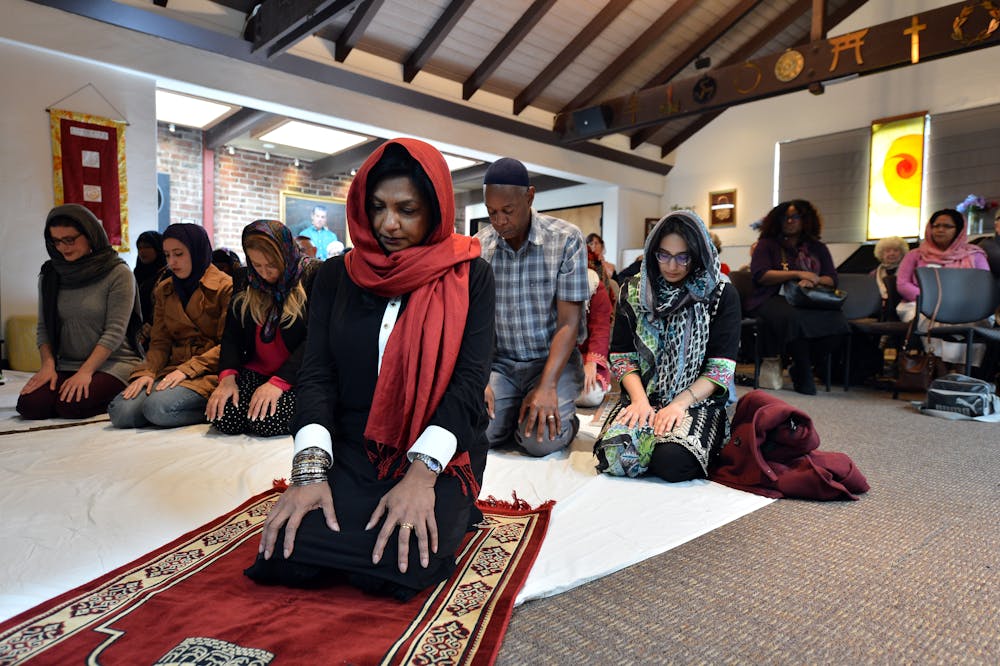
Not just in Somalia and Somaliland, but in many parts of the world, Muslim women are reclaiming their rights by studying and sharing Quranic verses and prophetic teachings. In Malaysia, for example, groups like Sisters in Islam and Musawah have been publicly putting forward feminist interpretations of Quranic verses to teach women about gender equality and inheritance rights.
In Egypt, women have invoked Sharia to expand access to divorce.
In my research in Sudan, I saw women lawyers teach women displaced by civil war that their rights come from God. On the Day of Judgment, these women said to one another, God will judge those who tried to take away women’s God-given rights.
And in Los Angeles, California, a women’s mosque offers women-led sermons, classes and events.
By interpreting theological and legal texts in less patriarchal ways, these women, as I found, are shattering age-old sexist interpretations of Sharia.
Beth Daley, Editor and General Manager
(Contributed by Janet Cornwell, H.W., m.)
Movie: “The Seer”
I am so excited to announce this film to you. The Seer was a great healer who healed thousands through the use of the Akashic Records, and taught Lars Muhl his healing techniques. Lars wrote the book, The Seer, and made this documentary of his learning and experiences to share with the world what he learned. He showed it on Easter Sunday and I was able to watch it 3 times. The film is very high frequency and it took me 3 days to integrate the powerful energies.
He doesn’t show it very often so be sure and watch it if you can. Below is the email I received to announce the showing with the timing and links to watch for 24 hours on the 21st and 22nd of August.
Free streaming of the film ‘The Seer’
I have once again chosen to give free access to my documentary film about my spiritual mentor the seer Calle Montségur.
The film will be available for 24 hours, so everyone will have a chance to see it worldwide.
The Seer’s message that joy is healing is more relevant than ever. The intention of watching the film at the same time is to create a common space for healing, presence and unity. Therefore, it will not be possible to watch the film at other times.
You can watch the trailer for the film in English here:
Enjoy.
Love,
Lars Muhl
Lars Muhl New showings of the film will be announced here: https://www.larsmuhl.dk/en/calendar ‘The Seer’ is a rare and beautiful documentary by Danish author Lars Muhl about his spiritual mentor Calle de Montségur, also known as the Seer. The Seer was not only capable of diagnosing and curing people across the globe using distance healing, he was also able to read ‘The Book of Life’, where the destiny of mankind is recorded. Lars Muhl became an apprentice to The Seer after he healed Lars, via the telephone, from a debilitating long-term illness that no doctor could diagnose. The film is based on unique footage of The Seer recorded by Lars when they first met in 1998, and covers the three years Lars was an apprentice to The Seer. This is an intimate first-hand account of The Seer in his element at the sacred mountain of Montsegur in southwestern France. The film is an opportunity to journey with Lars through his initiations by one of the most important healers of our time. The Seer shares several messages vital to understanding the current state of the world and changing the status quo.
Links for streaming
To access the film, please click the link below at an optional time from Saturday 21 August at 20.00 to Sunday 22 August at 20.00, Danish time (CEST) – see other world times further down the page.
Danish film: https://vimeo.com/375363629
English film: https://vimeo.com/354876796
French film: https://vimeo.com/388567503
German film: https://vimeo.com/527824171
NOTE: You will need no password at that time.
If you have problems, you can try reloading the page – on the computer: click F5.
The duration of the film: 1 hour and 40 min.
Unfortunately, the film does not have subtitles for hard-of-hearing.
World times (the film will be available from the mentioned time and 24 hours onwards):
Paris, France: Saturday 21 August at 20.00 / 8.00 pm CEST
Berlin, Germany: Saturday 21 August at 20.00 / 8.00 pm CEST
London, United Kingdom: Saturday 21 August at 19.00 / 7.00 pm BST
New York, USA: Saturday 21 August at 14.00 / 2.00 pm EDT
Los Angeles, USA: Saturday 21 August at 11.00 / 11.00 am PDT
Sydney, Australien: Sunday 22 August at 04.00 / 4.00 am AEST
Perth, Australien: Sunday 22 August at 02.00 / 2.00 am AWST
For other world times, you can use this time zone converter:
https://www.timeanddate.com/worldclock/converter.html
Description of the film
A rare and beautiful documentary by Lars Muhl about his spiritual mentor Calle de Montségur, also known as the Seer.
The Seer, Calle de Montsegúr, was capable of not only diagnosing and curing people with distant healing, no matter where they were on the globe, but was also able to read ‘The Book of Life’, where the destiny of mankind is recorded.
Lars Muhl became an apprentice to The Seer after he healed Lars from a debilitating long-term illness that no doctor could diagnose. The film is based on unique footage of The Seer recorded by Lars when they first met in 1998, and covers the three years Lars was an apprentice to The Seer.
(Contributed by Wendy Cicchetti)
Kierkegaard on labeling people

“What labels me, negates me.”
― Soren Kierkegaard
Søren Aabye Kierkegaard (May 5, 1813 – November 11, 1855) was a Danish philosopher, theologian, poet, social critic, and religious author who is widely considered to be the first existentialist philosopher. Wikipedia
Carl Jung and The Spiritual Problem of Modern Man
Vanessa Able (thedewdrop.org)

“The various forms of religion no longer appear to come from within, from the psyche; they seem more like items from the inventory of the outside world.” – Carl JungTweet
In this excerpt from an essay titled The Spiritual Problem of Modern Man, analytical psychologist Carl Jung attempted to mine down to the fundamental issues of the spiritual crisis he saw in people around him, almost a century ago during the interwar period. The groundswell of interest in psychic phenomena and spiritualism at the time was for him an indication of a recognition for mankind that what was needed was far more attention to one’s inner processes after people’s lives had outwardly changed so much after the industrial revolution and technological innovations at the beginning of the 20th century. Jung recognized that when the forms of religion appeared to people more like an inventory of objects rather than something that connected directly with and reflected their own inner lives, the sense of something important missing from their lives would lead them to look for a path back into themselves.
Modern man has lost all the metaphysical certainties of his medieval brother, and set up in their place the ideals of material security, general welfare and humanitarianism. But anyone who has still managed to preserve these ideals unshaken must have been injected with a more than ordinary dose of optimism. Even security has gone by the board, for modern man has begun to see that every step forward in material “progress” steadily increases the threat of a still more stupendous catastrophe. The imagination shrinks in terror from such a picture. What are we to think when the great cities today are perfecting defence measures against gas attacks, and even practise them in dress rehearsals? It can only mean that these attacks have already been planned and provided for, again on the principle “in time of peace prepare for war.” Let man but accumulate sufficient engines of destruction and the devil within him will soon be unable to resist putting them to their fated use. It is well known that fire-arms go off of themselves if only enough of them are together.
An intimation of the terrible law that governs blind contingency, which Heraclitus called the rule of enantiodromia (a running towards the opposite), now steals upon modern man through the by-ways of his mind, chilling him with fear and paralyzing his faith in the lasting effectiveness of social and political measures in the face of these monstrous forces. If he turns away from the terrifying prospect of a blind world in which building and destroying successively tip the scales, and then gazes into the recesses of his own mind, he will discover a chaos and a darkness there which everyone would gladly ignore. Science has destroyed even this last refuge; what was once a sheltering haven has become a cesspool.
And yet it is almost a relief to come upon so much evil in the depths of our own psyche. Here at least, we think, is the root of all the evil in mankind. Even though we are shocked and disillusioned at first, we still feel, just because these things are part of our psyche, that we have them more or less in hand and can correct them or at any rate effectively suppress them. We like to assume that, if succeeded in this, we should at least have rooted out some fraction of the evil in the world. Given a widespread knowledge of the unconscious, everyone could see when a statesman was being led astray by his own bad motives. The very newspapers would pull him up: “Please have yourself analyzed; you are suffering from a repressed father-complex.”
“However true that much of the evil in the world comes from the fact that man in general is hopelessly unconscious, as it is also true that with increasing insight we can combat this evil at its source in ourselves.”
I have purposely chosen this grotesque example to show to what absurdities we are led by the illusion that because something is psychic it is under our control. It is,however true that much of the evil in the world comes from the fact that man in general is hopelessly unconscious, as it is also true that with increasing insight we can combat this evil at its source in ourselves, in the same way that science enables us to deal effectively with injuries inflicted from without.
The rapid and worldwide growth of a psychological interest over the last two decades shows unmistakably that modern man is turning his attention from outward material things to his own inner processes. Expressionism in art prophetically anticipated this subjective development, for all art intuitively apprehends coming changes in the collective unconsciousness.
The psychological interest of the present time is an indication that modern man expects something from the psyche which the outer world has not given him: doubtless something which our religion ought to contain, but no longer does contain, at least for modern man. For him the various forms of religion no longer appear to come from within, from the psyche; they seem more like items from the inventory of the outside world. No spirit not of this world vouchsafes him inner revelation; instead, he tries on a variety of religions and beliefs as if they were Sunday attire, only to lay them aside again like worn-out clothes.
Carl Jung (1875-1961)
From: Civilization in Transition / The Portable Jung
Spiritual Awakening is Not Just a Peak Experience: The Liberating Discovery of Your True Nature
BY CRAIG HAMILTON | MAY 15, 2020 | craighamiltonglobal.com

By now, most of us have heard about the tremendous benefits of meditation for nearly every area of our lives.
Thanks to extensive research over the past few decades, the overwhelming scientific consensus seems to be that meditation is good for you.
But saying meditation is good for you is a bit like saying exercise is good for you.
Just as there are literally hundreds if not thousands of different forms of exercise, there are also hundreds if not thousands of different types of meditation.
And, as with physical exercise, different types of meditation are designed to achieve very different goals.
Various forms of meditation are being taught as a means of reducing stress, improving mental concentration and focus, enhancing athletic performance, boosting creativity, improving decision-making as well as generating relaxation, emotional well-being and a host of other physical, psychological, emotional and spiritual benefits.
But it wasn’t always this way. Amidst today’s enthusiasm for the diverse tangible, measurable benefits of meditation, it’s important to remember that meditation was originally practiced and taught with one goal in mind: spiritual awakening.
So, if we want to understand the true higher potentials of meditation, we need to first understand what spiritual awakening really is.
What is Spiritual Awakening?
Like meditation, the idea of spiritual awakening or enlightenment is used these days by different people to refer to many different types of insights and experiences.
So, before we even begin to approach the nature of spiritual awakening, it’s important to recognize that there are countless different kinds of religious or spiritual experiences human beings can have.
We can experience powerful spiritual feelings like bliss or ecstasy that overwhelm our system.
We can have experiences of oneness, where we feel like we merge with all of reality and lose the ability to distinguish between ourselves and the world around us.
We can suddenly perceive the profound interconnectedness of everything and realize we’re part of what Buddhism calls “Indra’s web.”
Some of us have had spiritual experiences where we were overcome with awe and a reverence for the sacred.
Or perhaps you’ve had an encounter with another person where you felt a deep soul connection—a kind of spiritual nakedness. In these moments, we feel our consciousness becoming one.
We can have experiences of divine love where we realize that we are loved by God or that our true nature is love. We discover that love is always here, ever-present and flowing through us. We just didn’t see it.
We can have spiritual experiences of intense clarity, where everything becomes lucid and unimaginably clear.
It’s also common for meditators to have experiences of intense energy, sometimes referred to as Kundalini. It can feel as if you are plugged into a wall socket with thousands of volts of electricity surging through your body.
On the other end of the spectrum, we can have spiritual experiences of a kind of expansiveness and openness where all the boundaries dissolve and there’s just this awareness of infinite space.
And we can have hundreds, if not thousands, of other kinds of spiritual experiences. And these are all wonderful experiences to have. They’re often transformational. They often give us powerful motivation to pursue the spiritual path.
But the distinction I want to make here is that awakening itself is not any of those experiences. It’s not a state of consciousness, but something more permanent and profound than that.
When I speak about awakened consciousness or enlightenment, I’m pointing to something very specific. It’s a very particular kind of realization. It’s been described as the discovery of our true nature or the recognition of our natural state. It’s the recognition that who we are is not this limited, separate self or any of the thoughts and feelings that we previously identified as ourself or took to be our self.
Spiritual awakening occurs when we realize that who we are at the deepest level is something much bigger and more profound than who we thought we were. We see that our true nature is this kind of superconsciousness, intelligence, love, being, and presence that is at the foundation of reality itself.
This essence is already free and whole and perfect. Who we truly are is this sacred dimension of reality that is beyond comprehension. It’s missing nothing, lacking nothing, and so full that it endlessly overflows with goodness, love, wisdom, power, clarity, humility, strength, courage, and care.
The kind of spiritual awakening I’m talking about is not just the realization that God exists. It’s the realization that that is what we are. The thing we were always seeking and putting outside ourselves is actually our true nature. It’s what’s looking out through our eyes and always has been.
It shatters every conscious or unconscious belief we’ve had in our own limitation. It destroys every sense of lack, of not being enough, of feeling there is somewhere else we need to get to. We realize that the whole thing is already here. I already am that.
I want to make it clear that the awakening I’m pointing to is not a special experience or an altered state of consciousness. It sounds pretty altered, and it does lead to a lot of altered states of consciousness. But the realization itself isn’t any of those experiences.
The reason awakening catalyzes so many powerful experiences is that the realization of our true nature unleashes profound energies and emotions in our psyche. We are living, breathing human beings after all, and when we wake up, we’re often overcome with the experience of the realization.
But awakening, in and of itself, is not a feeling or a particular kind of mental state. In fact, it’s the recognition that every feeling, every mental state, every experience—regardless of how spiritual it seems—has this same essence.
The life-changing realization that the mystics of the ages have been pointing to is the realization that the essence of everything is sacred beyond measure and glorious beyond comprehension. When you discover it, it will bring you to your knees.
It’s called a “nondual realization” because we recognize that the same sacredness and holiness that we associate with our most beautiful experiences is actually the essence of everything else too, even though it’s harder to see. When you look at a beautiful sunset, it’s easy to feel a sense of majesty. But when most of us look at a garbage dump, it’s not quite as easy to feel that way. In spiritual awakening, we realize that all of reality is actually made of this “God-stuff,” or “Buddha-stuff.” We just didn’t see what it was before.
Awakening doesn’t mean that we’re going to some other reality or some other dimension. It’s a realization of what this dimension really is. We just couldn’t see it, and now we do. And that changes everything.
The implications of awakening are immense. Although it often initially occurs in fits and starts, when we’re finally able to deeply embrace who and what we really are, we become a living expression of this miraculous dimension of being. Our cosmic essence, our super nature, is now free to express itself in this world because we’ve made room for it, embraced it, and allowed it to come forth.
That’s the power of awakening and it’s the ultimate promise of the practice of meditation. When we approach meditation as a spiritual practice, we are making a practice out of inviting this profound consciousness to reveal itself within us. We are practicing opening ourselves up to allow awakening to occur.
Imagination is ancient
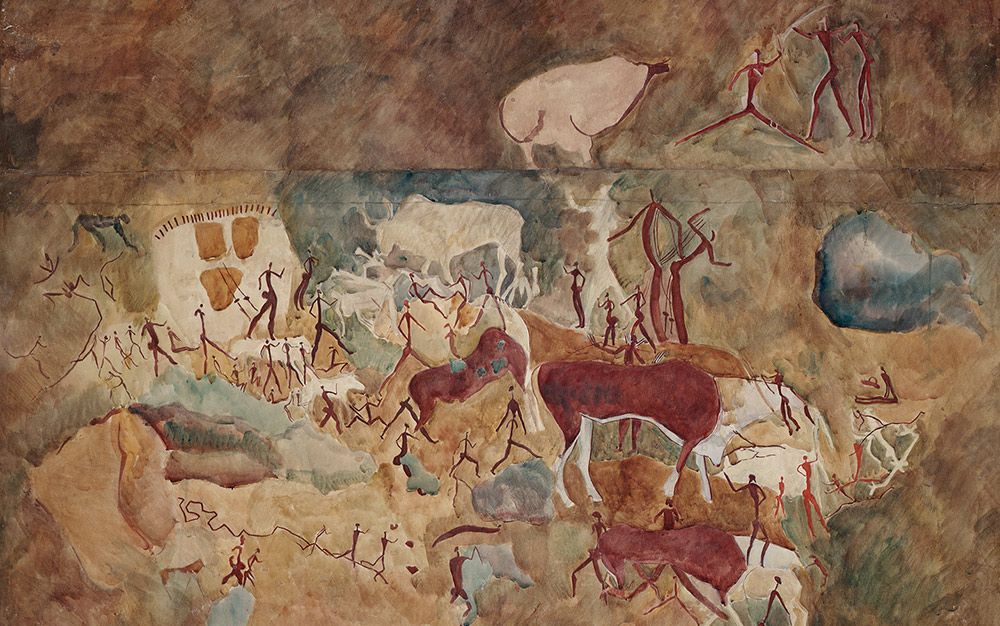
Our imaginative life today has access to the pre-linguistic, ancestral mind: rich in imagery, emotions and associationsEland antelopes, buffalos and humans, Republic of South Africa, Harrismith, Balmoral 8,000-2,000 BCE. Watercolour by Maria Weyersberg, 1929. Courtesy Frobenius-Institut Frankfurt am Main
Stephen T Asma is professor of philosophy at Columbia College Chicago and a member of the Public Theologies of Technology and Presence programme at the Institute of Buddhist Studies in Berkeley, California. He is the author of many books, including The Evolution of Imagination (2017), Why We Need Religion (2018) and his latest, The Emotional Mind: Affective Roots of Culture and Cognition (2019), co-authored with Rami Gabriel.
Edited by Brigid Hains
11 September 2017 (aeon.co)
Aeon for Friends
Imagination is intrinsic to our inner lives. You could even say that it makes up a ‘second universe’ inside our heads. We invent animals and events that don’t exist, we rerun history with alternative outcomes, we envision social and moral utopias, we revel in fantasy art, and we meditate both on what we could have been and on what we might become. Animators such as Hayao Miyazaki, Walt Disney and the people at Pixar Studios are masterful at imagination, but they’re only creating a public version of our everyday private lives. If you could see the fantastic mash-up inside the mind of the average five-year-old, then Star Wars and Harry Potter would seem sober and dull. So, why is there so little analysis of imagination, by philosophers, psychologists and scientists?
Apart from some cryptic passages in Aristotle and Kant, philosophy has said almost nothing about imagination, and what it says seems thoroughly disconnected from the creativity that artists and laypeople call ‘imaginative’.
Aristotle described the imagination as a faculty in humans (and most other animals) that produces, stores and recalls the images we use in a variety of mental activities. Even our sleep is energised by the dreams of our involuntary imagination. Immanuel Kant saw the imagination as a synthesiser of senses and understanding. Although there are many differences between Aristotle’s and Kant’s philosophies, Kant agreed that the imagination is an unconscious synthesising faculty that pulls together sense perceptions and binds them into coherent representations with universal conceptual dimensions. The imagination is a mental faculty that mediates between the particulars of the senses – say, ‘luminous blue colours’ – and the universals of our conceptual understanding – say, the judgment that ‘Marc Chagall’s blue America Windows (1977) is beautiful.’ Imagination, according to these philosophers, is a kind of cognition, or more accurately a prerequisite ‘bundling process’ prior to cognition. Its work is unconscious and it paves the way for knowledge, but is not abstract or linguistic enough to stand as actual knowledge.
This rather mechanical approach to the imagination is echoed in more recent computational and modular theories of the mind, according to which human thinking is packaged by innate processors. The American philosopher Denis Dutton, for example, argued in The Art Instinct (2009) that landscape paintings are popular because they trigger an innate instinctual preference for distant scouting positions in our ancestors, who were evaluating the horizon for threats and resources. That view – dominant in contemporary evolutionary psychology – seems very far away from the artist’s or even the engineer’s view of creative imagination.
It is perhaps unsurprising that philosophers and cognitive theorists have a rather arid view of the imagination, but our everyday ideas about the imagination are not much better. Following the Greeks, we still think of our own creativity as a muse that descends upon us – a kind of spirit possession or miraculous madness that flooded through Vincent van Gogh and John Lennon, but only trickles in you and me. After the great Texas guitar improviser Stevie Ray Vaughan died, Eric Clapton paid tribute by describing him as ‘an open channel … music just flowed through him’.
We’ve romanticised creativity so completely that we’ve ended up with an impenetrable mystery inside our heads. We might not literally believe in muse possession anymore, but we haven’t yet replaced this ‘mysterian’ view with a better one. As the Austrian painter Ernst Fuchs said of the mysterious loss of self that accompanies the making of art: ‘My hand created, led in trance, obscure things … Not seldom, I get into trance while painting, my state of consciousness fades, giving way to a feeling of being afloat … doing things I do not know much about consciously.’ This mysterian view of imagination is vague and obscure, but at least it captures something about the de-centred psychological state of creativity. Psychologists such as Mihaly Csikszentmihalyi have celebrated this aspect of creativity by describing (and recommending) ‘flow’ states, but the idea of ‘flow’ has proven little more than a secular redescription of the mysterian view.
Evolutionary thought offers a path out of this confusion. In keeping with other evolved aspects of the human mind, the imagination has a history. We should think of the imagination as an archaeologist might think about a rich dig site, with layers of capacities, overlaid with one another. It emerges slowly over vast stretches of time, a punctuated equilibrium process that builds upon our shared animal inheritance. In order to understand it, we need to dig into the sedimentary layers of the mind. In The Descent of Man (1871), Charles Darwin says: ‘The Imagination is one of the highest prerogatives of man. By this faculty he unites former images and ideas, independently of the will, and thus creates brilliant and novel results … Dreaming gives us the best notion of this power; as [the poet] Jean Paul Richter says: “The dream is an involuntary art of poetry.”’

Richard Klein, Maurice Bloch and other prominent paleoanthropologists place the imagination quite late in the history of our species, thousands of years after the emergence of anatomically modern humans. In part, this theory reflects a bias that artistic faculties are a kind of evolutionary cheesecake – sweet desserts that emerge as byproducts of more serious cognitive adaptations such as language and logic. More importantly, it is premised on the relatively late appearance of cave art in the Upper Paleolithic period (c38,000 years ago). It is common for archaeologists to assume that imagination evolves late, after language, and the cave paintings are a sign of modern minds at work, thinking and creating just as we do today.
Contrary to this interpretation, I want to suggest that imagination, properly understood, is one of the earliest human abilities, not a recent arrival. Thinking and communicating are vastly improved by language, it is true. But ‘thinking with imagery’ and even ‘thinking with the body’ must have preceded language by hundreds of thousands of years. It is part of our mammalian inheritance to read, store and retrieve emotionally coded representations of the world, and we do this via conditioned associations, not propositional coding.
Lions on the savanna, for example, learn and make predictions because experience forges strong associations between perception and feeling. Animals appear to use images (visual, auditory, olfactory memories) to navigate novel territories and problems. For early humans, a kind of cognitive gap opened up between stimulus and response – a gap that created the possibility of having multiple responses to a perception, rather than one immediate response. This gap was crucial for the imagination: it created an inner space in our minds. The next step was that early human brains began to generate information, rather than merely record and process it – we began to create representations of things that never were but might be. On this view, imagination extends back into the Pleistocene, at least, and likely emerged slowly in our Homo erectus cousins.
When we hear the word ‘cup’, the motor parts of our brain ‘pick up’ a ‘cup’
In contemporary philosophy, representation tends to be mostly understood in terms of language. A representation is an inner mental entity that has meaning via its correspondence with the external world or via its coherence within a context of other meaningful experiences (that is, other representations, rules, schema and so on). My representation of a ‘dog’ stands in for real flesh-and-blood mammals out in the world. Traditional semantic theories, from empiricism, positivism and even some semiology assumed that the basic element of meaning was the word – ‘dog’ or ‘chien’ or ‘gou’. However, philosophers such as Mark Johnson at the University of Oregon have challenged this model of meaning by showing that there are deep embodied metaphorical structures within language itself, and meaning is rooted in the body (not the head).
Rather than being based in words, meaning stems from the actions associated with a perception or image. Even when seemingly neutral lexical terms are processed by our brains, we find a deeper simulation system of images. When we hear the word ‘cup’, for example, our neural motor and tactile systems are engaged because we understand language by ‘simulating in our minds what it would be like to experience the things that the language describes’, as the cognitive scientist Benjamin Bergen puts it in Louder Than Words (2012). When we hear the word ‘cup’, the motor parts of our brain ‘pick up’ a ‘cup’.
This has been important research in how we understand the mind, but to fully understand the imagination we also need to explore the evolutionary period before language (a layer of prelinguistic mind to which I believe we still have access). Like prelinguistic toddlers, or even non-human primates, adult humans have an emotive, associational representation of a dog, for example. It might have cute associations that orient us to approach, or negative feelings that orient us to avoid. The image of a dog, in perception or in memory will be loaded with feelings and action possibilities. The word ‘dog’, by contrast, is a later, more attenuated and abstract level of representation – neutered of most emotional and motor content.
The imagination, then, is a layer of mind above purely behaviourist stimulus-and-response, but below linguistic metaphors and propositional meaning. Our modern imagination originates in this early era of image meaning, or image semantics. This historical moment (probably initiated during the early Pleistocene, c2 million years ago) is replicated or recapitulated in the processes of our contemporary imaginative activities. It is the power to take the mind offline – decoupled from the immediate flow of perception – and run simulations of counterfactual virtual realities.
Our improvisational and imaginative life today has an oblique access to the ancestral human mind. Understanding this connection is the aim of a growing research movement – called biosemantics – that seeks to ground human meaning in the embodied interaction of social primates, not just in human language. As great apes, we humans almost certainly engaged in the kind of subtle, antiphonal, body-language communication that we see throughout all social primates. Primate psychologists such as Louise Barrett in Beyond the Brain (2011) are starting to track the interaction networks that build up slowly during development, giving primates the local lexicon of gestures that ultimately serve the bigger functions of dominance and submission, mating, alliance, food sharing, provisioning and so on. But we too operate in these embodied gestural systems of meaning far more than we acknowledge. For a hilarious example of baby communication that is really about emotional expression, turn-taking and bonding, rather than describing the world or conveying information, see this video of ‘talking’ twin babies.
Our primate cousins have impressive abilities (grounded in the cerebellum) for sequencing motor activities – they have a kind of task grammar for doing complex series of actions, such as processing inedible plants into edible food. Gorillas, for example, eat stinging nettles only after an elaborate harvesting and leave-folding sequence, otherwise their mouths will be lacerated by the many barbs. This is a level of problem-solving that seeks smarter moves (and ‘banks’ successes and failures) between the body and the environment. This kind of motor sequencing might be the first level of improvisational and imaginative grammar. Images and behaviour sequences could be rearranged in the mind via the task grammar, long before language emerged. Only much later did we start thinking with linguistic symbols. While increasingly abstract symbols – such as words – intensified the decoupling of representations and simulations from immediate experience, they created and carried meaning by triggering ancient embodied systems (such as emotions) in the storytellers and story audiences.
The imaginative musician, dancer, athlete or engineer is drawing directly on the prelinguistic reservoir of meaning (sometimes called the ‘hot cognition system’ – a fast, ventral pathway through the brain that gives us emotional and semi-instinctual solutions to problems in our environment). A music improviser or intuitive problem-solver has to tap into that ancient call-and-response cognition of body language and emotional expression in order to navigate the social world properly. We try this move and watch for a response, try that move and watch. We dodge and parry this incoming gesture, accept that one. Flying by the seat of our pants, in these cases, is not just some analogy to prelinguistic communication – it is the thing itself.
Humans can just daydream about a desirable body, and the sexual equipment will begin to ramp up for action
Call-and-response, for example, is one of the oldest improvisational techniques, as is synchronisation of our melodies and our body movements (as in dance). These are ancient procedures for cementing communities, captured in performances that express and inspire emotion. At a simple level, humans synchronise their movements to dance in time. At a more complex level, they remember the dance later and experiment with it, reinventing it for themselves. Such simulation techniques allow us to explore open-ended options at the fringes of social and technological rules. Eventually such socially constrained exploration evolves into more and more offline experimentation, growing into forms of thinking with images, with sounds, with gestures.
The emotionally charged aspect of this kind of offline simulation is obvious when we consider that our animal cousins need chemical triggers and explicit perceptions of a sexually attractive body to become aroused, but humans can just daydream about a desirable body, and the sexual equipment will begin to ramp up for action. First our ancestors simulated others in real time, replicating dances and tool-making, but then these simulations became available offline (with no real-time model) as memory and executive function developed.
Computational theories of mind – that equate our minds with the binary blaze of a Google search – can jibe with our more recent linguistic thinking, but not with our earlier imaginative cognition. Image-based thinking employs gestalts of information-rich detail, and emotional and motor associations. We encode and manipulate images and gestures, thereby forming the basis of subsequent meaning. As Eric Kandel puts it in The Age of Insight (2012):
Perhaps in human evolution the ability to express ourselves in art – in pictorial language – preceded the ability to express ourselves in spoken language. As a corollary, perhaps the processes in the brain that are important for art were once universal but were replaced as the universal capability for language evolved.
I believe that the pictorial and gestural languages are still with us, and when we quiet our discursive consciousness long enough – as we do in improvisational and creative activities – we can still converse in these more ancient tongues.
Arare case from the medical literature gives us suggestive evidence that pictorial thinking has its own power independent of language. In a striking case study, in 1998 the psychologist Nicholas Humphrey at the University of Cambridge revealed the remarkable similarities between cave painting styles at Chauvet and the drawings of a 20th-century autistic girl named Nadia. Nadia’s case raises the possibility that painting and drawing, far from being the preserve of the fully modern mind, might have preceded language altogether.
Nadia was born in 1967 in Nottingham in England, and suffered from severe developmental disability. At age six, she still could not speak, had physical impairments, and many social incapacities. But even with these substantial deficits, Nadia could draw pictures with great accuracy and expression as early as age three. Humphrey placed Nadia’s toddler drawings next to the images from Chauvet and noticed striking similarities in the rendering of animals such as horses and elephants.
It is possible that Homo sapiens of 40,000 years ago were graphically literate before they were verbally literate
The contour lines of the creatures are remarkably similar, as are their dynamic poses, but also the way in which the figures are reiterated and overlaid on top of each other. This parallel is not mystical or a sign of innate representations, but rather an indication that the human mind is primed for accurate simulations. And graphic simulation – just as much as linguistic description – is a kind of knowledge.
We cannot place too much confidence in anecdotal data, but Nadia’s case should at least provoke some skepticism about the notion that Upper Paleolithic peoples had modern minds. If Nadia was so good with pictorial representation, while lacking the foundation of linguistic symbolism, then it is possible that Homo sapiens of 40,000 years ago were graphically literate before they were verbally literate. An even stronger interpretation is that Nadia was pictorially sophisticated because she had little to no conceptual/linguistic distraction in her mind. Without the alienating aspects of linguistic symbols, Nadia might have been more perceptually sensitive – leading to greater accuracy and expression in her drawing.
Nadia made meaning very effectively without propositional tools. Our recent ancestors could also have had impressive non-linguistic minds – perhaps always in imagination mode. Image-thinking could have had a complementary evolutionary pathway, alongside language, or could have evolved earlier from natural selection upon tool-making capacities and adornment techniques.
The imagination – whether pictorial or later linguistic – is especially good at emotional communication, and this might have evolved because emotional information drives action and shapes adaptive behaviour. We have to remember that the imagination itself started as an adaptation in a hostile world, among social primates, so perhaps it is not surprising that a good storyteller, painter or singer can manipulate my internal second universe by triggering counterfactual images and events in my mind that carry an intense emotional charge. Fantasy that really moves us – whether it is high or low culture – tends to resonate with our ancient fears and hopes. The associational mind of hot cognition – located more in the limbic system – acts as a reservoir for imaginative artists. Artists such as Edgar Allan Poe, Salvador Dalí, Edvard Munch and H R Giger can take controlled voyages to their primitive brain (an uncontrolled voyage is madness), and then bring these unconscious forces into their subsequent images or stories.

The imagination is proficient at image associations, but it’s also extremely adept at mixed-media associations. Thinking and communicating with images requires access to inner representations, but the artist is shuffling these images into unnatural and unexpected combinations. Our very ancient cognitive abilities to free-associate become interwoven with more sophisticated aspects of cognition, such as executive function and the ability to mix or violate taxonomic categories – hybridising images. When we imagine, we blend pictures and propositions, memories and real-time experiences, sounds, stories and feelings. It is a multimedia processor that jumps laterally through connotations, rather than downward through logical inference. Much of this is unconscious, which is why the muse simile is so powerful, but this phase is followed by a reentry phase, where the free associations or stream of consciousness are brought back under executive control, and integrated into the more focused projects of the agent or artist.
Hominin waking life might have been closer to the free associations of our contemporary dream life
The mysterians have focused on this egoless stream-phase of imagination, while the mechanists have focused on the combinatorial results, produced in the dark machinery of imagination. Each model captures an aspect of imagination, but when we consider the evolution of mind we see how the two models are integrated in the activity of our embodied cognition.
In the earliest phase of this evolutionary process (probably during the Pliocene epoch) we had a kind of involuntary imagination. At this time, hominin waking life might have been closer to the free associations of our contemporary dream life. Our ancestors could obviously perceive a lion on the savanna, but random memory images of lions might also rise up unpredictably while engaged in daily work. Next, during the Pleistocene, a semi-voluntary imagination arose, like we find in real-time hot cognition (still accessible in our contemporary improvisational creativity). We can imagine, for example, how ritualised behaviours guided by shamans would have brought imaginary beings (some based on lions) into consciousness through habitual actions and gestures.
And finally (from Upper Paleolithic through Holocene epochs), the voluntary imagination emerges, which harvests associational products from the first two phases and brings them under the executive control of cold cognition (slow, logical deliberation). For example, the cave paintings ‘lion man’ at Hohlenstein-Stadel in Germany and ‘bison man’ in the Grotte de Gabillou in France might be early examples of the voluntary mixing of animal and human forms in the visual arts. Hybridised or composite creatures occupy some of our earliest cultural expressions – from cave painting to Mesopotamian, Egyptian and Vedic mythologies. Such zoological category violations appear to be early (and persistent) manoeuvers in the logic of imagination.
Between the modular circuitry and mysterious flights of fantasy lies the humble realm of evolutionary degrees. Before you have a modern eye, you need a simpler optical predecessor, and before that you need responsive light-sensitive tissue. Evolution scales up from the ground, so to speak. Similarly, evolution built a crude imaginative faculty before language and culture refined it into a sophisticated one. The raw system (dominated by emotional and perceptual associations) is still alive and well in the basement of our psychology. You can get a glimpse of it in your dreams, or just pick up a musical instrument or a brush and paper, and open the ancestral mind’s eye.
Stephen T Asma’s latest book, ‘The Evolution of Imagination’ (2017), is published by the University of Chicago Press.
The infantilization of Western culture
Simon Gottschalk, Professor of Sociology, University of Nevada, Las Vegas
August 1, 2021 · news.yahoo.com

If you regularly watch TV, you’ve probably seen a cartoon bear pitching you toilet paper, a gecko with a British accent selling you auto insurance and a bunny in sunglasses promoting batteries.
This has always struck me as a bit odd. Sure, it makes sense to use cartoon characters to sell products to kids – a phenomenon that’s been well-documented.
But why are advertisers using the same techniques on adults?
To me, it’s just one symptom of a broader trend of infantilization in Western culture. It began before the advent of smartphones and social media. But, as I argue in my book “The Terminal Self,” our everyday interactions with these computer technologies have accelerated and normalized our culture’s infantile tendencies.
Society-wide arrested development
The dictionary defines infantilizing as treating someone “as a child or in a way that denies their maturity in age or experience.”
What’s considered age-appropriate or mature is obviously quite relative. But most societies and cultures will deem behaviors appropriate for some stages of life, but not others.
As the Bible puts it in 1 Corinthians 13:11, “When I was a child, I talked like a child, I thought like a child, I reasoned like a child. When I became a man, I put childish ways behind me.”
Some psychologists will be quick to note that not everyone puts their “childish ways” behind them. You can become fixated at a particular stage of development and fail to reach an age-appropriate level of maturity. When facing unmanageable stress or trauma, you can even regress to a previous stage of development. And psychologist Abraham Maslow has suggested that spontaneous childlike behaviors in adults aren’t inherently problematic.
But some cultural practices today routinely infantilize large swaths of the population.
We see it in our everyday speech, when we refer to grown women as “girls”; in how we treat senior citizens, when we place them in adult care centers where they’re forced to surrender their autonomy and privacy; and in the way school personnel and parents treat teenagers, refusing to acknowledge their intelligence and need for autonomy, restricting their freedom, and limiting their ability to enter the workforce.
Can entire societies succumb to infantilization?
Frankfurt School scholars such as Herbert Marcuse, Erich Fromm and other critical theorists suggest that – like individuals – a society can also suffer from arrested development.
In their view, adults’ failure to reach emotional, social or cognitive maturity is not due to individual shortcomings.
Rather, it is socially engineered.
A return to innocence
Visiting America in 1946, French anthropologist Claude Lévi-Strauss commented on the endearingly infantile traits of American culture. He especially noted adults’ childish adulation of baseball, their passionate approach to toy-like cars and the amount of time they invested in hobbies.
As contemporary scholars note, however, this “infantilist ethos” has become less charming – and more pervasive.
Researchers on both sides of the Atlantic have observed how this ethos has now crept into a vast range of social spheres.
In many workplaces, managers can now electronically monitor their employees, many of whom work in open spaces with little personal privacy. As sociologist Gary T. Marx observed, it creates a situation in which workers feel that managers expect them “to behave irresponsibly, to take advantage, and to screw up unless they remove all temptation, prevent them from doing so or trick or force them to do otherwise.”
Much has been written about higher education’s tendency to infantilize its students, whether it’s through monitoring their social media accounts, guiding their every step, or promoting “safe spaces” on campus.
Meanwhile, tourist destinations like Las Vegas market excess, indulgence and freedom from responsibility in casino environments that conjure memories of childhood fantasies: the Old West, medieval castles and the circus. Scholars have also explored how this form of Las Vegas-style “Disneyfication” has left its stamp on planned communities, architecture and contemporary art.
Then we’ve witnessed the rise of a “therapy culture,” which, as sociologist Frank Furedi warns, treats adults as vulnerable, weak and fragile, while implying that their troubles rooted in childhood qualify them for a “permanent suspension of moral sense.” He argues that this absolves grown-ups from adult responsibilities and erodes their trust in their own experiences and insights.
Researchers in Russia and Spain have even identified infantilist trends in language, and French sociologist Jacqueline Barus-Michel observes that we now communicate in “flashes,” rather than via thoughtful discourse – “poorer, binary, similar to computer language, and aiming to shock.”
Others have noted similar trends in popular culture – in the shorter sentences in contemporary novels, in the lack of sophistication in political rhetoric and in sensationalist cable news coverage.
High-tech pacifiers
While scholars such as James Côté and Gary Cross remind us that infantilizing trends began well before our current moment, I believe our daily interactions with smartphones and social media are so pleasurable precisely because they normalize and gratify infantile dispositions.
They endorse self-centeredness and inflated exhibitionism. They promote an orientation towards the present, rewarding impulsivity and celebrating constant and instant gratification.
They flatter our needs for visibility and provide us with 24/7 personalized attention, while eroding our ability to empathize with others.
Whether we use them for work or pleasure, our devices also foster a submissive attitude. In order to take advantage of all they offer, we have to surrender to their requirements, agreeing to “terms” we do not understand and handing over stores of personal data.
Indeed, the routine and aggressive ways our devices violate our privacy via surveillance automatically deprive us of this fundamental adult right.
While we might find it trivial or amusing, the infantilist ethos becomes especially seductive in times of social crises and fear. And its favoring of simple, easy and fast betrays natural affinities for certain political solutions over others.
And typically not intelligent ones.
Democratic policymaking requires debate, demands compromise and involves critical thinking. It entails considering different viewpoints, anticipating the future, and composing thoughtful legislation.
What’s a fast, easy and simple alternative to this political process? It’s not difficult to imagine an infantile society being attracted to authoritarian rule.
Unfortunately, our social institutions and technological devices seem to erode hallmarks of maturity: patience, empathy, solidarity, humility and commitment to a project greater than oneself.
All are qualities that have traditionally been considered essential for both healthy adulthood and for the proper functioning of democracy.
This article is republished from The Conversation, a nonprofit news site dedicated to sharing ideas from academic experts.
Simon Gottschalk is affiliated with the Democratic Party and other organizations affiliated with it.
(Contributed to the BB by Gwyllm Llwydd)
Conversations with Calvin Series on August 29
I wanted you to mark your calendars so as to not miss my next guest on Conversations with Calvin.
Mara Pennell is an ordained minister and a voice for ‘At Risk’ and ‘LGBTQ’ youth. Her counseling practice is an outgrowth of her personal mission statement which is “Clarity -Wholeness -Vision Now and into the Future.
Join us when we discuss Mara’s journey in self-reflection and where those intersections in the patterns of life intersect.
A Prosperos Sunday Meeting
Zoom Presentation
For this free, one-hour event beginning at 11: 00 a.m. Pacific time- Sunday, August 29, 2021, on Zoom.
https://us02web.zoom.us/j/332275676
Interesting people + Fun Conversation + Important Insights
The Angle Theory and the 12 Houses
You may know that the 12 houses of the natal chart represent 12 different areas of your life. The 1st house is who you are, the 2nd house your money, talents and assets, the 3rd house your siblings and so on.
But these 12 houses have not been randomly linked to different areas of your life… these 12 houses have a natural sequence, and are derived from the spatial relationship with the sky.We can understand the12 houses of our natal chart at a deeper level if we start from what defines them in the first place. The angles!
The Ascendant And The DescendantYour natal chart and all the 12 houses start from your Ascendant.
The Ascendant is where the horizon was rising when you were born.
The Descendant is the opposite point, where the horizon was setting when you were born. If we think of the Ascendant as the sunrise , the Descendant is the sunset 
That’s why the Ascendant (and the 1st house) describes YOU, while the Descendant (and the 7th house) describes the OTHER.

1st HOUSE: If the Ascendant and the 1st house is who you are, it is your Ego, the incarnation of spirit on Earth.
12th HOUSE: The 12th house is on top of the 1st house, so it represents what’s above the Ego, what we cannot see, our blind spot, but also what we can grow and develop into.
2nd HOUSE: The 2nd house is just under the 1st house, what we “stand on”, what we own, so it represents that part of ourselves that feeds the Ego, that part of ourselves that feeds us and works in our favor.That’s why the 2nd house is the house of money, possessions, talents, food, and energy levels. It is what we own, what is ours. The 2nd house is our piggy bank – of talents, energy, assets. The 2nd house describes qualities we already own and are ready to harness.
7th HOUSE: The Descendant (and the 7th house) is the OTHER, and in the chart it represents our relationships, our contracts, and where we aim to find equality.The 7th house is also the house of conflict, open enemies, and negotiations, because having equal relationships is a result of knowing when to set boundaries and when to compromise.
6th HOUSE: The 6th house is under the 7th house, so it shows where we feel we are “below” the other. In the past, the 6th house was the house of slaves. Now it’s the house or work and service; it is where we need to grow, to put some effort, where we need to “deliver” so that we are on an equal stand with others.
8th HOUSE: The 8th house is on top of the Descendant/7th house and it shows where we feel we’ve done more than our fair share in relationships. It is the house of intimacy and trust, but it can also be the house of entitlement. It’s where we feel the other “owes” us something.
The IC And The Midheaven
Now let’s move on to the other pair of angles, the Imum Coeli (IC) and the Midheaven (MC).The IC is the lowest point in our chart, when it’s completely dark outside.The Midheaven is the highest point in the chart when the Sun shines at its brightest, and there is no shadow.

4TH HOUSE: The IC (and 4th house) is our baseline. It represents our family, roots, home, comfort zone and tradition. The IC/4th house is that part of us that doesn’t change because they define us at a cellular level.We can’t change our parents, and we can’t change our genes. The IC is the core of who we are, as opposed to the qualities we develop throughout life (MC).
3RD HOUSE: The 3rd house is before the 4th house, so it represents everything that happens before we find our roots in the 4th house.Have you noticed how a cat behaves when she moves to a new home? The cat usually spends a few days getting acquainted with the new space, checking all the spots, sniffing everything around, basically making sure there is no hidden danger. That’s why the 3rd house rules our acquaintances, information analysis, research, small trips, and errands.
These are the small things we do every day to make sure we have a safe and comforting place to come back to. The 3rd house also rules communication, because it is through communication that we gather the information we need and adjust our expectations.The 3rd house also rules siblings, because we share 50% of our DNA with our siblings, 100% with ourselves or identical twins (4th house), and again 50% with our children (5th house).
5TH HOUSE: The 5th house is after the 4th house, so it represents everything that happens after we find our roots and a sense of safety in the 4th house. The 5th house is what we ‘create’, including our children. The 5th is also where we find joy, relaxation, and pleasure IF we have healthily embraced the 4th house.
When we can easily find joy, hobbies, romantic partners, and have no troubles expressing ourselves creatively (5th house) this is a result of a healthy 4th house. If someone feels creatively blocked, the answers can usually be found in the previous house, the 4th.
10TH HOUSE: The Midheaven (and the 10th house) is the opposite of the IC, so it is what we grow into, where we seek progress and change.If the IC is the lowest point in the chart, the Midheaven is the highest. When the Sun is at Zenith, there is no shadow, and nowhere to hide. That’s why the Midheaven rules our public life (as opposed to our private life, which is the IC/4th house).The Midheaven (MC/10th house) is the qualities we consciously develop because we find them desirable, as opposed to qualities we are born with (IC/4th house).The Midheaven also rules our career and vocation, but in general, it rules all the activities, people and projects we feel drawn to because we find them as being of a higher standard.These Midheaven/10th house aspirations will push us to go outside our comfort zone (IC) and develop new skills and qualities we didn’t have at birth.
9TH HOUSE: The 9th house comes before the 10th house, and it represents all the endeavors that prepare us to become the highest version of ourselves. That’s why the 9th house rules learning, travel, explorations, foreign places and people, and everything that teaches us something, and opens our minds in some way.
The 9th house is also the house of goals and planning because in order to find success (Midheaven) we first need to envision this future.The 9th house is also the house of law, apostilles, and legal paperwork so that you can prove that you have done your homework and are legit (10th house).
11TH HOUSE: The 11th house comes after the Midheaven/10th house so it represents everything that happens after we grow into the best version of ourselves, what happens after we find our vocation. That’s why in the 11th house we have a strong need to share and implement our vision, usually in a group of people.
Since the 10th house is where we peak, in the 11th house our personal success doesn’t matter that much, and we are less driven by ambition, but by a desire to implement our vision and drive change.The 11th house is the house of teamwork, where we ally with other people to spread the 10th house ideal to as many people as possible.
The Angle Theory
When we look at houses as being derived from the angles, we gain a totally new perspective of their themes and qualities, and we “see” connections that are not obvious otherwise.
Does the angle theory make sense to you?
Check your natal chart to see if you have any planets in the 12th, 1st or 2nd house. How do they describe YOU?
Do you have planets in the 6th, 7th or 8th house? How do they describe your relationship with OTHERS?
What about the 3rd, 4th, and 5th house, do you have any planet in these houses? How do they describe your ROOTS and inherited qualities?
Finally, do you have planets in the 9th, 10th or 11th house? How do they describe your AIMS and developed qualities?
–Astro Butterfly (astrobutterfly.com)