Spirituality and art have been a significant part of Indian society for ages. Ancient Sages were the scientists. Their every action had hidden meaning. Even kings had a great reverence for saints.
The science of herbal medicine (Ayurveda), health (Yoga), astrology, grand architecture were typical in ancient India. We can see the influence of art on their architecture. The precision and marvelous carvings are no less than a masterpiece.
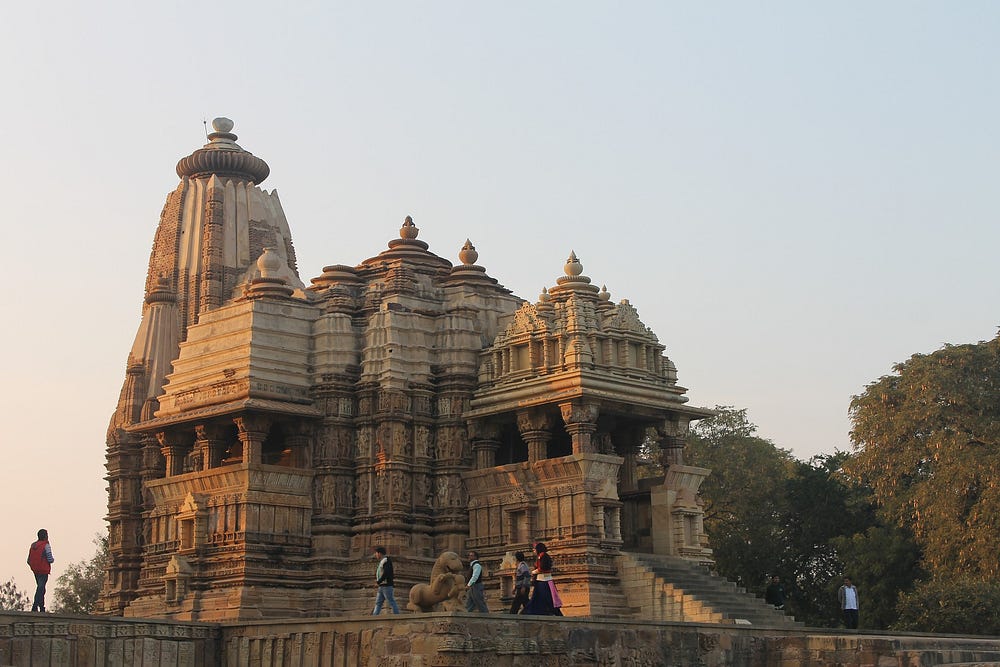
Khajuraho temples are one of those masterpieces. Chandela dynasty built Khajuraho temples in the 11th century. But, unfortunately, its legacy disappeared with the onset of Mughals and Muslim invaders. They plundered the temples.
But, it was not until the 19th century that Khajuraho was re-excavated by Britishers. They handed over temples to the Indian Archaeological Society in the early 20th century.
Garbhagriha (sanctum sanctorum) with Antarala (with narrow antechamber)
The Maha Mandapa (a large hall)
The Ardha Mandapa and Mandapa (several small extra halls)
The Pradakshina Path (circumambulation path)
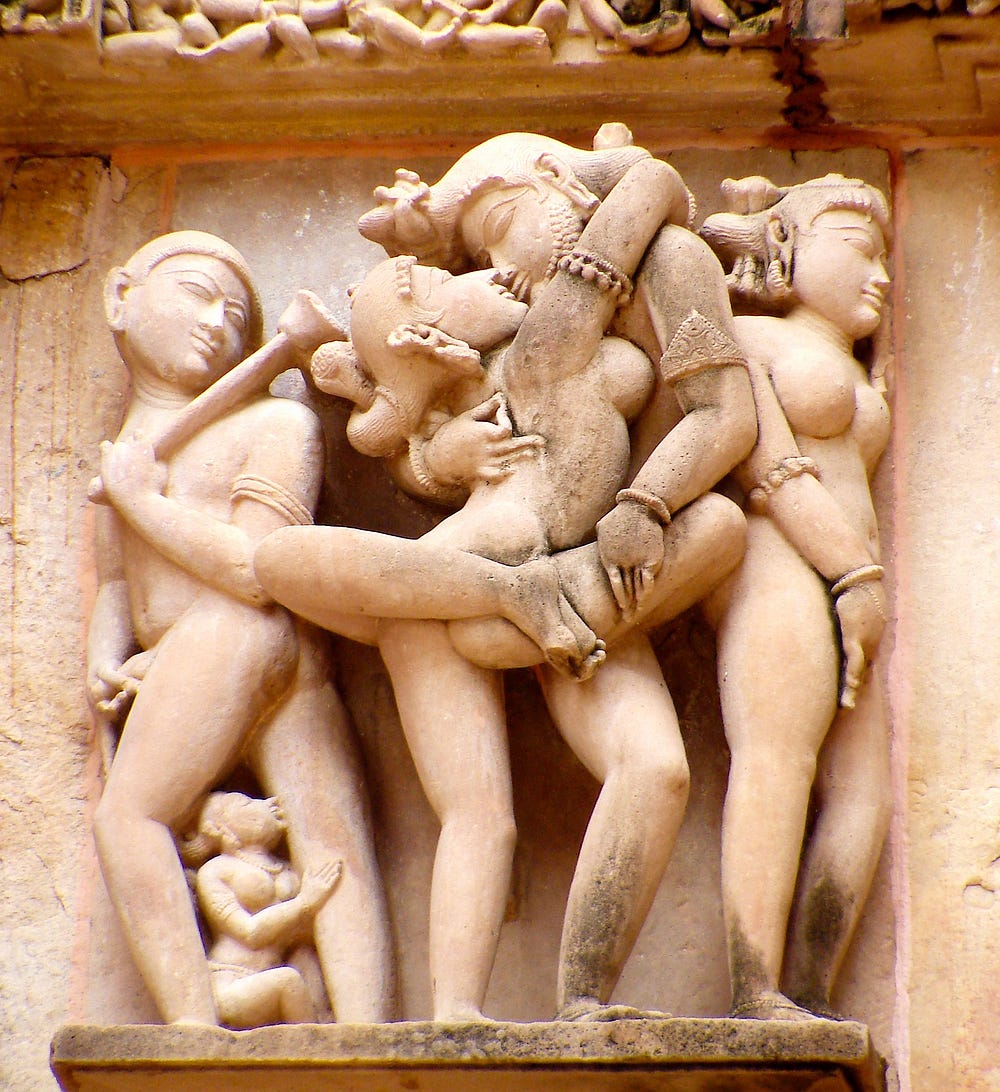
Various erotic statues adorn the outside walls of temples. The sculpture depicts the human’s carnal desire.
These statues show how ancient Indian society was open to sex. The figures explicitly show couples having sex in different postures, women and men masturbating, and also depicting sex with animals.
The Profound Meaning of Erotic Art Forms at Ancient Indian Temple
All these sensuous statues stand outside the temple. One can not find such a statue inside the temple. It signifies that the desires are part of your outer world. These desires are endless.
Every desire is a pleasure that you seek. To derive pleasantness in any activity, you run around the life. But you never go inside yourself to seek everlasting fulfillment.
Temple signifies a place of worship where one leaves behind the external world’s temporary joy to become one with self. The inner sanctum represents your soul.
One can only go inside when one is unaffected by the outside environment. Your lust/desire can never fully satisfy you. The contentment is momentary. These fleeting pleasures govern your mind. Chasing a colorful illusion leads you nowhere.
Life is like a mirror. You project the inside state to the outer world.
Your unmet desires lead an unfulfilled life. When you reside inside, you can experience the oneness and godly nature of the universe. The choice is always yours.
These sensual statues symbolize — Leave your desires outside to experience the eternal. Outside lies the impermanent. Inside lies the immortal bliss.
Takeaways
We can meet our basic needs of clothing, shelter, relationships, food, and the internet. But desires can never be satisfied. Your desire to have an updated version of a smartphone/laptop/car each time or anything makes you go crazy. But, even if you get that, your happiness is short-lived.
When you recognize the futile nature of desires, you break the cycle. Every human seeks fulfillment. But it does not lie outside you. It is always inside. The completeness of being, the bliss, and eternal joy lie within.
Meditate and touch your divinity.
Happiness is your nature. It is not wrong to desire it. What is wrong is seeking it outside when it is inside. — Sri Ramana Maharishi
Uranus goes retrograde on August 19, 2021, at 14° Taurus.
When a slow-moving planet like Uranus changes direction, is energy amplifies. Uranus is on steroids this week! What can you expect?
Uranus is different. Uranus is nothing like other planets. The only way to understand Uranus is to not try to understand… at least not with our Mercurial, facts-driven mind.
Uranus is the flash of insight that comes from the sky. It does not come from your mind, or from someone around you. It comes from the sky above.
The nature of Uranus is CHANGE.
Can you really prepare for change? Can you really prepare for a Uranus transit?
Not really. Uranus energy comes like a strike of lightning.
Uranus literally rules lightning.
Roy Sullivan, nicknamed “human lightning conductor”, the man who has been struck by lightning for a record of 7 times (and survived them all) has his chart ruler, Mercury in a very tight conjunction to Uranus at 0° Aquarius! (Uranus is the ruler of Aquarius).
Saturn Vs. Uranus – Rules Vs. Freedom
Uranus is the opposite of Saturn. If with Saturn you know what you get, with Uranus you never know what you get.
If Saturn rewards hard work and punishes you when you don’t put in the effort, Uranus can turn things in your favor even when you don’t deserve it and can disrupt your life even when you’ve done everything ‘right’… at least, by Saturn’s standards
Uranus will make sure that change happens, whether you like it or not.
Uranus is freedom, innovation, collective memory, sudden change, sudden illumination, breakthroughs, disruption, creativity, liberation, your true, authentic self.
Uranus Retrograde – It’s YOU Who Needs To Change
While Uranus direct is a time to make changes in your environment, in the outside world, Uranus retrograde is a time for an internal change.
This time, it’s you who needs to change, not the world around you. Uranian energy is like a scissor that cuts the ties of the past and pushes you to experience the world from a completely different perspective.
The shift will take place in the realm of the unconscious.
Don’t over-analyze your thoughts and actions. Remember, it is not Mercury that turns retrograde. With Uranus, the shift takes place in your subtle mind. Allow the Universe to talk to you in ITS language, not in yours.
Uranus retrograde can be experienced in a myriad of ways:
Freedom – Uranus is all about allowing your spirit to flow freely, unrestricted by false demands or pretense. The only freedom that is, is the one you already have. “You can chain me, you can torture me, you can even destroy this body, but you will never imprison my mind” – Ghandi
Reboot – think about electricity, its nature is on and off, 0 and 1. With Uranus we can be 100% “on” in a moment and then completely switch off and reboot. Whatever you do, start with a beginner’s mind. A good visualization exercise is to imagine you are an alien, you landed on Earth and you want to understand what the human race is all about. Approach life with curiosity.
A desire to get real and be honest with yourself – no more lies, no living someone else’s life. Become the person who you really want to be.
A desire to completely change your life. If you are not happy with your job change it. If you are not happy with your relationship, leave it. Do whatever you need to do to, change what’s not working and move on. The Universe is on your side.
Trauma – Uranus’ station can bring into your awareness long-forgotten memories. Any issues that you, or your ancestors (Uranus, together with Chiron, rules genetic memory) have not dealt with, can come to the surface now.
Anxiety – because of the disruptive quality of Uranus, we can experience fear and anxiety. Remember it is absolutely normal to experience fear and anxiety when you change something in your life. Make friends with your anxiety and let it propel you forward!
Flashes of intuitive energy – the higher guidance can come to you out of nowhere. Situations that seemed impossible will begin to work themselves out. Uranus wants to liberate your mind from dogmas so you can think free. A free mind has nothing to prove to anyone.
People who have a lot of Earth (Taurus, Virgo, Capricorn) or Fixed (Taurus, Leo, Scorpio) energy in their chart, may find this intense Uranus retrograde energy difficult to deal with, whereas people with a lot of Air or Mutable energy in their chart may thrive during the Uranus station.
If you have personal planets or angles at 14° in Taurus, Leo, Scorpio or Aquarius, Uranus retrograde can bring you sudden changes. However disruptive the change, remember that Uranus only works for your highest good.
“Do not go where the path may lead, go instead where there is no path and leave a trail.”
― Ralph Waldo Emerson
Ralph Waldo Emerson, who went by his middle name Waldo (May 25, 1803 – April 27, 1882), was an American essayist, lecturer, philosopher, abolitionist and poet who led the transcendentalist movement of the mid-19th century. Wikipedia
A sourcebook of the esoteric tradition, outlining the fundamental tenets of the Secret Doctrine of the Archaic Ages. This title addresses the perennial questions: continuity of life after death, purpose of existence, good and evil, consciousness and substance, sexuality, karma, evolution, and human and planetary transformation.
A new edition of the groundbreaking spiritual treasure, with a foreword by bestselling author Marianne Williamson .
Since its original publication in 1949, In Search of the Miraculous has been hailed as the most valuable and reliable documentation of G. I. Gurdjieff’s thoughts and universal view. This historic and influential work is considered by many to be a primer of mystical thought as expressed through the Work, a combination of Eastern philosophies that had for centuries been passed on orally from teacher to student. Gurdjieff’s goal, to introduce the Work to the West, attracted many students, among them Ouspensky, an established mathematician, journalist, and, with the publication of In Search of the Miraculous, an eloquent and persuasive proselyte.
Ouspensky describes Gurdjieff’s teachings in fascinating and accessible detail, providing what has proven to be a stellar introduction to the universal view of both student and teacher. It goes without saying that In Search of the Miraculous has inspired great thinkers and writers of ensuing spiritual movements, including Marianne Williamson, the highly acclaimed author of A Return to Love and Illuminata. In a new and never-before-published foreword, Williamson shares the influence of Ouspensky’s book and Gurdjieff’s teachings on the New Thought movement and her own life, providing a contemporary look at an already timeless classic.
Here is a reissue of the critically acclaimed bestseller, named one of the “20 books that changed the world” in New Age Journal’s Annual Source Book for 1995. Maverick theologian Matthew Fox provides a daring view of historical Christianity and a theologically sound basis for personal discovery of spiritual liberation.
In this revolutionary work, Fox shows how Christianity once celebrated beauty, compassion, justice, and provided a path of positive knowledge and ecstatic connection with all creation.
2nd step sense testimony: I don’t know who to believe.
5th step conclusion: There is only one Who.
–Mike Zonta, BB editor
[There are 5 steps in a Translation. These are two of them. For more information, check for upcoming Translation classes on this site or go to wwwtheprosperos.org.]
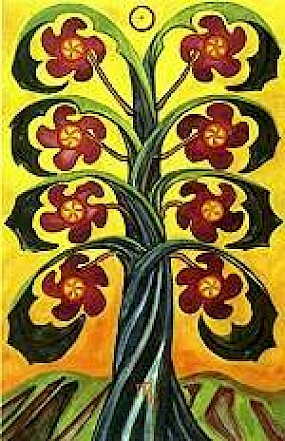
The Lord of Prudence is not quite as austere a card as it first sounds. It’s another of those Disks that works on more than one level. In the purely material and mundane sphere it indicates a period where financial resources must be carefully managed.
So long as it does not appear with cards like the Ten of Swords or the Five of Disks, there will not normally be any grave material problem. But there is a warning here that there may be unexpected expense, and good money management will enable us to fund whatever arises.
At the next level, the Eight of Disks can apply to a period where you enter into additional training in order to enhance your career projects. In this case look for cards like the Three of Disks, or the Ace, to indicate some new area of study. Then look for cards like the Universe, or the Sun to indicate the successful outcome of your efforts.
Finally in the spiritual area, when the Lord of Prudence comes up with cards like the Priestess, Death, the Moon, or the Hierophant, you’re approaching a period of rapid spiritual development – almost an initiation. In this case, this card is warning you to be alert for opportunities, ready to deal with stress and pressure, and to manage your energies thoughtfully and carefully. You can perhaps see the correlation which exists with regard to energy management between the material and spiritual definitions of the card – in either case energy must be regulated and respected in order for life to go smoothly and for you to get the best out of your experiences.
Dōgen Zenji (道元禅師; 19 January 1200 – 22 September 1253),[1] also known as Dōgen Kigen (道元希玄), Eihei Dōgen (永平道元), Kōso Jōyō Daishi (高祖承陽大師), or Busshō Dentō Kokushi (仏性伝東国師), was a JapaneseBuddhist priest, writer, poet, philosopher, and founder of the Sōtō school of Zen in Japan.
Originally ordained as a monk in the Tendai School in Kyoto, he was ultimately dissatisfied with its teaching and traveled to China to seek out what he believed to be a more authentic Buddhism. He remained there for five years, finally training under Tiantong Rujing, an eminent teacher of the Chinese Caodong lineage. Upon his return to Japan, he began promoting the practice of zazen (sitting meditation) through literary works such as Fukan zazengi and Bendōwa.
He eventually broke relations completely with the powerful Tendai School, and, after several years of likely friction between himself and the establishment, left Kyoto for the mountainous countryside where he founded the monastery Eihei-ji, which remains the head temple of the Sōtō school today.
Dōgen is known for his extensive writing including his most famous work, the collection of 95 essays called the Shōbōgenzō, but also Eihei Kōroku, a collection of his talks, poetry, and commentaries, and Eihei Shingi, the first Zen monastic code written in Japan, among others.
Biography
Early life
Dōgen was probably born into a noble family, though as an illegitimate child of Minamoto Michitomo, who served in the imperial court as a high-ranking ashō (亞相, “Councillor of State”).[2] His mother is said to have died when Dōgen was age 7.[3]
Early training
At some later point, Dōgen became a low-ranking monk on Mount Hiei, the headquarters of the Tendai school of Buddhism. According to the Kenzeiki (建撕記), he became possessed by a single question with regard to the Tendai doctrine:
As I study both the exoteric and the esoteric schools of Buddhism, they maintain that human beings are endowed with Dharma-nature by birth. If this is the case, why did the Buddhas of all ages — undoubtedly in possession of enlightenment — find it necessary to seek enlightenment and engage in spiritual practice?[4][5]
This question was, in large part, prompted by the Tendai concept of original enlightenment (本覚 hongaku), which states that all human beings are enlightened by nature and that, consequently, any notion of achieving enlightenment through practice is fundamentally flawed.[6]
The Kenzeiki further states that he found no answer to his question at Mount Hiei, and that he was disillusioned by the internal politics and need for social prominence for advancement.[2] Therefore, Dōgen left to seek an answer from other Buddhist masters. He went to visit Kōin, the Tendai abbot of Onjō-ji Temple (園城寺), asking him this same question. Kōin said that, in order to find an answer, he might want to consider studying Chán in China.[7] In 1217, two years after the death of contemporary Zen Buddhist Myōan Eisai, Dōgen went to study at Kennin-ji Temple (建仁寺), under Eisai’s successor, Myōzen (明全).[2]
Travel to China
In 1223, Dōgen and Myōzen undertook the dangerous passage across the East China Sea to China to study in Jing-de-si (Ching-te-ssu, 景德寺) monastery as Eisai had once done.[citation needed]
In China, Dōgen first went to the leading Chan monasteries in Zhèjiāng province. At the time, most Chan teachers based their training around the use of gōng-àns (Japanese: kōan). Though Dōgen assiduously studied the kōans, he became disenchanted with the heavy emphasis laid upon them, and wondered why the sutras were not studied more. At one point, owing to this disenchantment, Dōgen even refused Dharma transmission from a teacher.[8] Then, in 1225, he decided to visit a master named Rújìng (如淨; J. Nyōjo), the thirteenth patriarch of the Cáodòng (J. Sōtō) lineage of Zen Buddhism, at Mount Tiāntóng (天童山 Tiāntóngshān; J. Tendōzan) in Níngbō. Rujing was reputed to have a style of Chan that was different from the other masters whom Dōgen had thus far encountered. In later writings, Dōgen referred to Rujing as “the Old Buddha”. Additionally he affectionately described both Rujing and Myōzen as senshi (先師, “Ancient Teacher”).[2]
Under Rujing, Dōgen realized liberation of body and mind upon hearing the master say, “Cast off body and mind” (身心脱落 shēn xīn tuō luò). This phrase would continue to have great importance to Dōgen throughout his life, and can be found scattered throughout his writings, as—for example—in a famous section of his “Genjōkōan” (現成公案):
To study the Way is to study the Self. To study the Self is to forget the self. To forget the self is to be enlightened by all things of the universe. To be enlightened by all things of the universe is to cast off the body and mind of the self as well as those of others. Even the traces of enlightenment are wiped out, and life with traceless enlightenment goes on forever and ever.[9]
Myōzen died shortly after Dōgen arrived at Mount Tiantong. In 1227,[10] Dōgen received Dharma transmission and inka from Rujing, and remarked on how he had finally settled his “life’s quest of the great matter”.[11]
Return to Japan
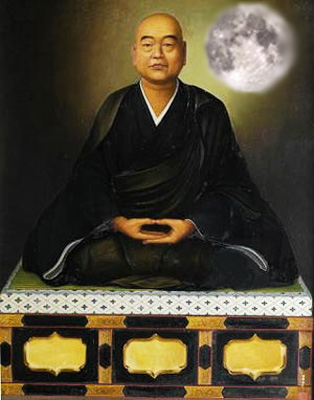
Dōgen watching the moon. Hōkyōji monastery, Fukui prefecture, circa 1250.
Dōgen returned to Japan in 1227 or 1228, going back to stay at Kennin-ji, where he had trained previously.[2] Among his first actions upon returning was to write down the Fukan Zazengi[12] (普観坐禅儀; “Universally Recommended Instructions for Zazen”), a short text emphasizing the importance of and giving instructions for zazen, or sitting meditation.[13]
However, tension soon arose as the Tendai community began taking steps to suppress both Zen and Jōdo Shinshū, the new forms of Buddhism in Japan. In the face of this tension, Dōgen left the Tendai dominion of Kyōto in 1230, settling instead in an abandoned temple in what is today the city of Uji, south of Kyōto.[14] In 1233, Dōgen founded the Kannon-dōri-in[15] in Fukakusa as a small center of practice. He later expanded this temple into Kōshōhōrin-ji (興聖法林寺).[16]
Eihei-ji
In 1243, Hatano Yoshishige (波多野義重) offered to relocate Dōgen’s community to Echizen province, far to the north of Kyōto. Dōgen accepted because of the ongoing tension with the Tendai community, and the growing competition of the Rinzai-school.[17]
His followers built a comprehensive center of practice there, calling it Daibutsu Temple (Daibutsu-ji, 大仏寺). While the construction work was going on, Dōgen would live and teach at Yoshimine-dera Temple (Kippō-ji, 吉峯寺), which is located close to Daibutsu-ji. During his stay at Kippō-ji, Dōgen “fell into a depression”.[17] It marked a turning point in his life, giving way to “rigorous critique of Rinzai Zen”.[17] He criticized Dahui Zonggao, the most influential figure of Song Dynasty Chán.[18]
In 1246, Dōgen renamed Daibutsu-ji, calling it Eihei-ji.[19] This temple remains one of the two head temples of Sōtō Zen in Japan today, the other being Sōji-ji.[20]
Dōgen spent the remainder of his life teaching and writing at Eihei-ji. In 1247, the newly installed shōgun’s regent, Hōjō Tokiyori, invited Dōgen to come to Kamakura to teach him. Dōgen made the rather long journey east to provide the shōgun with lay ordination, and then returned to Eihei-ji in 1248. In the autumn of 1252, Dōgen fell ill, and soon showed no signs of recovering. He presented his robes to his main apprentice, Koun Ejō (孤雲懐弉), making him the abbot of Eihei-ji.[citation needed]
Death
At Hatano Yoshishige’s invitation, Dōgen left for Kyōto in search of a remedy for his illness. In 1253, soon after arriving in Kyōto, Dōgen died. Shortly before his death, he had written a death poem:
Fifty-four years lighting up the sky. A quivering leap smashes a billion worlds. Hah! Entire body looks for nothing. Living, I plunge into Yellow Springs.[21]
Miraculous events and auspicious signs
Several “miraculous experiences”[22] and “auspicious signs”[23] have been recorded in Dōgen’s life,[22][24][25][note 1] some of them quite famous.[27][25] According to Bodiford, “Monks and laymen recorded these events as testaments to his great mystical power,” which “helped confirm the legacy of Dōgen’s teachings against competing claims made by members of the Buddhist establishment and other outcast groups.” Bodiford further notes that the “magical events at Eiheiji helped identify the temple as a cultic center,” putting it at a par with other temples where supernatural events occurred.[22] According to Faure, for Dōgen these auspicious signs were proof that “Eiheiji was the only place in Japan where the Buddhist Dharma was transmitted correctly and that this monastery was thus rivaled by no other.”[31]
In Menzan Zuihō’s well-known 1753 edition of Dōgen’s biography, it records that while traveling in China with his companion Dōshō, Dōgen became very ill, and a deity appeared before him who gave him medicine which instantly healed him:[25]
Dōgen fell gravely ill on his way back from China but had no medicines that could be of use. Suddenly, an immortal appeared and gave Dōgen a herbal pill, after which he immediately became better. The master asked this deity to reveal its identity. The mysterious figure replied, “I am the Japanese kami Inari” and disappeared. The medicine became known as Gedokugan, which has been ever since been part of the Dōshō family heritage […] Dōgen then told Dōshō that this rare and wondrous medicine had been bestowed on him by a true kami for the protection of the great Dharma, [and that] this medicine of many benefits should be distributed to temples so that they might spread the Dharma heritage.[25]
This medicine, which later became known as Gedokuen or “Poison-Dispelling Pill” was then produced by the Sōtō church until the Meiji Era, and was commonly sold nationwide as an herbal medicine,[32] and became a source of income for the Sōtō church.[25][32]The statue memorializing Dōgen’s vision of Avalokiteshvara at a pond in Eihei-ji, Japan.
Another famous incident happened when he was returning to Japan from China. The ship he was on was caught in a storm. In this instance, the storm became so severe, that the crew feared the ship would sink and kill them all. Dōgen then began leading the crew in recitation of chants to Kannon (Avalokiteshwara), during which, the Bodhisattva appeared before him, and several of the crew saw her as well.[26] After the vision appeared, the storm began to calm down, and consensus of those aboard was that they had been saved due to the intervention of Bodhisattva Avalokiteshwara.[26] This story is repeated in official works sponsored by the Sōtō Shū Head Office[27][26] and there is even a sculpture of the event in a water treatment pond in Eihei-ji Temple.[26][29] Additionally, there is a 14th-century copy of a painting of the same Kannon, that was supposedly commissioned by Dōgen, that includes a piece of calligraphy that is possibly an original in Dōgen’s own hand, recording his gratitude to Avalokiteshwara:
From the single blossom five leaves uncurled: Upon one single leaf a Tathagata stood alone. Her vow to harmonize our lives is ocean deep, As we spin on and on, shouldering our deeds of right and wrong. –written by the mendicant monk Dōgen, September 26, 1242.[33][26]
Another miraculous event occurred, while Dōgen was at Eihei-ji. During a ceremony of gratitude for the 16 Celestial Arahants (called Rakan in Japanese), a vision of 16 Arahants appeared before Dōgen descending upon a multi-colored cloud,[26] and the statues of the Arahants that were present at the event began to emanate rays of light,[34] to which Dōgen then exclaimed:
The Rakans caused to appear felicitous flowers, exceedingly wonderful and beautiful[28]
Dōgen was profoundly moved by the entire experience, and took it as an auspicious sign that the offerings of the ceremony had been accepted.[24] In his writings he wrote:
As for other examples of the appearance of auspicious signs, apart from [the case of] the rock bridge of Mount Tiantai, [in the province] of Taizhou, in the great kingdom of the Song, nowhere else to my knowledge has there been one to compare with this one. But on this mountain [Kichijōsan, the location of Eiheiji] many apparitions have already happened. This is truly a very auspicious sign showing that, in their deep compassion, [the Arahats] are protecting the men and the Dharma of this mountain. This is why it appeared to me.” [23][30]
Dōgen is also recorded to have had multiple encounters with non-human beings.[35][25][24] Aside from his encounter with the kami Inari in China, in the Denkōrou it is recorded that while at Kōshō-ji, he was also visited by a deva who came to observe during certain ceremonies, as well as a dragon who visited him at Eihei-Ji and requested to be given the eight abstinence Precepts:[35]
When he was at Kōshō-ji a deva used to come to hear the Precepts and join in as an observer at the twice-monthly renewal of Bodhisattva vows. At Eihei-ji a divine dragon showed up requesting the eight Precepts of abstinence and asking to be included among the daily transfers of merit. Because of this Dōgen wrote out the eight Precepts every day and offered the merit thereof to the dragon. Up to this very day this practice has not been neglected.[35]