I.M.
–Mike Zonta, BB editor

Scientists achieved a record level of visual detail with an imaging technique that could help develop future electronics and better batteries
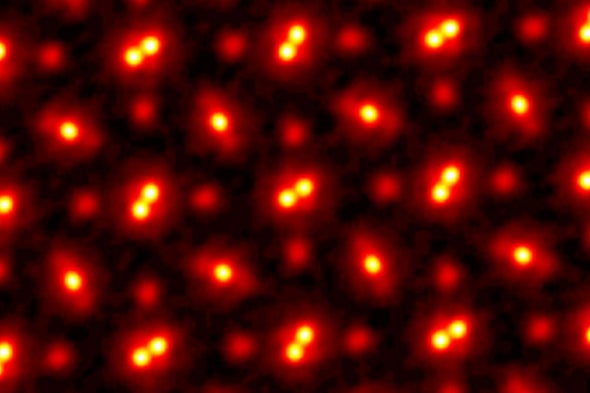
Behold the highest-resolution image of atoms ever seen. Cornell University researchers captured a sample from a crystal in three dimensions and magnified it 100 million times, doubling the resolution that earned the same scientists a Guinness World Record in 2018. Their work could help develop materials for designing more powerful and efficient phones, computers and other electronics, as well as longer-lasting batteries.
The researchers obtained the image using a technique called electron ptychography. It involves shooting a beam of electrons, about a billion of them per second, at a target material. The beam moves infinitesimally as the electrons are fired, so they hit the sample from slightly different angles each time—sometimes they pass through cleanly, and other times they hit atoms and bounce around inside the sample on their way out. Cornell physicist David Muller, whose team conducted the recent study, likens the technique to playing dodgeball against opponents who are standing in the dark. The dodgeballs are electrons, and the targets are individual atoms. Though Muller cannot see the targets, he can see where the “dodgeballs” end up, thanks to advanced detectors. Based on the speckle pattern generated by billions of electrons, machine-learning algorithms can calculate where the atoms were in the sample and what their shapes might be.
Previously, electron ptychography had only been used to image extremely flat samples: those merely one to a few atoms thick. The new study, published in Science, now allows it to capture multiple layers tens to hundreds of atoms thick. That makes the technique much more relevant to materials scientists, who typically study the properties of samples with a thickness of about 30 to 50 nanometers. (That range is smaller than the length your fingernails grow in a minute but many times thicker than what electron ptychography could image in the past.) “They can actually look at stacks of atoms now, so it’s amazing,” says Andrew Maiden, an engineer at the University of Sheffield in England, who helped develop ptychography but was not involved with the new study. “The resolution is just staggering.”
This marks an important advancement in the world of electron microscopy. Invented in the early 1930s, standard electron microscopes made it possible to see objects such as polioviruses, which are smaller than the wavelengths of visible light. But electron microscopes had a limit: increasing their resolution required raising the energy of the electron beam—and eventually the necessary energy would become so great that it would damage the sample. One way to avoid this problem was ptychography, which researchers developed in theory in the 1960s. But because of limitations in detectors and computational power, as well as the complex math required, it was decades before the technique was put into practice. Early versions only worked with visible light and x-rays, not the electron beams required to image atomic-size objects. Meanwhile scientists kept finding ways to improve electron microscopes, which worked so well that electron ptychography could not keep up. “You had to be a true believer in ptychography to be paying attention to it,” Muller says.
It was only in the past several years that Muller and his team developed a detector good enough for electron ptychography to work experimentally. By 2018, they had figured out how to reconstruct two-dimensional samples with the technique, producing “the highest-resolution image by any method in the world,” Muller says—which won that Guinness World Record. And the researchers did so with a lower-energy wavelength than other methods, allowing them to better preserve their samples.
Thicker samples, however, presented multiple challenges. Instead of bouncing just once before detection, an electron wave ricochets around atoms in a three-dimensional sample. “You know where it ended up, but you don’t know what path it took in the material,” Muller says. This pinballing is called the “multiple scattering problem,” and he and his team spent the past several years trying to solve it. With enough overlapping speckle patterns and computing power, they found they could work backward to determine which layout of atoms produced a given pattern. The researchers did so by fine-tuning a model until the speckle pattern it generated matched the experimentally produced one. Solving the multiple scattering problem is a major advancement, Muller says. Referring to the resolution his team’s technique can capture for samples 300 atoms thick or smaller, he contends that “we can do better than anyone else, and we can do better than anyone else by factors of two to four.”
Such high-resolution imaging techniques are essential for developing the next generation of electronic devices. For example, researchers are looking to move beyond silicon-based computer chips in search of more efficient semiconductors. To make this happen, engineers need to know what they are working with at an atomic level—which means taking advantage of technologies such as electron ptychography. “We have these tools sitting there, waiting to help us optimize what will become the next generation of devices,” says J. Murray Gibson, dean of the Florida A&M University–Florida State University College of Engineering, who was not involved in the new study. “Without these tools, we couldn’t do it.”
Batteries are a particularly promising area for applying imaging techniques such as electron ptychography, says Roger Falcone, a physicist at the University of California, Berkeley, who was also not involved with the research. “How do we make the structure of batteries,” he asks, “such that they can store a lot of energy and yet still be safe?” This is an essential question, especially for the transition from fossil fuels to renewable energies, including wind and solar. “Imaging technologies are very important to improving batteries because we can look at the chemical reactions in detail,” Falcone says.
But there is still a long way to go. In order for electron ptychography to lead to a new breakthrough for your cell phone or laptop, it must do more than take a picture—it has to be capable of precisely locating an individual atom in a material. Though the researchers demonstrated how the technique could do so theoretically, they have not yet performed an experimental demonstration. “With any new technique, it always takes a bit of time for your fellow researchers to try this out and see if it bears out into real, practical uses,” says Leslie Thompson, former manager of materials analysis and characterization at IBM Research–Almaden, who was not involved in the new study.
“To the extent that you invent a new tool like a high-resolution microscope, my sense is that you tend to be surprised [by] what problem it’s applied to solve,” Falcone adds. “People will look at things that we can’t even imagine now—and solve a problem that we’re not even sure we have yet.”Rights & Permissions
Anna Blaustein is a science journalist. She has a degree in biology from Bowdoin College and is currently pursuing her master’s in science writing at MIT.

Between the time Hypatia of Alexandria first pointed her pre-telescopic eye to the cosmos millennia before the notion of galaxies and the time Vera Rubin stood at the foot of the world’s most powerful telescope to confirm the existence of dark matter by observing how distant galaxies rotate, and in all the time before, and in all the time since, we have hungered to understand the forces that move the stars and the Moon and the mind. Ever since Galileo leaned on his artistic training in perspective to draw his astronomical observations intimating that the universe might not be what the theologians have claimed it to be, humanity has been on a passionate and disorienting quest to understand the nature of the mystery that made us.
Art from An Original Theory or New Hypothesis of the Universe, 1750. (Available as a print, as a face mask, and as stationery cards.)
In the centuries since, we have made staggering discoveries of fundamental forces swirling exotic particles into “the ricochet wonder of it all: the plain everythingness of everything, in cahoots with the everythingness of everything else.” Along the way, in our longing for a final theory of everything, we have been staggered by revelation after revelation that things are not what we previously thought them to be and beneath each layer of reality we have unpeeled lies another. The heavens are not a clockwork orrery of perfect orbs revolving around us in perfect circles. The cosmic wilderness is overgrown with a species of mystery we call dark matter and the fabric of spacetime is pocked with black holes the rims of which gape our Munchian scream at the sense that the universe remains a sweeping enigma whose native language we are only just beginning to decipher, naming our particles and composing our equations in the alphabet of a long-gone civilization that believed the Earth was flat and the stars were at its service.
Art from An Original Theory or New Hypothesis of the Universe, 1750. (Available as a print, as a face mask, and as stationery cards.)
Our yearning for a Theory of Everything has culminated in what we call the Standard Model — a conceptual map of all the known particles and the fundamental forces that govern them to make the universe cohere into everything we know and are. It is the most successful scientific theory in the history of our species. But it is rather a Theory of Everything We Know So Far, at once triumphal and tessellated with incompleteness.
The essence of that theory, its central contradictions, and how it contours the next layer of reality awaiting discovery is what theoretical physicist David Tong details in this animated primer for Quanta Magazine, drawing out discoveries and questions that punctuate the excellent anthology Alice and Bob Meet the Wall of Fire: The Biggest Ideas in Science from Quanta (public library).

Complement with an animated look at the little loophole in the Big Bang model, then revisit the remarkable story of how Johannes Kepler revolutionized our understanding of the universe while defending his mother in a witchcraft trial.
Issued on: 24/07/2021 – 18:48 (France24.com)
Text by:NEWS WIRES4 min
Thousands of Hungarians joined the annual Budapest Pride march on Saturday to support LGBTQ people and protest against a law that limits teaching about homosexuality and transgender issues in schools.
Hungary‘s nationalist Prime Minister Viktor Orban, in power since 2010, has introduced social policies that he says aim to safeguard traditional Christian values from Western liberalism, stoking tensions with the European Union.
The European Commission has launched legal action against Orban’s government over the new law, which came into force this month, saying it is discriminatory and contravenes European values of tolerance and individual freedom.
Demonstrators at the march through the streets of central Budapest said the legislation was dividing the former Soviet-bloc nation and now a member of the European Union.
“The law is an outrage. We live in the 21st century, when things like that should not be happening. We are no longer in communist times, this is the EU and everyone should be able to live freely,” Istvan, 27, said at the march with his boyfriend.
Orban‘s Fidesz-Christian Democrat government, which faces a tough election next year, says LGBTQ rights and other such social issues are matters for national governments to decide. It says the law aims to protect children not target homosexuals.
Organisers said in a statement the rally would show opposition to “power-hungry politicians” and reject intimidation of LGBTQ people.
“Instead of protecting minorities, the Fidesz-Christian Democrat government is using laws to make members of the LGBTQ community outcasts in their own country,” they said.
Orban owes some of his electoral success to a tough line on immigration. As that issue has receded from the political agenda, his focus has shifted to gender and sexuality issues.
‘Nothing more than a diversion’
Boglarka Balazs, a 25-year-old economist who joined the rally, said the legislation was a campaign tool. “This is nothing more than a diversion that tries to tear the country apart. It is a provocation because of the elections,” she said.
Daily newsletterReceive essential international news every morningSubscribe
A survey last month by the Ipsos polling organisation found that 46% of Hungarians supported same-sex marriage.
More than 40 embassies and foreign cultural institutions in Hungary issued a statement backing the Budapest Pride Festival.
“We encourage steps in every country to ensure the equality and dignity of all human beings irrespective of their sexual orientation or gender identity,” wrote the signatories, including the U.S., British and German embassies.
Balint Berta, 29, who works at a clothing retailer, said the legislation was creating artificial tensions in society. “The more politics incites this, society will turn around and people will turn against one another after a while,” he said.
(REUTERS)
Wendy Cicchetti | Twixt Earth and Sky Wendy Cicchetti is an internationally known astrologer with over 25 years experience blessing the lives of thousands around the world. Misty Tripoli travels the world, igniting communities and inspiring hearts to come together to be authentic, creative and have as much fun as humanly possible! Wendy is available for consultation at Wendy@TwixtEarthandSky.com or through her website https://twixtearthandsky.com Misty is the founder of https://theworldgroovemovement.com/
| By Craig Hamilton (support@craighamiltonglobal.com) |
| In this 10-minute guided meditation, excerpted from one of his virtual meditation workshops, Craig invites you to leave behind the cares and concerns of your life and step into the infinite depth of your true nature. Experience the freedom of simply resting here and now as a conscious, awake presence, without trying to make anything happen, and without imposing anything on this moment. |

Margaret Eleanor Atwood (born November 18, 1939) is a Canadian poet, novelist, literary critic, essayist, teacher, environmental activist, and inventor. Wikipedia

 |
Discovering Your Authentic Identity Welcome – so glad you’re here! I am Heather C. Williams, H.W.,M. Let us explore how destiny is always dependent upon identity. Our world today is unstable due to old habits that are causing big problems. Everyone agrees we have big problems. Working together to solve these problems is very challenging because…you cannot enlighten the world unless you enlighten yourself…and the number one cause of our frustration is that most of us have no idea of who we really are. The task today, for just about everyone, is to be curious: “Who am I? Why do we have this problem?” Now, the one indispensable key to discovering your true, authentic identity is your willingness to do the work that is needed to free yourself from old conditioning, old habits, old patterns. Your authentic identity is already here, alive and well, beneath layers of old stuff. You do not have to buy it or create it or affirm it. The Prosperos class, SUPRACARGO, was created by Thane to help individuals begin to awaken to the creative core of Beingness that is within each of us. My upcoming SUPRA CARGO CLASS will be a team project with my Teacher, Thane and myself. This will be a zoom class – 10:00 am to 2:00 pm Pacific Time on both Saturday & Sunday, August 21 & 22. I invite you to come, learn, explore and discover more about your True Identity as Consciousness. Learn more and register below: Learn More/Register |
