DALLAS, TX—Gathering his wife and children close to him as he shared the tragic news, area conservative Dan Gainey, 66, informed his family Tuesday that Critical Race Theory had spread to his liver. “There’s no easy way to say this, but I just got the diagnosis that I have Critical Race Theory, and soon my body will be completely ravaged by it,” said Gainey of the academic movement focused on studying social and cultural issues through the lens of institutional racism that was reportedly metastasizing within him. “I promise you all I’m going to fight like Hell to lick this thing, but the truth is that it’s a pernicious ideology capable of spreading rapidly, so I probably don’t have all that much longer. I just pray it doesn’t spread to my brain—if you ever hear me rambling incoherently about how the inequalities that spurred the civil rights movements are still with us today, I’m begging you right now to put me out of my misery.” At press time, Gainey sought to comfort his crying family with the promise that if they remembered the U.S. was historically the least racist country on Earth, he would always be with them in spirit.
The Capricorn Full Moon brings a reminder of winter’s trials and privations. The Moon is traditionally considered “in detriment” in this sign. The traditional idea of rulership (as laid out in ancient texts such as Claudius Ptolemy’s Tetrabiblos, for example) can help make sense of situations where we feel either “at home” or out of our depth. The theory goes that, when a planet is in the sign that it rules, it is at home and knows its territory well. When the planet represents us, it indicates that we easily thrive in such surroundings.
On turf where we are strangers and unfamiliar with the terrain, we may take wrong turns and make mistakes. We have more difficulty fitting in, and we may need to learn a lot, quickly, including the local language and customs. Our basic survival needs may go unmet for a while, making do with what’s at hand, rather than what we are used to. This is especially highlighted with the Full Moon in its sign of detriment. In Capricorn, the sign opposite to the one it rules, the Moon — commonly connected with basic needs and comforts — sits uneasily in alien territory. As Capricorn is governed by Saturn, we may be under pressure to work with rules and limitations, and deal with matters of basic duty, practical survival, and even scarcity.
Since the Full Moon has a habit of magnifying feelings and situations, any polarization of duty and practicality versus our personal issues and feeling states becomes heightened. With Saturn in its traditional home sign of Aquarius, though, we may find solace in knowing that whatever stress we’re dealing with is somehow for the best. Perhaps what we must go through will benefit a larger group of people, or improve conditions down the line. However, Saturn’s retrograde motion points to an extension or delay in a situation. We need to dig deep for our powers of resilience — whether internally or by reaching out to others. Sometimes, answers come more easily within a group context. However, if we need to operate in isolation, remember that there can be support without physical contact.
In fact, the air element of Aquarius reminds us that connection is possible at a distance — for instance, through the Internet, radio waves, psychic healing, or even angelic contact. The potential for spiritual extension to aid us is shown through the Moon’s sextile to Jupiter, planet of faith, comfortably situated in one of its domicile signs, Pisces, where it generously provides the best of itself. Jupiter in Pisces is happy making spiritual connections based on symbolic meaning, or working with coincidences and positive feelings.
Jupiter presents the willingness to believe that calling out to a divine entity during a sleepless night might bring relief, no matter what the source. The underpinning principles are the same: To enter into the realm of faith, reach towards a positive (healing, protective) force, and remember that we sometimes do need to actively ask for help. Giving words — spoken aloud or written — to our requirements and wishes lets someone beyond us know our intentions. Those with the capabilities to assist can then extend their positive powers to our cause.
Jupiter is also retrograde, so, if our call for assistance is not met immediately, we should not be surprised, but still ought to practice finding a way to keep the faith! This may be testing, but the wonderful thing about Jupiter is how it represents the cornucopia of multiple choice. We are not necessarily limited to just one area. If the usual call for help is not delivering enough, maybe we stretch our faith to other potentials still in alignment with our basic beliefs.
For example, in homeopathic medicine, whereas tissue salt remedies might be a typical first line of treatment, we could also explore flower remedies — so long as, in tune with Saturn in Aquarius, we pay careful heed to dosage limits and applicable timing. Saturn is equally comfortable with technical astrological calculations, so we may also find sound wisdom in exploring medical astrology, such as decumbiture charts (for when someone falls ill), many examples of which are found in Nicholas Culpeper’s Astrological Judgment of Diseases (1655).
This article is from the Mountain Astrologer, written by Diana Collis.
The Met Using time-lapse footage of New York City, the filmmaker Hilary Harris imagines the metropolis as a living organism. Traffic arteries are seen as the bloodstream circulating through the urban body; skyscrapers are the skeletal structure. Shops, railroads, bridges, beaches, and parades are juxtaposed with cellular activity shown under the microscope, illustrating the greater choreography of city life in all its fascinating complexity. As part of The Met’s 150th anniversary, each month in 2020 we released three to four films from the Museum’s extensive moving-image archive. The series will continue on a monthly basis through March 2022. Browse the entire film series: https://www.metmuseum.org/150/from-th… Subscribe for new content from The Met: https://www.youtube.com/user/metmuseu…
As they began to organize their communities of faith, early followers of Jesus struggled to understand and preserve his legacy. They wrote various Gospels, and debated which ones should guide their lives and spiritual practices.
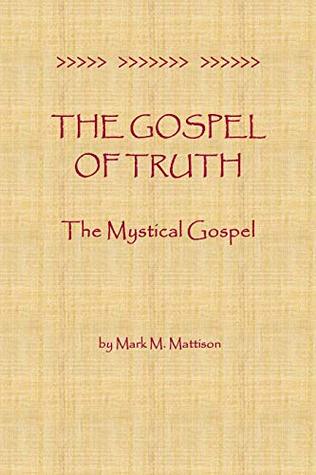
Late in the second century, one bishop sharply criticized the poetic Gospel of Truth, which was subsequently lost to history. However, two fourth-century Egyptian translations were discovered in 1945. This sublime Gospel describes a loving and merciful God who calls us all to return through “the Way” and find joyful rest in paradise.
Was this Gospel written by the eloquent teacher Valentinus? Were Valentinus and his followers really “heretics,” as some charged, or rather faithful mystics who were simply misunderstood? Explore these questions and more in the pages of this new, contemporary translation of the mystical Gospel of Truth.
John Shelby Spong, bestselling author and popular proponent of a modern, scholarly and authentic Christianity, argues that this last gospel to be written was misinterpreted by the framers of the fourth-century creeds to be a literal account of the life of Jesus when in fact it is a literary, interpretive retelling of the events in Jesus’ life through the medium of fictional characters, from Nicodemus and Lazarus to the “Beloved Disciple.” The Fourth Gospel was designed first to place Jesus into the context of the Jewish scriptures, then to place him into the worship patterns of the synagogue and finally to allow him to be viewed through the lens of a popular form of first-century Jewish mysticism.
The result of this intriguing study is not only to recapture the original message of this gospel, but also to provide us today with a radical new dimension to the claim that in the humanity of Jesus the reality of God has been met and engaged.
Even if I don’t see it again—nor ever feel it I know it is—and that if once it hailed me it ever does— And so it is myself I want to turn in that direction not as towards a place, but it was a tilting within myself, as one turns a mirror to flash the light to where it isn’t—I was blinded like that—and swam in what shone at me only able to endure it by being no one and so specifically myself I thought I’d die from being loved like that.
From the religious historian whose The Gnostic Gospels won both the National Book Award and the National Book Critics Circle Award comes a dramatic interpretation of Satan and his role on the Christian tradition. With magisterial learning and the elan of a born storyteller, Pagels turns Satan’s story into an audacious exploration of Christianity’s shadow side, in which the gospel of love gives way to irrational hatreds that continue to haunt Christians and non-Christians alike.
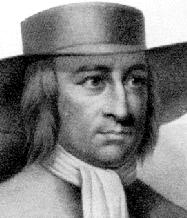
George Fox (July 1624[2] – 13 January 1691) was an English Dissenter, who was a founder of the Religious Society of Friends, commonly known as the Quakers or Friends. The son of a Leicestershireweaver, he lived in times of social upheaval and war. He rebelled against the religious and political authorities by proposing an unusual, uncompromising approach to the Christian faith. He travelled throughout Britain as a dissenting preacher, performing hundreds of healings, and often being persecuted by the disapproving authorities.[3] In 1669, he married Margaret Fell, widow of a wealthy supporter, Thomas Fell; she was a leading Friend. His ministry expanded and he made tours of North America and the Low Countries. He was arrested and jailed numerous times for his beliefs. He spent his final decade working in London to organise the expanding Quaker movement. Despite disdain from some Anglicans and Puritans, he was viewed with respect by the Quaker convert William Penn and the Lord Protector, Oliver Cromwell.
Early life
Memorial to Fox’s birthplace, situated on George Fox Lane in Fenny Drayton, England
George Fox was born in the strongly Puritan village of Drayton-in-the-Clay, Leicestershire, England (now Fenny Drayton), 15 miles (24 km) west-south-west of Leicester, as the eldest of four children of Christopher Fox, a successful weaver, called “Righteous Christer” by his neighbours,[4] and his wife, Mary née Lago. Christopher Fox was a churchwarden and relatively wealthy. He left his son a substantial legacy when he died in the late 1650s.[5] Fox was of a serious, religious disposition from childhood. There is no record of any formal schooling but he learnt to read and write. “When I came to eleven years of age,” he said, “I knew pureness and righteousness; for, while I was a child, I was taught how to walk to be kept pure. The Lord taught me to be faithful, in all things, and to act faithfully two ways; viz., inwardly to God, and outwardly to man.”[6] Known as an honest person, he also proclaimed, “The Lord taught me to be faithful in all things … and to keep to Yea and Nay in all things.”[7]
As he grew up, Fox’s relatives “thought to have made me a priest” but he was instead apprenticed to a local shoemaker and grazier, George Gee of Mancetter.[8] This suited his contemplative temperament and he became well known for his diligence among the wool traders who had dealings with his master. A constant obsession for Fox was the pursuit of “simplicity” in life – humility and the abandonment of luxury. The short time he spent as a shepherd was important to the formation of this view. Toward the end of his life he wrote a letter for general circulation pointing out that Abel, Noah, Abraham, Jacob, Moses and David were all keepers of sheep or cattle and so a learned education should not be seen as a necessary qualification for ministry.[9]
George Fox knew people who were “professors” (followers of the standard Church of England), but by the age of 19 he was looking down on their behaviour, in particular their consumption of alcohol. At prayer one night after leaving two acquaintances at a drinking session, Fox heard an inner voice saying, “Thou seest how young people go together into vanity, and old people into the earth; thou must forsake all, young and old, keep out of all, and be as a stranger unto all.”[10]
First travels
Driven by his “inner voice”, Fox left Drayton-in-the-Clay in September 1643 and moved towards London in a state of mental torment and confusion. The English Civil War had begun and troops were stationed in many towns through which he passed.[5] In Barnet, he was torn by depression (perhaps from the temptations of the resort town near London). He alternately shut himself in his room for days at a time or went out alone into the countryside. After almost a year he returned to Drayton, where he engaged Nathaniel Stephens, the clergyman of his home town, in long discussions on religious matters.[11] Stephens considered Fox a gifted young man, but the two disagreed on so many issues that he later called Fox mad and spoke against him.[12]
Over the next few years Fox continued to travel around the country, as his particular religious beliefs took shape. At times he actively sought the company of clergy, but found no comfort from them as they seemed unable to help with the matters troubling him. One, in Warwickshire, advised him to take tobacco (which Fox disliked) and sing psalms; another, in Coventry, lost his temper when Fox accidentally stood on a flower in his garden; a third suggested bloodletting.[13] Fox became fascinated by the Bible, which he studied assiduously.[14] He hoped to find among the “English Dissenters” a spiritual understanding absent from the established church, but he fell out with one group, for example, because he maintained that women had souls:[15]
as I had forsaken the priests, so I left the separate preachers also, and those esteemed the most experienced people; for I saw there was none among them all that could speak to my condition. And when all my hopes in them and in all men were gone, so that I had nothing outwardly to help me, nor could tell what to do, then, oh, then, I heard a voice which said, “There is one, even Christ Jesus, that can speak to thy condition”; and when I heard it my heart did leap for joy. Then the Lord let me see why there was none upon the earth that could speak to my condition, namely, that I might give Him all the glory; for all are concluded under sin, and shut up in unbelief as I had been, that Jesus Christ might have the pre-eminence who enlightens, and gives grace, and faith, and power. Thus when God doth work, who shall let (i. e. prevent) it? And this I knew experimentally.[16][17]
A Quaker woman preaches at a meeting in London.
He thought intensely about the Temptation of Christ, which he compared to his own spiritual condition, but he drew strength from his conviction that God would support and preserve him.[18] In prayer and meditation he came to a greater understanding of the nature of his faith and what it required from him; this process he called “opening”. He also came to what he deemed a deep inner understanding of standard Christian beliefs. Among his ideas were:
Rituals can be safely ignored, as long as one experiences a true spiritual conversion.
The qualification for ministry is given by the Holy Spirit, not by ecclesiastical study. This implies that anyone has the right to minister, assuming the Spirit guides them, including women and children.[5]
God “dwelleth in the hearts of his obedient people”: religious experience is not confined to a church building. Indeed, Fox refused to apply the word “church” to a building, using instead the name “steeple-house”, a usage maintained by many Quakers today. Fox would just as soon worship in fields and orchards, believing that God’s presence could be felt anywhere.[19]
Though Fox used the Bible to support his views, Fox reasoned that, because God was within the faithful, believers could follow their own inner guide rather than rely on a strict reading of Scripture or the word of clerics.[5][20]
Fox also made no clear distinction between Father, Son and Holy Spirit.[5]
Religious Society of Friends
In 1647 Fox began to preach publicly:[21] in market-places, fields, appointed meetings of various kinds or even sometimes in “steeple-houses” (churches) after the service. His powerful preaching began to attract a small following. It is not clear at what point the Society of Friends was formed, but there was certainly a group of people who often travelled together. At first, they called themselves “Children of the Light” or “Friends of the Truth”, and later simply “Friends”. Fox seems initially to have had no desire to found a sect, but only to proclaim what he saw as the pure and genuine principles of Christianity in their original simplicity, though he afterward showed great prowess as a religious organiser in the structure he gave to the new society.
There were a great many rival Christian denominations holding very diverse opinions in that period; the atmosphere of dispute and confusion gave Fox an opportunity to put forward his own beliefs through his personal sermons. Fox’s preaching was grounded in scripture but was mainly effective because of the intense personal experience he was able to project.[5] He was scathing about immorality, deceit and the exacting of tithes and urged his listeners to lead lives without sin,[22] avoiding the Ranter‘s antinomian view that a believer becomes automatically sinless. By 1651 he had gathered other talented preachers around him and continued to roam the country despite a harsh reception from some listeners, who would whip and beat them to drive them away.[23] As his reputation spread, his words were not welcomed by all. As an uncompromising preacher, he hurled disputation and contradiction to the faces of his opponents.[24] The worship of Friends in the form of silent waiting punctuated by individuals speaking as the Spirit moved them seems to have been well-established by this time,[25] though it is not recorded how this came to be; Richard Bauman asserts that “speaking was an important feature of the meeting for worship from the earliest days of Quakerism.”[26]
Imprisonment
Fox complained to judges about decisions he considered morally wrong, as he did in a letter on the case of a woman due to be executed for theft.[27] He campaigned against paying the tithes intended to fund the established church, which often went into the pockets of absentee landlords or religious colleges distant from the paying parishioners. In his view, as God was everywhere and anyone could preach, the established church was unnecessary and a university qualification irrelevant for a preacher.[5] Conflict with civil authority was inevitable. Fox was imprisoned several times, the first at Nottingham in 1649.[28] At Derby in 1650 he was imprisoned for blasphemy; a judge mocked Fox’s exhortation to “tremble at the word of the Lord”, calling him and his followers “Quakers”.[29] After he refused to fight against the return of the monarchy (or to take up arms for any reason), his sentence was doubled.[30] The refusal to swear oaths or take up arms came to be much more important in his public statements. Refusal to take oaths meant that Quakers could be prosecuted under laws compelling subjects to pledge allegiance and made testifying in court problematic.[5] In a letter of 1652 (That which is set up by the sword), he urged Friends not to use “carnal weapons” but “spiritual weapons”, saying, “let the waves [the power of nations] break over your heads”.
In 1652, Fox preached for several hours under a walnut tree at Balby, where his disciple Thomas Aldham was instrumental in setting up the first meeting in the Doncaster area.[31] In the same year Fox felt that God led him to ascend Pendle Hill, where he had a vision of many souls coming to Christ. From there he travelled to Sedbergh, where he had heard a group of Seekers was meeting, and preached to over a thousand people on Firbank Fell, convincing many, including Francis Howgill, to accept that Christ might speak to people directly.[32] At the end of the month he stayed at Swarthmoor Hall, near Ulverston, the home of Thomas Fell, vice-chancellor of the Duchy of Lancaster, and his wife, Margaret. Around that time, the ad hoc meetings of Friends began to be formalised and a monthly meeting was set up in County Durham.[5] Margaret became a Quaker, and although Thomas did not convert, his familiarity with the Friends proved influential when Fox was arrested for blasphemy in October. Fell was one of three presiding judges, and the charges were dismissed on a technicality.
Fox remained at Swarthmoor until the summer of 1653, then left for Carlisle, where he was arrested again for blasphemy.[5] It was even proposed to put him to death, but Parliament requested his release rather than have “a young man … die for religion”.[33] Further imprisonments came in London in 1654, Launceston in 1656, Lancaster in 1660, Leicester in 1662, Lancaster again and Scarborough in 1664–1666 and Worcester in 1673–1675. Charges usually included causing a disturbance and travelling without a pass. Quakers fell foul of irregularly enforced laws forbidding unauthorised worship, while actions motivated by belief in social equality – refusing to use or acknowledge titles, take hats off in court or bow to those who considered themselves socially superior – were seen as disrespectful.[34] While imprisoned at Launceston, Fox wrote, “Christ our Lord and master saith ‘Swear not at all, but let your communications be yea, yea, and nay, nay, for whatsoever is more than these cometh of evil.’ … the Apostle James saith, ‘My brethren, above all things swear not, neither by heaven, nor by earth, nor by any other oath. Lest ye fall into condemnation.'”[35]
In prison George Fox continued writing and preaching, feeling that imprisonment brought him into contact with people who needed his help—the jailers as well as his fellow prisoners. In his journal, he told his magistrate, “God dwells not in temples made with hands.”[36] He also sought to set an example by his actions there, turning the other cheek when being beaten and refusing to show his captors any dejected feelings.
Encounters with Cromwell
Cromwell was sympathetic to Fox and almost agreed to follow his teaching—but persecution of Quakers continued.
Parliamentarians grew suspicious of monarchist plots and fearful that the group travelling with Fox aimed to overthrow the government: by this time his meetings were regularly attracting crowds of over a thousand. In early 1655 he was arrested at Whetstone, Leicestershire and taken to London under armed guard. In March[37] he was brought before the Lord Protector, Oliver Cromwell. After affirming that he had no intention of taking up arms, Fox was able to speak to Cromwell for most of the morning about the Friends. He advised him to listen to God’s voice and obey it, so that as Fox left, Cromwell “with tears in his eyes said, ‘Come again to my house; for if thou and I were but an hour of a day together, we should be nearer one to the other’; adding that he wished [Fox] no more ill than he did to his own soul.”[38]
This episode was later recalled as an example of “speaking truth to power”, a preaching technique by which subsequent Quakers hoped to influence the powerful.[39] Although not used until the 20th century, the phrase is related to the ideas of plain speech and simplicity which Fox practised, but motivated by the more worldly goal of eradicating war, injustice and oppression.
Fox petitioned Cromwell over the course of 1656 to alleviate the persecution of Quakers.[40] Later that year, they met for a second time at Whitehall. On a personal level, the meeting went well; despite disagreements between the two men, they had a certain rapport. Fox invited Cromwell to “lay down his crown at the feet of Jesus” – which Cromwell declined to do.[41] Fox met Cromwell again twice in March 1657.[42] Their last meeting was in 1658 at Hampton Court, though they could not speak for long or meet again because of the Protector’s worsening illness – Fox even wrote that “he looked like a dead man”.[43] Cromwell died in September of that year.
James Nayler
One early Quaker convert, the Yorkshireman James Nayler, arose as a prominent preacher in London around 1655. A breach began to form between Fox’s and Nayler’s followers. As Fox was held prisoner at Launceston, Nayler moved south-westwards towards Launceston intending to meet Fox and heal any rift. On the way he was arrested himself and held at Exeter. After Fox was released from Launceston gaol in 1656, he preached throughout the West Country. Arriving at Exeter late in September, Fox was reunited with Nayler. Nayler and his followers refused to remove their hats while Fox prayed, which Fox took as both a personal slight and a bad example. When Nayler refused to kiss Fox’s hand, Fox told Nayler to kiss his foot instead. Nayler was offended and the two parted acrimoniously. Fox wrote that “there was now a wicked spirit risen amongst Friends”.[44]
After Nayler’s own release later the same year he rode into Bristol triumphantly playing the part of Jesus Christ in a re-enactment of Palm Sunday. He was arrested and taken to London, where Parliament defeated a motion to execute him by 96–82. Instead, they ordered that he be pilloried and whipped through both London and Bristol, branded on his forehead with the letter B (for blasphemer), bored through the tongue with a red-hot iron and imprisoned in solitary confinement with hard labour.[45] Nayler was released in 1659, but he was a broken man. On meeting Fox in London, he fell to his knees and begged Fox’s forgiveness. Shortly afterward, Nayler was attacked by thieves while travelling home to his family, and died.[5]
Suffering and growth
19th-century engraving of George Fox, based on a painting of unknown date
The persecutions of these years – with about a thousand Friends in prison by 1657 – hardened Fox’s opinions of traditional religious and social practices. In his preaching, he often emphasised the Quaker rejection of baptism by water; this was a useful way of highlighting how the focus of Friends on inward transformation differed from what he saw as the superstition of outward ritual. It was also a deliberate provocation of adherents of those practices, so providing opportunities for Fox to argue with them on matters of scripture. The same pattern appeared in his court appearances: when a judge challenged him to remove his hat, Fox replied by asking where in the Bible such an injunction could be found.
The Society of Friends became increasingly organised towards the end of the decade. Large meetings were held, including a three-day event in Bedfordshire, the precursor of the present Britain Yearly Meeting system.[46] Fox commissioned two Friends to travel around the country collecting the testimonies of imprisoned Quakers, as evidence of their persecution; this led to the establishment in 1675 of Meeting for Sufferings, which has continued to the present day.[47]
The 1650s, when the Friends were at their most confrontational, was one of the most creative periods of their history. Under the Commonwealth, Fox had hoped that the movement would become the major church in England. Disagreements, persecution and increasing social turmoil, however, led Fox to suffer from severe depression, which left him deeply troubled at Reading, Berkshire, for ten weeks in 1658 or 1659.[48] In 1659, he sent parliament his most politically radical pamphlet, Fifty nine Particulars laid down for the Regulating things, but the year was so chaotic that it never considered these; the document was not reprinted until the 21st century.[5]
The Restoration
With the restoration of the monarchy, Fox’s dreams of establishing the Friends as the dominant religion seemed at an end. He was again accused of conspiracy, this time against Charles II, and fanaticism – a charge he resented. He was imprisoned in Lancaster for five months, during which he wrote to the king offering advice on governance: Charles should refrain from war and domestic religious persecution, and discourage oath-taking, plays, and maypole games. These last suggestions reveal Fox’s Puritan leanings, which continued to influence Quakers for centuries after his death. Once again, Fox was released after demonstrating that he had no military ambitions.
At least on one point, Charles listened to Fox. The 700 Quakers who had been imprisoned under Richard Cromwell were released, though the government remained uncertain about the group’s links with other, more violent, movements. A revolt by the Fifth Monarchists in January 1661 led to the suppression of that sect and the repression of other Nonconformists, including Quakers.[49] In the aftermath of this attempted coup, Fox and eleven other Quakers issued a broadside proclaiming what became known among Friends in the 20th century as the “peace testimony”, committing themselves to oppose all outward wars and strife as contrary to the will of God. Not all his followers accepted this commitment; Isaac Penington, for example, dissented for a time, arguing that the state had a duty to protect the innocent from evil, if necessary by using military force. Despite the testimony, persecution against Quakers and other dissenters continued.[5]
Penington and others such as John Perrot and John Pennyman were uneasy at Fox’s increasing power within the movement. Like Nayler before them, they saw no reason why men should remove their hats for prayer, arguing that men and women should be treated as equals, and if, as according to the apostle Paul, women should cover their heads, then so could men. Perrot and Penington lost the argument. Perrot emigrated to the New World, and Fox retained leadership of the movement.[5]
Parliament enacted laws which forbade non-Anglican religious meetings of more than five people, essentially making Quaker meetings illegal. Fox counselled his followers to violate openly laws that attempted to suppress the movement, and many Friends, including women and children, were jailed over the next quarter-century. Meanwhile, Quakers in New England had been banished (and some executed), and Charles was advised by his councillors to issue a mandamus condemning this practice and allowing them to return.[50] Fox was able to meet some of the New England Friends when they came to London, stimulating his interest in the colonies. Fox was unable to travel there immediately: he was imprisoned again in 1664 for his refusal to swear the oath of allegiance, and on his release in 1666 was preoccupied with organizational matters — he normalised the system of monthly and quarterly meetings throughout the country, and extended it to Ireland.[citation needed]
Visiting Ireland also gave him a chance to preach against what he saw as the excesses of the Roman Catholic Church, in particular the use of ritual. More recent Quaker commentators have noted points of contact between the denominations: both claim the actual presence of God in their meetings, and both allow the collective opinion of the church to augment Biblical teaching. Fox, however, did not perceive this, brought up as he had been in a wholly Protestant environment hostile to “Popery”.[citation needed]
Fox married Margaret Fell of Swarthmoor Hall, a lady of high social position and one of his early converts, on 27 October 1669 at a meeting in Bristol. She was ten years his senior and had eight children (all but one of them Quakers) by her first husband, Thomas Fell, who had died in 1658. She was herself very active in the movement, and had campaigned for equality and the acceptance of women as preachers. As there were no priests at Quaker weddings to perform the ceremony, the union took the form of a civil marriage approved by the principals and the witnesses at a meeting. Ten days after the marriage, Margaret returned to Swarthmoor to continue her work there, while George went back to London.[51] Their shared religious work was at the heart of their life together, and they later collaborated on much of the administration the Society required. Shortly after the marriage, Margaret was imprisoned in Lancaster;[52] George remained in the south-east of England, becoming so ill and depressed that for a time he lost his sight.[53]
Travels in America and Europe
This stone in Flushing, New York, located across from the John Bowne House commemorates the place where George Fox preached a sermon on 7 June 1672.
By 1671 Fox had recovered and Margaret had been released by order of the King. Fox resolved to visit the English settlements in America and the West Indies, remaining there for two years, possibly to counter any remnants of Perrot’s teaching there.[5] After a voyage of seven weeks, during which dolphins were caught and eaten, the party arrived in Barbados on 3 October 1671.[54] From there, Fox sent an epistle to Friends spelling out the role of women’s meetings in the Quaker marriage ceremony, a point of controversy when he returned home. One of his proposals suggested that the prospective couple should be interviewed by an all-female meeting prior to the marriage to determine whether there were any financial or other impediments. Though women’s meetings had been held in London for the last ten years, this was an innovation in Bristol and the north-west of England, which many there felt went too far.[5]
Fox wrote a letter to the governor and assembly of the island in which he refuted charges that Quakers were stirring up the slaves to revolt and tried to affirm the orthodoxy of Quaker beliefs. After a stay in Jamaica, Fox’s first landfall on the North American continent was at Maryland, where he participated in a four-day meeting of local Quakers. He remained there while various of his English companions travelled to the other colonies, because he wished to meet some Native Americans who were interested in Quaker ways—though he relates that they had “a great dispute” among themselves about whether to participate in the meeting. Fox was impressed by their general demeanour, which he saw as “courteous and loving”.[55] He resented the suggestion (from a man in North Carolina) that “the Light and Spirit of God … was not in the Indians”, a proposition which Fox rejected.[56] Fox left no record of encountering slaves on the mainland.
Elsewhere in the colonies, Fox helped to establish organizational systems for the Friends, along the same lines as he had done in Britain.[57] He also preached to many non-Quakers, some but not all of whom were converted.Fox established a Yearly Meeting in Amsterdam for Friends in the Netherlands and German states.
Following extensive travels around the various American colonies, George Fox returned to England in June 1673 confident that his movement was firmly established there. Back in England, however, he found his movement sharply divided among provincial Friends (such as William Rogers, John Wilkinson and John Story) who resisted establishment of women’s meetings and the power of those who resided in or near London. With William Penn and Robert Barclay as allies of Fox, the challenge to Fox’s leadership was eventually put down.[5] But in the midst of the dispute, Fox was imprisoned again for refusing to swear oaths after being captured at Armscote, Worcestershire.[58] His mother died shortly after hearing of his arrest and Fox’s health began to suffer.[59] Margaret Fell petitioned the king for his release,[60] which was granted,[61] but Fox felt too weak to take up his travels immediately. Recuperating at Swarthmoor, he began dictating what would be published after his death as his journal and devoted his time to his written output: letters, both public and private, as well as books and essays.[62] Much of his energy was devoted to the topic of oaths, having become convinced of its importance to Quaker ideas. By refusing to swear, he felt that he could bear witness to the value of truth in everyday life, as well as to God, whom he associated with truth and the inner light.
For three months in 1677 and a month in 1684, Fox visited the Friends in the Netherlands, and organised their meetings for discipline. The first trip was the more extensive, taking him into what is now Germany, proceeding along the coast to Friedrichstadt and back again over several days. Meanwhile, Fox was participating in a dispute among Friends in Britain over the role of women in meetings, a struggle which took much of his energy and left him exhausted. Returning to England, he stayed in the south to try to end the dispute. He followed with interest the foundation of the colony of Pennsylvania, where Penn had given him over 1,000 acres (4.0 km2) of land.[5] Persecution continued, with Fox arrested briefly in October 1683. Fox’s health was worsening, but he continued his activities – writing to leaders in Poland, Denmark, Germany and elsewhere about his beliefs and their treatment of Quakers.
In the last years of his life, Fox continued to participate in the London Meetings, and still made representations to Parliament about the sufferings of Friends. The new King, James II, pardoned religious dissenters jailed for failure to attend the established church, leading to the release of about 1,500 Friends. Though the Quakers lost influence after the Glorious Revolution, which deposed James II, the Act of Toleration 1689 put an end to the uniformity laws under which Quakers had been persecuted, permitting them to assemble freely.
Two days after preaching as usual at the Gracechurch Street Meeting House in London, George Fox died between 9 and 10 p.m. on 13 January 1690 O.S. (23 January 1691 N.S.). He was interred three days later in the Quaker Burying Ground, in the presence of thousands of mourners.[64]
Book of Miracles
George Fox performed hundreds of healings throughout his preaching ministry, the records of which were collected in a notable but now lost book entitled Book of Miracles. This book was listed in the catalogue of George Fox’s work maintained by the Friends Library in Friends House, London. In 1932, Henry Cadbury found a reference to Book of Miracles in the catalogue, which included the beginning and ending of each account of a miraculous cure. The book was then reconstructed based on this resource and journal accounts. According to Rufus M. Jones, the Book of Miracles “makes it possible for us to follow George Fox as he went about his seventeenth-century world, not only preaching his fresh messages of life and power, but as a remarkable healer of disease with the undoubted reputation of miracle-worker.” The Book of Miracles was deliberately suppressed in favour of printing Fox’s Journal and other writings.[65]
A sample from Book of Miracles: “And a young woman her mother … had made her well. And another young woman was … small pox … of God was made well.”[66]
Her reforms met with determined opposition and interest from the Spanish Inquisition, but no charges were laid against her. Her order split as a result.
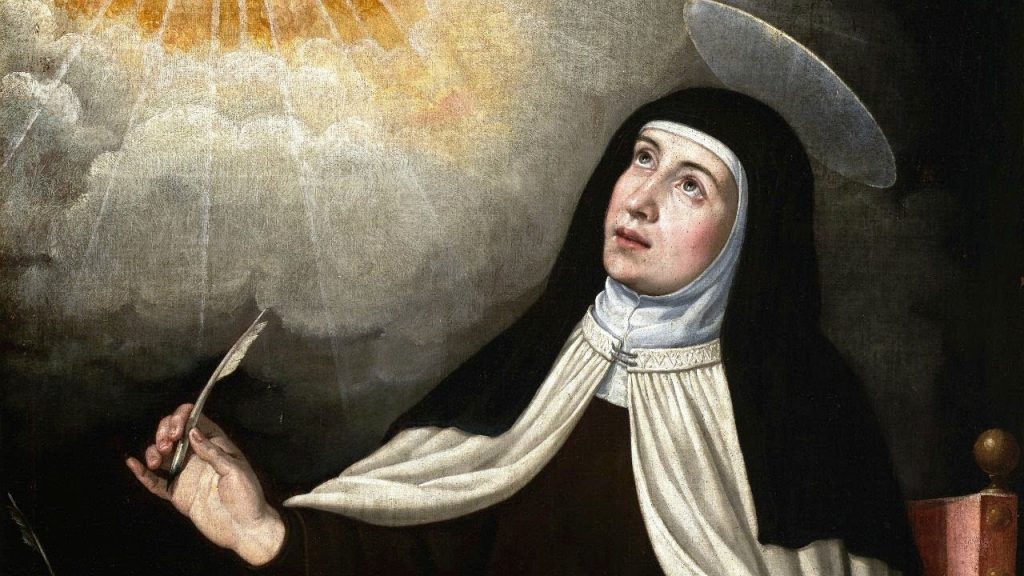
Teresa of Ávila, born Teresa Sánchez de Cepeda y Ahumada, also called Saint Teresa of Jesus (28 March 1515 – 4 or 15 October 1582[a]), was a Spanish noblewoman who felt called to convent life in the Catholic Church. A Carmelite nun, prominent Spanish mystic, religious reformer, author, theologian of the contemplative life and of mental prayer, she earned the rare distinction of being declared a Doctor of the Church, but not until over four centuries after her death.[b] Active during the Catholic Reformation, she reformed the Carmelite Orders of both women and men.[4] The movement she initiated was later joined by the younger Spanish Carmelite friar and mystic John of the Cross. It led eventually to the establishment of the Discalced Carmelites. A formal papal decree adopting the split from the old order was issued in 1580.[5]
Teresa, who had been a social celebrity in her home province, was dogged by early family losses and ill health. In her mature years, she became the central figure of a movement of spiritual and monastic renewal borne out of an inner conviction and honed by ascetic practice. She was also at the center of deep ecclesiastical controversy as she took on the pervasive laxity in her order against the background of the Protestant reformation sweeping over Europe and the Spanish Inquisition asserting church discipline in her home country. The consequences were to last well beyond her life. One papal legate described her as a “restless wanderer, disobedient, and stubborn femina who, under the title of devotion, invented bad doctrines, moving outside the cloister against the rules of the Council of Trent and her prelates; teaching as a master against Saint Paul‘s orders that women should not teach.”[6]
Other associations with Teresa beyond her writings continue to exert a wide influence. A Santero image of the Immaculate Conception of El Viejo, said to have been sent by her with a brother emigrating to Peru, was canonically crowned by Pope John Paul II on 28 December 1989 at the Shrine of El Viejo in Nicaragua.[7] Another Catholic tradition holds that Saint Teresa is personally associated with devotion to the Infant Jesus of Prague, a statue she may have owned.[8] Since her death, her reputation has grown, leading to multiple portrayals. She continues to be widely noted as an inspiration to philosophers, theologians, historians, neurologists, fiction writers and artists, as well as to countless ordinary people interested in Christian spirituality and mysticism.
Forty years after her death, in 1622, Teresa was canonized by Pope Gregory XV. At the time she was considered a candidate for national patron saint of Spain, but this designation was awarded to St. James the Apostle. She has since become one of the patron saints of Spain. However, not until 27 September 1970 did Pope Paul VI proclaim Teresa the first female Doctor of the Church in recognition of her centuries-long spiritual legacy to Catholicism.[9][10]
Early life
Teresa Sánchez de Cepeda y Ahumada was born in 1515 in Ávila, Spain. Her paternal grandfather, Juan Sánchez de Toledo, was a marrano or Converso, a Jew forced to convert to Christianity or emigrate. When Teresa’s father was a child, Juan was condemned by the Spanish Inquisition for allegedly returning to the Jewish faith, but he was later able to assume a Catholic identity.[11] Her father, Alonso Sánchez de Cepeda, was a successful wool merchant and one of the wealthiest men in Ávila. He bought a knighthood and assimilated successfully into Christian society.Teresa of Ávila elopes to travel to Africa by Arnold van Westerhout
Teresa’s mother brought her up as a dedicated Christian. Fascinated by accounts of the lives of the saints, she ran away from home at age seven, with her brother Rodrigo, to seek martyrdom in the fight against the Moors. Her uncle brought them home, when he spotted them just outside the town walls.[13]
When Teresa was eleven years old, her mother died, leaving her grief-stricken. This prompted her to embrace a deeper devotion to the Virgin Mary as her spiritual mother. Teresa was also enamored of popular fiction, which at the time consisted primarily of medieval tales of knighthood and works about fashion, gardens and flowers.[14][15] Teresa was sent to the Augustinian nuns’ school at Ávila.[16]
Entry into religious life
After completing her education, she initially resisted the idea of a religious vocation, but after a stay with her uncle and other relatives, she relented. In 1536, aged 20,[17] much to the disappointment of her pious and austere father, she decided to enter the local easy-going Carmelite Convent of the Incarnation, significantly built on top of land that had been used previously as a burial ground for Jews. She took up religious reading on contemplative prayer, especially Osuna’s Third Spiritual Alphabet (1527). Her zeal for mortification caused her to become ill again and she spent almost a year in bed, causing huge worry to her community and family. She nearly died but she recovered, attributing her recovery to the miraculous intercession of St. Joseph. She began to experience bouts of religious ecstasy.[12]
Foundations of spirituality
Her reading of the medieval mystics, consisted of guides to examination of conscience and spiritual exercises and inner contemplation known in mystical terms as oratio recollectionis or oratio mentalis. She also dipped into other mystical ascetical works such as the Tractatus de oratione et meditatione of Peter of Alcantara.
She reported that, during her illness, she had progressed from the lowest stage of “recollection”, to the “devotions of silence” and even to the “devotions of ecstasy”, which was one of perceived “perfect union with God” (see § Mysticism). During this final stage, she said she frequently experienced the rich “blessing of tears”. As the Catholic distinction between mortal and venial sin became clear to her, she came to understand the awful horror of sin and the inherent nature of original sin. She also became conscious of her own natural impotence in confronting sin and the need for absolute surrender to God.[citation needed]
Around the same time, she received a copy of the full Spanish translation of St. Augustine‘s autobiographical work Confessions, which helped her resolve and to tend to her own bouts of religious scruples. The text helped her realize that holiness was indeed possible and she found solace in the idea that such a great saint was once an inveterate sinner. In her autobiography, she wrote that she ‘was very fond of St. Augustine…for he was a sinner too.’[18]
Around 1556, friends suggested that her newfound knowledge could be of diabolical and not of divine origin. She had begun to inflict mortifications of the flesh upon herself. But her confessor, the JesuitFrancis Borgia, reassured her of the divine inspiration of her thoughts. On St. Peter’s Day in 1559, Teresa became firmly convinced that Jesus Christ had presented Himself to her in bodily form, though invisible. These visions lasted almost uninterruptedly for more than two years. In another vision, a seraph drove the fiery point of a golden lance repeatedly through her heart, causing her an ineffable spiritual and bodily pain:
I saw in his hand a long spear of gold, and at the point there seemed to be a little fire. He appeared to me to be thrusting it at times into my heart, and to pierce my very entrails; when he drew it out, he seemed to draw them out also, and to leave me all on fire with a great love of God. The pain was so great, that it made me moan; and yet so surpassing was the sweetness of this excessive pain, that I could not wish to be rid of it…[c]
The account of this vision was the inspiration for one of Bernini‘s most famous works, the Ecstasy of Saint Teresa at Santa Maria della Vittoria in Rome. Although based in part on Teresa’s description of her mystical transverberation in her autobiography, Bernini’s depiction of the event is considered by some to be highly eroticized, especially when compared to the entire preceding artistic Teresian tradition.[19]
The memory of this episode served as an inspiration throughout the rest of her life, and motivated her lifelong imitation of the life and suffering of Jesus, epitomized in the adage often associated with her: “Lord, either let me suffer or let me die.”[citation needed]
Embarrassment of raptures
Teresa, who became a celebrity in her town dispensing wisdom from behind the convent grille, was also known for her raptures, which sometimes involved levitation. It was a source of embarrassment to her and she bade her sisters hold her down when this occurred. Subsequently, historians, neurologists and psychiatrists like Peter Fenwick and Javier Alvarez-Rodriguez, among others, have taken an interest in her symptomatology. The fact that she wrote down virtually everything that happened to her during her religious life means that an invaluable and exceedingly rare medical record from the 16th century has been preserved. Examination of this record has led to the speculative conclusion that she may have suffered from temporal lobe epilepsy.[20][21]
Monastic reformer
Over time, Teresa found herself increasingly at odds with the spiritual malaise prevailing in her convent of the Incarnation. Among the 150 nuns living there, the observance of cloister, designed to protect and strengthen spiritual practice and prayer, became so lax that it appeared to lose its purpose. The daily invasion of visitors, many of high social and political rank, disturbed the atmosphere with frivolous concerns and vacuous conversation. Such intrusions in the solitude essential to develop and sustain contemplative prayer so grieved Teresa that she longed to intervene.[22]
The incentive to take the practical steps inspired by her inward motivation was supported by the Franciscan priest, Peter of Alcantara, who met her early in 1560 and became her spiritual adviser. She resolved to found a “reformed” Carmelite convent, correcting the laxity which she had found at the Incarnation convent and elsewhere besides. Guimara de Ulloa, a woman of wealth and a friend, supplied the funds for the project.[citation needed]
The abject poverty of the new convent, established in 1562 and named St. Joseph’s (San José), at first caused a scandal among the citizens and authorities of Ávila, and the small house with its chapel was in peril of suppression. However, powerful patrons, including the local bishop, coupled with the impression of well ordered subsistence and purpose, turned animosity into approval.[citation needed]
In March 1563, after Teresa had moved to the new convent house, she received papal sanction for her primary principles of absolute poverty and renunciation of ownership of property, which she proceeded to formulate into a “constitution”. Her plan was the revival of the earlier, stricter monastic rules, supplemented by new regulations including the three disciplines of ceremonial flagellation prescribed for the Divine Office every week, and the discalceation of the religious. For the first five years, Teresa remained in seclusion, mostly engaged in prayer and writing.[citation needed]Church window at the Convent of St Teresa
Extended travels
In 1567, Teresa received a patent from the Carmelite General, Rubeo de Ravenna, to establish further houses of the new order. This process required many visitations and long journeys across nearly all the provinces of Spain. She left a record of the arduous project in her Libro de las Fundaciones. Between 1567 and 1571, reformed convents were established at Medina del Campo, Malagón, Valladolid, Toledo, Pastrana, Salamanca, and Alba de Tormes.
As part of the original patent, Teresa was given permission to set up two houses for men who wished to adopt the reforms. She convinced two Carmelite friars, John of the Cross and Father Anthony of Jesus to help with this. They founded the first monastery of Discalced Carmelite brothers in November 1568 at Duruelo. Another friend of Teresa, Jerónimo Gracián, the Carmelite visitator of the older observance of Andalusia and apostolic commissioner, and later provincial of the Teresian order, gave her powerful support in founding monasteries at Segovia (1571), Beas de Segura (1574), Seville (1575), and Caravaca de la Cruz (Murcia, 1576). Meanwhile, John of the Cross promoted the inner life of the movement through his power as a teacher and preacher.[23]
Opposition to reforms
In 1576, unreformed members of the Carmelite order began to persecute Teresa, her supporters and her reforms. Following a number of resolutions adopted at the general chapter at Piacenza, the governing body of the order forbade all further founding of reformed convents. The general chapter instructed her to go into “voluntary” retirement at one of her institutions.[23] She obeyed and chose St. Joseph’s at Toledo. Meanwhile, her friends and associates were subjected to further attacks.[23]
Several years later, her appeals by letter to King Philip II of Spain secured relief. As a result, in 1579, the cases before the inquisition against her, Father Gracian and others, were dropped.[23] This allowed the reform to resume. An edict from Pope Gregory XIII allowed the appointment of a special provincial for the newer branch of the Carmelite religious, and a royal decree created a “protective” board of four assessors for the reform.[23]
During the last three years of her life, Teresa founded convents at Villanueva de la Jara in northern Andalusia (1580), Palencia (1580), Soria (1581), Burgos, and Granada (1582). In total, seventeen convents, all but one founded by her, and as many men’s monasteries, were owed to her reforms over twenty years.[24]
Last days
Her final illness overtook her on one of her journeys from Burgos to Alba de Tormes. She died in 1582, just as Catholic Europe was making the switch from the Julian to the Gregorian calendar, which required the excision of the dates of 5–14 October from the calendar. She died either before midnight of 4 October or early in the morning of 15 October, which is celebrated as her feast day. According to the liturgical calendar then in use, she died on the 15th in any case. Her last words were: “My Lord, it is time to move on. Well then, may your will be done. O my Lord and my Spouse, the hour that I have longed for has come. It is time to meet one another.”[25]Avila, Saint Theresa’s statue
She was buried at the Convento de la Anunciación in Alba de Tormes. Nine months after her death the coffin was opened and her body was found to be intact but the clothing had rotted. Before the body was re-interred one of her hands was cut off, wrapped in a scarf and sent to Ávila. Father Gracián cut the little finger off the hand and – according to his own account – kept it with him until it was taken by the occupying Ottoman Turks, from whom he had to redeem it with a few rings and 20 reales. The body was exhumed again on 25 November 1585 to be moved to Ávila and found to be incorrupt. An arm was removed and left in Alba de Tormes at the nuns’ request, to compensate for losing the main relic of Teresa, but the rest of the body was reburied in the Discalced Carmelite chapter house in Ávila. The removal was done without the approval of the Duke of Alba de Tormes and he brought the body back in 1586, with Pope Sixtus V ordering that it remain in Alba de Tormes on pain of excommunication. A grander tomb on the original site was raised in 1598 and the body was moved to a new chapel in 1616.
The body still remains there, except for the following parts:
Ronda, Spain – left eye and right hand (the latter was kept by Francisco Franco until his death after Francoist troops captured it from Republican troops during the Spanish Civil War)
Museum of the Church of the Annunciation, Alba de Tormes – left arm and heart
Church of Our Lady of Loreto, Paris, France – one finger
In 1622, forty years after her death, she was canonized by Pope Gregory XV. The Cortes exalted her to patroness of Spain in 1627. The University of Salamanca had granted her the title Doctor ecclesiae (Latin for “Doctor of the Church”) with a diploma in her lifetime,[dubious – discuss] but that title is distinct from the papal honour of Doctor of the Church, which is always conferred posthumously. The latter was finally bestowed upon her by Pope Paul VI on 27 September 1970,[9] along with Saint Catherine of Siena,[26] making them the first women to be awarded the distinction. Teresa is revered as the Doctor of Prayer. The mysticism in her works exerted a formative influence upon many theologians of the following centuries, such as Francis of Sales, Fénelon, and the Port-Royalists. In 1670, her coffin was plated in silver.
The ultimate preoccupation of Teresa’s mystical thought, as consistently reflected in her writings, is the ascent of the soul to God in four stages (see: The Autobiography Chs. 10–22):
The first, Devotion of the Heart, consists of mental prayer and contemplation. It means the withdrawal of the soul from without, penitence and especially the devout meditation on the passion of Christ (Autobiography 11.20).
The second, Devotion of Peace, is where human will is surrendered to God. This occurs by virtue of an uplifted awareness granted by God, while other faculties, such as memory, reason, and imagination, are not yet safe from worldly distraction. Although a partial distraction can happen, due to outer activity such as repetition of prayers or writing down spiritual things, the prevailing state is one of quietude (Autobiography 14.1).
The third, Devotion of Union, concerns the absorption-in-God. It is not only a heightened, but essentially, an ecstatic state. At this level, reason is also surrendered to God, and only the memory and imagination are left to ramble. This state is characterized by a blissful peace, a sweet slumber of at least the higher soul faculties, that is a consciousness of being enraptured by the love of God.
The fourth, Devotion of Ecstasy, is where the consciousness of being in the body disappears. Sensory faculties cease to operate. Memory and imagination also become absorbed in God, as though intoxicated. Body and spirit dwell in the throes of exquisite pain, alternating between a fearful fiery glow, in complete unconscious helplessness, and periods of apparent strangulation. Sometimes such ecstatic transports literally cause the body to be lifted into space.[28] This state may last as long as half an hour and tends to be followed by relaxation of a few hours of swoon-like weakness, attended by the absence of all faculties while in union with God. The subject awakens from this trance state in tears. It may be regarded as the culmination of mystical experience. Indeed, Teresa was said to have been observed levitating during Mass on more than one occasion.[28]
Teresa is regarded as one of the foremost writers on mental prayer, and her position among writers on mystical theology as unique. Her writings on this theme stem from her personal experiences, thereby manifesting considerable insight and analytical gifts. Her definitions have been used in the Catechism of the Catholic Church. Teresa states: “Contemplative prayer (oración mental), in my opinion is nothing other than a close sharing between friends. It means frequently taking time to be alone with Him whom we know loves us.”[29] Throughout her writings, Teresa returns to the image of watering one’s garden as a metaphor for mystical prayer.
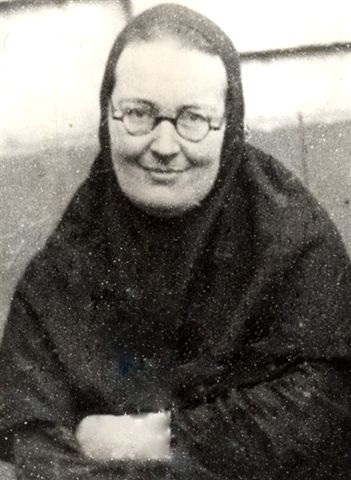
Maria Skobtsova (20 [8 Old Calendar] December 1891 – 31 March 1945), known as Mother Maria (Russian: Мать Мария), Saint Mary (or Mother Maria) of Paris, born Elizaveta Yurievna Pilenko (Елизавета Юрьевна Пиленко), Kuzmina-Karavayeva (Кузьмина-Караваева) by her first marriage, Skobtsova (Скобцова) by her second marriage, was a Russian noblewoman, poet, nun, and member of the French Resistance during World War II. She has been canonized a saint in the Eastern Orthodox Church.
Life
Maria Skobtsova Commemorative Plaque in Saint Petersburg
Born to an aristocratic family in 1891 in Riga, Russian Empire (now Latvia). She was given the name Elizaveta Pilenko.[3] Her father died when she was a teenager, and she embraced atheism. In 1906 her mother moved the family to St. Petersburg, where she became involved in radical intellectual circles. In 1910 she married a Bolshevik by the name of Dmitriy Kuz’min-Karavaev. During this period of her life she was actively involved in literary circles and wrote much poetry. Her first book, Scythian Shards (Скифские черепки), was a collection of poetry from this period. By 1913 her marriage to Dimitriy had ended and the latter subsequently converted to Russian Catholicism and became a Russian Catholic Priest.[4]
Through a look at the humanity of Christ — “He also died. He sweated blood. They struck his face” — she began to be drawn back into Christianity. She moved—now with her daughter, Gaiana—to the south of Russia where her religious devotion increased.
Furious at Leon Trotsky for closing the Socialist-Revolutionary Party Congress, she planned his assassination, but was dissuaded by colleagues, who sent her to Anapa.[5] In 1918, after the Bolshevik Revolution, she was elected deputy mayor of Anapa in Southern Russia. When the anti-communistWhite Army took control of Anapa, the mayor fled and she became mayor of the town. The White Army put her on trial for being a Bolshevik. However, the judge was a former teacher of hers, Daniel Skobtsov, and she was acquitted. Soon the two fell in love and were married.
Soon, the political tide was turning again. In order to avoid danger, Elizaveta, Daniel, Gaiana, and Elizaveta’s mother Sophia fled the country. Elizaveta was pregnant with her second child. They traveled first to Georgia (where her son Yuri was born) and then to Yugoslavia (where her daughter Anastasia was born). Finally they arrived in Paris in 1923. Soon Elizaveta was dedicating herself to theological studies and social work.
In 1926, Anastasia died of influenza. Gaiana was sent away to Belgium to boarding school. Soon, Daniel and Elizaveta’s marriage was falling apart. Yuri ended up living with Daniel, and Elizaveta moved into central Paris to work more directly with those who were most in need.
Her bishop encouraged her to take vows as a nun, something she did only with the assurance that she would not have to live in a monastery, secluded from the world. In 1932, with Daniel Skobtov’s permission, an ecclesiastical divorce was granted, and she took monastic vows. She took the religious name “Maria”. Her confessor was Father Sergei Bulgakov. Later, Fr. Dmitri Klepinin would be sent to be the chaplain of the house.
Mother Maria made a rented house in Paris her “convent”. It was a place with an open door for refugees, the needy and the lonely. It also soon became a center for intellectual and theological discussion. In Mother Maria these two elements — service to the poor and theology — went hand-in-hand.
Death
After the Fall of France in 1940, Jews began approaching the house asking for baptismal certificates, which Father Dimitri would provide them. Many Jews came to stay with them. They provided shelter and helped many to flee the country. Eventually the house was closed down. Mother Maria, Fr. Dimitri, Yuri and Sophia were all arrested by the Gestapo. Fr. Dimitri and Yuri both died at the Dora concentration camp.
Mother Maria was glorified (canonized a saint) by act of the Holy Synod of the Ecumenical Patriarchate on 16 January 2004. The glorification of Mother Maria, together with Fr. Dimitri, Yuri, and Ilya Fondaminsky took place at the Cathedral of Saint Alexander Nevsky in Paris on 1 and 2 May 2004. Their feast day is 20 July. [6]
According to Metropolitan Anthony (Bloom) of Sourozh: “Mother Maria is a saint of our day and for our day; a woman of flesh and blood possessed by the love of God, who stood face to face with the problems of this century.”








_19Jun10.JPG)