“When the sound and wholesome nature of man acts as an entirety, when he feels himself in the world as in a grand, beautiful, worthy and worthwhile whole, when this harmonious comfort affords him a pure, untrammeled delight: then the universe, if it could be sensible of itself, would shout for joy at having attained its goal and wonder at the pinnacle of its own essence and evolution. For what end is served by all the expenditure of suns and planets and moons, of stars and Milky Ways, of comets and nebula, of worlds evolving and passing away, if at last a happy man does not involuntarily rejoice in his existence?”
–Johann Wolfgang von Goethe (August 28, 1749 – March 22, 1832) was a German poet, playwright, novelist, scientist, statesman, theatre director, critic, and amateur artist. Wikipedia
In 1967, Lynn White, Jr.’s seminal article The Historical Roots of Our Ecologic Crisis was published, essentially establishing the academic study of religion and nature. White argues that religions–particularly Western Christianity–are a major cause of worldwide ecological crises. He then asserts that if we are to halt, let alone revert, anthropogenic damages to the environment, we need to radically transform religious cosmologies. White’s hugely influential thesis has been cited thousands of times in a variety of disciplines, including but not limited to religious studies, environmental ethics, history, ecological science, philosophy, psychology, and anthropology.
In practical terms, the ecological crisis to which White was responding has only worsened in the decades since the article was published. This collection of original essays by leading scholars in a variety of interdisciplinary settings, including religion and nature, environmental ethics, animal studies, ecofeminism, restoration ecology, and ecotheology, considers the impact of White’s arguments, offering constructive criticism as well as reflections on the ongoing, ever-changing scholarly debate about the way religion and culture contribute to both environmental crises and to their possible solutions. Religion and Ecological Crisis addresses a wide range of topics related to White’s thesis, including its significance for environmental ethics and philosophy, the response from conservative Christians and evangelicals, its importance for Asian religious traditions, ecofeminist interpretations of the article, and which perspectives might have, ultimately, been left out of his analysis. This book is a timely reflection on the legacy and continuing challenge of White’s influential article.
Gregory Bateson was a philosopher, anthropologist, photographer, naturalist, and poet, as well as the husband and collaborator of Margaret Mead. With a new foreword by his daughter Mary Katherine Bateson, this classic anthology of his major work will continue to delight and inform generations of readers.
“This collection amounts to a retrospective exhibition of a working life. . . . Bateson has come to this position during a career that carried him not only into anthropology, for which he was first trained, but into psychiatry, genetics, and communication theory. . . . He . . . examines the nature of the mind, seeing it not as a nebulous something, somehow lodged somewhere in the body of each man, but as a network of interactions relating the individual with his society and his species and with the universe at large.”—D. W. Harding, New York Review of Books
“[Bateson’s] view of the world, of science, of culture, and of man is vast and challenging. His efforts at synthesis are tantalizingly and cryptically suggestive. . . .This is a book we should all read and ponder.”—Roger Keesing, American Anthropologist
djclay33 “People Get Ready” was a 1965 single by The Impressions, and the title track from the album of the same name. Please appreciate 1965!!! Such a positive songwriter. The single is today the group’s best-known hit, reaching number-three on the Billboard R&B Chart and number 14 on the Billboard Pop Chart. The gospel-influenced track was a Curtis Mayfield composition, and displayed the growing sense of social and political awareness in his writing. People get ready, there’s a train a comin’ You don’t need no baggage, you just get on board All you need is faith to hear the diesels hummin’ Don’t need no ticket, you just thank the Lord People get ready for the train to Jordan It’s picking up passengers from coast to coast Faith is the key, open the doors and board ’em There’s hope for all among those loved the most. There ain’t no room for the hopeless sinner Who would hurt all mankind just to save his own Have pity on those whose chances grow thinner For there’s no hiding place against the Kingdom’s throne So people get ready, there’s a train a comin’ You don’t need no baggage, you just get on board All you need is faith to hear the diesels hummin’ Don’t need no ticket, you just thank the Lord
UMG, AltraModaMusic, Believe Music (on behalf of G Records); PEDL, BMI – Broadcast Music Inc., CMRRA, LatinAutor – Warner Chappell, SOLAR Music Rights Management, Warner Chappell, Sony ATV Publishing, UNIAO BRASILEIRA DE EDITORAS DE MUSICA – UBEM, LatinAutorPerf, LatinAutor – SonyATV, and 6 Music Rights Societies
Embracing cows, or “koe knuffelen” in Dutch, is more than a cute wellness trend. With immense mental health benefits, the practice has growing global appeal.
By BBC Reel
9 October 2020 (bbc.com)
From goat yoga to sound baths, the world is full of wellness trends designed to soothe and calm both body and spirit. Now, a self-care practice hailing from the Netherlands is promising practitioners serenity, and perhaps a smile or two.
Dubbed “koe knuffelen” in Dutch (literally “cow hugging”), the practice is centred on the inherent healing properties of a good human-to-animal snuggle. Cow cuddlers typically start by taking a tour of the farm before resting against one of the cows for two to three hours. The cow’s warmer body temperature, slower heartbeat and mammoth size can make hugging them an incredibly soothing experience, and giving the animal a backrub, reclining against them or even getting licked is all part of the therapeutic encounter.
Cow cuddling is believed to promote positivity and reduce stress by boosting oxytocin in humans, the hormone released in social bonding. The calming effects of curling up with a pet or emotional support animal, it seems, are accentuated when cuddling with larger mammals.
This wholesome pastime emerged in rural Dutch provinces more than a decade ago, and is now part of a wider Dutch movement to bring people closer to nature and country life. Today, farms in Rotterdam, Switzerland and even the United States are offering cow-hugging sessions and promoting the activity’s joy-inducing, stress-busting properties.
The cuddling experience can even be pleasurable for the cattle themselves. A 2007 study in the journal Applied Animal Behaviour Science states that cows show cues of deep relaxation, stretching out and allowing their ears to fall back when massaged in particular areas of their neck and upper back.
It seems that heartfelt bonding with bovines may just be what the doctor ordered.
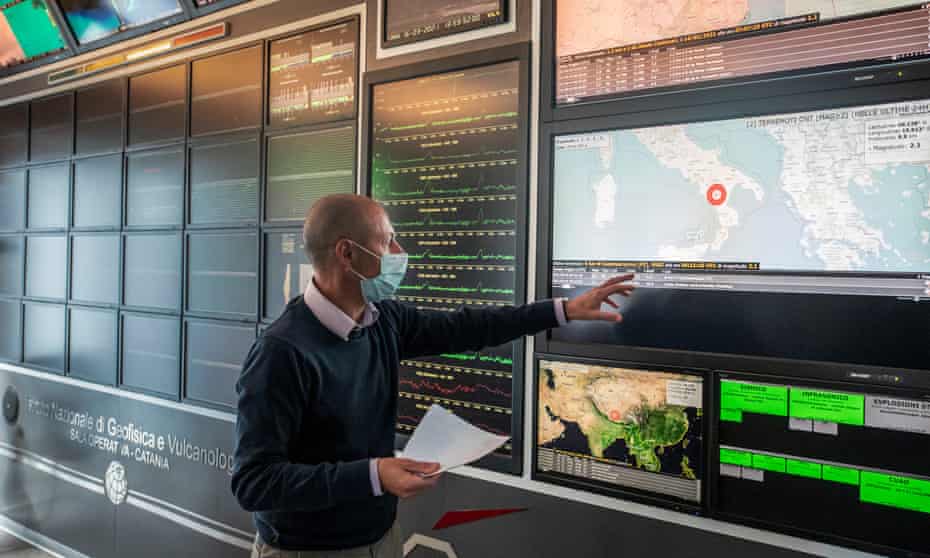
Giuseppe Salerno at Catania’s National Institute of Geophysics and Volcanology (INGV). ‘What is really peculiar is that the volcano is behaving like a machine.’ Photograph: Alessio Mamo
In the city of Catania, at the foot of the volcano, scientists are trying to explain its recent unusual behaviour
by Lorenzo Tondo in Catania 22 Mar 2021 (theguardian.com)
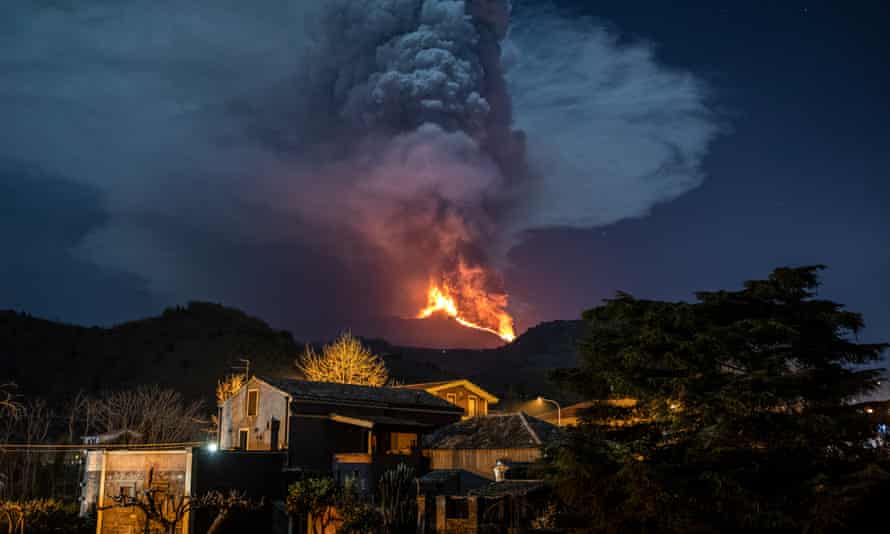
When his phone rang at 3.22am last Wednesday,50-year-old Giuseppe Salerno, the head of volcanologists at Catania’s National Institute of Geophysics and Volcanology (INGV), was already up after a thundering rumble had awoken many of the city’s inhabitants. The call came from the headquarters of the INGV where, a few seconds before that disturbance, seismic waves on one of the 40 monitors in the operations room seemed to jump off the screen. For the 14th time in less than a month, Mount Etna had sent another reminder that it is one of the world’s most active volcanoes.
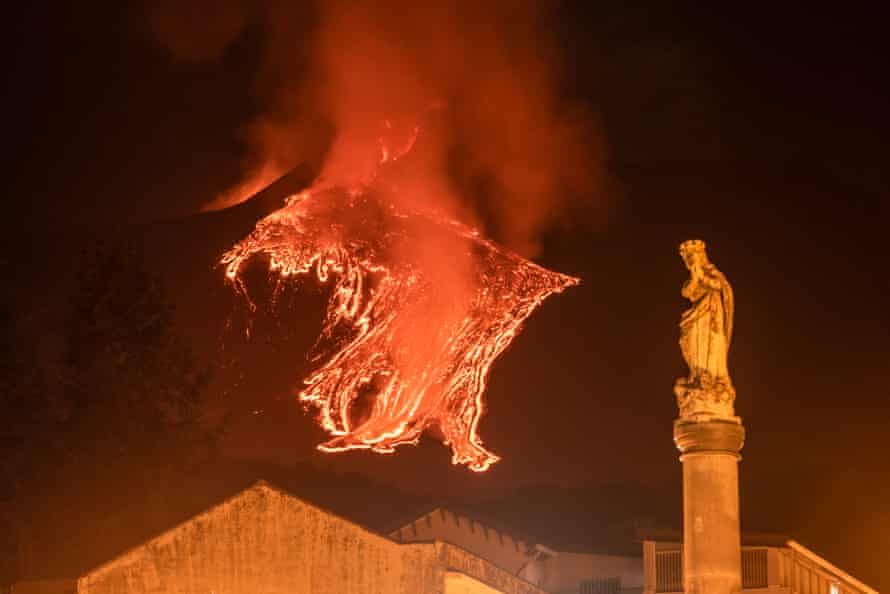
A statue of Virgin Mary near the main church in Milo, a village not far from the top of Etna, with the lava flow of an eruption in the background. Photograph: Alessio Mamo
For three days the Guardian had access to the rooms of the INGV in the Piazza Roma, Catania, where day and night 100 Italian scientists monitor Etna’s movements in an attempt to explain these recent phenomena.
“The recent activity is part of a so-called lava fountaining that is among Etna’s normal activities,” says Salerno, a former PhD researcher at Cambridge University’s department of geography. “What is really peculiar is that the volcano is behaving like a machine, with rhythms that have almost a mathematical precision. This is why we’ve been monitoring its every breath, rumble and quiver in recent months.”
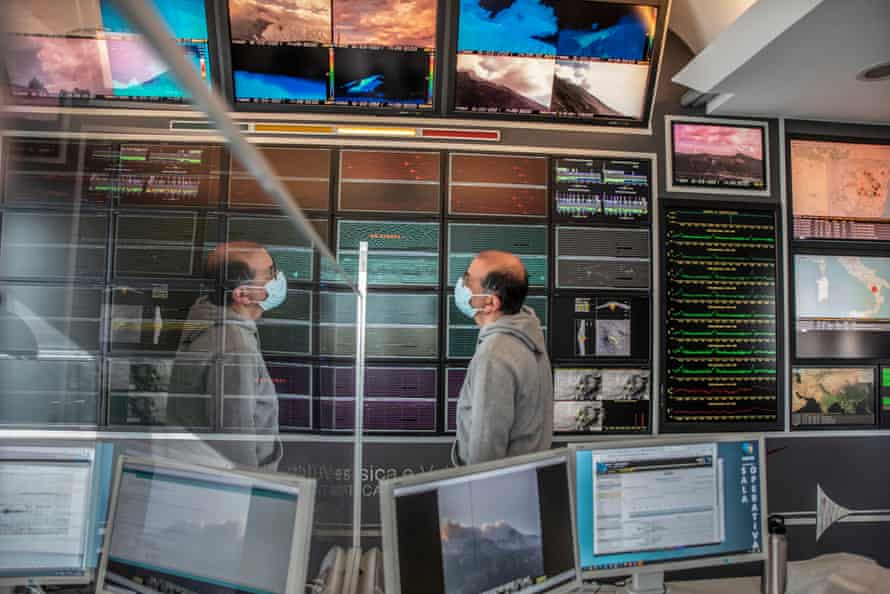
The operations room at the volcanology institute in Catania. Photograph: Alessio Mamo
The information recorded by the 150 monitoring stations located over the 460 sq miles of the volcano, including heat-sensor cameras, gas emission detectors and seismographs, is sent in real time to the control room and broadcast on dozens of monitors, which give the impression of a war room in a spy movie.
“You have to imagine this control room like a hospital,” adds Salerno, “with dozens of doctors working for the same patient: Etna, who in recent weeks has been manifesting peculiar symptoms. From here we can monitor its heartbeat with the seismographs or its breathing with the gas detectors.”
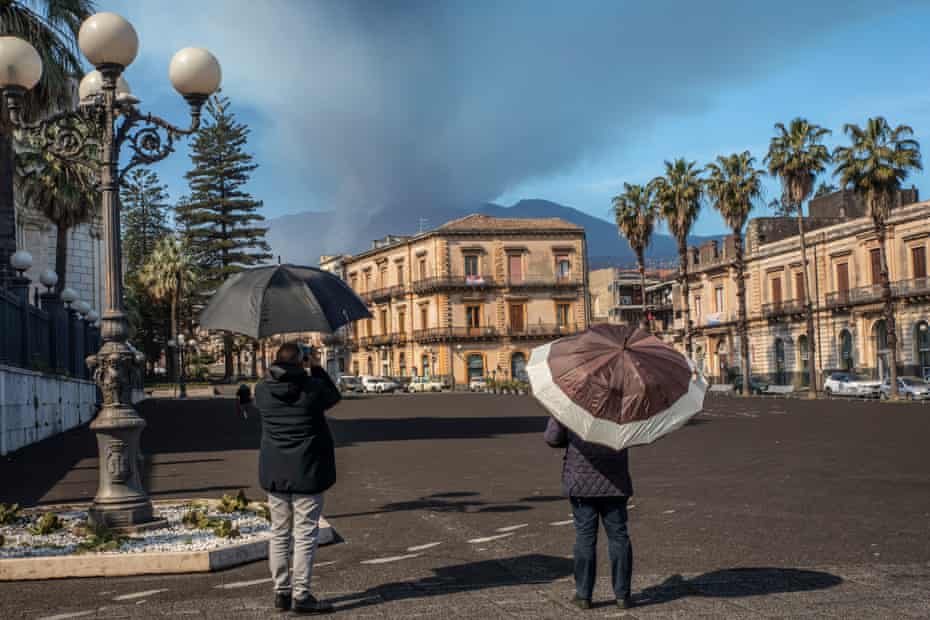
The recent eruptions have provoked some distress for people living on the volcano, with ash rains that have blanketed streets, squares and buildings. In recent weeks in the town of Giarre alone more than 12,000 tonnes of ash have fallen. “It’s an extremely dramatic situation, an emergency, says Alfio Previter, a council official. Salerno said: “We’re literally buried, and if this keeps up, many towns will go bankrupt in their attempt to remove the ash, which could cost hundreds of thousands of euros.”
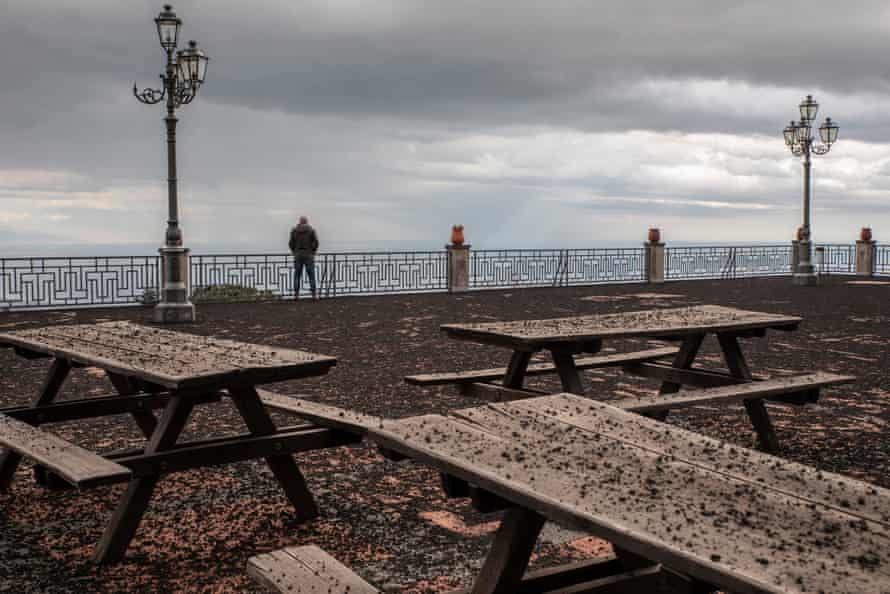
People in the town of Giarre use umbrellas as protection against volcanic ash. Photograph: Alessio MamoVolcanic sand covers a square in Milo, one of the villages most affected by the fall of ash from Etna. Photograph: Alessio Mamo
According to Italian law, ash collected from the streets and squares, and mixed with other forms of urban waste, is considered a special refuse, which increases the cost of its disposal. Proper disposal of a cubic metre of volcanic ash costs about €20 (£17).
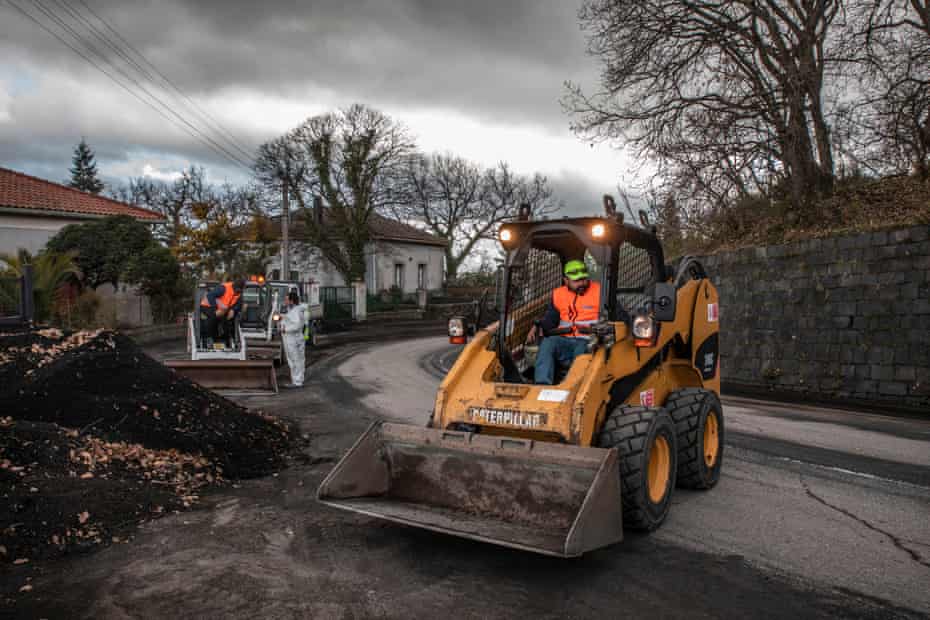
Workers near the village of Zafferana Etnea clean volcanic sand from the main streets. Photograph: Alessio Mamo
However, Salerno, whose career has taken him to Kīlauea in Hawaii and the volcanoes of Central America, explains that the key to unlocking the mystery of Etna’s unusually spectacular eruptions is precisely the volcano’s ash.
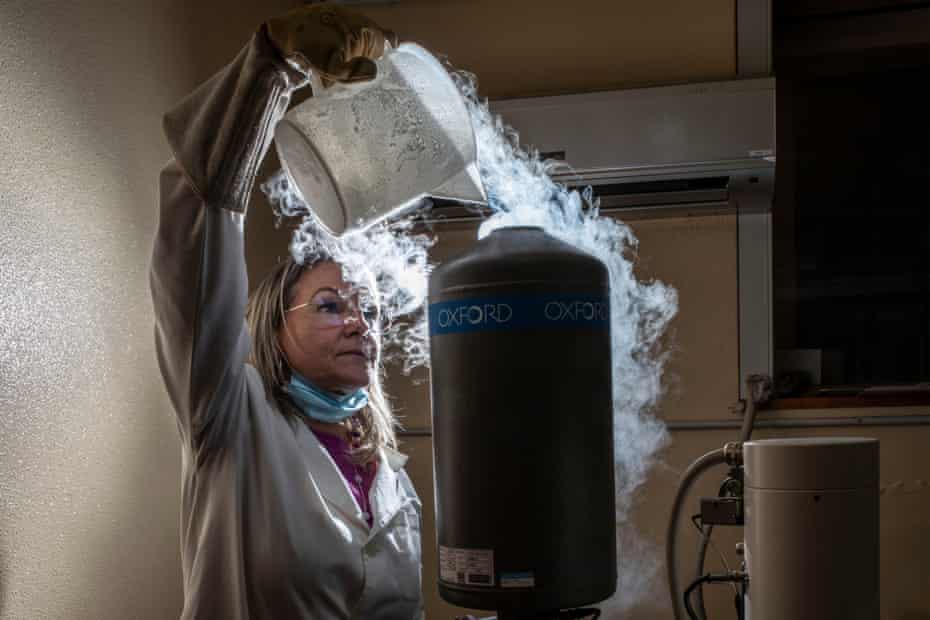
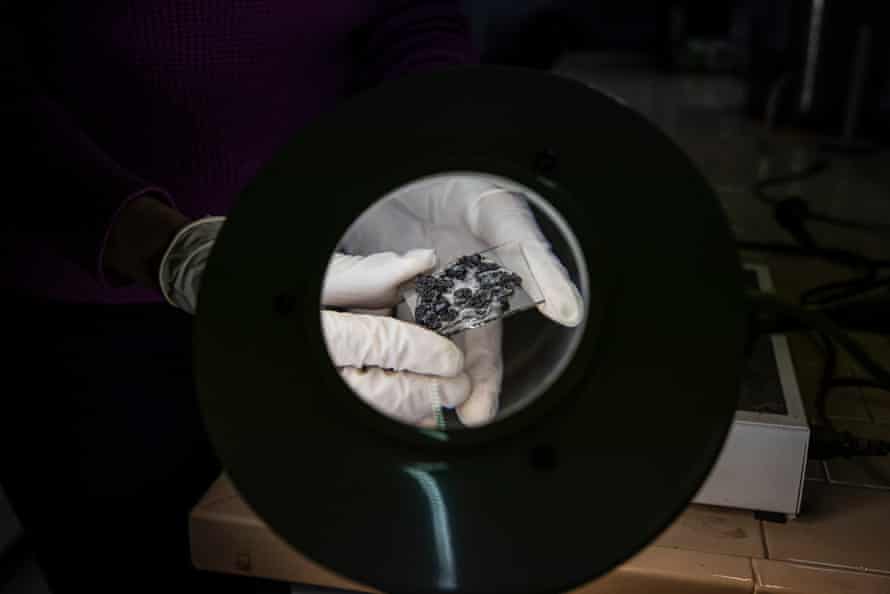
In an underground laboratory of the INGV, Lucia Miraglia, 53, a geologist and volcanologist who has studied Etna’s ash under a microscope for the past 20 years, recently made a revealing discovery: “Studying the ash that’s fallen in recent days, we noticed that it reflects what volcanologists call ‘primitive magma’; that is, a magma that comes from the bowels of the mountain and carries a greater charge of gas, which is the reason why we are seeing these strikingly tall lava fountains. This sort of fresh magma has been seen before, but what’s peculiar is that the magma that Etna has been spewing since 16 February is the most primitive I’ve studied in the last 20 years.”
Lucia Miraglia pours liquid nitrogen into a scanning electron microscope in a laboratory at the volcanology institute in Catania. Photograph: Alessio MamoLava samples mounted on a slide for microscope measurements at the volcanology institute. Photograph: Alessio Mamo
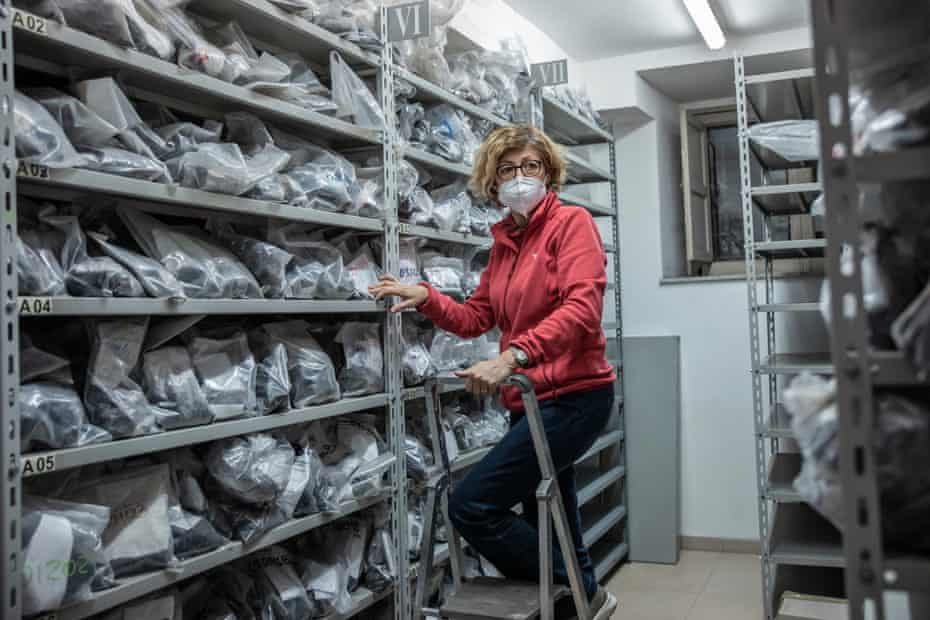
Etna’s magma originates from several reservoirs located miles underground. Experts at the INGV estimate that Etna’s main reservoir, and also its largest, is 12km (7.5 miles) underground. The Sicilian geophysicist Rosanna Corsaro, who studies Etna’s core from INGV headquarters, says: “The magma that’s been surfacing in these recent eruptions seems to come from about 10km underground.”
Recently, Etna has been going through a period in which there is a very efficient transfer of magma from deep beneath the surface. The south-east crater – which has been spewing lava in recent weeks – has until now been functioning as a safety valve. Other scenarios cannot be excluded, however. “Sometimes primitive magma eruptions are lateral: that is, when fractures appear on the side of the volcano and give rise to this sort of activity,” says Corsaro. “It could be that at a certain point this valve may no longer function efficiently. In that case, if the primitive magma continues to rise to the surface, a lateral opening could form.”
Rosanna Corsaro in the ‘petroteca’, a room storing old volcanic rock samples from Etna at the volcanology institute. Photograph: Alessio MamoLava samples melted and transformed into glass discs for X-ray fluorescence analysis. Photograph: Alessio Mamo
Such “flank eruptions” are the ones volcanologists most fear, as lava flows down the sides of the volcano, opening fractures on the low-lying mountains that risk inundating the cities below.
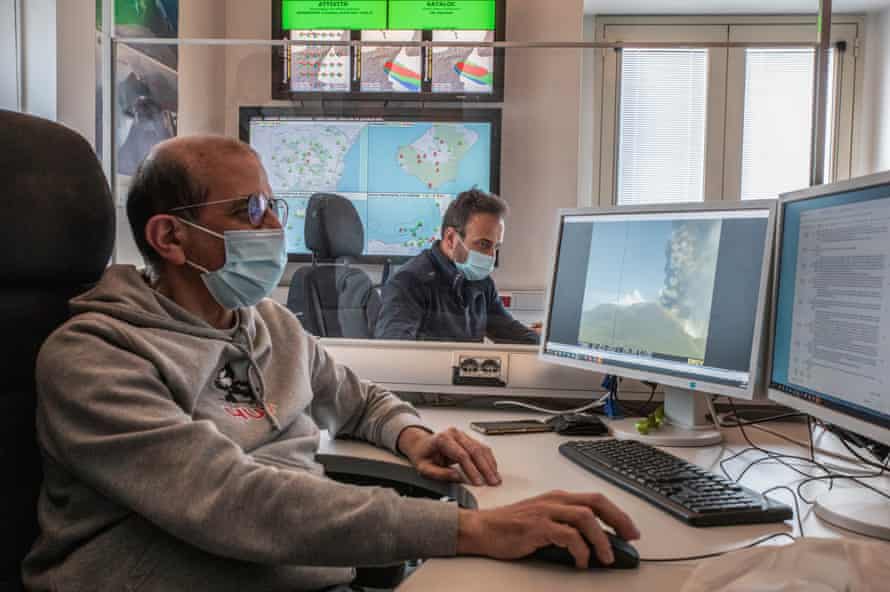
Roberto Maugeri, an operations room technologist in charge of monitoring the volcano’s activities. Photograph: Alession Mamo/The Guardian
Etna’s eruption seen from the village of Monterosso. Photograph: Alessio Mamo
“At this time, the volcano’s recent activity doesn’t suggest that there will be a flank eruption,” says Stefano Branca, the director of the INGV in Catania. “It is clear, however, that Etna is no stranger to lateral eruptions. It’s not a matter of risk: lateral eruptions will happen at some point in the future.
The Chicago suburb’s City Council voted 8-1 to distribute $400,000 to eligible black households.
March 23, 2021, 4:11 AM PDT / Source: Associated PressBy The Associated Press (nbcnews.com)
EVANSTON, Ill. — Evanston, Illinois, on Monday became the first U.S. city to make reparations available to its Black residents for past discrimination and the lingering effects of slavery.
The Chicago suburb’s City Council voted 8-1 to distribute $400,000 to eligible black households. Each qualifying household would receive $25,000 for home repairs or down payments on property.
The program is being funded through donations and revenue from a 3% tax on the sale of recreational marijuana. The city has pledged to distribute $10 million over 10 years.
Qualifying residents must either have lived in or been a direct descendant of a Black person who lived in Evanston between 1919 to 1969 and who suffered discrimination in housing because of city ordinances, policies or practices.
Alderman Rue Simmons, who proposed the program that was adopted in 2019, said pro-reparations groups have offered pro-bono legal assistance if the program is challenged in court.
“This is set aside for an injured community that happens to be Black, that was injured by the city of Evanston for anti-Black housing policies,” Simmons said.
The City Council acted after dozens of citizens addressed the body and the plan received some pushback from several.
Alderman Cicely Fleming, the lone vote against the plan, said she supports reparations, but what the City Council was debating is a housing plan that is being called reparations. She said the people should dictate the terms of how their grievances are repaired. Fleming described the program as paternalistic, and it assumes Black people can’t manage their own money.
Hundreds of communities and organizations across the country are considering providing reparations to Black people. They range from the state of California to cities like Amherst, Massachusetts, Providence, Rhode Island, Asheville, North Carolina, and Iowa City, Iowa; religious denominations like the Episcopal Church; and prominent colleges like Georgetown University in Washington.
The efforts, some of which have been underway for years, have gained momentum in the wake of the Minneapolis police killing of George Floyd last May. President Joe Biden has even expressed support for creating a federal commission to study Black reparations, a proposal that’s languished for decades in Congress.
http://www.ted.com We have no ways to directly observe molecules and what they do — Drew Berry wants to change that. At TEDxSydney he shows his scientifically accurate (and entertaining!) animations that help researchers see unseeable processes within our own cells.