He Created the Web. Now He’s Out to Remake the Digital World.

Tim Berners-Lee wants to put people in control of their personal data. He has technology and a start-up pursuing that goal. Can he succeed?

Tim Berners-Lee, at home in Oxfordshire, England, envisions a framework in which personal online data could be stored in a “pod” that the person controlled.
Tim Berners-Lee, at home in Oxfordshire, England, envisions a framework in which personal online data could be stored in a “pod” that the person controlled.Credit…Lola and Pani for The New York Times
Steve Lohr

By Steve Lohr

  • Jan. 10, 2021 (NYTimes.com)

Three decades ago, Tim Berners-Lee devised simple yet powerful standards for locating, linking and presenting multimedia documents online. He set them free into the world, unleashing the World Wide Web.

Others became internet billionaires, while Mr. Berners-Lee became the steward of the technical norms intended to help the web flourish as an egalitarian tool of connection and information sharing.

But now, Mr. Berners-Lee, 65, believes the online world has gone astray. Too much power and too much personal data, he says, reside with the tech giants like Google and Facebook — “silos” is the generic term he favors, instead of referring to the companies by name. Fueled by vast troves of data, he says, they have become surveillance platforms and gatekeepers of innovation.

Regulators have voiced similar complaints. The big tech companies are facing tougher privacy rules in Europe and some American states, led by California. Google and Facebook have been hit with antitrust suits.

But Mr. Berners-Lee is taking a different approach: His answer to the problem is technology that gives individuals more power.

The goal, he said, is to move toward “the web that I originally wanted.”

“Pods,” personal online data stores, are a key technical ingredient to achieve that goal. The idea is that each person could control his or her own data — websites visited, credit card purchases, workout routines, music streamed — in an individual data safe, typically a sliver of server space.

Companies could gain access to a person’s data, with permission, through a secure link for a specific task like processing a loan application or delivering a personalized ad. They could link to and use personal information selectively, but not store it.

Mr. Berners-Lee’s vision of personal data sovereignty stands in sharp contrast to the harvest-and-hoard model of the big tech companies. But it has some echoes of the original web formula — a set of technology standards that developers can use to write programs and that entrepreneurs and companies can use to build businesses. He began an open-source software project, Solid, and later founded a company, Inrupt, with John Bruce, a veteran of five previous start-ups, to kick-start adoption.

“This is about making markets,” said Mr. Berners-Lee, who is Inrupt’s chief technology officer.

Inrupt introduced in November its server software for enterprises and government agencies. And the start-up is getting a handful of pilot projects underway in earnest this year, including ones with Britain’s National Health Service and with the government of Flanders, the Dutch-speaking region of Belgium.

Inrupt’s initial business model is to charge licensing fees for its commercial software, which uses the Solid open-source technology but has enhanced security, management and developer tools. The Boston-based company has raised about $20 million in venture funding.

Start-ups, Mr. Berners-Lee noted, can play a crucial role in accelerating the adoption of a new technology. The web, he said, really took off after Netscape introduced web-browsing software and Red Hat brought Linux, the open-source operating system, into corporate data centers.

The world’s first web page as it appeared in 1992, a year after it was created. Mr. Berners-Lee is trying to pull the online world back toward its egalitarian roots. 
The world’s first web page as it appeared in 1992, a year after it was created. Mr. Berners-Lee is trying to pull the online world back toward its egalitarian roots. Credit…Fabrice Coffrini/Agence France-Presse — Getty Images

Over the years, companies focused on protecting users’ privacy online have come and gone. The software of these “infomediaries” was often limited and clunky, appealing only to the most privacy conscious.

But the technology has become faster and smarter — and pressure on the big tech companies is mounting.

Tech companies have formed a Data Transfer Project, committing to make personal data they hold portable. It now comprises Google, Facebook, Apple, Microsoft and Twitter. The Federal Trade Commission recently held a “Data to Go” workshop.Business & Economy

“In this changed regulatory setting, there is a market opportunity for Tim Berners-Lee’s firm and others to offer individuals better ways to control their data,” said Peter Swire, a privacy expert at the Georgia Tech Scheller College of Business.

Inrupt is betting that trusted organizations will initially be the sponsors of pods. The pods are free for users. If the concept takes off, low-cost or free personal data services — similar to today’s email services — could emerge.

The National Health Service has been working with Inrupt on a pilot project for the care of dementia patients that moves from development into the field this month. The early goal is to give caregivers access to a broader view of patients’ health, needs and preferences.

Each patient has a Solid pod with an “All About Me” form with information submitted by the patient or an authorized relative, supplementing the person’s electronic health record. The pod might list that the patient needs help for daily tasks like getting out of bed, tying shoelaces or going to the bathroom. It might also include what soothes the patient when agitated — perhaps country music or classic old movies. Later, activity data from an Apple Watch or Fitbit could be added.

The medical goal, said Scott Watson, technical director on the pilot project, is improved health and better care that are less stressful for the patient. “And it’s a fundamental change in how we share information in health care systems,” he said.

The initial project will begin with up to 50 patients in the Manchester region and be evaluated in a few months.

In Flanders, a region of more than six million people, the government hopes the new data technology can nurture opportunities for local entrepreneurs and companies and new services for citizens. Personal data in pods can be linked with public and private data to create new applications, said Raf Buyle, an information architect for the Flanders government.

One potential app, Mr. Buyle said, might suggest routes and modes of travel for work commutes, once Covid-19 restrictions are lifted. Such an app, he said, could combine location data from a person’s smartphone, with preferences for exercise and reducing the carbon footprint, and weather and public transport schedules and bike or scooter rental pickup sites.

“Most of the cool use cases will come from companies building new apps on top of the data,” Mr. Buyle said.ImageAs a young engineer at CERN outside Geneva, Mr. Berners-Lee developed the protocols for what would become the web as we know it.Credit…Fabrice Coffrini/Agence France-Presse — Getty Images

For Mr. Berners-Lee, the Solid-Inrupt venture is a fix-it project. He has spent his career championing information sharing, openness and personal empowerment online — as director of the World Wide Web Consortium, president of the Open Data Institute, and an academic at the Massachusetts Institute of Technology and Oxford University. His accolades include a Turing Award, often called the Nobel Prize of computer science. In his native England, he is a knight — Sir Tim.

“But Tim has become increasingly concerned as power in the digital world is weighted against the individual,” said Daniel Weitzner, a principal research scientist at the M.I.T. Computer Science and Artificial Intelligence Laboratory. “That shift is what Solid and Inrupt are meant to correct.”

The push to give individuals greater control over their data, Mr. Berners-Lee said, often begins as a privacy issue. But a new deal on data, he said, will require entrepreneurs, engineers and investors to see opportunities for new products and services, just as they did with the web.

The long view is a thriving decentralized marketplace, fueled by personal empowerment and collaboration, Mr. Berners-Lee said. “The end vision is very powerful,” he said.

Whether his team can realize that vision is uncertain. Some in the field of personal data say the Solid-Inrupt technology is too academic for mainstream developers. They also question whether the technology will achieve the speed and power needed to become a platform for future apps, like software assistants animated by a person’s data.

“No one will argue with the direction,” said Liam Broza, a founder of LifeScope, an open-source data project. “He’s on the right side of history. But is what he’s doing really going to work?”

Others say the Solid-Inrupt technology is only part of the answer. “There is lots of work outside Tim Berners-Lee’s project that will be vital to the vision,” said Kaliya Young, co-chair of the Internet Identity Workshop, whose members focus on digital identity.

Mr. Berners-Lee said that his team was not inventing its own identity system, and that anything that worked could plug into its technology.

Inrupt faces a series of technical challenges, but none that are “go-to-the-moon hard,” said Bruce Schneier, a well-known computer security and privacy expert, who has joined Inrupt as its chief of security architecture.

And Mr. Schneier is an optimist. “This technology could unlock an enormous amount of innovation,” potentially becoming a new platform as the iPhone was for smartphone apps, he said.

“I think this stands a good chance of changing how the internet works,” he said. “Oddly, Tim has done it before.”
CAN WE TAME THE WILD WEST OF BIG TECH MEDIA?

To Retain the Promise and Decrease the Danger of the Internet, the Federal Government Needs to Rebuild Our Digital Infrastructure—Starting With Revoking Section 230

Can We Tame the Wild West of Big Tech Media? | Zocalo Public Square • Arizona State University • Smithsonian

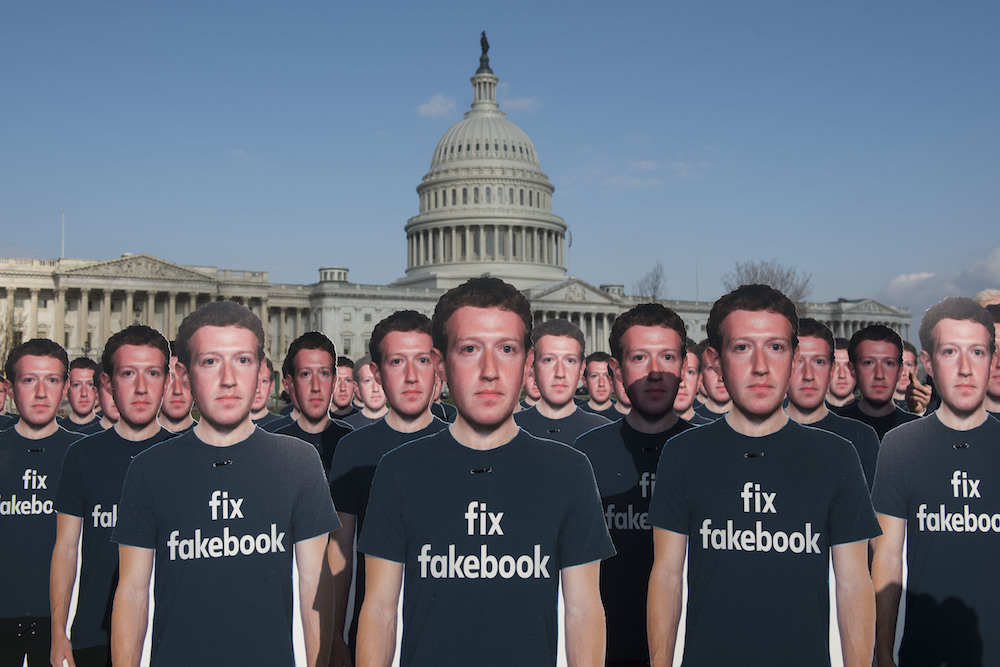
100 cardboard cutouts of Mark Zuckerberg stood outside the U.S. Capitol while Zuckerberg prepared to testify before the Senate on Tuesday, April 10, 2018. Courtesy of Kevin Wolf/AP images for AVAAZ.

by STEVEN HILL | JANUARY 25, 2021 (zocalopublicsquare.org)

Why do so many people, including both former President Donald Trump and new President Joe Biden, keep talking about getting rid of an obscure law called Section 230?

The short answer is that Section 230, part of the Communications Decency Act of 1996, is the legal underpinning for one of the largest and most consequential experiments in American history.

Since the birth of Big Tech Media 15 years ago—let’s drop the friendly-sounding misnomer “social” media—our nearly 250-year-old republic has become a test case. Can a nation’s news and information infrastructure, the lifeblood of any democracy, be dependent on digital media technologies that allow a global free speech zone of unlimited audience size, combined with algorithmic (non-human) curation of massive volumes of disinformation that can be spread with unprecedented ease?

This experiment has been possible because Section 230 grants Big Tech Media immunity from responsibility for the mass content that is published and broadcast across their platforms. A mere 26 words in the bipartisan law were originally intended to protect “interactive computer services” from being sued over what their users post, just like telephone companies can’t be sued over any gossip told by Aunt Mabel to every busybody in town.

But as Facebook, Google, Twitter, and other services scaled over time to an unimaginable size, the platforms’ lack of human editors has resulted in a gushing firehose of mis- and disinformation where scandals and conspiracies are prioritized over real news for mass distribution. Facebook alone sees more than 100 billion pieces of content posted each day, a deluge that its small corps of human monitors cannot realistically contain.

As the gripping videos and photos of a pro-Trump mob storming the Capitol make clear, this experiment has veered frighteningly off course. The protesters earnestly believed that they were trying to stop a stolen election, having been fed this false information by their political leaders for over two months since the November 3 election. Millions of people are now living inside their own “disinformation ghettos” where they do not hear contrary viewpoints. So, President Biden has called for ending Section 230 immunity in order to stop the Frankenstein’s monster this law helped create.

Facebook is no longer simply a “social networking” website—it is the largest media giant in the history of the world, a combination publisher and broadcaster, with approximately 2.6 billion regular users, and billions more on the Facebook-owned WhatsApp and Instagram. One study found that 104 pieces of COVID-19 misinformation on Facebook were shared 1.7 million times and had 117 million views. That’s far more than the number of daily viewers on the Wall Street JournalNew York TimesUSA Today, ABC News, Fox News, CNN, and other major networks combined.

Traditional news organizations are subject to certain laws and regulations, including a degree of liability over what they broadcast. While there is much to criticize about mainstream media, at least they use humans to pick and choose what’s in and out of the newsstream. That results in a degree of accountability, including legal liability.

But Facebook-Google-Twitter’s robot algorithm curators are on automatic pilot, much like killer drones for which no human bears responsibility or liability. Non-human curation, when combined with unlimited audience size and frictionless amplification, has clearly failed as a foundation for our democracy’s media infrastructure.

So, it is time to hit reset in a major way, not only to save our republic, but also to provide the best chance to redesign these digital media technologies so that we can retain their promise and decrease their dangers.Non-human curation, when combined with unlimited audience size and frictionless amplification, has clearly failed as a foundation for our democracy’s media infrastructure.

Revoking Section 230 by an act of Congress would be a good start. That’s not a perfect solution, but it would make Big Tech Media more responsible, deliberative, and potentially liable for the worst of its toxic content, including illegal content (like child pornography), especially when their algorithms automatically amplify such content.

But there is also a great deal of reckless online content that would likely not be impacted by 230’s revocation. For example, Trump’s posts on Twitter and Facebook claiming the presidential election was stolen, and his inflammatory speech that YouTube broadcast the morning of the Capitol attack, were false and provocative—but it would be difficult to legally prove that any individuals or institutions were harmed or incited directly by the president’s many outrageous statements. Any number of traditional media outlets also have published untrue nonsense without the protections of Section 230, yet they were never held liable.

The revocation of Section 230 also wouldn’t have stopped the use of Big Tech Media for disinformation campaigns that undermined elections in more than 70 countries, even helping to elect a quasi-dictator in the Philippines; or for widely amplifying and even livestreaming child abusers, pornographers and the Christchurch mass murderer of Muslims, who broadcast his carnage over Facebook (a video then seen on YouTube by millions). And losing Section 230 immunity wouldn’t impact the fact that a majority of YouTube climate change videos denies the science, and 70 percent of what YouTube’s 2 billion users watch comes from its recommendation algorithm.

So revoking Section 230 likely would not be as impactful as its proponents wish, or its critics fear. What needs to be done instead?

The federal government must intervene to change the way Big Tech Media operates. Facebook-Google-Twitter’s “engagement algorithms” recommend and amplify sensationalized, conspiracy-ridden user content for one reason—to maximize profits by increasing users’ screen time and exposure to more ads. In fact, the Wall Street Journal reported that Facebook executives scaled back a successful effort to make the site less divisive when they found that it was decreasing their audience share. Recently implemented warning labels are weak substitutes for actual curation. These greedy companies have purposely weaponized their platforms, and enabled the dividing, distracting, and outraging of people to the point where society is now plagued by a fractured basis for shared truths, sensemaking, and common ground.

In the face of such practices, our government must impose a whole new business model on these corporations—just as the United States did, in years past, with telephone, railroad, and power companies.

The government should treat these companies more like investor-owned utilities, which would be guided by a digital license. Just like traditional brick-and-mortar companies must apply for various licenses and permits, the digital license would define the rules and regulations of the business model (Mark Zuckerberg himself has suggested such an approach).

To begin with, such a license would require platforms to obtain users’ permission before collecting anyone’s personal data—i.e., opt-in rather than opt-out. When you signed up for a Facebook account, you probably didn’t imagine that 10 or 15 years on, you were unknowingly agreeing to allow the company to suck up your private data or track your physical locations, or mass collect every “like,” “share,” and “follow” into a psychographic profile that can be used by advertisers and political operatives to target you. Facebook and its fellow outlets started this data grab secretly, forging their destructive brand of “surveillance capitalism.” Now that we know, should society continue to allow this?

The new model also should encourage more competition by limiting the mega-scale audience size of these media machines; nearly 250 million Americans, about 80 percent of the population, have a profile on one of these platforms. Smaller user pools could be accomplished either through an anti-trust breakup of the companies, or through incentives to shift to a revenue model based more on monthly subscribers rather than on hyper-targeted advertising, which would cause a decline in users. The utility model also should restrain the use of specific engagement techniques, such as hyper-targeting of content, automated recommendations, and addictive behavioral nudges (like autoplay and pop-up screens).

We also should update existing laws to ensure they apply to the online world. Google’s YouTube/YouTube Kids have been violating the Children’s Television Act—which restricts violence and advertising—for many years, resulting in online lawlessness that the Federal Communications Commission should examine. Similarly, the Federal Elections Commission should rein in the quasi-lawless world of online political ads and donor reporting, which has far fewer rules and less transparency than ads in TV and radio broadcasting.

Like many other people, I have benefited from the internet and its revolution in communications. These businesses are creating the new infrastructure of the digital age, including search engines; global portals for news and networking; web-based movies, music, and live streaming; GPS-based navigation apps; online commercial marketplaces; and digital labor market platforms—services and technologies that are being interwoven into the very fabric of our societies.

I believe we can retain what is good about the internet without the toxicities. Like the promise of the internet itself, Facebook-Google-Twitter started out small, and then blew up into monopolistic giants that have established their own greedy and destructive rules that threaten our democracy. It is crucial that regulation evolves in order to shape this new digital infrastructure—and the future of our societies—in the right way.

STEVEN HILLis the former policy director at the Center for Humane Technology and author of seven books, including Raw Deal: How the Uber Economy and Runaway Capitalism Are Screwing American Workers and The Startup Illusion: How the Internet Economy Threatens Our Welfare.

The Coronavirus Update

(image) WIRED Coronavirus Update Logo

01.25.21 (wired.com)

Biden restricts travel, Moderna reports findings on virus variants, and Google bolsters vaccination efforts. Here’s what you should know:

Biden will reimpose international travel restrictions to curb the spread of new variants

President Biden plans to reimpose travel restrictions for non-US citizens trying to enter the country during the pandemic, in an attempt to limit the spread of the virus, particularly new variants. Most travelers from the UK, Ireland, Brazil, and the 26 countries in Europe’s Schengen Area will be banned starting today, and those from South Africa starting Saturday. Additionally, the CDC has said it will require travelers flying into the US to have negative test results before boarding the plane beginning Tuesday.

Moderna finds that its vaccine protects against virus variants

A new study by Moderna and the Vaccine Research Center at the NIAID has found that its vaccine is effective against the new virus variants from Britain and South Africa. The British variant had no effect on antibody levels, and though the South African mutation did, antibody levels were still high enough to be protective. Because of this, Moderna is developing a version of the vaccine aimed at the South African variant that can also be used as a booster shot a year after people receive their original two doses.

Google steps up to help with vaccination efforts

Google announced today that it will open up its facilities to be used as Covid-19 vaccination sites in Los Angeles, the Bay Area, a Seattle suburb, and New York City if that becomes necessary. They’ll be partnering with membership-based medical company One Medical, but Google says the sites will be open to anyone eligible for a vaccine according to state and local guidelines. In addition, vaccine distribution information and vaccination sites will start appearing on Google Search and Maps, and the company will donate $150 million to vaccine education efforts.

Full Moon in Leo – What about the Heart?

by Astro Butterfly (astrobutterfly.com)

On January 28th, 2021 we have a Full Moon at 9° Leo. The Full Moon is opposite the Sun/Saturn/Jupiter conjunction in Aquarius and square Mars and Uranus in Taurus – forming an intense Fixed T-square.

Fixed T-squares are high on energy, VERY motivated but also confrontational and uncompromising. Something has to give.

The Full Moon is a culmination of the energies that have been planted at the New Moon in Capricorn, on January 14th, 2021.

The Full Moon represents the missing counterbalancing perspective we need to be whole. Since we are in the Aquarius season, the Full Moon can only occur in the opposite sign, Leo.

As you may already know, the Aquarius energy is here to stay – and to make the best out of it, we must also embrace the energy of Leo.

Full Moon In Leo – The Tinman Wants A Heart

If you are familiar with the Wizard of Oz, you know the Tinman. The Tinman, made of tin, a symbol for the sign of Aquarius, desperately wanted a heart (a symbol for Aquarius’ opposite sign, Leo).

To feel whole, we always need the qualities of the opposite sign.

When the Wizard of Oz gave him his heart back, he told the Tinman something very profound: “A heart is not judged by how much you love; but by how much you are loved by others.”

The quote is a beautiful metaphor for Aquarius’ highest expression.

Aquarius without a heart is either the ruthless, rational energy that takes action without taking people into account (the investment banker that lays off people for extra profit, the spouse who asks for divorce via SMS) OR the fantasy-driven idealist that fights for causes no one cares about.

But when Aquarius taps into Leo’s energy and understands the motivations of the heart, this is when we get the driven, forward-looking, humanitarian Aquarius that really cares about the mission AND the people.

The Sabian symbol of the Full Moon in Leo is “Early morning dew sparkles, as sunlight floods the field”.

The rising Sun is a new day and a promise that after the dark night of the soul there is always a new beginning and something to look forward to. Even after the darkest night, the Sun comes to shine, to give warmth and light. No matter what, the Sun will always rise – every morning, every day, forever.

In a 2021 dominated by Aquarius’s idealism (“What about the world”?) and Taurus’ fixation on material and personal values (“But what about me?”), the Full Moon in Leo is here to draw your attention to the ‘missing element’.

What about your heart?

Colin Wilson – The Peak Experience

“Absurd as it sounds, masturbation is one of the highest faculties mankind has yet achieved. But its importance is in what it presages. That one day the imagination will be able to achieve this result in all fields.”

–Colin Wilson

Intellectual Deep Web Super Consciousness: The Quest for the Peak Experience: https://amzn.to/2Gi5IbA The Outsider: The Classic Exploration of Rebellion and Creativity: https://amzn.to/2IhFvxx The Occult: The Ultimate Guide for Those Who Would Walk with the Gods: https://amzn.to/2VJBDrW Beyond the Robot: The Life and Work of Colin Wilson by Gary Lachman: https://amzn.to/2D74dfN

Music in this video

Learn more

Listen ad-free with YouTube Premium

Song

The Essential Colin Wilson: Introduction

Artist

Colin Wilson

Album

The Essential Colin Wilson

Licensed to YouTube by

NaxosofAmerica (on behalf of Nimbus); ASCAP, and 2 Music Rights Societies

Song

The Essential Colin Wilson: Notes on Abraham Maslow: The Peak Experience

Artist

Colin Wilson

Album

The Essential Colin Wilson

Licensed to YouTube by

NaxosofAmerica (on behalf of Nimbus)

Song

The Essential Colin Wilson: The Self-image Concept: Conclusion

Artist

Colin Wilson

Album

The Essential Colin Wilson

Licensed to YouTube by

NaxosofAmerica (on behalf of Nimbus)

My Cancer Journey 1/24

Ned Henry January 24, 2021 · nedhenry.medium.com

Midnight. Been bouncing off the walls all night on a super Prednisone high, That’s one of the chemo drugs and is why I can’t sleep. I took it this morning and it’s still kicking in. Have had lots of energy today, and here I am no closer to sleep than I was at 8 AM when I woke up. I did take some sleeping pills. I hope they kick in soon. Never did get stoned. I was already kinda stoned with prednisone. Didn’t cath the news, Oh well. Mosly doing music stuff and I haven’ t even gotten to the Ride of the Valkyries yet. That’s next before the sleeping pills kick in. Getting a lot done. Prednisone is high energy and I have to take for 5 days to get the chemo drugs jump started. God I can hardly type at all. Just high on prescribed steroids. Memphis blues again plays on. I’m fading fast thank god.

God I’m confused, The Valkyries isn’t until Sunday night. I’m going to bed the sleeping pills are kicking in.

It’s noon on Sunday. Boy I was flying on Prednisone yesterday. I took my dose this morning and it will probably kick in later. That is a powerful steriod that makes you feel energetic and strong and high. Today is day 3 of it and I take it for 2 more days. It is a key component to the chemo and I guess it’s because it makes me feel better than I should after such a heavy dose of drugs into my body. This morning has been nice. Whole Foods delivered some groceries to the wrong door so the driver didn’t get his tip. Oh well. But I have food for the week. Pete might even bring something over today. I don’t know. I read 2 more chapters of Carey’s book. Just sitting in the easy chair. Laid back and listened to Bach piano and tried to find a state of meditation in a very relaxed pose in that easy chair. Took my selfie today. Here I am. You can see the changes.

Image for post

That’s the cardboard sign I made for the George Floyd protests in the background. I did not march in downtown Decatur although there was a march in my little town. But with Covid I passed on that but I did go stand on a street corner for a while wearing a mask and socially distanced and held my sign as cars drove by and honked. I did what I could. I read both White Fragility and How to be an Anti-Racist this summer. Both great books. The audio book of White Fragility is not as good. The narrator is not the author. How to be an Anti-Racist should be required reading in school. It is THAT good. We all need to read that book to begin to understand what is going on. Time for the Lesson today.

ACIM Lesson 23 — I can escape from the world I see by giving up attack thoughts.

This just came up on random play on a playlist I made. It’s 12 minutes long but worth it. Kasey I see that you are following me. If you get to this, then play this song for your dad. He sent me this album on vinyl for my 70th birthday. It was worthless to me since I don’t have a turntable but I sold it to a record store for $8. I think he will like the song even if my brothers won’t.

Pete just dropped by with a big pile of home made chocolate chip cookies and a big thing of Lobster Bisque with oyster crackers. There’s a couple of meals there and a weeks worth of munching on chocolate chip cookies my favorite. He and I may disagree on politics but he is a good friend who I value a lot and he values me a lot. He’s off to the play poker with the fantasy football guys and watch the games. Cris is hosting. He has 2 big screen TV’s on either side of the poker table so you can see the game from anyplace you sit at the table. It’s really fun to hang with those guys but I can’t win at poker. Just don’t spend enough time studying the game. It’s all math and probabilities. And different from bridge because there is much more of an element of bluffing. You really can’t bluff very much in bridge. You finesse but you don’t bluff if you’re good at the game. You really can’t bluff that much in poker either but people do do it in poker more. And you have to be ready to decide what’s a bluff and what’s not. I’m not good at making that determination. I’ll tape the NFL games and watch them and skip all the commercials and halftime shows and all the talking heads and just see the games themselves in speed up mode on Tivo. It takes me less than half the time of a game on TV to watch the whole thing that way. 30% speed up with no commercials and no halftime show. Kind of pulling for the Bucs (NFC South — homer) and the Bills. They deserve it and they are good. Anybody up for a Zoom super bowl party? Or even a super bowl chat open to all.

So I was listening to the album John Wesley Harding last night. A good Dylan album if you haven’t heard it and I remembered senior year in high school English class at Loyola. We had a young Jesuit brother as a teacher and he had us study the classic stuff but also contemporary music like Sounds of Silence and I am a Rock. Stuff like that. He also had us study this song.

This is a live version with the Grateful Dead and the words are hard to get. It’s easier to get the words from the album but I couldn’t find that version on You Tube. This was my first exposure to Dylan other than hearing Peter Paul and Mary sing Blowin’ in the Wind. I became a BIG fan. I have all his albums. You can hear Jerry jamming on this version. But the poetry is worth pondering and you can’t really get that on this on this version. This one is better for the words but no Jerry.

You can skip both. Hell you can skip anything you want and I know most of you do. And I am totally cool with that. I am writing to myself and I’m just glad to know that anybody might be listening. It’s almost 3 PM and family ZOOM call is coming up at 3. Not sure who will show up. It’s been pretty sparsely attended these last few weeks. So I’ll be back after the call.

5 PM — Small call today. Just Peg and Jan and me. Peg had a tree fall on her house in Olympia, WA this week and she is dealing will all that shit right now. The damage, the insurance claim, getting the tree removed, waiting for contaractors to give estimates, all that crap. What a hassle. Her sons, JV (the Captain Underpants obsessed character) and Patrick (the most kind and funny of really cool carpenters) are helping out full time. Bob, her husband is on my wall of dead people. Those are a couple of really good kids. But they all have weeks and weeks ahead of them to get everything rebuilt and all the damage repaired. Holes in the roof, sheet rock destroyed. Half of the interior of the house will have to be redone. And all during Covid. JV and Patrick will do most of the work. Patrick is a carpenter so he knows what he is doing and JV is a hard worker, and they both love their mama very much. Peg will get a check from the insurance company based on contractors estimates but she will hire the boys to do the work since they are covid safe in a kind of family bubble. They can’t do the roof but that is outside work so a contractor will do that.

I’m gonna go eat some of that bisque. I’ll let you know how it is. Back later (or not). I can escape the world I see by giving up attack thoughts.

6 PM — Lobster Bisque was Divine. Nourishment of the Gods. My god. And I have another full meal of it to have later this week. Am digging into the cookies a little at a time. Also amazing. Like Mom used to make. I want to make them last as long as I can stand. I could eat them all in one sitting but I don’t want to do that. Thank you Pete — even though I know you will never read this.

Here’s another Love song that came up in random play that I really like. Play it soft not too loud but loud enough to hear the words.

7 PM — I can escape from the world I see by giving up attack thoughts. I just listened to the lesson again. I’m sort of beginning to get it.

I’m gonna stop now and see if these NFL games are any good. I might get bored and be right back I don’t know. But I’m gonna take a peak. I can escape the world I see by giving up attack thouhgts. (That’s both thoughts of attacking and being attacked because the effects are exactly the same thing.)

So the first game is over and it’s 9 PM . I watch sports on tape in speed up mode and fast forward thru the commercials and all the talking heads so i JUST watch the game. Well, It’s halftime and Joe texted me the results. I read the first couple of words and I know who won the game. Thanks Joe btw. You created a unique experience for me. I did watch the second half and it WAS as GREAT game. and I’m glad the Bucs play the Super Bowl in Tampa. When I get stoned and watch sports is almost kinds like participating in a tiny way. I want to move and stuff. So I spend the game doing what I can to strengthen my body while being entertained. And of course being stoned makes it more enjoyable. I did write down one of those fleeting thoughts while I was stoned. Can’t remember it now but I’ll post it when I’m done for the day.

Good day today. Really good. Felt well taken care of. Here’s what I wrote down. Prayer is talking to your higher self. I’m gonna watch the next game and I am NOT going to look at any text messages. Out.

Continue reading My Cancer Journey 1/24

Einstein on the Political Power of Art

By Maria Popova (brainpickings.org)

silewen_parade_spiegelman.jpg?fit=320%2C460

“Tyrants always fear art because tyrants want to mystify while art tends to clarify,” Iris Murdoch wrote in her arresting 1972 address on art as a force of resistance. “Those who tell you ‘Do not put too much politics in your art,’” Chinua Achebe told James Baldwin in their superb forgotten conversation at the close of that decade, “are the same people who are quite happy with the situation as it is… What they are saying is don’t upset the system.”

A generation earlier, in the final years of his life, Albert Einstein sat down at his desk in Princeton, New Jersey, to compose a letter of consonant sentiment — a stirring letter of appreciation and assurance to the Polish Jewish artist Si Lewen (November 8, 1918–July 25, 2016), who had just quietly released a staggering work of art and resistance.SiLewen_BrainPickingsOrg.jpg?resize=680%2C948

Si Lewen

Born days before Armistice Day, Si was five when he decided to become an artist — or rather (as such elemental self-awarenesses tend to bubble up) when he knew that he was one. In those formative years, his family fled from place to place as the situation for Jews in Europe was darkening by the minute. During a period of refuge in Berlin, while ostracized and bullied at school for being Jewish, he began receiving his first formal art lessons from a disciple of Paul Klee’s. His young imagination and his understanding of the world were being imprinted as much by his refuge in art as by the thickening political atmosphere of animosity that would soon erupt into the world’s grimmest war yet.silewen_parade5.jpg?resize=680%2C475

Art by Si Lewen from The Parade

Lewen was still a teenager when his family fled to America as Hitler usurped power. When he arrived in New York, he was at first elated at the prospect of a new life full of art and free of persecution. He began taking drawing classes and going to the Metropolitan Museum every day. But when an antisemitic policeman beat him nearly to death, the terrifying thought that he would never be free from bigoted brutality and that the life of art could never be separate from the troubled life of the world drove him to a suicide attempt. And yet, like Lincoln, Lewen rose above the self-destructive impulse and turned the darkness into a motive force for action, for revising this broken and brutal world with his particular light.silewen_parade3.jpg?resize=680%2C465

Art by Si Lewen from The Parade

He enlisted in the American Army, in a secret intelligence unit of German-speaking immigrants who were flown into Germany for the invasion of Normandy that backboned D-Day, the liberation of France, and the ultimate defeat of the Nazis. There to do translation work and to illustrate posters and pamphlets rallying the troops, Lewen walked into one of the major concentration camps the day after it was liberated and saw what had happened to countless people who looked like him, who spoke the same language and dreamt kindred dreams — saw the would-be destiny he had narrowly escaped by making it to America as a refugee.silewen_parade2.jpg?resize=680%2C461

Art by Si Lewen from The Parade

When he returned to New York with a wounded body and a scarred soul, he spent six months recovering at the VA hospital, then poured his surviving spirit into a stirring narrative suite of fifty-five drawings titled The Parade — a wordless, intensely emotional, consummately illustrated black-and-white charcoal meditation on the grim and abiding paradox of armed antagonism: that every war appeals to some primal part of the human spirit in order to gain its destructive momentum, and every war ends up destroying what is most buoyant and beautiful in that spirit.silewen_parade1.jpg?resize=680%2C468

Art by Si Lewen from The Parade

Einstein, who had spent the years between the two wars making an emphatic case for the interconnectedness of our fates and corresponding with Freud about violence and human nature, saw The Parade — unclear how, but very probably through the trailblazing photographer Lotte Jacobi, who was soon to exhibit them in her New York gallery. Einstein had sat for her more than a decade earlier and remained in touch.AlbertEinstein_LotteJacobi1.jpg?resize=510%2C695

Albert Einstein by Lotte Jacobi, 1938. (University of New Hampshire Museum of Art.)

And yet despite how stirred those who saw it were by Lewen’s work, it fell into obscurity until it was rediscovered more than half a century later and resurrected in the final year of Lewen’s life in the stunning accordion volume Si Lewen’s Parade: An Artist’s Odyssey (public library), envisioned and edited by Art Spiegelman. It opens with the letter Einstein wrote to Lewen on August 13, 1951 — his most direct and impassioned statement on the political power of art:

2e292385-dc1c-4cfe-b95e-845f6f98c2ec.pngI find your work The Parade very impressive from a purely artistic standpoint. Furthermore, I find it a real merit to counteract the tendencies towards war through the medium of art. Nothing can equal the psychological effect of real art — neither factual descriptions nor intellectual discussion.

It has often been said that art should not be used to serve any political or otherwise practical goals. But I could never agree with this point of view.

In consonance with his contemporary and fellow humanist Anaïs Nin’s ardent case for the centrality of emotional excess in creativity — “great art was born of great terrors, great loneliness, great inhibitions, instabilities, and it always balances them,” she wrote to a seventeen-year-old aspiring author whom she was mentoring — Einstein adds:

2e292385-dc1c-4cfe-b95e-845f6f98c2ec.pngIt is true that it is utterly wrong and disgusting if some direction of thought and expression is forced upon the artist from the outside. But strong emotional tendencies of the artist himself have often given birth to truly great works of art. One has only to think of Swift’s Gulliver’s Travels and Daumier’s immortal drawings directed against the corruption in French politics of his time. Our time needs you and your work!

Lewen died days before Spiegelman’s gorgeous resurrection of The Parade was published, in the politically precipitous months leading up to the 2016 American election. He never lived to see the country that had given him refuge crumble into a republic of racism and xenophobia for four years, but also never lived to see the redemption of the republic in the subsequent election of a President who, in another time and another place, would have perished in a concentration camp.

Couple with another Nobel-winning Albert, Camus, on the artist as a voice of resistance and an instrument of freedom, then revisit Adrienne Rich on the political power of poetry.

What is a cytokine storm?

An immune reaction gone wild seems to be linked with the most severe cases of pandemic Covid-19. Here’s what happens.

By Amber Dance 04.10.2020 (knowablemagazine.org)

As Covid-19 cases fill the hospitals, among the sickest and most likely to die are those whose bodies react in a signature, catastrophic way. Immune cells flood and attack the lungs they should be protecting. Blood vessels leak; the blood itself clots. Blood pressure plummets and organs start to fail.

Such cases, doctors and scientists increasingly believe, are due to an immune system gone overboard — so that it harms instead of helps.

Normally, when the human body encounters a germ, the immune system attacks the invader and then stands down. But sometimes, that orderly army of cells wielding molecular weapons gets out of control, morphing from obedient soldiers into an unruly, torch- and pitchfork-bearing mob. Though there are tests and treatments that could help to identify and tamp down this insurrection, it’s too early to be sure of the best course of therapy for those who are suffering a storm due to Covid-19.

Variants on this hyperactive immune reaction occur in an array of conditions, triggered by infection, faulty genes or autoimmune disorders in which the body thinks its own tissues are invaders (see box). All fall under the umbrella term “cytokine storm,” named because substances called cytokines rampage through the bloodstream. These small proteins — there are dozens — are the immune army’s messengers, transiting between cells with a variety of effects: Some ask for more immune activity; some request less.

Storm central

A cytokine storm occurs in a variety of conditions:

Macrophage activation syndrome (MAS) often occurs in people with an autoimmune disorder such as lupusjuvenile arthritis or Still’s disease.

Hemophagocytic lymphohistiocytosis (HLH) is a genetic condition that causes too many active immune cells to be made. It is deadly in infants but can be treated with a bone marrow transplant, which replaces the faulty immune system with a functional one.

Viral infections — such as Epstein-Barr virus, cytomegalovirus and other herpes viruses — can trigger a cytokine storm, sometimes referred to as reactive HLH or MAS.

Sepsis, a blood infection, can also be a trigger.

Leukemia and lymphoma are blood cancers that sometimes create a cytokine storm.

Cytokine release syndrome develops in some people with leukemia who receive immunotherapy, such as infused antibodies or immune cells.

Graft-versus-host disease occurs when transplanted bone marrow produces immune cells that attack the recipient’s tissues. Scientists suspect that a cytokine storm underlies the condition.

Here’s what scientists know about cytokine storms and the part they play in Covid-19.

Rising storm

When the cytokines that raise immune activity become too abundant, the immune system may not be able to stop itself. Immune cells spread beyond infected body parts and start attacking healthy tissues, gobbling up red and white blood cells and damaging the liver. Blood vessel walls open up to let immune cells into surrounding tissues, but the vessels get so leaky that the lungs may fill with fluid, and blood pressure drops. Blood clots throughout the body, further choking blood flow. When organs don’t get enough blood, a person can go into shock, risking permanent organ damage or death.

Most patients experiencing a storm will have a fever, and about half will have some sort of nervous system symptoms, such as headache, seizures or even coma, says Randy Cron, a pediatric rheumatologist and immunologist at the University of Alabama at Birmingham and co-editor of the 2019 textbook Cytokine Storm Syndrome. “They tend to be sicker than you expect,” he says.

Doctors are only now coming to understand cytokine storms and how to treat them, he adds. Though there’s no fail-safe diagnostic test, there are signs that a storm may be underway. For example, blood levels of the protein ferritin may rise, as may blood concentrations of the inflammation indicator C-reactive protein, which is made by the liver.

Cytokine storm in Covid-19

The first hints that severe Covid-19 cases included a cytokine storm came out of Chinese hospitals near the outbreak’s epicenter. Physicians in Wuhan, in a study of 29 patients, reported that higher levels of the cytokines IL-2R and IL-6 were found in more severe Covid-19 infections.

IL-6 was also an early indicator of a cytokine storm-like condition in an 11-patient analysis by physicians in Guangdong. Another team, analyzing 150 cases in Wuhan, found that an array of molecular indicators for a cytokine storm — including IL-6, CRP and ferritin — were higher in those who died than in those who survived.

And immunologists in Hefei reported similar results among patients who died, as well as high levels of active, damaging immune cells spewing dangerous cytokines in the blood of Covid-19 patients who required intensive care.

Cytokine storms are also raging among US patients. “I’ve seen plenty of it,” says Roberto Caricchio, chief of rheumatology at Temple University in Philadelphia. Precise data aren’t in yet, but he says that a “sizable fraction” — perhaps 20 to 30 percent — of patients with severe cases and lung symptoms have signs of a cytokine storm.

The picture is still coming together. “Covid is — maybe — a relatively unique cytokine storm,” Cron says. Blood-clotting rates seem to go beyond those often seen in other storm conditions, but ferritin levels don’t rise to quite the same sky-high levels. In Covid-19, doctors may observe immune cells attacking the lungs so early, and so harshly, that a sort of scar tissue called fibrosis forms. “It seems to happen quickly with this virus.”

This is not the first time a cytokine storm has been linked to a pandemic. Scientists suspect that cytokine storms caused many of the fatalities in the 1918 flu pandemic and the 2003 outbreak of SARS, a virus related to the one that causes Covid-19.

“Covid is — maybe — a relatively unique cytokine storm. It seems to happen quickly with this virus.” RANDY CRON

More recently, Cron and colleagues analyzed 16 fatal cases, from between 2009 and 2014, of the pandemic H1N1 “swine” flu — a novel influenza virus that emerged in 2009 and has since become a fixture during flu season. Up to four-fifths of those patients met standard criteria for a cytokine storm. In addition, several had genetic variants that might have made their immune systems more likely to overreact.

Two patients, for example, had mutations in the PRF1 gene, which makes a protein called perforin. Made by certain immune cells, perforin pokes holes in other, infected cells to destroy them. Mutations in the perforin gene impede the process, but these immune cells — known as natural killer cells — don’t stop trying. “They just keep banging their heads against this, secreting all these cytokines, and you get a cytokine storm,” says study collaborator Grant Schulert, a pediatric rheumatologist at Cincinnati Children’s Hospital Center, who co-wrote an overview of one kind of storm and potential treatments in the Annual Review of Medicine.

And five of the patients looked at by Cron and colleagues carried mutations in a gene called LYST, which causes defects in trafficking of cellular garbage. This disrupts the activity of perforin and prevents immune cells from responding properly to invaders. A handful of others had mutations that the scientists suspect might also influence immune function.

It’s possible, Cron says, that these or similar mutations might explain why about 20 percent of people get a severe or critical version of Covid-19, while others have milder symptoms or even no symptoms at all. Those whose genomes carry such a mutation might, unknowingly, possess an immune system primed to get out of control, so they’d get sicker than everyone else.

“It’s hard to fight off infections when your immune system is being trashed,” Cron says.

Taming the storm

The solution, then, might be to quiet the rampaging immune response. Steroids are often the first choice of treatment. They act broadly to dampen the immune system — but, of course, that system is needed at a lower intensity to fight invaders. In the case of Covid-19, it’s not yet clear if steroids are beneficial or harmful, Cron says.

There are also medications that interfere with specific cytokines. If steroids are an atom bomb, these drugs are targeted missile strikes. The idea is that they’ll leave the good immune response intact.

For example, anakinra (Kineret) is a modified version of a natural human protein that blocks receptors for the cytokine IL-1. It’s FDA-approved for rheumatoid arthritis and a multisystem inflammatory disease in infants. And emapalumab (Gamifant), an antibody that stifles the cytokine interferon-gamma, is approved for people who are genetically predisposed to a cytokine storm.

“The biggest trick in cytokine storm is just recognizing it.” GRANT SCHULERT

Early evidence, again from China, indicates that the antibody tocilizumab (Actemra) may be beneficial in Covid-19. This antibody clogs the IL-6 receptor, preventing cells from receiving the IL-6 message. Tocilizumab is normally used to treat arthritis and to alleviate cytokine storms in cancer patients receiving immunotherapy. In early February, doctors from two hospitals in the province of Anhui tried it in 21 patients with severe or critical Covid-19. Fevers and other symptoms were substantially reduced within a few days. Levels of C-reactive protein dropped in the majority of patients. Nineteen patients were discharged within about two weeks.

Researchers are initiating several clinical trials of cytokine blockers for Covid-19. Tocilizumab is under further study in Italyand China; tocilizumab and sarilumab (Kevzara), another antibody to the IL-6 receptor used for rheumatoid arthritis, are both being tested in Denmark; and emapalumab and anakinra are undergoing trial in Italy.

In Philadelphia, Caricchio’s hospital is participating in a trial of sarilumab. If patients don’t want to risk being in the placebo arm, doctors are also prescribing tocilizumab, other anti-cytokine treatments or steroids. One patient who had lung disease and a cytokine storm improved quite a bit on tocilizumab, Caricchio says. It’s important that physicians develop a treatment plan to attack both the raging cytokine storm and the viral infection that caused it, he adds.

But for any treatment to work, doctors must catch the storm happening. “The biggest trick in cytokine storm is just recognizing it,” Schulert says. He, Caricchio and Cron recommend that everyone sick enough to be hospitalized with Covid-19 get an inexpensive test for ferritin in their blood. All three of their hospitals have instituted such testing, as have many other academic medical centers, they say.

Interim guidelines from the US Centers for Disease Control and Prevention, updated April 3, mention that high CRP and ferritin levels may be correlated with more severe illness; World Health Organization guidelines make no mention of markers for a cytokine storm.

The sooner doctors can treat the raging storm, the better the results, Cron says. “If it’s your immune system killing you, then you need to do something.”

Amber Dance has been working from home since 2008. www.AmberLDance.com