Nick Cave on Living with Loss and the Central Paradox of Grief as a Portal to Aliveness

By Maria Popova (brainpickings.org)

Perched near the untimely end of a life strewn with losses, contemplating what remains when a loved one vanishes into “the drift called the infinite,” Emily Dickinson wrote:

2e292385-dc1c-4cfe-b95e-845f6f98c2ec.pngEach that we lose takes part of us;
A crescent still abides,
Which like the moon, some turbid night,
Is summoned by the tides.

I too have waded through the tide pool with its lapping waves of grief. It is impossible to get through a life — through half a life, even — without living through the two most universal human experiences: love and loss, each presupposing the other, each haunted either by the specter of the other or by its ever-present prospect. To love is to live always with the possibility of loss; to sorrow with loss is to have loved.tree_by_MariaPopova.jpg?resize=680%2C680

“Broken/hearted” by Maria Popova. (Available as a print.)

That is what Abraham Lincoln sensed when he told a friend’s bereaved daughter that loss eventually resolves into “a sad sweet feeling in your heart, of a purer and holier sort than you have known before.” That is what Elizabeth Gilbert articulated a century and a half later in her exquisite meditation on how to move through grief as grief moves through you, drawing on her own experience to observe:

2e292385-dc1c-4cfe-b95e-845f6f98c2ec.pngGrief is a force of energy that cannot be controlled or predicted… Grief does not obey your plans, or your wishes. Grief will do whatever it wants to you, whenever it wants to. In that regard, Grief has a lot in common with Love.

That, too, is what Nick Cave — another lush mind rooted in a large and luminous spirit, another artist of uncommon originality — explores with tremendous sensitivity of insight in answering a young woman’s lyrical question about how to live with the disorientation of grief’s lapping waves, how to parse the almost-thereness with which a loved one gone haunts our days, consecrates the aliveness in all things — trees, birds, wind, night — with the thereness, breaks our heart over and over with the almostness.fog.jpg?resize=680%2C680

“Liminal Worlds” by Maria Popova. Available as a print.

Cave writes:

2e292385-dc1c-4cfe-b95e-845f6f98c2ec.pngThe paradoxical effect of losing a loved one is that their sudden absence can become a feverish comment on that which remains. That which remains rises in time from the dark with a burning physicality — a luminous super-presence — as we acquaint ourselves with this new and different world. In loss things — both animate and inanimate — take on an added intensity and meaning.

In a sentiment evocative of Pico Iyer’s soulful meditation on the autumn light as a portal to finding beauty and impermanence and luminosity in loss, Cave adds:

2e292385-dc1c-4cfe-b95e-845f6f98c2ec.pngThis feeling… of alertness to the inner-spirit of things — this humming — comes from a hard-earned understanding of the impermanence of things and, indeed, our own impermanence. This lesson ultimately animates and illuminates our lives. We become witnesses to the thrilling emergency of the present — a series of exquisite and burning moments, each extinguished as the next arises. These magical moments are the bright jewels of loss to which we cling.

At the heart of the young woman’s question is the central paradox of loss: how in grief we can still be profoundly, transcendently moved by beauty — by a symphony or a sunflower or the song of the hermit thrush — and yet a slender screen of unreality slips between us and these motive forces, us and everything. “It’s strange to feel so connected and yet have a feeling of being so disconnected,” she writes. Cave addresses this paradox not as a disconnect but as the very wellspring of our connection to life:

2e292385-dc1c-4cfe-b95e-845f6f98c2ec.pngThere is, of course, another side where we lose our resolve — we drop our guard, or just grow tired and descend into that other, darker, less-lovely world, as we disconnect and retreat deep into ourselves… These revolving feelings of connection and disconnection… are the opposing forces of loss that define our lived experience… Many of us inhabit this uncanny realm of loss — and all of us will find our way there in time.

cryheartbutneverbreak2.jpg

Art from Cry, Heart, But Never Break — a stunning Danish illustrated meditation on love and loss.

Complement with Hannah Arendt on love and how to live with the fundamental fear of loss, Seneca on the key to resilience through grief, and a soulful animated short film about loss and the unbreakable bonds of love, then revisit Cave on music, feeling, and transcendence in the age of artificial intelligence and do subscribe to his spare and excellent newsletter.

August Astrology ~ Finger Of God!

Home – Monthly Horoscope (darkstarastrology.com)

the fifth house

The August astrology is going to be a very exciting but it could also be pretty explosive and dangerous for some folk so keep your wits about you. This is because the planet of war Mars will be squaring the Capricorn stellium one by one starting on August 4. For example, Mars square Jupiter is the best combination for a military commander, for it is daring, courageous, pioneering and busting with red-hot, sexual energy. It is extremely physical and finds it impossible to keep still for very long. Because of this restlessness, we may see the return of protests and rioting in August. With Mars square Pluto on August 13 the predators will come under fire.

August Astrology 2020

August Astrology

On the positive side, we will also see the formation of a Yod which we have not seen in the skies for a while. This is because the Sun and Mercury will be in Leo Decan 2 and will pull a Yod from the Jupiter/Pluto conjunction which is sextile Neptune all around 20º. The Yod will start with the Sun on August 10 to 16 where it is joined by Mercury from August 14 to 16. It looks like some much needed divine intervention to me. We could see some progress with arresting the p3dolites between August 14 and 18. ?

On August 18 at the New Moon no less, a very interesting thing happens when the Yod flips over back to point at Saturn at 26º Capricorn with the Sun/Mercury conjunction sextile the North Node. This amazing Yod is illustrated below. I feel like some otherworldly influence happens here… The finger of god points to them that are guilty! Around about the same time Mars makes a conjunction to Eris which could see the holy hand grenade of Antioch being thrown into the Hollywood party. This could be a very interesting month indeed for matrix watchers!

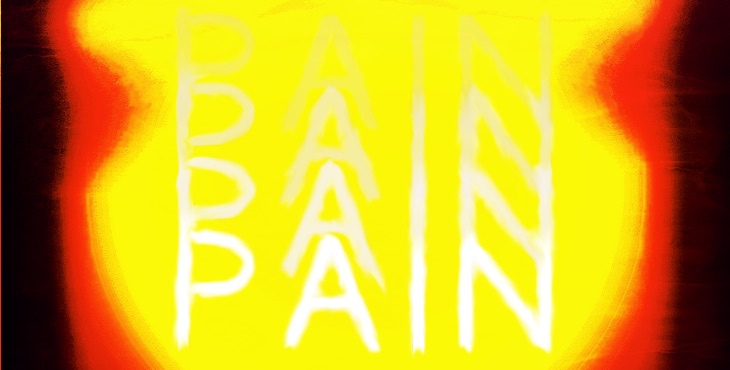
What Is Pain?

By Grant Duncan

November 13th, 2017 (blogs.lse.ac.uk)

Grant Duncan on the complexity of pain


What is pain? Surely we all know the answer to this. Certainly, we know when we are in it. If, for instance, a clinician asks me to rate my pain on a scale of one to ten, I can reply intelligibly. But the question ‘How precise was that?’ is irrelevant, as there is no objective criterion against which to assess ‘accuracy’. If I rate my pain as a ‘seven’, this is a way of expressing unpleasant feelings or sensations, not an estimation of a ‘knowable’ mental state that can be inspected by others for accuracy.

But even if we can’t define pain precisely, isn’t there a medical authority who can? A good place to begin is with the definition of pain proffered by the International Association for the Study of Pain (IASP): ‘An unpleasant sensory and emotional experience associated with actual or potential tissue damage, or described in terms of such damage.’

This acknowledges that the relationship between ‘actual tissue damage’ and the experience of pain is not a simple or direct one. People can suffer tissue damage and yet feel no pain. Or they may experience pain that feels as if it arose from injury (it is ‘described in terms of tissue damage’), but there may be no diagnosable lesion. A complaint of pain presented in the clinic—along with associated disability behaviours—may not correlate with identifiable pathology or ‘tissue damage’.

Neither clinicians nor scientists are able to identify a mental state called ‘pain’, and a pain complaint (‘it hurts’) is more performative expression than description. The IASP taxonomy of pain comes close to the same conclusion by accepting that ‘all pain is subjective’. Not even the neuro-scientist talks about pain without recourse to an imprecise language in which people express and respond to unpleasant sensations and emotions.

Reflecting the clinical purposes of the IASP definition, it encompasses both the sensory and emotional aspects of pain, but it does not include, for example, ‘hurt feelings’. Nonetheless, we commonly describe grief, for instance, as a kind of pain. ‘Pain’ is a term in common parlance, and we should not ignore these messy, everyday uses of words; they are valid and philosophically interesting. If we want to understand pain, we need to heed Wittgenstein: ‘the meaning of a word is its use in the language’.

If you take time to help me and I offer you a gift in return ‘for your pains’, or if I apologise to you ‘for being a pain’, then I am observing certain customs of reciprocation. ‘Pain’, in these uses, implies more than just a subjective experience, be it impatience, annoyance, or bodily strain. It entails also a burden or obligation for which amends or compensation may be appropriate. When we suffer pain of any kind, it is likely to raise questions about what caused it, whose fault it was, and who has an obligation to provide care or relief. Moral and political questions are never far away when we suffer pain.

The word ‘pain’ derives from the Latin poena, meaning ‘penalty’ or ‘punishment’. Romance languages use versions of the Latin dolor to talk about pain. But the English ‘pain’ originally referred to punishment or penalty for an offence, as well as to unpleasant bodily sensations and mental or emotional suffering. We still use the phrase ‘on pain of death’ to refer to capital punishment. But, in the past, pain meant punishment, and lawful punishments frequently involved the deliberate infliction of bodily pain.

Thomas Hobbes, for example, writes of ‘pain’ as extra-legal punishment. He also lists ‘stripes, wounds, chains, and any other corporal pain’ among the lawful punishments. Pain and punishment were inseparable.

Today, the deliberate infliction of bodily pain—even if state-sanctioned—is treated as inherently wrong. Torture in particular is out-lawed. In those jurisdictions that still have capital punishment, great effort is made (not always successfully) to try to ensure that the extinguishment of life will inflict neither pain nor visible bodily injury, and hence the uses of sedatives followed by lethal injections.

The modern historical trend in lawful punishment has favoured the deprivation of liberty (imprisonment) over the termination of life and/or the infliction of bodily pain and injury. One of the benefits that Jeremy Bentham (1748–1832) saw in his design for an ideal prison or ‘Panopticon’, for instance, was to make irons unnecessary, and hence eliminate a cause of pain and torture.

Bentham’s principle of utility asserted that the best criterion on which to judge a law or policy is the net sum of the consequential pains and pleasures. This led to a careful description of pain in its various forms: sensory, emotional, and social. He distinguishes between pains of privation, of the senses (divided into nine types), of awkwardness, of enmity, of an ill name, of piety, of benevolence, of malevolence, of the memory, of the imagination, of expectation, and pains dependent on association. This is a broad, even holistic, appreciation of what ‘pain’ means. But his aim was to determine principles of morality, public policy, and law. He was not writing a medical treatise.

Beginning in the nineteenth century, significant developments in anaesthesia occurred. Today, we are fortunate to have ready access to pain-relief for minor complaints, and to local and general anaesthesia during surgery. One of the consequences of this beneficial development, however, has been a tendency to regard pain as a medical—rather than a moral, legal, or penal—issue. And while anaesthetic and pharmaceutical technologies have done a huge amount to relieve or prevent much human suffering, medical sciences have not been entirely successful in the hoped-for ‘conquest of pain’. Chronic pain, in particular, remains a significant medical challenge, as well as a source of economically and socially costly disability.

Christian doctrines have held that pain is a curse to be endured, or even that it may signify martyrdom and salvation, and therefore is to be welcomed. But today, it’s common to hear that a person ‘should not have to suffer pain’, especially if that person is a child or a person nearing the end of life. Cases have been made for the reform of professional codes of ethics, healthcare systems, human-rights covenants, laws, and even constitutions, aimed at, in the words of Martha Nussbaum, ‘the mitigation of the sort of pain that is not an enrichment of the soul or a deepening of self-knowledge’.

There has been a flourishing of interest in the cultural, social, and political factors that affect pain. The roles played by learning and by social and economic factors are now widely recognized in medical theory and clinical practice, especially in the case of chronic pain. And while it is no longer lawful in any civilized society to use the infliction of pain as a means of punishment, new associations between politics, law, and pain have emerged, raising new and complex questions. For example, is there a right to pain relief? If we can prevent or relieve pain, does that mean there’s a socio-legal obligation to do so? In turn, we also have real power-struggles over what ‘pain’ signifies, whose complaints of pain are ‘genuine’, and who should receive healthcare and compensation. Compensation authorities, healthcare insurers, and personal-injury litigators all have vested interests, and law reforms are frequently called for.

So, while we owe a lot to medical science for preventing and relieving many kinds of pain that are, again to quote Nussbaum, ‘not conducive to anything good’, we cannot leave the question of what pain is—or the meaning of ‘pain’—in the hands of medical-scientific authority alone. And indeed clinicians today are (wisely) trained to accept that pain is what the patient says it is. People are skilled (in words and actions) at expressing, disguising, minimizing, elaborating, and sometimes exaggerating how ‘it hurts’.

Pain and complaint of pain raise important philosophical, moral, and political questions. And while we tackle them, something we can all do is try to communicate more fully and empathetically about one another’s pain and suffering.

This essay is based on the article, ‘The Meaning of Pain in Historical, Social, and Political Context’ by Grant Duncan, published in The Monist.


About the author

Grant Duncan

Grant Duncan is an Associate Professor at Massey University Auckland, New Zealand. His other research interests include the political uses of happiness and political trust, the latter being the topic of a forthcoming book. He also writes and comments publicly on contemporary New Zealand politics.

Aquarius New Moon on August 3, 2020

Wendy Cicchetti

Whatever is set in motion around a New Moon develops and comes under the spotlight with the following Full Moon. The Moon has passed through several phases of a cycle from 0° to 180° where it has now reached a crisis point, with the original New Moon issue somehow reflected back at us. This Full Moon in Aquarius conveys both a sense of social responsibility and the need for a breathe, according to Saturn and Uranus in the mix. Saturn is duty bound and keen on establishing rules and borders, with Uranus, more inclined towards breaking rules and making a bid for freedom.

This lunation also forms a t-square to Uranus in Taurus, giving Uranus the edge, if not the upper hand. The apex planet in a t-square tends to add a compulsive energy, which can work to drive a situation forward — for better or worse. Like it or not, Uranus is playing a big, disruptive role, which may seem slightly ironic given that the planet is in Taurus, with its associations of being peaceful until pushed too far. We now have the potential transition from placid grazer to raging bull, where the animal has been actively provoked. Depending on which side of this scenario we sit — metaphorically speaking — it could be that we suddenly experience some sort of imminent backlash; or that we act out ourselves, turning to face an aggressor and preparing to charge.

With outer planets (Uranus, Neptune and Pluto), we are not always so directly involved, but we see some fallout around us. So, alternatively, there may just be a bit of weird energy around, with random events that unsettle us. We are encouraged to embrace the unexpected, because there’s nothing else we can really do. Whatever happens, this t-square occurs in fixed signs, which makes a particular fate feel fixed, or at least gives it a “long-term” quality.

That said, note that Uranus will turn to apparent retrograde motion on August 15, so whatever this weird force may be, and however it presents, it very well could turn out to be simply “of the moment” — something temporary, with a peculiar appropriateness about it. With Taurus emphasized, it will almost certainly be related to security issues, and may tie in with concerns about money, possessions, and employment. The Aquarian focus also underlines fairness. From a societal perspective, this could indicate a move towards equalization between socioeconomic classes, with ordinary people securing more rights typically reserved for the privileged.

The strong Uranus/Aquarius signature in the t-square signals a concern with global and environmental issues, such as climate change — and the activities of related groups, such as “Extinction Rebellion,” who have felt a need to point out how the ongoing security of planet Earth is desperately at stake. Such groups have been urgently trying to awaken less concerned segments of the public, and may now deliver fresh lightning bolts that disrupt everyday activities. In terms of how we personally experience Uranus in Taurus, this could range from being the person calling out the message from the top of a commuter train, to being the recipient of the journalist’s story about it, which perhaps disrupts a cosy mealtime with the dramatic scene fleeting by on the news.

We ought not ignore Saturn’s involvement, though. With Saturn retrograde, clear boundaries may not be strong enough, or so stringent as to be suffocating, since there is often no happy medium with a retrograde planet acting “out of sorts.” Saturn in Capricorn forms an applying conjunction with Pluto, which is conjunct separating Jupiter. Far from being merely grouped together, these retrogradations show haphazard “comings and goings,” indicating how affiliations and developments may be changing. A project that had expansion or distance associated with it could need reining in. Many relationships are subject to U-turns.

Notably, all three of these planets — Saturn, Jupiter, and Pluto — are retrograde. So, although a review and adjustment may be necessary by all involved, an overall plan need not be lost forever. However, some characters may disappear and changes may merit a serious rethink based on new values.

This article is from the Mountain Astrologer, written by Diana Collis.

The Tao

Lao Tzu

“The Tao that can be told is not the eternal Tao.
The name that can be named is not the eternal name.
The nameless is the beginning of heaven and earth.
The named is the mother of ten thousand things.
Ever desireless, one can see the mystery.
Ever desiring, one can see the manifestations.
These two spring from the same source but differ in name;
this appears as darkness.
Darkness within darkness.
The gate to all mystery.”

― Laozi, Tao Te Ching

2020 Full Moon Calendar

By Tim SharpKimberly Hickok July 02, 2020 (space.com)

The moon shows its full face to Earth about once a month. Well, sort of. 

Most of the time, the full moon isn’t perfectly full. We always see the same side of the moon, but part of it is in shadow. Only when the moon, Earth and the sun are perfectly aligned is the moon 100% full, and that alignment produces a lunar eclipse

And sometimes — once in a blue moon — the moon is full twice in a month (or four times in a season, depending on which definition you prefer). [The Moon: 10 Surprising Facts]

The next full moonoccurs on Monday, Aug. 3 at 11:59 a.m. EDT (15:59 UTC), but the moon will appear full the night before and after its peak to the casual stargazer. August’s full moon is known as the Sturgeon Moon, though it has many other nicknames by different cultures. 

Related: Moon Photography Tips from Astrophotographers: A Visual Guide Related: How to Observe the Moon with a Telescope

Full moons in 2020

This is when full moons will occur in 2020, according to NASA:

DateNameU.S. Eastern TimeUTC
Jan. 10Wolf Moon2:21 p.m.19:21
Feb. 9Snow Moon2:33 a.m.7:33
Mar. 9Worm Moon1:48 p.m.17:48
Apr. 7Pink Moon10:35 p.m.2:35 (Apr. 8)
May 7Flower Moon6:45 a.m.10:45
Jun. 5Strawberry Moon3:12 p.m.19:12
Jul. 5Buck Moon12:44 a.m.4:44
Aug. 3Sturgeon Moon11:59 a.m.15:59
Sep. 2Corn Moon1:22 a.m.5:22
Oct. 1Harvest Moon5:05 p.m.21:05
Oct. 31Blue Moon9:49 a.m.14:49
Nov. 30Beaver Moon4:30 a.m.9:30
Dec. 29Cold Moon10:28 p.m.3:28 (Dec. 30)

Click here for more Space.com videos…

Additional full moon names

Many cultures have given distinct names to each month’s full moon. The names were applied to the entire month in which each occurred. The Farmer’s Almanac lists several names that are commonly used in the United States. There are some variations in the moon names, but in general, the same ones were used among the Algonquin tribes from New England on west to Lake Superior. European settlers followed their own customs and created some of their own names.

Other Native American people had different names. In the book “This Day in North American Indian History” (Da Capo Press, 2002), author Phil Konstantin lists more than 50 native peoples and their names for full moons. He also lists them on his website, AmericanIndian.net.

Amateur astronomer Keith Cooley has a brief list of the moon names of other cultures, including Chinese and Celtic, on his website. For example,

Chinese moon names:

MonthNameMonthName
JanuaryHoliday MoonJulyHungry Ghost Moon
FebruaryBudding MoonAugustHarvest Moon
MarchSleepy MoonSeptemberChrysanthemum Moon
AprilPeony MoonOctoberKindly moon
MayDragon MoonNovemberWhite Moon
JuneLotus MoonDecemberBitter Moon

Full moon names often correspond to seasonal markers, so a Harvest Moon occurs at the end of the growing season, in September or October, and the Cold Moon occurs in frosty December. At least, that’s how it works in the Northern Hemisphere.

In the Southern Hemisphere, where the seasons are switched, the Harvest Moon occurs in March and the Cold Moon is in June. According to Earthsky.org, these are common names for full moons south of the equator.

January: Hay Moon, Buck Moon, Thunder Moon, Mead Moon
February (mid-summer): Grain Moon, Sturgeon Moon, Red Moon, Wyrt Moon, Corn Moon, Dog Moon, Barley Moon
March: Harvest Moon, Corn Moon
April: Harvest Moon, Hunter’s Moon, Blood Moon
May: Hunter’s Moon, Beaver Moon, Frost Moon
June: Oak Moon, Cold Moon, Long Night’s Moon
July: Wolf Moon, Old Moon, Ice Moon
August: Snow Moon, Storm Moon, Hunger Moon, Wolf Moon
September: Worm Moon, Lenten Moon, Crow Moon, Sugar Moon, Chaste Moon, Sap Moon
October: Egg Moon, Fish Moon, Seed Moon, Pink Moon, Waking Moon
November: Corn Moon, Milk Moon, Flower Moon, Hare Moon
December: Strawberry Moon, Honey Moon, Rose Moon 

Just a phase

The moon is a sphere that travels once around Earth every 27.3 days. It also takes about 27 days for the moon to rotate on its axis. So, the moon always shows us the same face; there is no single “dark side” of the moon. As the moon revolves around Earth, it is illuminated from varying angles by the sun — what we see when we look at the moon is reflected sunlight. On average, the moon rises about 50 minutes later each day, which means sometimes it rises during daylight and other times at night.

At new moon, the moon is between Earth and the sun, so that the side of the moon facing toward us receives no direct sunlight, and is lit only by dim sunlight reflected from Earth.

A few days later, as the moon moves around Earth, the side we can see gradually becomes more illuminated by direct sunlight. This thin sliver is called the waxing crescent.

A week after the new moon, the moon is 90 degrees away from the sun in the sky and is half-illuminated from our point of view — what we call first quarter because it is about a quarter of the way around Earth.

A few days later, the area of illumination continues to increase. More than half of the moon’s face appears to be getting sunlight. This phase is called a waxing gibbous moon.

When the moon has moved 180 degrees from its new moon position, the sun, Earth and the moon form a line. The moon’s disk is as close as it can be to being fully illuminated by the sun, so this is called full moon.

Next, the moon moves until more than half of its face appears to be getting sunlight, but the amount is decreasing. This is the waning gibbous phase.

Days later, the moon has moved another quarter of the way around Earth, to the third quarter position. The sun’s light is now shining on the other half of the visible face of the moon.

Next, the moon moves into the waning crescent phase as less than half of its face appears to be getting sunlight, and the amount is decreasing.

Finally, the moon moves back to its new moon starting position. Because the moon’s orbit is not exactly in the same plane as Earth’s orbit around the sun, they rarely are perfectly aligned. Usually the moon passes above or below the sun from our vantage point, but occasionally it passes right in front of the sun, and we get an eclipse of the sun.

Each full moon is calculated to occur at an exact moment, which may or may not be near the time the moon rises where you are. So when a full moon rises, it’s typically doing so some hours before or after the actual time when it’s technically full, but a casual skywatcher won’t notice the difference. In fact, the moon will often look roughly the same on two consecutive nights surrounding the full moon.

Additional resources:

Join our Space Forums to keep talking space on the latest missions, night sky and more! And if you have a news tip, correction or comment, let us know at: community@space.com.

SUNDAY NIGHT TRANSLATION GROUP – 8/2/20

Translators:  Mike Zonta, Melissa Goodnight, Hanz Bolen, Sarah Flynn, Richard Branam

SENSE TESTIMONY:  Pandemic fatigue and anxiety is beyond ability to cope normally.

5th Step Conclusions:

1)  Truth is one people, one power, infinite ability, uncollared, unleashed, all hands on deck being the only norm, the True pandemic.

2) One Infinite Consciousness is always expressing, our limitless universal Well-Being — inexhaustibly yielding and supplying, with effortless ease, the exact outpicturing that adheres perfectly, to incorruptible principle of Truth.

3)  Truth is Certain, Absolute, Abstract, this Carefully arranged systematic program of Action; ONE PERSON, Being the Ultimate Cause of empowerment, and strength, this Infinite Mind Set is Beyondness, Exceeding in any action or scheme, the Androgynous Identity.

4) Truth being principled totality, wholeness is infinitely competent, tirelessly attaining and expressing its complete intrinsic nature always.

5) All One Mind Truth I AM is the knowing presence of All, occupies and employs all ably, soundly, abundantly. always, everywhere with complete well being. Able Well Being is the Everpresent only Expression of Truth.

All Translators are welcome to join this group every Sunday at 7 p.m. Pacific time. Zoom link:
https://us02web.zoom.us/j/652387027

Live from Lincoln Center: Rodgers and Hammerstein’s Carousel

Lincoln Center Jul 10, 2020 Carousel was hailed by Time Magazine as “the best musical of the 20th Century.“ The New York Philharmonic presents a stunning staged production of this iconic American work, featuring a star-studded cast including Kelli O’Hara, Nathan Gunn, Stephanie Blythe, Shuler Hensley, Jason Danieley, Jessie Mueller, Kate Burton, John Cullum and New York City Ballet dancers Robert Fairchild and Tiler Peck. Learn more and connect with Rodgers & Hammerstein here: http://www.rodgersandhammerstein.com Facebook: http://www.facebook.com/rodgersandham… Twitter: http://www.twitter.com/RnH_Org Instagram: http://www.instagram.com/rodgersandha…

“You’ll Never Walk Alone” Virtual Choir/Orchestra 15 Countries: 300 People

Harrison Sheckler In the midst of the Covid-19 pandemic, 300 people from 15 different countries came together to participate in a virtual rendition of the beautiful song “You’ll Never Walk Alone” from the Rodgers and Hammerstein musical, Carousel. Please share this video to help spread a little hope during this time! “I left New York City on March 14, anticipating a short absence. The Brooklyn College Choir had been preparing for performances with the New York Philharmonic, and then that was gone. Arriving home in Iowa, I found comfort in playing the beautiful song from the musical Carousel, ‘You’ll Never Walk Alone.’ I embarked on collaborating online like so many others are doing. What started to fill the void of music collaboration has evolved to new meaning for me with the lengthened quarantine. Hopefully, the words, ‘you’ll never walk alone,’ along with the visual of 300 people joining together offers the audience some comfort and peace during this time. Stay safe and healthy my friends!” – Harrison Sheckler Brooklyn College M.M. ’21 Piano Performance Audio Mixing and Mastering: Josh Meyer and Grant Bayer of Zated Records in Cincinnati, Ohio Video Editing: Harrison Sheckler Listen to my music on Spotify: https://open.spotify.com/artist/2o9ZY… Instagram: @harrisonsheckler Twitter: @HarrisonSheckl1 Facebook: @hsheckpiano