We make things and seed them into the world, never fully knowing — often never knowing at all — whom they will reach and how they will blossom in other hearts, how their meaning will unfold in contexts we never imagined. (W.S. Merwin captured this poignantly in the final lines of his gorgeous poem “Berryman.”)
Today I offer something a little apart from the usual, or sidelong rather, amid these unusual times: A couple of days ago, I received a moving note from a woman who had read Figuring and found herself revisiting the final page — it was helping her, she said, live through the terror and confusion of these uncertain times. I figured I’d share that page — which comes after 544 others, tracing centuries of human loves and losses, trials and triumphs, that gave us some of the crowning achievements of our civilization — in case it helps anyone else.
Meanwhile, someplace in the world, somebody is making love and another a poem. Elsewhere in the universe, a star manyfold the mass of our third-rate sun is living out its final moments in a wild spin before collapsing into a black hole, its exhale bending spacetime itself into a well of nothingness that can swallow every atom that ever touched us and every datum we ever produced, every poem and statue and symphony we’ve ever known — an entropic spectacle insentient to questions of blame and mercy, devoid of why.
In four billion years, our own star will follow its fate, collapsing into a white dwarf. We exist only by chance, after all. The Voyager will still be sailing into the interstellar shorelessness on the wings of the “heavenly breezes” Kepler had once imagined, carrying Beethoven on a golden disc crafted by a symphonic civilization that long ago made love and war and mathematics on a distant blue dot.
But until that day comes, nothing once created ever fully leaves us. Seeds are planted and come abloom generations, centuries, civilizations later, migrating across coteries and countries and continents. Meanwhile, people live and people die — in peace as war rages on, in poverty and disrepute as latent fame awaits, with much that never meets its more, in shipwrecked love.
I will die.
You will die.
The atoms that huddled for a cosmic blink around the shadow of a self will return to the seas that made us.
What will survive of us are shoreless seeds and stardust.
Mike Zonta and Bernie Sanders standee at 18th & Castro, San Francisco, on January 26, 2020 . Photo by Anton O’Donnell (www.antonshootsfilm.com)
March 18, 2020
A few days ago it gave me great satisfaction to come up with a sense testimony which seemed to clarify what has been going on these past few weeks and months. The sense testimony is this: “Political and biological corruption seems to be on the ascendant.”
I campaigned very hard for Bernie Sanders mostly for one reason: to get money out of politics. When large corporations and organizations like the National Rifle Association can buy politicians, what chance does public opinion really have?
For those who require a study to point out the obvious, Martin Gilens from Princeton and Benjamin Page from Northwestern did just that in 2014. Their conclusion: “When the preferences of economic elites and the stands of organized interest groups are controlled for, the preferences of the average American appear to have only a minuscule, near-zero, statistically non-significant impact upon public policy.” (See https://bulletin.represent.us/american-government-isnt-democracy/)
Former San Francisco Mayor and current San Francisco Chronicle columnist Willie Brown said in a recent column: “Sen. Bernie Sanders is already telling supporters that his campaign is a fight against the billionaire-dominated Democratic establishment. Black, white, gay, straight or whatever, if you don’t support the “revolution,” then you are either a greedy millionaire or an unwitting pawn of Wall Street interests.“
What Da Mayor pretends to misunderstand is that the “revolution” is against the billionaire-dominated Democratic establishment. So their money is exactly the problem and exactly what the Sanders campaign is revolting against.
My work for the Bernie Sanders campaign was not just political work. It was spiritual work. And you could feel it. I wasn’t just working for myself. I was working for generations yet unborn. And for generations more recently born than my own.
So when Bernie began losing states on Super Tuesday, the let down was devastating to me and many others. And then came the Covid-19 crisis. Thus my sense testimony: “Political and biological corruption seems to be on the ascendant.”
Today a nice young lady from the VA phoned me up and said that, due to the Covid-19 crisis, I would have to reschedule my VA appointment from March 24 to some time in June. She was so sweet that I found myself involuntarily wanting to cry out to her: “Please help me. I’m so scared.”
I didn’t. But it surprised me. I didn’t think I was that scared. So I can understand people who voted against Bernie. They’re scared too. And they think the DNC-approved candidate will make it all better.
I don’t think most of us really want democracy. We want to be taken care of. We want dependency.
Even in The Prosperos democracy is not very popular. Article IV, Section 6 of The Prosperos By-Laws: “The Executive Council may veto any action of the High Watch or of the Trustees; but such veto must be unanimous on the part of the Executive Council.”
Last year I proposed doing something about this draconian power imbalance by granting veto power to the High Watch and the Trustees. It was voted down by the High Watch by 10-4.
Thane Walker, guru-in-chief and founder of The Prosperos, was adamant about getting us to stand on our own two feet. Whether in our Translations or our RHSes or our life.
So to the corporate Democrats, to the Covid-19 fear-mongers and to the High Watch of The Prosperos, I repeat Benjamin Franklin’s famous quote: “Those who would give up essential Liberty, to purchase a little temporary Safety, deserve neither Liberty nor Safety.”
Russell Brand What does self isolation mean? What effect is Coronavirus and Covid-19 going to have on our mental health, society and culture? How are YOU coping with the quarantine? Subscribe to my channel here: http://tinyurl.com/opragcg (make sure to hit the BELL icon to be notified of new videos!)
conscioustv Bruce Lipton – ‘The Power Of Consciousness’ – Interview by Iain McNay Bruce is a cellular biologist who is the author of “The Biology Of Belief” and “Spontaneous Evolution”. He talks about his life, his work, and how he sees the predicament of the human race. The transcript of this interview is available to view here – http://www.conscious.tv/text/53.htm
I care about how you feel right now. My goal for this note is to anchor you in your center, empower you to choose your strongest self, and soothe and steady you.
This note is a work in progress and I will continue to add resources to strengthen and ground you during this challenge. Please leave your comments and questions or use the contact us button on the bottom of the page. We are going to get through this. How you feel as you get through it is my concern.
xo,
Cynthia
Virtually the whole world is experiencing the impacts of measures to control the current viral pandemic. It’s alarming to witness entire countries close borders and stores and cancel flights, services, and events. It’s tragic that some people who contract the virus do not recover. All of this is factual and beyond your control.
Many people are cascading through intense cycles of fear in reaction to these out of control events and they’re panicking, hoarding, feeling paranoid that their very survival is at stake. Feeling and behaving this way is not beyond your control. In fact, this is the area you have great dominion over, your internal state.
Emotion is moving energy. It moves in our bodies and is highly contagious. Sadness, anger, joy, patriotism, and celebratory feelings are all examples of emotions that spread when enough people feel them. Fearful emotions spread like wildfire.
Check-in and Change
Before you read on, check-in with yourself. Be honest, no stiff upper lips or stoicism. How are you doing? Do you feel safe? Are you a little off? Or is everything inside you spiraling? Whatever your answer, it’s okay. Recognize it without judging it. Observe it. It’s not you. It’s a feeling.
This page is a resource designed to guide you to a grounded, centered state of fortitude.
Prime Yourself To Grasp This Information – Breathwork
Okay, I am working from the premise that you have done the breathwork in the drop-down above.
Right now, in the midst of change and uncertainty, you can work to help yourself into an increased state of calm and centered wholeness.
This note is broken into sections to speak to different aspects of this challenge and your mind. All of them are designed to put your feet on the ground and pull your mind out of fear. You can read it in order, or go to a header that feels interesting right now. Go to whatever you can grasp and then go back to what you skipped.
Challenge Navigation Guidelines
Here are some guidelines for handling this and most any significant challenge. Click the rule for an explanation of the guideline. Take them slow. Read each one and reflect on it. Take one into meditation. See yourself becoming better able to control your inner world. Your outer world will reflect your changes. This is the most important work.
I understand how my thoughts interact with my body and health.
Nothing happens in a vacuum; there is a connection at every level. Every act impacts someone or something else. This is true within our bodies too.
The CDC cites stress at the leading cause of disease. If you are living in stress, it is exacerbating all of the challenges you’re facing.
“Certain types of chronic and more insidious stress due to loneliness, poverty, bereavement, depression and frustration due to discrimination are associated with impaired immune system resistance to viral linked disorders ranging from the common cold and herpes to AIDS and cancer. Stress can have effects on hormones, brain neurotransmitters, additional small chemical messengers elsewhere, prostaglandins, as well as crucial enzyme systems, and metabolic activities that are still unknown. Research in these areas may help to explain how stress contributes to depression, anxiety and its diverse effects on the gastrointestinal tract, skin and other organs.” Stress.org
In addition to causing physical aging and disease, stress blocks inspiration, creative flow and the ability to see the bigger picture. From this contracted space we cannot create success, happiness, health or joy.
What is stress? Stress is the result of your thinking. It comes from your thoughts about what you’re focusing on. Whether something is stressful or not is highly subjective. Many people experiencing today’s global challenge are not feeling stressed. I am among them.
I am not superior. I don’t have special qualities. I have lived a life that’s presented massive upheaval and life-changing challenges and it taught me that I can control what I allow to occur inside of me. I can control what I focus on. I can choose not to undermine myself or allow outside influences or circumstances to undermine me. I have worked myself up into frenzies that left me trembling in corners and relegated to desperation so intense that I just gave up.
At the bottom, I discovered how to operate my mind and body. I learned how my systems work and that if I wanted to thrive and connect with higher forces, I had to live at that level of energy.
The good news is you can learn and practice this for yourself and change the way you show up and feel during challenges.
Here’s a look inside the body’s response to your thoughts about events. Remember when you perceive life as scary and threatening you feel stressed. When you perceive life as an experience with challenges that you can handle you feel empowered. The state you end up in dictates your what how your autonomic nervous system responds.
Your body’s autonomic nervous system is made up of the sympathetic and parasympathetic systems. Here’s a table and a graphic to illustrate their different effects. While you read, consider which system is most often activated in your body?
Parasympathetic Response – Relax and Renew
Sympathetic Response – Stress and Defend
decreased blood pressure
increased blood pressure
hormones of relaxation and regulation flow (acetylcholine, oxytocin)
stress hormones spike and circulate (cortisol, epinephrine)
body relaxes and feels safe
body readies to flee from danger
digestion increases as blood flows
digestion slows as blood is diverted
feel calm, relaxed, able to assess circumstances patiently, reasonably, flexible thought, open to higher solutions, responsive
feel anxious, charges, unable to rest, or think with altitude, hyper-vigilant, and over-focused, reactive
There’s a lot you can do to help reduce stress reactions and move back into a state of relaxation and renewal. Here are some approaches:
1) The breathing process shared at the opening of this page when practiced for more than four minutes helps move the body from a stress reaction to the relaxation response. Click here to go to it.
2) Meditation. Meditation is not thinking with your eyes closed. That’s actually going to allow you to stay stressed and will not create any changes. Meditation is a fast from thinking. Focus on your breathing. If you find it challenging to get quiet. Follow a guided meditation. I have some free ones here.
3) Massage and touch. If you’re home with healthy loved ones massage each other. If you have a pet, devote 10-15 minutes to just petting and connecting with them. If you’re alone, use a pleasant oil and rub your own hands, arms, neck, and shoulders. All of these bring you into the present and help the body relax.
4) News and media fast: Smartphone use has been shown to increase heart rate and lower autonomic nervous system activity. Take a break from all electronics and get back in touch with living in the present without being bombarded with fear-inducing information.
5) As mentioned in another section of this note, exercise has a miraculous effect on relaxation, hormones, depression, and well-being. It’s like taking anti-depressants. Find something that works for you at this time. Yoga (I do video classes on Youtube). Walking in nature. Stretch and do 20 push-ups, 50 squats, and 30 sit-ups (work up to this and take your time). Repeat 2-4 times if you’re conditioned. Clean your house with passion. Dance. Get creative.
6) Get into nature. If this is possible for you, do it. Get out under the sky and trees. Breathe and let nature restore and ground you.
7) Cultivate pleasure. What makes you feel really good and has no negative consequence? Do that. This rules out barrels of bonbons and a 72 hour Netflix fest. Consider being creative. Do you like to draw, paint, write, dance, sing?
I distinguish between what I can and can’t control.
Let go, release, step-away from everything that you have no influence over. Say a prayer and take your focus off of fear-based what if’s. Invest that energy into something you can impact (your health, your home, your mind, helping others in safe ways).
Do something about what you can control.
What you can control:
– CDC’s recommendations for preventing the spread of the virus (click here to see them). It’s wise to be informed and to take proactive precautions. Take them for yourself and for your fellow humans. Accept them. Practice them. Move forward.
-Your emotional and behavioral response to this event.
-Who you talk with about this event.
-Your mental diet. This includes what you watch, read, and think about. Choose a reputable source of information and check it once or twice a day for information that may be relevant to your area and situation. Do not leave the news running, repeatedly check it on your phone, listen to news radio shows or other mediums that deplete and incite fear. Listen to my podcasts and radio shows here. I promise to leave you better off at the end of every show.
-Your physical diet, activity level, sleep hygiene, and internal well-being.
-The kindness, care, love, generosity, and compassion you give yourself and others.
–Your ability to find positive ways to use this time at home. Clean up. Organize. Exercise. Write. Read. Learn a language. Grow.
What you can’t control:
-The media and its scare tactics
-Panic-stricken and hysterical people. Your best chance to change them is to model being genuinely grounded and centered. Invest in you.
-Events outside of your home, family, or business. Let go.
-Politicians and community leaders. Do vote for what your calm heart and rational mind tell you.
-The daily shifts, surprises, and changes inherent to this event. Let go.
I know that my sound mind makes better choices and creates better outcomes.
Worrying, agonizing, doomsday prophesying, dark fantasies, and other wild rides into the abyss of your creativity, negativity, and imagination do nothing but weaken you mentally, physically, and emotionally.
Hypervigilance and worrying do not stop events from happening in the future. They rob you of present joy, sap your mental capacity, drain you emotionally, and undermine your health with stress hormones.
To thrive in the face of challenge and go on to better days, you must assert authority over your inner world and all that you can control.
Mental discipline is key here. If you tend toward spiraling out of control, interrupt the pattern by taking your attention completely off of the crisis. You do have the power to do this. Do the breathing exercise at the top of this page. You cannot successfully do this exercise and continue to ruminate or analyze in your mind.
Remind yourself often that by remaining gripped by negative thoughts and imaginings you are reducing your ability to make good choices and handle challenges. Further, your upset doesn’t change the events at all.
It is as though you’ve shown up to a battle with an opponent you have a strong chance of defeating and instead of dealing with them, you attack yourself.
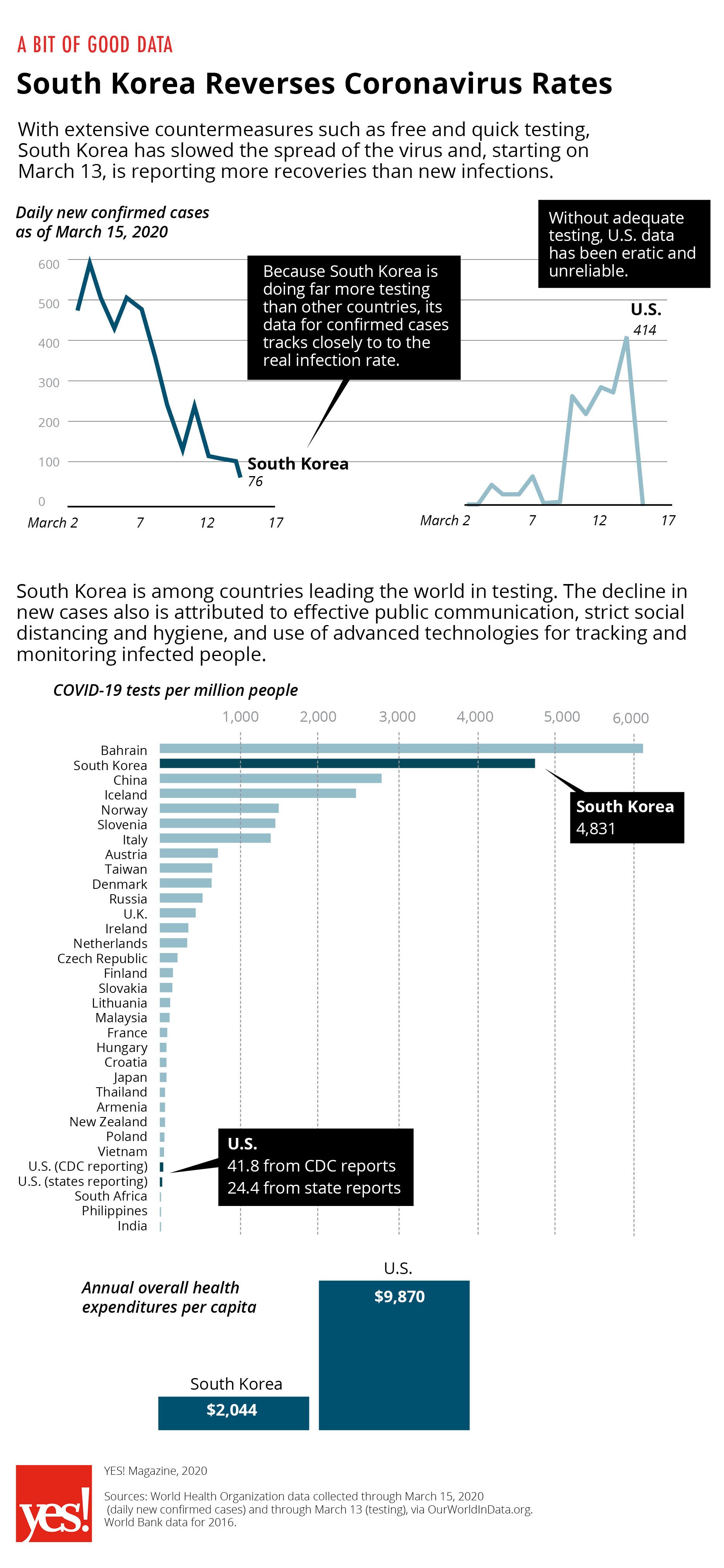
How did they do it? With extensive countermeasures such as free and quick testing, South Korea has slowed the spread of the virus and on March 14 reported more recoveries than new infections.
How to stop the spread of coronavirus – video explainer
The coronavirus epidemic plainly poses an exceptionally serious global problem: in a few short weeks, it has spread from China to more than 80 countries, infecting more than 100,000 people so far and causing more than 3,400 deaths.
But as we are hit with minute-by-minute updates from around the world, experiencing the advance of Covid-19 in real time – news alerts, huge headlines, social media hysteria – there’s a risk that we might lose some essential context.
Yes, this virus is obviously a massive challenge: medical, political and – perhaps most strikingly at present – social and economic. But it is worth remembering the world has never had better tools to fight it, and that if we are infected, we are unlikely to die from it.
Here, courtesy of a number of scientists but mainly Ignacio López-Goñi, a professor of microbiology and virology at the University of Navarra in Spain, are what might hopefully prove a few reassuring facts about the new coronavirus:
We know what it is. As López-Goñi wrote for the Conversation France, the virus causing cases of severe pneumonia in Wuhan was identified within seven days of the official announcement on 31 December, and, three days after that, the gene sequence was available. HIV, by contrast, took two years to identify after it first appeared in mid-1981, López-Goni noted. We also know the virus is natural, that it is related to a virus found in bats, and that it can mutate, but does not appear to do so very often.
We can test for it.By 13 January – three days after the gene sequence was published – a reliable test was available, developed by scientists at the department of virology at Berlin’s Charité university hospital with help from experts in Rotterdam, London and Hong Kong.
We know it can be contained (albeit at considerable cost).China’s draconian quarantine and containment measures appear to be working. On Thursday 120 new cases were reported in Wuhan, the lowest figure for six weeks, and, for the first time since the start of the outbreak, none at all in the rest of Hubei province. Several Chinese provinces have had no new cases for a fortnight and more are reopening their schools. In many countries, infections are in defined clusters, which should allow them to be more readily contained.
Catching it is not that easy (if we are careful) and we can kill it quite easily (provided we try). Frequent, careful hand washing, as we now all know, is the most effective way to stop the virus being transmitted, while a solution of ethanol, a solution of hydrogen peroxide or a solution of bleach will disinfect surfaces. To be considered at high risk of catching the coronavirus you need to live with, or have direct physical contact with, someone infected, be coughed or sneezed on by them (or pick up a used tissue), or be in face-to-face contact, within two metres, for more than 15 minutes. We’re not talking about passing someone in the street.
In most cases, symptoms are mild, and young people are at very low risk.According to a study of 45,000 confirmed infections in China, 81% of cases caused only minor illness, 14% of patients had symptoms described as “severe”, and just 5% were considered “critical”, with about half of those resulting in death. Only 3% of cases concern people under 20, children seem barely affected by the virus at all, and the mortality rate for the under-40s is about 0.2%. The rate rises in the over-65s, reaching nearly 15% in the over-80s, especially those with pre-existing heart or lung conditions. Calculating mortality rates during an ongoing epidemic is hard because it is not clear how many mild or asymptomatic cases have been tested for, but the best estimate we have for the coronavirus so far is 1.4% – somewhere between 1918 Spanish flu and 2009 swine flu.
People are recovering from it. As the daily count maintained by the Johns Hopkins CSSE shows, thousands of people around the world are making confirmed recoveries from the coronavirus every day.
Hundreds of scientific articles have already been written about it. Type Covid-19 or Sars-19 into the search engine of the US national library of medicine’s PubMed website and you will find, barely five weeks after the emergence of the virus, 539 references to papers about it, dealing with vaccines, therapies, epidemiology, diagnosis and clinical practice. That’s an exponentially faster publication rate than during the Sars epidemic, López-Goñi notes – and most publications’ coronavirus articles are free to access.
Vaccine prototypes exist. Commercial pharmaceutical and biotechnology labs such as Moderna, Inovio, Sanofi and Novavax, as well as academic groups such as one at the University of Queensland in Australia – many of which were already working on vaccines for similar Sars-related viruses – have preventive vaccine prototypes in development, some of which will soon be ready for human testing (although their efficacy and safety will of course take time to establish).
Dozens of treatments are already being tested. By mid-February, more than 80 clinical trials were under way for antiviral treatments, according to Nature magazine, and most have already been used successfully in treating other illnesses. Drugs such as remdesivir (Ebola, Sars), chloroquine (malaria), lopinavir and ritonavir (HIV), and baricitinib (rheumatoid polyarthritis) are all being trialled on patients who have contracted the coronavirus, some as a result of the application of artificial intelligence.
• This article was amended on 7 March 2020. An earlier version wrongly stated that “a solution of ethanol, hydrogen peroxide and bleach will disinfect surfaces”. It is dangerous to combine such substances. It now states correctly that “a solution of ethanol, a solution of hydrogen peroxide or a solution of bleach” will disinfect surfaces.
How special is the solar system? The history of astronomy has mostly been a one-way journey from a worldview in which our solar system is orderly (and divine) to a view in which we are not special. Our solar system’s planets, once thought to dance in god-ordained perfect circles in a “music of the spheres,” deviate from circular orbits. Johannes Kepler, who demonstrated the non-circular orbits of the planets, tried to restore a sense of heavenliness by latching onto a new pattern for their orbits based on Plato’s mathematical solids—but that notion was discredited many years later with the discovery of Uranus.
So when, on a sunny afternoon in California in 2017, I discovered a set of patterns that seem to rule planetary systems other than our own, I was skeptical. Were these patterns real, or were they an illusion? And if real, what did they mean about our solar system’s place in the cosmos?
In addition to our solar system, we now know of over 400 multi-planet systems, thanks largely to the Kepler Mission. Kepler is a NASA spacecraft (named after the 17th century German astronomer) that was launched in 2009 for the sole purpose of discovering exoplanets—worlds orbiting other stars. It finds those exoplanets by continuously measuring the brightnesses of about 100,000 stars and waiting for the starlight from any of them dim ever so slightly due to the shadow of a planet in transit. The transit of each planet is unique, allowing the discovery of multiple planets orbiting the same star.
The pattern I found on that sunny afternoon: planets in the same system tend to be the same size. For example, if one planet is 1.5 times the radius of Earth, the other planets in the system are very likely to be 1.5 times the radius of Earth, plus or minus a little bit.
This is not at all what my colleagues and I expected. In our solar system, planets range from the size of Mercury (less than half the radius of Earth) to Jupiter (more than ten times the radius of Earth). The whole population of exoplanets discovered by Kepler ranges from one quarter the size of Earth to about twenty times the size of Earth. Yet, despite this wide range of possible sizes, planets tend to be about the same sizes as their neighbors. One of my collaborators decided they looked like “peas in a pod,” and that moniker became our shorthand for the pattern.
To test whether the peas-in-a-pod pattern was real, I concocted (on my laptop) imaginary planetary systems in which the sizes of planets orbiting a given star were random. Could some sort of bias in Kepler’s method of finding planets—which favors the detection of large planets close to their stars—contrive to make the planets in each of my imaginary systems appear to fit the pattern?
A representation of the planet sizes and spacings in each of the multi-planet systems with four or more planets from the California Kepler Survey, and our solar system (SOL). Each row represents a planetary system, with the star at the left (denoted by the Kepler Object-of-Interest name for the system), and planet orbital distance increasing to the right in astronomical units (AU). Credit: Lauren Weiss.
The answer was no: in more 1000 trials with randomly assigned planet sizes put through a virtual Kepler’s detection scheme, a pattern of similarly-sized planets in the same systems never emerged. This computational experiment did not reproduce what we observe in the Kepler planetary systems. Thus, the regular sizes of planets is a real astrophysical pattern.
In addition to having similar sizes, planets in these peas-in-a-pod-like systems also have regular orbital spacing. We found that the orbital distance between the first pair of planets is a good predictor of the orbital distance of the third planet, and the fourth, and so on. (Regular spacing also exists in our solar system out to Uranus and is called the Titius-Bode Law, but Neptune and Pluto do not follow the pattern). Furthermore, there is a link between the sizes of the planets and their spacing: the systems with the smallest planet sizes also have the closest orbital spacings.
What do these patterns mean? Planet formation is surely governed by the laws of physics, but we do not have a clear narrative of how these laws manifest in the messy environment of planetary birth. Theories of planet formation were mostly written before the discovery of the first exoplanet; their purpose was to explain the emergence of our own solar system from a disk of gas and dust. A widely accepted (but unconfirmed) theory about planet formation involves the rise of so-called “oligarchs,” young precursors of planets that each influence a swath of fixed width within the disk around the star. (Pluto is no longer considered a planet because Pluto was never big enough to be an oligarch.)
Oligarchic theory predicts roughly equal-mass oligarchs spaced at regular intervals, with the size of the oligarch dependent on the width of its influence. However, because our solar system is not a system of equal-mass planets at regular spacing, the rise of oligarchs is considered a mere chapter in our solar system’s history, an early pattern that was later overwritten by violent impacts that formed our very dissimilar terrestrial planets.
Yet hundreds of exoplanets exhibit a pattern that, in a qualitative sense, resembles our long-lost oligarchs. Perhaps the peas-in-a-pod are aged oligarchs. If so, how did they evade the violence that later shaped our solar system? We might find the answer, if we continue measuring the fundamental properties of the peas-in-a-pod planets. Or we might find additional planets in these systems that break from the pattern, just as the discovery of Uranus deviated from Kepler’s proposed pattern for the orbits in our solar system. Regardless, I think Kepler would be pleased to see that, thanks to a telescope bearing his name, we have discovered a pattern that pervades not just one, but hundreds of planetary systems.
Lauren Weiss, PhD, is the Parrent Postdoctoral Research Fellow at the Institute for Astronomy at the University of Hawai’i, Manoa. She lives in Honolulu, Hawai’i. You can find more of her writing on rockyworlds.wordpress.com.
Note: The author was the Trottier Postdoctoral Research Fellow at the Université de Montréal when she performed the research described above, which has been refereed and published in the Astronomical Journal and is also publicly available on the ArXiv and in a press release. This research was conducted as part of the California Kepler Survey, which made use of data from the NASA Kepler Mission and from the W. M. Keck Observatory on Mauna Kea, Hawai’i. The views expressed are those of the author(s) and are not necessarily those of Scientific American.
This article was originally published on October 16, 2018, by Scientific American, and is republished here with permission.
Here is detailed information on the class, this will be an exciting class so please plan to come and tell your friends who you think will be interested. Thanks….
At night, I like to say, that we’re all swimming in our subconscious mind when we dream. With Lucid Dreaming we bring the conscious mind to be aware that we’re dreaming (while we’re in the subconscious mind) and amazing things can happen. Come to class and learn the methods and process to become a Lucid Dreamer.
Photo Credit: LunarLanding | Gardens of Time | mcscrooge54
Releasing the power of your Dreams
Accelerate your personal Growth
Understand the route to your conscious evolving
Solve Problems
Realize those “not so secret” messages in your unconscious.
Gain ideas to help in waking life
Turn up your creativity
Learn to interpret your dreams
Practice methods to remember dreams
Review of the Latest scientific information on dreaming and health