
Emily Annette The Covid 19 virus panic hits MY breaking point.
Monthly Archives: March 2020
Pandemics & Infodemics – Wisdom In The Time Of Covid-19 | Russell Brand & Dr. Gabor Mate
Russell Brand A clip from the latest Under The Skin podcast with Dr. Gabor Mate out tomorrow Saturday 21st only on Luminary. If you don’t have the Luminary app already you can sign up here: http://luminary.link/russell Subscribe to my channel here: http://tinyurl.com/opragcg
Tom Lehrer – We Will All Go Together When We Go
The Tom Lehrer Wisdom Channel http://www.amazon.com/Tom-Lehrer-Coll… Use the above link and get the uninterrupted Lehrer TV-performance and The Tom Lehrer Collection from Amazon.com. http://www.shoutfactorystore.com/prod…
LEPROSY DEMONSTRATES HOW FEARS OF DISEASE SPREAD—AND THEN LIVE FOREVER
From Hawai‘i to China to Europe, This Ancient Malady Has Long Been a Magnet for Wider Political and Cultural Anxieties
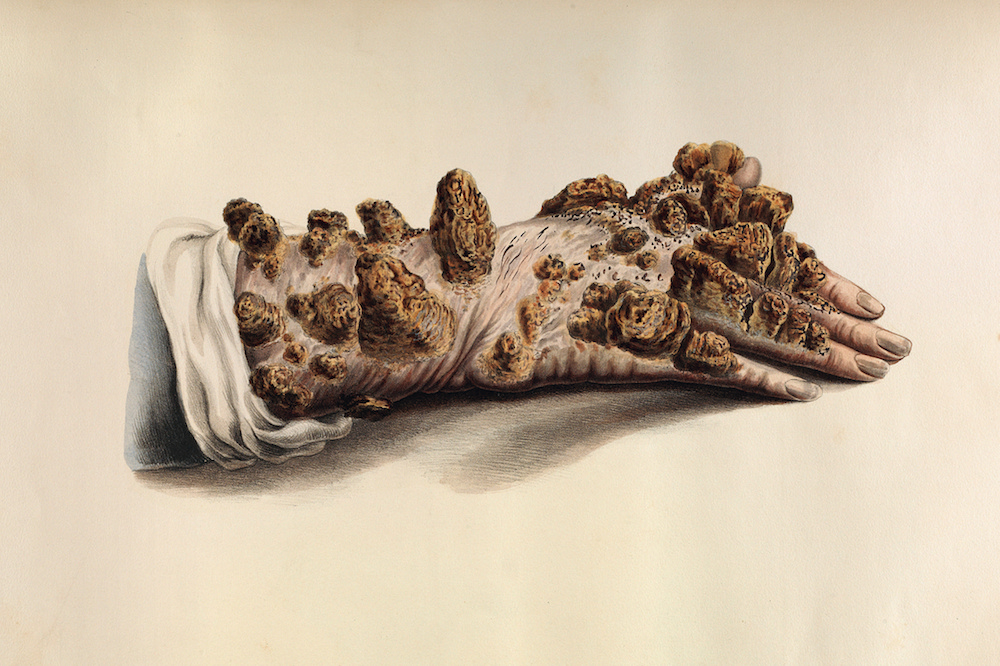
Severe tubercular leprosy (or ichthyosis) of the hand. Courtesy of the Wellcome Library, London.
by ROD EDMOND | MARCH 19, 2020 (zocalopublicsquare.org)
What is it, exactly? How do you catch it? How do you diagnose it? How do you treat it? Can it be cured? If not, how do you manage it?
These difficult questions are at the heart of our fear of diseases. The story of leprosy—and about other, newer maladies—helps explain how fears spread and endure, especially within Judeo-Christian cultures.
The Book of Leviticus is a good starting point. Chapter 14 returns obsessively to the problem of distinguishing leprosy from less serious skin afflictions. How is the priest to know if a spot, blemish or sore is “clean” or “unclean”? If the bright spots are “darkish white,” Leviticus advises, it’s merely “a freckled spot” and the person is “clean.” But “if the rising of the sore be white reddish” the person is leprous or “unclean” and must be isolated (“without the camp shall his habitation be”).
Of course, the trouble with such diagnoses is that each identifying symptom prompts further uncertainty. How “darkish”? How “reddish”? How “white”?
Leprosy has always had an extraordinary signifying power, of being more than itself and becoming a magnet for wider political or cultural anxieties. Leviticus was composed during a long period of political upheaval between 538 and 332 B.C. Rumors of the poisoning of wells by lepers in 14th-century France grew into a wider fear of a conspiracy involving Jews and the Muslim king of Granada, a potent cluster of pariah groups with leprosy at its core.
In a Hollywood movie made during the Cold War, Big Jim McLain (1952), John Wayne plays an investigator for the Un-American Activities Committee sent to Hawai’i where a sinister communist bacteriologist is planning to infect the water supply. Approaching Honolulu, the film zooms in on the famous leper colony on Molokai, associating a disease thought to have been introduced by Chinese indentured laborers in the mid-19th century with the danger now posed by communism.
For much of the 19th century, leprosy was understood by advanced metropolitan medicine to be hereditary and constitutional rather than contagious. An Empire-wide survey of the disease undertaken by the British Royal College of Physicians in the 1860s concluded that leprosy was ‘essentially a constitutional disorder’, that it was overwhelmingly an affliction of the “dark populations” of the empire, transmitted indigenously and unlikely to jump barriers of geography and race, and that it was best tackled by improving the health and diet of native peoples.
But to many living in colonial settings, this seemed counter-intuitive. In India and the West Indies, especially, traditional practices of isolation—sending the leper “without the camp”—continued, and the more progressive approach, which challenged the stigma and opposed segregation, was widely ignored.
Medical opinion was correct in concluding that leprosy had low levels of communicability and was essentially a disease of poverty, though the prevailing theory of causation was wrong. But then came Hansen’s discovery of the leprosy bacillus, at a time when micro-biology was discovering the bacterial causation of other diseases (tuberculosis, for example), reinforcing traditional fears of leprosy and undermining the idea that Europeans were immune to it.
Why has leprosy inspired such fear? The leprous body—decomposing and putrefying while still living and able to reproduce—has often provoked horror. The Book of Numbers in the Bible defines leprosy as a condition in which the flesh is “half-consumed,” challenging the fundamental boundary between the living and death. The fear of losing this boundary is what has so often led to the construction of other kinds of borders to protect the living. Among such borders has been the lepers’ squint—that feature of medieval church architecture which allowed the leper to see into the church but not enter or partake of communion.Hawai’i was the locus classics of the intensification of fear around leprosy in the later 19th and early 20th century, and became the earliest example of compulsory segregation in the modern imperial world.
A more stringent kind of exclusion—one characteristic of the imperial world of the late 19th and 20th centuries—was the leper colony. These isolated settlements, frequently placed on uninhabited islands, were for those thought to have the disease.
Hawai’i was the locus classicus of the intensification of fear around leprosy at this time and became the earliest example of compulsory segregation in the modern imperial world. A rapid spread of the disease in the Hawai’ian islands group in the 1850s and 1860s resulted in a leper colony being established on an isolated peninsula on the island of Molokai. As an imperial debate over leprosy widened, Hawai’i became a laboratory for studying the disease.
Most of the cases involved Native Hawai’ians but a few Europeans also contracted the disease and were taken to the settlement. The unusual speed of this increase in the disease among a small population on a remote group of islands where it had not previously existed attracted international attention. It seemed to confirm that leprosy really was contagious, capricious, with no regard to racial boundaries.
Leprosy in Hawai’i was commonly blamed on Chinese indentured laborers and was known as mai pake, “the Chinese evil.” And here is where Charles McEwan Hyde, a Protestant missionary and schoolmaster in Honolulu, enters the story.
There had been several cases of leprosy in the college Hyde ran. One morning in 1884, putting on stockings just back from a Chinese laundry, Hyde noticed a rash and a discolored spot on his ankles. Then blotches began to spread over his body. He wrote to a friend:
I presume I have been poisoned, whether with syphilis or with leprosy remains to be seen … I saw only last week at Dr. Arning’s a leprous boy with matter exuding from his stockings which doubtless were sent to some Chinaman to wash.
The “Dr. Arning” of this note was a leprologist employed by the Hawai’ian government to investigate how the disease was communicated. He had conducted an experiment of implanting leprous tissue in a convicted murderer to see if it would take. It didn’t. But that finding didn’t stop fear from taking hold.
Moreover, many at the time thought of leprosy as the final stage of syphilis. So when Father Damien, the Catholic priest who lived and worked among the lepers of Molokai, died in 1889, Hyde—the missionary and schoolmaster—published an open letter suggesting the priest had died of syphilis from having sexual relations with female members of the colony. Robert Louis Stevenson, who had visited Molokai and met Damien, replied with a blistering response on behalf of the priest. In the meantime, Hyde’s worst fears had been allayed, his skin disorder proving to have been eczema.
Chinese indentured laborers were blamed for introducing leprosy throughout the Empire. In Australia, they were regarded as a threat to the racial integrity of the emerging nation—external contaminants dangerously prone to sexual relations with Aboriginal women. The consequences of this fear were severe. A group of Chinese lepers removed to an island in the Torres Strait starved to death. In 1903, a Chinese fruiterer in Wellington, Kim Lee, was diagnosed with leprosy and removed to a large rock off Matiu/Somes Island in Wellington harbor where he lived in a cave and had his food delivered by rope. He died the following year.
“I would rather a case of the plague here than see a hundred Chinese land,” declared Richard John Seddon, who served as Prime Minister of New Zealand from 1893 to 1906. “The chow element in New Zealand is like a cancer eating into the vitals of our being … insidiously encompassing the doom of its victim.’
When considering this history from today, comparisons with Covid-19 coronavirus—or Sars-CoV-2, as it has just been renamed—suggest themselves. The same uncertainties about cause, transmission, treatment, the pattern of spread and the issue of asymptomatic carriers that spread leprosy fears now raise the question of whether or not to quarantine. And that question, in turn, is creating world-wide anxiety and provoking responses that go beyond the purely medical and gather in their train other cultural fears and prejudices.
The most obvious connection between leprosy and coronavirus is the stigmatization of China. The West’s historic view of the Chinese as carriers of infection has been reactivated by Sars-CoV-2. Reports of the random abuse and occasional physical assault are spreading. I’ve come to see the face masks so commonly worn by Chinese people in European cities as not only a protection from the virus, but an attempt to reassure others: we might be Chinese but we’re ‘clean’; you have nothing to fear. Insofar as this inevitably becomes as much a warning as a reassurance, face masks are currently reminding me of the leper’s bell.
Matteo Salvini, the far-right leader of the Northern League and recent Deputy Prime Minister of Italy, has exploited the outbreak of coronavirus in his country to reinforce his virulent opposition to refugees entering Italy from North Africa, this despite the negligible number of cases so far reported from that continent.
Donald Trump has minimized the risk of the coronavirus, saying “one day it’s like a miracle, it will disappear.” But when he belatedly acknowledged its virulence he called it the “Chinese virus.” As the history of leprosy suggests, fear and panic—and the prejudices and stigma they provoke—can be as worrying as the disease itself.
ROD EDMONDis a New Zealand native and was a professor of modern literature and cultural history at the University of Kent until his retirement. He is the author of Leprosy and Empire: A Medical and Cultural History.
HAIRY LEGS – Songify Joe Biden getting fired up about legs and the hairiness thereof
schmoyoho The track for all your dance parties: https://open.spotify.com/album/6hqAIC… (and everywhere else, too) Vice President Biden knows that to catch up he must talk about his strengths. So he aims to fight Sanders, Warren, and the rest of the Democratic contenders with cold, hard, facts about his sun-bleached, hairy legs, setting the tone for the tough battle ahead on the road to Election 2020. Original hairy legs / Corn Pop video! – https://www.youtube.com/watch?v=oihV9… *Disclaimer––”Hairy legs” was not discussed at the debate, please explain when showing to anyone above the age of 65*
Love in the Time of Coronavirus: What Living Through the HIV/AIDS Epidemic Taught Me
KEVIN FONG MAR 18, 2020 (yesmagazine.org)
PHOTO BY KEVIN FONG
Pandemics are powerful phenomena. One moment, life proceeds per usual routines, and the next, we find ourselves scrambling over toilet paper. The coronavirus (COVID-19) has affected our lives in every way, and preventing transmission, while far from assured, appears to be straightforward.
An equally daunting challenge, however, is about how we are going to interact with one another as this crisis unfolds.
I remember a similar dynamic in another pandemic I lived through. The first cases of HIV/AIDS were reported when I was 19 years old. In those days, the modes of transmission were not widely known, prompting a widespread panic. We saw a proliferation of people wearing masks and gloves in public. People hoarding supplies. Acts of blatant discrimination and hatred abounded. Like today, the White House was more harmful than helpful. In fact, then President Reagan did not mention the words HIV/AIDS publicly until 1985, four years after the first cases were reported. In other words, we were on our own.
For the next dozen years, HIV/AIDS became my vocation and advocation. By day, I directed a project in Oakland Chinatown that offered everything from prevention/education to clinical care. After work, I facilitated support groups, delivered meals and meds to friends and clients, provided outreach at bathhouses and sex clubs, and took to the streets in protest. On weekends, I attended funerals.
While my friends back home were getting married and starting families, this pandemic defined my 20s as a decade of grief and loss. I was 26 years old when, after being asked for the 18th time, I promised myself that I would never be a pallbearer again. When I was 28, I had to decide whether to attend Michael’s or George’s funeral—because they were happening at the same time. At 29, I stopped recording in my journal the names of friends, lovers, clients, and colleagues who had died. The last entry—Robbie—was my 175th.
It was an unimaginably hard time—one that I would not wish on anyone. How ironic that my sons, who are now in their 20s, are facing a pandemic, the ramifications of which are still unknown. Rafa is working at Harborview Medical Center in Seattle, arguably the epicenter of COVID-19 in the U.S. Santi just returned home to finish the remainder of his semester online. Given what I had lived through, what guidance would I give them?
When fear and othering are the norms, how might we act with love in the time of corona?
Practice Social Solidarity
“Social distancing,” the term used to describe proximity restrictions to prevent transmission of viruses are a disruption of our cultural and social norms, and many people are still struggling with that. My family, friends, and hula brothers normally greet each other with hugs and kisses. We join hands in prayer. New greetings, such as the elbow and foot bump, are becoming acceptable and commonplace, but it’s going to take some time before we reach the level of connection, respect, and joy that a hug, handshake, or kiss express. If social distancing leads to isolation, fear and othering, this is a condition that can be as dangerous as the virus itself.
In the midst of practicing social distancing, it is important to practice social solidarity. In his New York Times op-ed, Eric Klinenberg writes:
In addition to social distancing, societies have often drawn on another resource to survive disasters and pandemics: social solidarity, or the interdependence between individuals and across groups. This an essential tool for combating infectious diseases and other collective threats. Solidarity motivates us to promote public health, not just our own personal security. It keeps us from hoarding medicine, toughing out a cold in the workplace or sending a sick child to school. It compels us to let a ship of stranded people dock in our safe harbors, to knock on our older neighbor’s door.
Stories of social solidarity are emerging everywhere.
• My friend Vonnie gift-wrapped rolls of toilet paper and delivered them to neighbors with a note saying – If we can ease a worry or lend a hand – a cup of sugar or flour, some relief meds or tissue, cleaning products, yes, even TP, please don’t hesitate to reach out. We’ll get through this together.
• Several of my clients and fellow consultants have reached out to me to discuss how we can support each other through the coming months of canceled gigs and financial hardship.
• Friends who run organizations and businesses are doing the right thing by enacting compassionate policies for their employees.
• Neighbors in Italy are singing from their windows to counter their isolation.
All of these examples prove that, even though we have to practice physical distance, we don’t have to be socially distant. Social solidarity reminds us that we are not alone.
Could this be a turning point for you?
It was just another night out in San Francisco with my cousin Allister. I was 23 years old, and starting my career in the corporate management program at Macy’s. Allister mentioned that we were going to visit Billy before dinner. My heart raced. Billy was a model with thick brown hair, deep blue eyes, an arresting smile. I had a crush on Billy the moment I laid eyes on him seven years earlier.
When we arrived at his apartment, I expected Billy to answer the door as he always did, with his megawatt smile and perfect hair, surrounded by equally beautiful people, music blaring in the background. Instead, the place was quiet and dark. We walked down the hall to his bedroom and there was Billy, emaciated and covered with lesions. It had been days since anyone had visited.
I left that apartment resolved that I would no longer pursue a career at Macy’s, and set my course on community service. Even though I never had the opportunity to tell Bill Richmond how he changed my life for good, I hope he knows that his passion for joy and beauty live on through me.
What do these times have to teach you? How might this pandemic inform your life’s work? How you are leading your life? No matter how old or young you are, keep your eyes, ears, and heart open, and be ready to receive some deep lessons that can affect your life for good.
There is no fear in love; Perfect love casts out all fear.
This bible passage from 1 John 4:18 became one of my guiding lights during the pandemic. As a young gay man coming up in the AIDS years, I had so much to fear. I had to navigate relationships, media hysteria, concerned family and friends, and the prospect of surviving this epidemic and growing old alone. When Father John McNeill delivered his sermon on this scripture, my perspective shifted, and I began to seek out moments of perfect love in the midst of the sadness, chaos, and fear. Singing hymns with my buddy Tom in his final days at Coming Home Hospice sustained me. Making brownie sundaes with my best friend Scott to keep his weight up sustained me. Leaving notes of appreciation on my colleagues’ desks after another long day at work sustained me. Dancing with my partner Gerard sustained me.
We have so many ways to practice moments of perfect love. A simple wave or smile to a stranger can make a difference. Thanking folks at the grocery store, police folk, first responders, and health care providers who are working extra hard to provide for our needs makes a difference. We all have elders in our lives, whether they are our relatives, friends, neighbors, teachers and mentors. Reaching out to them regularly (via phone, social media, other communication platforms such as FaceTime, WhatsApp, Zoom, Skype, etc.) so they don’t feel othered and isolated makes a difference.
In spite of the lack of support from the world at large during those early years of HIV/AIDS, our small community made it through by holding on to hope and conquering our fear with perfect acts of love.
I don’t know how this pandemic will unfold. But I do know that the entire global community is in high alert. We have the power, choice, and potential to practice social solidarity, embrace turning points, and treat each other with moments of perfect love.
The scientists, researchers and health care providers will find the ways to vanquish this virus and heal our bodies. It is up to the rest of us to vanquish the pandemic of fear and hatred, and heal our souls.
Questions for Reflection and Consideration
Make a list of the elders in your life. What can you do today to let them know that they are loved, valued, and cared for?
Think about what you are reading and sharing on social media. How might you shift from an orientation of fear and othering to one of love and belonging?
What is one thing you want to learn or do at this time of retreat and reflection? Some things on my list—Compose a Hawaiian chant, Clean out that dreaded closet. Read two books. Cook. Write, write, write.
This article was originally published on Medium. It has been published here with permission.
| KEVIN FONG is a nationally recognized cultural translator, facilitator, trainer, and speaker in transformative justice leadership development and organizational design. He is founder and principal of Elemental Partners, and a former a board member at YES! Media. |
Why Coronavirus Is Humanity’s Wake-Up Call
DAVID KORTEN MAR 18, 2020 (yesmagazine.org)
PHOTO BY ADA YOKOTA
The rapid spread of novel coronavirus has prompted government, business, and civil society to take dramatic action—canceling events large and small, restricting travel, and shutting down major segments of the economy on which nearly all of us depend. It is a demonstration of our ability, when the imperative is clear, for deep and rapid global cooperation and change at a previously unimaginable speed and scale.
There is an obvious desire to protect ourselves and our loved ones. But we are also seeing something more as communities mobilize to address the crisis—a sense of mutual responsibility, born of a recognition that we are ultimately bound to a common fate. The speed of the resulting global shift is beyond any prior human experience.
At the same time, the crisis of the coronavirus pandemic focuses attention in the United States on the disastrous deficiencies of a profiteering health care system. Corporations are competing only to increase their take from health expenditures while minimizing the amount of money they spend on providing care. This system is reasonably proficient in providing boutique care for the very rich at exorbitant prices, but it is disastrously deficient in addressing the health care needs of ordinary people affordably. It is similarly deficient in anticipating, preparing for, and responding to public health emergencies such as the one we are in now.
I sense that as our eyes open to this reality, we are seeing a simultaneous awakening to the imperative to deal with a host of other system failures that imperil our common future. For example:
• An economic system that values nature only for its market price, ignores Earth’s limits, and wantonly destroys the stability of its climate and the health and purity of its air, water, and soil. This directly imperils our survival and well-being.
• Military expenditures that consume more than half of all federal discretionary funding to prepare for conventional wars of the past and engage us in unwinnable conflicts born of environmental and social collapse. This represents wasted resources that would be better applied to addressing the underlying sources of current security threats.
• A financial system devoted to generating speculative profits for the richest without the burden of contributing to meaningful livelihoods and security for those who do useful work. Money must serve us, not enslave us.
•An education system that promotes maximizing personal financial returns as the highest moral obligation to society. Education should prepare us to transform a self-destructive system into one that will support our long-term future.
For far too long, we have ignored the failures of a system that reduces ever more people to homelessness, incarceration, refugee camps, permanent indebtedness, and servitude to institutions devoted to conflict and the generation of unearned financial returns. The challenges are monumental and are likely to be addressed only as we begin to understand that business as usual is simply not an option.
We need leaders committed to effective government of, by, and for the people.
This is humanity’s wake-up call. As we awaken to the truth of the profound failure of our existing institutions, we also awaken to the truth of our possibilities and interconnections with one another and with Earth. With that awakening comes a recognition that we must now learn to live lightly on the Earth, to war no more, and to dedicate ourselves to the well-being of all in an interdependent world.
We in the United States also face a special challenge. We have much that the world admires. But far from being a model for others to emulate, we represent an extreme example of what the world must now leave behind.
As a nation, we have for too long battled over simplistic political ideologies that limit our choices to granting ultimate power either to government or corporations, both of which are controlled by the richest among us. The coronavirus pandemic is a powerful reminder that effective government committed to the common good is essential to our well-being, and that there is no place in our common future for politicians committed to proving that government cannot work.
We need leaders committed to effective government of, by, and for the people. These leaders must simultaneously recognize that the collective well-being of all depends on institutions in all three sectors—government, business, and civil society—that are effective at, committed to, and accountable for serving the well-being of the communities that create them.
These are challenging and frightening times. As we respond to the coronavirus emergency and the immediate needs of the people and communities impacted by it, let us also keep in view the systemic needs and possibilities that crisis exposes. Despite the trauma all around us, let us embrace this moment as an opportunity to move forward to create a better world for all.
| DAVID KORTEN is co-founder of YES! Media, president of the Living Economies Forum, a member of the Club of Rome, and the author of influential books, including “When Corporations Rule the World” and “Change the Story, Change the Future: A Living Economy for a Living Earth.” His work builds on lessons from the 21 years he and his wife, Fran, lived and worked in Africa, Asia, and Latin America on a quest to end global poverty. CONNECT: Twitter |
Employee Working From Home Frantically Trying To Finish Report By End Of Days

NY GOVERNOR INVOKES “NUCLEAR WAR” TO DESCRIBE CORONAVIRUS LOCKDOWN
“I’M AS AFRAID OF THE FEAR AND THE PANIC AS I AM OF THE VIRUS.”
BY JON CHRISTIAN / March 19, 2020 (futurism.com)
New York governor Andrew Cuomo invoked nuclear war in a discussion of the coronavirus on Thursday morning, during remarks on CNN‘s New Day:
Should everybody stay home? Of course. Are we imprisoning people? No. Can you stay inside 24 hours a day? No. When you go out to shop or go out to take a walk and get exercise, social distancing. But look at your words, shelter in place, you know where that came from? That came from nuclear war. What it said is people should go into an interior room of their home with no windows, stay there until they get the all clear sign.
Needless to say, COVID-19 is presumably not as bad as an all-out nuclear war. Though, to be fair, neither we nor Andrew Cuomo could say for sure, having never experienced nuclear war.
But this is a serious public health crisis, and it’s forcing leaders like Cuomo to make tough decisions. He’s grappling here with the question of how firmly to crack down on New Yorkers leaving their homes during the outbreak — a delicate question of balancing the population’s physical health against its mental wellbeing.
Here’s more of his remarks this morning:
What I am least sanguine about is that we are battling two things, a virus and fear and panic. And I’m as afraid of the fear and the panic as I am of the virus and I think that the fear is more contagious than the virus right now. You take a place like New York City, we are at near panic levels, so what you say and how you communicate is very important.
Cuomo, who’s been governor since 2011 — and whose father, Mario Cuomo, held the same job during the late 70s and early 80s — has had a high-profile streak as he runs the state containing New York City, a cultural metropolis that’s expected to be slammed by the pandemic in coming weeks.
At moments, his remarks have come across as measured and realistic.
At other times… well:

CHRIS CUOMO: There’s always time to call mom. She wants to hear from you. Just so you know.
ANDREW CUOMO: I called mom just before I came on this show. By the way, she said I was her favorite. Good news is she said you are her second favorite. Second favorite son, Christopher.53.6K6:34 PM – Mar 16, 2020Twitter Ads info and privacy11.6K people are talking about this
More Coronavirus Information (or sense testimony): Rogan and Osterholm
In this episode of his “Experience” series, Joe Rogan (aka: “The Human Vacuum Cleaner”) interviews Michael Osterholm –
“… an internationally recognized expert in infectious disease epidemiology. He is Regents Professor, McKnight Presidential Endowed Chair in Public Health, the director of the Center for Infectious Disease Research and Policy (CIDRAP), Distinguished Teaching Professor in the Division of Environmental Health Sciences, School of Public Health, a professor in the Technological Leadership Institute, College of Science and Engineering, and an adjunct professor in the Medical School, all at the University of Minnesota.”
Osterholm is the author of, most recently, the book Deadliest Enemy: Our War Against Deadly Germs, available on Amazon here. For more information, visit the CIDRAP website here.
Also note: This discussion ranges far beyond the coronavirus crisis to address other issues of public health, such as SARS, MERS, Ebola, BSE, and chronic wasting disease among the deer population.