
Merlin Holland has spent decades dismantling the myths that grew up around his grandfather. He hopes his new book may finally settle the record.
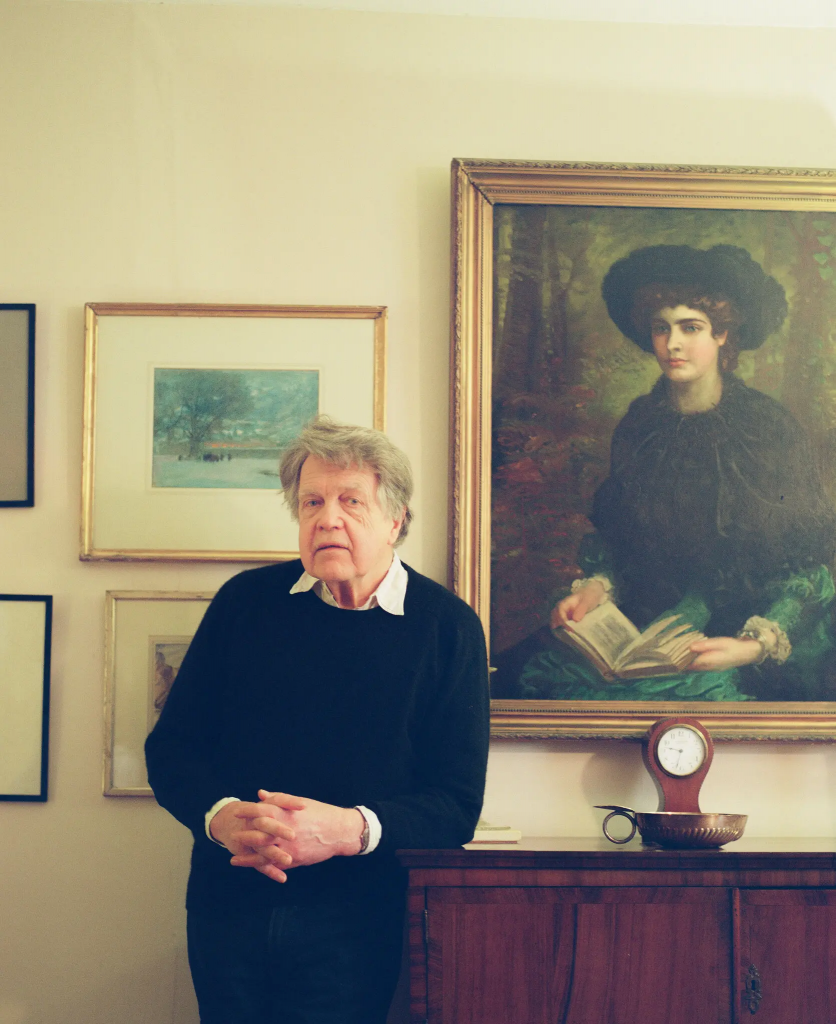
“So much after his death was invented one way or another,” Merlin Holland says of his grandfather, Oscar Wilde. Credit…Clara Watt for The New York Times
By Elizabeth Winkler
- April 10, 2026 (NYTimes.com)
On the evening of Nov. 30, 1994, Merlin Holland sat in a dim side aisle of the Église Saint-Germain-des-Prés, the Paris church where, in 1900, Oscar Wilde had been given a quiet, almost clandestine funeral. Holland had spent the day tracing his grandfather’s final, penniless years in exile for a BBC documentary, and it had disturbed him. That evening, several dozen candles were already burning at the entrance to the chapel, far more than on his previous visits. Working out the day, he realized it was the anniversary of his grandfather’s death.
The fans had remembered; he hadn’t. He sat there with his unlit candle, resenting what felt like the intrusion of strangers on a private moment.
Then something shifted. “Blood and history flowed together,” he writes in a new book, “and I found myself the unwilling conduit for a century of unwept family grief”: for Wilde’s two sons, Cyril and Vyvyan, who were raised to forget him; for his wife, Constance, who stood by him through scandal and imprisonment for “gross indecency,” dying within a year of his release; and for Wilde himself, who never saw his family again after prison.
“For the first time,” Holland wrote, “I felt it was part of me, not just cold, bare facts from the past.”
The book, “After Oscar: The Legacy of a Scandal” (Europa Editions), charts Wilde’s posthumous reputation, but it’s really an investigation into how scandal reverberates, how narratives calcify, how erasure operates. What do we inherit when we inherit shame? And what does it mean to spend your life as both custodian and captive of someone else’s legend?
“He caused more trouble after his death than he ever did alive,” Holland said by Zoom from his home in France. “In spite of himself.”
The book (which came out in the U.S. on April 7) was published in Britain last fall. In a roundup of 2025 books of the year, the Times Literary Supplement called it “not only a fascinating work of family history that induces sorrow and anger,” but also “a highly detailed and extremely valuable refutation of the many fabrications about Wilde that have been unquestioningly repeated by generations of biographers.”
It is, Holland said, the book he has spent his writing life working toward.
As literary executor, he has for 40 years been the family’s chief authority on Wilde: coediting the complete letters, publishing the first uncensored transcript of the 1895 libel trial that eventually led to his imprisonment, creating an illustrated pictorial biography.
“After Oscar” is something different: not an edition or a scholarly apparatus but a 700-page reckoning — with the myths, the distortions, the family damage and his own complicated place in the story.

Holland was born in 1945, into a family that had spent half a century not saying Oscar Wilde’s name. Where his grandfather was theatrical, Holland, now 81, is the opposite: composed and understated. The flamboyance didn’t travel — whatever Wilde passed down, it was not the fur coats or the green carnations.
As a boy, walking down Shaftesbury Avenue with his father, Holland spotted a billboard advertising a musical based on one of Wilde’s plays.
“Was Oscar Wilde your father?” he asked. His father recorded the exchange in his diary: “Fortunately I said ‘yes.’ Fortunately, he left it at that.”
Later, at school, a classmate called Wilde “an old poofter.” Holland thumped him, was hauled before a prefect, and caned.
Still, he doesn’t like to call himself Oscar Wilde’s grandson. “That gives me more importance than I’m due,” he said. “He is the important one in this whole story.”
The ‘second tragedy’
In 1895, Oscar Wilde was the most celebrated wit in London, the author of a string of hit comedies as well as the novel “The Picture of Dorian Gray.” He was also conducting a flagrant love affair with Lord Alfred Douglas.
Wilde’s ill-conceived decision to sue Douglas’s father for calling him a “sodomite” backfired, and led to a trial of his own. Convicted and sentenced to two years’ hard labor, he stood in handcuffs on a rain-soaked train platform while a crowd jeered and spat at him.
His plays were pulled from the West End. His wife took their sons abroad and changed their surname to Holland, an old family name on her side. They never changed it back.
“There’s an element of hubris, of pride — of thinking he’s above the law, that society thinks he’s wonderful,” Holland reflected. “And there’s an element of wanting to please this young man who he loves.”

But Wilde didn’t know it would be the end of his creative life. Holland reached for a line from “De Profundis,” the letter Wilde wrote to Douglas from prison, in which he describes his art as the great passion of his life. Had he anticipated the consequences, Holland said, he never would have walked into that courtroom.
Wilde was released in 1897, crossing immediately to France. He hoped to be reunited with Constance and their sons — but her family couldn’t stomach taking back a convict and known homosexual.
“It was the second tragedy,” Holland said. Wilde never saw his sons again.
Bankrupt and broken, Wilde died at 46 of cerebral meningitis. For decades, biographers promoted a theory that he had died of syphilis, fitting the narrative of a life destroyed by sexual transgression. Holland has spent years dismantling it. “There’s absolutely no evidence for it at all,” he said.
The myth was typical: gossip hardening into biography, biography hardening into fact. “So much after his death was invented one way or another,” Holland said. “I felt I needed to give him a posthumous voice. There was always a sense of the injustice of people using him for their own ends — to sell books, to sensationalize. It needed a little bit of family help to set things right.”
Matthew Sturgis, the author of a full-bore, 800-page Wilde biography, praised Holland for his way with detail. “The points are often small — friendships denied, acquaintanceship overemphasized, gifts and bon-mots invented — but they have a cumulative force,” he wrote by email.
Wilde’s sons responded to their inheritance differently. Cyril was determined “to wipe that stain away,” as he put it, by being unimpeachably masculine. Rejected by the Navy likely because of his paternity, he became a soldier and was killed on the Western Front in 1915, at 30. Vyvyan, Holland’s father, wanted to go to Oxford — Wilde’s university — but the family vetoed it, fearing the connection would be made.

He went to Cambridge instead, where his entry in the college admissions register was the only one without a father’s name: “Father deceased.” He drifted for years before finding his footing as a translator, man of letters and collector of erotic literature. “Vyvyan’s almost overstated heterosexuality was his way of trying to right the family wrong,” Holland said.
Vyvyan eventually wrote a memoir, “Son of Oscar Wilde,” which his son spent years fact-checking, discovering false memories and embellishments.
“I take down ‘Son of Oscar Wilde’ from the bookshelf, and see the inscription ‘For Merlin with fondest love from his Daddy September 1954,’ ” Holland writes, “and I feel a jolt of perfidy at what I’m doing though I know it has to be right.”
When Holland turned 21, his father suggested he take back the Wilde name. “He was asking me to do something by proxy. Something he would have liked to have done himself but couldn’t.” Holland demurred.
“One can’t change history,” he said. “It’s not going to make my father’s childhood any happier. The fact that the family never changed it back is a permanent rebuke to Victorian morality.”
Vyvyan died in 1967, two months before homosexuality was decriminalized in England. His wife, Thelma, went on a crusade to sanitize the family image, visiting the biographer Richard Ellmann to insist Wilde had been “basically heterosexual” and excising pages from Vyvyan’s 19-volume diary with a razor blade. (She didn’t end up persuading the scholar.)
“She felt it was her duty to protect us,” Holland said. “It’s sad, it’s funny, but it’s understandable.” She still visits him in dreams, he said, in full argumentative flow about his grandfather: “It’s all part of the collateral damage of what happened all those years ago.”
‘Monkey in a cage’
At a 1980 production of Wilde’s “The Importance of Being Earnest” in a borough of London, the mayor’s wife turned to Holland and said: “You must be so proud of your grandfather.” But pride was not quite what he felt.
“I had plenty of other feelings about him,” he writes. “Admiration, envy even, for his remarkable facility with words; bewilderment sometimes tinged with anger at the recklessness which destroyed his family’s life as well as his own; and a curious, almost possessive sense of protection about this man whom I had never known; but pride?”

It took decades. Holland wrangled French authorities to protect Wilde’s tomb at Père-Lachaise Cemetery, in Paris, where fans pressed lipstick kisses into the stone, layering tribute on top of tribute until the stone itself needed protecting.
And he participated in Moscow’s first Pride celebration, where neo-fascists disrupted his lecture on his grandfather and he was pelted with eggs and potatoes in the streets. He thought of Wilde being spat on in the rain.
The inheritance stopped feeling like a burden and started feeling like a choice. He is still asked what it’s like to be Oscar Wilde’s grandson.
“It’s like being a monkey in a cage,” Holland said. “Once I had found the way out of that cage, and could stand with the rest of the spectators — that was one of the great ghosts laid to rest. If I have to be in the cage occasionally, I don’t mind. But I’ve got the key to let myself out.”
A version of this article appears in print on May 10, 2026, Page 12 of the Sunday Book Review with the headline: Profile / Merlin Holland. Order Reprints | Today’s Paper | Subscribe
See more on: Oscar Wilde
(Contributed by Michael Kelly, H.W.)