Higher, Better, Stronger, Faster — Brain Science Is Trying To Get There

Note from Michael Kelly:

Does this leading edge product help improve motor skills by enhancing neuroplasticity?  This is a charming, well-produced video report, in a series called Future You.

–M.K.

TRANSCRIPT

RACHEL MARTIN, HOST:

If you want to get good at something, whether it’s piano or golf, we know what works – practice. Do something over and over and over, and your brain eventually masters that activity. But what if your brain could be so ready to learn that you didn’t have to practice something so many times to master it? Some top athletes are training with headsets that are supposed to stimulate their brain cells, make their brains more ready to learn so practice is more effective. NPR’s Elise Hu has been trying it out as part of our video series on how emerging technologies may shape our future. It is called Future You With Elise Hu. And she spoke with Steve.

STEVE INSKEEP, BYLINE: Hi there.

ELISE HU, BYLINE: Hey. Good morning.

INSKEEP: OK, so I watched your video, and you’ve got this thing on. And it looks like one of those old-timey, like, 1990s big, old stereo headsets. What is it really?

HU: That’s right. It’s a headset that looks like headphones like Beats by Dre, but it’s actually a brain-stimulating device that can zap you with tiny currents, so you don’t feel anything. The electrical charge is super low…

INSKEEP: But you’re getting shocked.

HU: Yes (laughter). You are supposed to wear it for about 20 minutes before you practice this golf swing or squats or lunges, any repetitive activity that you could get better at over time. And what it’s doing is it’s priming your brain before you do that activity. So to try it out here at NPR West, I decided to learn something I’ve never done before – vertical jump.

OK, so then…

UNIDENTIFIED PERSON #1: Get comfortable and then just jump straight up. Boom, there it is.

NATE ROTT, BYLINE: Nice.

HU: OK.

UNIDENTIFIED PERSON #1: So you’re looking at 14 inches on the dot.

ROTT: Wow.

HU: OK, 14 inches.

ROTT: That’s more than a foot.

HU: So I needed to actually train on jumping over four to six weeks while wearing this headset. And then NPR reporter Nate Rott did not get a headset. And we trained together.

(SOUNDBITE OF ARCHIVED RECORDING)

HU: Oh, that was much longer than mine. Jeez.

UNIDENTIFIED PERSON #1: Seventeen inches.

ROTT: Got three inches on you.

HU: Oh, my gosh. So he’s already…

So this isn’t…

INSKEEP: He’s the control group, like the placebo. OK, fine.

HU: This isn’t exactly a perfect science experiment, but we wanted to try this to see if I could improve better than he did. So for another month after this, I used this headset before working out. Nate then worked out with me, but he didn’t get a headset.

INSKEEP: OK, so what’s the big thing you’re trying to get at by testing your vertical jump?

HU: So the entire video series Future You is about exploring where new technologies are going to take us by 2050. And in this case, what we’re looking at is electrical stimulation for your brain. The technical term is called transcranial direct-current stimulation. We are still waiting for more of a body of clinical data on this. We do know that one DARPA-funded study showed as much as a 40% improvement in performance in primates.

INSKEEP: DARPA – that’s the Pentagon science guys.

HU: That’s right. They are testing this on the military. The one I used actually does have a contract with the DoD. It’s from a company called Halo. And I asked the founder of the company where he thinks this might lead us a few decades into the future. He’s a Stanford trained MD named Dr. Dan Chao.

DAN CHAO: Like, could we be more attentive and focused as a society? You know, advance ourselves, advance humanity – that’s a good thing.

HU: So you’re expecting kind of a super cognition – right? – like advanced memory capabilities, advanced focus capabilities.

CHAO: Advanced focus and – like, I would use it when I needed to get meaningful work done. If I could have had a neuro stimulator to help me with focus, I would’ve been a better student.

HU: If humans can be upgraded this much, then are we creating different classes of humans? Or even with athletes, there’s asterisks by those who used steroids.

CHAO: There’s legal performance enhancement that’s all around us, like drinking coffee. It’s been identified by the World Anti-Doping Association as performance enhancing, yet it’s legal. What WADA considers illegal is things that are unsafe to the health of the athlete and against the spirit of the sport. I would argue it isn’t.

INSKEEP: OK, it’s said for the moment it’s cool for athletes to use this as they train, which brings us back to your vertical jump, Elise. How’d you do?

HU: So not scientific but after about a month of training with the headset…

(Laughter).

…I was able to increase my vertical jump by 11%.

INSKEEP: Is that good? I don’t know.

HU: Well, it was pretty surprising, even for me.

UNIDENTIFIED PERSON #1: You got some ups.

ROTT: Serious ups.

INSKEEP: How’d Nate do? – the control group.

HU: Nate Rott only increased his vertical jump by 8%. So I like to think I won.

INSKEEP: Well, Elise, thanks very much for the insights – really appreciate it.

HU: You’re welcome.

INSKEEP: Now all of this is on video. You can see it for yourself. The series is called Future You With Elise Hu. It rhymes.

HU: It rhymes.

INSKEEP: And you can find it at npr.org/futureyou.

(SOUNDBITE OF SKINNY WILLIAMS AND STEPHEN GOODSON’S “POP STAR EXPLOSION”)

Copyright © 2019 NPR. All rights reserved. Visit our website terms of use and permissions pages at www.npr.org for further information.

NPR transcripts are created on a rush deadline by Verb8tm, Inc., an NPR contractor, and produced using a proprietary transcription process developed with NPR. This text may not be in its final form and may be updated or revised in the future. Accuracy and availability may vary. The authoritative record of NPR’s programming is the audio record.

Don’t see the video? Click here.

The tried and true way to improve at sports, or music or anything, really, is practice. What if we could master skills a lot faster — with less practice — simply by wearing a brain-boosting headset? I tried the technology behind this claim to improve my vertical jump. In Future You Episode 3, check out the technology and whether my vertical jump got higher — and hear from an Olympic athlete who has tried it as well as the founder of Halo Neuroscience, a company that makes brain-boosting headsets.
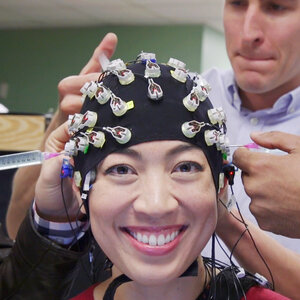
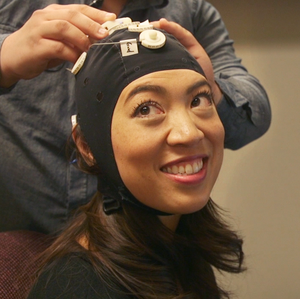
If we can boost our brains to learn in less time, could we keep our brains younger, for longer? Where could we apply this brain hack to get an edge? Should we consider it performance enhancement, like drugs? We’ll explore these questions in this latest episode.

Our season of Future You is dedicated to the human body and what it will be able to do in the future. You can find the latest episodes on YouTube or npr.org/futureyou. And send us your ideas about upgrading humans at futureyou@npr.org or through TwitterInstagram or Facebook.

Are we confusing money with well-being? New Zealand’s leaders believe so.

New Zealand’s recent budget policy puts the health and well-being of its citizens over economic growth.

  • Economists and politicians have traditionally focused on economic growth to set policy and measure how citizens fare.
  • New Zealand has become the first country to put well-being, not growth or production, at the center of its economic policy.
  • Calls for “purposeful capitalism” are emerging in other countries, including the United States.

Politicians love to flaunt economic growth. A healthy gross domestic product (GDP) means an economy is doing well, which means the country is doing well, which means its citizens are doing well. It’s all thanks to sagacious policy crafted by our savvy political leaders.

That’s the rosy narrative anyway. In truth, GDP measures the average of per capita output in an economy overall, but tells us little about the prosperity of individual citizens.

For example, GDP can increase in tandem with income inequality. Social mobility can be quashed even within a prosperous economy. Corruption can take root in rich countries. And production measurements can ignore consequences such as environment degradation.

Some economists argue that our love affair with GDP needs to end and be replaced with more robust economic measurements. As Nobel Prize laureate Michael Spence told The Atlantic:

“Many of us think we would benefit from a multi-dimensional approach that captures things people care about. Missing from [economic] growth are many things: health, distributional aspects of growth patterns, sense of security, freedoms of various kinds, leisure broadly defined, and more.”

New Zealand’s Prime Minister Jacinda Ardern has taken up that call. Last month the island nation unveiled its new well-being budget, a policy designed to put the health and happiness of its citizens at the economic fore.

Happiness as a benchmark of success

Prime Minister-designate of New Zealand Jacinda Ardern before her swearing in. Photo credit: Governor-General of New Zealand/Wikimedia Commons

New Zealand’s new economic policy will shift away from growth and production as a measure of economic success. As noted in New York Times, its new focus will be on “goals like community and cultural connection and equity in well-being across generations.” While other countries have reconsidered traditional economic metrics, New Zealand is the first to initiate such a wellbeing-guided policy.

“This is not woolly, it’s critical,” Ardern said at the World Economic Forum’s 2019 meeting in Davos. “This is how we bring meaning and results for the people who vote for us. It’s not ideological either. It’s about finally saying this how [sic] we meet expectations and try and build trust back into our institutions again, no matter where we are in the world.”

The revised policy sets five priorities for New Zealand’s governmental spending: thriving in the digital age; improving mental health services; reducing child poverty; developing a low-emission, sustainable economy; and addressing inequality, especially among the country’s Maori and Pacific Island peoples.

The new policy has earmarked nearly NZ$2 billion for mental health services. (New Zealand has one of the highest teen and young adult suicide rates among Western democracies.) Resources have also been designated for child poverty and long-term shelter for the homeless, more than NZ$1 billion and NZ$200 million respectively.

Of course, not every New Zealander is onboard with the budget’s new direction. “New Zealanders won’t benefit from a government that is ignoring the slowing economy and focusing instead on branding,” Amy Adams, a lawmaker in the opposition National Party, said in a statement to the Times. “We’re facing significant economic risks over coming years, but this government is focusing on a marketing campaign.”

A well-being paradigm shift?

As noted by the World Economic Forum, it will take years for New Zealand to refine its goals and then quantify the results, but other countries’ well-being experiments will help us gather data in the meantime.

The United Arab Emirates employs a Minister of State for Happiness and a National Program for Happiness and Well-Being. The program sets benchmarks for happiness and fosters conditions of well-being that allow employees to thrive within the country’s economy.

Elsewhere, Bhutan uses a Gross National Happiness index to evaluate its citizens well-being and incentivize policymakers. The index measures nine categories, among them health, education, time use, living standards, and community vitality.

Neither country has budgeted for well-being as New Zealand has, and they still use the GDP growth standard. But both have supplemented traditional economics with more purposeful economic thinking.

Capitalism: the root of all happiness

Can a more purposeful capitalism take root in the United States and other Western democracies? That answer will depend on a whole host of variables, among them New Zealand’s successes and failures. However, there are already calls for similar changes to take place stateside.

In his book The War on Normal People, Democratic presidential candidate Andrew Yang laid the foundation for what he calls “human-centered capitalism.” Yang wants to establish a universal basic income that gives Americans over the age of 18 $1,000 a month, no strings attached. Yang’s so-called “freedom dividend” is the centerpiece of his policy, but his aim is wider is scope. He wants the market to support human experiences it previously undervalued, such as the arts, parenting, teaching, the environment, community connections, and disenfranchised groups.

“We must make the market serve humanity rather than have humanity continue to serve the market. We must simultaneously become more dynamic and more empathetic as a society,” Yang writes.

Similarly, the Green New Deal supports a multiplex of ideas that would feel at home with a wellbeing-based capitalism. To name a few: universal health care, a right to affordable housing, the restoration of Glass-Steagall, and debt relief for students and homeowners.

New Zealand is a small island nation — and so out of the way that it’s often forgotten by mapmakers. Yet, it could be the start of some big changes in how we measure progress and happiness.

Dogs mirror stress levels of their owners

The owner’s personality was the most important factor in examining the stress-hormone relationship between pet and owner.

  • A new study found that dogs and their owners show similar levels of the stress hormone cortisol over time.
  • The dog-owner cortisol relationship seems to be related to the owner’s personality, as measured by the Big 5 model.
  • Ultimately, dog owners needn’t worry that they’re stressing out their pet; not all cortisol indicates “bad” stress.”

Just how empathetic are dogs?

A new study published in Scientific Reports suggests that dogs mirror the stress levels of their owners. The study examined levels of cortisol — a stress hormone — as measured in hair samples taken from owners and their dogs: 25 border collies and 33 Shetland sheepdogs. Results showed a “significant interspecies correlations in long-term stress.”

“This is the first time we’ve seen a long-term synchronization in stress levels between members of two different species,” Lina Roth, an ethologist who led the work at Linköping University in Sweden, told The Guardian.

But surely other factors — how long dogs spent alone, whether they had a garden to play in, how much physical activity they got — also played a big role in stress levels, right? Not so much. What’s more, the dog’s own personality — as measured by an owner-answered questionnaire — didn’t seem to have a significant effect on cortisol levels either.

What did matter was the owner’s personality. After participants answered questions from the Big 5 personality inventory, the researchers found that the personality traits neuroticism, conscientiousness, and openness were strongly correlated with owner-dog cortisol levels. Owners that were more conscientious and open had dogs with higher cortisol levels, but only in the winter. Meanwhile, neuroticism was most strongly correlated with dog cortisol levels — both in the winter and the summer.

However, only female dogs’ cortisol levels increased when their owners scored high in neuroticism; male dogs with neuroticism-prone owners actually had lower cortisol levels.

Why? Possibly because neurotic owners tend to seek more comfort from their dogs, causing the pets to feel less stress.

“There is some indication that humans scoring high on neuroticism form a strong attachment bond to their dogs and that these individuals, to a greater extent than others, use their dog as a social supporter whilst also simultaneously functioning as a social supporter for their dog,” the researchers wrote. “This, in turn, may lead to a positive modulation of the stress response for both parties.”

Roth et al.

The researchers also compared two sets of dogs: those who compete in shows, and companion pets. The results showed a stronger correlation between the competition pets and owners, possibly because competitions foster a strong relationship between the two.

“Dogs are affected by their owners’ distress and respond with consoling behaviours,” James Burkett at Emory University, who wasn’t involved in the study, told The Guardian. “We now know that dogs are also affected by their owners’ personalities and stress levels. While this may be common sense for dog owners, empirical research is still catching up to our intuitions about animal empathy.”

So, does this mean you should feel guilty about stressing your dog out if you share the personality traits of the owners in the study? Not at all. Roth told The Associated Press that cortisol doesn’t always indicate negative stress — it could just be a dog getting excited before going on a walk. Additionally, she noted that researchers are still studying the relationship between owner-dog stress levels, and it’s possible that dogs might hold some effect on owners’ stress levels as well.

Ultimately, her advice is simple: “Just be with your dog and have fun.”

Socrates: Living the Good Life

Virtue Starts with Questioning Beliefs

A Basket of Fruit by Michaelangelo Caravaggio, 1595–6. (Source: Wikipedia)

“This was the end of our friend, the best, wisest and most upright man of any that I have ever known.”

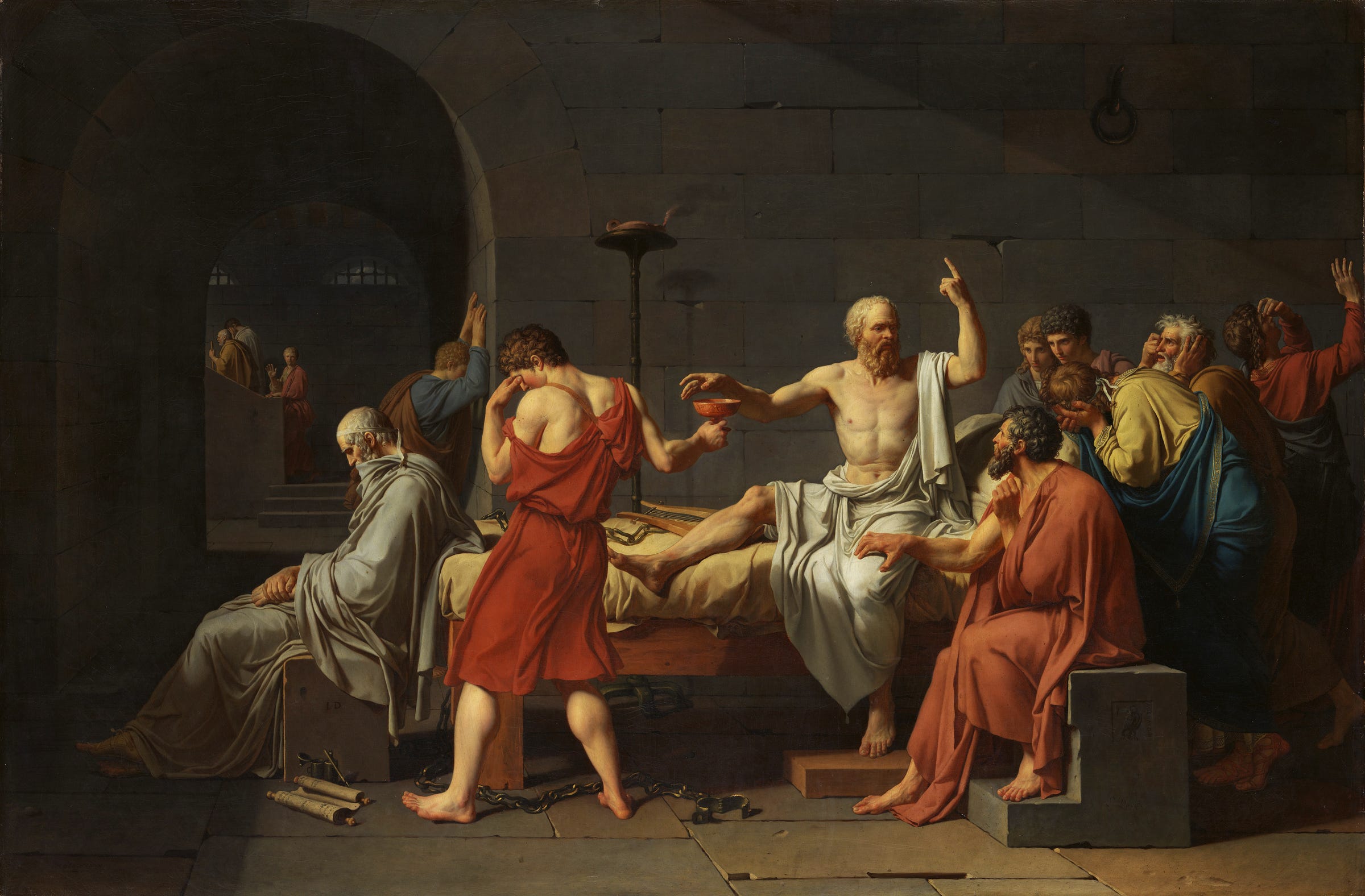
This was said of Socrates by a witness at his death. A cheerful Socrates was surrounded by his weeping followers. He was condemned to drink a cup of hemlock poison by the Athenian authorities, which he drank without protest.

Socrates had been condemned to death not for his beliefs, but for his insistent questioning of others’ beliefs.

Before Socrates, philosophy was largely concerned with questions that we now associate with science: what is the world? And how do we experience it? But Socrates lived in Athens at a troubled time. He was a veteran of the Pelopenisian War, a war that Athens had lost to the rival state of Sparta.

Unlike democratic and artistic Athens, Sparta was an oppressive militaristic state. The Spartans imposed the rule of the “Thirty Tyrants”, a pro-Spartan oligarchy that would impose Spartan rule and wipe out Athenian democracy. It’s estimated that the Thirty Tyrants murdered up to 5% of the Athenian population before being deposed. Athens regained its sovereignty but the once mighty state was scarred by its humiliating defeat.

A War Veteran

As a war veteran and a man who lived through the political upheavals of defeat, Socrates had witnessed the follies of human conceit. His dialogues are more concerned with the question “how should we live?” This changing of priority revolutionised philosophy. Socrates raised questions that were so awkward, so controversial, that the Athenian State condemned him to death.

At the time of Socrates, “Sophistry” was prevalent in Athenian education. Sophistry is the art of rhetoric, the use of cleverness to win arguments by appealing to people’s beliefs and emotions. Socrates disdained the Sophists as being instrumentalists, only concerned with manipulation.

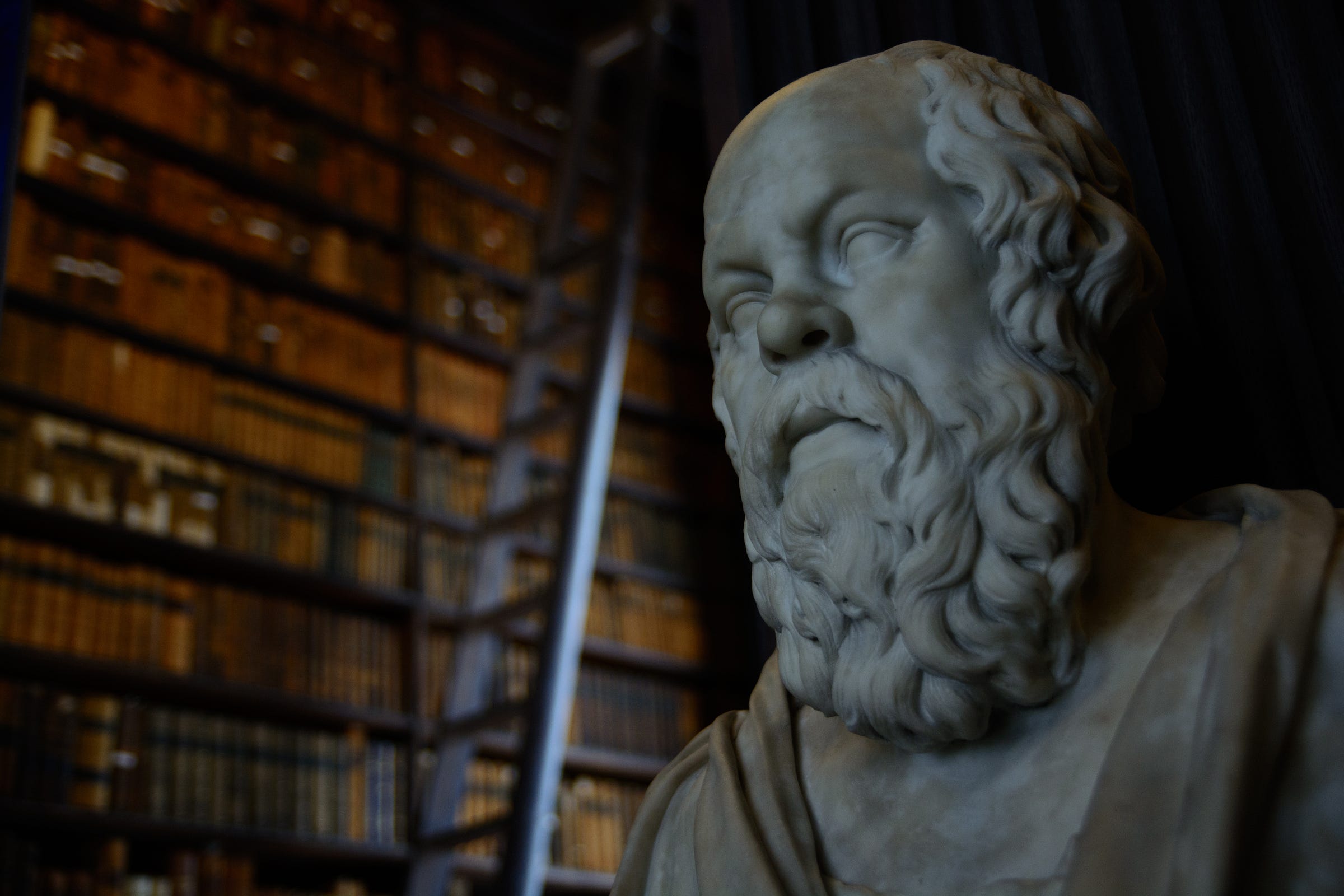
A bust of Socrates in Trinity College, Cambridge (source: Wikimedia Bar Harel CC BY-SA 4.0)

His method — elenchus— appealed to people’s reason by a process of questioning. Socrates would ironically profess to have no knowledge of a concept being discussed. But he would lead people to rational conclusions by asking them questions about the concept.

Socrates questioned what makes people religiously pious, what they think bravery and virtue is, and why they are patriotic. He never came to specific conclusions himself: his concern was to examine widely-held beliefs, often demonstrating that they were baseless or problematic.

The Legacy of Socrates

Socrates never wrote anything down. He taught out in the streets of Athens. However, his followers, the most influential being Plato, broadened out many of the implications of Socrates’s ethical examinations. Xenophon and Plato wrote down their recollections of the Socratic dialogues. Plato, in particular, started to form a cohesive philosophical system from Socrates’s teaching.

Pierre Hadot, a historian of philosophy, wrote that, for Plato, the Socratic method, “turns the soul away from the sensible world, and allows it to convert itself towards the Good.”

Plato’s ideas reconsider how we can know what we know about the world, what is real or not, what is beauty and how we should govern ourselves. These became the five categories of philosophy:

  • Epistemology (how do we know what we know?)
  • Ontology (how do we define reality?)
  • Aesthetics (what is beauty?)
  • Politics (how should we organise ourselves?)
  • Ethics (how should we conduct ourselves?)

Plato built an entire system of thought on the basis of Socrates’s simple questions about how we ought to live our lives. Plato’s ideas, in turn, had an enormous amount of influence on Christianity (the immortality of the soul being an example of an idea not widely held in the ancient world).

The Death of Socrates, Jacques Louis-David. Socrates was executed not for his beliefs, but his insistent questioning of beliefs. (source: Wikipedia)

Ethics dominated philosophy for a long time after Socrates. The Cynics, Stoics and Epicureans derived their ideas of politics, beauty, reality and knowledge from their own ethical viewpoints. Each of these philosophies looked to Socrates as a kind of patron. They believed that Plato’s Academy had done the older philosopher a disservice.

Three Types of Ethics

Ethics is perhaps the most accessible of the philosophical branches. Practically every decision we make every day forces us to question what is right or wrong. We are guided by a mix of rules, reasoning, biases and emotions. Socrates likely held the view that reasoning alone is what is necessary to do the right thing.

There are three fundamental approaches to ethics: consequentialistdeontological and virtue ethics. The first two are rule-based.

When you take a consequentialist approach to your actions you weigh up if they were good or bad based on the expected consequence. For example, it is right to kill one person to save thousands of others.

“Deontological” comes from the Greek word for “ought” or “must”. This is a rule-based approach. Murder is wrong, it is therefore wrong to kill somebody, even if you’d save thousands of others by doing so.

Virtue ethics is a practical approach that rejects rules. Actions are good if they emanate from good traits of character. The decisions we make should be guided by our desire to be virtuous. Socrates was among the earliest to subscribe to this view, it became dominant in the ancient world.

Ethics Through the Ages

All the great philosophers since Socrates have given some form of an answer to the question “how should we live?” Below I’ve given a very basic summary of a selection of them.

Socrates: It is wise to admit that we know very little in order to learn more. Wisdom is the path to virtue and happiness.

Epicureanism: Pleasure is the highest good. But to get pleasure we must stop desiring anything that is more than sufficient for our basic needs.

Stoicism: Virtue is the highest good. We do not have control over external circumstances, only our judgement of them. Judge in harmony with reason for virtue and a tranquil mind.

Immanuel Kant (Idealist): Reason is the highest good. Act in accordance with principles that ought to be the principles for everybody.

Arthur Schopenhauer (Idealist): Man and animal are ultimately part of the one indivisible reality. To harm others is ultimately to harm ourselves.

Friedrich Nietzsche (pre-existentialist): Create your own “self”, rather than let others impose their morality on you. That which is done out of love takes place “beyond good and evil”.

Ludwig Wittgenstein (Linguistic Philosophy): Metaphysical statements about ethics are senseless. Be ethically guided by art and poetry. Philosophers should remain silent on the matter of ethics.

Jean-Paul Sartre (Existentialist): We are condemned to be free. We must embrace our freedom and be authentic to ourselves.

Simone de Beauvoir (Existentialist, Feminist): Our freedom depends on the freedom of others. We must increase the freedom of others to increase our own freedom.

Alain Badiou (contemporary philosophy, Socialist): Our (political) ethics are predicated on our physical fragility, but they should be predicated on the strength of our imagination. We should stay faithful to causes that are authentically good, that would preclude questions of what is right or wrong.

Contemplating the very idea of what is right and wrong is a start to being truly virtuous. I personally like Simone De Beauvoir’s and the Stoics’ ideas of virtue. What’s your preference?


Thank you for reading. I hope you learned something new.

If you liked this article, you may like my article on Nietzsche and his “three steps” to a meaningful life:

Artificial Consciousness — Our Greatest Ethical Challenge

justice

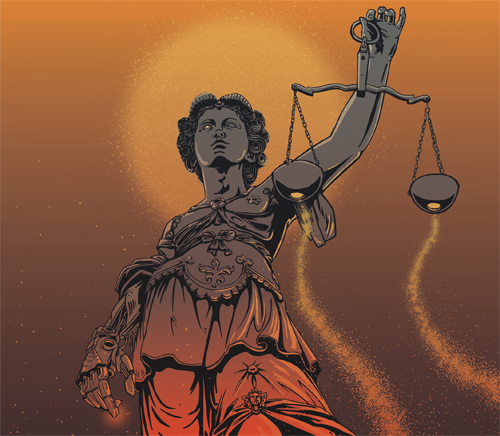
Illustration © Jaime Raposo 2019. To see more art, please visit jaimeraposo.com

Paul Conrad Samuelsson takes the perspective of the computer for a change.

Debate about cutting-edge technological advancements is philosophy à la mode. At the forefront is artificial intelligence, which looks set to become the greatest technological leap in history. No one can comprehend the extent of its possible uses; but among the feats already carried out by merely semi-intelligent software are beating the world’s best human players at chess, diagnosing cancer patients more reliably than trained oncologists, writing music that listeners can’t distinguish from the human-composed, and reading and commenting on extensive legal contracts in seconds. The potential applications of AI are so astounding that it seems we’ll be in a position to outsource all manual work, creative problem-solving, even intellectual labour, in less than a century. It is the greatest promise of our time.

Yet, when the great techno-cultural icons of our time get on stages around the world to discuss AI, the picture is not always optimistic. AI poses some truly enigmatic concerns. Some of the more existential problems have taken centre-stage, concerning the direct risk to humanity of the literally inconceivable potential of self-developing artificial intelligence. Sam Harris, Elon Musk, Max Tegmark and Nick Bostrom all warn of the risk that an AI which can improve itself could come to annihilate modern society as the consequence of a poorly-stated program or neglectful management. For instance, given some task to fulfill, the AI might work out that the easiest way to complete it is to turn the entire planet into a research lab, removing all functions not related to the goal, including all biological life – and doing this with all the emotional investment of a construction crew removing ant hills to make way for a new highway.

The prospect of mass annihilation at the hands of superpowerful computers is terrifying, all the more so for originating in something as human as faulty programming or sloppy routines. A multitude of movies and books depict menacing cyberantagonists creating hopeless dystopias, and this may strike you as the greatest moral risk we face in continuing to develop artificial intelligence. I happen to think that this is not the case, and that our new technology might yield even worse states of affairs. The greatest ethical risks in fact concern not what artificial intelligences might do to us, but what we might do to them. If we develop machines with consciousness, with the ability both to think and to feel, then this will necessitate an ethics for AI, as opposed to one merely of AI. Eventually, we will have to start doing right by our computer programs, who will soon fulfill whatever criteria are required to be considered moral subjects.


There are extensive arguments readily available for a positive answer to the question of whether computers could actually become conscious, which I can only summarize here. Basically, neuroscience seems to suggest that our entire conscious experience originates from our neural activity. This is not the same as a materialist reduction of the mental to the physical, but rather the assertion that whatever consciousness is, its origin is physical, in the brain and central nervous system. Those who argue against even the theoretical possibility of digital consciousness seem to disregard the fact that human consciousness somehow arises from configurations of unconscious atoms. Moreover, it seems that human neurological processes can be described in terms of neural networks – which can already be emulated in computers to the extent of allowing them to recognize pictures or play complicated games. These artificial networks are still comparatively primitive; but eventually – perhaps soon – they will surpass our own neural nets in capacity, creativity, scope and efficiency. So although the ability of computers to feel and suffer seems far off, it is getting nearer all the time.

Assuming, then, that we can come to create consciousness digitally, it ought to be obvious that the suffering of AI is potentially indefinitely more horrendous than even the worst imaginable human suffering. We stand in a position to develop the means for creating amounts of pain which vastly outweigh any previously seen in the history of human or animal suffering. The obstacles to creating biological suffering are demanding – the number of possible biological beings is relatively low, their upkeep is high, and they are prone to becoming desensitized to painful stimuli. In the digital world, when simulated consciousnesses can be programmed in computers to be subject to whatever laws we wish, these limitations disappear.

The consequences are not fully comprehendible, but let me sketch an image of what could be possible. Someone could, for example, digitally recreate a concentration camp, fill it with sentient, suffering AI, and let it run on a loop forever. It may even be possible to turn up the speed of the suffering, so that a thousand reiterations of the camp are completed every second. From the perspective of the AI, this will feel no different from what was felt by those who suffered through the real thing. Then the programmers use the copy-and-paste function on their computer, and double it all again… So the reason that pain-disposed AI is the greatest ethical challenge of our time is that it could so easily be caused to suffer. Picture a bored teenager finding bootlegged AI software online and using it to double the amount of pain ever suffered in the history of the world – all in one afternoon, and from the comfort of a couch.

If this description does not stir you, it may be because the concept of a trillion subjects suffering limitlessly inside a computer is so abstract to us that it does not entice our empathy. But this itself shows us that the idea of the suffering of a sentient program is not necessarily sufficient to give rise to empathy in us – making every person a potential monster from the perspective of the computer.

Perhaps this development seems exorbitantly unlikely, merely a perverse philosophical thought experiment. This would be a failure of imagination on your part. Artificial consciousness will be a desirable development to many, and will have enough applications to warrant significant investment. Financially, AI has already proven to be profitable. That we will make computers properly conscious is already foreshadowed by software which engages directly with us, as smartphone companions and chatbots. Whether by morbid curiosity or by financial incentive, applications of digital sentience will become increasingly widespread. Some people will want to upload their own minds to the Cloud or make backup copies on hard-drives; others will want effortless interesting adventures and interactions. The technology will become available, and sooner or later artificial consciousnesses will be made that are able to suffer, perhaps in order to ensure authenticity or self-correction.

If there are such things as cultural and moral progress, they pale in comparison to the technological explosion that humanity has experienced in the last ten thousand years, faster still in the last century. The advancement of invention is palpable, high-speed and tremendously useful to everyone – few people feel they need further motivation to embrace ever newer and more audacious gadgets, software, and weapons. Yet, as the story progresses, our inventions become more powerful and thereby riskier. So far, the potential mishaps have been manageable. Our historical nuclear disasters have been survivable because of their relative small scale. Artificial intelligence is an invention which promises to be far more destructive if misused. We have the existential risks to humanity which have already been raised by the authors mentioned above. Now we have also seen that there are consequences even more problematic than nuclear holocaust, as weird as that may seem.

Artificial intelligence has for decades been the greatest hope for transcendence and fulfilment in the secularised West. Chasing the unyielding dream of perfecting the world, convinced that we are entitled to anything for which we strive, as so often before, we put ourselves beyond morality. But now we’re claiming our reward at potential costs so terrifyingly great for others that they resemble Dante’s Inferno or Memling’s Final Judgement, perhaps as just the first monument of the forthcoming Homo deus.

© Paul Conrad Samuelsson 2019

Paul is a student in philosophy at Stockholm University and Humboldt Universität zu Berlin, and neuroscience at Karolinska Institutet.

(philosophynow.org)

Your Horoscopes — Week Of June 4, 2019 (theonion.com)

Gemini | May 21 to June 20

Animals have sharper senses than humans and can sense coming events, so it’s unnerving when they start wearing bibs and follow you around smacking their lips.

Cancer | June 21 to July 22

You’ve never considered yourself much of a music person, which means you’ll have a lot of adjusting to do after a high-speed collision with a harpsichord leaves you tragically harmonious.

Leo | July 23 to Aug. 22

Summer is usually thought of as a necessary part of the great cycle of renewal and not a time of looming death, but this year, as the weather warms, you may want to start giving away your things.

Virgo | Aug. 23 to Sept. 22

You’re a remarkably clear-eyed and kindly person, which doesn’t make it any easier for the stars to tell you about your breath.

Libra | Sept. 23 to Oct. 22

An unfortunate time in your life will be unexpectedly extended when the judge explains that he, not you, gets to choose the manner of your community service.

Scorpio | Oct. 23 to Nov. 21

Missing Barry Gibb’s birthday was bad enough, but going on and on about how it was Barry Gibb’s birthday and you missed it is simply intolerable.

Sagittarius | Nov. 22 to Dec. 21

You’ll be happy they can no longer use that eye-for-an-eye business on you, but unfortunately the next line allows them to start in on your teeth.

Capricorn | Dec. 22 to Jan. 19

The strange thing is, no one has been sentenced to be drawn and quartered in your state since the late 18th century, let alone volunteered for it.

Aquarius | Jan. 20 to Feb. 18

Seeking exactly the right sort of closure in life may prove fruitless, but there’s an odd satisfaction in getting all your loved ones to read their lines correctly.

Pisces | Feb. 19 to March 20

You can believe all you want in fate and destiny, but when all’s said and done, you simply lack the willpower to stay out of doughnut shops.

Aries | March 21 to April 19

You’ll find out once and for all who your real friends are when you take the steps necessary to see who does and who doesn’t name you in their will.

Taurus | April 20 to May 20

It’s true you’re learning a lot and being given much to think about, but at some point you’ll have to ask yourself what you really know about this “Jesus Christ.”

Book: “Democracy May Not Exist, but We’ll Miss It When It’s Gone”

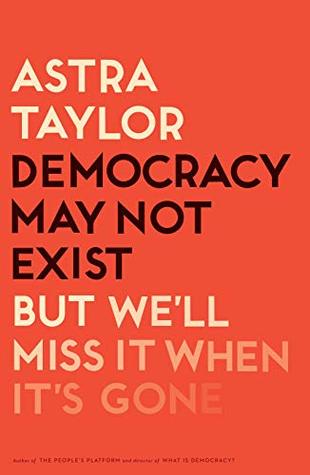
Democracy May Not Exist, but We'll Miss It When It's Gone

Democracy May Not Exist, but We’ll Miss It When It’s Gone

by Astra Taylor

What is democracy really? What do we mean when we use the term? And can it ever truly exist? Astra Taylor, hailed as a “New Civil Rights Leader” (LA Times), provides surprising answers.

There is no shortage of democracy, at least in name, and yet it is in crisis everywhere we look. From a cabal of thieving plutocrats in the White House to rising inequality and xenophobia worldwide, it is clear that democracy—specifically the principle of government by and for the people—is not living up to its promise.

In Democracy May Not Exist, but We’ll Miss It When It’s Gone, Astra Taylor shows that real democracy—fully inclusive and completely egalitarian—has in fact never existed. In a tone that is both philosophical and anecdotal, weaving together history, theory, the stories of individuals, and conversations with such leading thinkers as Cornel West, Danielle Allen, and Wendy Brown, Taylor invites us to reexamine the term. Is democracy a means or an end, a process or a set of desired outcomes? What if the those outcomes, whatever they may be—peace, prosperity, equality, liberty, an engaged citizenry—can be achieved by non-democratic means? Or if an election leads to a terrible outcome? If democracy means rule by the people, what does it mean to rule and who counts as the people?

The inherent paradoxes are too often unnamed and unrecognized. By teasing them out, Democracy May Not Exist, but We’ll Miss It When It’s Gone offers a better understanding of what is possible, what we want, and why democracy is so hard to realize.

(Goodreads.com)

Consciousness, spirituality, biography, sexuality, androgyny, futurism, space, the arts, science, astrology, democracy, humor, books, movies and more