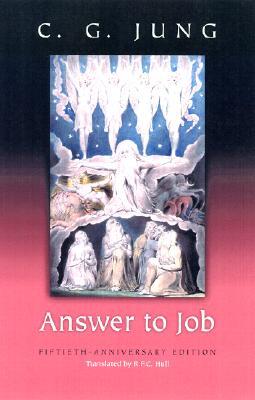
Book: “Answer to Job” by C.G. Jung

Answer to Job

Answer to Job

by Carl Jung,

R.F.C. Hull (Translator)

Jung has never pursued the “psychology of religion” apart from general psychology. The unique importance of his work lies rather in his discovery and treatment of religious, or potentially religious, factors in his investigation into the unconscious as a whole and in his general therapeutic practice. In Answer to Job, first published in Zurich in 1952, Jung employs the familiar language of theological discourse. Such terms as “God,” “wisdom,” and “evil” are the touchstones of his argument. And yet, Answer to Job, perhaps Jung’s most controversial work, is not an essay in theology as much as it is an examination of the symbolic role that theological concepts play in a person’s psychic life.

(Goodreads.com)

(Recommended by Richard Branam)

SUNDAY NIGHT TRANSLATION GROUP – 5/12/19

Translators:  Melissa Goodnight, Richard Branam, Mike Zonta, Hanz Bolen

SENSE TESTIMONY:   The outdated instinct to reproduce is leading to overpopulation and undermines nurturance.

5th Step Conclusions:

1)  Truth is the only cause and the only effect, the only foundation and the only superstructure, all that can be produced, all that can result, the only instinct inhabiting infinity, feeding and cherishing all.

2)  Truth is One Infinite Consciousness Beingness — constantly and eternally supporting the limitless variety of mutable expressions, which always regenerate and procreate the consummate quality of this perfect Universal Life.

3)  Universal Integrity of Each and Every Individuation of All One Mind I Am is marking Gratitude, clear strong guidance, sustenance and joy always, everywhere, instantaneously.  OR:  Integrity I Am Universally sustains and guides with joyous gratitude.

4)  Truth is the Popular Intention Being One Infinite Mind: I THOU AMNESS. this MEANS; Meaningful Purpose is the Stimulus Response Incitefulness, Promptly calling forth this Innate Functional Instrument Is Christ Consciousness Being Ecstatic Nurturing Feminine Tendency Provoking the Mothered Maturation, this Spirit to Act in Pure Rhythmic, Harmony of the Infinite Androgynous Identity.

The Mueller Report

The Mueller Report, formally titled Report on the Investigation into Russian Interference in the 2016 Presidential Election, is the official report documenting the findings and conclusions of Special Counsel Robert Mueller‘s investigation into Russian efforts to interfere in the 2016 United States presidential electionallegations of conspiracy or coordination between Donald Trump‘s presidential campaign and Russia, and allegations of obstruction of justice. The report was submitted to Attorney General William Barr on March 22, 2019,[1] and a redacted version of the 448-page report was publicly released by the Department of Justice (DOJ) on April 18, 2019. It is divided into two volumes.

More at:   https://en.wikipedia.org/wiki/Mueller_Report

Link to Mueller report:  https://www.justice.gov/storage/report.pdf

Social democracy isn’t socialism

By Eva Schiorring 

My mother did not reveal much about herself, but one thing was clear. She had lived for 45 years in the same house in Naerum, Denmark, and did not want to move into a rest home. “I want to die in my nest,” she said, quoting a Danish queen. A big fan of everything royal, my mother had hoped I would marry a count. Her first wish came true; the second did not.

My mother stayed in her house, despite being diagnosed with dementia five years before her death at 95. She was able to do this thanks to the remarkable home aides who came to the house four times each day. They knew my mother very well, including her aversion to having anybody help her with anything. The first time they brought along groceries, she threw them in the trash, declaring, “I do my own damned shopping.” So they invented a system where one of them would keep my mother occupied in the living room while a colleague stooped under the window and delivered the groceries to the kitchen through the back door before sneaking out. My mother’s neighbor, also elderly and frail, loved Thor, her dog, more than anything. So what did her home aides do? They walked Thor.

What is this? Well, it is social democracy in action. My mom did not have to pay for her home care. As the other members of the family said: “She already paid for it in taxes.”

And yes, taxes in Denmark are relatively high. With income from these taxes, the Danish state supports a national health care system, a good public education system, college tuition within certain guidelines, services for the elderly and disabled, and much more.

The Danes were astonished when I told them I pay $1,350 a month for a terrible health insurance plan. They could not believe that care for my best friend’s demented dad was $8,000 a month. “But U.S. taxes are low,” they might say. “Yes,” I agreed, “but total expenses are higher when you consider health care, elderly care, college tuition and on and on.”

When I was growing up, there was a tax revolt in Denmark, and the focus in the ensuing public debate was entirely on how much people had to pay. Now, 40 years later, people still complain about high taxes, but almost always proceed to list the benefits they get in exchange for paying into the social compact of services.

I think the change in public opinion is largely caused by Danes looking at the United States and recognizing that they do not want a society that allows people to fall through the cracks because of an unexpected illness, limited access to a decent education, or from simply growing old without a support system.

We are seeing an incipient shift in opinion in the United States and especially in California where it has become incumbent on all politicians to stake out a position on single-payer health care, improved access to affordable housing, and free college. In San Francisco, tuition at City College of San Francisco is free for local residents. An initiative to extend free tuition for 10 years will be on the ballot in the next election. San Francisco is also debating a tax on stock-based compensation with the proceeds supporting programs for affordable housing and workforce development.

The Republicans have been quick to label any talk of single-payer health care and other publicly funded programs that increase access to basic human services as “socialism.” But it is not. It is social democracy. The difference is vast.

Socialism means the state owns the means of production. Social democracy, by contrast, is — and I quote Collins’ English dictionary: “a political system according to which social justice and equality can be achieved within the framework of a market economy.”

Denmark, a social democracy, has a strong market economy. Unemployment is below 5 percent. The stock market is strong. Danish entrepreneurship is thriving. Think Maersk, Novo Nordisk, Bang & Olufsen, Lego, to name a few.

As UC Berkeley Professor Robert Reich has pointed out, we need to talk about taxes as investments. Not all tax spending is equal. The idea of wasting billions of tax dollars on a senseless border wall infuriates me. But I’m happy to pay taxes to support good local schools. That is a good investment. And I would be happy to pay more taxes to ensure that everybody can access health care, higher education, and social support they need, when like my mom, they can no longer manage alone.

I think most Americans, like most Danes, would be willing to pay for these kinds of investments. What we need are politicians who can explain the principles of social democracy and help voters understand that taxes are not inherently bad — it all depends on how they are invested. With more wisely invested taxes we may even be able to afford a public education system that would equip most Americans to grasp that it is nonsensical to talk about universal health care as inherently socialist.

Eva Schiorring is a dual citizen of Denmark and the United States. She lives and works as a researcher in Kensington. Robert Reich was her favorite professor at Harvard’s Kennedy School of Government. Schiorring grew up in Denmark and, after her mother’s death, recently spent three months in her native country. To comment, submit your letter to the editor at SFChronicle.com/letters.

Art Kunkin, Free Press publisher who was the pied piper of counterculture in L.A., dies at 91

By STEVE MARBLE

Art Kunkin, Free Press publisher who was the pied piper of counterculture in L.A., dies at 91
Art Kunkin stands next to a computer with his World Wide Free Press home page in an undated photo. Kunkin was the founder of the L.A. Free Press, a hub for the counterculture movement in the 1960s. (Bob Carey / Los Angeles Times)


Art Kunkin, the rumpled, curly-haired publisher who arose as the pied piper of L.A.’s counterculture movement in the 1960s with the irreverent but vital Los Angeles Free Press, has died in hospice care in Joshua Tree.

Kunkin, who offered readers a brew of politics, drug talk and rock ’n’ roll, died April 30 at the Institute of Mentalphysics, where he’d lived for years studying philosophy, alchemy and meditation. He was 91. No cause of death was given.

The Free Press — known as the Freep to those who loved or loathed it — rolled onto the streets as L.A. was barreling toward the Watts riots, a tabloid that covered the antiwar movement, the emerging hippie scene and the free speech rallies at UCLA and Berkeley. It was derisive, profane yet sweetly life-affirming.

Inspired by the Village Voice in Greenwich Village and the listener-sponsored radio station KPFK-FM in Hollywood, the Free Press was all things the Los Angeles Times was not.

Kunkin said the mainstream media tended to cover all the events plaguing L.A. as isolated, unconnected events. The Free Press viewed the growing unease in the city as something larger and far more sinister.

“The sense of the 1960s alternative press was that these issues were all connected, that indicated a certain sickness in society,” Kunkin told The Times in 1996.

A 1967 file photo of Art Kunkin.
A 1967 file photo of Art Kunkin. (File photo)


Launched in 1965, the Free Press was run out the Fifth Estate coffeehouse on Sunset Boulevard. The working environment was familial — reporters, aging beatniks, children, street musicians and the lost and confused milled about in what passed for a newsroom.

The late author Harlan Ellison, then a reporter for the Free Press, said in a 1996 interview that the tabloid seemed to function like “a rambunctious baby with a shotgun in its mouth; it didn’t know when to shoot.”

And that, perhaps, is what upended the paper’s run as the city’s edgy counterweight to the button-down stiffness of L.A.’s traditional media.

For reasons that were never abundantly clear, in the summer of 1969 — as Charles Manson’s followers were terrorizing the city and Neil Armstrong was stepping onto the moon — Kunkin published the names, phone numbers and addresses of 80 narcotics officers in California. “There Should Be No Secret Police,” the headline blared.

The reaction was explosive.

Kunkin was sued by the state and Los Angeles. After two years of legal skirmishes, he was ordered to pay $53,000 in damages, enough to bankrupt the paper. The Free Press limped along for several years before shutting its doors in the late ’70s.

Born in the Bronx in 1928, Kunkin became a tool and die maker. Politically active, he became an organizer for the Socialist Workers Party and later worked for the party’s paper, the Militant. He came west in the 1950s, continuing to work on an assembly line.

In 1964, he was asked to publish an eight-page newsletter for the Renaissance Pleasure Faire in L.A. Kunkin filled it with strange and fantastical stories — Joan Baez’s supposed tax strike, an obscenity bust during a showing of the film “Scorpio Rising.”

The first issue of the Los Angeles Free Press was printed in July 1964. Along with his wife, Abby Rubinstein, Kunkin put up $200 to bankroll the paper, money spent mostly on postage to solicit advertisers. The couple edited the paper at their dining room table, writing headlines, cropping photos, keeping their fingers crossed it would all somehow work.

The paper sold for a quarter, nearly double what The Times cost at a newsstand. The lifeblood of the Free Press were sex ads, which were unwelcome in traditional family newspapers. By 1969, circulation had swelled to 100,000 and the paper had growing political clout.

View image on TwitterView image on Twitter

Matt Haber@Matthaber

Los Angeles Free Press cover archive in honor of the late Art Kunkin: (https://www.nytimes.com/2019/05/08/obituaries/art-kunkin-dead.html ): http://www.adsausage.com/covers4/ 

See Matt Haber’s other Tweets


The Free Press turned Kunkin into a high priest of resistance in L.A. He swapped story ideas with Yippies founder and satirist Paul Krassner, discussed music with Frank Zappa and hung out with Timothy Leary. In 1973, with his legal bills due, Kunkin closed the Free Press.

It was revived briefly after it was purchased by Hustler publisher Larry Flynt and then shut for good when Flynt was shot in 1978.

For a while, Kunkin taught journalism at Cal State Northridge and then became involved with several efforts to revive the Free Press. None lasted.

Finally he faded away, heading off to Salt Lake City where he studied alchemy at the Paracelsus Research Society for seven years. He moved to the Joshua Tree compound after returning to California.

Lionel Rolfe, the late Herald Examiner columnist and author, said he first met Kunkin in the 1960s at the Sunset Boulevard coffeehouse. Rolfe wrote in a blog that his old friend remained as spirited and bohemian as ever at the desert institute, living in a trailer surrounded by a mountain of books and records.

“Those days are forever gone,” Rolfe wrote of the Free Press days. “Now Art reads The Times, mainly the obituaries to see which of his old Marxist comrades has died.”

Kunkin’s first two marriages ended in divorce. A third wife, Elaine Wallace, died in 2017. He is survived by two daughters, Anna and April Fountain.

Shakerism and the God Head

Great Stone Dwelling, Enfield New Hampshire

The Great Stone Dwelling, Enfield, New Hampshire. Built by the Shakers 1837-1841.
Photograph courtesy of Enfield Shaker Museum, Enfield, NH.

Shakerism and the God Head

By Arthur Gagnon, Jr. (shakerworkshops.com)
Interpreter, Enfield Shaker Museum, Enfield, NH

Individuals from all walks of life visit our museum. Their questions are varied and sometimes complex. Many are interested only in the furniture, while others are interested in Shaker history and theology. It has been my experience that Shaker theology is the one area least understood by our visitors, especially the concept of the Godhead. In an effort to better explain the Shakers and their beliefs, I looked at Shaker texts, both early and contemporary. I offer the following comparisons between the traditional Christian Godhead, the Holy Trinity, and the dual deity of the Shakers.

Central to any religious belief system is a definition of the Godhead. The traditional Christian Godhead—the Holy Trinity—is revealed in Old and New Testament scripture. The Oneness, or unity of the Godhead, is illustrated by Deut. 6:4:

Hear, O Israel: The Lord our God is one Lord.

The three distinct Persons of the Trinity are readily seen in Matthew 28:19 of the “Great Commission”:

Go ye therefore, and teach all nations, baptizing them in the name of the Father, and of the Son, and of the Holy Ghost.

The following example of the Trinity is often used as a benediction: The grace of the Lord Jesus Christ, and the love of God, and the communion of the Holy Ghost, be with you all. Amen. (II Corr. 13:14)

The preceding passages of scripture illustrate the mysterious nature of the Trinity. Within the Oneness and the unity of the Godhead, there are three distinct and coequal persons.

Any discussion of Shaker beliefs must include Mother Ann Lee, the seminal figure in Shaker history. Historians Anna White and Leila S. Taylor, also members of the Mt. Lebanon, NY, Shaker community, highlighted Mother Ann’s importance in a single sentence:

Among the revelations to Ann Lee and imparted through her life and teachings, were ideas new to the Christian World (White &Taylor 1905:255).1

Central to the teachings was the duality of God. Mother Ann Lee taught the Believers that God was a duality of Father and Mother, and not an all male Trinity (as defined in “God is Dual” below). White and Taylor felt compelled to vigorously examine the concept of the Trinity. In the following carefully worded definition of the Shaker Godhead, it is obvious that they were defending their unorthodox beliefs:

God is Dual

Shakers believe in One God—not three male beings in one, but Father and Mother. And here the Bible reader turns at once to Genesis 1:26.
“And God said”—in the beginning of creative work, whether by fiat or evolution matters not—“let us make man in our image, after our likeness.” Did three masculine beings appear, in contradistinction to every form of life heretofore known? Nay! Verse 27 says: “So God created man in His own image, in the image of God created He him, male and female created He them” (White & Taylor 1905:255).

The above definition uses Genesis 1:26-27 to illustrate their belief that male and female are mirror images of the maleness and femaleness of God, the Father-Mother progenitor.

The following is a clear and concise contemporary explanation of the Shaker Godhead. It can also be found at the Sabbathday Lake website:

Having no body, God has no sex in our human understanding of the term; yet being pure spirit He may be thought of by man with his limited power of comprehension as having the attributes of both maleness and femaleness. This duality of attributes within God’s oneness is one of the Shaker theological concepts most misunderstood by the world (Johnson 1969:6).

Most of the misunderstanding regarding the Shaker Godhead may come from “the world’s people” who assume that Shaker beliefs are the same as orthodox Christianity. However, there are clear and profound differences.

Hervey L. Eads, a Shaker Bishop of South Union, Kentucky, defended and promoted Shaker beliefs in an 1889 publication called Shaker Sermons: Scripto-Rational. The following is a spirited examination of Trinitarian concepts:

I am well aware that your divines (?) when closely pressed, acknowledge the Unity of the Supreme Being . . . . and so interpret words as to make you believe that the terms unity and trinity are synonyms. . . . . . . But these divine reasoners, whilst they declare that the Son is the Father still hold that there is a Father aside from the Son . . . . . But the defenders of the triple-God doctrine say the three are combined in a “mysterious yet all harmonious union” . . . (Eads 1889:14-16).

The notion that the Trinity is a great mystery is answered by Eads in the following statement, “God is no mystery to those to whom He is revealed” (1889:17).

A booklet, Plain Talks, published by the Shakers at Watervliet, New York, circa 1882, states under the section titled “Are the Shakers Spiritualists?”:

By our Spiritualism we are become confirmed infidels to the foolish Bodily Resurrection theory; to the untrue and disappointing Atonement doctrine; to the monstrous Trinity scheme; to the cruel Predestination belief, and to all the man-made creeds of the popular churches professing Christianity (Lomas 1882:12).

In this strongly worded booklet, the Shakers leave no doubt about their opinion of the Trinity and firmly state their position as Spiritualists, believing in the Second Coming in spirit rather than in flesh. This booklet reveals other Shaker theological concepts that should be studied as well. 2

The belief that God is dual, both male and female, is fundamental to the development of Shaker theology, which is reflected in the organizational structure, the architecture, and the sacred imagery of Shakerism. One’s appreciation and understanding of Shaker gift drawings is greatly enhanced by knowing that the symmetry and unity have theological foundations. In his publication The Testimony of Christ’s Second Appearing, Shaker theologian Benjamin S. Youngs expounds on the idea that the dual essence of the Godhead is reflected in Jesus and Ann Lee, Father-Son, Mother-Daughter. Thus the notion of the dual Godhead, as well as the dual messiahship, completes the symmetrical and spiritual balance. Youngs writings will be further examined in a subsequent article.3

The Shakers have a long and remarkable history. We, as interpreters, answer questions about our displays, discuss the millennial laws, and inspire our visitors to marvel at the inventions and products that the Shakers produced and sold. Our interpretations should be balanced and responsive. When we answer questions about Shaker beliefs accurately and contrast them with other communal societies in a meaningful way, visitors leave with a deeper understanding of the Shakers as a radical religious sect.

Works Cited

Eads, Hervey L. Shaker Sermons: Scripto-rational. Containing the Substance of Shaker Theology. Together with Replies and Criticisms Logically and Clearly Set Forth, Fifth edition. rev. and enl. (South Union, KY: 1889). [ A digital edition of the Fourth edition of this book is now available on line.]

Johnson, Theodore E. Life in the Christ Spirit: Observations on Shaker Theology (Sabbathday Lake, ME: United Society of Shakers, 1969).

Lomas, George Albert. Plain Talks: upon Practical Christian Religion; Being Answers to Everrecurring Questions Concerning the Shakers Prominent among which is the Answer to “What Must an Individual Do to Become a Shaker?” (Watervliet, NY: The Shakers, [1882?]).

White, Anne and Leila S. Taylor. Shakerism, Its Meaning and Message (Columbus, OH: Press of Fred J. Herr, 1905). [ A digital edition of this book is now available on line.]

Youngs, Benjamin S. The Testimony of Christ’s Second Appearing Containing a General Statement of All Things Pertaining to the Faith and Practice of the Church of God in this Latter-day, Second edition, Corrected and Improved. (Albany, NY: E. & E. Hosford, 1810). [ A digital edition of this book is now available on line.]

1. See White and Taylor 1905:255-270 for further study.

2. Held in the Rauner Rare Book Collection, Dartmouth College Library, Hanover, NH.

3. See Youngs 1810 for the role of Ann Lee as Messiah.

Copyright © 2005 Enfield Shaker Museum. Used by permission.

Translation Adventure

Heather Williams is inviting you to a scheduled Zoom meeting.
Topic: TRANSLATION ADVENTURE
Time: May 12, 2019 7:00 AM Pacific Time (US and Canada)
.
Join Zoom Meeting
.
One tap mobile
+16699006833,,839971019# US (San Jose)
+19292056099,,839971019# US
Dial by your location
       +1 669 900 6833 US (San Jose)
       +1 929 205 6099 US
Meeting ID: 839 971 019
Find your local number: https://zoom.us/u/adfbYz4l0a

Gabor Maté – The Roots of Healing


Sounds True
Published on May 1, 2019
A renowned speaker, and bestselling author, Dr. Gabor Maté is highly sought after for his expertise on a range of topics including addiction, stress and childhood development.
Subscribe to Sounds True for more: http://bit.ly/2EAugMf

Tami and Gabor talk about the immune system and how it is connected to healthy, emotional expression, and why it matters so much that we own our healthy anger and express it. They also talk about how our body can function as a teacher, and how Gabor views such diagnoses as ADHD and depression, and how his views differ from the way the medical community views those conditions.

Sounds True was founded in 1985 by Tami Simon with a clear mission: to disseminate spiritual wisdom. Since starting out as a project with one woman and her tape recorder, we have grown into a multimedia publishing company with more than 80 employees, a library of more than 1500 titles featuring some of the leading teachers and visionaries of our time, and an ever-expanding family of customers from across the world. In more than three decades of growth, change, and evolution, Sounds True has maintained its focus on its overriding purpose, as summed up in our Mission Statement.

Connect with us:
Facebook: http://bit.ly/2XFIIeE
Instagram: http://bit.ly/2UlEoiH
Website: http://bit.ly/2tOl02d