Your Horoscopes — Week Of March 26, 2019 (theonion.com)

Aries | March 21 to April 19

It’s very principled of you, not to mention brave, to stand by your beliefs, but by week’s end you’ll have graphically conclusive proof that bullfighting is not fake.

Taurus | April 20 to May 20

You were just being clever, if a bit arch, when you said “Either this wallpaper goes or I do,” but the wallpaper will use its powerful social connections to have you ostracized from polite society.

Gemini | May 21 to June 20

It was probably a little cynical for you to have used such base physical tactics to get a husband, but on the other hand, he doesn’t seem to mind.

Cancer | June 21 to July 22

You’ve always thought your life would be better if you could go back in time and tell yourself a few things, so it’ll be pretty depressing this week when you find out you’ve tried that already.

Leo | July 23 to Aug. 22

You’ve always believed that everything happens for a reason, so there will probably be a perfectly reasonable explanation for what the less philosophical would call your senseless death next week.

Virgo | Aug. 23 to Sept. 22

Sometimes, it feels as if your life’s long, empty hours are all beginning to blur together, but take heart. There really aren’t very many left.

Libra | Sept. 23 to Oct. 22

Although the doctors want to do all they can to help ease your recovery, they cannot legally allow you to make a cool chair out of your severed limbs.

Scorpio | Oct. 23 to Nov. 21

Scorpio is a water sign, with all that implies, but this week it will be much more important for you to pay attention to fire-exit signs.

Sagittarius | Nov. 22 to Dec. 21

You’ll continue to be baffled by people who expect you to be their friend and call them just because you have previously said the words “we’re friends” and “I’ll call you.”

Capricorn | Dec. 22 to Jan. 19

Love magick is strong in Taurus this week, leading those lucky enough to be born under that sign far, far away from you.

Aquarius | Jan. 20 to Feb. 18

Your death will be painful, but it will give a notorious femme fatale a chance to say “I’m afraid I’ve always had a rather sharptongue.”

Pisces | Feb. 19 to March 20

Your life will soon lose all direction, which, considering how it has been going, should come as a vast relief.

The Boy Crisis

What is the Boy Crisis?

It’s a crisis of education. Worldwide, boys are 50 percent less likely than girls to meet basic proficiency in reading, math, and science.

It’s a crisis of mental health. ADHD is on the rise. And as boys become young men, their suicide rates go from equal to girls to six times that of young women.

It’s a crisis of fathering. Boys are growing up with less-involved fathers and are more likely to drop out of school, drink, do drugs, become delinquent, and end up in prison.

It’s a crisis of purpose. Boys’ old sense of purpose—being a warrior, a leader, or a sole breadwinner—are fading. Many bright boys are experiencing a “purpose void,” feeling alienated, withdrawn, and addicted to immediate gratification.

Image may contain: one or more people and closeup

Warren Farrell talks to Ken Wilber take an in-depth look at the many social, cultural, and psychological challenges that young boys are facing today, while noting how many of these challenges are the products of well-intentioned — but often misguided — feminist praxis.

Not that feminism is inherently hostile to men. Far from it. As Warren notes in his book, many prominent feminist leaders over the decades have understood the critical role that fathers play in their children’s development and psychological well-being. He quotes Gloria Steinem, who famously said, “what the world needs now is more women at work and more dads at home”. He also recalls Betty Friedan’s popular book, The Second Stage, which was a call for men to consciously begin the same process of self-liberation and redefinition of their identities and roles that women have struggled with over the last century — going so far to say that the major goals of feminism can never be fully attained if men are not also engaged in an equivalent praxis on their side. As the saying goes, if you only row the boat with one oar, you’re just going in circles.

As the era of #MeToo continues to put a spotlight upon the many inertias, indignities, and injustices that women face in the public sphere, Farrell and Gray are bringing some much-needed attention to the inertias, indignities, and injustices that men are experiencing in the public and private spheres, and in their private lives.

“We have seven federal offices of women’s health, and zero federal offices of men’s health. Can you imagine the sexism that we would accurately be accused of if women died five years earlier than men, and died earlier of 14 out of 15 of the leading causes of death, and we had seven offices of men’s health, and zero offices of women’s health? It’s not conceivable that that would be the case. Yet that is the case. And more potently, no one is protesting it, and very few people even know about it.” ~ Warren Farrell.

 This critical discussion helps us better understand the enormous anxieties and rates of depression that many men are facing today, resulting in men committing suicides 350% more often than women. Men have traditionally been regarded as “disposable heroes” by society — as Warren often says, a man has classically demonstrated his value to the family by being away from the family, i.e. earning money. And when the “hero” side of that equation gets deconstructed by extreme feminism, men are left only with their disposability. When men are surrounded on all sides by messages they are inherently biased, privileged, toxic, and unconscious participants in all kinds of social evils, they are left with no solid ground to stand upon in terms of their identity — the lack of a strong “men’s movement” results in a lack of resilience when their traditional identities are dismantled, which leads to increased fragility, increased desperation, and yes, increased toxicity. Which means that the praxis that is most critical of “toxic masculinity” — extreme feminism — is itself partly responsible for creating that toxicity in the first place.

Power and powerlessness both lay at the heart of our ongoing cultural discussion of equality among the sexes. Too often we perceive this as a somewhat binary distinction — one group as the oppressor, the other as the oppressed — and thus one gender’s power tends to be defined by another group’s powerlessness. But there is much more to this story: both men and women experience power and powerlessness, and no single gender has a monopoly on oppression. Or, as Warren Farrell often points out, “the weakness of men is the facade of strength, while the strength of women is the facade of weakness.”

Just as the industrial age helped create the conditions allowing for women to move en masse into the public sphere, challenging and overcoming and transforming the cultural inertia of previous generations, perhaps the information age will afford men a similar opportunity, as new technologies like automation will force men to redefine their identity in relation to things like work, career, and money, and to hopefully confront and liberate themselves from the deeply harmful legacy of disposability and detachment that has come to define men’s roles in culture and society.

Written by Corey deVos
Image by Jeff Lieberman

Real Magic with Dean Radin

March 25, 2019 (awake2onenessradio.org)

By Caroline Chang

Dean is the Chief Scientist at the Institute of Noetic Sciences (IONS) and he turns a critical eye toward such practices as telepathy, clairvoyance, precognition and psychokinesis. Are such powers really possible? Science says “Yes”.

According to noted scientist and bestselling author of The Conscious Universe, Dean states that magic is a natural aspect of reality, and each of us can tap into this power with diligent practice. However, aren’t things like ESP and telepathy just wishful thinking and flights of the imagination? Not according to Dean, who worked on the US government’s top secret psychic espionage program known as Stargate.

Dean has spent the last forty years conducting controlled experiments that demonstrate that thoughts are things, that we can sense others’ emotions and intentions from a distance, that intuition is more powerful than we thought, and that we can tap into the power of intention (think The Secret, only on a more realistic and scientific level). These dormant powers can help us to lead more interesting and fulfilling lives.

Beginning with a brief history of magic over the centuries, what was called magic two thousand years ago is turning out to be scientific fact today, a review of the scientific evidence for magic, a series of simple but effective magical techniques. The key is mental focus, something elite athletes know a lot about, Dean then offers a vision of a scientifically-informed magic and explains why magic will play a key role in frontiers of science.

Dean Radin , PhD, is Chief Scientist at the Institute of Noetic Sciences and Associated Distinguished Professor at the California Institute of Integral Studies. He earned an MS in electrical engineering and a PhD in psychology from the University of Illinois, Urbana-Champaign. Before joining the research staff at IONS in 2001, Dean held appointments at AT&T Bell Labs, Princeton University, University of Edinburgh, and SRI International. He has given over 500 talks and interviews, and he is author or coauthor of hundreds of technical and popular articles, four dozen book chapters, and four popular books: The Conscious Universe (1997), Entangled Minds (2006), Supernormal (2013), and Real Magic (2018). These books are all in print, together they’ve sold over 120,000 copies, and they’ve been translated into 14 foreign languages so far.

To learn more about Dean visit his website:
http://www.deanradin.org/

Real Magic

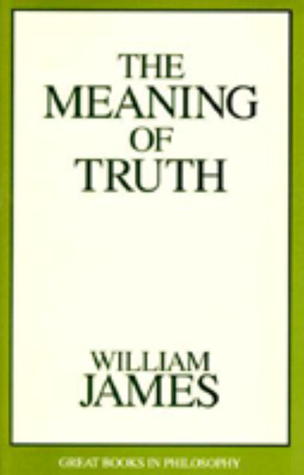
Book: “The Meaning of Truth”

The Meaning of Truth

The Meaning of Truth

by William James

Preeminent American philosopher and educator John Dewey (1859-1952) rejected Hegelian idealism for the pragmatism of William James.

In this collection of informal, highly readable essays, originally published between 1897 and 1909, Dewey articulates his now classic philosophical concepts of knowledge and truth and the nature of reality. Here Dewey introduces his scientific method and uses critical intelligence to reject the traditional ways of viewing philosophical discourse. Knowledge cannot be divorced from experience; it is gradually acquired through interaction with nature. Philosophy, therefore, has to be regarded as itself a method of knowledge and not as a repository of disembodied, pre-existing absolute truths.

Nobel-Winning Physicist Wolfgang Pauli on Science, Spirit, and Our Search for Meaning

By Maria Popova (brainpickings.org)

figuring_jacket_final.jpg?fit=320%2C486

“The fact that religions through the ages have spoken in images, parables, and paradoxes means simply that there are no other ways of grasping the reality to which they refer,” physicist and quantum mechanics pioneer Niels Bohr observed while contemplating the nature of realityfive years after he received the Nobel Prize, adding: “But that does not mean that it is not a genuine reality. And splitting this reality into an objective and a subjective side won’t get us very far.”

Bohr, who introduced the notion of complementarity, went on to influence generations of thinkers, including a number of Nobel laureates. Among them was the Swiss-Austrian physicist Wolfgang Pauli (April 25, 1900–December 15, 1958) — another pioneering figure of particle physics and quantum mechanics. Invested in the conquest of truth at the deepest strata of nature, Pauli took up this question of reality as a physical and metaphysical object of inquiry in a rather improbable arena: his friendship with the influential Swiss psychiatrist Carl Jung, whose entire body of work was centered on the conviction that “man cannot stand a meaningless life.”

jung_pauli.jpg?resize=680%2C387

Carl Jung and Wolfgang Pauli

Pauli’s longtime correspondence and collaboration with Jung occupies a small but significant portion of Figuring (public library) — an exploration of the tessellated facets of our search for meaning, from which this essay is adapted. Their unlikely friendship, which precipitated the invention of synchronicity, bridged the world of science and the world of spirit, entwining the irrepressible human impulses for finding truth and making meaning — a kind of non-Euclidean intersection of our parallel searches for understanding the reality within and the reality without.

Long before he won the Nobel Prize in Physics for his exclusion principle — the tenet of quantum physics stating that multiple identical particles within a single quantum system cannot occupy the same quantum state at the same time — and around the time he theorized the neutrino, Pauli was thrust into existential tumult. His mother, to whom he was very close, died by suicide. His tempestuous marriage ended in divorce within a year — a year during which he drowned his unhappiness in alcohol. Caught in the web of drinking and despair, Pauli reached out to Jung for help.

Jung, already deeply influenced by Einstein’s ideas about space and time, was intrigued by his brilliant and troubled correspondent. What began as an intense series of dream analyses unfolded, over the course of the remaining twenty-two years of Pauli’s life, into an exploration of fundamental questions regarding the nature of reality through the dual lens of physics and psychology — a testament to Einstein’s assertion that “every true theorist is a kind of tamed metaphysicist.” Each used the tools of his expertise to shift the shoreline between the known and the unknown, and together they found common ground in the analogy between the atom, with its nucleus and orbiting electrons, and the self, with its central conscious ego and its ambient unconscious.

songoftwoworlds3.jpg

Art by Derek Dominic D’souza from Song of Two Worlds by Alan Lightman

While there is a long and lamentable history of science — physics in particular — being hijacked for mystical and New Age ideologies, two things make Jung and Pauli’s collaboration notable. First, the analogies between physics and alchemical symbolism were drawn not only by a serious scientist, but by one who would soon receive the Nobel Prize in Physics. Second, the warping of science into pseudoscience and mysticism tends to happen when scientific principles are transposed onto nonscientific domains with a false direct equivalence. Pauli, by contrast, was deliberate in staying at the level of analogy — that is, of conceptual parallels furnishing metaphors for abstract thought that can advance ideas in each of the two disciplines, but with very different concrete application.

Jung had borrowed the word “archetype” from Kepler, drawing on the astronomer’s alchemical symbolism. More than three centuries after Kepler’s alchemy, Pauli’s exclusion principle became the basic organizing principle for the periodic table. The alchemists had been right all along, in a way — they had just been working on the wrong scale: Only at the atomic level can one element become another, in radioactivity and nuclear fission. Even the atom itself had to transcend the problem of scale: The Greek philosopher Democritus theorized atoms in 400 BC, but he couldn’t prove or disprove their existence empirically — a hundred thousand times smaller than anything the naked eye could see, the atom remained invisible. It wasn’t for another twenty-three centuries that we were able to override the problem of scale by the prosthetic extension of our vision, the microscope.

What had originally attracted Pauli to the famous psychiatrist was Jung’s work on symbols and archetypes — a Keplerian obsession that in turn obsessed Pauli, who devoted various essays and lectures to how Kepler’s alchemy and archetypal ideas influenced the visionary astronomer’s science. In physics, he saw numerous analogies to alchemy: In symmetry, he found the archetypal structure of matter and in elementary particles, the substratum of reality that the alchemists had sought; in the spectrograph, which allowed scientists for the first time to study the chemical composition of stars, an analogue of the alchemist’s oven; in probability, which he defined as “the actual correspondence between the expected result… and the empirically measured frequencies,” the mathematical analogue of archetypal numerology.

cosmigraphics28.jpg

A 1573 painting by Portuguese artist, historian, and philosopher Francisco de Holanda, a student of Michelangelo’s and a contemporary of Kepler’s, found in Cosmigraphics: Picturing Space Through Time

But Pauli recognized that the dawn of quantum physics, in which he himself was a leading sun, introduced a new necessity to reconcile different facets of reality. Nearly a century after the trailblazing astronomer Maria Mitchell — a leading figure in Figuring — asserted that “every formula which expresses a law of nature is a hymn of praise to God,” Pauli reflected in one of his Kepler lectures:

2e292385-dc1c-4cfe-b95e-845f6f98c2ec.pngIt would be most satisfactory of all if physics and psyche could be seen as complementary aspects of the same reality. To us [modern scientists], unlike Kepler and Fludd, the only acceptable point of view appears to be one that recognizes both sides of reality — the quantitative and the qualitative, the physical and the psychical — as compatible with each other, and can embrace them simultaneously.

[…]

In my own view it is only a narrow passage of truth (no matter whether scientific or other truth) that passes between the Scylla of a blue fog of mysticism and the Charybdis of a sterile rationalism. This will always be full of pitfalls and one can fall down on both sides.

lieber3.jpg?resize=680%2C989

Illustration by Hugh Lieber from Human Values and Science, Art and Mathematics by Lillian Lieber

Four decades before the revered physicist John Archibald Wheeler, who popularized the term black hole, made his influential assertion that “this is a participatory universe [and] observer-participancy gives rise to information,” Pauli wrote to Jung:

2e292385-dc1c-4cfe-b95e-845f6f98c2ec.pngModern [particle physics] turns the observer once again into a little lord of creation in his microcosm, with the ability (at least partially) of freedom of choice and fundamentally uncontrollable effects on that which is being observed. But if these phenomena are dependent on how (with what experimental system) they are observed, then is it not possible that they are also phenomena (extra corpus) that depend on who observes them (i.e., on the nature of the psyche of the observer)? And if natural science, in pursuit of the ideal of determinism since Newton, has finally arrived at the stage of the fundamental “perhaps” of the statistical character of natural laws… then should there not be enough room for all those oddities that ultimately rob the distinction between “physics” and “psyche” of all its meaning?

And yet Pauli was careful to recognize that “although [particle physics] allows for an acausal form of observation, it actually has no use for the concept of ‘meaning’” — that is, meaning is not a fundamental function of reality but an interpretation superimposed by the human observer.

Complement with Carl Sagan on science and spirituality and Einstein’s historic conversation with the Nobel-winning Indian poet and philosopher Tagore, then revisit other excerpts from Figuring: Emily Dickinson’s electric love letters to Susan Gilbert, Margaret Fuller on what makes a great leader, the story of how the forgotten pioneer Harriet Hosmer paved the way for women in art, Herman Melville’s passionate and heartbreaking love letters to Nathaniel Hawthorne, and astrophysicist Janna Levin’s stunning reading of the Auden poem that became the book’s epigraph.

11 Traps that Sabotage Your Spiritual Growth

Below I want to share with you eleven of the most common traps that we fall into on the spiritual path. I have personally experienced these pitfalls many times, and they have resulted in a lot of pain and struggle. See how many of these traps you can identify with:

1. The trap of spiritual bypassing

Spiritual bypassing is the practice of using spirituality to avoid, suppress or escape from certain emotions or situations in life. Common types of spiritual bypassing include:

  • numbing one’s emotions through “spiritualized” repression and avoidance
  • unhealthy obsession and attachment to the positive (e.g. positive thinking) and adopting a passive-aggressive “nice” mask
  • debilitating judgment about one’s negativity or shadow self
  • anger-phobia
  • weak personal boundaries
  • blind or excessively tolerant compassion (to the detriment of oneself and the other)
  • forcefully trying to “kill” the ego and condemning it as “bad/evil”
  • exaggerated detachment
  • getting stuck in theoretical spirituality and dogmatic beliefs about “truth”
  • denial of self-responsibility by placing it on another higher being (e.g. spirit guide, angel)
  • delusions of having arrived at a higher level of being
  • using spiritual practices to escape unpleasant emotions; for example, using meditation to dissociate from emotions, rather than transmute them

Read more about spiritual bypassing.

2. The trap of superiority

This manifests as the tendency to “look down” upon others who are not as “consciously advanced” or “awakened.” The trap of superiority can be seen as a subtle feeling of “being better” than others who aren’t “spiritual.” In more extreme cases, this trap can appear as the tendency to lash out at people who are still “asleep,” “blind” or “sheep” of society. This kind of reactive behavior can often be seen in people who have just “woken up” to the state of the world, yet have undergone minimal spiritual growth. We need to remember that everyone is doing the best they can at their level of consciousness. When the time comes, they will awaken too.

3. The trap of forcefully trying to wake others up

Once we have awoken out of the “matrix” it is common for us to desperately want our loved ones and fellow peers to awaken. We can see how much pain and delusion other people are in, and that riles up in us the intense desire to “show them the truth.” However, often our attempt to forcefully awaken people misfires quickly. Even though we have good intentions, our desire to “save” others causes them to backlash in ways that infuriate both them and us. The less responsive they are to our pushy attempts to “wake them up,” the more frustrated and alienated we become. Eventually, trying to force others to wake up ends up harming both ourselves and others. Not only that, but this trap generates a lot of anger and misunderstanding, which results in further ego ensnarement, sabotaging our spiritual growth. Let people wake up when they are ready.

4. The trap of wanting to help others

This trap is closely entwined with the previous trap except it is more geared towards giving others advice. There is nothing wrong with wanting to help others, as long as you respect their boundaries. But sometimes developing an expanded spiritual perspective gives the ego an opportunity to feel more “knowledgeable” than others still trapped in illusion. When unsolicited advice is given to others, the results can be disastrous (think anger, upset, offense etc.).

Wanting to help others can also be used as a way of escaping our need to help ourselves. Under the guise of being “spiritual” and compassionate, helping others can be just another form of spiritual bypassing.

5. The trap of wanting to revolutionize the world

Once we wake up to the lies and corruption present in our current societal structure, many of us want to desperately change society. We fall into the trap of thinking that freedom, honesty, and justice can be created by changing the external systemAs a result, we buy into the “us versus them” and “divide and conquer” mentality that is a product of the ego’s tunnel vision. We don’t realize that we’re actually fuelling the corrupt system which depends on anger and chaos to thrive and survive. Instead of understanding that all true change comes from an internal revolution, we get caught up in the pursuit of external revolution which is fragile and transient.

6. The trap of meaninglessness

Once we experience divine and transcendent states of being in which we become One with all, we can fall into the trap of spiritual nihilism after the experience passes. In other words, once we realize, from the perspective of the Universe, that nothing we do ultimately matters because all is passing, we can fall into a depressive mindset. Using truths such as “All is an illusion,” the person who falls for this trap tends to filter life through the mind. By mentally clinging to these truths, they become beliefs that the ego uses as an excuse to paradoxically feel separate from existence.

7. The trap of avoiding everyday responsibilities

Some people get so infatuated with the spiritual path that they avoid dealing with ordinary, everyday affairs. This form of escapism can lead to leeching off others, not paying bills, evading taxes, obsessing with “living off the grid,” etc. When avoiding everyday responsibilities is worn as a badge of being consciously elevated or “more spiritual” this too is a form of egotism in disguise. Avoiding ordinary responsibilities which are not perceived as being “spiritual enough” can also be a form of distraction that the ego uses to limit spiritual growth. The more concerned and obsessed you are with living an outwardly “spiritual” looking life, the more distanced from your inner work you become. Sometimes we need to feed the sharks to keep the calm and live balanced lives.

Remember the old Zen saying: “Before Enlightenment: chop wood, carry water; after Enlightenment: chop wood, carry water.” We need to be humble and recognize that ordinary daily life is the perfect place to spiritually grow and mature.

8. The trap of self-victimization

Soon after we experience a spiritual awakening and wake up to the insanity of the world, it is common for us to get stuck in self-victimization. We may start to perceive the world as a “prison” and other people as the “captives” or even “capturers.” The shock of awakening may send us spiraling into anxiety and paranoia. Inevitably, we may start feeling like victims resulting in us blaming other people and the higher powers for how we feel. The spiritual trap of self-victimization can be seen a lot on social media which often tends to become a pity party for spiritual fledglings. At the end of the day, we need to see that it is actually our thoughts that cause us to suffer, not other people or situations. Once we can take self-responsibility for our perspectives and beliefs, we can become empowered once again.

9. The trap of the Savior Complex

This trap is related to the previously mentioned trap of wanting to help others. The Savior Complex is adopted by people who feel a sense of superiority to the rest of humanity. Their sense of being “different” and more “spiritually elevated” can make them feel as though they are destined to fix the world. The Savior Complex can most often be seen within the “lightworker/Starseed/healer” circles who tend to put themselves up on pedestals, believing it is their cosmic duty to “save the planet.” This perception aligns with the belief that there is something “wrong” with reality and that other people are “broken” and need to be fixed (which is an ego perspective). This perception also reinforces the ego’s sense of “specialness” and self-importance.

The Savior Complex can go one step further and evolve into a Martyr Complex. Martyrs believe they must “bear the burdens” of others. Obviously, this is an extremely unhealthy way of living which is based on Christian conditioning (think of the story of Jesus). By “carrying” other people’s pain, Martyrs bypass taking responsibility for their own happiness and enable other people’s immature behavior. Read more about the Martyr Complex.

10. The trap of attachment

After experiencing profound and expansive mystical experiences which often come after significant spiritual growth, it is common for us to attach to the experience. It can be painful to come down from these experiences and return back to usual, unenlightened reality. We can also attach to our “stories” and beliefs about spirituality. Because the mind tries to make sense of this transcendent experience, it will often latch onto various ideas as a form of control. But the more we attach to our beliefs, stories, desires, and mental interpretations, the more we suffer. We forget that everything passes, even transcendent experiences. Enlightenment isn’t a destination, it is a complete surrender; a fundamental shift in the way we approach life.

Attachment is perhaps the most common trap that sabotages our spiritual growth. On one hand, attachment to ideas helps us to grow, but ultimately, those ideas that we are unwilling to let go of end up stagnating our growth. When ideas become protection blankets rather than catalysts for our growth, there is a big problem. We need to realize that freedom cannot be experienced through the mind. Freedom is felt when we can be liberated from attachment to our thoughts.

11. The trap of relying on external answers

As we progress through our spiritual paths it is normal, and beneficial, for us to seek out external support. Reading books, attending workshops and seminars, going to retreats, practicing holistic techniques, and getting a personal guru all help us experience spiritual growth. However, after a while, it is common for us to become too dependent on external answers for our freedom and happiness. This pitfall can be seen in many spiritual seeker’s obsession and glorification of their gurus (in other words, projecting and disowning their divinity onto another).

Eventually, as we become accustomed to constantly searching outside of ourselves for answers, we forget the presence of our own Souls. We forget that our ultimate source of guidance and wisdom comes from within us, and instead, we keep chasing things outside of ourselves that we believe will “enlighten” us.

We need to stop, pause, and reflect on our spiritual journeys. Are we seeking out first-hand experience or second-hand experience given to us by others? Don’t forget to look within for your answers as well because it is by connecting with your Soul that you will ultimately experience freedom.

Final Thoughts

In order to see through and extricate ourselves from these traps, we need to be radically honest with ourselves. We need to be willing to see that we have indeed gone astray and have fed into the ego. We will also immensely benefit from exploring our Shadow Selves and exploring our mistaken beliefs.

Don’t worry if you have fallen into any of these traps. We all become ensnared by the ego. It can be particularly difficult for us to see clearly when the ego “spiritualizes” certain beliefs and ideas. The more open, humble, and honest you are, the more you will be able to see through these tricks and liberate yourself.

Finally, don’t be afraid of the dark. Don’t be afraid of being wrong. Everything, no matter how painful, is a learning opportunity. At the end of the day, your Soul is everything you have been searching for.

By Mateo Sol

https://wakeup-world.com/2018/12/14/11-traps-sabotaging-your-spiritual-growth

TRANSLATION ADVENTURE – 3/24/19

Translators: Alex Gambeau, Hanz Bolen, Sara Walker, Heather Williams

SENSE TESTIMONY: We need to make valuable lessons available to more people

  1.  I AM I Infinite Being, Humanity Body, that is essential action of an orderly system that is valuable comfort to others
  2. Formless Principles of Life are fully available to all people and shared constantly and formlessly.
  3. People is all-Beingness knowing that all is the One Value of perfect  instruction throughout the restrictionless freedom of being Truth.
  4. The powerful knowing present well being of Truth touching all, being all is sound and abundant expressing universal integrity always and everywhere instantaneously.  Universal Integrity is all there is.

Consciousness, spirituality, biography, sexuality, androgyny, futurism, space, the arts, science, astrology, democracy, humor, books, movies and more