What we do in these meetings is imagine we’re all together at a restaurant around a round table waiting for dinner, and conversation spontaneously arises. It is recorded and a YouTube is made.
.
We had our second Spontaneity in Conversation Zoom meeting today, with Rick, Melissa, Zoe, and Ben.
What trait do you think best enabled people imprisoned in Nazi concentration camps to survive?
It wasn’t strength, youth or selfishness, according to Austrian psychologist and Holocaust survivor Viktor Frankl, but rather having a firm reason to live.
Frankl believed we all have within us a “will to meaning,” and that we can make it through even the most unimaginable suffering when we find a sufficient reason for living – an idea echoed in the writings of Friedrich Nietzsche: “He who has a why to live can bear almost any how.”
After the Holocaust, Frankl created logotherapy – a psychoanalytic approach that argues life is inherently worth living and people should strive to find their own meaning. Frankl’s “Man’s Search For Meaning” gives three suggestions:
“We can discover this meaning in life in three different ways: (1) by creating a work or doing a deed [the way of achievement or accomplishment]; (2) by experiencing something or encountering someone [the way of nature and culture, and the way of love]; and (3) by the attitude we take toward unavoidable suffering.”
There are few dedicated logotherapists working today, but it’s easy to see Frankl’s influence in more modern psychological approaches like meaning therapy, cognitive behavioral therapy (CBT) and acceptance and commitment therapy (ACT).
Before Richard Dawkins was known as an dogmatic atheist, he wrote The Selfish Gene, an incredibly poetic take on the subjects of genetics and evolution.
Originally presented as a sequence of lectures given in Scotland in 1985, Dyson’s inquiries spread from biological diversity on Earth to the cosmic scheme of things.
Kuhn challenges the concept of scientific process and considers it rather to be a shift of paradigms in which we radically change our view of the world.
The philosopher Alan Watts framed the confusion of modern society this way: ‘We’re all alone together, whistling in the dark.’ How do we make sense of the world without a guiding myth like religion?
According to Watts and the renowned Joseph Campbell – who popularized the idea of the hero’s journey – ideology is a poor guide because it’s not your story. “Like the hunter of old who has nobody around him to tell him how to feel,” as Watts described in the essay “A Return to the Forest”, we must search for truth on our own.
Campbell expressed a similar idea:
“You enter the forest at the darkest point, where there is no path. Where there is a way or path, it is someone else’s path. You are not on your own path. If you follow someone else’s way, you are not going to realize your potential.”
“These are the kinds of experiences that cannot be transmitted, which for their very nature are something one finds out for themselves,” Watts said. “If they could be explained or transmitted they couldn’t be the very thing which they are intended to be. Our discoveries of something authentic, genuine, first hand and part of one’s universe, cannot be codified and be factored into social communication.”
Synopsis: The story of a black musician and his limo driver overcoming racial barriers in the 1960s, this road movie is a prime example of the antiquated, offensive Italian Savior narrative
Prospects: Like all the nominees for Best Picture, Green Book stands a one in eight chance of winning
Defining Line: “Look at this book, Don. Tell me what color this fucking book is.”
Roma
Synopsis: It’s hard to describe—it’s sort of like—well, you know that feeling when you’re just having a really swell day? And you look over and there’s your best gal Susie. And you turn on the radio and Buddy Holly is playing “Everyday,” and, heck, just then they’re rolling out with your strawberry malt and onion rings? Well, that’s Roma in a nutshell
Prospects: As the objective best film of 2018, Roma will most likely leave the Oscars empty-handed
Defining Line: “Buffering…buffering…buffering…”
Black Panther
Synopsis: The heartbreaking story of a white arms dealer who is tragically killed after getting mixed up in the political struggles of an African nation
Prospects: Shamelessly panders to Academy voters with its heavy-handed, one-sided take on the vibranium mining industry
Defining Line: “You are a good man, with a good heart. And it’s hard for a good man to be a king. And in a truly just society, of course, we wouldn’t have a king, or rich dynastic forces who wield undemocratic, unaccountable power. And anyone who desires and propagates that model of society, like a person such as yourself, is, frankly, immoral, and should not be looked up to in any circumstances. So that’s all pretty fucked up, and certainly nothing to celebrate. But, yeah, anyway, you’ll be good at being a king.”
Vice
Synopsis: Left-leaning hack Adam McKay betrays his ignorance with a biased portrayal of the former vice president and longtime ally of The Onion as some sort of villain, when his generosity towards journalists and, indeed, the world at large, has no bounds
Prospects: Look, they tried, okay? Can you blame a man for trying?
Defining Line: “Wow, 9/11! I can’t believe we actually pulled it off! The heist of the century!”
Bohemian Rhapsody
Synopsis: Follows Queen singer Freddie Mercury as he struggles with the difficult and courageous decision to get AIDS
Prospects: Ah, yes, another singy! We love the singys!
Defining Line: “Hey—hey kids, you like parties? Come on up to my hotel room. I got a few bottles. What of? Ha, you crack me up. Yeah. I’m the guy who directed Bohemian Rhapsody. Pretty cool, huh?”
BlacKkKlansman
Synopsis: BlacKkKlansman is an accurate portrayal of the struggles of many police officers serving on the force and in the KKK at the same time
Prospects: The consensus among Academy members is that Spike Lee should just be happy being nominated
Defining Line: “Hey, Adam Driver here. Just wanted to pop in for a second to let everyone know that this movie is about Trump. Okay, thanks! And now, back to the show!”
A Star Is Born
Synopsis: Same as the first four versions of this movie
Prospects: May be popular among Academy voters who believe rewarding it with Best Picture may be the only way to end the ceaseless deluge of remakes
Defining Line: “Your star! It’s…hatching!”
The Favourite
Synopsis: Starring Olivia Colman, Emma Stone, and Rachel Weisz, The Favouriteis this year’s British one
Prospects: While it did well with critics and audiences alike, it could have a tough time beating out…uh, Green Book? Wow, the films this year were fucking awful
Defining Line: “These 17 rabbits are my 17 children. I married a rabbit, you see, and they all got their father’s genes, which are rabbit genes. This is why I am constantly upset.”
What tires you out is excessive attention on objects—which in turn generates a heavily imagined sense of an external world. There is nothing external to you—this is the lie that tires out your soul. What liberates and rejuvenates your spirits is the release of the world-sense and the resting of attention in that intimate space of Self; the alive beingness of the subject (seer). Being aware of being aware. This is your essential and limitless nature realizing itself. There, peace and joy never-ending await you, along with a creative intelligence your regular mind can only dream of.
Paulo Coelho de Souza (born 24 August 1947) is a Brazilian lyricist and novelist. He is best known for his novel The Alchemist. In 2014, he uploaded his personal papers online to create a virtual Paulo Coelho Foundation.
Biographical details
Paulo Coelho was born in Brazil and attended a Jesuit school. As a teenager, Coelho wanted to become a writer. Upon telling his mother this, she responded, “My dear, your father is an engineer. He’s a logical, reasonable man with a very clear vision of the world. Do you actually know what it means to be a writer?” At 17, Coelho’s introversion and opposition to following a traditional path led to his parents committing him to a mental institution from which he escaped three times before being released at the age of 20.[2][3] Born into a Catholic family, his parents were strict about the religion and faith.[4] Coelho later remarked that “It wasn’t that they wanted to hurt me, but they didn’t know what to do… They did not do that to destroy me, they did that to save me.”[5] At his parents’ wishes, Coelho enrolled in law school and abandoned his dream of becoming a writer. One year later, he dropped out and lived life as a hippie, traveling through South America, North Africa, Mexico, and Europe and started using drugs in the 1960s.[6][7]
Upon his return to Brazil, Coelho worked as a songwriter, composing lyrics for Elis Regina, Rita Lee, and Brazilian iconRaul Seixas. Composing with Raul led to Coelho being associated with magic and occultism, due to the content of some songs.[8] In 1974, Coelho was arrested for “subversive” activities by the ruling military government, who had taken power ten years earlier and viewed his lyrics as left-wing and dangerous.[5] Coelho also worked as an actor, journalist, and theatre director before pursuing his writing career.[8]
In 1980 Coelho married artist Christina Oiticica. Together they had previously spent half the year in Rio de Janeiro and the other half in a country house in the Pyrenees Mountains of France, but now the pair reside permanently in Geneva, Switzerland.[9]
In 1986, Coelho walked the 500-plus mile Road of Santiago de Compostela in northwestern Spain, a turning point in his life.[6][10] On the path, Coelho had a spiritual awakening, which he described autobiographically in The Pilgrimage.[11] In an interview, Coelho stated “[In 1986], I was very happy in the things I was doing. I was doing something that gave me food and water – to use the metaphor in The Alchemist, I was working, I had a person whom I loved, I had money, but I was not fulfilling my dream. My dream was, and still is, to be a writer.”[12] Coelho would leave his lucrative career as a songwriter and pursue writing full-time.
In 1996, he founded the Paulo Coelho Institute, which provides support to children and the elderly.[13]
Coelho posts up to three times a week at his blog,[14] and has millions of fans on both Facebook and Twitter. He discussed his relationship with readers through social media platforms with The Wall Street Journal in August 2014.[15] Another development came in November 2014, when he finished uploading around 80,000 documents-manuscripts, diaries, photos, reader letters, press clippings-and created a virtual Paulo Coelho Foundation,[16] together with the physical foundation which is based in Geneva.[17]
Writing career
In 1982, Coelho published his first book, Hell Archives, which failed to make a substantial impact.[8] In 1986 he contributed to the Practical Manual of Vampirism, although he later tried to take it off the shelves since he considered it “of bad quality.”[8] After making the pilgrimage to Santiago de Compostela in 1986, Coelho wrote The Pilgrimage that was published in the year 1987. The following year, Coelho wrote The Alchemist and published it through a small Brazilian publishing house who made an initial print run of 900 copies and decided not to reprint.[18] He subsequently found a bigger publishing house, and with the publication of his next book Brida, The Alchemist took off. HarperCollins decided to publish the book in 1994. Later it became an international bestseller.[18]
While trying to overcome his procrastination of launching his writing career, Coelho said, “If I see a white feather today, that is a sign that God is giving me that I have to write a new book.” Coelho found a white feather in the window of a shop, and began writing that day.[11] Since the publication of The Alchemist, Coelho has generally written at least one novel every two years. Four of them – The Pilgrimage, Hippie, The Valkyries andAleph – are autobiographical, while the majority of the rest are broadly fictional.[6] Other books, like Maktub, The Manual of the Warrior of Light and Like the Flowing River, are collections of essays, newspaper columns, or selected teachings. His work has been published in more than 170 countries and translated into eighty languages. Together, his books have sold in the hundreds of millions.[19]On 22 December 2016, Coelho was listed by UK-based company Richtopia at number 2 in the list of 200 most influential contemporary authors.[20]
Reaction to his writing has not been without controversy, however. Though he was raised in a Catholic family, and describes himself as of that faith even now, his stance has been described as incompatible with the Catholic faith, because of its New Age, pantheist and relativist contents.[21] And whatever his sales, reviews of Coelho’s later work consistently note its superficiality.[22][23][24]
The Pilgrim
The Pilgrim – Story of Paulo Coelho is the international title for the film Não Pare na Pista, a movie about Coelho’s life. A co-production between Brazil’s Dama Filmes, led by Carolina Kotscho and Iôna de Macedo, Angélica Huete’s Babel Films in Spain and directed by Daniel Augusto. Ravel and Júlio Andrade play the young and old Coelho, and other cast members include international names such as Fabiana Gugli, Nancho Novo and Paz Vega. Those working on the film include Pedro Almodovar’s regular art director Antxón Gómez and Oscar-winning make-up artists Montse Ribé and David Marti.
De Macedo told Screen: “The film tells the story of a man who has a dream. It’s a little like Alice in Wonderland – he’s someone who is too big for his house.” The film, shot in Portuguese, had its premiere in Brazilian Theaters on 2014, was internationally distributed by Picture Tree on 2015, according to Variety.[25]
Ava Bogle in “The Pleasure Project,” which performs at Z Below.Photo: Jeff Lorch
Bolinas native Ava Bogle believes the clitoris can “save humanity,” and that it can also save your Valentine’s Day.
The 32-year-old writer, performer, stand-up comedian and sex blogger, who’s now based in Los Angeles, has been performing her solo show “The Pleasure Project” since 2017. Now she brings the sci-fi celebration of female sexual pleasure and a takedown of sexual shame to Z Below on a date that’s traditionally more about finding reward from a male partner than about finding it from within.
We talked to Bogle, by phone from Los Angeles, about sexual shame and how her mother talked to her about sex.
Q: So two years ago, you started doing a bunch of research on the shame women feel around pleasure.
A: I’d been writing this blog (Diary of a Slutty Feminist). … Women readers would approach me and say, “This is so brave that you’re writing about this embarrassing stuff,” and I really wasn’t embarrassed by it. … So that kind of led me to want to talk to women about shame — because I realized that that was a much bigger problem than I even knew, really. I found that that was kind of a common denominator, that every single woman I talked to about sex and pleasure and masturbation had some kind of pervasive feeling of shame, usually from some instance in childhood.
Ava Bogle is bringing her sci-fi celebration of female sexual pleasure and a takedown of sexual shame to Z Below.Photo: Jeff Lorch
Q: How did you find women to talk to?
A: They were kind of loose interviews — friends and friends of friends, and I tried to talk to women of different ages and backgrounds and religions, different racial and socioeconomic backgrounds — just trying to get a spectrum of voices.
Q: Any stories that especially stood out?
A: I talked to my grandmother. … She was really open with me, which I loved and appreciated. A lot of that material actually ended up in the show. That was interesting just because of the time she grew up in — it wasn’t even talked about at all. Female pleasure is really grossly under-talked about these days, … but back then, it was even worse.
Q: I was ashamed that I even had this question, because I think it partly shows how pervasive shame around female sexuality is, but I wanted to ask if your family had seen the show, what their reaction was and how you felt about them seeing it?
A: My family is very unusual, I think, in that I was raised in kind of a shameless way. I think that’s why I’m drawn to this material. I mean, my mom bought me a vibrator when I was 12. … I’ve written about that for Bust magazine. That’s a foundational story of my childhood; that set me up as the kind of feminist that I am and the kind of subject matter that I’m interested in.
Ava Bogle explores sexual shame in “The Pleasure Project.”Photo: Jeff Lorch
Q: I’m in awe.
A: We bought it from the Good Vibrations catalog, actually. That kind of dates me.
Q: What do you think made your family want to raise you in this way?
A: … (My mom) remembered what it was like to be that age, and I think that’s the missing piece for a lot of women, that, because women still carry this shame, we’re in denial about what it is to be a young person and discovering your body. We still feel ashamed about that, so we pass it on to our kids.
Q: Why does shaming work so well?
A: I think because it’s pervasive — because it’s in every aspect of our culture. We grow up around it, even in the language that we use in talking about sexuality, particularly when it comes to women and girls. With virginity, for example, you “lose” your virginity. You’re losing something; something’s being taken from you. I think boys have shame, too, but there’s this “boys will be boys.” There’s this penis pride in the culture that we just don’t have with vaginas. … Sex education is a big part of it. Even so-called comprehensive sex education rarely mentions female pleasure. It’s like, the male comes, and sex is over.
Q: You use extraterrestrial characters in “The Pleasure Project.” Where did that come from?
A: I had these alien characters that I’d developed years before in these YouTube videos that I’d made, with aliens in a support group for aliens living among us, called Aliens Anonymous. I was interested in filtering this material through their eyes and looking at female sexuality from an outsider’s perspective — from a perspective outside of our Puritan-founded, shame-based culture. I was thinking about these creatures from another planet coming down here and being put into this human female form and going, “Oh my god, these bodies are amazing. They can do so much. There’s this clitoris, which has 5,000 nerve endings. And yet women are ashamed of these bodies that are are incredible from our perspective.” It’s helpful for me to filter the material through the aliens’ eyes, because they’re nonjudgmental and curious about humans — and they’re a lot more open-minded than I am.
Ava Bogle looks at female sexuality through the eyes of aliens in “The Pleasure Project,” which performs at Z Below.Photo: Jeff Lorch
Q: Even more open-minded than you?
A: I get bleak about stuff and feel depressed by it. But the aliens are just interested.
Q: You are performing this show in San Francisco on Valentine’s Day. What do you notice about the way Valentine’s Day is typically framed and celebrated in art?
A: Valentine’s Day is one of these strange Hallmark holidays that just sets up this huge expectation and is often disappointing. Valentine’s Day, traditionally, as a a woman, is all about giving your power away and relying on someone else to bring you happiness and pleasure and chocolate and buy you dinner. My show really encourages women to take their pleasure into their own hands — literally — and realize how powerful they are when they do.
“The Pleasure Project”: One-woman show. Written and performed by Ava Bogle. Directed by Rachel Avery. 8 p.m. Thursday, Feb. 14. $15. Z Below, 470 Florida St., S.F. www.zspace.org
Lily JaniakLily Janiak is The San Francisco Chronicle’s theater critic. Email: ljaniak@sfchronicle.com Twitter: @LilyJaniak
It is true that the common man respects Napoleon more than Freud, General Patton more than Aristotle, King Henry V more than Nietzsche. He does not feel a need for a philosophy or a particular worldview that brings a new perspective to his suffering. He has a natural fear of intellectual thought, a fear as instinctive as his impulse towards pleasure. Those inclined towards the abstract will scoff at the ordinary man, and they will assume superiority simply because they earn a living using a pen, rather than a shovel. But by refusing to involve himself with the realm of metaphysics, the ordinary man remains in touch with his most primal nature. The less you know, the more you wonder. And when confronted with the presence of Caesar, Hannibal or Alexander the Great, the common man cannot help but gaze in awe.
This will be an uncomfortable truth for many people. But it must be understood that the common man is not, upon first sight, interested in the history, terrors and deeds of these men. Rather, he is infatuated with the symbol, the metaphor that these men represent. It is a symbol that resonates with his most primitive and prehistorical nature. For there exists an archetypal structure, an eternal, constant construct in the masculine collective unconscious that is embodied by such leaders as Caesar, Hannibal, Charlemagne and Alexander the Great.
Robert Moore studied the historical expressions of kingship across ancient and medieval cultures and he discovered striking similarities and agreements between many cultures. This consistent portrayal of the king across history and culture reveals the contents within the unconscious of the masculine; the images of kingship allow us to see the characteristics of men that have been most respected since the beginning.
The mythologies that have resonated most with our emotions and, therefore, the subconscious have survived throughout human history. Each man feels an internal drive towards this symbol of kingship, and it is natural that he examines his life according to whether he is proving the king within him. For the king is the highest expression of the masculine energy — it is man’s most original state of being, his highest orientation to morality.
Our ancestors accessed the archetype of the King through ancient mythology and folklore; they listened to poems and tales of King Arthur, Robin Hood and Beowulf, and there were older men, real men who had witnessed war, plague and horror, who told the youth about the days and traditions of old. They practiced rituals and rites of passage, they celebrated the coming of the summer months and they mourned the winter, they toiled in the dirt and they gave the gift of language, beauty and symphony to the ineffable
Modern man, however, has no time for myth or ritual — he calls himself a man of science; he could never entertain anything that exists beyond the limits of the observable. He laughs at the mention of Jesus walking on water and he will write an entire dissertation on why Noah would not have survived an apocalyptic flood in a wooden ship. All the while, owing to the narrowness of his mind, he fails to see the wisdom that hides within these old stories. And so, he has abandoned religion and mythology, indeed he has turned away from the experience, the wonder, the imagination of life itself.
Men need a purpose, men need to ascend beyond their humanity, but in order to rise, there must be an ideal and a story that each can strive towards. All the religions and the mythologies hold an idea of the divine masculine — Jesus Christ, Krishna, Buddha, Muhammad — but where is our king? Where are our fathers? Where are those who will teach us how to be gentlemen, how to behave in a working men’s club, how to treat women, how to be ruthless… how to be men? The truth is our God and our fathers, the best among all men, have long since died. They were killed in the great wars of the last century — wars that do not seem to really matter anymore. All that was fought for and all that our fathers held dear has slowly faded away. Our country has not been the same since.
We live in a time of great deconstruction, a time when all that was ever valued is now questioned and hated, a time of institutional collapse, spiritual confusion and personal division. But, eventually, a day will come when there will be nothing left to destroy and all the sacrifice and profits of our ancestors will have vanished. On this day, a brave new age will arrive, an age of creation and potential — we are on the cusp, we are the middle children of the world. And this new world will need men, proper men, men who are unashamed of their spontaneity, men of courage and mythology, men who travel by the chariot and live up high in the mountains —the world will need kings.
The Anglo-Saxons believed the king to be a descendant from Odin, a Germanic god most associated with wisdom, healing, death, royalty and battle. The Germanic king was the warrior chief of his realm, the messenger of the gods. His divine ancestry gave him access to the heavens, and through communication with the gods, the king ensured the well-being of his tribe or army. Similarly, the Rajas of India were the embodiment of Dharma, meaning that which upholds, supports, or maintains the order of the universe. The balance within the world was the Raja’s responsibility, and he guaranteed this harmony by drawing the souls of all living things towards the higher spiritual dimensions. Because of his divine powers, he removed himself from the earthly world and communicated to his people only energetically.
According to Christian tradition, Jesus Christ was the only incarnation of king energy. He was the final servant, the final sacrifice of God. However, during the medieval ages, European kings began to imagine themselves alongside the ancient ideal of kingship, believing that they were the chosen orator of God’s word. It was God who gifted the throne to the king and so, it was the king’s responsibility to serve the higher power of God, not the desires of his people. By serving this divine power, the king presents himself as an incarnation of the highest ideal and, as a symbol of the divine, he elevates his people towards the majesty of God.
The mortal king himself, as Moore writes, was relatively unimportant. It was the king energy, the sacredness of kingship that scholars valued most. The expressions ‘Your Majesty’ and ‘God Save The King’, as is the tradition here in Britain, are a recognition of the standing monarch, but most importantly of the unchanging symbol that the monarch represents. Indeed, kings in the ancient world were killed if they failed to uphold the sacred archetype of kingship.
Therefore, the monarch sits beyond the earthly quarrels of politics and should restrain from any sentimental indulgences or declarations of opinion. For monarchy is a divine duty sent from God to provide the common man with an ideal to strive towards; the symbol should remain out of reach from the ordinary people in order to preserve its magnificence. The mortal monarch, then, must answer only to God, not the ordinary people.
The function of the king is to embody the peace, prosperity and order of his realm. It is not his duty to take to his people and demand principle and law, but rather to live law and order in his own life; he should only enforce order when necessary. Therefore, the focus of the king is the maintenance of harmony in the spiritual world, or rather the depths of his own unconscious.
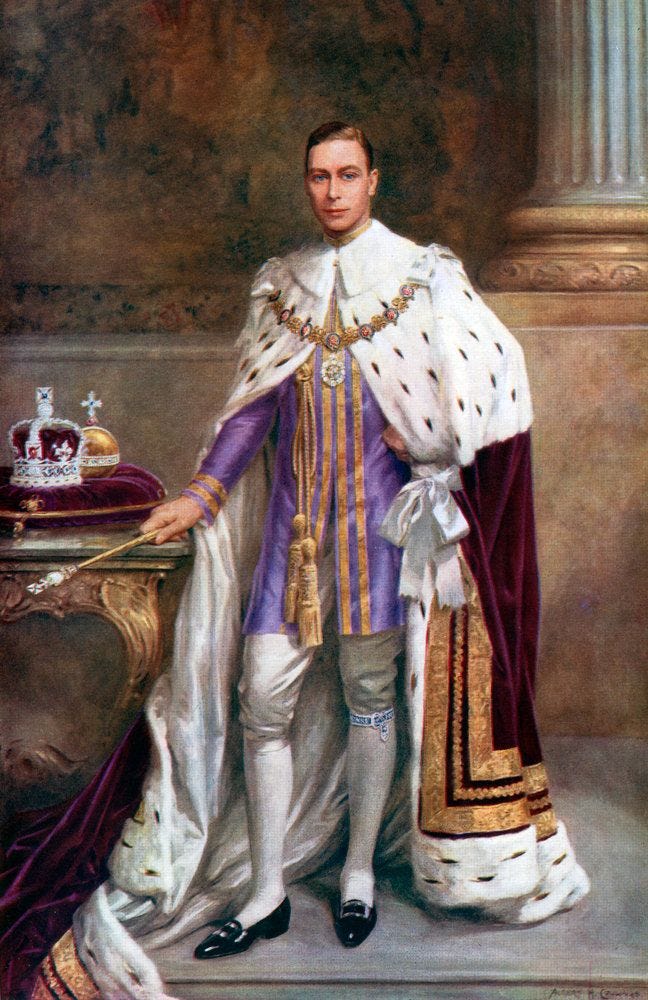
This is a painting of King George VI. He lifted the entire British nation during the Blitz in 1940 by walking around the bombed streets of London and greeting his people. The presence of the king was enough; he did not have to dig the rubble or prove that he was part of the war effort. This is the power of the king energy when it is embodied in fullness.
If the king energy is not present within the mortal king, if the standing king is too weak or absent, then the world will give over to chaos and sickness. The mortal king is the middle way between heaven and earth. And as he brings the two, an explicit duality, together, he creates the third, an implicit unity — the harmony and balance of his kingdom. The kingdom is a reflection of the king’s inner world, and if his mind is troubled, then his people will be troubled also. It is the king’s responsibility to live according to the divine will of God, the ‘right order’ of nature — known as the Ma’at, meaning truth and balance, in ancient Egypt, or the Dharma, understood as the cosmic law and order, in Hinduism and Buddhism, or the Tao, which symbolises the ‘the way’ or ‘the path’ of the universe in China.
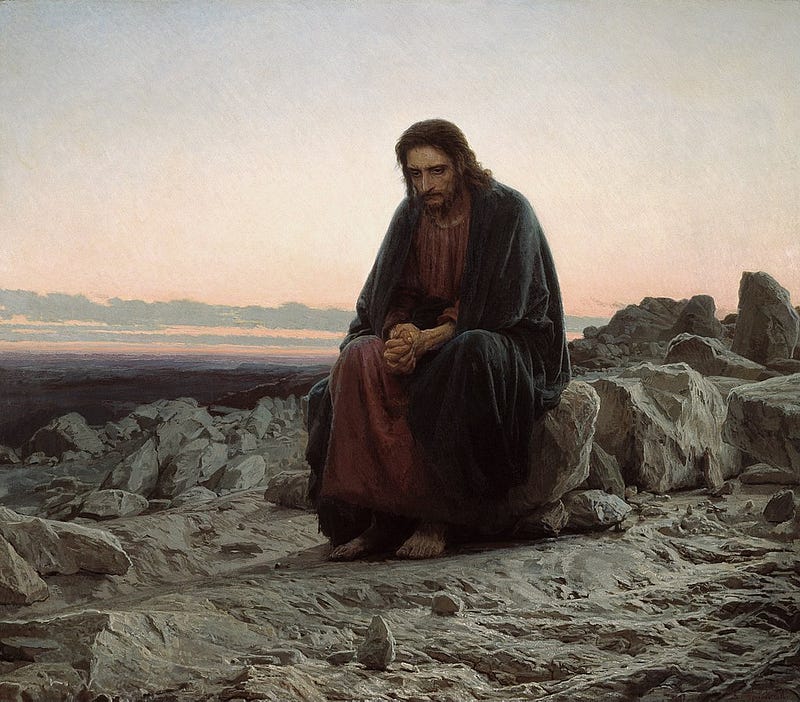
This image of the king can be found in most of the ancient scriptures across the world. To illustrate one example, in the New Testament, the disciples tell the story of when they saw Jesus walking across the sea towards their boat. In this story, water is the symbol of the unconscious, of the emotions that rise when one confronts the unknown. But by remaining still and calm, by having faith in the water, the stream of nature, by not allowing his emotions to overthrow his balance, Jesus was able to float and guide his disciples to safety. Here, the Bible shows Jesus as the king of the world, as the son of God who remains peaceful in a place of chaos so that he can negotiate the storm with reason and care.
Now, if one wishes to access the king energy, it must first be understood that it is a matter of conviction. A beast is led by his impulses, but a king is led by reason. And reason is the balance between the excesses. There are two extremes of men in this world: tyrants and cowards. In this age, cowards outnumber the tyrants, but they are also the most dangerous. A harmless man, as Dr Jordan Peterson writes, is one who has the devil within him under loose control, but once the rope snaps, and it will snap one day, the world turns upside down. A tyrant can be thrown in jail, but a coward is he who commits violence against himself — the greatest of all crimes. The thread that unites the two is fear — both the tyrant and the coward fear who they truly are.
The king, however, is not moved by fear. He is not carried by his emotions, he remains firm against the persuasion of the world. Nor does he waver or tremble in the presence of the feminine. For the masculine king is the consciousness, the presence of all that thrives and blossoms around him. To rise above emotions does not mean to repress them. Rather, it requires that one rotate through and confront all that rises to the surface — a king takes himself lightly, even though he may feel heavy, and he does not allow his heart to be overwhelmed by the quicksand of passion.
The king holds a deep, grounded sexuality; his masculine vitality is married with the earth — he does not bury his energy in apathy, nor does he allow it to soar into the sky and be taken by the wind. He is in firm control of his prehistorical nature and he gives his gift only when there is an opportunity for total and honest expression. True strength is never hysterical, destructive or uncontrollable — it is humble and forgiving. A man may feel desire for women other than his wife, but if he pursues this attraction, if he seeks fulfillment through the feminine, then the gift of his sexual energy will be partitioned and detached, rather than full and conscious. Acting upon the impulses turns man not into an animal, but a slave of desire and attachment.
The ideal of kingship maintains that the king is able to create order from mayhem and harmony from chaos. And this creative power is born from the king’s energetic balance between the masculine and the feminine, of the mind and the body, of consciousness and emotion — the fullness of the entire universe. The character of the king, then, is also a balance between the poles of the extreme. He carries an aggressive tenderness, a grounded enthusiasm and an unspoken intelligence. This balance is the source of creation; it is the force that pulls together the two elements in order to create the whole. And so, the king rises above the duality of the senses — he represents the union, the oneness of all existence.
The force of kingship does not move or even flinch under pressure, it remains still and watchful, like the Sun round which the planets of our Solar System orbits. The king simply allows himself to ‘be’, to exist without conflict, to be one with God, to flow with the Tao or the Dharma — to live alongside that which moves the moon and the stars. He understands himself to be whole and undivided and he has learnt that there is nothing he must do, nor anything — women, money, fame — that he needs in order to feel full. It must be noted, however, that it is the archetype of the king that serves as the Sun, the true centre of the system, not the mortal king. When the ego becomes its own priority and identifies itself with the king energy, the tyrant arises. Instead, men need to think of themselves as a ‘steward’ of the king energy. This creates a psychological distance from the king archetype.
Only a tyrant, a warrior, a real troublemaker tries to submit the world to his will. The king’s world is within, he does not need to reach out into the world, the world comes to him — he is the centre of the kingdom. And if he keeps himself present and stable, as the air and the water does, then the world around him will become orderly and peaceful too. For the king is the creator of the universe, he is the oxygen that breathes life, the magnetic force field that repels the immoral and attracts the moral. The king’s responsibility, then, is to trust a higher power, rather than his mind, which can only create problems. And by becoming a divine channel of goodness between heaven and earth, he in turn provides stewardship and order for his people.
Thank you, Harry J. Stead
Consciousness, spirituality, biography, sexuality, androgyny, futurism, space, the arts, science, astrology, democracy, humor, books, movies and more