NASA: Icy object past Pluto looks like reddish snowman

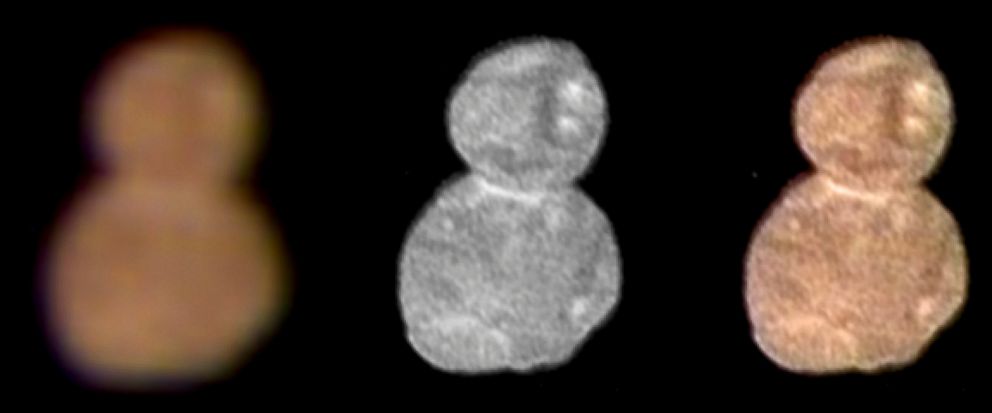
This image made available by NASA on Wednesday, Jan. 2, 2019 shows images with separate color and detail information, and a composited image of both, showing Ultima Thule, about 1 billion miles beyond Pluto. The New Horizons spacecraft encountered itThe Associated Press
This image made available by NASA on Wednesday, Jan. 2, 2019 shows images with separate color and detail information, and a composited image of both, showing Ultima Thule, about 1 billion miles beyond Pluto. The New Horizons spacecraft encountered it on Tuesday, Jan. 1, 2019. (NASA via AP)

A NASA spacecraft 4 billion miles from Earth yielded its first close-up pictures Wednesday of the most distant celestial object ever explored, depicting what looks like a reddish snowman.

Ultima Thule, as the small, icy object has been dubbed, was found to consist of two fused-together spheres, one of them three times bigger than the other, extending about 21 miles (33 kilometers) in length.

NASA’s New Horizons, the spacecraft that sent back pictures of Pluto 3½ years ago, swept past the ancient, mysterious object early on New Year‘s Day. It is 1 billion miles (1.6 billion kilometers) beyond Pluto.

On Tuesday, based on early, fuzzy images taken the day before, scientists said Ultima Thule resembled a bowling pin. But when better, closer pictures arrived, a new consensus emerged Wednesday.

“The bowling pin is gone. It’s a snowman!” lead scientist Alan Stern informed the world from Johns Hopkins University’s Applied Physics Laboratory , home to Mission Control in Laurel. The bowling pin image is “so 2018,” joked Stern, who is with the Southwest Research Institute.

The celestial body was nicknamed Ultima Thule — meaning “beyond the known world” — before scientists could say for sure whether it was one object or two. With the arrival of the photos, they are now calling the bigger sphere Ultima and the smaller one Thule.

Thule is estimated to be 9 miles (14 kilometers) across, while Ultima is thought to be 12 miles (19 kilometers).

Scientist Jeff Moore of NASA’s Ames Research Center said the two spheres formed when icy, pebble-size pieces coalesced in space billions of years ago. Then the spheres spiraled closer to each other until they gently touched — as slowly as parking a car here on Earth at just a mile or two per hour — and stuck together.

Despite the slender connection point, the two lobes are “soundly bound” together, according to Moore.

Scientists have ascertained that the object takes about 15 hours to make a full rotation. If it were spinning fast — say, one rotation every three or four hours — the two spheres would rip apart.

Stern noted that the team has received less than 1 percent of all the data stored aboard New Horizons. It will take nearly two years to get it all.

The two-lobed object is what is known as a “contact binary.” It is the first contact binary NASA has ever explored. Having formed 4.5 billion years ago, when the solar system taking shape, it is also the most primitive object seen up close like this.

About the size of a city, Ultima Thule has a mottled appearance and is the color of dull brick, probably because of the effects of radiation bombarding the icy surface, with brighter and darker regions.

Both spheres are similar in color, while the barely perceptible neck connecting the two lobes is noticeably less red, probably because of particles falling down the steep slopes into that area.

So far, no moons or rings have been detected, and there were no obvious impact craters in the latest photos, though there were a few apparent “divots” and suggestions of hills and ridges, scientists said. Better images should yield definitive answers in the days and weeks ahead.

Clues about the surface composition of Ultima Thule should start rolling in by Thursday. Scientists believe the icy exterior is probably a mix of water, methane and nitrogen, among other things.

The snowman picture was taken a half-hour before the spacecraft’s closest approach early Tuesday, from a distance of about 18,000 miles (28,000 kilometers).

Scientists consider Ultima Thule an exquisite time machine that should provide clues to the origins of our solar system.

It’s neither a comet nor an asteroid, according to Stern, but rather “a primordial planetesimal.” Unlike comets and other objects that have been altered by the sun over time, Ultima Thule is in its pure, original state: It’s been in the deep-freeze Kuiper Belt on the fringes of our solar system from the beginning.

“This thing was born somewhere between 99 percent and 99.9 percent of the way back to T-zero (liftoff) in our solar system, really amazing,” Stern said. He added: “We’ve never seen anything like this before. It’s not fish or fowl. It’s something that’s completely different.”

Still, he said, when all the data comes in, “there are going to be mysteries of Ultima Thule that we can’t figure out.”

———

The Associated Press Health & Science Department receives support from the Howard Hughes Medical Institute’s Department of Science Education. The AP is solely responsible for all content.

Choir Boy Music Video: Keep Your Eyes on the Prize


Manhattan Theatre Club
Published on Nov 29, 2018
Read more or buy tickets at http://www.choirboybroadway.com/
#ChoirBoy
– – – – – – – – – – – – – – – – – – – – – – – – – –
CHOIR BOY
Broadway Premiere by Tarell Alvin McCraney
Directed by Trip Cullman
– – – – – – – – – – – – – – – – – – – – – – – – – –
For half a century, the Charles R. Drew Prep School for Boys has been dedicated to the education of strong, ethical black men. One talented student has been waiting for years to take his rightful place as the leader of the legendary gospel choir. But can he make his way through the hallowed halls of this institution if he sings in his own key? On its US debut at MTC’s Studio at Stage II, The New York Times called the play “vivid, magnetic and moving,” and The New York Post hailed it as “bracing and provocative.” Now, we’re thrilled to bring this soaring music-filled work to Broadway. Playwright Tarell Alvin McCraney is an Oscar®-winning screenwriter of Moonlight and a recipient of the MacArthur Fellowship Grant. Directing is Trip Cullman (Murder Ballad).

What is Truth?

WHILE DEBATE ABOUT “TRUTH” SEEMS TO DOMINATE PUBLIC DISCOURSE LATELY, THIS IS NOTHING NEW: SCHOLARS AND THINKERS HAVE BEEN WRESTLING WITH CONCEPTS OF TRUTH SINCE ANCIENT TIMES.  (www.college.ucla.edu)

For Bruins, including the humanities faculty we’ve quoted in this issue, the pursuit of truth is a fundamentally social process. Any claim is subject to testing, refinement and occasionally flat-out debunking. We seek truth like connoisseurs – passionate and ever wary of shoddy substitutes.

Whoever you are and wherever you come from, when you step onto the UCLA campus, you’re invited to speak your own ideas, to defend them through the peaceful exercise of good thinking, to answer critiques, perhaps to change a mind, perhaps to change the world.

We know that books alone won’t preserve or defend truths. For that we need the willing, critical engagement of young and diverse thinkers who will take on the pursuit of truth as a project for their own time.

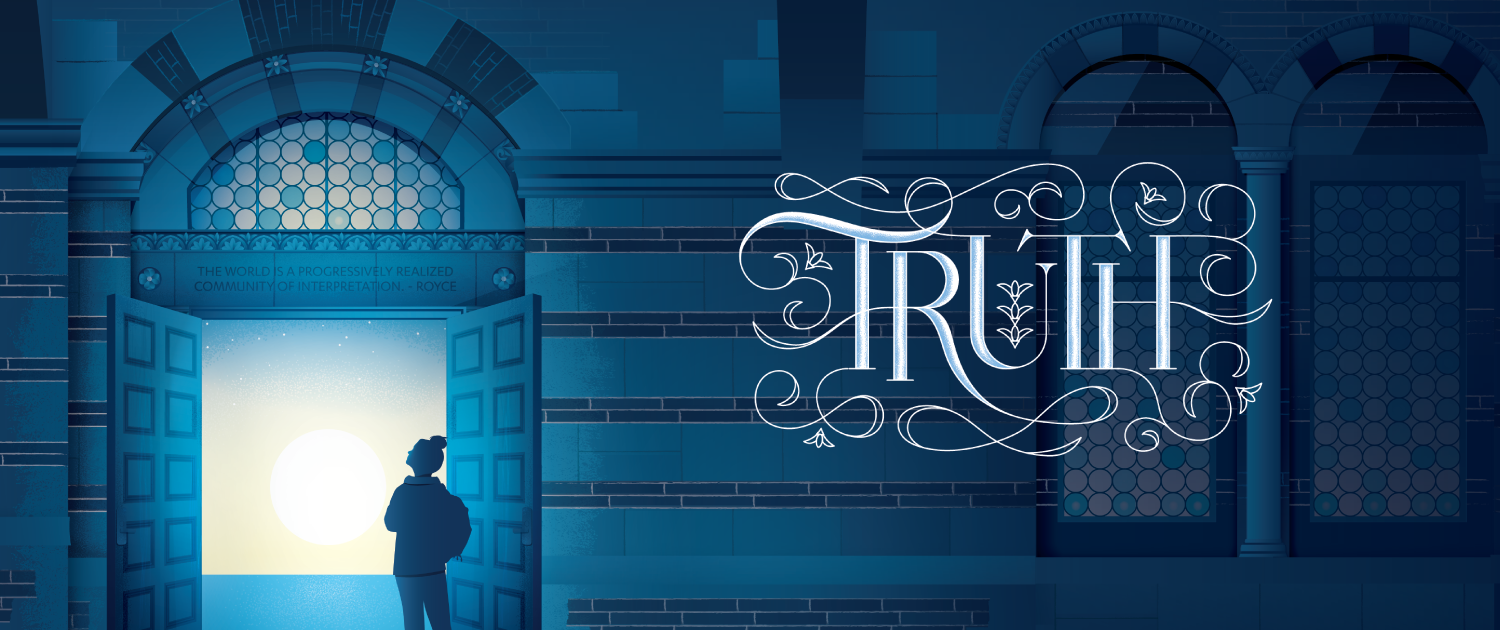
Little wonder that UCLA’s early leaders thought to inscribe iconic Royce Hall with Josiah Royce’s observation: “The world is a progressively realized community of interpretation.”

This world belongs to you.

– David Schaberg, Dean of Humanities

WHAT IS TRUTH? WE ASKED FACULTY FROM A VARIETY OF HUMANITIES DISCIPLINES TO OFFER THEIR PERSPECTIVES. THE FOLLOWING ARE UNABRIDGED VERSIONS OF THE WRITINGS ON TRUTH FEATURED IN THE MAGAZINE.

ARCHAEOLOGY

As an archaeologist, I am focused on how to understand the past from the material things we leave behind, I have always been careful with using the term “objective” and certainly the term “truth”. I would shudder when colleagues used these words freely and, in my opinion, naively. Yet, for the past two years, I have landed in a philosophical crisis and, in spite of my well-founded reservations, I now feel that it is important to recognize that there is a basis on which we can decide what is true and what is not. People in history were as divided and opinionated as we are, but we recognize that events in the past happened, and we base that on facts we discover in archaeological or historical sources. Evidence can be debated, but should never be disregarded, warped, or denied. Civilized human society is founded on an informed and tolerant discussion. It is rooted in the weighing of information that can be checked independently. Throwing out all rules of debate in exchange for personal or political gain is unethical and potentially dangerous. Rendering intellectual, fact-based criticism as suspicious and those who wield it as enemies, is the pursuit of tyrants. We need to bring the grand narratives of oppression, inequality, injustice, and even just the stories of inattentiveness and lack of empathy, under the attention of those who have forgotten the past, or consider it unimportant. History does not repeat itself, but historical events allow us to analyze where human behavior has serious negative consequences. We do not have to agree, as long as we keep listening.

Willeke Wendrich
Director, Cotsen Institute of Archaeology at UCLA
Joan Silsbee Chair of African Cultural Archaeology
Prof. Egyptian Archaeology and Digital Humanities

COMPARATIVE LITERATURE, ENGLISH, AND FRENCH AND FRANCOPHONE STUDIES

I open my undergraduate Comparative Literature 100 class on “Truth and Simulation” with Nietzsche’s provocation: “What then is truth?  A mobile army of metaphors…. Truths are illusions about which it has been forgotten that they are illusions, worn-out metaphors without sensory impact, coins which have lost their image and now can be used only as metal, and no longer as coins.” Most of the modern Continental philosophical tradition I study follows Nietzsche (and Freud and Marx) in questioning the reliability of our perception of truth and suggesting that other forces are at work.  Michel Foucault writes of “games” and “regimes” of truth, or the idea that what we consider true is a function of current power structures.  Gilles Deleuze goes so far as to invert Plato’s attack on artists as second order simulators of truth and affirm the “powers of the false.”  More recently, Alain Badiou has refreshingly tried to salvage Plato and a strong model of truth from this lineage of detractors.  My own sense is that Medieval philosophy produced perhaps the most interesting commentaries on the difficulties of understanding truth in relation to falsity, which is to say that these questions are far from new to our era.

Eleanor Kaufman
Professor of Comparative Literature, English, and French and Francophone Studies

PHILOSOPHY

Truth is a value, a relation, and a mystery. It is not the only thing that as thinkers we seek; there is, after all, understanding, but without it the rest is, well, phony.

Truth is a value because it is kind of rightness. Just as we act rightly so we can believe and speak rightly. True beliefs and true declarations meet a standard. Just as true friends are those who adjust their actions to the standards for friendship so to count as believing and not just wishful thinking a state of mind has to aim at truth—which is why for me to say that of something that it is true but I don’t believe it would be met with an incredulous stare. To speak and think without even aiming at truth is at best to speak and think bullshit.

Thoughts and claims are true only if they relate to the world by representing it correctly but that is not always enough. Truth is so elusive that a theory from which every truth followed would contradict itself and so mysterious that some religions have identified it with God. And that is just the beginning.

Calvin Normore
Professor, Philosophy
Brian P. Copenhaver Chair

FRENCH AND FRANCOPHONE STUDIES

In our era where scientists challenge the Cartesian mind/body duality, our mission as a university cannot simply seek to educate the mind separate from the whole person. Truth is not limited to something knowable through the mind alone — abstract, disembodied concepts and things that exist out in the world, objectively measurable and verifiable. The body, heart and soul must also be contacted and cultivated. This is why the Humanities are so important. The kinds of truth that humanists cultivate touch the whole human being. They are inner truths to which personal stories give us access. Stories are the data of the soul. They cultivate qualities of empathy for others by bringing their experiences close inside the heart, our inner knowing.

Stories teach an embodied form of knowing, underlining that the content of any truth depends on HOW we know and express it, embodied in language. HOW we know a truth, HOW we frame it, shapes what we know and can’t know.

As the lens of our HOW keeps shifting, we come to realize one of the most profound truths at the center of a humanist education: the ambiguous nature of all truth. As much as we long to grasp on to one fixed, certain principle, the ground always shifts beneath us, leaving uncertainty in its place. A Humanist education teaches us to value the nature of ambiguity and uncertainty as the ground of our being. Scientists, doctors, engineers are now looking more and more to humanists because they realize that their values and modes of knowing are a crucial complement to their own.

Sara E. Melzer
Professor, French and Francophone Studies

PHILOSOPHY

Truth is of central importance in philosophy as a discipline. In a sense it’s all we care about. Where some say “truth be damned,” we say “everything else be damned.

If I say “The bird is on the wire” and you say, of the same bird at the same time and place, “The bird is not on the wire,” these are not alternative facts from which we may freely choose. For a statement to refer to a fact, the statement has to be true, and these cannot both be true.

But when statements contradict each other, or are inconsistent with each other, they are not two alternative facts; one is true and the other is false.

The phrase “my truth” is often used to refer to claims whose truth is more accessible to me, or important to me, than it is to someone else. Fair enough, but if it is a truth, then it is the case, and suggesting that I possess that seems like an affectation. What I may possess and you may not is belief about or knowledge of the truth. I think we would find less need to torture the word “truth” if we paid more attention to the concepts of belief and knowledge.

If we care about the truth, we should instead respond to assertions by asking “How do you know?” or “What are your reasons?” It is a strong disciplinary norm in philosophy that we assume the other person has reasons for their beliefs. It’s not that we’re naïve; we know it’s always possible that a person is rationalizing or motivated by self-interest, or has been led along by the crowd or tribal loyalty, but if we started a conversation by assuming any of those things about our interlocutor, we would be assuming we have nothing to learn from them. The philosopher isn’t cynical enough to think we know that.

Sherrilyn Roush
Professor, Philosophy

CLASSICS

We Classicists have been studying Greco-Roman antiquity for the better part of two millennia, always learning from our predecessors even as we seek to surpass them in understanding the rich and yet problematic legacy of these increasingly distant cultures. Sometimes we make new discoveries—new texts or new objects come to light or new tools expand our knowledge of old texts and old objects—but even when the factual record remains unchanged, we change, and with changes in us come new perspectives, new insights, new problems, and new questions to explore. So where does truth enter the scene? It entices us there on the frontier between fact and interpretation and is as much a function of how we do our work as of what we discover while doing it. Whether we focus on the written record or the material record, we strive for honesty in representing what is entrusted to us and combine that honesty with a humility that comes from knowing beyond all doubt that whatever we believe, whatever we claim, whatever we know, the next generation will surely say, “That’s not good enough! We need to know more and we need to know better!” And that’s the truth.

Sander M. Goldberg
Distinguished Research Professor
Department of Classics

WRITING

Cento*: On Truth in Poetry

My favourite poem is the one that starts
‘Thirty days hath September’
because it actually tells you something

Poetry is seen as the furthest thing from fact
because of the way people encountered
poetry when they were young

not as work that clarified and illuminated
but that had to be deciphered and explained
Experience, in a work of art, may be rendered

most truthfully by attending to something beyond
the verifiable fact. Subjectivity may be
as severe and demanding a discipline

as objectivity. The real work of the poem
is the education of the emotions
Poems are like dreams: in them you put

what you don’t know you know
They are roadmaps of our humanity
Nothing is too wonderful to be true

Amber West
Lecturer, UCLA Writing Programs
Assistant Director, UCLA Undergraduate Writing Center

*Sources: Groucho Marx (lines 1-3), Kwame Dawes (4-8), David Yezzi (9-11), Alicia Ostriker (11-13), David Yezzi (13-14), Adrienne Rich (15-16), David Yezzi (17), Michael Faraday (18)

(Submitted by Janet Cornwell, H.W.)

Heather Williams Sunday Meeting

Dear friends,

We all have problems…But…Did you know that our problems contain GIFTS?

And, did you know that we can learn to see through the appearance of a problem to the inherent gift that it contains?

Bring a problem that you are dealing with to the next Sunday Meeting. I will invite you to explore this problem in a NEW way. Let’s see if you can SEE THE GIFT!

Image may contain: ocean, sky, cloud, text, outdoor and nature

ONLINE SUNDAY MEETING
DATE: Sunday, January 13, 2019
TIME: 11:00 am Pacific Time.
SPEAKER: Heather C. Williams, H.W., M.

ZOOM COMPUTER LINK: https://zoom.us/j/894796275

One tap mobile
+19292056099,,894796275# US
+16699006833,,894796275# US (San Jose)

Dial by your location
+1 929 205 6099 US
+1 669 900 6833 US (San Jose)

Articulate your Rationale

Overcome anxiety: Articulate your rationale, quell your doubts

Canadian author, psychologist, and intellectual Dr Jordan B Peterson has an interesting way of overcoming your self-doubt and anxiety: run right into it. Or, rather, write right into it.

Posted by Big Think on Wednesday, January 9, 2019

Your Horoscopes — Week Of January 8, 2019

Capricorn | Dec. 22 to Jan. 19

With NASA under increased pressure to perform and to curry public favor, they’re seriously considering using cutting-edge technology to launch you into orbit.

Aquarius | Jan. 20 to Feb. 18

Once, you were just the infant found in a city dumpster. Now, you’re known nationwide as “that guy who’s lived his entire life in the dumpster where he was found as an infant.”

Pisces | Feb. 19 to March 20

Your exuberance at suddenly discovering you can fly is muted somewhat when the discovery happens during your tour of the White House, causing you to be blown out of the air by vigilant F-15 pilots.

Aries | March 21 to April 19

Your friends will soon hold an intervention to take away your barge pole, wide-brimmed white straw hat, and Chianti bottle in an effort to stop your wanton and dangerous gondoliering.

Taurus | April 20 to May 20

Taurus includes the stars of the Pleiades—mentioned in the Bible and instrumental in the design of the Pyramids—but these beauties are just one of the many reasons to visit the most popular constellation in the Zodiac.

Gemini | May 21 to June 20

Maybe in your next life, you’ll believe the Zodiac when it tells you to cut the red wire.

Cancer | June 21 to July 22

Actually, a goatsucker is an order of insect-eating nocturnal birds that includes the whippoorwill and the nighthawk, you pervert.

Leo | July 23 to Aug. 22

In a certain light, from just the right angle, you will begin to bear an uncanny resemblance to Abe Lincoln.

Virgo | Aug. 23 to Sept. 22

You’ll be found guilty of 12,582 counts of bee murder and given the responsibility of pollinating every flower in your immediate neighborhood for 11 years.

Libra | Sept. 23 to Oct. 22

Change is long overdue in your life, but sadly, the Zodiac can no longer find a place in the budget for such expenditures.

Scorpio | Oct. 23 to Nov. 21

You’ve always reported the incidents as “drive-by shootings,” but that may not be the proper term to describe your situation, wherein everyone you drive by shoots at you.

Sagittarius | Nov. 22 to Dec. 21

Word to the wise: Although your baby is indeed badly in need of a new pair of shoes, it is not likely that any situation involving dice is likely to produce said shoes.

Absolute Certainty will Always Win

What is the relationship between understanding, clarity and illumination? And how are they used in Translation to melt our beliefs in error?

Nothing contaminates heaven but belief in error, nothing makes possible belief in error but ignorance, nothing dissolves Absolute Certainty will Always Winignorance but understanding, nothing evokes understanding but clarity, and nothing provides clarity like the illumination shining in the self-evidence of Truth.

So the objective of a Translation is to use as much clarity as possible, to evoke as much understanding as possible, to replace the ignorance behind belief in error with the clear understanding of how Truth absolutely must be the sole Reality.

The light of understanding is clearly the antidote to the darkness of ignorance.  But this understanding must be absolutely certain, because much erroneous belief simply will not melt in the face of anything less.  Sense testimony can be so longstanding and persistent that it leaves us believing in error with an almost-certain sense of conviction, and the only way to melt such a belief is with the heat that only absolute-certainty would provide.  In a Translation, a confrontation occurs between our conviction borne of sense testimony about which we are almost certain, and our new conviction borne of the self-evidence of Truth about which we can be absolutely certain.

And absolute certainty will of course always win.

~ Ben Gilberti

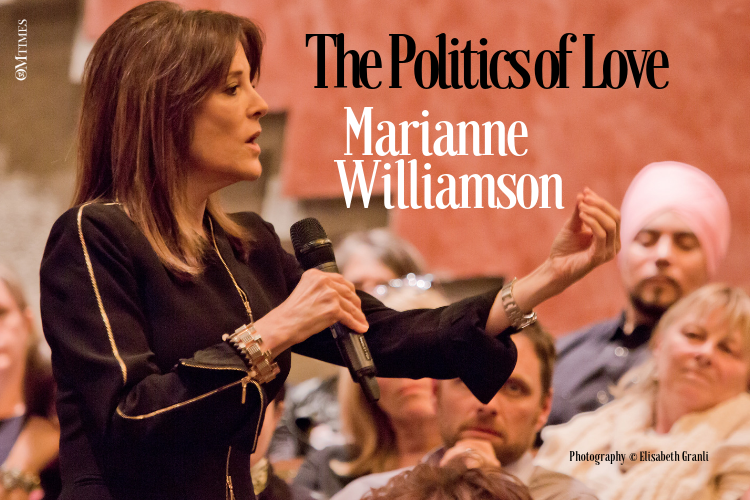
MARIANNE WILLIAMSON: THE POLITICS OF LOVE

Politics of Love

Marianne Williamson is an internationally acclaimed lecturer, activist, and author of four #1 New York Times bestselling books. She has been one of America’s most well-known public voices for more than three decades. Seven of her twelve published books have been New York Times bestsellers, and Marianne has been a popular guest on television programs such as Oprah, Good Morning America, and Bill Maher. A quote from the mega-bestseller A Return to Love, “Our deepest fear is not that we are inadequate. Our deepest fear is that we are powerful beyond measure…” is considered an anthem for a contemporary generation of seekers.

Marianne’s other books include The Law of Divine Compensation, The Age of Miracles, Everyday Grace, A Woman’s Worth, Illuminata, Healing the Soul of America, A Course in Weight Loss, The Gift of Change, Enchanted Love, A Year of Miracles, and Tears to Triumph: The Spiritual Journey from Suffering to Enlightenment. Her newest book, A Politics of Love: Handbook for a New American Revolution, will be published soon.

Marianne is a native of Houston, Texas. In 1989, she founded Project Angel Food, a meals-on-wheels program that serves homebound people with AIDS in the Los Angeles area. To date, Project Angel Food has served over 11 million meals. Marianne also co-founded the Peace Alliance.

An Interview with Marianne Williamson: The Politics of Love

Interview by Victor Fuhrman

When I grew up in the 1960’s and seventies, there was a sense of rebirth and renewal in our country. Many of us started looking upon one another and brother and sister and embraced the ideas of sharing, caring love and peace. We lived these ideals as best we could with the hope that future generations would equally embrace them. Somewhere along the way, we have strayed from that path. We have birthed a generation of divisiveness, ego-based actions, and fear. Is there a way that we can return to the spirit of embracing diversity, caring for one another and moving from fear to love?

My interviewee this week, Marianne Williamson, says there is.  She joins us to discuss her new book, and her exploration of a possible run to become the next president of the United States. Welcome, Marianne.

MARIANNE WILLIAMSON: Thank you so much for having me.

VICTOR FUHRMAN: So wonderful for you to join us and share your plans. Share with our readers who are meeting you for the first time about your early life and path.

MARIANNE WILLIAMSON: Well, when you were talking in your introduction about the fact that you grew up in the ’60s and ’70s, so did I, and I was impacted just as you were by the flower child generation, the hippie scene. However, you know, a young man said to me about a year ago at one of my lectures, he said: “You know, you’re just an aging hippie.

Your generation was just about sex, drugs and rock and roll.” My response to him was: “That was just part of the day. The rest of the day we stopped a war, and what have you done, by the way?” This was a generation which talked about all the things you were talking about.

We would meet Ram Das and Alan Watts in the morning, but we would attend anti-war protests in the afternoon. I think many people today, younger people certainly, can’t imagine, perhaps, what it meant when there was a Draft. These wars were not just over there somewhere in a far-off part of the world, fought by volunteers. They were fought by brothers and cousins and sons and fathers. The issue of the war was far more urgent.

So that was what I grew up with. I grew up in time, as did you from what you were saying when there was very easy compatibility between what was a spiritual and philosophical expansion at that time and a very, very potent and urgent sense of political activism.

VICTOR FUHRMAN: Absolutely. A Course in Miracles is the foundation of much of your work. How were you called to study it, and what led you to lecture and speak on these materials?

MARIANNE WILLIAMSON: I first saw A Course in Miracles on someone’s coffee table in New York City in the 1970s, and I had already been ever since I was a teenager very much interested in philosophical, spiritual pursuits; anything that had to do with the higher mind.

I have always been equally drawn to Eastern and Western traditional and esoteric traditions. None of them have ever seemed in conflict with any others to me. I have a very natural embrace of this comparative religious and spiritual variety that makes up the great spiritual and religious traditions of the world.

However, until I found A Course in Miracles the issue of practicing these principles provided challenges that I had not been able to overcome. I’m not saying I’ve completely overcome them to this day. I’m not an enlightened Master, but when I read A Course in Miracles, it was the first time where I got a sense of how these great and higher principles of universal spiritual truth were applicable on a practical basis. Before that, I didn’t understand that the search for God and the search for communion with other human beings was the same search. I didn’t know that the spiritual path was my reaching out across the world that I had constructed in my mind that separated me from other human beings. So, A Course in Miracles meant so much to me. Now, the Course, you know, it does not claim to be for everyone, but if it’s for you, you know it.

So, for me, it was a very personal excitement, a very personal passion, and also at that time, the kind of career that I had did not exist. There was no career niche that now, you know, is a mainstream, cultural impulse: the non-denominational spiritual wise woman. That did not exist.

So, I had no ambition for a career goal based on this, and I think that was a blessing in my life. I just was so excited when after I had been studying the Course for five years I had moved to Los Angeles, and there’s a place still owned, of course, in LA called “The Philosophical Research Society.”

When I was working there, in their book publishing department, they had these lecture series. The woman who was the President at the time of PRS asked me if I’d like to start giving lectures on Saturday mornings based on A Course in Miracles. I’d been studying the Course for five years, and I was just so excited to have the opportunity to do it. I had no concept that it would be more than just a spin I did because I loved it. Not too long after that, the AIDS crisis blew up. Gay men in Los Angeles gave me what would be a career. So, at that time, this then-young woman was talking over in LA who was talking about a God who loved you no matter what, and who worked miracles, and so suddenly, my little talks began attracting more and more people and went from there.

VICTOR FUHRMAN: Did you ever imagine – you alluded to this – but did you ever imagine you would become a world leader in consciousness and spirituality? Was that ever your goal?

MARIANNE WILLIAMSON: Well, that niche didn’t exist. You could be a Clergy – you know, my Mother kept saying your Father, and I have discussed it, and we will send you to Rabbinical School – and I didn’t quite see myself becoming Clergy. The other path you could take could be an Academic, you could be a Professor in Comparative Religion, and I didn’t see that for myself either. There was no reason to think it would be anything other than sharing from my heart about these books that so excited me. That was 35 years ago, the essence of it all, and it is the essence of it all even today.

VICTOR FUHRMAN: We’re both grateful to you because we, both, in our later years followed an inter-faith path and were ordained here in New York, and were able to bring this beautiful message, to so many people who required that and needed to hear it.

Continue with the Interview with Marianne Williamson here:  https://omtimes.com/2019/01/marianne-williamson-politics-love/2/

SUNDAY NIGHT TRANSLATION GROUP – 1/6/19

Translators:  Melissa Goodnight, Richard Branam, Hanz Bolen, Mike Zonta

SENSE TESTIMONY:  Structural distortion causes pain and may oppose rehabilitation.

5th Step Conclusions:

1)  Truth/Wholeness is unopposed, unopposable, undisturbable, the only Cause, the only Effect, effortlessly rehabilitating Itself at every moment.

2)  The Truth Being Self Evidently All Consciousness there is, is all I am, All We are, All Thou art, knowing and possessing certain secure artful, skillful, essential Being and expression 
everywhere always
.  OR:  The Essential art of Truth is all there is.

3)  All is One Infinite, Consciousness Beingness, functioning in perfectly orderly alignment, with the upright incorruptible virtue that is boundlessly expressing resounding resolution.

4)  Truth Is This SELF Instructed Built In Cosmic Consciousness, this Instrumental Zeal Actively Motivates with Purposeful Effort Being Creative Androgynous Super – Structure, THIS I Am that I Am, Individuated Identity Always Acts’ According to the Goodness of All Concerned.

Consciousness, spirituality, biography, sexuality, androgyny, futurism, space, the arts, science, astrology, democracy, humor, books, movies and more