Telling the Truth as a Means of Healing

A new documentary shows how one state is confronting Native American child removal.
dawnland_primary.jpg


When we think of the history of forced cultural assimilation of Native Americans into U.S. culture, we often point to residential schools. From the mid-19th to the early-20th centuries, residential schools removed Native American children from their communities, punished them for speaking their home language and practicing their religion, and attempted to assimilate them as working-class members of society. These residential schools are widely known to have been sites of abuse and trauma. But the story of removal of Native American children did not end with these schools. The new documentary Dawnland documents other more contemporary child removal practices and one state’s effort for justice.

In February 2013, the state of Maine launched the Maine Wabanaki-State Child Welfare Truth and Reconciliation Commission, the first government-mandated TRC in the United States. The commission was charged with establishing a more complete account of Native American foster care placement between 1978 and 2012 and with formulating policy recommendations to empower tribal communities and start to reverse generations of colonial violence.

Native American children are overrepresented in the child welfare system. In Maine, in 1972, Native children were placed in foster care at a rate 25.8 times that of non-Native children. They were often placed in non-Native homes, sometimes without any legal proof that their birth parents were “unfit.” Stories like these across the nation led to the passage of the Indian Child Welfare Act in 1978, which legally declared that it is in the best interest of Native American children to stay within their families or tribes. ICWA recognizes the potential damage that child removal does both to the children and their tribe as a whole: How can a tribe continue to exist if it cannot pass on its language, cultural traditions, and history to the next generation? As gkisedtanamoogk, co-chair of the Maine Wabanaki Child Welfare Truth and Reconciliation Commission, reflected in Dawnland on child-removal practices, “You take away a people’s understanding of who they are, their self-sufficiency, and you replace it with nothing.”

Yet decades after the passage of ICWA, Native American children are still removed from their homes at a disproportionately high rate. Between 2000 and 2013, Native children were removed at 5.1 times the rate of non-Native children in Maine. This is one reason the commission was formed. The commission, along with the advisory group Maine-Wabanaki REACH, or Reconciliation Engagement Advocacy Change Healing, began collecting stories in 2013. For the next two years, they gathered testimony from state child welfare staff, children who were placed in foster care or adopted, and parents in Maine’s four remaining tribes who had their children taken away. Dawnland is both an intimate lens into the personal and communal impacts of child removal practices and an exploration of the conflict that arises when White communities and communities of color jointly confront historical trauma and racism.

Dawnland, directed by Adam Mazo and Ben Pender-Cudlip, 2018

These tensions play out in real time in Dawnland. One  community event for gathering testimony did not have a high turnout, so members of Maine-Wabanaki REACH asked staff from the commission to leave the room to ensure all participants were comfortable sharing their truths. This did not go over well with the commission staff, the majority of whom were White women. REACH co-director Esther Anne Attean defended the decision, saying that the goal of truth-telling is “not about making White people feel welcome.” She argued that part of being an ally is recognizing when you need to leave the room and allow Native peoples the space to share their stories as a form of healing.

We are left to ponder: Whom is this truth-telling for? Is it to educate White people on colonial violence and how it continues to harm indigenous communities in Maine, or is it for the Native participants to heal and be heard? Can it simultaneously be both, or should one be privileged over another?

Though child removal is a sensitive and at times traumatic subject matter, conducting research and making recommendations is the easy part. Sustained healing and an assertive confrontation of colonial and White supremacist violence are much harder. But as the commission’s executive director, Charlotte Bacon, reflected in the report, “None of us is exempt from that responsibility.” We have a collective responsibility to address the ongoing violence of colonialism, and the impacts of child removal on tribal communities and tribal survival.

An elementary report card for Georgina Sappier (Passamaquoddy) from Mars Hill elementary in Maine for the years 1947–53. Photo by Ben Pender-Cudlip/Upstander Project.

As the testimony of children removed from their homes makes clear in the film, changing policy alone cannot end the impacts of colonial violence. The commission focused specifically on Native American children in foster care from 1978 to 2012—after the passage of ICWA. Whether intentional or not, racism from foster parents and racism from child welfare staff continues to traumatize Native families.

“My foster mother told me that I was at her house because nobody on the reservation wanted me. … And that she would save me from being Penobscot,” Dawn Neptune Adams said in the film. She also said she had her mouth washed out with soap when she spoke her Native language.

Like Adams’ foster mother, not everyone sees distancing Native children from their tribal cultures as violent. As with residential schools, some view it as benevolent. Jane Sheehan, a retired child welfare worker who worked in the system for decades, is shown in the film saying that “two sneakers for the feet is sometimes more important than learning an Indian dance.” Intentionally and aggressively confronting racism—particularly unintentional racism coming from ill-informed rather than overtly hateful viewpoints—must be addressed in any truth and reconciliation effort.

Tracy Rector, a producer for the film, is hopeful that Dawnland can help with this process. “In the majority of the screenings to date, the audiences have been primarily non-Native and more specifically White,” she told me. “The vast majority of these audience members often comment that they were not aware of the policies involved in colonization, the boarding schools, or forced adoption and foster care. I see and hear in these discussions that we are building allies.”

Dawnland makes clear that any effort to empower tribal sovereignty and right historical wrongs—what some may call reconciliation—must center indigenous leadership and indigenous healing. While it remains to be seen how Maine and its tribal communities will continue to work toward justice for those most affected by violent child welfare practices, truth-telling is a vital and historic first step. And non-Natives must be willing to listen deeply. As activist Harsha Walia asserted: “Non-Natives must be able to position ourselves as active and integral participants in a decolonization movement for political liberation, social transformation, renewed cultural kinships, and the development of an economic system that serves, rather than threatens, our collective life on this planet. Decolonization is as much a process as a goal.”

Abaki Beck wrote this article for The Good Money Issue, the Winter 2019 issue of YES! Magazine. Abaki is a free-lance writer and researcher passionate about Indigenous community resiliency, public health and racial justice. She is a member of the Blackfeet Nation of Montana and Red River Metis. You can find more of her writing on her website.

How to Create a Zoom Meeting and Invite People to Join

First, watch this 45-second video about Zoom Meetings: https://youtu.be/VnyitUU4DUY
The following Zoom Invitation is one from my personal Zoom account because I didn’t want to use the Prosperos’ Pro Zoom account to illustrate my points.
But this invitation is just for illustration; it’s a genuine Zoom invite, but I won’t be holding that meeting! Emoji
The black type or blue type is what Zoom actually gives you when you schedule a Zoom meeting. The red type are my comments.  
 

I’ll cover how to schedule a Zoom meeting below the Zoom Invite.

Ok so this is how a Zoom Invitation looks when you schedule a meeting:

********************
Hi there,
Ben Gilberti is inviting you to a scheduled Zoom meeting. <This you can change to whatever you want.
Topic: Ben Gilberti’s Zoom Meeting <This also you can change to whatever you want.
 
You can also enter here any more description about your meeting beyond the Topic.  
Time: Nov 9, 2018, 6:00 PM Eastern Time (US and Canada) <I usually put in a few more time zones here, since we are reaching globally, especially GMT (Greenwich Mean Time).  Anybody in the world will be able to tell when your meeting starts if you supply the GMT time. 
Join from PC, Mac, Linux, iOS or Android: https://zoom.us/j/225841423 <This is for joining the Zoom meeting you scheduled.  
Or iPhone one-tap :
    US: +16465588665,,225841423#  or +14086380986,,225841423#
Or Telephone:
    Dial(for higher quality, dial a number based on your current location):
        US: +1 646 558 8665  or +1 408 638 0986
    Meeting ID: 225 841 423 <You’ll need to use this number when you start your meeting.  I’ll show you what I mean below.
    International numbers available: https://zoom.us/u/adLBNwZwuu <The link above this one is actually International for using the Zoom interface.  This link is for International people who don’t have a computer and want to call in using their phone. If they click on this link, they’ll see the phone numbers to use outside of the USA. Most of them are toll-free.
 
You can put any photo of yourself or any kind of artwork here.
***************
To generate the above Zoom invitation, after you log on to Zoom, you’ll see this interface:
Inline image < this is not active  now

And all you have to do is click on “Schedule,” fill in the data for your meeting, and then click on Copy to Clipboard, and then paste the contents of the clipboard into your email, Facebook page, Twitter or Skype message.
To start your meeting, click on “Meetings” on the bottom of the above interface. That will open the following interface:
Inline image

Don’t click on the first “Start” button or it will start a completely different meeting.
If you hover of “Today,” if this was an active interface, it would open a new “Start” button that will be for the meeting you’ve invited people to attend. Usually, it will not say “Today” but rather the date your meeting is to occur. You can check to be sure that you are starting the right meeting by comparing the Meeting ID in the interface above with the Meeting ID that shows up on your meeting invite above. Make sure both meeting ID’s are the same. Start your meeting about ten minutes before it is scheduled to begin so people joining your meeting will find you there if they come early.
And remember, a Zoom meeting can be recorded and converted into a YouTube video that you can use to share with others.
If you don’t have Zoom on your computer, type “Zoom.us/download” in your browser, press enter, download Zoom, click on the “exe” file that will show up in the lower left-hand corner to install Zoom, sign-up for a free account, sign in, and you’ll get the interface shown above.
However, the friends or prospects you will be sending the Zoom Invitation to will not have to prepare in any way, they will be prompted to download zoom if they don’t already have it and will then automatically be placed in your meeting.
I encourage all of you to create Zoom meetings with your Free Zoom Account for your private circle of friends just for social reasons. Those meetings, started with a Free Zoom Account, have a time limit of 40 minutes.  The Prosperos Pro Zoom Account has no time limit.
Remember, Zoom meetings are video meetings, so remember to clean up, dress up and put on your makeup. Emoji
If you believe you may qualify for a Prosperos Pro Zoom Account, send an email to Rick Thomas and ask if you are eligible. Rick Thomas is the Administrator of the Prosperos Pro Zoom Account. But realize that the number of Prosperos Pro Zoom accounts is very limited.
Rick and I have created a 19-minute video about all of this.  For those of you in my Spontaneity Course, this video is spontaneous, because Rick and I didn’t plan anything in advance, we just started talking about how to create your own Zoom meeting and how to invite your friends.  Since the video is spontaneous, it’s slightly clumsy in a folksy, charming and almost humorous way, but it does the job. In the video, we even show you how to convert the recording of your Zoom meeting into a YouTube  video.
Here is the video Rick and I have made for you: https://youtu.be/nqbiN8TajvQ
And of course, I’m always available to answer questions.
Ben Gilberti

Lucy McBath Wins Georgia Congressional Race Against Karen Handel

Note from Michael Kelly:

I made some small donations to help Democratic women in the election, and Ms. McBath in particular because she is from Georgia. I didn’t really know her story until now, and I think many in our community will find it moving.

I know that Congresswoman-elect McBath is just one of the many new Congress-people who ran because of some particular social event or issue that mobilized them. It gives me hope.

–Michael  

Image

Lucy McBath defeated the Republican incumbent, Karen Handel.CreditCreditLynsey Weatherspoon for The New York Times

By Astead W. Herndon (NYTimes.com)

Lucy McBath, the gun control and racial justice activist whose son was killed in a 2012 shooting, is now headed to Congress, after winning a razor-thin election decided Thursday morning.

Ms. McBath defeated the Republican incumbent Karen Handel, who only last year won a closely watched special election in the same Georgia district. Though Ms. Handel did not concede the race until Thursday morning, Ms. McBath, who is also a former Delta flight attendant, claimed victory in a statement released Wednesday. The Associated Press officially called the race for Ms. McBath on Thursday morning, with her lead at just under 3,000 votes.

“Six years ago I went from a Marietta mom to a mother on a mission,” she said, referencing her teenage son’s death. Jordan Davis, Ms. McBath’s son, was 17 when he was shot and killed by a white man at a gas station after refusing to turn down the volume of the rap music playing in his car. The man was later convicted of first-degree murder.

The win furthers the advantage in the House for Democrats, who could see more gains in several still-too-close-to-call races across the country. The district, once held by Newt Gingrich, was initially thought to have been out of reach for Democrats, but tightening polls in the campaign’s final weeks pushed the National Republican Campaign Committee, the House political arm, to run several new advertisements in the district in support of Ms. Handel.
Image
Ms. Handel won her seat during a special election in 2017.CreditCurtis Compton/Atlanta Journal-Constitution, via Associated Press

“It is clear I came up a bit short Tuesday,” Ms. Handel said on Thursday morning. “Congratulations to Representative-Elect Lucy McBath and send her only good thoughts and much prayer for the journey that lies ahead for her.”

Ms. McBath was once thought to be a long-shot candidate even among members of her own party, and had even first planned to run for state or local office. Now, she will be the first nonwhite person to represent Georgia’s Sixth District, a section of the state overwhelmingly filled with white and affluent voters.

[Read more about Ms. McBath here.]

“At the end of the day, whatever you think about me; whatever happens or whatever I become in the future, I’ll still always be Jordan’s mom,” Ms. McBath said during a campaign event last month.

Her win defies conventional wisdom of how minority candidates must campaign in order to gain traction in districts predominately composed of white voters. While some had advised Ms. McBath to dilute the most explicit parts of her son’s murder, she believed it was integral to telling an authentic story about her life and experiences, she said.

“What I’m doing today is still mothering his legacy,” Ms. McBath said last month. “I’m extending what I would do for my son to my community.”

A version of this article appears in print on , on Page A13 of the New York edition with the headline: Winner Is Declared for Congressional Race in Georgia. Order Reprints | Today’s Paper | Subscribe

Against Self-Criticism: Adam Phillips on How Our Internal Critics Enslave Us, the Stockholm Syndrome of the Superego, and the Power of Multiple Interpretations

By Maria Popova (brainpickings.org)

adamphillips_unforbiddenpleasures.jpg?fit=320%2C479

I have thought and continued to think a great deal about the relationship between critical thinking and cynicism — what is the tipping point past which critical thinking, that centerpiece of reason so vital to human progress and intellectual life, stops mobilizing our constructive impulses and topples over into the destructiveness of impotent complaint and embittered resignation, begetting cynicism? In giving a commencement address on the subject, I found myself contemplating anew this fine but firm line between critical thinking and cynical complaint. To cross it is to exile ourselves from the land of active reason and enter a limbo of resigned inaction.

But cross it we do, perhaps nowhere more readily than in our capacity for merciless self-criticism. We tend to go far beyond the self-corrective lucidity necessary for improving our shortcomings, instead berating and belittling ourselves for our foibles with a special kind of masochism.

The undergirding psychology of that impulse is what the English psychoanalytical writer Adam Phillips explores in his magnificent essay “Against Self-Criticism”, found in his altogether terrific collection Unforbidden Pleasures(public library).

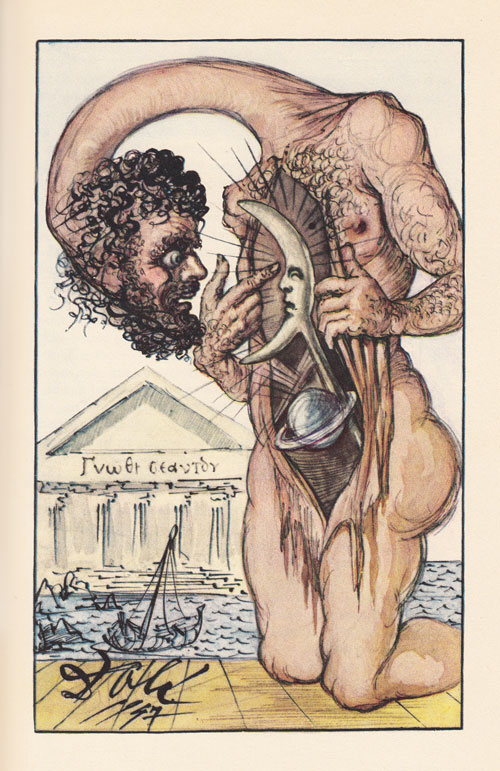
dalimontaigne35.jpg

One of Salvador Dalí’s illustrations for the essays of Montaigne

Phillips — who has written with beguiling nuance about such variousness of our psychic experience as the importance of “fertile solitude,” the value of missing out, and the rewards of being out of balance — examines how “our virulent, predatory self-criticism [has] become one of our greatest pleasures,” reaching across the space-time of culture to both revolt against and pay homage to Susan Sontag’s masterwork Against Interpretation. He writes:

2e292385-dc1c-4cfe-b95e-845f6f98c2ec.pngIn broaching the possibility of being, in some way, against self-criticism, we have to imagine a world in which celebration is less suspect than criticism; in which the alternatives of celebration and criticism are seen as a determined narrowing of the repertoire; and in which we praise whatever we can.

Our masochistic impulse for self-criticism, he argues, arises from the fact that ambivalence is the basic condition of our lives. In a passage that builds on his memorable prior reflections on the paradox of why frustration is necessary for satisfaction in romance, Phillips considers Freud’s ideological legacy:

2e292385-dc1c-4cfe-b95e-845f6f98c2ec.pngIn Freud’s vision of things we are, above all, ambivalent animals: wherever we hate, we love; wherever we love, we hate. If someone can satisfy us, they can also frustrate us; and if someone can frustrate us, we always believe that they can satisfy us. We criticize when we are frustrated — or when we are trying to describe our frustration, however obliquely — and praise when we are more satisfied, and vice versa. Ambivalence does not, in the Freudian story, mean mixed feelings, it means opposing feelings.

[…]

Love and hate — a too simple, or too familiar, vocabulary, and so never quite the right names for what we might want to say — are the common source, the elemental feelings with which we apprehend the world; and they are interdependent in the sense that you can’t have one without the other, and that they mutually inform each other. The way we hate people depends on the way we love them, and vice versa. And given that these contradictory feelings are our ‘common source’ they enter into everything we do. They are the medium in which we do everything. We are ambivalent, in Freud’s view, about anything and everything that matters to us; indeed, ambivalence is the way we recognize that someone or something has become significant to us… Where there is devotion there is always protest… where there is trust there is suspicion.

[…]

We may not be able to imagine a life in which we don’t spend a large amount of our time criticizing ourselves and others; but we should keep in mind the self-love that is always in play.

But we have become so indoctrinated in this conscience of self-criticism, both collectively and individually, that we’ve grown reflexively suspicious of that alternative possibility. (Kafka, the great patron-martyr of self-criticism, captured this pathology perfectly: “There’s only one thing certain. That is one’s own inadequacy.”) Phillips writes:

2e292385-dc1c-4cfe-b95e-845f6f98c2ec.pngSelf-criticism, and the self as critical, are essential to our sense, our picture, of our so-called selves.

[…]

Nothing makes us more critical, more confounded — more suspicious, or appalled, or even mildly amused — than the suggestion that we should drop all this relentless criticism; that we should be less impressed by it. Or at least that self-criticism should cease to have the hold over us that it does.

But this self-critical part of ourselves, Phillips points out, is “strikingly unimaginative” — a relentless complainer whose repertoire of tirades is so redundant as to become, to any objective observer, risible and tragic at the same time:

2e292385-dc1c-4cfe-b95e-845f6f98c2ec.pngWere we to meet this figure socially, as it were, this accusatory character, this internal critic, we would think there was something wrong with him. He would just be boring and cruel. We might think that something terrible had happened to him. That he was living in the aftermath, in the fallout of some catastrophe. And we would be right.

mauricesendak_junipertree_grimm5.jpg?w=680

One of Maurice Sendak’s illustrations for the Brothers Grimm fairy tales

Freud termed this droll internal critic superego, and Phillips suggests that we suffer from a kind of Stockholm syndrome of the superego:

2e292385-dc1c-4cfe-b95e-845f6f98c2ec.pngWe are continually, if unconsciously, mutilating and deforming our own character. Indeed, so unrelenting is this internal violence that we have no idea what we are like without it. We know virtually nothing about ourselves because we judge ourselves before we have a chance to see ourselves (as though in panic). Or, to put it differently, we can judge only what we recognize ourselves as able to judge. What can’t be judged can’t be seen. What happens to everything that is not subject to approval or disapproval, to everything that we have not been taught how to judge? … The judged self can only be judged but not known. [We] think that it is complicitous not to stand up to, not to contest, this internal tyranny by what is only one part — a small but loud part — of the self.

The tyranny of the superego, Phillips argues, lies in its tendency to reduce the complexity of our conscience to a single, limiting interpretation, and to convincingly sell us on that interpretation as an accurate and complete representation of reality:

2e292385-dc1c-4cfe-b95e-845f6f98c2ec.pngSelf-criticism is nothing if it is not the defining, and usually the overdefining, of the limits of being. But, ironically, if that’s the right word, the limits of being are announced and enforced before so-called being has had much of a chance to speak for itself.

[…]

We consent to the superego’s interpretation; we believe our self-reproaches are true; we are overimpressed without noticing that that is what we are being.

With an eye to Freud’s legacy and the familiar texture of the human experience, Phillips makes his central point:

2e292385-dc1c-4cfe-b95e-845f6f98c2ec.pngYou can only understand anything that matters — dreams, neurotic symptoms, literature — by overinterpreting it; by seeing it from different aspects as the product of multiple impulses. Overinterpretation here means not settling for one interpretation, however apparently compelling it is. Indeed, the implication is — and here is Freud’s ongoing suspicion, or ambivalence, about psychoanalysis — that the more persuasive, the more compelling, the more authoritative, the interpretation is, the less credible it is, or should be. The interpretation might be the violent attempt to presume to set a limit where no limit can be set.

Here, the ideological wink at Sontag becomes apparent. Indeed, the Sontag classic would’ve been better titled “Against an Interpretation,” for the essence of her argument is precisely that a single interpretation invariably warps and flattens any text, any experience, any cultural artifact. (How tragicomical to see, then, that a reviewer who complains that Phillips’s writing is too open to interpretation both misses his point and, in doing so, makes it.)

What Phillips is advocating isn’t the wholesale relinquishing of interpretation but the psychological hygiene of inviting multiple interpretations as a way of countering the artificial authority of the superego and loosening its tyrannical grip on our experience of ourselves:

2e292385-dc1c-4cfe-b95e-845f6f98c2ec.pngAuthority wants to replace the world with itself. Overinterpretation means not being stopped in your tracks by what you are most persuaded by; it means assuming that to believe one interpretation is to radically misunderstand the object one is interpreting, and indeed interpretation itself.

tobeornottobe_adventure4.jpg?w=680

Illustration by Kate Beaton from To Be or Not To Be, a choose-your-own-adventure reimagining of Hamlet

Cuing in Shakespeare’s Hamlet, that “genius of self-reproach,” Phillips considers the cowardice of self-criticism:

2e292385-dc1c-4cfe-b95e-845f6f98c2ec.pngTragic heroes always underinterpret, are always emperors of one idea.

[…]

The first quarto of Hamlet has, “Thus conscience does make cowards of us all,” while the second quarto has, “Thus conscience does make cowards.” If conscience makes cowards of us all, then we are all in the same boat; this is just the way it is. If conscience simply makes cowards we can more easily wonder what else it might be able to make. Either way, and they are clearly different, conscience makes something of us; it is a maker, if not of selves, then of something about selves. It is an internal artist, of a kind… The superego … casts us as certain kinds of character: it, as it were, tells us who we really are. It is an essentialist: it claims to know us in a way that no one else, including ourselves, can ever do. And, like a mad god, it is omniscient: it behaves as if it can predict the future by claiming to know the consequences of our actions (when we know, in a more imaginative part of ourselves, that most actions are morally equivocal, and change over time in our estimation; no apparently self-destructive act is ever only self-destructive; no good is purely and simply that).

Half a century after Eleanor Roosevelt’s memorable admonition that “when you adopt the standards and the values of someone else … you surrender your own integrity [and] become, to the extent of your surrender, less of a human being,”Phillips urges us to question the superego’s despotic standards:

2e292385-dc1c-4cfe-b95e-845f6f98c2ec.pngThe superego is the sovereign interpreter… [It] tells us what we take to be the truth about ourselves. Self-criticism, that is to say, is an unforbidden pleasure. We seem to relish the way it makes us suffer [and] take it for granted that each day will bring its necessary quotient of self-disappointment. That every day we will fail to be as good as we should be; but without our being given the resources, the language, to wonder who or what is setting the pace; or where these rather punishing standards come from.

Under this docile surrender to self-criticism, Phillips cautions, our conscience slips into cowardice:

2e292385-dc1c-4cfe-b95e-845f6f98c2ec.pngConscience … it is the part of our mind that makes us lose our minds; the moralist that prevents us from evolving a personal, more complex and subtle morality; that prevents us from finding, by experiment, what may be the limits of our being. So when Richard III says, in the final act of his own play, “O coward conscience, how dost thou afflict me!”, a radical alternative is being proposed. That conscience makes cowards of us all because it is itself cowardly. We believe in, we identify with, this starkly condemnatory and punitively forbidding part of ourselves; and yet this supposedly authoritative part of ourselves is itself a coward.

The most virulent and culturally contagious form of this cowardice, I would argue, is the resignation of cynicism — a resignation Phillips traces to the punitive system at the root of our culture’s moral framework, in which good behavior is incentivized largely through fear of punishment for bad behavior. This effort to foster the constructive by the destructive, he suggests, ends up turning us on ourselves as our fear of punishment metastasizes into self-criticism. (The cynic bypasses the constructiveness — that is, refuses to do anything about changing a situation for the better — and rushes straight to inflicting punishment, be it by insult or condemnation or that most cowardly and passive-aggressive fusion of the two, the eyeroll.)

Phillips returns to the central paradox, arguing for the importance of overinterpreting our self-critical conscience:

2e292385-dc1c-4cfe-b95e-845f6f98c2ec.pngHow has it come about that we are so bewitched by our self-hatred, so impressed and credulous in the face of our self-criticism, as unimaginative as it usually is? And why is it akin to a judgement without a jury? A jury, after all, represents some kind of consensus as an alternative to autocracy… We need to be able to tell the difference between useful forms of responsibility taken for acts committed, and the evasions of self-contempt… This doesn’t mean that no one is ever culpable; it means that culpability will always be more complicated than it looks; guilt is always underinterpreted… Self-criticism, when it isn’t useful in the way any self-correcting approach can be, is self-hypnosis. It is judgement as spell, or curse, not as conversation; it is an order, not a negotiation; it is dogma, not overinterpretation.

Our self-criticism, to be sure, couldn’t be entirely eradicated — nor should it, for it is our most essential route-recalculating tool for navigating life. But by nurturing our capacity for multiple interpretations, Phillips suggests, self-criticism can become “less jaded and jading, more imaginative and less spiteful.”

Unforbidden Pleasures is a magnificent read in its entirety, exploring such strands of our psychic complexity as desire, disappointment, indifference, and idealism. Complement this particular portion with Albert Camus on happiness, unhappiness, and our self-imposed prisons, then revisit Phillips on why our capacity for boredom is essential for a full life.

“A Glitch in the Matrix” – Jordan Peterson, the Intellectual Dark Web & the Mainstream Media


Rebel Wisdom
Published on Feb 15, 2018

Journalist David Fuller made the first full documentary about Jordan Peterson, and also used to work at Channel 4 News as producer and reporter for over a decade. He takes a close look at the recent viral interview with Cathy Newman and uses this cultural watershed to unpack the deeper political, psychological and archetypal levels of the clash.

Background to the ‘making of’ – in this Medium article: https://medium.com/rebel-wisdom/a-gli…

Rebel Wisdom is a new platform making films about the biggest ideas – if you found our work valuable, please consider sponsoring us on Patreon: https://www.patreon.com/rebelwisdom

http://davidfuller.tv/

For more great films check the Rebel Wisdom website: http://rebelwisdom.co.uk/

Links:

Rebel Wisdom: Jordan Peterson, Truth in the Time of Chaos
https://www.youtube.com/watch?v=EjqXX…

(Submitted by Ben Gilberti, H.W., M.)

New Moon November 7, 2018

The new moon 7 November 2018, falls at 15º Scorpio decan 2. The new moon November 2018 astrology carries on the theme of the T-square with the Nodes but now it plugs into a learning triangle. I have already looked at what the T-square means in the monthly forecast now that its as moved into the cardinal signs. But this is a stubborn as ***k fixed Scorpio new moon digging its heels in and clinging onto Jupiter for dear life before it leaves Scorpio for good the very next day. The new moon falls on fixed star Zuben Elgenubi the southern scale of Libra and its closest aspect is a trine to Neptune.

There is a childlike curiosity to the Moon in Scorpio 2, it is also extremely tender and affectionate. The Moon is in its fall here, however. The energies evoked at this time are lustful and desirous, with much focus on seduction. The Moon here needs sexual relationships and adores the courtship process. Add in the inky depth of Neptune and we find great mastery of manipulation. Those touched by new moon might be lucky enough to find they can pull in anyone they want into their labyrinth of love. It’s easy for this Moon Scorpio 2 to put you under a spell, well maybe they have. This is the moon of sirens, the song that hypnotizes sailors.

(darkstarastrology.com)


Scorpio New Moon, November 7, 2018 (156 degrees) 8:01 am PST

Wendy Cicchetti

The Scorpio New Moon trines Neptune in Pisces. This is a time when deep emotions and or deep spiritual connection can be activated. And particularly strong for those with Scorpio or Pisces at 7 degrees in your Natal chart. Watch your emotions, especially if the elections didn’t go your way. Stay calm as no amount of anger alone will make the changes desired. You must use the anger to move you to positive action.

Remember, the Scorpio New Moon naturally homes in on typical Scorpio themes, such as the deeper and passionate experience of feelings, good and bad. We may relish the highs and then sink to the lows on life’s roller-coaster ride! But the intensity of feeling will be significant, possibly in a way that we remember for a long time to come. We might be motivated to write about what has happened, or to create an artwork that expresses the feelings surrounding events.

We cannot talk about Scorpio without mentioning its modern rulership by Pluto — a planet that the Sun and Moon happen to sextile during this lunation. Power struggles may be resolved, then, since the sextile often represents an opportunity. With Pluto, it is easy to either feel overpowered or sense that our energy is too strong for the situation we’re in or the people we’re around. Issues of acceptability may have reared up in the past. But under newer conditions, these may evaporate. So much becomes easier to handle if we remember to put self-acceptance in the pole position, too, allowing any approval from others to be only a bonus.

With Pluto in Capricorn and Mars in Aquarius, a Saturnian presence lingers in the background. The power and needs of the collective remain paramount, requiring a certain amount of careful discipline and self-alignment. We do not really want to step on anyone else’s toes under this lunation, if we can help it. We may also get a stronger glimpse into the importance of our role towards the greater good. Activities that fall within Saturn’s realm include forming an orderly queue. Since Mars in Aquarius is configured with Venus and Ceres, we can be sure that individual desires will be dealt with — but we must wait our turn. We might make more effort to connect with our fellows as we do so, passing the time, easing tension, or just being neighborly!

This article is from the Mountain Astrologer, written by Diana Collis.

PLAN YOUR OWN NEW MOON CEREMONY. Give yourself some quiet time in meditation to see where you need to seed new ways of becoming. List these areas within your life you want to change. What areas do you want to break free from the norm and become more productive and discerning? The NEW MOON is the time to manifest the personal attributes you want to cultivate as well as the tangible things you want to bring to you. Possible phrasing: I now manifest ____ into my life. I am now _______ . Remember, think, envision and feel with as much emotion as possible, as though you already have what you want. Thoughts are things and the brain manifests exactly what you show it in the form of thoughts, visuals and emotions. The Buddha said, and I am paraphrasing, “We are the sum total of our thoughts up to today. ” If we want to be different then we must change our thoughts. “If you always do what you’ve always done then you’ll always get what you’ve always got.” CONSCIOUS CHANGE is the key.

What it Means to be Man Enough

What It Means to Be "Man Enough"

Justin Baldoni has a challenge for men: Are we strong enough to be sensitive too?Watch Justin's full TED Talk about being #ManEnough: http://t.ted.com/JCPmRa5

Posted by TED on Monday, December 4, 2017