
Jesus talks about the virgin birth, the resurrection, his disciples, John, Mary Magdalene, Judas, Buddha, Mohammed, Christian Science, the Jews, the Christians, the pope, the poor, celibacy, his mother, his father, faith, his ab routine, anti-Semitism.
Monthly Archives: August 2018
When Things Fall Apart: Tibetan Buddhist Nun and Teacher Pema Chödrön on Transformation Through Difficult Times
“Only to the extent that we expose ourselves over and over to annihilation can that which is indestructible be found in us.”
BY MARIA POPOVA (brainpickings.org)

In every life, there comes a time when we are razed to the bone of our resilience by losses beyond our control — lacerations of the heart that feel barely bearable, that leave us bereft of solid ground. What then?
“In art,” Kafka assured his teenage walking companion, “one must throw one’s life away in order to gain it.” As in art, so in life — so suggests the American Tibetan Buddhist nun and teacher Pema Chödrön. In When Things Fall Apart: Heart Advice for Difficult Times(public library), she draws on her own confrontation with personal crisis and on the ancient teachings of Tibetan Buddhism to offer gentle and incisive guidance to the enormity we stand to gain during those times when all seems to be lost. Half a century after Albert Camus asserted that “there is no love of life without despair of life,” Chödrön reframes those moments of acute despair as opportunities for befriending life by befriending ourselves in the deepest sense.

Writing in that Buddhist way of wrapping in simple language the difficult and beautiful truths of existence, Chödrön examines the most elemental human response to the uncharted territory that comes with loss or any other species of unforeseen change:
Fear is a universal experience. Even the smallest insect feels it. We wade in the tidal pools and put our finger near the soft, open bodies of sea anemones and they close up. Everything spontaneously does that. It’s not a terrible thing that we feel fear when faced with the unknown. It is part of being alive, something we all share. We react against the possibility of loneliness, of death, of not having anything to hold on to. Fear is a natural reaction to moving closer to the truth.
If we commit ourselves to staying right where we are, then our experience becomes very vivid. Things become very clear when there is nowhere to escape.
This clarity, Chödrön argues, is a matter of becoming intimate with fear and rather than treating it as a problem to be solved, using it as a tool with which to dismantle all of our familiar structures of being, “a complete undoing of old ways of seeing, hearing, smelling, tasting, and thinking.” Noting that bravery is not the absence of fear but the intimacy with fear, she writes:
When we really begin to do this, we’re going to be continually humbled. There’s not going to be much room for the arrogance that holding on to ideals can bring. The arrogance that inevitably does arise is going to be continually shot down by our own courage to step forward a little further. The kinds of discoveries that are made through practice have nothing to do with believing in anything. They have much more to do with having the courage to die, the courage to die continually.
In essence, this is the hard work of befriending ourselves, which is our only mechanism for befriending life in its completeness. Out of that, Chödrön argues, arises our deepest strength:
Only to the extent that we expose ourselves over and over to annihilation can that which is indestructible be found in us.
[…]
Things falling apart is a kind of testing and also a kind of healing. We think that the point is to pass the test or to overcome the problem, but the truth is that things don’t really get solved. They come together and they fall apart. Then they come together again and fall apart again. It’s just like that. The healing comes from letting there be room for all of this to happen: room for grief, for relief, for misery, for joy.

Decades after Rollo May made his case for the constructiveness of despair, Chödrön considers the fundamental choice we have in facing our unsettlement — whether with aggressive aversion or with generative openness to possibility:
Life is a good teacher and a good friend. Things are always in transition, if we could only realize it. Nothing ever sums itself up in the way that we like to dream about. The off-center, in-between state is an ideal situation, a situation in which we don’t get caught and we can open our hearts and minds beyond limit. It’s a very tender, nonaggressive, open-ended state of affairs.
To stay with that shakiness — to stay with a broken heart, with a rumbling stomach, with the feeling of hopelessness and wanting to get revenge — that is the path of true awakening. Sticking with that uncertainty, getting the knack of relaxing in the midst of chaos, learning not to panic — this is the spiritual path. Getting the knack of catching ourselves, of gently and compassionately catching ourselves, is the path of the warrior. We catch ourselves one zillion times as once again, whether we like it or not, we harden into resentment, bitterness, righteous indignation — harden in any way, even into a sense of relief, a sense of inspiration.
Half a century after Alan Watts began introducing Eastern teachings into the West with his clarion call for presence as the antidote to anxiety, Chödrön points to the present moment — however uncertain, however difficult — as the sole seedbed of wakefulness to all of life:
This very moment is the perfect teacher, and it’s always with us.
[…]
We can be with what’s happening and not dissociate. Awakeness is found in our pleasure and our pain, our confusion and our wisdom, available in each moment of our weird, unfathomable, ordinary everyday lives.

Remaining present and intimate with the moment, she argues, requires mastering maitri — the Buddhist practice of loving-kindness toward oneself, that most difficult art of self-compassion. She contrasts maitri with the typical Western therapy and self-help method of handling crises:
What makes maitri such a different approach is that we are not trying to solve a problem. We are not striving to make pain go away or to become a better person. In fact, we are giving up control altogether and letting concepts and ideals fall apart. This starts with realizing that whatever occurs is neither the beginning nor the end. It is just the same kind of normal human experience that’s been happening to everyday people from the beginning of time. Thoughts, emotions, moods, and memories come and they go, and basic nowness is always here.
[…]
In the midst of all the heavy dialogue with ourselves, open space is always there.
Another Buddhist concept at odds with our Western coping mechanisms is the Tibetan expression ye tang che. Chödrön explains its connotations, evocative of Camus’s insistence on the vitalizing power of despair:
The ye part means “totally, completely,” and the rest of it means “exhausted.” Altogether, ye tang che means totally tired out. We might say “totally fed up.” It describes an experience of complete hopelessness, of completely giving up hope. This is an important point. This is the beginning of the beginning. Without giving up hope — that there’s somewhere better to be, that there’s someone better to be — we will never relax with where we are or who we are.
[…]
Suffering begins to dissolve when we can question the belief or the hope that there’s anywhere to hide.
Decades after Simone de Beauvoir’s proclamation about atheism and the ultimate frontier of hope, Chödrön points out that at the heart of Buddhism’s approach is not the escapism of religion but the realism of secular philosophy. And yet these crude demarcations fail to capture the subtlety of these teachings. She clarifies:
The difference between theism and nontheism is not whether one does or does not believe in God… Theism is a deep-seated conviction that there’s some hand to hold: if we just do the right things, someone will appreciate us and take care of us. It means thinking there’s always going to be a babysitter available when we need one. We all are inclined to abdicate our responsibilities and delegate our authority to something outside ourselves. Nontheism is relaxing with the ambiguity and uncertainty of the present moment without reaching for anything to protect ourselves.
[…]
Hopelessness is the basic ground. Otherwise, we’re going to make the journey with the hope of getting security… Begin the journey without hope of getting ground under your feet. Begin with hopelessness.
[…]
When inspiration has become hidden, when we feel ready to give up, this is the time when healing can be found in the tenderness of pain itself… In the midst of loneliness, in the midst of fear, in the middle of feeling misunderstood and rejected is the heartbeat of all things.

Only through such active self-compassion to our own darkness, Chödrön suggests, can we begin to offer authentic light to anybody else, to become a force of radiance in the world. She writes:
We don’t set out to save the world; we set out to wonder how other people are doing and to reflect on how our actions affect other people’s hearts.
Complement the immensely grounding and elevating When Things Fall Apart with Camus on strength of character in times of trouble, Erich Fromm on what self-love really means, and Nietzsche on why a fulfilling life requires embracing rather than running from difficulty, then revisit Chödrön on the art of letting go.
Polish Poet and Nobel Laureate Wisława Szymborska on Great Love
By Maria Popova (brainpickings.org)

“For one human being to love another,” Rilke wrote to a young friend, “that is perhaps the most difficult of all our tasks… the work for which all other work is but preparation.”
Two generations later, the Polish Nobel laureate Wisława Szymborska (July 2, 1923–February 1, 2012) — another visionary poet with uncommon insight into the human psyche — examined the forbearance and hardiness of heart that love requires in a beautiful short piece simply titled “Great Love,” found in her Nonrequired Reading (public library) — a collection of Szymborska’s short, soaring essays inspired by various books she devoured during one voracious reading binge in the 1970s.

Wisława Szymborska
After reading the extraordinary memoir of the love of Fyodor Dostoyevsky’s life, Anna — the record of one of history’s truest and most beautiful loves, in the course of which Anna buoyed Fyodor through an inordinate share of hardship that would have sunk most — Szymborska reflects on a particularly trying period in the couple’s life and considers how true love swathes its bearers with a superhuman resilience of spirit:
Anna was pregnant during this period, and it was an exceptionally difficult pregnancy, perhaps because of her perpetually strained nerves. But… she was happy, she wanted to be happy, she managed to be happy and couldn’t even conceive of greater happiness…
We’re dealing here with the phenomenon of great love.
With an eye to the unseeing cynicism with which people often view what they don’t understand — especially the private universe of any great love, incomprehensible to the outside observer and often incomprehensible even to the lovers who inhabit it themselves — Szymborska likens great love to the blind optimism of plants and adds:
Complement this particular portion of the endlessly rewarding Nonrequired Reading, which also gave us Szymborska’s meditations on why we read, the necessity of fear, and our cosmic destiny, with Anna Dostoyevskaya on the secret to a happy marriage, Fyodor Dostoyevsky’s compatriot Leo Tolstoy on love’s paradoxical demands, and Lebanese-American poet, philosopher, and painter Kahlil Gibran on weathering the uncertainties of love, then revisit Szymborska on how our certitudes constrain us, her ode to the number pi, and her stunning poem “Possibilities.”
Loneliness in Time: Physicist Freeman Dyson on Immigration and How Severing Our Connection to the Past Shallows Our Present and Hollows Our History
By Maria Popova (brainpickings.org)

What a disorienting feeling to wake up one hot early-August morning and realize that exactly fifteen early-August mornings earlier, I had awakened to face my first day on American soil, having arrived alone as a teenage immigrant from Eastern Europe with $800 my parents had cobbled together to last me a year. I thought about how my life might have turned out if immigration policies and attitudes were then what they are now, and about the generations of immigrants who have devoted their lives to making this country what it is. I thought about the great physicist and inventor Michael Pupin, after whom the physics building at Columbia University is named, reflecting on his own improbable path from immigrant to inventor after arriving in America as a penniless teenage boy from Serbia, born across the border from my native Bulgaria. I thought about James Baldwin and Margaret Mead challenging the problematic nature of the melting pot metaphor and Hannah Arendt contemplating the many layers of the immigrant plight for identity. I thought about Alfred Kazin’s bittersweet meditation on the loneliness of the immigrant experience.
It seems to me that in a country so fundamentally shaped by immigrants, a societal sentiment so suddenly unwelcoming to them can only be the product of an absurd narrowing of perspective — an unthinking self-expatriation from history, a willful blindness to the cultural legacy of the past, and an inability to take the telescopic perspective so vital to inhabiting the present with lucidity, integrity, and a deep sense of connection to the whole of humanity.
Somewhere in this cascade of thought and feeling, I was reminded of a brief and beautiful reflection by physicist Freeman Dyson (b. December 15, 1923) from his magnificent epistolary memoir, Maker of Patterns: An Autobiography Through Letters (public library).

Freeman Dyson, late 1940s (Photograph by Verena Huber-Dyson courtesy of George Dyson)
Dyson writes in a letter from January 2, 1948, shortly after arriving in America as a twenty-four-year-old Englishman, having survived World War II to work on some of the most exciting scientific questions of the twentieth century:
In a sentiment evocative of Hannah Arendt’s insight into how demagogues and dictators use loneliness as a weapon of oppression, Dyson adds a wonderfully generous and optimistic counterpoint:
For more of Dyson’s timeless insight into the human experience, savor his vivid recollection of how the unconscious mind ferments creative breakthrough, then revisit Carla Torres’s lovely children’s book about immigration.
SUNDAY NIGHT TRANSLATION GROUP – 8/12/18
Translators: Mike Zonta, Melissa Goodnight, Richard Branam
SENSE TESTIMONY: Some people would rather pick a fight than look inward for solution/resolution to their own challenges.
5th Step Conclusions:
-
Truth is the commonality of all being, one action without reaction, inward-looking and inward-seeing, the solution/resolution, always holding Itself accountable, always making Itself whole.
-
ONE infinite Consciousness Beingness is the innermost heavenly heart of ALL, continually pouring forth harmonious perfect solution — the answer already arrived.
-
Truths’ Universally Principled Dynamics Dominated Its’ own non-dimensional relevance BE-ing this Kingdom of Benevolent Splendor; Utterly Firm in its’ intentional purpose ; Utterly self Commanding Mutational I am I, Individuated Consciousness Aware, Isomorphed Relationship..
Thailand’s rescued cave boys end stay at Buddhist temple
By SAKCHAI LALIT
August 4, 2018 (APnews.com)
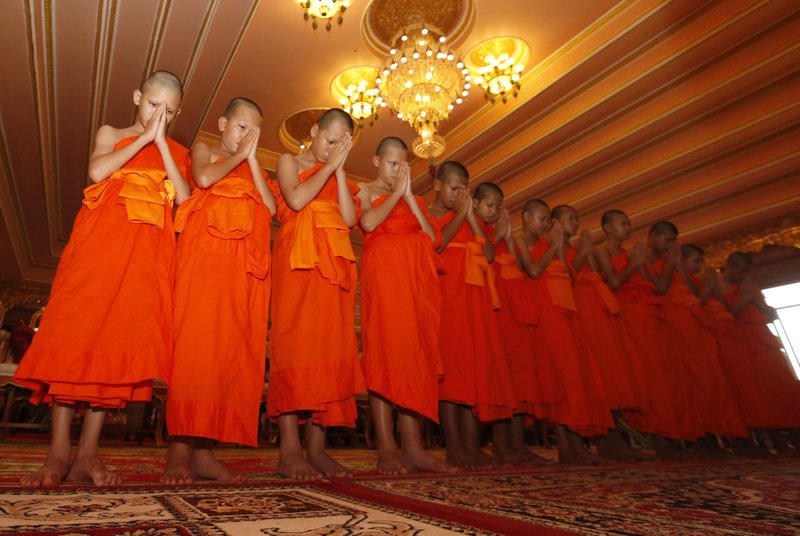
MAE SAI, Thailand (AP) — With their heads bowed and wearing orange robes, the members of the boys’ soccer team rescued from almost three weeks trapped in a cave in northern Thailand on Saturday completed their time as novice Buddhist monks.
About 300 people gathered for the ceremony on a rainy morning that saw the boys leave temple life to return to their families. Those present gave alms — flowers, food, money — as a gesture of their religious devotion.
The July 25 ordination of 11 boys of the Wild Boars soccer team along with the 25-year-old coach was especially dedicated to a former Thai navy SEAL, Saman Gunan, who died while diving during a volunteer mission to supply the cave with oxygen tanks essential to a successful rescue. A twelfth boy did not go through the religious ritual because he isn’t Buddhist.
At the temple near Thailand’s mountainous border with Myanmar, the boys and their coach sat barefooted in a large pavilion in their orange robes. The adults sitting behind them wore white.
With heads bowed, they prayed, fidgeted and occasionally yawned as monks chanted sacred texts. They then placed new monks’ robes on a table in front of a large photo of Saman.
They afterward changed into white shirts and blue pants. Coach Ekapol “Ake” Chanthawong remained in his Buddhist robe, as he has committed to an extended period in the monkhood.
Although they will be giving up their Buddhist robes, it is likely that the boys will retain some of the solitude of temple life, as the government has discouraged for the time being any interviews with them, wielding the threat of legal action under child protection laws.
While there has been some criticism that the government wants to control the narrative of the boys’ ordeal to exploit for political purposes — Thailand’s military rulers are seeking to booster their popularity ahead of a possible election next year — psychologists agree that the boys may be vulnerable to post-traumatic stress disorder. Both their physical and mental health has been judged fine.
According Dr. Paul Auerbach of the Department of Emergency Medicine at Stanford University’s medical school, it’s possible that they might suffer withdrawal or perhaps post-traumatic stress disorder, which is characterized by symptoms that include insomnia, nightmares, hypervigilance, low mood, difficulty concentrating on schoolwork, flashbacks and avoidance of situations similar to those that caused the original trauma.
“On the bright side, it is predictable that not all will be adversely affected — perhaps only about a third of them — and in those cases only a few might require professional psychological or psychiatric intervention,” he said, speaking before the rescue.
The boys and their coach entered the cave on June 23 for a quick, casual trek, but flooding quickly blocked the exit and they had to retreat deeper inside the cave. Heavy rains raised water levels further and thwarted the initial searches before two British divers on July 2 found the group huddled on a dry patch of ground, safe but hungry. They were extricated from the cave in an intricate operation involving an international team of divers over three days beginning July 8.
The epic event is being commemorated with construction of a museum, expected to open within six months, along with a statue of Saman.
Saman, who is considered a national hero, was cremated in a royally sponsored funeral and had his ashes scattered in the Mekong River.
Ray Kurzweil on the state of the world today

“The world isn’t getting worse — our information is getting better.”
–Ray Kurzweil (born February 12, 1948) is an American author, computer scientist, inventor and futurist. He is involved in fields such as optical character recognition, text-to-speech synthesis, speech recognition technology, and electronic keyboard instruments. Wikipedia
Seeing the Sounds Waves
Leo New Moon, Solar Eclipse, August 11, 2018 (19 degrees) 2:57 am PDT

Wendy Cicchetti (wendy@twixtearthandsky.com)
Leo is the natural performer of the zodiac — the actor, the drama queen, and the charismatic leader — comfortable at center stage when any desired applause arrives and confidence is high with recognition of a job well done. The regal lion rules the jungle. We can hardly fail to notice that unmistakable roar or the halo of golden hair around the wild cat’s face. Through Leo’s lens, we need a focal point and anchor. We are drawn to leaders, whether we fear or admire them; we look to those who have the resilience to stand on the world stage to be observed and judged. We equally need to know whom we can trust and believe in, while recognizing who represents danger as we decide our own direction. Leo is the fire sign ruled by the Sun and intrinsically linked with light and warmth. Leo can carry a light ahead of us, illuminating inner wisdom — or it can singe us if we step on its proud paws!
With the Sun’s light eclipsed by the Moon, there may also be a difference in the quality or transmission of the Leo light. For ancient peoples, an eclipse, often viewed as a precursor of ruined crops, would have been greeted with panic. In modern times, we may appreciate its symbolic power as more like a power outage. Perhaps we do panic, at first, if electricity stops flowing! Many of us have come to rely on electronic devices and appliances to the extent that our livelihoods and lifestyles depend on them. A power outage will almost certainly force us out of our routine, prompting us to become more innovative or to delve into a memory of past ways and knowledge, to cope with our sudden “powerlessness.” Such moments can help to remind us that we are humans, not machines. As much as we may attempt to regularize and systematize our lives by giving them our own timetables, the truth is that we are not robots running on computer programs — and may not thrive if we try to mirror them.
We have all had “programming,” of course, from family life, school, and other sources of formative experience. Leo, as natural ruler of the 5th house, reminds us of the inner child within the psyche, whose messages were shaped early and who may yet need communication with the adult “self” today. The child within may need to be consulted about feelings, ideas, and desires. Maybe our child-self was never allowed an opinion, which could suddenly want to be voiced during this eclipse. Perhaps our child-self wanted to participate in certain ways, or felt that it gave more than was ever acknowledged; these facts and the emotional energies linked to them may need space to be honored and expressed.
A solar eclipse is like blinking and finding that you have woken up somewhere new — such as traveling and momentarily forgetting that you are not at home. Yet you are not stranded, since the Leo focus connects firmly with the heart: the true home within each of us. This last eclipse of the year beckons us to tune into the diagnostics of the heart and notice what is going on there. Do we hurt? Are we lonely? What does the heart really want for us? Can it take the risk to open up once more and let life in more fully? Even if our desires sometimes bring pain along the way, the pleasure and satisfaction of fulfilling them may be worth the price of any temporary discomforts.
This article is from the Mountain Astrologer, written by Emily Trinkaus
PLAN YOUR OWN NEW MOON CEREMONY. Give yourself some quiet time in meditation to see where you need to seed new ways of becoming. List these areas within your life you want to change. What areas do you want to break free from the norm and become more productive and discerning? The NEW MOON is the time to manifest the personal attributes you want to cultivate as well as the tangible things you want to bring to you. Possible phrasing: I now manifest ____ into my life. I am now _______ . Remember, think, envision and feel with as much emotion as possible, as though you already have what you want. Thoughts are things and the brain manifests exactly what you show it in the form of thoughts, visuals and emotions. The Buddha said, and I am paraphrasing, “We are the sum total of our thoughts up to today. ” If we want to be different then we must change our thoughts. “If you always do what you’ve always done then you’ll always get what you’ve always got.” CONSCIOUS CHANGE is the key.
Olompali: A Hippie Odyssey Trailer
Olompali: A Hippie Odyssey Trailer from Maura McCoy on Vimeo.
Trailer for the feature-length documentary “Olompali: A Hippie Odyssey.”