Ra Wins Westminster God Show

February 13, 2018 (theonion.com)
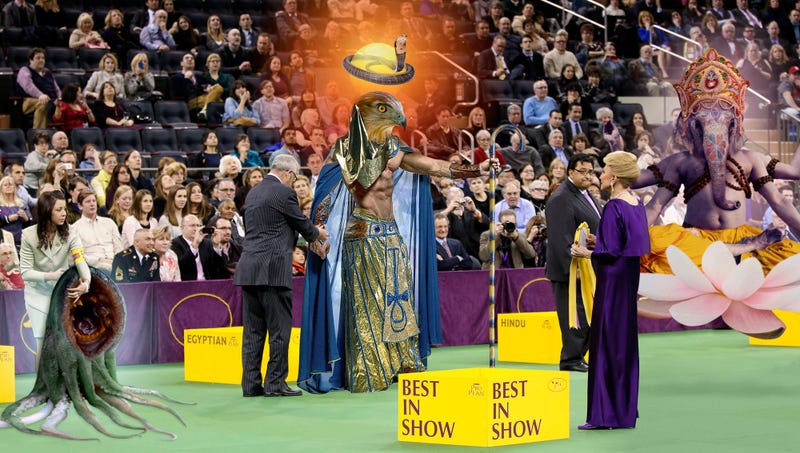
Egyptian sun god Ra impressed judges with his overall body proportions as well as his celestial temperament.


NEW YORK—Commending his healthy frame, impeccable lineage, and ability to form light and order from the primordial chaos, judges announced Thursday that Egyptian deity Ra has taken top honors at the 141st annual Westminster God Show.

The purebred Egyptian sun god, who competed against divinities from more than 290 recognized pantheons—including Roman gods of war, trickster deities, and the Mesopotamian Anunnaki—reportedly overcame stiff competition to impress judges with high marks in gait, ear shape, and all-around omnipotence, ultimately winning best in show.

“Since 1877, the Westminster God Show has conferred its highest award upon only the most distinguished of deities, and Ra is without question one of the finest specimens we’ve ever seen,” said judge Allison Brand, citing the distinguished pedigree of the 26,000-year-old creator of all life, who sired himself from the endless void and infinite night. “His victory is especially impressive when you consider this year’s incredibly competitive field. [Japanese storm god] Susanoo-no-Mikoto, for instance, really thrilled us when he rode the crest of a tsunami across the show floor and summoned the power of lightning to defeat the evil spirits of the world.”

“But at the end of the day, Ra is just a tremendously pretty god,” she continued as she patted the deity’s falcon head and presented his handler with a purple-and-gold ribbon.

Judges at the Westminster God Show, which takes place each year at Madison Square Garden, told reporters they subject deities to the highest levels of scrutiny, evaluating them on criteria that include miracle performance, disciple loyalty, and ability to herd souls into the afterlife. Officials noted that even small flaws can prove disastrous for a divine entrant, as was the case this year when Tezcatlipoca, Aztec god of the night sky, received low marks on his build after a judge’s inspection revealed his testicles were slightly mismatched.

To avoid such pitfalls, handlers typically spend hours in the caged-off god-grooming area, where earlier this week they could be seen feeding hearts of the damned to Egyptian underworld goddess Ammit and rubbing coconut oil on four-armed Hindu god Ganesha to ensure he had a silky red coat for the show’s inspection portion.

“For Ra to be crowned champion, several fan-favorite gods unfortunately had to lose,” said veteran Westminster announcer Nigel Masters, who described an incident in which the highly favored Kuba giant god Mbombo was disqualified after becoming sick and vomiting the sun, stars, and moon onto the artificial turf of the competition ring. “Many expected Hephaestus to win it all this year, but his maimed foot lost him serious points. In the end, he didn’t even place well in his own fire-god division.”

According to historical records, the Westminster God Show has changed its rules of competition substantially over the years, most notably in 1938, when it relaxed its purebred restriction to include a demigod category. This reportedly led to the 1947 victory of Odin-sired Sæmingr and, more recently, a 1993 runner-up prize for the Lord Jesus Christ, who was said to have impressed judges with His even-keeled temperament and strong bite.

Like most winners before him, Ra is expected to move on to a lucrative career in studding, unless, like 2015 best-in-show recipient Uranus, he is castrated with a sickle and has his genitals thrown into the sea.

“From the first time I saw Ra weep, his tears falling to the earth to create humanity itself, I knew he was something special, but this is truly a great honor,” said 57-year-old Gerald Simons, the sun god’s longtime handler. “It’s been extraordinary to watch him come up from the literal vast expanse of nothingness to form the land, the sky, and the underworld. He’s a very good god. Yes, he is!”

“Somebody deserves a treat,” he added as he pet the solar disk floating above Ra’s head and gestured toward a sacrificial bull in a nearby handling crate.


A New Goal: Aim To Be Less Wrong

Starting from the assumption that you are wrong may help push scientific research forward, says Tania Lombrozo.

H. Armstrong Roberts/ClassicStock/Getty Images

At a conference last week, I received an interesting piece of advice:

“Assume you are wrong.”

The advice came from Brian Nosek, a fellow psychology professor and the executive director of the Center for Open Science. Nosek wasn’t objecting to any particular claim I’d made — he was offering a strategy for pursuing better science, and for encouraging others to do the same.

To understand the context for Nosek’s advice, we need to take a step back — to the nature of science itself, and to a methodological revolution that’s been shaking the field of psychology.

You see, despite what many of us learned in elementary school, there is no singlescientific method. Just as scientific theories become elaborated and change, so do scientific methodsThe randomized controlled trial — which we now take for granted as a method for evaluating the causal efficacy of a drug — was a methodological innovation. Statistical significance testing — which is often taken for granted as a method for evaluating the probability that an outcome was due to chance alone — was a methodological innovation.

Triggered by a so-called “replication crisis,” the field of psychology has been actively engaged in a critical evaluation of our methods and how they ought to be improved. This has involved a close look at how psychological science is produced, evaluated, and published, alongside a shift in norms concerning how decisions about studies are made and reported.

For example, many academic journals have moved away from a narrow focus on statistical significance testing to consider a broader range of statistical measures. And some journals now allow researchers to submit papers that undergo peer-review priorto data collection, thus ensuring that decisions about the study are not made after seeing the data, and that the evaluation of the paper is not based on whether the data fit in with reviewers’ preferences or expectations. These, too, are methodological innovations.

But methodological reform hasn’t come without some fretting and friction. Nasty things have been said by methodological reformers; nasty things have been said aboutmethodological reformers. There have been victims (though who they are depends on whom you ask). Few people like public criticism, or having the value of their life’s work called into question. On the other side, few people are good at voicing criticisms in kind and constructive ways. So part of the challenge is figuring out how to bake critical self-reflection into the culture of science itself, so it unfolds as a welcome and integrated part of the process, and not an embarrassing sideshow.

In some ways, science is already the poster child for critical self-reflection. As a community, we actively try to falsify our own and other people’s ideas. Peer-review is basically structured peer criticism, and the methodological innovations that fuel science come from science itself. But scientists are still humans and, like any human community, the scientific community can benefit from norms that make it easier to embrace our overarching values. These values include a commitment to seeking out and pursuing scientific methods that yield reliable conclusions — even as we use the tools of science to determine what those methods ought to be.

So how can the scientific community better instantiate such norms? What, for example, does this mean for scientists conducting basic research?

When Nosek recommended that I and other scientists assume that we are wrong, he was sharing a strategy that he’s employed in his own lab — a strategy for changing the way we offer and respond to critique.

Assuming you are right might be a motivating force, sustaining the enormous effort that conducting scientific work requires. But it also makes it easy to construe criticisms as personal attacks, and for scientific arguments to devolve into personal battles. Beginning, instead, from the assumption you are wrong, a criticism is easier to construe as a helpful pointer, a constructive suggestion for how to be less wrong — a goal that your critic presumably shares.

This advice may sound unduly pessimistic, but it’s not so foreign to science. Philosophers of science sometimes refer to the “pessimistic meta-induction” on the history of science: All of our past scientific theories have been wrong, so surely our current theories will turn out to be wrong, too. That doesn’t mean we haven’t made progress, but it does suggest that there is always room for improvement and elaboration — ways to be less wrong.

One worry about this approach is that it could be demoralizing for scientists. Striving to be less wrong might be a less effective prod than the promise of being right. Another concern is that a strategy that works well within science could backfire when it comes to communicating science with the public. This is a topic I’ve written about before: Without an appreciation for how science works, it’s easy to take uncertainty or disagreements as marks against science, when in fact they reflect some of the very features of science that make it our best approach to reaching reliable conclusions about the world. Science is reliable because it responds to evidence: As the quantity and quality of our evidence improves, our theories can and should change, too.

Despite these worries, I like Nosek’s suggestion because it builds in epistemic humility (“there are things I do not know!”) along with a sense that we can do better (“there are things I do not know yet!”). It also builds in a sense of community — we’re all in the same boat when it comes to falling short of getting things right. Perhaps the focus on a shared goal — our goal as scientists and humans of being less wrong — can help compensate for any harms in scientific motivation or communication.

I also like Nosek’s advice because it isn’t restricted to science. Striving to be less wrong— rather than more right — could be a beneficial way to construe our aims across a variety of contexts, whether it’s a marital dispute or a business decision. I may be wrong about who did the dishes last night, or about which stock is the best investment; if I begin from the assumption that I’m fallible and striving to be less wrong, a challenge may not feel so threatening.

Unfortunately, this still leaves us with an untested psychological hypothesis: that assuming one is wrong can change community norms for the better, and ultimately support better science (and even, perhaps, better judgments and decisions in everyday life).

I don’t know if that’s true. In fact, I should probably assume that it’s wrong. But with the benefit of the scientific community and our best methodological tools, I hope we can get it less wrong, together.


Tania Lombrozo is a psychology professor at the University of California, Berkeley. She writes about psychology, cognitive science and philosophy, with occasional forays into parenting and veganism. You can keep up with more of what she is thinking on Twitter: @TaniaLombrozo

(Submitted by Bruce King.)

Joe Rogan Experience #1077 – Johann Hari


PowerfulJRE
Streamed live on Feb 12, 2018

Johann Hari is a writer and journalist. He has written for a number of publications including The Independent (London) and The Huffington Post and has written books on the topic of the war on drugs, the monarchy, and depression, in an accessible and non-technical style. His new book “Lost Connections” is available now. https://thelostconnections.com/

The Hubbard Quartet: Oblivion


LeDroit ChamberPlayers
Published on Dec 5, 2017

The Hubbard Quartet – Oblivion March 19, 2017
The all-female group, Hubbard Quartet presents a program of all female composers in their first concert tour of the West Coast. The concert program includes Julie Barwick’s “Shroud” and Vivian Fine’s “Capriccio”, and the West Coast premiere of Devree Lewis’ “Luz de Agosto” andMarilyn Zupnik’s “Oboe Quartet No. 1”.

The Hubbard Quartet is comprised of four dear friends. The ladies met teaching at the Boston University Tanglewood Institute during the summer of 2015, where they were all living together in a New England-style home on Hubbard Street in Lenox, MA. All four instantly bonded both personally and musically, and thus the Hubbard Quartet was born! The members of the Quartet are spread out in cities all across the United States (Boston, Washington D.C,. and San Francisco), but they come together throughout the year to spend time together and make music.

Hubbard Quartet:
Klaudia Szlachta, Violin
Jamie Roberts, Oboe
Laura Manko Sahin, Viola
Hyun Min Lee, Cello

“What Happens When Your Soul Begins to Awaken” by Hafiz

What happens when your soul
Begins to awaken
Your eyes
And your heart
And the cells of your body
To the great journey of love?

First there is wonderful laughter
And probably precious tears

And a hundred sweet promises
And those heroic vows
No one can ever keep.

But still God is delighted and amused
You once tried to be a saint

What happens when your soul
Begins to awake in this world

To our deep need to love
And serve the Friend?

O the Beloved
Will send you
One of His wonderful, wild companions

My Funny Valentines: Joe Rogan and Jimmy Dore


PowerfulJRE
Streamed live 8 hours ago

Jimmy Dore is a stand-up comedian, political commentator, host of “The Jimmy Dore Show” available on YouTube (https://www.youtube.com/channel/UC3M7…) and as a podcast available on iTunes.

Three gems in three hours from Jimmy Dore:

1) “Nothing has a stronger influence psychologically on their environment and especially on their children than the unlived life of the parent.”
–Carl Gustav Jung

2) “We have a whole system of preparation of the child for life which always is preparation and never actually gets there. Making plans for the future is of use only to people who are capable of living completely in the present.”
–Alan Watts

3) “The world isn’t here to make you happy. It’s here to frustrate you ’til you wake up.”
–Eckhart Tolle

Joe Rogan – Depression IS NOT Caused By A Chemical Imbalance In The Brain?


Joe Rogan Fan Page
Published on Feb 12, 2018

Joe Rogan talks to Johann Hari whom argues that depression and anxiety are not caused by a chemical imbalance in the brain. From The Joe Rogan Experience Podcast, JRE #1077. Full podcast – https://www.youtube.com/watch?v=DQUgd…

Joe Rogan – Depression IS NOT Caused By A Chemical Imbalance In The Brain?:
https://www.youtube.com/watch?v=aujaQ…

Beyond Conspiracy – The Terrifying Truth Of Corporate Power


Russell Brand
Published on Nov 21, 2017

Under The Skin #36
Beyond Conspiracy – The Terrifying Truth Of Corporate Power

Having spent years investigating some of the wealthiest people on the planet, journalist and broadcaster Jacques Peretti joins me to discuss the secret billion dollar deals that we never hear about but which are changing our world and revolutionising everything we do.

Unf*ck Yourself From The Modern World with my new book Recovery
Get it here in US: http://tinyurl.com/ydcwz3kd

Consciousness, spirituality, biography, sexuality, androgyny, futurism, space, the arts, science, astrology, democracy, humor, books, movies and more