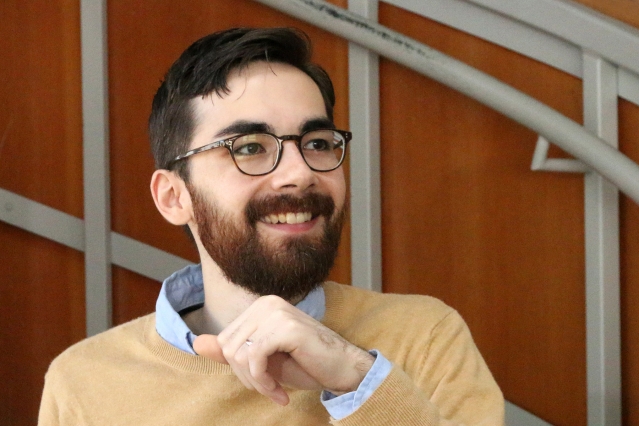
“The danger emerges when distrust undercuts the sources for truth in society,” says Justin Khoo, an assistant professor of philosophy. “You give up on the truth and retreat to subjectivism: ‘All I know is the content of my own mind.’ That’s paving the path to authoritarianism. The point of democracy is to think about issues yourself.” Photo: Allegra Boverman
In Justin Khoo’s new class, students explore how language affects censorship, dissent, truth, and propaganda.
School of Humanities, Arts, and Social Sciences
February 9, 2018 (news.mit.edu)
Why would a politician publicly contradict himself? What does it mean to call someone a racist? Can you control hate speech without eroding free speech? What happens to democracy if truth is subjective?
These are among the rich range of topics discussed in 24.192 (Language, Information, and Power), an undergraduate philosophy seminar taught by Assistant Professor Justin Khoo. Offered for just the second time last fall, the class explores philosophical and political issues surrounding discourse, with a focus on connecting philosophical ideas to current controversies about speech.
“The class has been a great space for discussion about very relevant issues we face today. In 24.192 we regularly engaged on topics of bigotry, ideal political discourse, and the ever-growing polarization of partisanship and media sources,” says Joseph Edwards, a sophomore in electrical engineering and computer science. “This class has put philosophy and linguistics on the front line in terms of how we look at our cultures and societies.”
“We’re not just playing with ideas, but ideally articulating viewpoints in a way that can change hearts and minds,” says Khoo. “It’s a lofty goal.”
Philosophy of language as a framework for difficult questions
Readings range from classics of philosophy such as John Stuart Mill’s “On Liberty” to works by contemporary philosophers, such as University of Connecticut professor Michael Lynch, as well as a wide selection of opinion articles on such topics as censorship, racism, and the nature of truth in politics.
“We have to distinguish between what is objectionable within a certain context and the idea that a view should never be expressed ever,” says Khoo, noting that the philosophy of language provides a framework for considering such difficult questions. “When you call a person ‘racist,’ it’s not just the dictionary definition. You are judging them in a particular way. You are labeling them a bad person.”
With that in mind, is “racist” a useful label? Khoo says that the tool philosophy provides for considering such questions is abstraction — getting away from the particularities of today’s political firestorms to try to understand the fundamentals underlying language-related issues.
Truth and politics
For example, one evening this fall the class met in a Stata Center lecture hall to discuss truth in the context of politics while enjoying a buffet dinner provided by Radius, an MIT initiative that fosters greater engagement with ethics, and which served as co-sponsor of the course.
Rather than debating the latest headline-grabbing bit of news, however, Khoo introduced the class to the liar paradox. He wrote “This sentence is false” on the whiteboard and examined the challenges the sentence presents. “Things shouldn’t be both true and false. As soon as you talk about truth you come across some interesting paradoxes in philosophy,” says Khoo.
While belief is not the same thing as truth, and lying is commonplace, human interactions depend on the norm that people generally assert things that they know to be true, Khoo says. “Under what conditions would it be reasonable to try to get your belief into someone else’s mind just by asserting it if that rule weren’t widely adhered to?” asks Khoo. “Violations of these rules can’t be the norm, because if they were it’s hard to see how we could communicate at all.”
Nevertheless, Khoo notes, “There are rewards for flouting these norms. This is where we’re going to get political.” Citing an article by Lynch, he points out that a politician who contradicts himself can actually win people over on both sides of an issue — because, Khoo says, “Listeners can believe what they want.”
“The danger emerges when distrust undercuts the sources for truth in society. You give up on the truth and retreat to subjectivism: ‘All I know is the content of my own mind.’ That’s paving the path to authoritarianism. The point of democracy is to think about issues yourself,” says Khoo.
Applying philosophy to life
Students say the class has enriched their thinking about topical issues. “I talk about the subjects and the ideas we talk about in the class with people in my dorm,” says Lawson Kosulic, a junior double majoring in philosophy and physics. “Many of the frameworks we use in philosophy of language are very applicable to real-life situations.”
For example, the class discussed the effects that hate speech and subtler forms of discriminations can have on human behaviors. “Some people feel silenced by what other people are saying. This restricts the amount of information and perspective we get,” says Kosulic.
Edwards says, “We spent many hours approaching how we communicate our values and what effect communication has on our democracy. Finally, we discussed how much credence we give our information … and whether academia offers us any factual security.”
The question of what to do about the issues raised in the class is answered differently by different philosophers, but Khoo says his point was not to give students answers but to provide resources for them to think through questions on their own. “The goal of the course is to create an open and friendly environment for students to talk about these issues,” says Khoo.
Kosulic says the class has gotten him thinking about how he uses language himself. “This is why I’m so interested in philosophy. When you take these classes, you see it takes something subjective and emotion-filled and makes it more structured. It lets you look at it in a logical framework,” says Kosulic. “When I go to class it leaves me feeling inspired. Every time there’s a new piece to the puzzle.”
Millions of people watched on Tuesday as SpaceX’s Falcon Heavy, the world’s most powerful rocket since Saturn V, launched out of the atmosphere, delivered a Tesla Roadster into space, and then, in three separate pieces, descended back to earth. It was exciting. It was awe-inspiring. It was a grand spectacle.
But most of all, it was a sham.
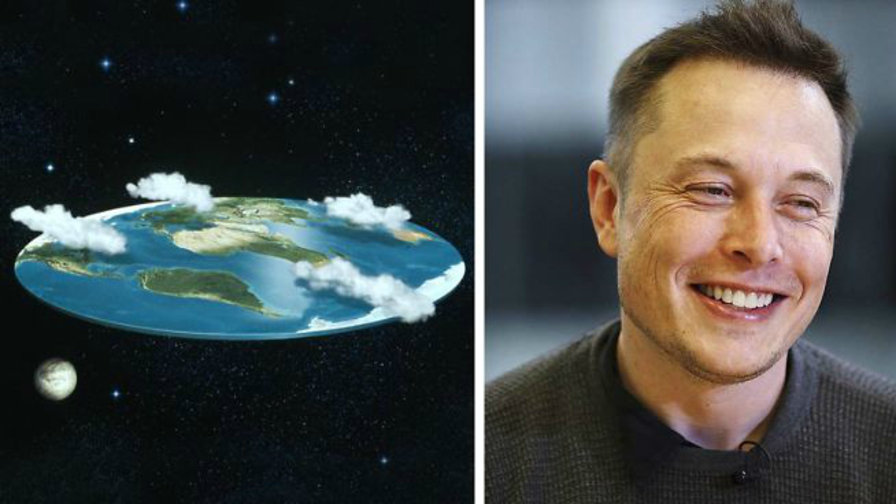
The revelation comes from the Flat Earth Society (this one, not this one), and it tells of how Elon Musk’s recent foray into space was an intricately planned hoax, just the latest in the decades-long “globularist” conspiracydesigned to fool the world into believing that Earth is round.
“It certainly is interesting to see the shift of focus in space programs from official government organisations to privately-run organisations,” Pete Svarrior, a moderator on the society’s website, wrote in a blog post.
Interesting indeed. The society proposes that people’s willingness to believe things they see on the internet is just a new version of the old phrase “It’s true, I saw it on TV!”
People who believe that the Earth is a globe because “they saw a car in space on the Internet” must be the new incarnation of “It’s true, I saw it on TV!” It’s a poor argument.
Why would we believe any privately-held company to report the truth?
Forget, for a moment, the fact that the once-fledgling Flat Earth Society found new life after thousands of people were able to “see it on the internet” in the early 2000s. And never mind the tweet’s curious implication that we should be extra skeptical of “privately-held” companies while assuming government-controlled organizations are more trustworthy.
There’s a bigger issue at hand: beloved inventor and entrepreneur Elon Musk is a crook.
Wake the hell up.
Even Apple cofounder Steve Wozniak “doesn’t believe anything” Musk says, as Svarrior noted by citing an article in which “The Woz” expressed doubt over the quality of the technology in Tesla cars.
There’s reason to doubt Tesla. The company says its cars use GPS to navigate. Why is that a problem? GPS technology, which relies on a network of satellites to triangulate positions on the ground, is based on the assumption that Earth is round. Maybe that’s why Tesla cars keep crashing into fire trucks and stuff.
“I would like to appeal to everyone, Round Earther and Flat Earther alike, to exercise more caution when approaching online content,” Svarrior wrote, going on to suggest (grab a pen because you’ll want to write this one down) that everyone should “Exercise critical thinking.”
Still, even Svarrior can’t deny that Musk has a knack for marketing.
Cosmopsychism might seem crazy, but it provides a robust explanatory model for how the Universe became fine-tuned for life
In the past 40 or so years, a strange fact about our Universe gradually made itself known to scientists: the laws of physics, and the initial conditions of our Universe, are fine-tuned for the possibility of life. It turns out that, for life to be possible, the numbers in basic physics – for example, the strength of gravity, or the mass of the electron – must have values falling in a certain range. And that range is an incredibly narrow slice of all the possible values those numbers can have. It is therefore incredibly unlikely that a universe like ours would have the kind of numbers compatible with the existence of life. But, against all the odds, our Universe does.
Here are a few of examples of this fine-tuning for life:
The strong nuclear force (the force that binds together the elements in the nucleus of an atom) has a value of 0.007. If that value had been 0.006 or less, the Universe would have contained nothing but hydrogen. If it had been 0.008 or higher, the hydrogen would have fused to make heavier elements. In either case, any kind of chemical complexity would have been physically impossible. And without chemical complexity there can be no life.
The physical possibility of chemical complexity is also dependent on the masses of the basic components of matter: electrons and quarks. If the mass of a down quark had been greater by a factor of 3, the Universe would have contained only hydrogen. If the mass of an electron had been greater by a factor of 2.5, the Universe would have contained only neutrons: no atoms at all, and certainly no chemical reactions.
Gravity seems a momentous force but it is actually much weaker than the other forces that affect atoms, by about 1036. If gravity had been only slightly stronger, stars would have formed from smaller amounts of material, and consequently would have been smaller, with much shorter lives. A typical sun would have lasted around 10,000 years rather than 10 billion years, not allowing enough time for the evolutionary processes that produce complex life. Conversely, if gravity had been only slightly weaker, stars would have been much colder and hence would not have exploded into supernovae. This also would have rendered life impossible, as supernovae are the main source of many of the heavy elements that form the ingredients of life.
Some take the fine-tuning to be simply a basic fact about our Universe: fortunate perhaps, but not something requiring explanation. But like many scientists and philosophers, I find this implausible. In The Life of the Cosmos(1999), the physicist Lee Smolin has estimated that, taking into account all of the fine-tuning examples considered, the chance of life existing in the Universe is 1 in 10229, from which he concludes:
In my opinion, a probability this tiny is not something we can let go unexplained. Luck will certainly not do here; we need some rational explanation of how something this unlikely turned out to be the case.
The two standard explanations of the fine-tuning are theism and the multiverse hypothesis. Theists postulate an all-powerful and perfectly good supernatural creator of the Universe, and then explain the fine-tuning in terms of the good intentions of this creator. Life is something of great objective value; God in Her goodness wanted to bring about this great value, and hence created laws with constants compatible with its physical possibility. The multiverse hypothesis postulates an enormous, perhaps infinite, number of physical universes other than our own, in which many different values of the constants are realised. Given a sufficient number of universes realising a sufficient range of the constants, it is not so improbable that there will be at least one universe with fine-tuned laws.
Both of these theories are able to explain the fine-tuning. The problem is that, on the face of it, they also make false predictions. For the theist, the false prediction arises from the problem of evil. If one were told that a given universe was created by an all-loving, all-knowing and all-powerful being, one would not expect that universe to contain enormous amounts of gratuitous suffering. One might not be surprised to find it contained intelligent life, but one would be surprised to learn that life had come about through the gruesome process of natural selection. Why would a loving God who could do absolutely anything choose to create life that way? Prima facietheism predicts a universe that is much better than our own and, because of this, the flaws of our Universe count strongly against the existence of God.
Turning to the multiverse hypothesis, the false prediction arises from the so-called Boltzmann brain problem, named after the 19th-century Austrian physicist Ludwig Boltzmann who first formulated the paradox of the observed universe. Assuming there is a multiverse, you would expect our Universe to be a fairly typical member of the universe ensemble, or at least a fairly typical member of the universes containing observers (since we couldn’t find ourselves in a universe in which observers are impossible). However, in The Road to Reality (2004), the physicist and mathematician Roger Penrose has calculated that in the kind of multiverse most favoured by contemporary physicists – based on inflationary cosmology and string theory – for every observer who observes a smooth, orderly universe as big as ours, there are 10 to the power of 10123 who observe a smooth, orderly universe that is just 10 times smaller. And by far the most common kind of observer would be a ‘Boltzmann’s brain’: a functioning brain that has by sheer fluke emerged from a disordered universe for a brief period of time. If Penrose is right, then the odds of an observer in the multiverse theory finding itself in a large, ordered universe are astronomically small. And hence the fact that we are ourselves such observers is powerful evidence against the multiverse theory.
Neither of these are knock-down arguments. Theists can try to come up with reasons why God would allow the suffering we find in the Universe, and multiverse theorists can try to fine-tune their theory such that our Universe is less unlikely. However, both of these moves feel ad hoc, fiddling to try to save the theory rather than accepting that, on its most natural interpretation, the theory is falsified. I think we can do better.
In the public mind, physics is on its way to giving us a complete account of the nature of space, time and matter. We are not there yet of course; for one thing, our best theory of the very big – general relativity – is inconsistent with our best theory of the very small – quantum mechanics. But it is standardly assumed that one day these challenges will be overcome and physicists will proudly present an eager public with the Grand Unified Theory of everything: a complete story of the fundamental nature of the Universe.
In fact, for all its virtues, physics tells us precisely nothing about the nature of the physical Universe. Consider Isaac Newton’s theory of universal gravitation:
The variables m1 and m2 stand for the masses of two objects that we want to work out the gravitational attraction between; F is the gravitational attraction between those two masses, G is the gravitational constant (a number we know from observation); and r is the distance between m1 and m2. Notice that this equation doesn’t provide us with definitions of what ‘mass’, ‘force’ and ‘distance’ are. And this is not something peculiar to Newton’s law. The subject matter of physics are the basic properties of the physics world: mass, charge, spin, distance, force. But the equations of physics do not explain what these properties are. They simply name them in order to assert equations between them.
If physics is not telling us the nature of physical properties, what is it telling us? The truth is that physics is a tool for prediction. Even if we don’t know what ‘mass’ and ‘force’ really are, we are able to recognise them in the world. They show up as readings on our instruments, or otherwise impact on our senses. And by using the equations of physics, such as Newton’s law of gravity, we can predict what’s going to happen with great precision. It is this predictive capacity that has enabled us to manipulate the natural world in extraordinary ways, leading to the technological revolution that has transformed our planet. We are now living through a period of history in which people are so blown away by the success of physical science, so moved by the wonders of technology, that they feel strongly inclined to think that the mathematical models of physics capture the whole of reality. But this is simply not the job of physics. Physics is in the business of predicting the behaviour of matter, not revealing its intrinsic nature.
It’s silly to say that atoms are entirely removed from mentality, then wonder where mentality comes from
Given that physics tell us nothing of the nature of physical reality, is there anything we do know? Are there any clues as to what is going on ‘under the bonnet’ of the engine of the Universe? The English astronomer Arthur Eddington was the first scientist to confirm general relativity, and also to formulate the Boltzmann brain problem discussed above (albeit in a different context). Reflecting on the limitations of physics in The Nature of the Physical World (1928), Eddington argued that the only thing we really know about the nature of matter is that some of it has consciousness; we know this because we are directly aware of the consciousness of our own brains:
We are acquainted with an external world because its fibres run into our own consciousness; it is only our own ends of the fibres that we actually know; from those ends, we more or less successfully reconstruct the rest, as a palaeontologist reconstructs an extinct monster from its footprint.
We have no direct access to the nature of matter outside of brains. But the most reasonable speculation, according to Eddington, is that the nature of matter outside of brains is continuous with the nature of matter inside of brains. Given that we have no direct insight into the nature of atoms, it is rather ‘silly’, argued Eddington, to declare that atoms have a nature entirely removed from mentality, and then to wonder where mentality comes from. In my book Consciousness and Fundamental Reality (2017), I developed these considerations into an extensive argument for panpsychism: the view that all matter has a consciousness-involving nature.
There are two ways of developing the basic panpsychist position. One is micropsychism, the view that the smallest parts of the physical world have consciousness. Micropsychism is not to be equated with the absurd view that quarks have emotions or that electrons feel existential angst. In human beings, consciousness is a sophisticated thing, involving subtle and complex emotions, thoughts and sensory experiences. But there seems nothing incoherent with the idea that consciousness might exist in some extremely basic forms. We have good reason to think that the conscious experience of a horse is much less complex than that of a human being, and the experiences of a chicken less complex than those of a horse. As organisms become simpler, perhaps at some point the light of consciousness suddenly switches off, with simpler organisms having no experience at all. But it is also possible that the light of consciousness never switches off entirely, but rather fades as organic complexity reduces, through flies, insects, plants, amoeba and bacteria. For the micropsychist, this fading-while-never-turning-off continuum further extends into inorganic matter, with fundamental physical entities – perhaps electrons and quarks – possessing extremely rudimentary forms of consciousness, to reflect their extremely simple nature.
However, a number of scientists and philosophers of science have recently argued that this kind of ‘bottom-up’ picture of the Universe is outdated, and that contemporary physics suggests that in fact we live in a ‘top-down’ – or ‘holist’ – Universe, in which complex wholes are more fundamental than their parts. According to holism, the table in front of you does not derive its existence from the sub-atomic particles that compose it; rather, those sub-atomic particles derive their existence from the table. Ultimately, everything that exists derives its existence from the ultimate complex system: the Universe as a whole.
Holism has a somewhat mystical association, in its commitment to a single unified whole being the ultimate reality. But there are strong scientific arguments in its favour. The American philosopher Jonathan Schaffer arguesthat the phenomenon of quantum entanglement is good evidence for holism. Entangled particles behave as a whole, even if they are separated by such large distances that it is impossible for any kind of signal to travel between them. According to Schaffer, we can make sense of this only if, in general, we are in a Universe in which complex systems are more fundamental than their parts.
If we combine holism with panpsychism, we get cosmopsychism: the view that the Universe is conscious, and that the consciousness of humans and animals is derived not from the consciousness of fundamental particles, but from the consciousness of the Universe itself. This is the view I ultimately defend in Consciousness and Fundamental Reality.
The cosmopsychist need not think of the conscious Universe as having human-like mental features, such as thought and rationality. Indeed, in my book I suggested that we think of the cosmic consciousness as a kind of ‘mess’ devoid of intellect or reason. However, it now seems to me that reflection on the fine-tuning might give us grounds for thinking that the mental life of the Universe is just a little closer than I had previously thought to the mental life of a human being.
The Canadian philosopher John Leslie proposed an intriguing explanation of the fine-tuning, which in Universes (1989) he called ‘axiarchism’. What strikes us as so incredible about the fine-tuning is that, of all the values the constants in our laws had, they ended up having exactly those values required for something of great value: life, and ultimately intelligent life. If the laws had not, against huge odds, been fine-tuned, the Universe would have had infinitely less value; some say it would have had no value at all. Leslie proposes that this proper understanding of the problem points us in the direction of the best solution: the laws are fine-tuned because their being so leads to something of great value. Leslie is not imagining a deity mediating between the facts of value and the cosmological facts; the facts of value, as it were, reach out and fix the values directly.
It can hardly be denied that axiarchism is a parsimonious explanation of fine-tuning, as it posits no entities whatsoever other than the observable Universe. But it is not clear that it is intelligible. Values don’t seem to be the right kind of things to have a causal influence on the workings of the world, at least not independently of the motives of rational agents. It is rather like suggesting that the abstract number 9 caused a hurricane.
But the cosmopsychist has a way of rendering axiarchism intelligible, by proposing that the mental capacities of the Universe mediate between value facts and cosmological facts. On this view, which we can call ‘agentive cosmopsychism’, the Universe itself fine-tuned the laws in response to considerations of value. When was this done? In the first 10-43 seconds, known as the Planck epoch, our current physical theories, in which the fine-tuned laws are embedded, break down. The cosmopsychist can propose that during this early stage of cosmological history, the Universe itself ‘chose’ the fine-tuned values in order to make possible a universe of value.
Making sense of this requires two modifications to basic cosmopsychism. Firstly, we need to suppose that the Universe acts through a basic capacity to recognise and respond to considerations of value. This is very different from how we normally think about things, but it is consistent with everything we observe. The Scottish philosopher David Hume long ago noted that all we can really observe is how things behave – the underlying forces that give rise to those behaviours are invisible to us. We standardly assume that the Universe is powered by a number of non-rational causal capacities, but it is also possible that it is powered by the capacity of the Universe to respond to considerations of value.
It is parsimonious to suppose that the Universe has a consciousness-involving nature
How are we to think about the laws of physics on this view? I suggest that we think of them as constraints on the agency of the Universe. Unlike the God of theism, this is an agent of limited power, which explains the manifest imperfections of the Universe. The Universe acts to maximise value, but is able to do so only within the constraints of the laws of physics. The beneficence of the Universe does not much reveal itself these days; the agentive cosmopsychist might explain this by holding that the Universe is now more constrained than it was in the unique circumstances of the first split second after the Big Bang, when currently known laws of physics did not apply.
Ockham’s razor is the principle that, all things being equal, more parsimonious theories – that is to say, theories with relatively few postulations – are to be preferred. Is it not a great cost in terms of parsimony to ascribe fundamental consciousness to the Universe? Not at all. The physical world must have some nature, and physics leaves us completely in the dark as to what it is. It is no less parsimonious to suppose that the Universe has a consciousness-involving nature than that it has some non-consciousness-involving nature. If anything, the former proposal is more parsimonious insofar as it is continuous with the only thing we really know about the nature of matter: that brains have consciousness.
Having said that, the second and final modification we must make to cosmopsychism in order to explain the fine-tuning does come at some cost. If the Universe, way back in the Planck epoch, fine-tuned the laws to bring about life billions of years in its future, then the Universe must in some sense be aware of the consequences of its actions. This is the second modification: I suggest that the agentive cosmopsychist postulate a basic disposition of the Universe to represent the complete potential consequences of each of its possible actions. In a sense, this is a simple postulation, but it cannot be denied that the complexity involved in these mental representations detracts from the parsimony of the view. However, this commitment is arguably less profligate than the postulations of the theist or the multiverse theorist. The theist postulates a supernatural agent while the agentive cosmopsychist postulates a natural agent. The multiverse theorist postulates an enormous number of distinct, unobservable entities: the many universes. The agentive cosmopsychist merely adds to an entity that we already believe in: the physical Universe. And most importantly, agentive cosmopsychism avoids the false predictions of its two rivals.
The idea that the Universe is a conscious mind that responds to value strikes us a ludicrously extravagant cartoon. But we must judge the view not on its cultural associations but on its explanatory power. Agentive cosmopsychism explains the fine-tuning without making false predictions; and it does so with a simplicity and elegance unmatched by its rivals. It is a view we should take seriously.
This essay was made possible through the support of a grant from Templeton Religion Trust to Aeon and a separate grant from the Templeton funded‘Pantheism and Panentheism’ project to the author. The opinions expressed in this publication are those of the author(s) and do not necessarily reflect the views of Templeton Religion Trust.
Philip Goff is associate professor in philosophy at the Central European University in Budapest. His research interest is in consciousness and he blogs at Conscience and Consciousness.
In this fascinating footage, legendary novelist and philosopher Ayn Rand is interviewed by a young Mike Wallace, at the outset of his career. Rand is questioned on the philosophy she founded–Objectivism. Today The Atlas Society continues to develop and promote that philosophy.
And it was at that age … Poetry arrived
in search of me. I don’t know, I don’t know where
it came from, from winter or a river.
I don’t know how or when,
no they were not voices, they were not
words, nor silence,
but from a street I was summoned,
from the branches of night,
abruptly from the others,
among violent fires
or returning alone,
there I was without a face
and it touched me.
I did not know what to say, my mouth
had no way
with names,
my eyes were blind,
and something started in my soul,
fever or forgotten wings,
and I made my own way,
deciphering
that fire,
and I wrote the first faint line,
faint, without substance, pure
nonsense,
pure wisdom
of someone who knows nothing,
and suddenly I saw
the heavens
unfastened
and open,
planets,
palpitating plantations,
shadow perforated,
riddled
with arrows, fire and flowers,
the winding night, the universe.
And I, infinitesimal being,
drunk with the great starry
void,
likeness, image of
mystery,
felt myself a pure part
of the abyss,
I wheeled with the stars,
my heart broke loose on the wind.
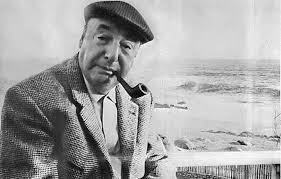
–Pablo Neruda (July 12, 1904 – September 23, 1973) was the pen name and, later, legal name of the Chilean poet-diplomat and politician Ricardo Eliécer Neftalí Reyes Basoalto. He derived his pen name from the Czech poet Jan Neruda. Pablo Neruda won the Nobel Prize for Literature in 1971. Wikipedia
Film Description
Post-traumatic stress disorder, or PTSD, affects almost 30 percent of the 834,467 Iraq and Afghanistan War veterans treated through the U.S. Department of Veterans Affairs. Consumed by anger and traumatic memories long after their return, soldiers often resort to drugs or suicide to end their suffering.
Filmmaker Laurent Bécue-Renard provides a searing account of how the disorder has affected veterans and their families in Of Men and War, an unparalleled look at the enduring consequences of PTSD and the role treatment can play in helping soldiers reclaim their lives.
The film, made between 2003 and 2014, begins with a scenic drive through California’s Napa Valley, where therapist and social worker Fred Gusman, who pioneered revolutionary PTSD programs at the Veterans Administration in the late 1970s, opened The Pathway Home residential treatment center in Yountville in 2008. The beauty of the surroundings stands in stark contrast to the intense inner turmoil suffered by the veterans arriving by van.
Bécue-Renard filmed the soldiers speaking for the first time about their experiences. “I leveled my weapon, led my target and I pulled the trigger,” one veteran recalls during a group therapy session, adding that when he tried to move the body, “a big chunk of his brain fell on my boot.” Tears gathering, he recalls that he was soon unnerved by one of the corpse’s open eyes. “He just kept looking at me.”
The veterans’ anguished reactions to their own words and their descriptions of combat are unforgettable. One recalls being covered by a “mist” of blood after a fellow soldier was shot in the neck, while another describes smelling his own burning flesh. Their recollections are often punctuated by tears and fist-pounding, or long periods of stunned silence as they contemplate what they’ve just said.
Survival in a war zone required a hardened attitude — “Rage and anger carried me through everything,” says one veteran — accompanied by alienation even from those in their units. “He was there and then he was gone,” a soldier says of a friend killed during their deployment together in Iraq. “It’s hard being close to anybody because you know they’re going to leave any time.” These attitudes did not disappear when combat tours ended.
While deployed soldiers eagerly look forward to going home, they often take the war with them.
“The return to civilian life is not what they thought it would be,” says Gusman, The Pathway Home’s lead therapist. One veteran says that he “woke up mad” and “took things out” on loved ones. “When you come back you feel like you should have died over there. It would have been a hell of a lot easier to just fall down over there and not get back up.” Something as ordinary as driving can cause severe distress; in the combat zone, a soldier explains, an approaching vehicle was always seen as potentially carrying a bomb. That fear returns if a car pulls too close to his in traffic.
The war resurfaces in nightmares and panic attacks. A sudden noise might trigger a flashback. Other times, all it takes is a disagreement with a spouse or an ambiguous look from a stranger. Then the groundswell takes over-all that was buried from the war boils up, and the veteran lashes out. Some girlfriends and spouses understandably feel threatened. “The day I came home from Iraq was the last time I saw my daughter,” says one soldier. “I was given a restraining order.” The family has remained estranged ever since.
The film underscores another problem: Seeking help for PTSD can be a difficult step to take. “What we have is embarrassing,” a soldier says. It makes him feel “small” and “defective.” For their part, wives and girlfriends often feel helpless. “I’m scared he’s going to give up trying,” says one. Discouraged and adrift, many veterans spend countless hours playing video games, drinking or abusing drugs.
While the immersive therapy at The Pathway Home is demanding, the film shows it can have positive results — and is sometimes the only hope for family survival. A veteran candidly explains that his wife “said if you don’t go to this program, she’s like ‘I’m going to divorce you.’ And we want to stay married. We’re working on it, but she’s not playing around, and I don’t blame her.”
Bécue-Renard says his camera performed a significant role in the soldiers’ therapy. “They came to perceive the filming itself as an additional glimmer of hope. Consciously or not, the veterans began to sense that voicing their brutal experiences might uncover deeper meaning: Their stories might contribute to a greater public consciousness of the hardships veterans confront long after the war’s end.”
Of Men and War shows that for many veterans, recovery will be a lengthy process. Although therapists cite the necessity of forgiveness, one soldier, who killed a colleague by mistake, responds, “I think it would be really selfish for me to learn to forgive myself.”
“Of Men and War came out of a reflection on what was left unspoken by my grandfathers,” says Bécue-Renard. “They had died by the time I was born — but they had also staunchly refused to talk about their experiences from the First World War while they were alive. In my first film, War-Wearied (De guerre lasses), I broached this subject with three widows who survived the Bosnian war. In a sense, that film was a portrait of my grandmothers. All the while, the war experiences of my grandfathers continued to haunt me. Of Men and War is my way of honoring them.
“It took 11 years between my first idea for the film — when the Iraq war began in 2003 — and its completion in May 2014. I spent 14 months in the therapy center and returned many times in the four years that followed.
“Filming therapy was a way of acknowledging people who had decided to move forward with their lives. Some days I’d leave the therapy room overwhelmed. How was I to make sense out of this mess? How could I communicate it to an audience? I became convinced that from all this mud, I could eke out rays of light. In doing so, I could find meaning for the protagonists in Of Men and War as well as for its viewers.”
“Hate breeds hate.The injustices perpetrated upon a childarouse in him unendurable reactions of retaliation which the child must repress and postpone but which sooner or later come out in some form or other.”
–Dr. Karl Menninger in his book Man Against Himself (1938)
“Keep me away from the wisdom which does not cry, the philosophy which does not laugh and the greatness which does not bow before children.”
― Kahlil Gibran, Mirrors of the Soul
“Life is an island in an ocean of solitude and seclusion.
Life is an island, rocks are its desires, trees its dreams, and flowers its loneliness, and it is in the middle of an ocean of solitude and seclusion.
Your life, my friend, is an island separated from all other islands and continents. Regardless of how many boats you send to other shores, you yourself are an island separated by its own pains,secluded its happiness and far away in its compassion and hidden in its secrets and mysteries.
I saw you, my friend, sitting upon a mound of gold, happy in your wealth and great in your riches and believing that a handful of gold is the secret chain that links the thoughts of the people with your own thoughts and links their feeling with your own.
I saw you as a great conqueror leading a conquering army toward the fortress, then destroying and capturing it.
On second glance I found beyond the wall of your treasures a heart trembling in its solitude and seclusion like the trembling of a thirsty man within a cage of gold and jewels, but without water.
I saw you, my friend, sitting on a throne of glory surrounded by people extolling your charity, enumerating your gifts, gazing upon you as if they were in the presence of a prophet lifting their souls up into the planets and stars. I saw you looking at them, contentment and strength upon your face, as if you were to them as the soul is to the body.
On the second look I saw your secluded self standing beside your throne, suffering in its seclusion and quaking in its loneliness. I saw that self stretching its hands as if begging from unseen ghosts. I saw it looking above the shoulders of the people to a far horizon, empty of everything except its solitude and seclusion.
I saw you, my friend, passionately in love with a beautiful woman, filling her palms with your kisses as she looked at you with sympathy and affection in her eyes and sweetness of motherhood on her lips; I said, secretly, that love has erased his solitude and removed his seclusion and he is now within the eternal soul which draws toward itself, with love, those who were separated by solitude and seclusion.
On the second look I saw behind your soul another lonely soul, like a fog, trying in vain to become a drop of tears in the palm of that woman.
Your life, my friend, is a residence far away from any other residence and neighbors.
Your inner soul is a home far away from other homes named after you. If this residence is dark, you cannot light it with your neighbor’s lamp; if it is empty you cannot fill it with the riches of your neighbor; were it in the middle of a desert, you could not move it to a garden planted by someone else.
Your inner soul, my friend, is surrounded with solitude and seclusion. Were it not for this solitude and this seclusion you would not be you and I would not be I. If it were not for that solitude and seclusion, I would, if I heard your voice, think myself to be speaking; yet, if I saw your face, i would imagine that I were looking into a mirror.”
― Kahlil Gibran, Mirrors of the Soul
“FOR HEAVEN’S SAKE, MY HEART!
For heaven’s sake, my heart, keep secret your love, and hide the secret from those you see and you will have better fortune.
He who reveals secrets is considered a fool; silence and secrecy are much better for him who falls in love.
For heaven’s sake, my heart, if someone asks, “What has happened?”, do not answer.
If you are asked, “Who is she?”;
Say she is in love with another
And pretend that it is of no consequence.
For heaven’s sake, my love, conceal your passion; your sickness is also your medicine because love to the soul is as wine in a glass – what you see is liquid, what is hidden is its spirit.
For heaven’s sake, my heart, conceal your troubles; then, should the seas roar and the skies fall, you will be safe.”
― Kahlil Gibran, Mirrors of the Soul
“The things which the child loves remain in the domain of the heart until old age. The most beautiful thing in life is that our souls remain hovering over the places where we once enjoyed ourselves. I am one of those who remembers those places regardless of distance or time.”
― Kahlil Gibran, Mirrors of the Soul
“I abstain from the people who consider insolence bravery and tenderness cowardice. And I abstain from those who consider chatter wisdom and silence ignorance.”
― Kahlil Gibran, Mirrors of the Soul
“THE ROBIN
O Robin, sing! for the secret of eternity is in song.
I wish I were as you, free from prisons and chains.
I wish I were as you; a soul flying over the valleys,
Sipping the light as wine is sipped from ethereal cups.
I wish I were as you, innocent, contented and happy
Ignoring the future and forgetting the past.
I wish I were as you in beauty, grace and elegance
With the wind spreading my wings for adornment by the dew.
I wish I were as you in beauty, a thought floating above the land
Pouring out my songs between the forest and the sky.
O Robin, sing! and disperse my anxiety.
I listen to the voice within your voice
that whispers in my inner ear;”
― Kahlil Gibran, Mirrors of the Soul
“Our world is so complex that we take for granted engineering processes that would dwarf any of the ancient Seven Wonders of the World; we ride railroad tracks that do not follow faithfully the curvature of the earth, for the train would jump the tracks if they were level. We pass skyscrapers whose stress and strain are figured to the millionth of an inch, yet take for granted that the Empire State Building actually sways constantly many feet. If we are religiously inclined, we take going to the church of our choice for granted; if we are non believers, we give no second thought to the fact that we do not have to attend religious services if we do not choose. Yet the very privilege of non-belief represents the victory of philosophy; otherwise the non-churchgoer would still face the lions or the stake.”
― Kahlil Gibran, Mirrors of the Soul
“It were wiser to speak less of God, Whom we cannot understand, and more of each other, whom we may understand.”
― Kahlil Gibran, Mirrors of the Soul
“the very privilege of non-belief represents the victory of philosophy; otherwise the non-churchgoer would still face the lions or the stake. Gibran”
― Kahlil Gibran, Mirrors of the Soul
You’ve got an ancient virus in your brain. In fact, you’ve got an ancient virus at the very root of your conscious thought.
According to two papers published in the journal Cell in January, long ago, a virus bound its genetic code to the genome of four-limbed animals. That snippet of code is still very much alive in humans’ brains today, where it does the very viral task of packaging up genetic information and sending it from nerve cells to their neighbors in little capsules that look a whole lot like viruses themselves. And these little packages of information might be critical elements of how nerves communicate and reorganize over time — tasks thought to be necessary for higher-order thinking, the researchers said.
Though it may sound surprising that bits of human genetic code come from viruses, it’s actually more common than you might think: A review published in Cell in 2016 found that between 40 and 80 percent of the human genome arrived from some archaic viral invasion. [Unraveling the Human Genome: 6 Molecular Milestones]
That’s because viruses aren’t just critters that try to make a home in a body, the way bacteria do. Instead, as Live Science has previously reported, a virus is a genetic parasite. It injects its genetic code into its host’s cells and hijacks them, turning them to its own purposes — typically, that means as factories for making more viruses. This process is usually either useless or harmful to the host, but every once in a while, the injected viral genes are benign or even useful enough to hang around. The 2016 review found that viral genes seem to play important roles in the immune system, as well as in the early days of embryo development.
But the new papers take things a step further. Not only is an ancient virus still very much active in the cells of human and animal brains, but it seems to be so important to how they function that processes of thought as we know them likely never would have arisen without it, the researchers said.
The Arc gene
Shortly after a synapse fires, the viral gene known as Arc comes to life, writing its instructions down as bits of mobile genetic code known as RNA, the researchers found. (A synapse is the junction between two neurons.)
RNA is DNA’s messenger and agent in the world outside the cell’s nucleus. A single-strand copy of code from DNA’s double helix, it carries genetic instructions to places they can be useful. (And, interestingly, viruses tend to store their genetic code in RNA, rather than in DNA.)
Following the Arc RNA’s instructions, the nerve cell builds “capsids” — virus-like envelopes — around it. Those envelopes let it travel safely between cells, and it does just that, entering neighboring neurons and passing its packet of genetic information along to them, according to the studies.
It’s still unclear what that information does when it arrives in a new cell, but the researchers found that without the process functioning properly, synapses wither away. And problems with the Arc gene tend to show up in people with autism and other atypical neural conditions, the researchers said.
In a companion article, two experts who were not involved in the 2018 papers (the same two experts, in fact, behind the 2016 review) wrote that this process offers the best explanation yet for how nerve cells exchange the information necessary to reorganize themselves in the brain over time.
“These processes underlie brain functions ranging from classical operant conditioning to human cognition and the concept of ‘self,'” they wrote. (Classical and operant conditioning are simple forms of reward and punishment-based learning in animals and humans.)
Bizarrely, Arc seems to have made the jump from virus to animal more than once. The researchers found that Arc genes in humans and other four-limbed creatures seem to be closely related to one another. The Arc genes in fruit flies and worms, however, seem to have arrived separately.
The next step for this research, the outside experts wrote in the companion article, is to bring experts in neuroscience and ancient viruses together to work out the mechanisms for just how Arc arrived in the genome, and exactly what information it’s passing between our cells today.